Maladjustment of the New Creation of Wealth to Its Distribution—Have Any of the Bible Prophets Spoken on This Question?
By PROF. G. W. RINE.
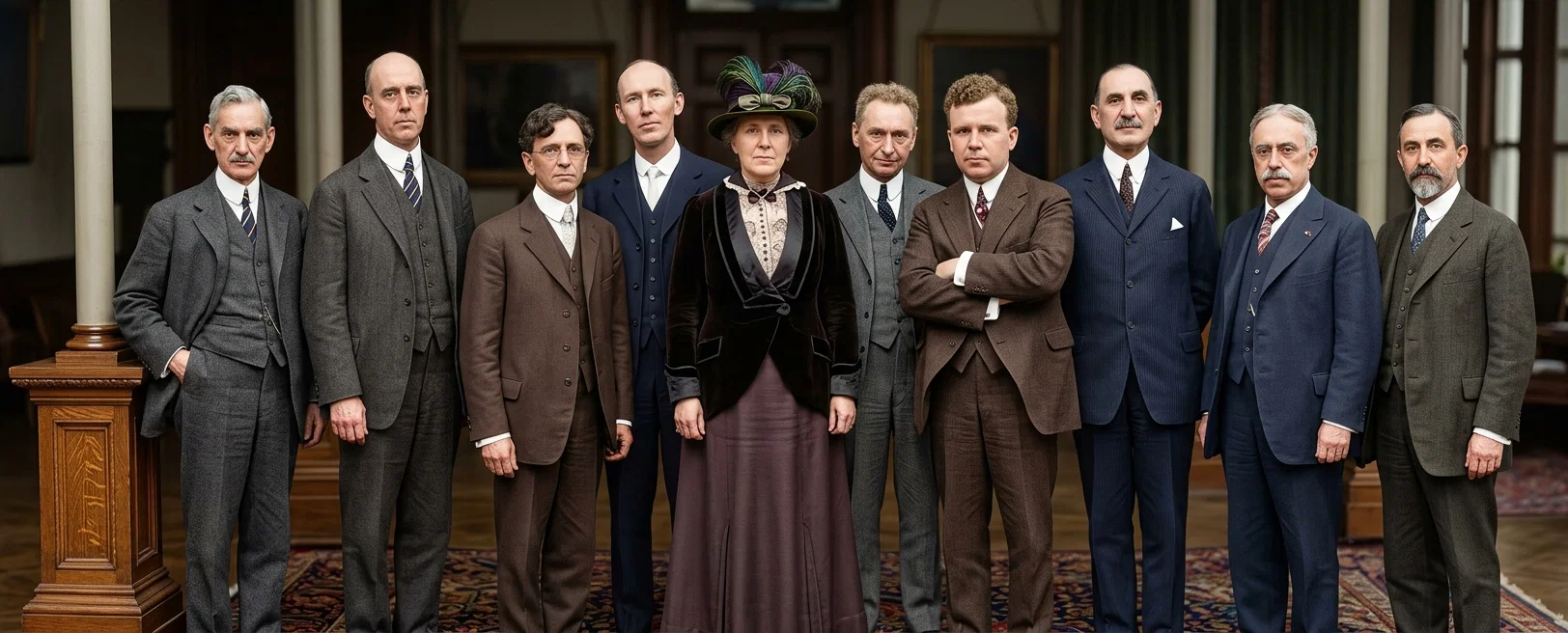
UNITED STATES INDUSTRIAL COMMISSION
PROFESSOR RINE, of the Pacific Union College, has had occasion to devote much study to the industrial situation. This is the second of the articles he has contributed. Last week he recounted the changed conditions that have been produced by the facilities of this generation for travel and intercommunication. The testimony of the Bible prophets is only briefly introduced this week, but will be more fully presented in later issues. Next week the theme will be the struggle between the economic autocracy and the political and intellectual democracy. Each article is devoted to some particular phase of the subject, and is therefore complete in itself.
EDITOR.
We have seen that the scientific application of machine power has enormously increased the wealth of the civilized world. “The problem of production has been solved,” says Dr. Josiah Strong, “but that of distribution remains to keep the working man sore under a sense of injustice.” Dr. Carroll D. Wright is quoted as saying that “two hours and fifteen minutes daily work by each able-bodied man, if systematically applied, would produce all the food, clothing, and shelter that people need.” The use of modern instruments of production is here assumed.
The secretary of the treasury shows that the total wealth of the United States was, in 1850, $7,000,000,000, while in 1904 it had reached the fabulous sum of $107,000,000,000. Dr. Strong tells us that during the first two years of this century we saved two billion dollars more wealth than had been accumulated in this country from the first settlement down to 1850, a period of nearly 250 years. According to the federal census, the aggregate wealth of our nation was $135,000,000,000 in 1910. Eminent statisticians, of both the United States and Great Britain, declare this estimate to be too low. New York City alone is to-day very materially richer than was the entire country in 1850. Our per capita wealth in 1850 was $307, while in 1910 it was a trifle less than $1,420. During the past sixty years, the nation's wealth increased more than six times as fast as her population.
There were but two millionaires in the United States one hundred years ago—John Jacob Astor, of New York, and Stephen Girard, of Philadelphia. To-day there are more than six thousand of our fellow countrymen who must each use from seven to nine figures to indicate his wealth. The ten richest persons of this country possess outright property worth more than three billion dollars. The richest of the ten has repeatedly been reputed the world's first billionaire. They are all multimillionaires. Several years ago, according to press reports, one of the principal owners of the Singer sewing-machine property went to bed worth many millions, and, owing to an abrupt fluctuation in certain stocks, he woke up the next morning worth $29,000,000 more. A noted publicist estimated that if the twelve apostles had remained working men, and had been condemned to live until, by physical toil, they should have earned, at a daily wage of three dollars each, a total of $20,000,000, their sentence would not end until A.D. 2240.
The English statistician Sir Robert Giffen shows that while the population in Great Britain increases only one and three tenths per cent yearly, wealth increases three per cent. Owing to the marvelous development of industrial chemistry and the almost endless diversity in the use of machine power, Germany has increased her wealth nineteen-fold during the last fifty years. The ratio of increase in France and other civilized countries has been not much less.
THE FLOOD OF GOLD
Notwithstanding the centuries of careful hoarding of the yellow metal, there was less than $250,000,000 of gold in all Europe in the historic year 1492. Down to that time the world had plodded along with the modest production of about $40,000,000 of gold annually. By the year 1800 the yearly production had risen to $12,000,000. Because of the discovery of the famous mines in California and Australia, the world's output in 1850 was $44,450,000. A high tide of production, $161,250,000, was reached in 1856, and not again attained for thirty-eight years. The output of the year 1900 was $254,000,000; while in each of the three years 1910-1912 it reached approximately $500,000,000—twice as much as the total supply of all Europe at the time Columbus first caught sight of the New World.
To the Fortnightly Review, July, 1913, Mr. W. F. Ford, an English sociologist, contributes an article under the caption, “Decreasing Value of Gold.” He tells his readers that between 1450 and 1850 the world's total production of gold was $3,500,000,000, while during the sixty years 1851-1911 the total output of the world was $11,579,150,000.
These titanic strides made in the production of gold since 1850 have been a prime factor in making the world incomparably richer in our day than it ever was before.
DISPARITY OF DISTRIBUTION
The problem of producing wealth has assuredly been solved. But what about the problem of distribution? Has it been solved? There is no end to the social wealth of to-day. The world is flooded with gold. But how about its apportionment—its distribution among the several classes of society? The fact that wealth, phenomenal as it is in magnitude, is congested in the hands of a relatively very small number of persons, is so notoriously in evidence as to need no attestation.
Again and again statisticians have told us that one per cent of the 16,000,000 families in the United States own more of the social wealth than the remaining ninety-nine per cent. Dr. Strong reminds us that there are men in this country each of whom, because of his vast riches, holds in his hands decidedly more power than does the king of Great Britain and Ireland. It is well known that a board of twenty-four directors, whose office is in New York, practically controls the prodigious capital—slightly less than $16,000,000,000—represented by the 163,000 miles of railway in the United States. The industrial capital of the nation, including that of the railroads, is, in round numbers, $30,000,000,000. While this enormous wealth is owned by many thousands of people, yet it is, for all practical purposes, dominated by about ten of the master spirits of the money world, and, again, eight of these men are pliant in the hands of the other two.
Two years ago a writer in the Wall Street Journal gave a list of banks, trust companies, insurance companies, together with railways and industrial plants, the assets of which aggregate $9,300,000,000, all of which was either directly or indirectly controlled by the late J. P. Morgan. This was more than the entire wealth of the nation, in 1850, by two billion dollars. This vast economic power—and as ominous as it is vast—passed into the hands of Mr. Morgan's son, J. P. Morgan, Jr., at the death of the father last March. This stupendous mass of wealth, virtually directed in its flow by one man, is nearly double the total annual revenues of the United States, Great Britain, Germany, France, Austria-Hungary, and Italy. Is such industrial autocracy compatible with democratic institutions?
Of all present-day signs of the times, this astounding congestion of wealth, particularly the concentration708of its control, is universally admitted to be the most portentous. Several years ago the late Justice Harlan, of the United States Supreme Court, said to Dr. Strong, “I regard the vast and increasing corporate wealth as the supreme peril of the United States.” In his “Christianity and Socialism,” Dr. Washington Gladden says, “The effect of all this concentration of capital has been to widen the distance and deepen the alienation between the employer and the employed.”
An eminent economist asseverates as follows: “There is a popular discontent in Europe which has not been equaled since the revolution of 1848. Indeed, there is a great world ferment as wide as modern civilization and as deep as the sense of injustice which has taken possession of the working men— a situation which can be ignored only at the peril of society.” Yet during the past fifty years wealth has increased in Europe three times as rapidly as has the population. Then why this widespread, deep-seated discontent on the part of the populace? In our country, as we have noted, wealth grew six times as fast as did the population during the same period. Yet with us popular discontent is as insistent and ubiquitous as in Europe.
All publicists are at one with Prince Kropotkin, the noted Russian author, when he says, “For the first time in the history of civilization, mankind has reached a point where the means of satisfying its needs are in excess of the needs themselves.” If this is true—as it assuredly is—there should be no occasion for the popular discontent, the social unrest, the class antagonism, universally epidemic in these latter days.
A very definite reason, however, does exist. The workers cherish the conviction that they are far from receiving a just share of the boundless wealth resulting from the application of modern scientific methods to industry. They see that this wealth is becoming more and more congested in the hands of the comparatively few, who, by forming themselves into trusts and syndicates, are making themselves the masters of all the sources of wealth and of the means of producing it. They dominate absolutely the business and commerce of the world. They determine the schedule of prices, regulate wage rates, and often mold legislation and corrupt courts of justice.
The people see the gulf of inequality between themselves and their economic masters widening apace. They know that men by the millions are standing idle in the market-places, while barns are filled with plenty, presses are bursting out with new wine, and warehouses are groaning with the goods for lack of which these same millions are starving. The toilers are aware of the dread fact that in New York, the richest city in the New World, 75,000 school children are shamefully underfed, and, in consequence, so anemic as to be unable to make their school work at all worth while. They know that though our wealth as a nation is twenty-fold as great as it was sixty years ago, there are ten millions of our fellows who are doomed to live in acute, chronic poverty. They know that though wealth is increasing three times as fast in England as is the population, there are nearly a million people in London alone who go perpetually hungry. They know that several hundred thousand joyless, hopeless women, with pinched faces and despairing brains, are toiling from ten to fourteen hours a day in the sweat-shops of the great cities of Christendom, while their opulent masters indulge themselves in all the luxuries and social amenities that their millions can command.
ANTICIPATED BY PROPHETS
NEW HEADQUARTERS OF THE UNITED STATES DEPARTMENT OF COMMERCE, WASHINGTON, D. C.
Doubtless some of my readers will be surprised to learn that the unhappy conditions which obtain in the economic world of to-day were all distinctly anticipated by the ancient prophets of God. It is this solemn fact that invests current economic phenomena with more than human, more than temporal, significance. Infinite wisdom decreed that they should serve as a few of the manifold harbingers of the dawn of a new economic, a new spiritual, era—the endless era of universal righteousness, truth, peace, light, life, and love; in short, the kingdom of God and His Christ, prepared for His redeemed children from the foundation of the world.
In concluding this paper, it is fitting that we should advert to a few of the more striking of these inspired forecasts. That the second chapter of Isaiah covers a last-day or end-of-the-age prophecy is attested by the first part of the second verse: “And it shall come to pass in the last days,” etc. See also verses 17-21. In verse 7 is recorded the prophet's startlingly faithful preannouncement of one of the most obvious economic facts of our day—the unprecedented magnitude of the world's wealth. These are the prophet's words: “Their land also is full of silver and gold, neither is there any end of their treasures.” Now, we must not forget that, according to verse 2, the prophet was, in rapt vision, taking note of conditions that would characterize “the last days.”
Let us now note another inspired prognostication of precisely the same bearing which has come down to us from a New Testament prophet. As given in the first part of the fifth chapter of James, that prophet foresaw that, preceding “the coming of the Lord,” “in the last days,” there would arise a class of persons distinctively called “rich men.” “Go to now, ye rich men,” says the prophet, “weep and howl for your miseries that shall come upon you. . . . Ye have heaped treasure together for the last days.” Now, let the reader revert to the “flood of gold” and the story of the phenomenal increase of wealth in the civilized world during the last sixty or more years, set forth in this article, and observe the astonishing exactness with which these prophecies have, in that time, been fulfilled.
One of the reasons why this present-day plethora of wealth has become congested in the possession of so few men, is stated by implication in verse 4 of the fifth chapter of James. The apostle continues to address the “rich men” in this fashion: “Behold, the hire of the laborers ... which is of you kept back by fraud, crieth; and the cries of them which have reaped are entered into the ears of the Lord of sabaoth.”
No unprejudiced person would think of denying that a very large part of the compensation justly due to the workers is systematically “kept back” by the “rich men,” or capitalist employers. Of course this is only one of several reasons why they are enabled to heap treasure “for the last days.”
The Jericho Traveler
By T. E. Bowen
DID you ever think of the parable of the wounded man down the road to Jericho as representing this lost world — robbed, wounded, and left to die miserably in its own blood? That the good Samaritan represented the compassionate Son, who, instead of going by on the other side, as He might have done, turned to bind up our wounds, pouring in oil and wine, then taking us to the inn and Himself providing for our further care — Himself paying the price of it all?
It was the love in the Samaritan's heart that caused him not to go by on the other side. Likewise it was the love of Christ that brought Him on past all the shining worlds on high to this one lost, perishing world needing His divine ministrations.
Seest thou one in need? Go thou and do likewise, and thou shalt experience a joy — a holy joy — that is described in Holy Writ as the “joy of thy Lord.”
T. E. BOWEN.
The Light of a Good Deed
“How far that little candle throws its beams! So shines a good deed in a naughty world.”
The King Is Coming Soon
By Worthie Harris Holden
By WORTHIE HARRIS HOLDEN
SPEED, ye heralds of the sky!
Zion wake! Her Lord is nigh!
Cry aloud through Sodom's plain,
Urge the mountain merchant-train,
Stir each vale and moor and dune,
“Christ, the King, is coming soon!”
Linger not, for death awaits.
Angels urge thee from thy gates.
Look not back or lose the prize
Waiting thee in yonder skies.
Warn the exiles far and near,
“Christ, the Judge, will soon appear!”
Fling away what bars thy speed.
Tarry not in hill or mead.
Blow the trumpet, sound alarm:
“Every warrior, fully arm!”
Choose Jehovah's brave array
Or the doom of Judgment-day!”
Love Devises a Plan of Redemption
By Ellen G. White
All Heaven Involved in the Salvation of Fallen Man—Sadness Among the Angels as They Are Made Aware of the Sacrifice and the Cost—A Complete Restoration Is Purchased
By MRS. E. G. WHITE
THE fall of man filled all heaven with sorrow. The world that God had made was blighted with the curse of sin, and inhabited by beings doomed to misery and death. There appeared no escape for those who had transgressed the law. Angels ceased their songs of praise. Throughout the heavenly courts there was mourning for the ruin that sin had wrought.
The Son of God, heaven's glorious Commander, was touched with pity for the fallen race. His heart was moved with infinite compassion as the woes of the lost world rose up before Him. But divine love had conceived a plan whereby man might be redeemed. The broken law of God demanded the life of the sinner. In all the universe there was but One who could, in behalf of man, satisfy its claims. Since the divine law is as sacred as God Himself, only one equal with God could make atonement for its transgression. None but Christ could redeem fallen man from the curse of the law, and bring him again into harmony with heaven. Christ would take upon Himself the guilt and shame of sin—sin so offensive to a holy God that it must separate the Father and the Son. Christ would reach to the depths of misery to rescue the ruined race.
Before the Father He pleaded in the sinner's behalf, while the host of heaven awaited the result with an intensity of interest that words can not express. Long continued was that mysterious communing—“the counsel of peace”—for the fallen sons of men. The plan of salvation had been laid before the creation of the earth; for Christ is the Lamb “foreordained before the foundation of the world”; yet it was a struggle, even with the King of the universe, to yield up His Son to die for the guilty race. But “God so loved the world, that He gave His only-begotten Son, that whosoever believeth in Him should not perish, but have everlasting life.” O, the mystery of redemption! the love of God for a world that did not love Him! Who can know the depths of that love which “passeth knowledge”? Through endless ages, immortal minds, seeking to comprehend the mystery of that incomprehensible love, will wonder and adore.
ALL HEAVEN INVOLVED
The plan by which alone man's salvation could be secured, involved all heaven in its infinite sacrifice. The angels could not rejoice as Christ opened before them the plan of redemption; for man's salvation must cost their loved Commander unutterable wo. With what wonder and grief did they listen to His words as He told them how He must descend from heaven's purity and peace, its joy and glory and immortal life, and come in contact with the degradation of earth, to endure its sorrow, shame, and death! He would appear upon earth and humble Himself as a man, and by His own experience become acquainted with the sorrows and temptations which man would have to endure. All this would be necessary in order that He might succor those who should be tempted. He must be delivered into the hands of wicked men, and be subjected to every insult and torture that Satan could inspire them to inflict. He must die the cruelest of deaths, lifted up between the heavens and the earth as a guilty sinner. He must endure anguish of soul, the hiding of His Father's face, while the guilt of transgression—the weight of the sins of the whole world—should be upon Him.
ANGELS WILLING TO BE SACRIFICED
How gladly would the angels have given themselves to die in place of their Commander, if the sacrifice could have been accepted in behalf of man! But only He who created man had power to redeem him. Yet the angels were to have a part to act in the plan of redemption. Christ was to be made “a little lower than the angels for the suffering of death.” As He should take human nature upon Him, they were to minister to Him in His sufferings. They were also to be ministering spirits, sent forth to minister for those who should be heirs of salvation. They would guard the subjects of grace from the power of evil angels, and from the darkness thrown around them by Satan.
By His death, Christ would ransom many, and would destroy him who had the power of death. He would recover the kingdom which man had lost, and the redeemed were to inherit it with Him, and dwell therein forever. Sin and sinners would be blotted out, never-more to disturb the peace of heaven or earth.
What wonder that joy, inexpressible joy, filled heaven! The glory and blessedness of a world renewed outmeasured even the anguish and sacrifice of the Prince of Life. Through the celestial courts echoed the first strains of that song which was to ring out above the hills of Bethlehem—“Glory to God in the highest, and on earth peace, good will toward men.” With a deeper gladness now than in the rapture of the new creation, “the morning stars sang together, and all the sons of God shouted for joy.”
THE FIRST PROMISE OF SALVATION
To man the first intimation of redemption was communicated in the sentence pronounced upon Satan in the garden. The Lord declared, “I will put enmity between thee and the woman, and between thy seed and her seed; it shall bruise thy head, and thou shalt bruise his heel.” This sentence, uttered in the hearing of our first parents, was to them a promise. While it foretold war between man and Satan, it declared that the power of the great adversary would finally be broken. Adam and Eve stood as criminals before the righteous Judge, awaiting the sentence which transgression had incurred; but before they heard of the life of toil and sorrow which must be their portion, or of the decree that they must return to dust, they listened to words that could not fail to give them hope. Though they must suffer from the power of their mighty foe, they could look forward to final victory.
A COMPLETE RESTORATION
Not only man, but the earth also, had by sin come under the control of the wicked one, and was to be restored by the plan of redemption. At his creation, Adam was placed in dominion over the earth. But by yielding to temptation, he was brought under the power of Satan, and the dominion which he held passed to his conqueror. Thus Satan became “the god of this world.” He had usurped that dominion over the earth which had been originally given to Adam. But Christ, by His sacrifice paying the penalty of sin, would not only redeem man, but recover the dominion which he had forfeited. All that was lost by the first Adam will be restored by the second. The prophet says, “O Tower of the flock, the stronghold of the daughter of Zion, unto Thee shall it come, even the first dominion.” And the apostle Paul points forward to710the “redemption of the purchased possession.” God created the earth to be the abode of holy, happy beings. That purpose will be fulfilled when, renewed by the power of God, and freed from sin and sorrow, it shall become the eternal abode of the redeemed. “And there shall be no more curse: but the throne of God and of the Lamb shall be in it; and His servants shall serve Him.”
The sacrificial offerings were ordained by God to be to man a perpetual reminder and a penitential acknowledgment of his sin, and a profession of his faith in the promised Redeemer. They were intended to impress upon the fallen race the solemn truth that death is the result of sin, the transgression of the law of God. To Adam the offering of the first sacrifice was a most painful ceremony. His hand must be raised to take life, which God alone could give. It was the first time he had ever witnessed death, and he knew that had he been obedient to God there would have been no death of man or beast. As he slew the innocent victim, he trembled at the thought that his sin must shed the blood of the spotless Lamb of God. This scene gave him a deeper and more vivid sense of the greatness of his transgression, which nothing but the death of God's dear Son could expiate. And he marveled at the infinite goodness that would give such a ransom to save the guilty. A star of hope illumined the dark and terrible future, and relieved it of its utter desolation.
THE LAW THE POINT OF ISSUE
From the first, the great controversy had been upon the law of God. Satan had sought to prove that God was unjust, and that His law was faulty, and that the good of the universe required it to be changed. In attacking the law, he aimed to overthrow the authority of its Author. In the controversy, it was to be shown whether the divine statutes were defective and subject to change, or perfect and immutable.
When Satan was thrust out of heaven, he determined to make the earth his kingdom. When he had tempted and overcome Adam and Eve, he claimed that by virtue of this conquest, the fallen race were his rightful subjects, and the world was his. By sin, the human race had been alienated from God, they were brought into sympathy with Satan, and were ready to unite with him in rebellion against God's law. Christ undertook to redeem man and rescue the world from the grasp of Satan.
The law of God could not be set aside, even to save lost man. The well-being of the universe demanded that the divine government should be maintained. But in His infinite love and mercy, the Creator sacrificed Himself. In His Son, God Himself bore the penalty of transgression, “that He might be just, and the justifier of him which believeth in Jesus.” Thus man, redeemed from Satan's power, and brought again into harmony with God, might be restored to “the first dominion.” In this world the great controversy was to be decided. The plan of redemption was to be wrought out on the very field that Satan claimed as his.
The Sure Mercies of David
By Francis Monroe Burg
The Manifestation of God’s Love in Forgiving and Cleansing a Sinful Man
By Francis Monroe Burg
The reader’s attention is invited to an expression in the fifty-fifth chapter of Isaiah which shows the meaning and purpose of the story that is told of David’s experience and of the psalms of praise to which his harp was tuned. In verse 4, the prophet continues, “Behold, I have given him for a witness to the people, a leader and commander to the people.”
Why has God chosen this man David, and given him for a “witness,” a “leader,” and a “commander” to the people? In the eighty-ninth psalm He calls David “My chosen.” Verse 3. Why is this choice and appointment made? The answer must be clear to all from the nature of the case. No one is so fitted and prepared to tell men how good and how merciful God is as is the one who has been rescued from the very depths of sin, and who, through the grace and power of God, has been “established” in the higher life.
Such was the experience of this man David, at whom men have hurled their bitterest thrusts and their anathemas. The Lord pardoned him because he humbly acknowledged his transgression and the iniquity of his sin, Ps. 51:3. And because of the great and wonderful redemption wrought for him, and because he so greatly extolled the mercy and loving-kindness of the Lord toward him (Ps. 89:1, 2), he has been “chosen” and appointed to be Jehovah’s witness to the people,—to tell men the one thing that, more than all else, exalts and honors Him above all gods, and that is that He is merciful to men, and will “abundantly pardon” their sins.
The writings of this honored man are placed in the very heart of the blessed Book, and the harmonies of his song of praise make the whole Volume vibrant with his characteristic and favorite theme.
Above All Gods
David said that among all the gods none is like Jehovah. Ps. 135:5. No other gods to whom the devotion of men is given, are characterized as delighting in mercy. See Micah 7:18. One seventh of the world’s population bow down in a servile devotion to the one god, as they regard him—the Allah of the Mohammedans. Under this command are about two hundred and thirty millions of people. And strange as it may seem, these devotees of Allah see nothing whatever of the element of mercy or love in him. None the less true is this of all heathen deities, which are worshiped by countless millions, than it is of the Mohammedan’s god.
Think of the slavish service it is to render all the devotion that the heart, body, and soul are capable of exercising, where not one iota of love or mercy is seen to command the homage! The best that can be offered is given out of fear alone; as in the case of the poor, credulous, benighted mother who will throw her precious babe into the river, to be devoured by crocodiles, in devotion to her god, or to appease his wrath.
Does not this world need the story of Jehovah’s love to men? Will anything exalt Him as the theme that filled the soul and engaged the songs of David? “God so loved the world, that He gave His only-begotten Son, that whosoever believeth in Him should not perish, but have everlasting life.” John 3:16. And when the precious Babe of Bethlehem appeared on earth, God among men, a choir of angels came down, and men heard them “praising God” over the plains of Judea, saying, “Glory to God in the highest, and on earth peace, good will toward men.” Luke 2:13, 14.
This account of the angel host singing over the plains when the Babe of Bethlehem was born is usually looked upon as a pleasing story to interest children on Christmas occasions. It truly is an interesting story for the children; but there are thoughts in this narrative that we will not fathom fully till we have spent the eternal years. There is scarcely an account in all the Scripture record that has a deeper meaning than has this one of the angels praising and glorifying God when Jesus was born.
“Thou shalt call His name Jesus: for He shall save His people from their sins.” Matt. 1:21. Not alone that He is able, but that He is willing, to forgive and save His people, is why He is called Jesus.
“Sweetest note in seraph song,
Sweetest name on mortal tongue;
Sweetest carol ever sung,
Jesus, blessed Jesus!”
Willing to forgive! Will “abundantly pardon”! “Passeth by the transgression of the remnant of His heritage”! “Delighteth in mercy”! Will “subdue our iniquities,” and will cast all our sins “into the depths of the sea.” “He is faithful and just to forgive us our sins, and to cleanse us from all unrighteousness.”
And when on the cross, suffering the “just for the unjust,” He prayed for the forgiveness of His murderers.
The “good will” of God toward men, His willingness to forgive, was exhibited in the gift of His Son; and when the Son was born among men, the choir from heaven shouted Jehovah’s praises, and “glorified” Him for His “peace” and “good will” toward a sinful world.
So He forgave David his great sin, lifted him up out of the “horrible pit,” and filled his mouth with the ever “new” song, even praises to God. And for David’s gratitude toward Him, God has chosen this subject of His grace, and given him to be a “witness” to the people of His mercy toward men. His songs of praise have been embodied in the blessed Book that points sinners to the way of salvation; and, as David said, many have seen, and feared, and have trusted in God. Many poor souls have been led to repentance and faith, and to trust in the Lord, by hearing the testimony of this witness to His goodness. They are following his lead in the great anthem that will make Jehovah’s praise glorious forever and ever.
(To be continued)
Quarrel Not with God's Unfinished Providences
“QUARREL not with God's unfinished providences.”
Be Rigid to Yourself, Gentle to Others
“Be rigid to yourself and gentle to others.”
Forgiveness
By Eliza H. Morton
By Eliza H. Morton
We trample on the flowers, and they
Resist it not,
But fragrance breathe, and cover o'er
The very spot.
Let us from them a lesson learn,
And bid depart
Revenge, and have forgiving love
within the heart.