Review and Herald Publishing Company · Battle Creek, Mich. · Aug 31, 1899
FRUIT CULTURE IN THE RUSSIAN RIVER VALLEY.
By J. Edgar Ross
AFTER the gold excitement of ’49 and the early ’50’s had partially subsided, many of the disappointed gold-seekers in California began to look around for some other way to gain a competence. Most of the land had been granted by the Spanish and Mexican governments to individuals; and the newcomers found the original grantees or their descendants occupying large tracts for grazing purposes, while they lived a life of indolence and ease. These open-hearted, open-pursed dons were no match for the shrewd Yankees, and soon their lands passed from their control. Through mortgage and foreclosure, or direct sale, some of these grants were transferred intact, and usually became great fruit or grain ranches.
On such ranches, land is measured by the thousand acres, and crops are estimated by the thousand tons. The work is done by men who receive a fixed salary, and see their employer perhaps only once or twice a year.
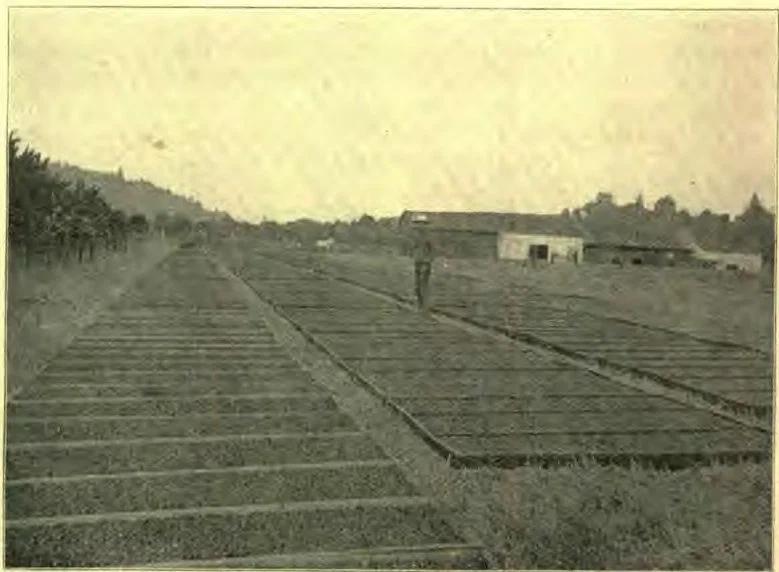
DRYING PRUNES.
These great ranches, and the methods of working them, have been described again and again, until the prevailing belief outside the State is that California is a land of great enterprises, where everybody is either a millionaire or a wage-earner. But California has its middle class,—the class that is neither rich nor poor, but is the mainstay of every nation,—the class from which spring the great men of all ages.
Most of the old Spanish land-grants were divided and subdivided until a tract of land that once boasted but a single ranch-house now supports hundreds of country homes, and perhaps several thrifty little villages.
California fruit has contributed more to the fame of the State than has any other one product except gold. But not all parts of the State are suited to fruit-culture. Some places are so arid that nothing can be grown without irrigation; in others the rainfall is so great that drainage must be resorted to. In some sections the summers are so long and hot that all but tropical plants will wither and die in the burning sun; while in others only the most hardy trees and shrubs can bear the rigor of the long winters. Some famed regions, however, nature has blessed with a happy medium between heat and cold, between drought and flood; and these are almost entirely given over to fruit-culture.
The Russian River Valley, a short distance north of San Francisco, is probably a fit representative of these regions. Within the memory of the “old-timers” this entire valley was owned by a few men, and was used wholly for stock-raising. Now it is occupied by thousands of fruit ranches.
Many of these contain but ten or fifteen acres; yet the smallest of them supplies work for at least one man throughout the whole year, and necessitates the employing of extra help in the busy seasons.
Grapes, prunes, peaches, and apricots are the fruits most commonly grown; but oranges, figs, olives, and, in fact, all fruits that can be grown in temperate or subtropical countries, find a place in this fertile valley. Because of the great diversity of the crops grown, there is no time in the year (except on holidays or during rain-storms) but some one will be found at work in the orchards.
January is fertilizing and pruning time.
In February comes the harvest of citrus fruit. This is sold in the open market, the principal part of the crop being shipped East.
About the first of March the early plowing begins. The soil is then thrown from the trees, leaving each row in a sort of trough, or ditch, made by the double furrow. The water from the spring rains is thus spread in about the roots of the trees.
The trees begin to blossom about this time, and by the middle of March the whole valley is filled with great patches of pink and white blossoms. It is a wonderful sight to stand upon a hilltop, and look down upon this vast flower garden, broken here and there by a green meadow or a dark, bare field, which marks a vineyard.
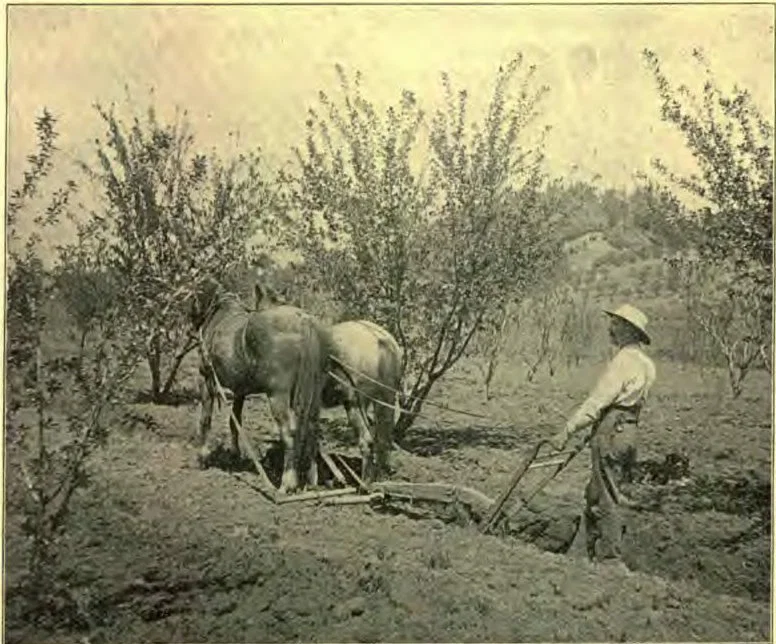
THE LATE PLOWING.
The orchards are often attacked by fungi and numerous insect pests. To guard against these, the trees are sprayed with poison while they are in bloom. The State Department of Agriculture is a great help to the farmers in this matter. Bulletins and pamphlets are periodically published, and circulated free of charge. By consulting these, the farmer is able to identify any pest that may attack his trees, and to apply the required remedy.
After the rains are over, the ground is again plowed; but this time the earth is thrown toward the trees, and the double furrow left between the rows. It is then thoroughly harrowed and “clod-mashed,” until the soil is soft and mellow, to prevent the moisture from evaporating too rapidly. When the spring rains are over, the trees must feed upon the moisture stored in the soil until the season’s crop is harvested. Sometimes when the ground is “laid by,” or prepared for the dry season, a late rain comes upon it. Then unless it is cultivated and harrowed again, the sun will bake a few inches of the soil into an adobe brick, under which the trees will not thrive.
Immediately after the late plowing comes the thinning of the fruit, to prevent the trees from overbearing. This will occupy the time until early in May, when the cherries begin to ripen. The local canneries use part of the cherry crop. The remainder is sold for home consumption, or shipped to the neighboring States.
June brings the apricots. The canneries take the best of these, and the remainder are dried.
Early in July some varieties of apples are ripe; and from that time until late in November462apples are in season. The flavor of California apples can not compare with that of those grown in the East; and for this reason there is little market at the canneries, and no call for shipment of this fruit outside the State. Some apples are sold for home consumption, but the principal part of the crop is either dried or left to rot where it falls. Seven dollars a ton is thought to be a good price for apples sold for drying. Despite the usual waste and small price, however, the trees are so prolific that apples are one of the best-paying fruit-crops.
About the first of July the first figs are ripe. A fig-tree is said to bear three crops during the season; but it really bears continuously from July till November. Very few of the first figs mature; but those that do ripen have a much finer flavor than those that come later.
The early peaches are gathered in July, and from then until September the later varieties, with the pears, plums, apples, and figs, keep the farmer busy. The most of this fruit, with the exception of apples and figs, is used by the canneries; the remainder is dried.
In September the prune crop must be cared for. There is no market for this fruit until it is dried. As soon as possible after the prunes are gathered, they are dipped in a hot solution of lye to break the skins. They are then washed, and spread out on large trays to dry in the sun. Within the last few years, machines that greatly facilitate the dipping and washing process have come into general use, but it is hard work at best. Undipped prunes require about six weeks to dry; but by dipping, the time is shortened to ten days. Before the drying is finished, the early fall rains sometimes begin, and then the trays must be piled up and covered until the storm is past. If the rains are frequent, or of long duration, part of the crop sometimes mildews, and must be thrown away.
About this time the olives are ripe, if they have not been picked green. Ripe pickled olives are now being placed upon the market, but as yet only a small part of the crop is utilized in this way and for the production of olive-oil. By far the greater portion goes to the consumer as pickled green olives.
October is the time for grape-picking. The grapes of this section are almost entirely used in wine-making. They are hauled from the vineyard directly to the winery, and are often crushed the same day they are picked.
Early in November the last of the figs and winter apples are gathered. Then, when the fruit-boxes and drying-trays are collected, the farmer has a few weeks for a general clean-up before the Christmas holidays; for his year’s work really begins and ends with the year.
J. EDGAR ROSS.
TRUE EDUCATION.
By Ellen G. White
TRUE education is to know and to do the will of God. This education is as lasting as eternity. The Bible is to be our text-book; for true religion is the foundation of all true education. Intellectual training can never safely be disconnected from religion; and with the study of books, manual training is to be combined, that the mind may be correctly balanced, and solidity be given to brain, bone, and muscle. This world is our preparatory school. The school and the college are necessary for the development of the mind and the formation of the character. But the cultivation of the intellect alone, apart from a moral and religious education, has a baleful influence. The man who neither loves nor fears God may reach dazzling heights in intellectual attainments, and yet use his acquired knowledge to war against his Maker. If men accept the Lord God of heaven as their teacher, will they not gain the best kind of knowledge, for this world as well as for the next? Mental strength comes alone from a knowledge of the laws that God has established in nature and in the human structure. We must be obedient to these laws, or our lives will be a failure.
Under the controlling influence of Christ, the human intellect can achieve wonderful things. The youth should be encouraged to reach the highest standard of intellectual acquirement. If the fear and knowledge of God are made first, there is no danger that the student will soar too high. The knowledge of God, the understanding of his will in his word, as far as human minds may grasp it, incorporated into the thoughts and woven into the character, will make efficient men and women. The study of the word of God will enable us to do his work intelligently and acceptably. The mind will be enriched, enlarged, and broadened. Those who thus constantly study the Word will go upward and forward toward the highest standard, because they are partakers of the divine nature.
Daniel was closely connected with the source of all wisdom, and this was to him more precious than the gold of Ophir. He kept his religious training on an equality with the advantages that were given him for becoming a wise and learned man. He used his entrusted capital aright. He was aroused by the situation in which he found himself in the king’s court. He co-operated with God in the use of every power that had been given him, and we read: “As for these four children, God gave them knowledge and skill in all learning and wisdom: and Daniel had understanding in all visions and dreams.” Daniel was connected with God, and the secrets of the Most High were opened to him; for God is with those that fear him. “And the king communed with them; and among them all was found none like Daniel, Hananiah, Mishael, and Azariah; therefore stood they before the king. And in all matters of wisdom and understanding, that the king inquired of them, he found them ten times better than all the magicians and astrologers that were in all his realm.” Continual growth in religious wisdom and intelligence did not in any way disqualify these youth for the faithful discharge of the important duties assigned them in the kingdom of Babylon. God gave them his wisdom and knowledge for the perfecting of a thorough education.
Let children and youth be given true education. Teach them to give God their entire devotion; for they are wholly dependent on him in this life, and for the future, immortal life. The knowledge of truth is the nutrition that the soul needs, in order to be prepared to act as wise a part as did Daniel and his associates. Every time the conscience is violated, sin is committed, for which the wrong-doer must suffer the sure result. The penalty of sin is death. With persevering effort and patient forbearance, children must be taught that the fear of the Lord is the beginning of wisdom. When very young, they may be taught the statutes and commands of God. The thoughts and sentiments of his law are to be interwoven with their knowledge of the sciences. A true knowledge of the word of God is the only true scientific education.
We can not afford to separate spiritual from intellectual training. Well may parents dread intellectual greatness for their children unless it is balanced by a knowledge of God and his ways. It is of great importance that the youth take with them from school an intelligent love for God and his truth. This lies at the foundation of all true knowledge. We are in a world subject to disease and death. He who during his lifetime serves God faithfully has the assurance that he will come forth from the grave to a glorious immortality. Of such a one it may indeed be said, “It is well with his soul.” In every school in our land the Lord God of Israel should be exalted, revered, and honored. In the place of unsanctified rivalry for earthly honor, the highest ambition of students should be to go forth strengthened, established missionaries for God, educators who can teach what they have learned.
Goodness alone is true greatness. With persevering faith, teachers are to hold to the infinite One, saying, as did Jacob, “I will not let thee go, except thou bless me.” Education is not perfect unless the body, the mind, and the heart are equally educated. Students who go from school with this education will draw to Christ not only men and women, but children and youth. These need to learn to discipline self; to take up the duties nearest them; and then, however unpleasant the work may seem, to advance steadily. When they learn what constitutes them true children of God, a work will be done that Satan himself can not undo nor make of none effect. He who opens his heart to receive true education receives power from God to impart light to others.
Mrs. E. G. White.
Rapid Manufacture.
The story is told that in 1811 Sir John Throgmorton, a Berkshire baronet, made the assertion that at eight o’clock on a particular evening he would sit down to dinner in a well-woven, well-dyed, well-made suit, the wool of which had formed the fleece on sheep’s backs at five o’clock that morning. The feat was considered impossible. On June 28 the test was made, and successfully accomplished, with an hour and three-quarters to spare, the suit being ready at a quarter past six.
May 18, 1898, Mr. Thomas Kitson, of Stroudsburg, Pa., attempted a similar feat. The sheep were shorn at half-past six in the morning, the fleece was passed through eighteen processes of manufacture, and came out finished cloth in three hours and thirty-four minutes.
The cloth passed into the hands of six tailors, and in two hours and a half the suit, complete in every particular, was ready for Mr. Kitson.
The whole process, from the time that the wool was on the sheep’s backs, until the suit was ready for the man’s back, occupied six hours and four minutes; less than half the time it took to make the suit for Sir John Throgmorton in 1811.—Wellspring.
Daring to Be True
“ONLY he who dares to be true can be great.”
HABIT
Habit at first is but a silken thread,
Fine as the light-winged gossamers that sway
In the warm sunbeams of a summer’s day;
A shallow streamlet, rippling o’er its bed;
A tiny sapling, ere its roots are spread;
A yet unhardened thorn upon the spray;
A lion’s whelp that hath not scented prey;
A little, smiling child, obedient led.
Beware! that thread may bind thee as a chain;
That streamlet gather to a fatal sea;
That sapling spread into a gnarled tree;
That thorn, grown hard, may wound and give thee pain;
That playful whelp his murderous fangs reveal;
That child, a giant, crush thee ’neath his heel.
— Selected.
THE SIN OF FRETTING.
“THERE is one sin which, it seems to me,” writes Helen Hunt, “is everywhere, and by everybody underestimated, and quite too much overlooked, in valuations of character. It is the sin of fretting. It is as common as air, as speech,—so common that, unless it rises above its usual monotone, we do not even observe it. Watch any ordinary coming together of people, and see how many minutes it will be before somebody frets; that is, makes some more or less complaining statement, which every one in the room, or the car, or on the street corner, knew before, and which nobody can help. It is cold, it is hot, it is wet, it is dry; somebody has broken an appointment; a meal is ill-cooked; stupidity or bad faith somewhere has resulted in discomfort. There are plenty of things to fret about. It is simply astonishing how much annoyance and discomfort may be found in the course of every-day’s living, even at the simplest, if one only keeps a sharp eye out on that side of things. The Bible itself says that we are born to trouble as sparks fly upward. But even to the sparks flying upward, in the blackest of smoke, there is a blue sky above; and the less time they waste on the road, the sooner they will reach it. Fretting is all time wasted on the road.”
ANCIENT BOOKMAKING.
By C. B. Morrill
The Volume.
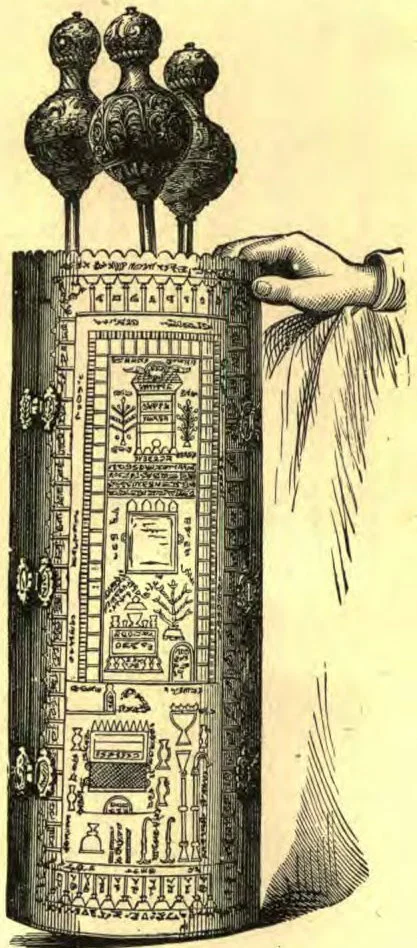
In one of the visions recorded in the Apocalypse, the apostle saw a book “written within and on the back side, sealed with seven seals.” This was the volumen, or scroll, the ordinary form of a papyrus book. Most scrolls were written only on the inside; but the original copies of authors were often written on both sides, and this one was written in that way.
The papyrus was usually made up into rolls of a convenient size; twenty sheets usually went to a roll. The first, or left-hand, sheet was of the best quality; for it had to endure much wear. This sheet was called the protocol, a term now used of the first draft of a treaty. The last sheets, which were well protected, and were often, when not needed, cut away entirely, were of the poorer grades of papyrus. After a book was finished, the last sheet was fastened to a round stick, with knobs at the ends, called the umbilicus, upon which the papyrus was rolled. In reading the book, the umbilicus was held in the right hand, and the part which had been read was rolled up with the left. No doubt this was very clumsy; at least we should find it so. It may have seemed easy and convenient to those who knew of no better way.
The edges of the roll were trimmed so as to make an even surface, smoothed with pumice-stone, and sometimes handsomely stained. The backs of valuable manuscripts were rubbed with cedar-oil to keep away moths. A wrapper, called the “traveling cloak,” made of colored vellum, was rolled about the book. Finally a strip of vellum, usually colored, was pasted to the upper edge of the papyrus, so as to hang out; and upon this was written the title, or label, of the book. This was called the index, or syllabus.
A large work could not be written on a scroll of convenient size, so authors usually divided their writings into small “books,” about long enough to cover an ordinary roll. This roll was sometimes called a tomos, or cutting. We still have all three words applied to the larger divisions of a book,—book (liber), volume, or tome. The last two of these, at least, remind us of the time when books were scrolls of papyrus; while the first carries us back to the original roll of bark.
To make reading easy, the writing was arranged in narrow columns called paginæ,—pages,—from a word which originally meant a plank. They were also called by another name, which meant a gang-plank. To rule the papyrus into lines and columns, a rolling disk of lead was used; a pencil would have torn the fabric. If errors were to be erased, the ink was wiped off with a sponge. In the older books the title was written at the end; but afterward it was written also at the beginning, on the protocol, which usually bore the signature and trade-mark of the makers of the papyrus. The back of the manuscript, like the fly-leaves of a modern book, was used for notes, for scribbling, or for any sort of writing that waste paper is likely to receive.
The several volumes of a book could not be tied together; that would have destroyed the papyrus. They were kept in a round chest, or capsa, made for the purpose. Each book had its own chest, or chests; for if the book was very large, one chest would not contain it all,—the chest having room for from three to ten volumes. The luggage of a literary gentleman on his travels in those days included an assortment of these chests.
ANCIENT BOOK-ROLL.
If we could walk through one of the great libraries of classic times, we should see on each side, not shelves, but tiers, of boxes, like pigeonholes, and from each box would project the ends of several scrolls. Some would be wrapped in traveling cloaks of rough shipping-papyrus,—charta emporetica,—others in gay coats of scarlet and blue and costly purple vellum, with umbilici of handsomely carved ivory. Some would have plain white edges, others would be stained or gilded, and from all would hang the little bright-colored tags bearing the syllabus. In places handy to get at would be the catalogues,—heavy volumes with endless lists of books. There would be attendants, too,—in Greek costume, of course,—passing back and forth through the aisles.
Though the scroll belongs to the age of papyrus, it was not always of that material. The Jews always wrote the law upon scrolls of skins, and invariably on the inner side; to write any part of the sacred text on the back was thought to be a sacrilege. Vellum was sometimes made into rolls; but by the time it came into general use, the modern form of book had become common. Enumerations, genealogies, charters, and similar documents were written on rolls, even up to recent times; but always crosswise, and not lengthwise, as ancient books were written. From the use of the roll in England for such records, we have the expressions “enrolment,” “tax-roll,” and the like; and to call out the names of the members of a body in order is to “call the roll.”
C. B. MORRILL.
A FEW FACTS ABOUT LIGHTHOUSES.
By H. L. Carlisle
THE government of every nation is particular about having light and fog-signal stations erected at every point along its seacoasts where vessels are liable to be wrecked. The erection of these stations involves large expense and some wonderful feats of engineering.
The height of the light-tower depends on the relative surroundings of the location. The Point Arena (Cal.) tower is two hundred feet high, being the highest on the Pacific Coast. Its base is about twenty-five feet in diameter, the tower tapering gradually to the top, which contains the lamps, lens, etc. The walls are about five feet thick at the base, growing thinner toward the top. The means of ascent is by steel spiral stairs on the inside. The whole structure is built of brick and steel.
Different lights are used, to help the mariner easily to locate the position of his vessel on the coast. Some lights are fixed, or have a steady flame: others are revolving; that is, dark and light shades revolve around the light, so that at one moment the light is visible, and the next it is not: others have a colored fixed light: and still others flash different colors every few minutes.
“Light up,” as the keepers call it, is at sunset; and lights are turned out at sunrise, not before.
The light is the next most interesting part of the station, and, with the lens, is the most expensive. The size of the lamp itself, which is made of brass, with a circle wick, surprises a visitor who has never seen one before, as it is small compared with the lens and tower. Indeed, it is not much larger than an extra-size home lamp. It is the lens that makes the light; that is, it magnifies the small light in such a way that its rays can be seen, in some instances, forty miles out at sea.
The lens is made with great care, and costs several thousand dollars; it is about seven feet high, and completely encircles the light. The space inside the lens is sufficient to allow the keeper to move about. The lens is enclosed by one-fourth-inch plate-glass. At night numerous ducks and other large birds are attracted by the powerful rays of the lens, and fly directly at the light, many times with such force that they go through the thick plate-glass, and up against the lens itself. Each time this happens, the lens is more or less damaged. Ducks are frequently picked up at the base of the tower, not having struck the plate-glass with sufficient force to break it, but quite hard enough to stun them. In this case the keepers have roast duck for dinner.
The fog-signal, or siren, looks like an immense fish-horn, and its mournful blasts can be heard from six to ten miles. It projects over the water, and is operated by steam. The machinery is so arranged that the siren blows automatically every thirty seconds; and its warning is very sweet music to those aboard ship during a heavy fog, when it is impossible to see ten feet ahead of the vessel, even during the day.
It is arranged that during time of war, when war-ships of other nations might be expected to bombard our coasts, the lights shall be ordered out, and fog-signals stopped. Of course this would result in grave danger to vessels of our own flag, but this is somewhat lessened by a code of signals, which both station-keepers and officers of American war-ships have in their possession. These signals will be promptly answered, and assistance rendered, either by light or siren. If the enemy is known to have passed, this information can also be signaled.464
Regardless of the care taken by the government to afford protection against wrecks, many occur, and sometimes within a stone’s throw of lighthouse stations. This was recently the case near the Point Arena light, where a vessel went ashore during a storm, and was broken completely in half. The crew took refuge in the rigging, and remained there all night and part of the next day, with breakers constantly dashing over them. Although these unfortunate sailors were within sight of shore, little could be done for them. Some became exhausted by the cold and exposure, dropped into the ocean, and were drowned; a few attempted to swim ashore, but only two were successful. Finally the keeper of the light-station, Mr. J. M. Brown, with the assistance of an Indian, who volunteered (the only one out of one hundred men on the beach who would go), launched a small boat, after securing a line to boat and shore. The attempt was unsuccessful, on account of the storm; but each of the brave men will receive a gold medal for the “attempt to save.” The sailors were rescued by a steamer that opportunely passed by.
On first-class stations there are four keepers, — the head keeper, and the first, second, and third assistants. H. L. CARLISLE.
BOOKKEEPING IN BABYLONIA.
PAPER and ink are perishable things, like certain other “modern improvements;” but some of the clay tablets used by earlier civilizations still survive. In the buried city of Nippur, American explorers have recently found, in one room, more than seven hundred of them,—the business records of a rich firm of merchants, Ulurashu Sons, who flourished twenty-five hundred years ago.
Among them is this guarantee for twenty years that an emerald is so well set that it will not fall out:—
“Bel-ahiddina and Bel-shumu, sons of Bel, and Hatin, son of Bazuza, spoke unto Bel-nad-inshumu, son of Morashu, as follows: ‘As concerns the gold ring set with an emerald, we guarantee that for twenty years the emerald will not fall out of ring. If it should fall out before the expiration of twenty years, Bel-ahiddina (and the two others) shall pay to Bel-nad-inshumu an indemnity of ten mant of silver.’”
There are also leases of various kinds, and contracts for the sale of sun-dried bricks and other merchandise, and for the loan of seed-corn and oxen for plowing.—Youth’s Companion.