The next morning the girls, of whom Shirley was by this time one, were early astir. Breakfast was taken in big swallows, while standing or perching on any convenient projection amid the tossed and tumbled confusion of bed-making and hasty toilets; then each was off to her work for the long, weary day.
Shirley’s day was passed much as before. She found comfort, however, amid the discouragement that constantly crowned her search for employment, in feeling that she was anchored for at least one night, and looked forward all day to the stuffy little room and the girls with a strange pleasure, at which she herself wondered. Her reason told her that those girls were really nothing to her, that she should claim their hospitality; and yet all the strongest feelings by which she was actuated that day bound her to them. They were alike struggling for independence, compatriots in a common cause, with the same difficulties to overcome; and to have shared the same room, breathed the same close air, practised the same economies, for twelve hours together, made them more than ordinary friends. If she could only stay with them, Shirley was sure she could be happy and succeed; but the “other girl” was coming the next day, and she must have a place of her own at once. The next night came, however, and found her still unsettled. She was to keep her bag at the “Gooses’ Nest” until she knew where she was to live, so as to be left free from the burden of it; but she could not think of crowding herself in upon them: seven would certainly be a jam in that tiny room. She went empty-handed to a hotel, paid a dollar for her room, and tossed all night, dreaming of Henry and the other girls, with an occasional thought of home thrown in. She was yet, however, too near the starting-point of her adventure to spend much time in dreams of anybody. Her thoughts of her father were still angry; those of her mother were filled with a sense of weariness. That burden was too heavy for her to lighten. It was better for her mother that she should be away, she was sure.
The next day passed with no success and ever-increasing expense. Then came the Sabbath. She had never regarded it very carefully, but now she must at least keep the promise made in the letter to her mother; so she went out to the church on Forty-sixth Street, stayed to Sabbath-school, and spent the remainder of the day in the park as quietly as possible, and certainly realized that it had been a day of rest.
The next day she called on the girls, as that would be their rest day. She was disappointed in not seeing Henry, who had gone out with her friend for the day.
On Monday she began again her weary search; and now economies became more imperative every hour. It was surprising how the one item of car-fare mounted up; and the most unsatisfactory restaurant lunches made such inroads on her purse that at last she found herself, after closing-up hours, without money, lodging, or any prospect of a situation.
Shirley had been half-conscious all the afternoon of what was coming, but had had no experience by which to even foreshadow such possibilities; and when she knew that she was in the streets of the great city, supperless, friendless, homeless, moneyless, she could not understand, all at once, what it meant. She snapped the clasp of the empty purse in her hand as she stood before a restaurant window, with a peculiar sense of loneliness creeping over her, but smiling a little as she said to herself: “I’m a poor lone goslin this time, sure ’nough,—’way out in the tall prairie grass, ready to ‘zeap! zeap!’ but I won’t ‘zeap! zeap!’ It’ll be a new experience to go without supper,—often wondered how it would seem to have nothing and nobody,—going to find out, I guess,—but I can stand it one night. My! but wouldn’t father crow? Mother—what would she do? What would Seth do if he knew? Will would laugh, and so will I. Nobody need ever know. I can walk about,—got the city before me, and can see the sights,—never shall have a better chance. I can be comfortable out-of-doors this hot night, and in the morning I’ll try again. I’ll not go home unless I have to. Something is sure to come my way after a while.”
She found plenty to take her attention as long as the shops were open. There was a weird attraction in watching the lights go out of the residence windows, and in seeing the business places made ready for the night-watch. She became interested in the long line of carriages waiting before a great theater, and walked slowly back and forth until the crowd began to pour out into the street, and she became a part of it. For a while she stayed with it, attaching herself to floating fragments of it, and listening to the chatter of bevies of girls, and the talk of men and women as they discussed the play, until the throng had melted away, and she was alone with the ordinary street population of a great city on a warm spring night. She was not molested. For a long time no one seemed to be conscious of her existence; and she wandered around this block and that, wherever the lights were brightest, watching the darkening alleys and the dimming streets until at last the occasional light, the long stretches of shadow, the almost empty street-cars, the lonely, hurrying footmen, with once in a while a carriage, betokened the end of both labor and pleasure for another day.
The city was in its night dress; and the peculiar hush with which the ceaseless throbbing of its great arteries is heard, as, just before he sleeps, one hears the beating of his own heart, settled down upon it, and made it more desolate than a desert. Here and there a drug-store with its many colored lights brightened the long, shadowy reaches. Saloons on every hand kept their baleful eyes, which never shut, fixed upon the street, and made Shirley more afraid than she could have been of the darkness.
As a natural result of associated ideas, the recognition of saloons brought Martin McCarty vividly before her. With a sense of sudden chill and alarm, she remembered that he came into the city on the same train with her; and the thought of him intensified the fear that had been awakened by the vicinity of the only haunts of vice of which she had ever dreamed. Yet why she should think of him with fear she could not for a moment imagine, but she never forgot that first sickening touch of its clammy hand.
It was long past midnight. She was walking along State Street, south of Adams, with a growing sense of weariness, and wondering how long the night would last, when she suddenly became aware that she was observed by a man who had passed her, turned, and was now coming toward her. As he approached, to her intense alarm she recognized Martin McCarty. Then she remembered dimly that she had seen the same figure at a distance several times during the evening, and knew that he had been following her. This accounted for the instinctive fear that had taken possession of her so suddenly; but now, when she recognized the actual occasion for it, it was superseded by a furious indignation, which was equivalent to courage, especially as he, without a word, turning at her side, began to walk with her.
She stopped, looked him full in the face, and drew back.
“Miss Shirley, you certainly will not make me believe that you object to my company,” he said, in a mocking tone. “But I beg your pardon; perhaps I should have been more formal;” and turning so as to face her, lifting his hat, and bowing in the most approved style, he said: “May I have the pleasure of walking with you, fair lady, this evening?”
“No, sir, you can not!” answered Shirley, with a fire in her voice and manner that to such as he only made her more attractive. “You can just go your own way, and leave me to go mine.”
“Oh, no, please; you can’t be so cruel,” sneered the fellow, taking a step nearer.
“I do mean it—go!”
“Oh, not alone,—with you gladly,” making an attempt to take her arm.
Shirley, with her strong nature fully aroused, lifted her parasol, and with the knobbed end struck out straight before her twice, and sent the fellow’s silk hat flying into the street; then, giving wings to her feet, she flew around the corner, westward, into the welcome darkness.
McCarty felt his forehead, which had not entirely escaped, then with great deliberation recovered his hat, brushed it with his sleeve, tried to mend a dent with his finger, the while he gave his mind to a mean little plot of revenge. He stood looking about for a moment, hat in hand; then, putting two fingers to his lips, he blew a shrill call, which was immediately answered by a policeman’s whistle, and an officer strode around the Adams Street corner toward him.
“Well, what’s up?” he asked.
“Nothing very alarming, and yet a fellow don’t let even a woman club him in the streets of Chicago, you know,” holding out his hat, and pointing to his forehead, in evidence.
“Well, no,—a woman?”
“A girl, pretty and neat as wax, too; you’d never have thought it. Spoke to me as I passed, you know. I answered civilly enough, and she up with the loaded end of her parasol, and gave it to me.”
“Did she speak first?”
“Of course she did. I’d seen her before. She acted suspicious. I’d been watching her—a little detective on my own account, you see—before I said anything. Saw her going about here all this evening,—rather late for honest women, eh? Just better keep an eye out—she ran off westward around that corner. Gray dress, white sailor hat, natty as you please. Will bear watching. I’ll call around ’bout noon, and see what you’ve found.”
The fellow walked off hurriedly, as if to escape questioning, and the officer turned thoughtfully west on Jackson.
“I wish I could run in a few such as he is just once,” he said, to himself, “instead of the poor little chickabiddies: they have to take the stone floors and hard benches, while the fellows—oh, I would like to lock them up!”
It may have been because of a certain little saleslady that Policeman McFarlan was more charitable toward the poor “astrays” and less toward the young “swells.” He could not but agree, however, that the hour was late for an honest woman, or man for that matter, to be on the street; and his duty as well as his police sense soon asserted itself, and he was on the outlook for the woman in the gray dress and white hat.
MRS. S. M. I. HENRY.
(To be continued.)
A YELLOW QUEEN AND HER SUBJECTS.
By Mrs. Effie Brown
WISH to tell the young people of the INSTRUCTOR family about a beautiful Yellow Queen, who is not only pretty to look at, but is also the most wonderful mother I ever saw or heard of. Her children never quarrel, nor get jealous of one another. She never has to scold one of them, or even tell them to go to work; for they are always busy, either in the house or outdoors, cheerfully attending to their duties; and instead of leaving home as soon as they are old enough to help, as many young folks do, they remain her dutiful and loving subjects. What do you think of that?
Perhaps I ought not to call them subjects; for where there is no disaffection, there is no need of a ruler; so, after all, this queen is only the mother, and the subjects are her children. And they are such loving children, too! Ten or a dozen of them follow the queen about continually, forming a circle around her, caressing her, and offering her the daintiest food they can prepare.
Now I know you are beginning to think about the size of her family, and the number of the children. Do you doubt that there are a dozen waiting on the queen, and wonder how many more there are, and what they do? Why, there are ever so many more! She never has to hire any servants; for her own children do all the work themselves. Some take care of the babies; some clean the house; others work in the fields, or carry water and food; and a good many are busy all through June and July, and sometimes in August, making its odd six-sided boxes, in which they keep their food. When these boxes are empty, they are often used as cradles for the babies.
But you are still thinking that I am mistaken in regard to the size of the family. Well, you’re the ones that are mistaken, this time. The Yellow Queen I am talking about is the mother of over one hundred thousand children, counting both dead and alive. Just think!—as many as three thousand five hundred new babies in a single day! Where do you suppose the mother finds names for them all? Perhaps she calls them by numbers. Wouldn’t it seem queer to have Eighteen-hundred-and-ninety-nine for a name?
Oh, I didn’t tell you that the Yellow Queen is a bee, did I? Before a bee is fully developed, it must be, first, an egg; secondly, a larva; and thirdly, a pupa. The queen lays two kinds of eggs,—one for workers, and the other for drones.
As the queen walks over the beautiful cells of honeycomb, some filled with babies and some with food, she comes to one that is empty. Then down she goes, head first, to the bottom of the cell, to examine it. If it suits her, she will draw herself up, and, turning around, will back down into it and deposit an egg. There are always enough bees in a hive, or colony, to keep nice and warm the eggs laid by the queen. In about three days the eggs hatch, not into bees, but larvæ. You would never suspect that one of these tiny white worms, not much larger than a poppy seed, would grow into a bee that could chase the strongest man ever seen. This very often happens, though.
As soon as the baby bee hatches, it is fed by the workers. They always have on hand many cells of bee-bread, and this they mix with honey till they have a substance that looks much like cream, and makes the proper food for bee-larva. The baby bees never have to wait for anything to eat; for their faithful nurses feed them “between-meals” and at all times, so they grow very fast.
These little worms eat and grow in their cells, curled up like sleepy puppies, till they get too large for their skins, and too fat to lie in the bottom of their cells. Then they begin to stretch, and their skins crack and rip open; but, luckily for them, there is another skin underneath each old one. Presently the larvæ straighten out in their cells, and the nurse bees give them some more food, and cover them all up, so no one could see one of them. It is while they are in this state that they are called pupæ.
Just twenty-one days after the egg is laid, the pupa cuts the cover off its cell, and crawls out, a bee. It is very pale and weak at first; but after sipping some honey, and walking about awhile, it grows strong.
Besides the workers, there are the drones, or male bees. These bees never work. While there is plenty of honey to be found, they live in idleness, feasting on the sweets that the workers have toiled hard to store up; but as soon as the flowers fail, these loafers are killed, and their bodies dragged away from the hive by the workers.
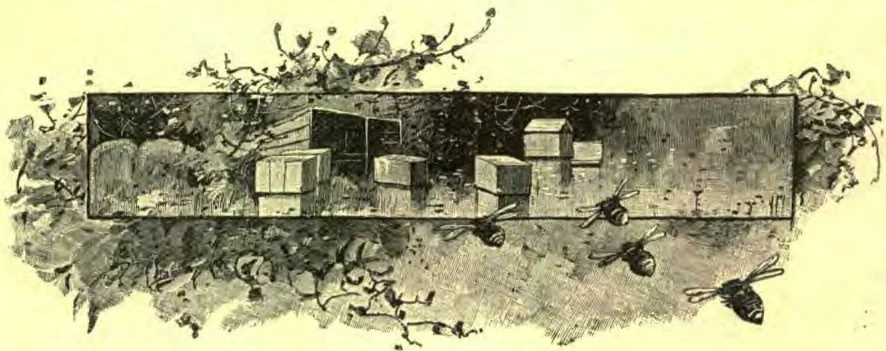
A hive full of bees that are at work, is called a colony, and a number of colonies is an apiary. In every apiary there are many queen bees just as wonderful as the one I have told you about. Occasionally strange bees begin robbing a weak colony; then a tent made of netting is set down over it for a while. Very often robber bees bother the person working a colony, in which case the tent is used for shelter to both the man and the colony he is handling.
MRS. EFFIE BROWN.
A TRUE STORY.
OLD DAPPLE was so tired when haying-time was over, that grandpa said he should rest a whole week, with oats for dinner every day.
“You’re the faithfulest old fellow!” grandpa said, stroking Dapple’s old nose back and forth lovingly. “Now you shall have a holiday, and munch hay instead of rake it. Wait; I’ll trundle the big rake under the mow, so you’ll forget there was ever any such thing as work.”
Then grandpa went to dinner with grandma and The Twins—everybody called them The Twins, with the capital T’s in their voices when they said it.
It was quite late in the afternoon when grandpa asked The Twins to lead out old Dapple to water.
“Let him stay and drink as long as he wants to,” he called after them. “You needn’t wait; he knows the way back alone.”
So old Dapple stood and drank his fill of the clear, sweet water, and The Twins ran back to their play. But it wasn’t long before grandpa saw them coming toward him at a scamper. Both their faces were excited, and they shouted, like in a breathless chorus, “O grandpa! grandpa! quick! look up in the mowing-field! Old Dapple’s up there rakin’ hay all alone, ’thout any rake or any hay! He’s goin’ back and forth and back and forth like everything!”
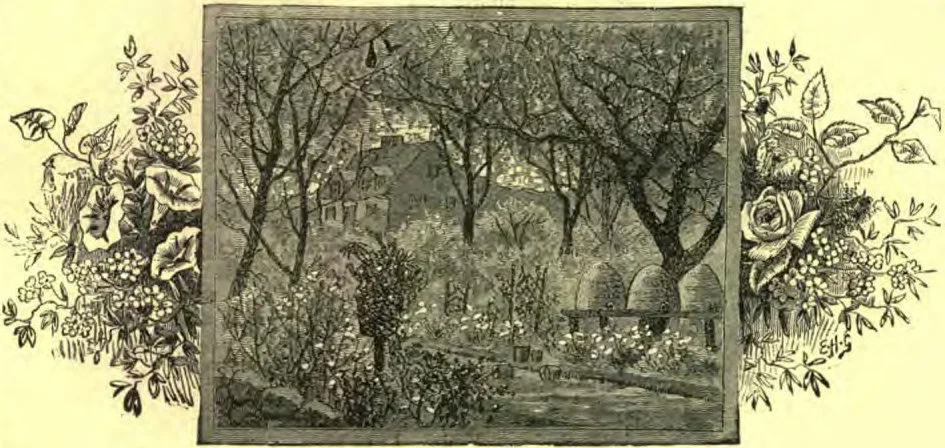
SOME OLD-FASHIONED BEE-HOMES.
And when grandpa got on his “fur-offs” and looked, sure enough, there was faithful Dapple up in the mowing-field, patiently trudging up and down, making neat turns at the end of every “bout”! His tired old legs wavered unsteadily, but he kept on. The afternoon sunshine lay on his rough back, and dazzled his old eyes on the return trips, but he never thought of stopping.
Something suddenly dimmed grandpa’s “fur-offs,” and he took them off.
“Faithful old fellow!” he muttered. “Go lead him back, children, and give him oats for his supper.”
And how The Twins hugged him while they were doing it!— Youth’s Companion.
WHY NETTLES STING.
The leaf and stem of a nettle are literally clothed with erect hollow hairs. If one of these hairs is viewed through a microscope, it will be seen that its free end, after tapering to a very fine degree of slimness, finishes as a little knob; while in the other direction, after gradually becoming more robust, it suddenly expands into a large bulb, corresponding to the poison-gland of the adder. The point of the hair is very brittle, and contact with our skin causes the end to snap off, leaving a hollow needle-point, which readily pierces our cuticle, and pressing upon the bulb at the other end, the poison is forced through the central channel, and inflames our blood. It is said that those who just touch the nettle slightly are stung, and that those who grasp it firmly escape. There is just this much truth in it,—that a firm grasp is apt to break the hairs at the thickest parts, where they are too stout to prick. But you can not make sure of firmly grasping and breaking all the hairs that touch you; and if you break a score, and another score just touch your hand sufficiently to prick, you come off badly.—Selected.
A BOY I KNOW.
By Laura E. Richards
I know a bright-eyed little boy,
Who lives not far away;
And though he is his mother's joy,
He plagues her, too, they say;
For when his task he's bid to do,
He sits him down, and cries, "Boohoo!"
I can't! I can't! I can't! I can't! I can't!
Yes; whether he's to practise well,
Or do his "horrid" sums,
Or "hippopotamus" to spell,
Or clean to wash his thumbs,
It matters not; for with a frown
The corners of his mouth go down—
"I can't! I can't! I can't! I can't! I can't!"
Oh, what a joyful day ’t will be
For mother and for son,
When smiling looks they both shall see
Beneath the smiling sun!
For in his heart he knows ’tis stuff,
And knows that if he tries enough,
He can! he can! he can! he can! he can!
TIME.—A. D. 30. PLACES: Perea, Bethany, Jerusalem. PERSONS: Jesus, Martha and Mary, Lazarus, disciples, Jews, Pharisees, Caiaphas.
QUESTIONS.
1. While Jesus was preaching in Perea, what message came to him? John 11: 3. What message did Jesus return to Martha and Mary by the messenger? V. 4. What seeming lack of interest did he manifest? V. 6; note .
2. When Jesus prepared to go to Judea, what did his disciples say? V. 8. What was his reply? Vs. 9, 10; note . What did he say was his purpose in going? V. 11. What misconception of his words did the disciples have? Vs. 12, 13. With what words did Jesus correct them? Vs. 14, 15; note .
3. When Jesus reached the vicinity of Bethany, who met him, and with what words? Vs. 20–22. In reply, what did Jesus say? V. 23. To what time did Martha look for the fulfilment of Jesus’ words? V. 24.
4. What wonderful truth concerning himself did he then utter? Vs. 25, 26. In answer to the question, “Believest thou this?” what did Martha say? V. 27. What did she then do? V. 28. As Martha responded to the call, what did the Jews who were with her do? V. 31. Describe her meeting with Jesus. V. 32.
5. How was Jesus affected by the scene of affliction? Vs. 33, 35, 38. As the people beheld his sorrow, what superficial view did they take? Vs. 36, 37; see “The Desire of Ages,” page 533.
6. Coming to the tomb, what did Jesus say? V. 39. How did Martha look upon his request? Id. What did Jesus say to her? V. 40. What prayer did he then offer? Vs. 41, 42.
7. In what manner and with what words was the resurrection accomplished? Vs. 43, 44. What were the two immediate results of this miracle? Vs. 45, 46.
8. How did the Jewish leaders now regard Christ’s work? Vs. 47, 48. What did Caiaphas especially have to say? Vs. 49, 50. What does the Scripture say concerning his words? Vs. 51, 52; note .
TIME: A. D. 30. PLACE: City of Ephraim, Pharisee’s house. PERSONS: Jesus, disciples, Pharisees, scribes, lawyers, publicans, sinners.
QUESTIONS.
1. In harmony with the counsel of Caiaphas, what did the Jewish leaders determine to do? John 11:49-53; note 1. Knowing their purpose, what did Jesus do? V. 54.
2. With whom was Jesus brought into contact? Luke 14:2. What was the place and time? V. 1; note 2. Before healing the man, what question did he ask? V. 3. What did he then do and say? Vs. 4, 5.
3. What did Jesus note concerning the action of the guests who were present? V. 7. What parable did he relate by way of instruction? Vs. 8-10. What principle did he then state? V. 11. What did he further say to his host? Vs. 12-14.
4. What remark was then dropped by one present? V. 15. Relate the parable that Jesus gave as a rebuke to the selfishness of the Jewish people. Vs. 16-24; note 3.
5. How much interest in Jesus’ work was now shown by the people? V. 25. What testing truths did Jesus place before them? Vs. 26, 27; note 4. What illustrations did he use to make his meaning plain? Vs. 28-32. What conclusion did he draw? V. 33.
6. As a symbol of his hearers’ spiritual condition, what did Jesus say in reference to salt? Vs. 34, 35; note 5.
7. What class of people now became the Saviour’s audience? Chapter 15:1. What complaint was immediately made by the Pharisees? V. 2. What parable did Jesus use to show the righteousness of his course? Vs. 3-6. What reason did he then give for associating with sinners? V. 7.
8. To show that he was justified in working for publicans and sinners, what further illustration did Jesus draw from life? Vs. 8, 9. What did he say is the experience of heaven upon the conversion of the ungodly? V. 10.
NOTES.
1. Acting under the inspiration of Satan, the Jewish teachers regarded the raising of Lazarus with the utmost alarm. Having closed their eyes to the truth, they could see nothing more, as the result of so wonderful a miracle, than the loss of their influence over the people. But behind all this was a hatred more deep. Satan saw in the resurrection power of Christ that which would finally prove the destruction of his work and kingdom. All his wrath was therefore stirred up, and he determined to put an end at once to Jesus’ work. The very fact that this miracle was the immediate cause of the death of the Son of God, should lead us all to see the importance of the question of the resurrection, and to study it so earnestly that we may have a knowledge which will keep us in the days of peril before us. Upon the knowledge of the resurrection power depends the salvation of the soul. See Eph. 1:17-20; Phil. 3:7-11.
2. Time after time, Jesus chose the Sabbath day in which to perform his acts of healing, not to oppose himself to the customs of his time, simply for the sake of so doing, but to show the true spirit of his Father’s holy day. The whole object and desire of his heart was to remove from the law of God the darkness of tradition, and lead his people to see and experience it as a law of love and liberty. For this reason the lesson was often repeated, even during these closing weeks of Jesus’ ministry.
3. The parable of the supper is one of the most important ever given by the Saviour. By reference to Matt. 22:1-10, it will be seen that there had been a “dinner” time, while in the present lesson it is “supper” time. The time of dinner was when Jesus in person (and through his apostles for three and one-half years afterward) invited the Jewish people to the gospel feast. But they rejected his call, and became so rebellious against God that they were, as a nation, finally destroyed. Matt. 22:7. Because of its rejection by the Jews, the gospel invitation was sent directly to the Gentiles, and continues to our own time,—to the time of supper. Excuses heaped upon excuses have been made, but the Lord mercifully continues his invitation. The supper call is the last call. To refuse now, by making excuses, is but to choose destruction as our final portion.
5. To the Jews, salt was almost indispensable, “being to them not only an appetizing condiment in the food both of man (Job 6:6) and beast (Isa 30:24, margin), and a most valuable antidote to the effects of the heat of the climate on animal food, but also entering largely into their religious services as an accompaniment to the various offerings presented on the altar. They possessed an inexhaustible and ready supply of it on the southern shore of the Dead Sea. . . . It is a well-known fact that the salt of this country, when in contact with the ground, or exposed to rain and sun, does become insipid and useless.”—Smith’s “Bible Dictionary.” The illustration of salt was most fitting and forcible. Though God had designed the Jews, his people, to be the “salt of the earth,” they had become worldly, and lost the savor of righteousness. Like the salt, which, having lost its savor, is worthless, and a blight to all upon which it falls, so they had become a hindrance and a curse to men who were seeking after God.
Why had the work of rebuilding stopped? What prophet was commissioned to urge it forward? Through whom were the people to be addressed? What was promised for the encouragement of the builders? When did Haggai begin to prophesy? How long after the return? What place is named? What rulers and leaders are mentioned? What is said of Haggai? To whom does the prophet speak? By whose authority? How long had it been since the beginning of the captivity? What would some of the old men remember? In what did the first temple greatly surpass the second? What is the prophet’s exhortation? What had they to encourage them? What covenant would the Lord surely keep? What was the Lord about to do? What was the result of these commotions among the nations? How was the work done? Under whose direction? Whom did the Lord say would come? With what should the second temple be filled? In what respect should the latter temple surpass the first? How and when was this fulfilled? Is the second temple still standing? What promise is expected? How would the “shaking” help the work? What is promised to Zerubbabel?
NOTES.
1. The rebuilding of the temple was hindered for fourteen years, through the enmity of the Samaritans and the command of the Persian rulers. God now sends them a message through Haggai and Zechariah. Haggai 1:7–15; Zech. 4:6, 7, 8. The exact date of Haggai’s prophecy was “in the second year of Darius,”—B. C. 520, sixteen years after the return from captivity.
2. Though there are but two short chapters in Haggai, they supply an interesting link in the story of the returned captives, and are full of force and encouragement. The people had given up to what they supposed were insurmountable difficulties, concluding that the time had not yet come that the Lord’s house should be built. They had builded their own houses in the interval, and, swallowed up with their own interests, had neglected the house of God.
3. In the first chapter of Haggai, the prophet throws a light upon the results of their selfishness and unbelief, describing their temporal conditions as disappointing and disastrous. They had sown much, and reaped little, and put their earnings into a bag with holes. The dew of heaven had not fallen, and there was drought and scarcity, because God’s house was waste, and every man ran “unto his own house.” The people were in a condition to respond. They were ashamed of their ingratitude and selfishness. Zerubbabel, the governor, and Jeshua, the high priest, led the people to obey the voice of the Lord. The zeal that had animated them fourteen years before came upon them afresh. They returned to their first love, and without delay began again to build the house of the Lord.
4. No sooner was the work begun, than the Samaritans were all alive again. This time, however, the man who was governor of Samaria, and his companions, were much more fair-minded than were those who had carried on the former opposition. . . . They tried to stop the work on the building; but the decree of the false Smerdis was of no avail any more, since he was dead. And the Jews, having the decree of Cyrus, whom they knew was respected by Darius; and knowing the work of restoration that was being carried on by Darius against the reaction attempted by the Magians through the false Smerdis, they were rather anxious that this cause should be brought to the notice of Darius. And being still urged on by the prophets, they refused to receive any commands from the Samaritans, or to pay any attention to their wishes.—“The Great Empires of Prophecy,” page 68.
5. Christ was the foundation and life of the temple. Its services were typical of the sacrifice of the Son of God. The priesthood was established to represent the mediatorial character and work of Christ. The entire plan of sacrificial worship was a foreshadowing of the Saviour’s death to redeem the world. . . . By virtue of his death and resurrection he became the minister of the “true tabernacle, which the Lord pitched, and not man.” . . . “Behold the man whose name is The Branch; . . . he shall build the temple of the Lord: and he shall bear the glory, and shall sit and rule upon his throne; and he shall be a priest upon his throne.”—“The Desire of Ages,” pages 165, 166.
When did the incidents of this lesson occur? At what place? From whose prophecy is the lesson taken? What is known of the author? What is a vision? Who appeared to the prophet? What did he first see? What was the object of the bowl and pipes? What were their respective positions? What question did the prophet ask the angel? What was the answer? What was the great object of the vision? What was meant by the mountain? When had the foundation of the temple been laid? What doubt had risen in the minds of some? What assurance did the angel give the prophet? Who was watching over the work? Where were the olive-trees? What question did the prophet ask? What peculiarity did he notice? What was the angel’s explanation? For what institutions did Zerubbabel and Joshua respectively stand?
NOTES.
1. There are numerous records of visions of the prophets. A person in vision was in a condition somewhat similar, and yet in some respects very unlike, the condition of one in a trance, as understood to-day. Daniel says: “Therefore I was left alone, and saw this great vision, and there remained no strength in me. . . . Then was I in a deep sleep upon my face,” neither was “there breath left in me.” The medium of spirits breathes, has closed eyes, and fails to fulfil the condition described as the condition of a true vision from God, The true prophet has at first no strength; but is afterward strengthened, and through the vision is breathless, sustained miraculously, and has open eyes. The angel Gabriel ministered to Daniel, and doubtless to all other prophets; for he says “there is none that holdeth with me in these things, but Michael [Christ] your prince.” In the Revelation the angel who ministered to John is recorded as saying, “I am thy fellow servant, and [the fellow servant] of thy brethren that have the testimony of Jesus; . . . for the testimony of Jesus is the spirit of prophecy.” Doubtless it was Gabriel who wakened Zechariah.
2. The candlestick, or chandelier, was patterned after that which stood in the holy place of the tabernacle and temple, but some features are added. Both were of gold, both had seven lamps, and both were fed with olive-oil. The two olive-trees, the bowl on the top, and the seven pipes are features not mentioned in the description of the golden candlestick of the sanctuary. The candlestick of the sanctuary was a type; the candlestick of the vision is a symbol. Indeed, its use as a symbol is not uncommon. The seven churches (Rev. 1:12) are seven candlesticks. . . . The church should be pure as gold, and shine like light.—Lesson Commentary. But John sees seven lamps of fire burning before the throne in the heavenly sanctuary, and they are explained as meaning “the seven spirits of God,”—the fulness of his Spirit. The church, filled with the Spirit, would indeed be as a lamp of fire.” Was the restored worship of Israel to go forth “as a lamp that burneth”?—So the prophet seems to indicate, and so the history of their reformation would seem to prove.
3. “These are the two anointed ones, that stand by the Lord of the whole earth.” Rev. 11:4 says, speaking of the two witnesses: “These are the two olive-trees, and the two candlesticks standing before the God of the earth.” “Evident allusion is here made to Zech. 4:3–6, where it is explained that the two olive-trees are taken to represent the word of God; and David testifies, ‘The entrance of thy words giveth light,’ and, ‘Thy word is a lamp unto my feet, and a light unto my path.’ Written testimony is stronger than oral. Jesus declares of the Old Testament Scriptures, ‘They are they which testify of me.’” In the New Testament alone we find his works recorded. “These declarations and considerations are sufficient to sustain the conclusion that the Old and New Testaments, one given in one dispensation, and the other in the other, are Christ’s two witnesses.”—“Thoughts on Daniel and Revelation,” page 499.