THE importance of systematic physical exercise in the maintenance or development of a healthy, vigorous body and mind is not appreciated as it should be. By the majority, physical work is performed in a mechanical manner, not from choice, but simply because it is a necessity, or to gain a livelihood. It is regarded as mere drudgery, an evil to be tolerated until sufficient means can be accumulated to enable one to live in idleness. Then the full benefit that should result from exercise is not gained. The woman at the wash-tub, laughing and good-natured, is seldom ill. The amount of good we get out of work depends in a great measure upon the good we see in it, or upon cheerfulness of mind, and the amount of mental and physical energy we invest. Therefore the wise man says, “Whatsoever thy hand findeth to do, do it with thy might;” in other words, put your heart into all you do.
Walking, the best of all exercises, may be taken in a listless way, stumbling along with no special aim in view, and very little good be received. But by taking a brisk walk in the open air, in a cheerful spirit, with shoulders back, head erect, throwing some life into it, expecting some returns for the means of vitality invested, we are never disappointed; we reap with compound interest. The life current flows more freely, and every organ of the body is benefited thereby.
Many go to the seashore or to sanitariums to regain health; some are greatly benefited, others are not. If you should follow the two classes in their treatments, you would find that the one class go through the treatments and exercises prescribed in a mechanical way, while the other class make a business of getting well; they expect much and receive much. There is something wrong with our education. Honest labor is considered by nearly all as a curse, and not as an inestimable blessing. The Egyptians seemed to have this conception of labor; for fear that the children of Israel should multiply and become a people more powerful than they, and join their enemies and fight against them, they said, “Let us deal wisely with them.” Thinking that hard work was the surest way to cause physical degeneracy and to weaken the race, they placed taskmasters over them, and afflicted them with the hardest kind of labor. They were sadly disappointed in this, however. The record tells us, “But the more they afflicted them, the more they multiplied and grew. And they were grieved because of the children of Israel.”
The good derived from food or from the air inhaled, depends on a good, vigorous circulation of the blood. It is the blood that carries life from the food, air, and water, to the different organs and muscles of the body.
The arm of the blacksmith becomes well developed and strong. By constant exercise the circulation of blood is quickened, and more life is carried to it. Upon the other hand, inaction of any organ causes a sluggish circulation of the stream of life through it, and inevitably results in decrease in its size and strength. Not only does physical exercise build up, develop, and strengthen the muscles, but it also develops the brain. A leg or an arm amputated causes atrophy, or a wasting, of that portion of the brain which has control over those muscles. This shows that a well-developed and well-balanced mind depends on a well-developed body.
Gladstone’s clear-headedness and success as a statesman depended in a large measure upon his systematic physical exercise. We are living in an unfortunate age,—an age of specialization. A few years ago, only all-round men and women were in demand. Clerks in stores were supposed to handle everything,—groceries, clothing, hardware, machinery, etc. Light and heavy, inside and outside work were combined. The women did housework, made the clothing for their families, worked in the fields, etc. Economy had to be studied, and much thought was given to the home. This variety of labor compelled the use of nearly all the muscles of the body.
Now we have bookkeepers, who lean over the desk ten hours each day, and handle only the pen; stenographers, who operate only the typewriters; telephone operators; in fact, every one has his specialty. Thus while some muscles and certain cells of the brain are constantly exercised, and wear out from overwork, others lie idle, and rust from disuse. This in a great measure accounts for the increase in mental and other diseases, and for the rapid degeneracy in the race during the past fifty years.
Institutions of learning are beginning to see the need of having physical exercise as an aid in mental development and maintenance of physical health. They have encouraged football, baseball, bicycle riding, the gymnasium, etc. I have no hesitancy in saying that the harm that has resulted from these will in many instances overbalance the good derived from them. The greatest danger in the various games, the gymnasium, and the bicycle, is overexertion. From my own observation I should say nine have been injured where one has been benefited. I think it has been demonstrated that the bicycle does not develop symmetrically; in fact, the cyclist is recognized by the contracted chest and round shoulders. Only certain sets of muscles are developed. It is the aim of bicyclists to send all the energy to the muscles needed in propelling the machine.
In the gymnasium there is the greatest danger from overexertion by lifting heavy weights, swinging on bars or rings, etc. Muscles are so severely taxed that they are injured beyond repair. No mode of exercise can take the place of useful labor or walking in the open air. The farmer, the gardener, etc., have exercises which are the most beneficial; all the muscles are brought into use. But work must not be looked upon as drudgery. It must be taken up with cheerfulness, just as boys engage in the playing of ball.
Bind up an arm and do not use it for a short time. It will be found weaker than the one that has been in use. General inactivity will also result in general weakness.
Not long ago a robust, strong young man met with an injury to his arm. He was compelled to lie in bed for two weeks very quietly. At the end of this time he attempted to walk, but found, to his surprise, that he was unfit for the task.
When inactive, the blood does not circulate freely, little life is carried to the muscles, and the impurities, or wastes, are not expelled. This accumulation of impurities in the system not only acts as muscle poison, causing feelings of physical feebleness and sickness, but it also causes a depraved condition of the brain, leading to impure thoughts and acts. This was the cause of the licentious condition of Sodom. “Fullness of bread, and abundance of idleness was in her and in her daughters.”
The young men and women found walking in the streets of our large cities, trying to gain a livelihood without honest work, have in nearly every case been reared in idleness. By tracing back the history of these poor unfortunates, we find that in their homes, pride was encouraged, children were allowed to eat and drink to excess, controlled by appetite instead of principle. The daughters were permitted to spend their time in idleness, or doing a little fancy work, or12playing the piano, while mother did the housework and drudgery. This is the surest way for mothers to ruin their sons and daughters. Hard work and a simple dietary with God’s blessing are the surest protectors against immorality. The only way for us to save our children from lives of shame and crime is by avoiding the causes which lead to such a life. We are all anxious to avoid results, but this we cannot do without avoiding causes.
The standing pool becomes filled with filth, germs, and slime. A flowing stream keeps the water free from these poisons. Air in motion purifies itself. Perfect health and purity depend on perfect circulation of the life stream.
None are so happy and healthy as those who are always busy, cheerfully going about their daily work, not scheming to do as little as possible, but seeing how much they can do to lighten the burdens of others.
Home Training for Boys
SHALL the training for home life be confined to the girls? There is much agitation over the necessity for training girls for domestic life and for motherhood. It is high time that the boy shall go into training to live intelligently in the home, and to assume his part of the burden wisely. While the mother's work may be that which is strongest and most observed in home making, the father's supplements and strengthens it, and is necessary for the completion of the home plan. Ignorant as many girls are of the principles of domestic life when they marry, girls are less strangers to their domestic responsibilities than are boys. Boys are in many instances left to care for themselves. They have a manly pride for independence in the affairs which govern their physical welfare. Many, when they go away to school or to college, must shift for themselves, darn their own stockings, and get their own meals. While they may be the better off for this experience, they should learn how to live, and not sacrifice their physical welfare too much in their efforts for intellectual attainments. Their interest in camp life affords an opportunity for instruction in many lines which will be of value in home life. They will certainly become proficient in building a fire, though perhaps they may not acquire so much skill that later in home life they will long to get up early in the morning to be the first to build it.—Home and Flowers.
If the Coat Fits, Put It On
By Mrs. M. C. Warner
MRS. M. C. WARNER
How shall we teach our children to be truthful?—By being truthful ourselves. This is the first and most important step.
“But,” says one mother, “I am truthful. What do you mean?”
What do I mean? You shall see: A lady called upon a friend who had a little girl about two years old. After the call was over, and the lady was putting on her wraps to go, the child put its tiny hand into the coat pocket. The mother exclaimed, “No! no! Anna, you mustn’t put your hand into the pocket. Something will bite you. Would you like to put your hand into the pocket and have a little mouse bite you?”
The lady took the child’s hands in hers, looked into her little face, and said, “There is nothing in the pocket, dearie, that will bite you.”
“Well,” the mother replied, “she mustn’t do it. Her father lets her feel in his pockets, but she must let others alone. She is not too small to learn.”
True, she was not too small to learn, and was taking her first lessons in untruthfulness from mother’s own lips.
Do you see now what I mean? Can we not look over the past and see where we have done the very same thing?
What is the effect on older children? Will such a course tend to increase their respect for us?
A mother said to Sammie: “Sammie, if you do that again, I shall punish you.” In about five minutes Sammie was doing the same thing. The mother took no notice of it. A relative of the child said, quietly, “Sammie, don’t you remember mama said she would punish you if you did that again?” He laughed, and answered, “Yes, but she does not mean what she says.”
The child recognizes, if we do not, that a lie has been told. Would it not be well for us to stop and ask, How many lies have I told my child? O mothers! let us seek God and be forgiven. Let us stop our threatening, and be perfectly truthful with our children, and it will help them to be truthful.
“Let us deal with them decidedly, yet patiently, lovingly, pityingly, as Jesus has dealt” with us. “Be not discouraged; be not faint-hearted. Although you may have temptations, although you may be beset by the wily foe, yet if you have the fear of God before you, angels that excel in strength will be sent to your help, and you can be more than a match for the powers of darkness. Jesus lives.” Praise the Lord. Let him live in us, in the home.
Philosophy of Water Treatments
By David Paulson, M. D.
THE beautiful benefits of hydrotherapy can be illustrated by simply bathing the face with cold water upon a hot day, and then noting the refreshing effects which follow this application. If treating only one square foot of skin produces such a pleasant feeling, how much good must come from similar applications to the seventeen feet of skin surface, even if the internal organs do not have the necessary nerves to tell us how thankful they feel after such a treatment.
Each of the internal organs of the body has an area on the skin with which it is in communication, and through which we can speak to it. The skin is really the keyboard of all the internal organs, and we may learn how to play upon it. The most successful physician or nurse is the one who knows this keyboard the best, and can bring harmonious action from the internal organs by the simple applications which he makes to the skin.—David Paulson, M. D.
Why I Memorize the Bible
A BUSY housekeeper thus tells how she began to memorize the Bible:— At first, being long unused to such study, it was difficult for me to learn even one verse correctly, but, with determination to have every “and” and “the” right, I can now commit to memory accurately and rapidly.
I find, too, that the constant repetition of high thoughts and noble language improves my own thought and expression, especially in prayer.
While committing the Bible to memory, cares, worries, bitter thoughts, vain regrets, morbid fancies, and all the jumble of things that lumber an unoccupied mind are crowded out. By frequent repetition, rich meanings often stand out clearly in the lines, which would otherwise escape my notice.
This growing familiarity with the Bible makes it ready for use in guiding my own way and in helping others. How can I walk and talk with God unless I have in mind some word of his to which I can respond, or which satisfies my own questions and aspirations?
Sometimes I may be deprived of reading, and then what riches I shall have in this store of Bible verse hid in my heart! Often at twilight or in helpless hours I say the sweet words over with a sense of comfort and companionship, that otherwise I should miss. Then besides all this, I believe that one of the great joys of heaven will consist in tracing out God’s providences in the light of his Word, and for that reason I can never be too familiar with the Bible.—The Christian.
Try It This Week
Let no day pass without personal secret communication with God.
Begin each day by taking counsel from the Word of God, if but one verse while you are dressing.
Put away all bitter feelings and broodings over slights or wrongs, no matter from whom received.
Have on your heart some person or some cause for which you are pleading God's blessings each day.
Let no opportunity pass to say a kind word, do some kind deed, or at least smile upon those you meet. Do this, not affectedly, but sincerely, “as unto the Lord.”
Guard well the door of your lips, that no unchaste word, jest, or story, no slander or cutting remark, no irreverent or untruthful statement, shall pass out.
Remember each day that Christ will surely come, suddenly come, quickly come; and it may be, this day will determine how his coming will find us, as it must to thousands.—Way of Faith.
Longing for Mental Grace
“HELP me to long for mental grace
To struggle with the commonplace
I daily find.
May little deeds not bring to fruit
A crop of little thought to suit
A shriveled mind.”
Progress in Paraguay
By E. W. Snyder
E. W. SNYDER
We came to this colony about four weeks ago, with the object of developing some interests awakened by the Christlicher Hausfreund, which had been sent to different addresses from time to time since our arrival in the country over two years ago.
ASUNCION HARBOR
This colony was founded in 1881, and is the oldest and largest settlement of foreigners in Paraguay, numbering one thousand souls, more or less, nearly all being of German nationality. Situated on the northern shore of Lake Ipacaray, it is reached by steamer, which connects it with the nearest railroad station of the Paraguay Central. The water trip is about five and one-half miles long, and two hours more are required to make the journey to Asuncion.
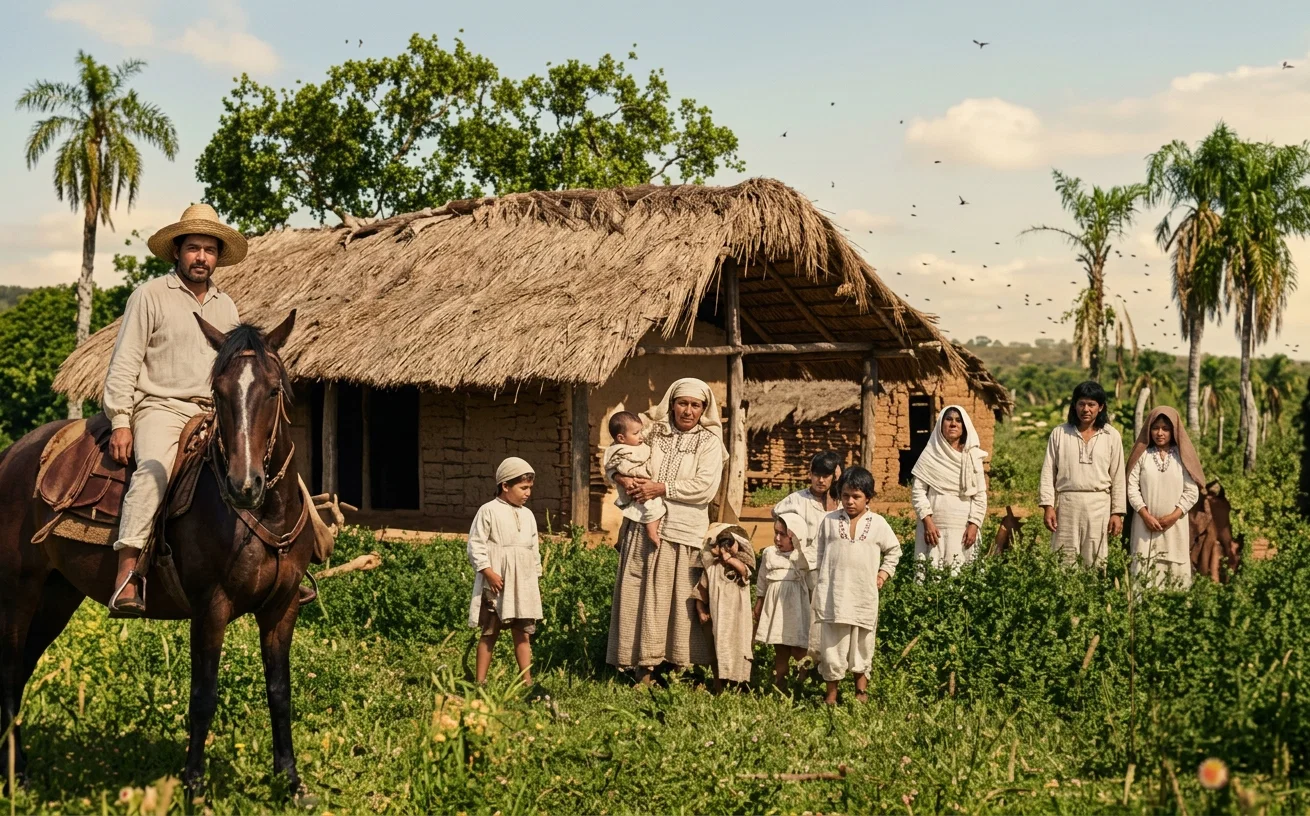
The damp, cloudy, dreary days of the Argentine winter drive many of the better-to-do Argentines to the sunny clime of Paraguay, during the months of June, July, and August; and San Bernardino, with its picturesque location on the lake shore, and with a range of mountains in the background, attracts a goodly number of these visitors. The income thus derived is the mainstay of the colony. The first impression of the village received by a North American on arriving, is that of a summer resort, the one-story brick structures, with roof of zinc and wide corridors or piazzas, presenting an attractive and comfortable appearance. The country around the village within a radius of seven or eight miles is settled by German farmers, the greater number of whom live by the cultivation of corn and vegetables and the making of butter and cheese, which are sold in the village and in Asuncion. Notwithstanding the accumulations that they have in the bank, nearly all live with few of the conveniences, to say nothing of comforts. Recently we had occasion to pass the night with one of this class. His house, a one-story brick structure, with floor of the same material and roof of straw thatch, consisted of one general living-room, and a small bedroom attached to one end. The furniture was scanty and very plain, consisting of a rough board bench, a table, and a few chairs, of the same material. A wardrobe, cold cupboard, and a few rough board beds completed the outfit. Their accustomed manner of eating indicated that table-cloths, as well as knives and forks, for general use, were considered superfluous, while inquiry solicited the fact that a wash-basin and towels were not to be had. In view of these facts, our surprise may be imagined when told that this man was considered a well-to-do colonist, with over ten thousand pesos Paraguayan currency in the bank.
PARAGUAYAN FAMILY
A COLONIST’S HOME
The spirit of covetousness and mammon worship rules here quite as generally as in the United States, although the folly of this spirit is more manifest here, from the fact that money has comparatively little purchasing power in supplying the highest-priced imported conveniences and comforts, since it has greatly depreciated in value. At present it is worth only about ten cents gold to the peso, which corresponds to the United States dollar. We are often made sad by the thought that these poor people will spend money for that which is not bread, and their labor for that which satisfies not.
With all the wealth one can accumulate, life in the interior of Paraguay is but a mere existence, tending to the development of the animal, to the deterioration of the intellectual and spiritual nature. The colonist on settling here finds his neighbors to be of the lower class of Paraguayans, living in ranchos. The climate being warm nearly the entire year, and cotton goods being expensive, clothing for Paraguayan children of both sexes, until of quite an advanced age, seems to be considered unnecessary. There is no recognized standard of purity and morality to serve as a basis on which to appeal to the people here. The would-be reformer in this country must undertake the up-hill work of creating a standard himself, by arousing public sentiment on the subject.
The difficulty of this reform work will be more apparent from the fact that in the native Paraguayan language no corresponding expressions to these virtues are found. The excessive and general use of tobacco among both men and women tends also to grossness, and to the obliteration of all sense of shame because of their degraded condition. These depressing influences surrounding the children of foreigners, together with the absence of almost all intellectual and moral influences in the home, will account for their degradation to almost the level of the native. One indication of this condition is the frequent elopements of daughters of foreign colonists with Paraguayan peons. However, the parents are not without responsibility in14these cases. Having come from Europe with the faith of the state church, which at best is but an empty form, they soon, under their depressing environment, lose sight of even this, and, like a drowning man grasping at straws, many of them find consolation in spiritism and theosophy.
These delusions are making an alarming headway all through this part of South America, their adherents in this colony numbering over one hundred families of foreigners. We are safe in saying that the individuals who have a daily Christian experience can be counted on the fingers of one's hands.
But in nature there is abundant evidence of that invisible Power that is constantly at work as man's servant to feed and clothe him. Footprints of this love are seen everywhere. The mountain, in the form of terrace on terrace, recedes from the back of the village, and is covered with perpetual green, dotted here and there with trees laden with beautiful pink and golden flowers, which in the distance appear like huge rose-bushes in bloom.
The country is covered with timber, and is well watered, in the latter respect reminding us of the mountain streams and springs of Pennsylvania. Severe droughts are almost unknown here, although during the months of August and January there is but little rain.
In all work the most primitive methods are employed. The greater part of the timber for building purposes is cut by hand, while the land is mainly cultivated with only the aid of a hoe. Hand cultivation is necessitated by the fact that in clearing the land only the small wood and brush are burned, while the trunks are left wherever they happen to fall, until they rot. Apparently, the stumps and tree trunks occupy as much space as the available land for cultivation. In places where the land will permit of plowing, we find the most primitive implement for this purpose in use. This may be described as a stick of timber about three by four inches thick and about twelve feet long, to one end of which is securely fastened a piece of wood about two feet long, which is so inserted as to make an acute angle with the main beam. The latter piece is usually covered with thin iron, and serves to scratch the ground. The plow, or scratcher, is guided by one vertical handle, and usually one man is employed to guide the plow, while another drives the oxen.
Owing to such primitive methods of cultivation, the individual farmer finds eight or ten acres sufficient for his purpose; and although his corn and other products bring good prices, owing to the small area cultivated, his income is necessarily small. Corn in the season of plenty sells at sixty-eight cents a bushel, and at the present time, owing to scarcity, it sells as high as $1.40 a bushel.
Before concluding, we can only express gratitude that the precious seed of the Word has found lodgment in some good and honest hearts, although the soil seems to be generally quite barren for the seed sowing. Four adults have begun to keep the Sabbath, while others are interested. The Harold and the Hausfreund are also coming into ten families from month to month, laden with present truth. We might be discouraged at the unfavorable situation, if we were not assured that where sin abounds, grace much more abounds. We are confident that the power of the Lord is present to heal all of sin and its consequences as verily as it was with the Saviour as he trod the earth. We solicit the prayers of all of like precious faith in behalf of this dark land.
Asuncion, Paraguay.
Mission Work in India
By J. L. Shaw
J. L. SHAW
The largest missionary conference ever held in southern Asia convened last month in Madras. The Decennial Conference, as the name implies, meets once in every ten years, and accepts as its delegates, representatives from all Protestant missions in India, Burma, and Ceylon. The privilege of attending a gathering of this kind gives one a far broader idea of mission work in this part of the Orient than could be gained in any other way. To meet men and women from all parts of this field engaged in various kinds of mission work,—to talk with them and to hear their experiences,—tends to deepen the desire to see India evangelized in this generation. There are many missionaries in India, and among them are consecrated, devoted men and women who are throwing their lives into the work of winning souls. It is inspiring to talk
with men who have put in fifteen, twenty, thirty, and even forty years of service for the Master in this land where at best many perplexities and hardships come.
At the opening of the conference an address of welcome was given by John Murdock, who came to India in 1844. He told in few words and broken voice of some of the trials and triumphs of truth which he had witnessed. Confessing that his work was almost over, he exhorted younger men to faithfulness, telling them that the motto of his life, like that of Carey, was, “Attempt great things for God, and expect great things from God.” At the conference in 1892 this aged brother said, “Long before another conference shall meet, I must lay down my pen,” but his life has been spared, and still he labors on.
The lives of such men and the effect of the work they have done are known only to God. Many have spent long years in patient work with little apparent fruit; but as years go by, one plants, another waters, and still another reaps, so that slowly but surely the gospel of the kingdom is finding its way to the darkest corners of India.
At this conference the recent census of India, though not officially published by the government, was given, showing the combined population of India and Burma to be 294,361,056. Of these 207,147,026 are Hindus; 62,458,077 are Mussulmans; 9,476,759 Buddhists, and the rest of the population is divided up among Christians, Jews, Sikhs, Jains, Parsees, and others. During the last ten years, although the population has increased one and one-half per cent, the Hindu population shows a decrease. On the other hand, the Christian population shows an increase from 2,284,380 in 1891 to 2,923,241 in 1901, or about thirty-one per cent. Missionaries think this numerical increase a great cause of rejoicing; but when it comes to resorting to numbers as evidence of Christian growth in India, it is easy to err; for the word “Christian” in India is probably the most misused word in any language or literature. One man wears one form of dress, and is called a Hindu; another wears another form of dress, and is called a Mohammedan; and still another, because he wears a European costume, is called a Christian. When it comes to be a matter of custom and dress, it certainly is unsafe to look to numbers. We might add, however, that the numerical increase of Christians shows that in some measure the prejudice of the native is abating toward the Christian religion. Especially is this evident when we consider that Hinduism, by far the most prevalent religion in India, has fewer devotees than it had a decade ago. We are glad to say that Hinduism is in a measure losing its hold upon the Indian. Western education is revealing the nothingness of this religion, but it is sad to record that while Christianity is making some progress, infidelity and atheism are getting possession of the educated classes to a remarkable extent; so the15missionary, while rejoicing at the decline of Hinduism, groans at the spread of Western unbelief in the Orient.
We feel certain of this, that a knowledge of the Christian religion is being carried to the masses as the years go by. The Bible is continually being translated and re-translated into many different languages, and its circulation is being widely increased.
THE HARVEST TRULY IS GREAT, BUT THE LABOURERS ARE FEW
Missionaries have done much in educating the people and teaching the English language. It is surprising to see how the native people in Madras speak English. Every servant speaks in English. In this respect natives of Madras are in advance of those in other parts of India. This is due in part, probably, to the fact that missionary efforts have been more extended for a longer period here than in other places, and in part to the cleverness of the people of Madras.
It is estimated that there are five million natives of India who can speak the English language, and year by year the number is increasing. In large cities the rising generation are fast getting hold of it. When we consider the fact that there are more young men every year attending colleges in India than in England, and thousands are taking their degrees every year, some idea can be gained of the rapidity of the introduction of Western education and the English language.
All this is simply preparing the way for the third angel’s message. While we are so slow in getting hold of the vernacular to carry the truth to the people in their own language, they throng our doors who talk our tongue.
There are as many people in India who speak the English language as comprise the whole population of Australia. Is not this an evidence that God is opening the door for the entrance of his Word in this land? and can we not see him going out before us, and hear in the wide diffusion of English education in India the voice of God saying, Now, just now, is the time to take hold in earnest in the East?
Come along, then, brethren and sisters in the home land, you who have heard the call to India ringing in your ears. Delay no longer. Twenty people die every minute in this land. As the second-hand moves around, every third second some one dies who never learned to love our Lord. Every year more than eight million die not knowing that “God so loved the world, that he gave his only begotten Son, that whosoever believeth in him should not perish, but have everlasting life.”
Think not of home and country while issues so great are at stake, and souls are dying whom you might help to save.
There are trials and perplexities to be met, but there are victories to be gained, and men and women to be saved. Some people get suddenly frightened when India is mentioned. They think of the bubonic plague, the excessive heat, the cholera, and the snakes, but if such things as these hold us from doing our duty, what shall we do in the swellings of Jordan? There are three thousand foreign missionaries in India, and some have lived here fifty years. Any one who is young and of reasonable health should be able to work in India. We say to you, “Come;” if God bids you “come,” come on.
The accompanying drawing shows but one corner of the great East. There are the unentered fields of Africa and China, with their cry of human woe ascending to God. What shall we do? What can we give? These are the questions this denomination must answer, and answer soon. Our faith demands a consecration no less than all. “Whosoever he be of you that forsaketh not all that he hath, he cannot be my disciple.”
Calcutta, India.
How It Seemed to Chalmers
JAMES CHALMERS’ standard of devotion was a high one. Here is an example from one of his letters:—
“Is it impossible to find missionaries who will gladly dare all for Christ—not the ‘life in hand,’ business, or the ‘sacrifices I have made;’ but men and women who think preaching and living the gospel to the heathen the grandest work on earth, and the greatest of heaven’s commissions? We want missionaries like the men Colonel Gordon defines. He says: ‘Find me the man, and I will take him as my help, who utterly despises money, name, honor, and glory; one who never wishes to see his home again; one who looks to God as the source of good and the controller of evil; one who has a healthy body and an energetic spirit, and one who looks on death as a release from misery. Leave the twaddle of sacrifices for those who do not appreciate the sacrifice of the cross. Let the church give her very best in heart, mind, and body, for Christ’s work. The best and greatest of all works require the best and greatest men. We want men who will thoroughly enjoy all kinds of roughing it, who will be glad when ease and comfort can be had, but who will look upon all that comes as only that which gives zest to work, and creates the appetite for more.’”
General Notes
THE Bible in whole or in part has been translated into fifty-nine different languages and dialects in India. Never was it more widely read in that country than at the present time.
A YOUNG gaikwar, or chief, of Baroda, a province in India, was educated in England. He has issued a special enactment which legalizes the re-marriage of widows. Baroda, the state of which the gaikwar is chief, shows the largest relative increase of Christians in all India for the last ten years.
ACCORDING to the census of the Chinese empire which has just been completed, the entire population is 426,000,000. Of these, 400,000,000 reside in the eighteen provinces, which are nearly as densely populated as the German empire. In Shantung, the most densely populated, there are more than four hundred people to the square mile.
THE report of General Booth gives an idea of the extent of the work of the Salvation Army. Missions are conducted in 49 countries. The workers preach in 31 different languages. There are engaged 13,486 chief officers, 3,000 employees, and 47,000 local officers. The Army publishes 61 periodicals and 27 newspapers in 23 different languages, with an annual circulation of 52,000,000 copies. They have founded 15 farm colonies and 157 slum posts. During the last year 17,000 persons, on an average, were sheltered at night, and 30,000 fed each day. In 114 rescue homes, 5,850 girls were received, and during the same time 14,000 ex-criminals received attention, 3,000 missing people were found, and 84,000 were assisted to employment.