The Youth’s Instructor, Vol. 65, No. 39.

For Hire
Earlier text: Ruth, the True-Hearted

How Sir Thomas Came Back

I JUST think it is a shame.
“And I, too,” said another voice.
“Who do you think did it, Billy?” asked a third.
“I’m sure I can’t say, but I have some suspicions,” answered the one addressed.
Billy Larkin was the center of a group of boys ranging between the ages of fourteen and seventeen years. Evidently they were on their way home from school. The object that had caused their exclamations was a dead cat, lying near the walk just inside of the fence. Ordinarily such a sight would not have called forth so much concern from them. But this was a beautiful white Angora cat, and the owner was well known to them.
“What will Granny Whitney say when she finds out some one has killed her pet! I say, fellows, it’s a heartless piece of business, whoever did it.”
“Yes, she always prized him so much because he was such a fine cat, a gift from an old friend of her girlhood. Sir Thomas, she called him, has always been company for her as long as I can remember.” Billy spoke with some feeling.
“Shall we take him down to her and tell her what happened?” asked Rob Moore. “There doesn’t seem to be any one else to do it, and she ought to know.”
“Yes, Bob; I guess we shall have to tell her. I’m sure it will make her feel bad.”
“She’s a nice old lady; every one likes her, or at least we thought so.”
“You’re right there, Bob,” said Billy with enthusiasm. “I have reason to thank her for lots of things. Do you remember the cookies she gave us that day when we shoveled the snow off her pavement? My, but they were good! She knows how to make the best cookies I ever tasted.” Then growing sober, he added: “I might not be here at all today if it had not been for her. She nursed me through diphtheria when I was only eight years old, when mother was sick and father could not afford to have a trained nurse for me. I feel as if we ought to do something about this.”
“What do you have to suggest, Billy?”
“What can we do?”
“Let’s walk down toward her house, and maybe by that time we can think of something.”
When they reached the widow’s gate, they stood a few minutes to decide on a plan.
“I have it, fellows; how many of you have any money with you?”
“What do you want with money, Billy? Do you want to buy a coffin for Sir Thomas?”
“Not at all, Gray, I’m not thinking about the funeral; we can do all that in regular order. But how much cash can we raise? Let’s see, here are five of us. How many of you can spare fifty cents for a good cause?”
“Say what’s on your mind, Billy Larkin,” spoke up Gray again. “Who’s getting the benefit of all the money?”
“Well, it’s like this,” he began. “You fellows all know how hard it is for Granny to get along, and how lonesome she sometimes is. Sir Thomas has always been good company for her, and now that he has been killed she will surely miss him. Would you fellows like to chip in and help buy another cat to take his place? There, that’s the whole plan up to date. What do you say?”
“I guess I can do it for one,” said Bob.
“And I”—“And I,” added the others.
“But where can you get another Angora to take his place? He surely cost more money than we can raise.”
“Don’t worry, Gray; I think I know just the place to get one, and unless Granny looks pretty close she won’t know the difference. Only he will be strange at first.”
“Shall we tell her about it?”
“We will see about that later.”
As they were about to separate, Billy said: “Bring your money to school in the morning, and we will go down town at noon to see about it.”
“But, Billy, what about Sir Thomas here?”
“Oh, yes! We will appoint you and Bob minister and undertaker. You live near here. Now do your duty, boys.”
The next evening a delivery wagon stopped in front of Granny Whitney’s gate, and a box was carefully lifted out by the driver and carried to the door.
“Here is a parcel I was ordered to deliver to Mrs. Whitney,” the man said, and made a movement to carry it into the house.
“I’m afraid you have made a mistake; I did not order anything,” she began.
“No, there isn’t any mistake ma’am; the directions on the box are plain.”
“What is it?” she asked wonderingly.
“If you say, I’ll open it so you may see. I think he wants to get out as quickly as he can.”
“Why, is it alive?”
“Very much alive, ma’am; he doesn’t like being penned up this way.”
By this time the box was open, and out jumped a pure white Angora cat. He was surely a second edition of Sir Thomas.
“Why, where have you been, Tommy boy?” she exclaimed with surprise and joy written all over her face. The cat did not respond, but stood off watching her with strange eyes.
“You have been gone for days, and I thought you were lost. Now you come back all done up in a box as if you were a real gentleman. Can’t you say, how-de-do to Granny? Why I do declare he’s afraid of me. Never mind, you’ll soon remember that this is your home.”
She seemed to have forgotten for the moment the presence of the man in the joy of seeing her pet again.
“Thank you very much, sir, for bringing Sir Thomas back; he is so much comfort to me. Where did you find him?”
It was with difficulty that the man suppressed a smile. He only said that a man asked him to bring him to her. He quickly drove away, leaving the old lady to form her own conclusions.
The visitor was being treated very much like a prodigal son, for he was soon enjoying some choice bits that Granny had been saving against his return. As she watched him eat she began to talk to him in a familiar way.
“Seems like you ought to tell Granny where you’ve been all this time, Sir Thomas. You need not be afraid of me. I’m not going to whip you for staying away so long. You made me feel real bad when I could not find you the other night, but I guess you must have been enjoying yourself.”
Meanwhile Billy Larkin and two of his companions were on their way to see Granny. They chuckled as they walked along, for they were aware that the box had been delivered. They were anxious now to know what the widow had made of it.
“What will you say, Billy, when she tells you about Sir Thomas coming back?”
“Perhaps we won’t have to say anything about it.” And then he added, “You fellows want to be careful and not give anything away. When we see her, we shall know better what to say.”
A knock brought Granny to the door, and when she saw the boys she opened it wide, saying, “Come in, boys. I have something nice to tell you. See Sir Thomas there? He’s been away on a visit somewhere, and he won’t tell me where he was. I don’t mind, though, just so he is back again.”
“What makes him so shy?” ventured one of the boys. “He was always so happy when we were here before.”
“Oh, I think he has been in bad company and is ashamed of himself! He’ll be all right soon.”
The boys looked at each other and nodded.
“I have some nice ginger cookies, boys, if you would like some. Now don’t all speak at once.”
While they were doing justice to the plate of cookies they observed that Sir Thomas was already making himself at home. Surely there was no reason to tell the old lady the whole story.
“Must you be going, boys?” she asked as they reached for their caps.
“Yes, Granny, we must get home to our lessons. Don’t let Sir Thomas play any tricks on you and run away again.”
“No,” she said, laughing. “I’ll keep him right here all the time and give him to understand this is his home.”
“I wonder what she would think,” said Billy a little later, “if she knew what we know.”
“Well, we won’t tell her anyway. But I’m more than glad we hit upon the scheme to bring Sir Thomas back.” J. A. RENNINGER.

Indignant

“SAID a handsome dandy lion To a dandelion wee: ‘Pray, who ever in creation Thought to name you after me?’” —St. Nicholas.
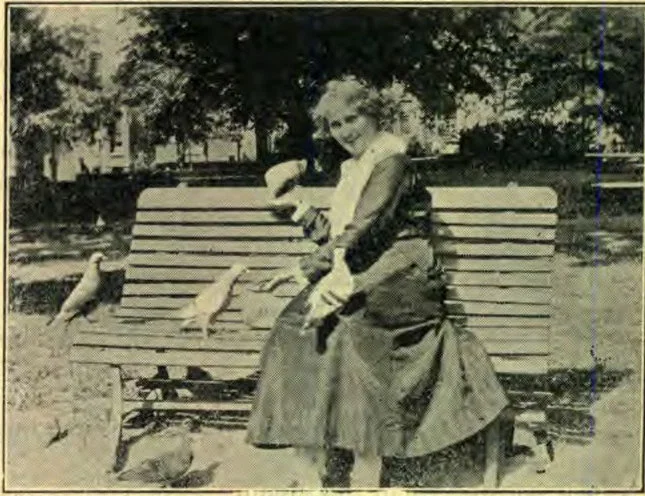
FEEDING TIME
FEEDING TIME

Missionary Volunteer Society Programs for Week Ending October 6

The programs for this date, with notes, illustrations, and other helpful material, will be found in the Church Officers’ Gazette for October.

The Bible Year

Senior Assignment

September 30. Zechariah 5 to 8: Restoration of Jerusalem.
October 1. Zechariah 9 to 11: Prophecies of Christ; promises of victory.
October 2. Zechariah 12 to 14: A fountain for sin.
October 3. Malachi: Acceptable offerings.
October 4. General review of the Old Testament. As far as you can, give a one-name title to each book; as, Genesis, “Beginnings;” Leviticus, “Law;” Psalms, “Praise.” Note that the Old Testament contains thirty-nine books, divided into five parts—law, history, poetry, major prophets, minor prophets. There are five books of law, twelve of history, five of poetry, five major prophetical books, and twelve minor prophetical books.
October 5. Matthew 1 to 4: Genealogy; birth; baptism; temptation.
October 6. Matthew 5 to 7: The Sermon on the Mount.
For notes on this assignment, see Review for September 27.

Junior Assignment

September 30. Luke 6: A lesson on Sabbath keeping.
October 1. Luke 7: The centurion’s servant healed.
October 2. Luke 8: Parables and miracles.
October 3. Luke 9: The twelve sent out to preach.
October 4. Luke 10: The seventy sent out.
October 5. Luke 11: Jesus teaches his disciples to pray.
October 6. Luke 12: God’s care for his children.

A Model Prayer

Hanging over the bed in a little girl’s bedroom is a picture showing a curly-haired, white-robed figure kneeling at the bedside in prayer, and underneath the picture are these words:
“Jesus, I thank thee for the way That thou hast led me all the day. O Jesus, keep me through the night, That I may see the morning light.”
Our Father in heaven would have every one of us seek him in prayer every day, that we may do what is right. Children, as well as older people, need to pray, and even the smallest child should learn to pray to Jesus; for he is a Friend who will always help us.
One day the disciples of Jesus came to him, and asked him to teach them how to pray. The prayer which he taught them you will read this week in the eleventh chapter of Luke. It is the most perfect prayer ever made, yet it is very short, for it takes but half a minute to repeat it without hurry. Can you repeat the Lord’s Prayer as he gives it in Matthew 6? We often say this prayer in concert; but when repeating it let us remember to do so very earnestly, and to think of just what we are saying. We are speaking to our heavenly Father who is worthy of the deepest reverence. “Hallowed” means consecrated, or holy.
While God expects us to pray in public sometimes, it is when we are all by ourselves that we can best open our hearts to him. Then it is that we may confess our sins and ask him to help us to overcome them.
Perhaps you have seen a person go into a telephone booth to send a long-distance message. Before he begins speaking, it is necessary to close the door, and shut out all the noise, so that the voices can be heard. So when we are alone with Jesus, the world shut out, we can best talk with him.
The words, in the Lord’s Prayer, “Lead us not into temptation, but deliver us from evil,” do not mean that we shall never be tempted. Every one is tempted, and we must expect that; even our Saviour had temptations of the hardest kind. The wrong is not in being tempted, but in yielding to temptations. What a good thought it is that Jesus is able to help us just when we need him most. If we are tempted to speak a hasty word, or do some unkind thing, a little prayer for help will always bring the needed strength to conquer the temptation. God would send every angel from heaven, if necessary, rather than that even one of his trusting little ones should be overcome.
ELLA IDEN.

The Law Psalm

(Texts for October 1-6)
To some of us the ocean never loses its fascination. It can hold us spellbound by the hour. And somehow as I study the one hundred and nineteenth psalm, I am reminded of the boundless deep, and experience again the feeling that has always crept over me when sitting quietly on the seashore listening to the ceaseless music of the grand ocean chorus. Each surf that rolls in and breaks upon the shore, contributing its mite to the great chorus, is very much like those that have gone before. Still, to some of us neither the sight nor the sound becomes wearisome. Perhaps to those who love the seaside, each wave carries a little different degree of light, and breaks with a tone all its own; or perhaps it is the subtle, soothing monotony of the never-halting onward march of the ocean waves—all alike and yet all different—that charms them.
However that may be, it is the ever changing, ever sameness of the ocean that suggests to my mind its comparison of the one hundred and nineteenth psalm; or perhaps better, the comparison of that psalm to the ocean. This psalm is a mighty deep filled with thoughts of God’s law—the law of “surpassing excellence.” It is a chapter of a single idea; and every verse, with the exception of two or three, reiterates it. There seems no special continuity in this psalm—just a constant surging of beautiful thoughts around the one supreme idea, each verse like a rippling wave contributing its own individual note to the great song of praise to God’s law.
“This is an alphabetical psalm,—the longest and most perfect of its kind in the entire collection of psalms. The peculiarity of the composition consists in this, that the first eight verses of the psalm begin with the first letter of the Hebrew alphabet; the next eight with the second letter; and so on through the twenty-two letters of the alphabet.” All but two or three verses in this psalm mention the law of God, or use some of the familiar synonyms for it,—word, statutes, commandments, testimonies, judgments, etc. The divisions of the psalm do not represent various phases of the theme; they are more like groups of proverbs. All are exceedingly good, and the members of the Morning Watch circle could spend time delightfully and profitably in grouping the verses in this psalm, regardless of alphabetical divisions, under headings such as, The Law of God—“in youth, in trial, in duty, in meditation, in prosperity, in adversity, in public, in private.”
One commentator says of this psalm: “It is a great storehouse of truths, most precious and valuable, on one of the most important subjects of religion—the word of God; and it may have been intended, as would seem not improbable from the alphabetical arrangement, to be committed to memory by the young, that their minds might be early stored with valuable precepts to be their guide in the journey of life. A young man could not have a better treasure laid up in his mind than he would possess by committing this psalm to memory.”
When and by whom this psalm was written is not definitely known; but we can join with an author of the past century in saying: “This psalm is so applicable to the people of God at all times, so fitted to strengthen the mind in trial, so adapted to guide, comfort, and support the soul, and so true in regard to the influence and value of the law of God, that it is not needful to know when it was composed or who its author was. It is sufficient to know that it was composed under the guidance of the Holy Spirit, and is a repository of truths which will be of inestimable value in all ages of the world.”
Young friend, will you not make the one hundred and nineteenth psalm a close companion? Learn it; master it; meditate upon it. It will be a safeguard to you in all the walks of life. It has wisdom for the perplexed, comfort for the sorrowing, strength for the faint, and it points the way to eternal life for the hopeless. Do you not think it will be well for you to become thoroughly acquainted with it during October?
MEDITATION.—Glancing over my calendar, I notice that October is devoted to a study of the one hundred and nineteenth psalm. Surely I shall never have a better opportunity to become acquainted with it. Each morning I can study carefully the division in which the verse for the day appears; from a few divisions I notice that no selections have been made; these divisions I can study as I go along and compare them with others. I am resolved to use this opportunity for learning the one hundred and nineteenth psalm, as I am sure I shall wish I had when the month is past.
SPECIAL PRAYER.—Father, help me to hide a portion of thy Word in my heart every day, that I may overcome and live a life on which thou canst place thy approval.
M. E.

I—The Giving of the Law

(October 6)
MEMORY VERSE: “Fear God, and keep his commandments: for this is the whole duty of man.” Eccl. 12:13.

Questions

1. Where did the children of Israel camp when they came into the wilderness of Sinai? What event did the Lord say would take place? Ex. 19:2, 9, 11.
2. What preparations were to be made for this solemn occasion? Verses 10-13.
3. What was seen and heard the morning of the third day? How were the people affected? Verses 16-18.
4. When the trumpet sounded long, who spoke? Who answered? Verse 19.
5. With what words did the Lord begin the speaking of his law? Ex. 20:1, 2.
6. Where are the ten commandments found in the Bible? Ex. 20:3-17. Repeat the first. Verse 3. What is forbidden by this commandment? Note 1.
7. Repeat the second commandment. Verses 4-6. How is the worship of images sometimes defended? Note 2.
8. What does the third commandment forbid? Verse 7. Note 3.
9. Repeat the fourth commandment. Verses 8-11. What special care should be taken to observe it? Note 4.
10. Which of the commandments is given especially to children? Verse 12. Note 5.
11. Repeat the sixth commandment. Verse 13. What Bible comment is made on this scripture? 1 John 3:15.
12. Repeat the seventh commandment. Verse 14. Note 6.
13. Repeat the eighth commandment. Verse 15.
14. Repeat the ninth commandment. Verse 16. What is meant by false witness? Note 7.
15. Repeat the tenth commandment. Verse 17. Define the word “covet.” Note 8.
16. What is the whole duty of man? Memory verse.

Notes

1. “Man is forbidden to give to any other object the first place in his affections or his service. Whatever we cherish that tends to lessen our love for God or to interfere with the service due him, of that do we make a god.”—“Patriarchs and Prophets,” p. 305.
2. “The second commandment forbids the worship of the true God by images or similitudes. Many heathen nations claimed that their images were mere figures or symbols by which the Deity was worshiped; but God has declared such worship to be sin.”—Id., p. 306.
3. “This [the third] commandment not only prohibits false oaths and common swearing, but it forbids us to use the name of God in a light or careless manner, without regard to its awful significance. By the thoughtless mention of God in common conversation, by appeals to him in trivial matters, and by the frequent and thoughtless repetition of his name, we dishonor him.”—Id., pp. 306, 307.
4. “Those who discuss business matters or lay plans on the Sabbath, are regarded by God as though engaged in the actual transaction of business. To keep the Sabbath holy, we should not even allow our minds to dwell upon things of a worldly character.”—Id., p. 307.
5. “Children who dishonor and disobey their parents, and disregard their advice and instructions, can have no part in the earth made new. The purified new earth will be no place for the rebellious, the disobedient, the ungrateful son or daughter. Unless such learn obedience and submission here, they will never learn it; the peace of the ransomed will not be marred by disobedient, unruly, unsubmissive children.”—“Testimonies for the Church,” Vol. I, pp. 497, 498.
6. “This commandment [the seventh] forbids not only acts of impurity, but sensual thoughts and desires, or any practice that tends to excite them. Purity is demanded not only in the outward life, but in the secret intents and emotions of the heart.”—“Patriarchs and Prophets,” p. 308.
7. “False speaking in any matter, every attempt or purpose to deceive our neighbor, is here included. An intention to deceive is what constitutes falsehood. By a glance of the eye, a motion of the hand, an expression of the countenance, a falsehood may be told as effectually as by words.”—Id., p. 309.
8. Webster thus defines the word “covet:” “To wish for with eagerness; to desire possession of. To long for inordinately or unlawfully; to hanker after (something forbidden).”

Sewing Circle in the Jungle

SIXTY native women of Umtassa, Africa, have acquired the mysterious art of using a needle, reports Miss Mullikin of the Methodist Mission. They regard it as a great achievement. Many more tried to learn and failed, for their patient, willing fingers were old and long stiffened by toil. These women, with many young girls, have made garments for themselves and their children. They have also been initiated into the mysteries of the modern laundry, so that they not only make and mend their clothes, but also keep them washed and ironed. Washing and ironing appeal to these girls as entertaining occupations.—Selected.

The Only Courtesy Worth Possessing

IT is not well to gauge our courtesy by that of the one on whom it is bestowed. To be polite to the polite, abrupt with those who are gruff, and positively discourteous to the rude, is to be a chameleon, at the best. The only kind of courtesy worth possessing is that which, like the sunshine, falls on the just and the unjust, and sheds its beams impartially on all.”

How Porto Rico Went Dry

PORTO RICO joined the “drys” on July 16. She voluntarily lined up on the right side of a great question. The Christian Herald gives the following account of how it happened:
“The people of this country are Latins, proverbial for their liberal attitude toward the use of liquor. The per-capita consumption is small compared with similar territories in the United States, and drunkenness and the more serious evil effects of the traffic are little seen, so that the usual appeal against the brutality of the business could not be made. Seventy per cent of the voting population is illiterate, and therefore presumably susceptible to the sort of campaigning employed by the liquor advocates, who received generous support from local and foreign sources, and spent money liberally. On the other hand, the prohibition funds were almost negligible, scarcely sufficient for adequate advertising. Under these conditions, and with but eighteen years’ history under the Stars and Stripes, Porto Rico nevertheless cast 100,000 “dry” votes to but 61,000 “wets.”
“There was no time for a definite prolonged election campaign. The election was held Monday, July 16, under the prohibition referendum of the recently enacted Jones Bill, which measure granted citizenship and territorial rights to Porto Rico. The result was a surprise even to the prohibition leaders.”
“The government officials and big business interests offered the most active and formidable opposition outside of the liquor distillers themselves. There was very little business organization among the prohibition defenses. As one newspaper afterward aptly put it, ‘Nobody for prohibition but the people.’”
The good results that will inevitably follow the elimination of the drink traffic, will convince even the liquor dealers themselves that prohibition is a good thing for the country, for business, for the people, and for themselves.
Our own people helped considerably in the campaign, distributing temperance tracts, TEMPERANCE INSTRUCTORS, and Temperance Signs of the Times, and a special temperance issue of our Spanish paper. The efficiency of their work was recognized by other temperance workers.
The national W. C. T. U. sent Mr. Paul Barnhart to the island to direct the work. Our mission workers, with Mr. D. D. Fitch as leader, did all they could to assist Mr. Barnhart in making his work effective. This was greatly appreciated. The following letter written by Dr. Wilbur F. Crafts to Brother Fitch, emphasizes this fact:
“DEAR SIR AND BROTHER: Mr. Paul Barnhart has just returned from Porto Rico, and here at Washington last night told the story of the last days of the campaign, in which he mentioned prominently your splendid temperance literature, and I have noticed that this is a point in which your people excel. Many thousands of your temperance paper were distributed, at my suggestion, in Maine, in 1911.
“There will be abundant need of such educational work now that the election is over, to prepare the people for law enforcement, and I am sending you the greatest utterances on that subject, hoping that you will print some of them. There ought to be some illustrated scientific temperance material provided for every teacher and, so far as possible, for every voter, including those who were outvoted and who ought to be won over to the wisdom of the majority. Again expressing our appreciation for your coöperation, I am
“Yours for a ‘better world’ here and now,
“WILBUR F. CRAFTS.”
We congratulate Porto Rico on her wisdom in enacting the prohibitory law as one of her first legislative acts. We wish England and the United States would follow her example.

Absolute Certainty

NO human intellect can be wholly right—least of all the one that thinks itself so. Cocksureness is made up mostly of ignorance. There is no absolute certainty, except in matters of clear revelation, and even in these the truth must pass through finite intellect, as “light through a glass darkly.” No mind is so full of error as that which believes it possesses absolute wisdom. Nor can any one be wholly wrong. The dullest are bound to know some things pretty accurately. Street gamins are apt to know many elemental truths better than college professors can.—The Christian Herald.

“Right About Face”

HAVE you been following hard after the world? Have you been facing the same way the world faces, traveling in the same path in which it travels, content to keep at a short distance behind? Have you been congratulating yourself that you do not dress just the same, that you keep some space between yourself and the world of fashion, or are you facing in exactly the opposite direction, traveling in an altogether different path from that of the world? Are you endeavoring to keep as far away as possible from the pleasures and allurements of the world, or are you seeing how near you can keep to the world without completely separating from the people of God?
The better way is evident. It is the safer, the more enjoyable. It is the way that brings character and power into the life. It is the way that wins souls for the kingdom of God. To those whose heart and life are turned toward the world, the Lord’s admonition now is, “Right about face.” He calls for a complete separation; for a joining of hands with him for a march to the city of God along the straight and narrow way, that shineth more and more unto the perfect day. Shall we not enter the path of light, keeping the eye fixed upon the eternal Sun of Righteousness, that we may at the end enter into the fulness of the joy of our Lord?

Several Things in One

A CALIFORNIA young woman is responsible for a most serviceable knapsack that will answer nearly every need for the camper in the open. It weighs about six pounds, is made of army canvas, and is about nine and a half feet long, and is thoroughly waterproof. It may be easily transferred into a raincoat, hammock, sleeping bag, folding cot, army tent, or canoe. This last possibility is not so strange as it seems. In the first place, one side of the canvas is painted black, to insure its waterproof character. To make the canoe, the canvas is stretched over rough sticks of the proper size and shape. The young woman who invented this utility used it almost a week as a canoe, even allowing it to remain all night in water, and it was still in good condition at the end of the experiment.—Selected.
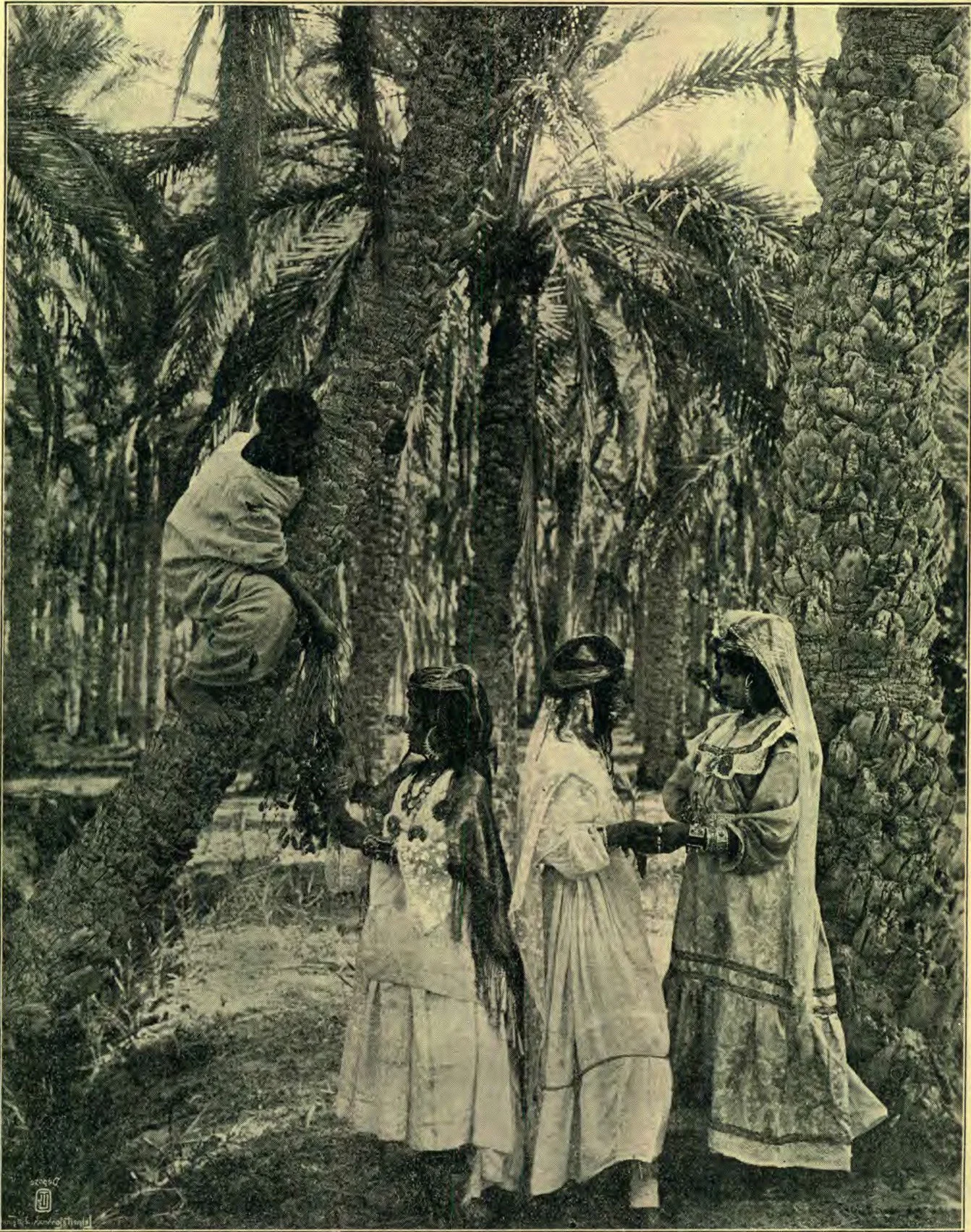
IN A DATE PLANTATION, TUNIS, AFRICA
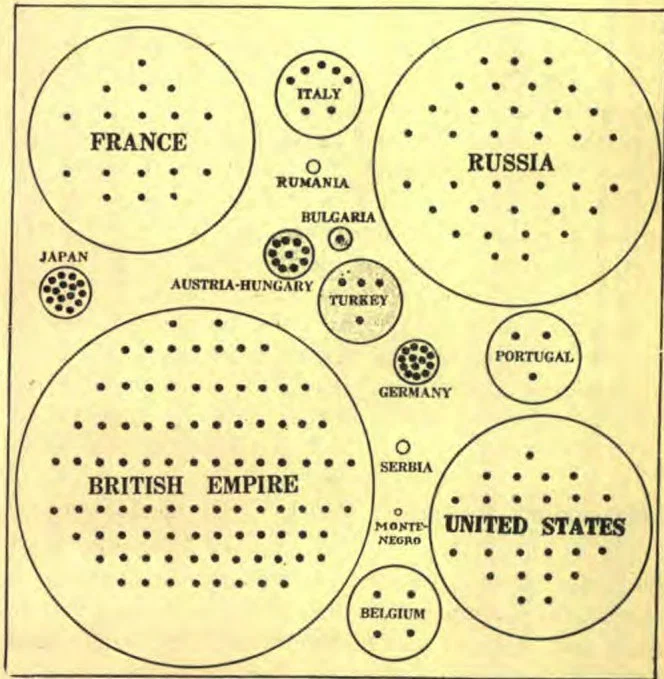
Each dot in the chart represents 5,000,000 people, and the size of the circle the area of the territory possessed by the countries named.

You have reached the end of this edition.

The Youth’s Instructor · Sep 25, 1917