ABOUT one hundred and twenty-five years before King David ruled in Israel, there lived in a quiet little village six miles south of Jerusalem, a family consisting of four members. The father's name was Elimelech, the mother's Naomi, and the two sons were called Mahlon and Chilion.
The Lord had blessed Elimelech and his family with plenty. The harvest had yielded richly year by year, and his flocks and herds brought forth increase, adding each year to the wealth of the owner. But a time came when drouth spread over the land. The clouds that occasionally floated over the clear blue sky were light and fleecy, and gave forth no rain. In the valleys the grass died and the herds could find no food. When Elimelech saw his herds decrease, he decided to leave the land of drouth and go to a place where he could find pasture. So he moved his family to the land of Moab.
They reached their new home of plenty, and settled in a goodly part of the land. Although they had escaped the drouth, death visited them in this new land, and claimed Elimelech while he was in the midst of his prosperity. Naomi was now a widow in a strange land, and would have liked to return home, but she was courageous, and remained on account of her two sons, for Mahlon and Chilion had become interested in this new land, and the bond for it was strengthened by their marriage to Ruth and Orpah, daughters of the idol-worshiping Moabites.
Though heathen, these girls possessed beautiful characters, and they both loved Naomi. While Naomi mourned the death of her husband, she found comfort in her children, and the years that followed were passed pleasantly. But they came suddenly to a sad close when her sons both died.
Sorrowful and lonely, the three widows came back from the last funeral. Naomi's heart turned to her old home and to the friends left behind. She reasoned, “Why not return? I have no ties binding me here now.” She talked it over with the girls, and a smile must have played over her face as she said, “I'm going back to Bethlehem.”
The morning of her departure was bright and clear, so the three started slowly along the way to the ford of the Jordan. The new hope of seeing her kinsfolk brought color to Naomi's cheeks and a new light to her eyes. While they were journeying, she spoke in glowing terms of the land to which she was going, and although she longed to have her daughters with her, she did not encourage them to go, because she knew that they did not realize what it would mean8to give up their idols. Instead, she urged them in strong yet tender words to return to the home of their fathers. When they came to the river, Orpah, weeping, kissed Naomi good-by, turned her back on Bethlehem, and her face toward Moab and its idols. Ruth, however, determined to go with Naomi, to leave behind her the handmade idols of her kinsfolk, and to accept the salvation offered by the living God.
The Jordan crossed, Naomi and Ruth wended their way along the vine-clad hills of the Promised Land, toward the little village of Bethlehem. To Naomi the scenes were familiar. She was glad to greet every nook and turn which brought to her mind the days of her youth and earlier womanhood. To Ruth, all was new, but she looked forward with anticipation and joy to her future home.
It was the beginning of the harvest time, when the two women reached Bethlehem, and the harvesters were already at work in the fields of ripened grain. Ruth saw her opportunity to obtain provisions for herself and mother. She asked Naomi to let her go to the fields and glean. Going down over the hill path to the great fields below, she stepped up to the chief reaper and gently said, “I pray you, let me glean and gather after the reapers among the sheaves.” Her winsome way of asking pleased the master, and he most willingly granted her request.
Ruth worked quietly and steadily until finally Boaz, the owner, coming down from Bethlehem to the fields, spied her among the gleaners, and asked of his head servant, “Whose damsel is this?” He was the “mighty man of wealth” of whom the Bible speaks, and later Ruth learned that this “mighty man” was a kinsman of Elimelech.
Boaz had not forgotten Elimelech and his wife Naomi. When he heard Naomi's sad story his heart was touched. To Ruth he showed much kindness. He urged her to work near the other women in the field for companionship, and, contrary to custom, asked her to eat with the reapers the food prepared for them.
Each day she walked over the stubble of the field, while the sun poured down hot rays upon her back. As she gleaned, she occasionally found a small bunch that had been purposely missed. Weary with the heat and labor of the day, she would put her burden of grain, be it much or little, upon her head, and march homeward with joy in her heart. Tiresome work it was, yet by her labor she was able to provide food for herself and Naomi.
In this manner the busy harvest days passed swiftly away. Boaz, the master, having heard the story of Ruth's faithfulness to her mother-in-law, regarded her with much favor. So interested did he finally become in the industrious young gleaner, that he urged her to become the mistress of his vast household.
And thus it was that this most humble of women, because of her great kindness of heart, her faithfulness to friendship, and her keen sense of duty, has left her name as one of the fairest upon the pages of all Biblical history. GRACE V. ADAMS.
Missionary Volunteer Work in Rhodesia, Africa
By G. H. Clark
Up to June [1916], no Missionary Volunteer work had ever been attempted on our mission stations in this dark portion of Africa. But according to the plan and vote of the Union committee, the writer then accompanied Pastor W. B. White, the president of the South African Union Conference, in the interests of the Missionary Volunteer work in Rhodesia. Pastor White was touring this field with the special object of holding Bible schools with the natives on our missions; but other lines of work also received attention, especially the Missionary Volunteer work.
Solusi
After a twelve-hundred-mile ride from Cape Town, we reached Solusi Mission, in Matabeleland, southern Rhodesia. This mission station was opened in 1894, twenty-three years ago, and was the first one established among heathen people by Seventh-day Adventists. When we reached the mission home on the sixth of June, the white missionaries and the native students gave us a royal welcome. “Welcome” was not only written on the blackboard, but was acted out by all, especially by our faithful and self-sacrificing white brethren and sisters. To meet again those of like precious faith brought joy to all our hearts.
We presented to the church the object of our Missionary Volunteer organization and some of its lines of missionary work, also the plan of organization, and then asked how many wished to become members. Thirty responded to the call. At a later meeting fourteen more joined, and still later seven others, making in all fifty-one natives, besides the three white persons who are serving as officers.
After the society was organized, and the officers were elected, several workers spoke words of encouragement to the members. Clarence, one of the native teachers, who had been elected assistant leader, was asked to speak. He arose, and with deep emotion said: “Today I am very glad to be here. I am glad for what I see. I am very weak, and do not know how to work for Jesus. I hope this society will help us to do better work for our people. They need light, and I give myself to do all I can to save them.” Here he stopped speaking, and sat down, weeping.
The following are some of the other testimonies that were given:
“I thank the Lord that he give me strong. This week, I give the Lord my heart. I praise the Lord give me power on my heart.”
“I am like an old blanket. I am full of holes. I can’t be mended. I must have a new one.”
“God saw me in darkness. My heart wish to see more of his love. I thank the Lord, he stay long, he wait for me.”
We presented the Bible doctrines portion of the Standard of Attainment, and one hundred and sixteen persons gave their names for membership. They cannot take the denominational history portion, as they do not have the books in their language; but they will soon learn the Bible texts from their Zulu Bibles.
The Lord surely visited us all during the few days upon this station. As Pastor White, on two Sabbaths, presented Christ to these people, thirty or more for the first time in their lives expressed a desire to find Jesus as their personal Saviour. This shows how the Lord is working to finish the message and bring us home to heaven.
With Brother R. P. Robinson as experienced leader, Clarence as assistant leader, Sister Robinson as secretary-treasurer, Sister W. C. Walston as a member of the executive committee, and Brother Walston as elder, we believe the Solusi Missionary Volunteer Society will, under the blessing of God, accomplish great things for Christ and his cause among this needy people.
The Somabula Mission
From the Solusi Mission we went about one hundred and fifty miles to the Somabula Mission, riding9fourteen miles of the last twenty-one of our journey after a team of ten donkeys, and the last seven miles in an oxcart.
We reached the station about 9 P. M., and were ready for a night’s rest. All the missionaries were glad to see us, and we rejoiced to meet them again in the bonds of Christian love.
In the morning, the native students welcomed us heartily to the mission. Many of the outschool teachers were there to attend the Bible school, and great interest was shown in all the lessons. I believe many souls will be gathered into the fold of Christ as the result of this institute.
The first Sabbath we were there, Pastor White spoke from Matt. 11:28-30: “Come unto me, all ye that labor and are heavy laden, and I will give you rest. Take my yoke upon you, and learn of me; for I am meek and lowly in heart: and ye shall find rest unto your souls. For my yoke is easy, and my burden is light.” The message seemed to be just what these poor, heavy-laden, sin-sick souls needed. There was a large number of unbelievers present; and when the call was made for those who wished to get rid of their load of sin and take the yoke of Christ upon them, full twenty for the first time publicly came to the altar, seeking the Lord for mercy and peace. Among the seekers was a chief, a man about thirty or thirty-five years of age. He was the first to pray for himself when opportunity was given. Later on in the day we had a testimony meeting, and he with others who had come forward confessed that he believed the Lord had forgiven his sins, and declared that he wished to live for him.
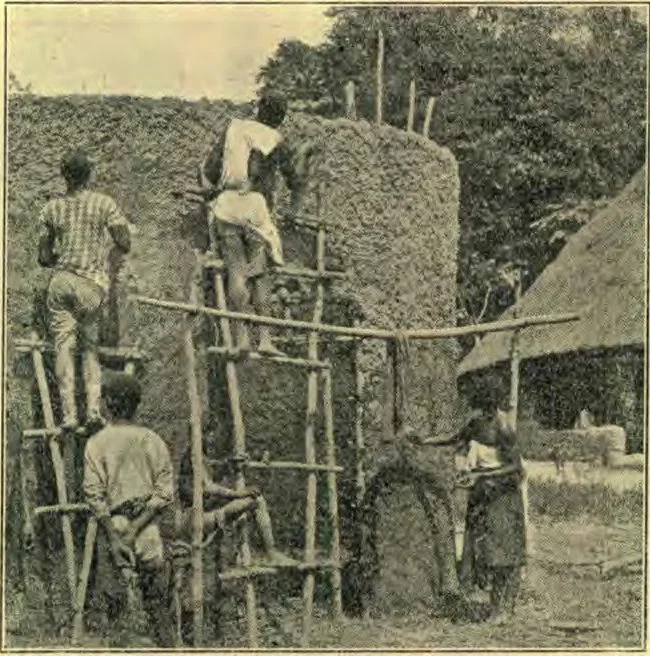
Native Housebuilders at Work, Matimba, Sierra Leone, Africa
As Brother J. N. de Beer, the mission superintendent, was leaving at once for an extended visit to the outschools, and Brother Hubert Sparrow, his assistant, would be extremely busy during his absence, it hardly seemed best to organize a Missionary Volunteer Society then; but all the mission workers were anxious to do their utmost in this direction, and doubtless Somabula will soon be well organized, and do her part in pressing forward in this work.
A number of the more experienced native teachers are so far away from the mission that they cannot get in oftener than once in three months; but when the society is organized, they will join, and send in their reports.
We presented the Bible doctrines portion of the Standard of Attainment at Somabula also, and eighty-five persons enrolled.
Glendale Mission, near Fort Victoria
After a half-day’s ride from Somabula, first with oxen and then with donkeys, we reached Gwelo, where we took the train for Fort Victoria, eight miles from Glendale Mission. We reached Fort Victoria in the evening, and riding for about three hours with an ox team, we camped for the night, and early in the morning proceeded to the station.
This is our youngest mission in Rhodesia, having been established in 1911. Brother T. J. Gibson is the superintendent and teacher, with Brother Laurie Sparrow as assistant. Brother Gibson’s house is beautifully situated on the top of a hill, and Brother Sparrow’s is near by on the side of a hill.
The natives have their huts on the mission farm, not far away. These are built of poles and mud, with grass roofs. Some of the natives keep these little homes very neat and orderly, while others show small interest in looking after them.
Previous to our visit, no church organization had been effected here. Both white and native members were formerly connected with the Somabula church; but at this time Pastor White organized a church of about twenty-five members.
As nearly all the native members are inexperienced in church work and methods, and young in the truth, it was deemed best to postpone the formation of a Missionary Volunteer Society until a later date; but after I explained the idea of the Bible doctrines portion of the Standard of Attainment, six white persons and forty-eight natives gave their names for membership. Brother Gibson has a large baptismal class, and is planning to use these subjects and texts in connection with other matter in preparing the candidates for intelligent church membership and consistent Christian living.
One of the native outschool teachers connected with this station, attended the Bible school at Somabula, and since his return to his school has sent for extra copies of the Bible doctrines list of subjects and references for use in his school.
There seems to be in the hearts of this people a strong desire to learn what the great God has spoken to them through his Word. May this desire possess all our hearts until we shall search the Scriptures, and learn for ourselves what the Lord has spoken to us.
Tsungwesi Mission, near Inyazura Siding
After two days’ travel by train from Glendale, we reached this, our last station, safely. When we arrived, all the white workers and natives, about one hundred, met us, and welcomed us heartily.
When I explained the organization and work of the Missionary Volunteer Society, I said that just as the nations are calling on their people to act a part in gaining victories for their side in the great war, so the Lord is now calling all his people, especially the young, to come to the front in the great conflict between the forces of good and the forces of evil. After explaining fully, and, to my mind, clearly, the whole matter, I asked all who wished to unite, and form a society to do this kind of work, to raise their hands. Not a hand went up. I then asked why they did not wish to have such a society. After some time, I found that they understood me to be after recruits for German East Africa. This called for more instruction10and explanation, which finally resulted in removing all obstacles from their minds, and they were ready to act intelligently. We formed a society of forty-five members. Brother F. B. Jewell, the mission superintendent, was chosen leader, with Isaac, one of the native teachers, assistant, and Sister Ida Bowen as secretary-treasurer. Brother E. Tarr and Sister Jewell were chosen members of the executive committee.
All the members, and thirty-four others, joined the Bible doctrines portion of the Standard of Attainment, making seventy-nine in all.
Plans were discussed, and I believe aggressive work will be done there through the members of the Missionary Volunteer Society.
My visit to these missions in Rhodesia was most pleasant and interesting. Surely the gospel is the power of God unto salvation to those who believe and obey it. In a few years’ time, heathen men and women are wonderfully changed. Instead of being idle, aimless, and hopeless, they are filled with a desire to learn and to impart to others the good news of salvation. How changed are the men and women found on our stations from what they were in their heathen condition! To God be all the glory.
The report of this trip in figures is as follows: Number of Missionary Volunteer Societies formed, 2; number of members, 100 (9 white persons and 91 natives); number taking Standard of Attainment texts, 344 (21 white persons and 323 natives).
This is only the foundation; yet we feel thankful that a beginning has been made for this work among the mission stations. Let us help them by prayers and in every other way possible. G. H. CLARK.
“El Apadrinamiento”
By Inez Holland-Stevens
INEZ HOLLAND-STEVENS
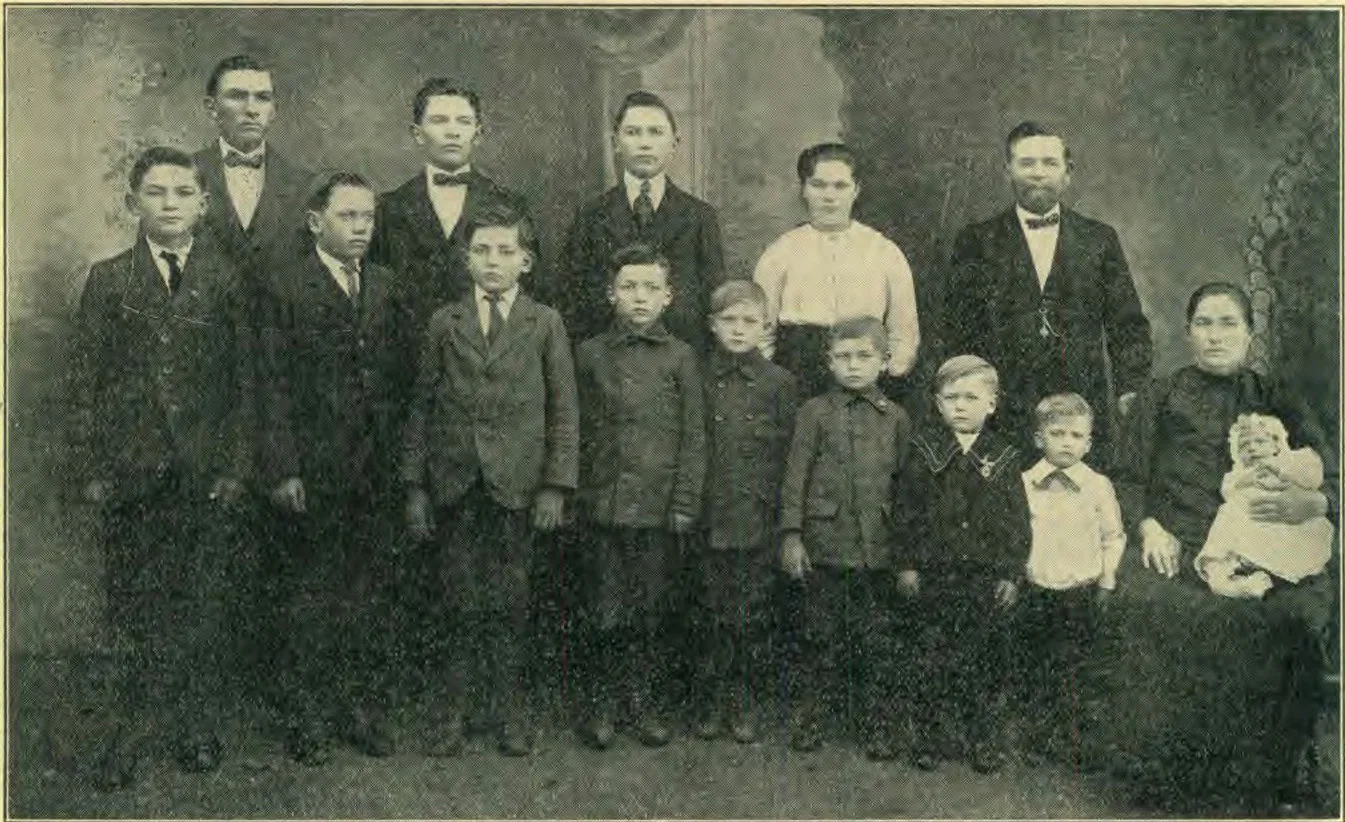
FAMILY OF DAVID AND JULIA RIFFEL, OF CRESPO, ENTRE RIOS, ARGENTINA
The seventh boy in the front row, next to the youngest boy standing, wears the medal given him by the Argentine government in April, 1917
ARGENTINA is a country of large families, eight or ten children being an ordinary number, and there are many families much larger. I know one Adventist mother who hovers a brood of eighteen, and two other families that have twenty-two and twenty-five children, respectively. These large families are especially common among the Italian and Russian-German settlers; but the native Argentinians are also great lovers of home and fond of children, and seem to take seriously the command to multiply and replenish the earth.
The government, moreover, smiles upon the prolificness of its people, and to show its approval has instituted a custom known as “El apadrinamiento,” which means the official act of becoming godfather to a child.
To explain further: The government, represented by any one of its higher officials, promises to become the godfather, or protector, of the seventh son in any Argentinian family. However, there must be seven sons in succession, without a death or a daughter born between.
That seventh son is, in a way, adopted by the government; that is, after finishing the public school he may choose any profession or career, and the attending expenses to the completion of the course will be met by the government.
The public ceremony is interesting, and varies somewhat according to the conditions and religion of the family in question. In the case of a wealthy or distinguished family living in the city, much is made of the event, the music being furnished by the provincial band, the governor of the province being present to act as godfather, accompanied by soldiers finely uniformed. After the christening, performed often by a priest, the officer attending presents the medal to the child, and then follow congratulations, and refreshments consisting of liquors and cakes.
The government gives two hundred pesos to the family to defray the expenses; but in wealthy families this money is, after the ceremony, distributed by the father among the poor who assemble to witness the ceremony.
The accompanying photograph shows an Adventist family of Russian-German extraction who recently celebrated this most interesting rite with their seventh son. They live just a few miles from the school, and the three oldest sons are pupils in our school and sanitarium here.
This particular family is interesting because its father, David Riffel, with his parents, first brought the Adventist truth to Argentina. More than thirty years ago they came from Russia to Brazil, and shortly after came to Argentina, locating in Entre Rios. Cousins in North America, however, soon persuaded them through correspondence, to go north, which they did, settling in Marion, Kansas. While there they became Adventists, and their first desire was to return to Argentina to impart the good news to their former neighbors. This they did in 1890, bringing with them some other German families, among the company being Brother Oswaldo Frick, who is one of our old charter members here now. They were active missionaries, and soon had several believers ready for baptism.
Old Santiago Riffel, grandfather of the children in the picture, was always a zealous missionary, and did a great deal of good among the Germans. Just last year he was laid to rest, and we all miss him greatly. Having had no schooling himself, his great desire was to see his grandchildren get an education,11and he worked constantly to that end by his influence and means.
But to return to the photograph. As you see, these parents first had three sons and one daughter (standing in the back row with the father). Then followed nine sons, the seventh being the little lad wearing the gold medal, who now has the honor of being the adopted son of the president of Argentina.
The public ceremony in this case was simple, owing to their being Adventists and living in the country. One of our ministers, Brother Godofredo Block, was present to preach a short sermon and offer prayer. The mayor was present to represent the government, and after a few remarks he placed the medal on the child. It is of gold, bears the date and the Argentinian shield, and on it is engraved the name of the child,—Andres Hipolito Riffel, being named after the president, Hipolito Irigoyen.
After the ceremonies, there were congratulations, and a typical German “feast,” consisting of a fruit soup, roast mutton with potatoes, and a dessert of fresh fruit with kuchen.
Little Andres seemed to enjoy the dinner more than anything else; in fact, I think he only half realized what the whole affair was about. However, he is very proud of that gold medal, and stoutly declares that he is a loyal son of Argentina.
The Rose of a Thousand Delights
WITH her knitting bag on her arm, Ruth Hollis was on her way to spend the afternoon with Kate Meeker. She was walking very slowly. She was reluctant to acknowledge it even to herself, but she did dread an afternoon with Kate. It always left you feeling uncomfortable, with things you wanted to forget and could not. And it was such a pity, for there was no one bigger hearted than Kate Meeker. There was nothing in the world she would not do for you if you were in trouble—no sacrifice she would not make. And yet she was almost sure to spoil it all afterward by some little thing—some miserable little chip that she carried on her shoulder.
“If there were only some way to make her understand!” Ruth sighed.
Kate was watching for her and gave her a warm welcome. The big piazza was delightfully comfortable, and little Katharine had made some cookies, which she served with great pride. Perhaps, after all, it was going to be “nice” for once.
But it was not. Katharine had hardly disappeared,12shyly happy over the compliments upon her cookies, when Kate began.
“Ruth, you know I’m not one to make a fuss over things. No one in the world is more glad than I am if I have a chance to help anywhere; and of course I never think of anything like pay. But you do like to be appreciated; any one does. It’s only human. And when I think how many times I carried things over to the Houstons last winter when Benny broke his leg—”
“But I thought Mrs. Houston was very grateful. I’m sure she spoke of it to me more than once.”
“Oh, words!” Kate retorted. “Any one can say things! But look down there—you can see from where you sit. Their whole piazza is covered with that Rose of a Thousand Delights. And Mrs. Houston knows how I love roses, and how I felt when mine got winterkilled. Wouldn’t you think she would have sent over just a handful? It’s little things like that—”
And then it happened. It rarely does happen so upon the moment, but it actually did. Mrs. Houston herself appeared at the gate. And in Mrs. Houston’s hand was a basket filled with exquisite pink blossoms, with a fluffy pink tulle bow of exactly the same shade tied on the handle. Her eyes were full of laughter. “Benny sent it,” she declared. “He’s been saving his pennies for the basket ever since last winter, and he particularly insisted upon the bow. And then, after all, he was too shy to bring it! But we want to keep it full—Benny and I—as long as our roses last.”
Ruth was very wicked. She did not even try to hold it back.
“It’s the loveliest thing I ever saw!” she exclaimed. “Kate was just this minute speaking of your roses.”
Kate’s eyes met hers pleadingly; her face was hot, and she stammered her thanks.
“If it would only last,” Ruth thought, “but I’m so afraid it won’t!”—Youth’s Companion.
A Great Little Word Is “Why”
By Bruce Barton
A SUCCESSFUL man whom I know recently changed from a business with which he was thoroughly familiar to a business that he knew absolutely nothing about.
I watched to see what he would do.
For two solid weeks he did nothing but ask questions.
He took a train to Washington to learn what information the government had on trade conditions in the new field.
He visited around among jobbers and manufacturers; he even went to the company’s strongest competitors.
Everywhere asking questions. It was simply amazing, the amount of useful data that he was able to dig out.
Curiosity is a human characteristic that has been much maligned. Men speak of it slightingly, as if it were something to be ashamed of; a weakness to be repressed.
My own idea is that when a man gets beyond the point of asking questions, he might as well be dead.
Without curiosity there would be no growth, no progress.
Theirs not to make reply,
Theirs not to reason why,
may be a good enough motto for men who are on their way to be shot. But from such men expect no empires to be built, no inventions made, no great discoveries brought to light. The Scientific American once said:
“Curiosity is the handmaiden of Science.
“No doubt many a man before the time of Columbus had remarked the exotic fruits and branches tossed up by the waves on the shores of the Canary Islands. The natives had gathered them for generations without ever so much as a thought. But to Columbus those strange gifts of the sea were messages sent from a land that no European ship had ever touched. Out of his wonder about them came his voyage to the New World.
“Then we have Newton’s apple. Things have fallen ever since the universe was created. And no man before Newton seems ever to have asked himself, Why?
“Robert Meyer, a ship’s surgeon in the East Indies, noticed that the venous blood of his patients seemed redder than that of people living in temperate climates. Doubtless other physicians had also noticed the fact. Meyer, pondering on it, reached the conclusion that the cause must be the lesser degree of oxidation required to keep up the body temperature in the torrid zone. That thought led to the discovery of the mechanical theory of heat, and to the first comprehensive appreciation of the great law of the conservation of energy.”
If you have witnessed the gradual progress of the mind of a little baby, you have seen a miracle.
And what is the golden ladder on which the baby climbs out of mere consciousness into intelligence?
Curiosity—nothing else. The constant reaching out for the untried (even though the reaching involves much upsetting of flower vases, and many burned and bleeding fingers), the eternal why: the unquenchable how and what.
Some men climb a little way up that ladder, and are satisfied.
They reach a point where the day’s task becomes more or less automatic; where their feet follow easily along a familiar path. And they are content. They would not pay a nickel to see an earthquake: they would not open a new book, or stretch their minds in wonder at what lies even beyond the next desk above them, to say nothing of what lies beyond the stars.
Ceasing to be curious, they cease to grow.
For surely one secret of genius is this—the ability to remain interested in new things, even into old age.
The curiosity of Bluebeard’s wife proved fatal, to be sure; and Lot’s wife, yielding to her curiosity, reaped a bitter recompense.
One must use judgment in the exercise of even the divinest gifts.
On the other hand, Zacchaeus, braving the ridicule of the passing crowd for the sake of his curiosity, was rewarded with the secret of happiness and everlasting life.—Bruce Barton, editor of Every Week.