Some time in January, while we were yet on the island of Huaheine, we wrote a report for the REVIEW, and mailed it. The mail sent from the adjoining islands to foreign countries is first brought to Tahiti, and is taken from here by steamers to the United States or to New Zealand. Last month, when most of our mail was here waiting, a hurricane came, and the post-office here in Papeete was entirely destroyed by the sea. We understand that the mail was not saved, so we suppose that our report never reached the REVIEW.
After we had labored for three months on Huaheine, our hearts were rejoiced to see a number of souls take their stand to keep all the commandments of God.
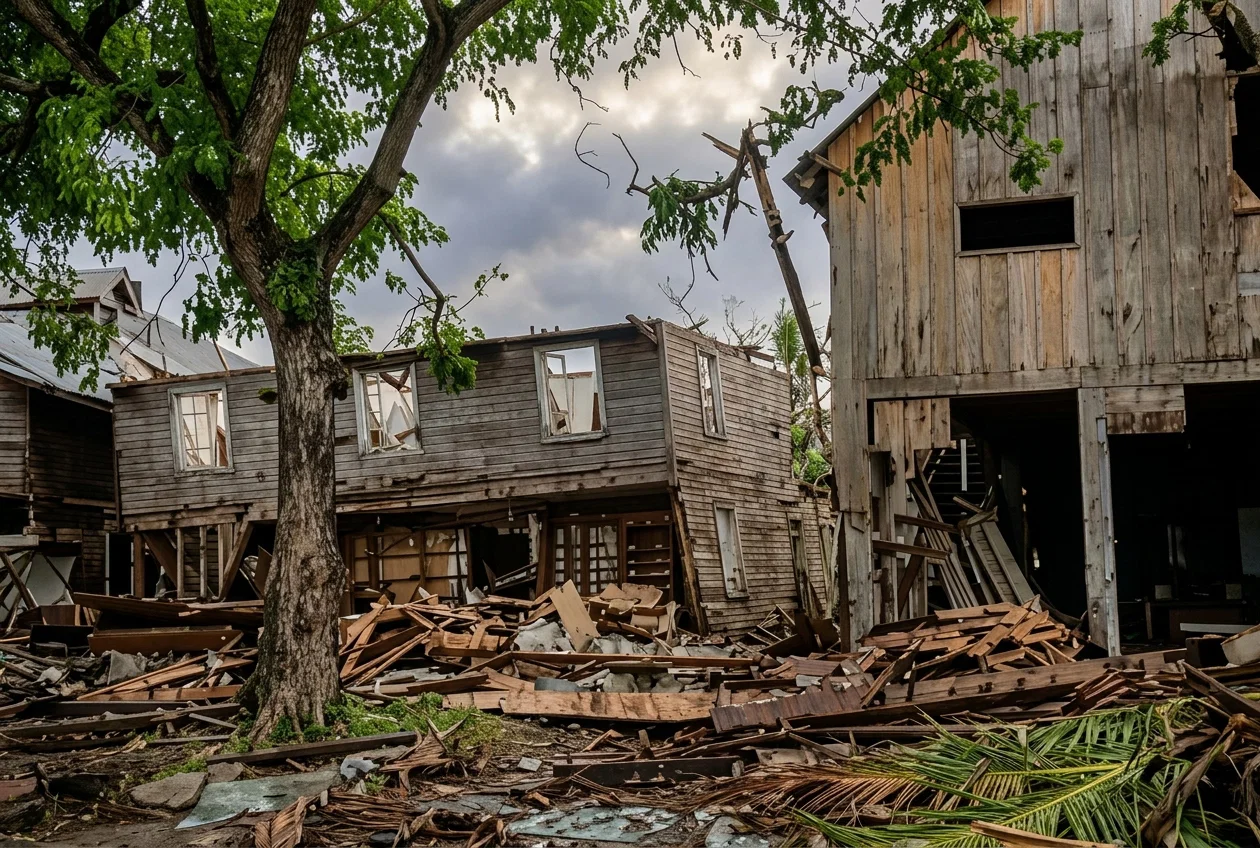
A SCENE IN PAPEETE AFTER THE HURRICANE
At that time they began attending our Sabbath meetings, and came nearly every evening to study the Bible with us. There are two families and two other adults who were keeping the Sabbath at that time. Others were interested, and were still investigating the truth.
Our Sabbath-school numbered twenty-one. During the last few weeks that we were there, as the leaders of the established church denounced it as sin for their people to study the Bible with us, some of our readers dropped off; so we appointed a meeting for the women and two for the children each week, and did what we could to strengthen and build up those who had taken their stand with us.
The white minister, who has charge over the established church in the Leeward Islands, has waged warfare against us from the first through a little Tahitian paper which he edits. As we had the sword of the Spirit (the Word of God) on the side of the truth, he could not use that effectually, so he resorted to ridicule, and has manifested a spirit very unlike that of the meek and lowly Jesus. But we trust that the Lord will not permit one honest heart to be deceived by the sophistries of the enemy.
Brother Beckner and his wife remained at Huaheine, and we went to Raiatea the last of January, where we spent one month. While there, the hurricane which I mentioned took place. The wind was very strong the afternoon and night of February 7 and all the next day, but the most damage was done in the night, when the wind raged the hardest. Large trees were uprooted, branches broken off, and houses blown to pieces. Mr. Cady was in town that night. When he found that he could not get home on account of the storm, he planned to put his horses and buggy under a shed for shelter, but afterward concluded to leave them outside. The next morning he found that two large trees had fallen on the shed, and if the horses had been under it, they would probably have been killed.
Trees fell on either side of the buggy, but it was not injured. The minister who has been opposing us so bitterly, had the roof blown off his house, and his furniture was damaged by the rain. On account of many breadfruit, plantain, and banana trees being destroyed, food will be quite scarce for a while, and it will be hard times for the natives. Some lost many of their cocoanut trees, which is their principal source of income. Our loss was very little, only about twelve cocoanut trees and four breadfruit. The thatched-roofed buildings on our place were blown down, but twenty-five dollars will repair them. We felt very thankful for the protecting care of God at this time.
The last of February we came to Tahiti, and here we saw some of the ruin wrought by the sea during the storm. Many houses were entirely destroyed. Our property here was unmolested, for which we feel to praise the Lord.
We recently had a letter from our new Sabbath-keepers on Huaheine, in which they tell us not to fear that they will be led away by the tempter, for they are trying instead to lead their friends and neighbors to see and obey the truth. Papeete, Tahiti.
The Third Angel's Message in Syria
By W. H. Wakeham
(Concluded)
W. H. WAKEHAM
LEAVING Sidon, we started toward snow-covered Hermon; and three hours after leaving orchards yellow with luscious oranges, we were traversing fields of snow, greatly to the chagrin of our bare-legged muleteers. Not being able to get to our destination that night, we were obliged to stop at a small native village, the inhabitants of which were Moslems and Catholics. As we were wondering where we should find shelter for the night, Providence led us to a Catholic family, the father of whom had met Brother Zarub some time before, and had received from him some of our Arabic tracts. This man has the reputation of knowing more of the Bible than any other man in the village, and as a result is really a Protestant at heart. This family received us most cordially into their humble abode (the house consisted of one large room with two doors and no windows), and provided us with a bountiful meal and fairly comfortable bed. The entire family listened eagerly to the truth we presented. We left some more reading-matter, and urged them to walk in the light they had received.
At Der Mimas, the next town we visited, we were detained five days by almost continuous rain and snow. Two brethren here are keeping the Sabbath, the result of Brother Zarub's labors, who was stationed at this place when the Sabbath came to him. These brethren were strengthened and encouraged by our visit, and we hope they will remain faithful to the end. While here we visited a Jewish colony situated near the headwaters of the Jordan River, and not far from a peak of Hermon supposed to be the mount of transfiguration, close by the village of Cæsarea Philippi. Here we found a real Christian Jew, one who does not think it necessary, in order to follow Christ, to give up the Sabbath of Jehovah. He is a teacher of Hebrew in the school of the colony and is trying in a quiet way to sow the seed of truth among his people. He is a German by nationality, but having lived in England for some time, he knows English well. He seems to be walking in the light as far as he sees it. He has read some of our tracts, and I promised to send him more.
Leaving the snowy hills of Hermon, we came again to the seashore, and visited the site of the old city of Tyre, the former metropolis of Phoenicia. The old city is barren and desolate, a striking fulfilment of the sure word of prophecy. The new city is builded on what was formerly an island, but is now connected with the mainland by a narrow stretch of sand. Here we remained one day, visiting some interested persons, speaking the truth as opportunity afforded, and distributing some tracts. The population of the town is about five thousand, almost wholly Moslem and Catholic. A few families of Protestants live here, and13some English ladies are carrying on a mission school.
From Tyre we traveled on mules to the village of Alma. This is Brother Zarub's native village; and the seeds of truth have been sown here. A few are interested, and one young man is keeping the Sabbath, but still holds onto that curse of the Orient, the cigarette. The people in most of these Syrian villages are very poor, and live under wretched conditions, especially in winter time. Many are in financial bondage to their religious leaders. It has been the policy of these men to loan the people money or rent them land under easy conditions, which make them seem benefactors. But let one of these poor people begin to keep the Sabbath, and immediately these overlords begin to draw the cords, so that their very existence seems threatened.
The houses are dark and dismal in winter time, as few of them have any windows. Fires are built in one corner of the room, and the smoke gets out where it can. Men, women, and children live together under one roof with horses, cows, donkeys, chickens, etc., and many of these houses have but one room. Such articles of furniture as tables, chairs, bedsteads, etc., to say nothing of bureaus, commodes, and wash-stands, are usually conspicuous by their absence, to use a hackneyed phrase. Knives, forks, and spoons for eating purposes are considered superfluous. When eating, you must sit a la Turk on a mat or cushion. One or two dishes are placed before you on a small tray or mat, and bread in the form of immense griddle-cakes, eighteen or twenty inches in diameter and as thin as brown wrapping paper, is placed on the floor beside you. You tear off a piece of the paper-bread, wrap up a portion of the food from the dish before you, and put it into your mouth. If the food is liquid or semiliquid, as soup, milk, or kumiss, you form a piece of the bread into a small scoop and convey the food to your mouth, eating the improvised spoon, and then forming a new one for the next mouthful. If one were alone, it would not be so bad, but when he knows that a dozen curious eyes are watching every move he makes, ready to laugh at the least slip, one longs for a good English spoon with which to defy the gaping, impertinent crowd.
From Alma we went direct to Acre, the Ptolemais of olden time, and the scene of the great Napoleon's defeat in modern times. This is still considered an important military post. Here we stayed only long enough to secure a carriage for Haifa, a rapidly growing town at the foot of Mt. Carmel.
This ended our trip through Syria; for Haifa is in Palestine, and an account of the progress of our work in the holy land must be reserved for another article. Altogether, Syria is an interesting, though difficult field; but the third angel's message is firmly planted there, and we believe that it will grow until every soul shall hear the message, and the Lord's work be finished in righteousness.
Cairo, Egypt.
The Morning Cometh, and Also the Night
“THE morning cometh, and also the night.”
Portugal During the Eighteenth Century
By C. E. Rentfro
C. E. RENTFRO
Many are the interesting items in the history of this small country. As the Portuguese seemed to be foremost in opening the world to the travels of later generations, during the fifteenth century and the opening of the sixteenth, so we find them among the foremost in advocating the freedom of mankind. I will proceed to show this by giving some results of researches in Portuguese histories.
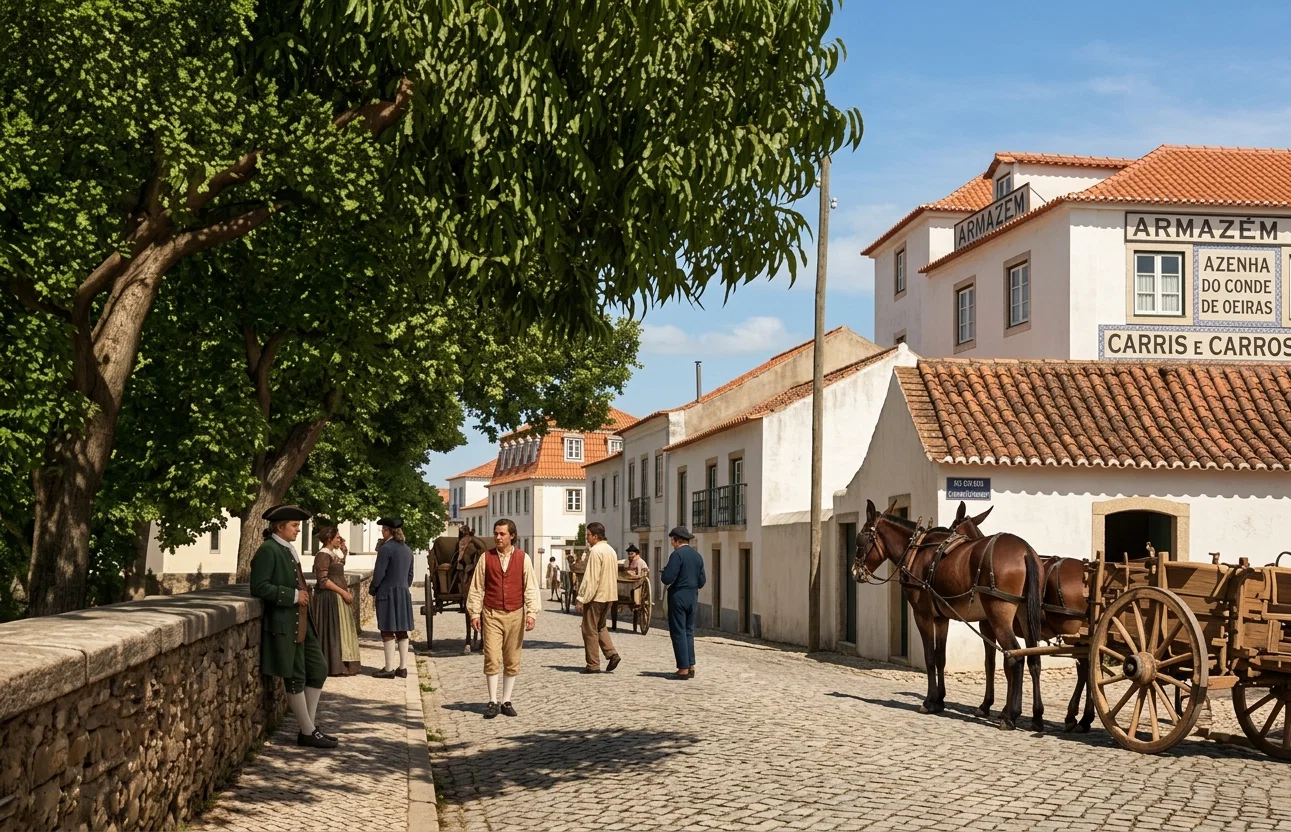
A STREET SCENE IN CARCAVELLOS
In this work of reform figures very highly a noted statesman named Sebastian Joseph de Carvalho Mello, whose title was first Count of Oeiras, because of his lands near a village of the same name, and afterward named Marquez de Pombal. He was born May 13, 1699, at a place in Lisbon where now is published a daily paper called O Secula (The Century). He lived to reach the age of eighty-two years, dying about six years before Washington was elected president of the United States. One may see at once that his were stirring times.
This man served his country as ambassador to England in 1733, procuring for his country a concession of important rights. Also he represented the Portuguese government as mediator between the courts of Rome and Vienna, in 1745. Finally he was raised to the position of prime minister of the kingdom, in which position he was enabled to bring about many important reforms. As these were times when the lords were tyrannizing over their vassals, and the Jesuits with the Inquisition were in control of affairs, his acts assumed great importance.
Two great principles were expressed by the historian. “In the land of the free all are free.” “Among Christians all are Christians.” These have been brought together in the United States under civil and religious liberty. For this liberty men in those times were seeking. The Indians of Brazil who were in slavery had their liberty proclaimed by one of the first acts of the marquez as prime minister, in 1751. Slaves in Portugal were given freedom, and the natives of India were put on a par with humanity in general by a special law. In those days there was a distinction between persons who by birth were Catholics, and others who had been converted to Catholicism by fear or otherwise. These were called Old Christians and New Christians. The new Christians, mostly Jews, were much despised by the Jesuits, and were subject to noxious laws and penalties of the Inquisition. The reforms of this statesman gave them shelter from the insults of the old Christians. Thus ended distinctions most odious between nobles and plebians, lords or masters and slaves, and new Christians and old Christians.
Following these reforms, work was begun to increase national riches. He founded companies to fish whales and tunny fish, and others for exploration, for commerce with South America, and for other purposes. He attempted to create a greater interest in agriculture, and started industries in different lines, and protected those already begun. Some important factories were those of wool and silk and paper.
It was during the reign of Don Jose I, and while the marquez was prime minister, that the great Lisbon earthquake occurred. The latter was asked what he would do in view of so great a disaster. He replied, “Bury the dead and look after the living.” He rebuilt the city, arranging the different trades, shops, etc., in separate streets, calling the street by the name of the goods sold there or by the industry carried on. These are seen yet, such as Gold Street, Silver Street, Silk Street, Linen Drapers Street, etc.
One of the most important acts of the Marquez de Pombal was the expulsion from Portugal of the Jesuits, Sept. 3, 1759. From his early public life he was convinced that they were a hindrance to reform, and sought to find proof for a foundation of his accusations. They dominated everywhere, reigned in the consciences by confession. In the education they were the teachers, so that whatever14was done by them brought to the country naught but ignorance, superstition, and eternal degradation. They claimed that the earthquake came as a judgment on account of the grand reforms in the years preceding. After their expulsion from Portugal, Spain, France, and Naples followed suit in driving them out, but they were readmitted in the other countries by Pope Pius VII, Aug. 7, 1814. But Portugal refused to admit them; yet they have come in one by one until their power is felt in private to a great extent. The present Marquez de Pombal, a grandson of the former, is said to be a Jesuit also.
It was under the power of this strong-minded prime minister that the Inquisition lost much of its power in Portugal. One may see what determination will do in reading of the life of this great statesman, one of the greatest in Europe, especially in his days. The people are raising a subscription to erect a statue to him.
Surely since Portugal at one time was swayed by a great reform, it can and will be moved from one side to the other, from king to the lowliest subject, by the greatest reform message the world has ever known. May God grant that the threefold message may go with power in this land, and the coming of the King of kings be hastened.
Lisbon.
Among the Santals, India
By W. A. Barlow
W. A. BARLOW
SOME time ago while traveling through the jungles, I came across a Santal shepherd boy, with his herd of cattle. I noticed a small bundle on his shoulder. On asking him what it was, he opened the bundle and showed me a Gospel of Luke, which he takes with him when looking after his cattle. I turned to Luke 15, and asked him to study the parable of the lost sheep. He is a student in our Seventh-day Adventist school, and had secured the Gospel from the school. At this time he was enjoying his winter holiday for one month.
Early one morning a man came to ask me to lend him one rupee, or about half a dollar, to help him bury his poor old man father, who died very suddenly the night before. I inquired the cause of his death, and the poor man could not tell me the story in full, his heart was too heavy and sad; but I learned from others that his father had come to visit him, and after offering the annual sacrifice of a pig, etc., to Satan, and dining from the same, he went out into the garden and died. His body was burned near our place on the banks of a river, and a small bone preserved and carried many miles to a sacred river, and there buried in the sand on the river bank with some eatables, etc., his son believing that this act will land the poor old father in heaven at last. How these poor heathen souls are deluded and bound by Satan, who is their principal object of worship, not from love, but from fear. They worship evil spirits, and the chief spirit is Maran-burn, or the devil, also river spirits, jungle spirits, mountain spirits, and a host of others. They appease their anger by offerings of pigs, goats, fowls, etc.
They are troubled by witches also. It is a common sight to see a number of men going off to inquire from the “Janguru,” witch-finder, the reason of sickness and death in their village. The witch-finder pretends to be inspired, and reads from an oiled sal-leaf, afterward charging a fee of about a dollar or less. They need the love of God in their hearts, homes, and villages, and this is the reason I have given my life to labor among them, that I might win some for Jesus.
While visiting a new village a few Sabbaths ago, with our school-teachers and students, we met a poor crippled Santal man, about twenty-five years old, blind and lame, but glad to hear us sing the song of Jesus and his love for poor sinners. After some gospel songs and a talk on God's love, he began to sing a song which he had learned by heart from some preachers in his old home many miles away. I got him to sing it over and over again with our singing band and my violin, and I tell you it touched my heart. I felt so happy to see this poor blind cripple singing a song of heaven, learned from some humble village preacher.
A few days ago I went down to Karmatar with a candidate for baptism, and he was baptized with five other students from our Karmatar girls' school by Elder W. W. Miller in a large sheet of water near the mission compound, who was assisted by Brother and Sister J. C. Little, Sisters Burroway and Whiteis, Belchambers and others. I had the pleasure of giving an address to the students and others in the evening on the three baptisms, of water, the Holy Spirit, and suffering, and we closed with hearts full of joy and praise.
The next day Elder W. W. Miller, Brother J. C. Little, and the writer visited Koro village, a few miles from Karmatar, to look for a plot of land for the medical missionary work among the villages around Karmatar. David, the man who was baptized by Brother Miller, went with us, and gave us much help, speaking and singing to the Hindus and Bengales along the highways and byways. Brother Little was very busy distributing tracts to all who could read. God was with us, and blessed us in speaking a word for him.
I left for Babalmohal the same day, via Simultala. We are busy with the school, village preaching, and building a house which we will occupy until we have a mission house built, and then it will be used for school and other purposes. We have one of our Santal teachers stationed about fifteen miles away, among the heathen, teaching school half a day and preaching half a day. Pray for us here in the Santal jungle life.
Simultala, India.
Mission Notes
It has been estimated that in Palestine there is one missionary for every thousand Jews.
“Go your way, eat the fat, and drink the sweet, and send portions to them for whom nothing is prepared.” Neh. 8:10.
THERE are three hundred million Buddhist women, with no hope of immortality unless in some future transmigration they may be born again as men.
THE tendency toward insufficiency of income to do the work of missionary societies is not yet overcome. The Church Missionary Society, with an income (1904-05) of $1,643,582, reports a deficit of $220,029. The London Missionary Society reports an income of $864,835, and a deficit of $129,843. The Berlin Missionary Society is nearly $125,000 in debt. The Presbyterian Board (North) spent about $4,000 more than it received. The Paris Missionary Society is about $30,000 in arrears. These deficits arise not so much from falling off in interest in the missionary enterprise as from the tremendous pressure upon missionary societies caused by their success in getting a hearing. It is easy to say, as to a man who lives beyond his income, Cut down your expense. But pagan peoples are demanding teachers. What shall we say to them? As the secretary of the Paris Missionary Society says: “Mission means a sending. What becomes of the missionary society which ceases to send?” The fact is that we have occasion to meditate upon the truth that Christians belong to a growing body. The kingdom is being established, and Christians can not escape responsibility to God for meeting the expense of it. This is the Christian’s burden. To bear this burden is a duty springing from profession to follow Jesus Christ. There is grandeur, then, in the attitude of the Paris Society under this stress. One expects to see in its Journal of Missions frantic appeals for funds, arguments from the success of the missions, pleas to those who have put their hand to the plow, not to look back. The emphasis in the February number, however, is not laid on the question of finance, but on an appeal to the people, first, to extend their sphere of vision beyond their own mission fields to take in the majestic advance of the kingdom in all the world, and second, to pray, with hearts thus kindled, for a new baptism in the Holy Spirit. The basis of the stability of missions is touched in this appeal. The true need of missions is not satisfied with money. The need everywhere is an outpouring of the Holy Spirit. There is great significance in the unanimity with which missionary societies in England and America also are now urging continual and systematic prayer for missions.
U. C. FATTEBERT, M. D
By U. C. Fattebert
Mexico
CELAYA, GUANAJUATO.—The State of Guanajuato is the second in population in Mexico, having over a million inhabitants. It has a number of large towns, Leon, Guanajuato, Silao, Celaya, and Irapuato, with populations ranging from seventy thousand down to twenty-five thousand.
Celaya has two railroads, with eight trains daily. It has several mills and factories, while a woolen mill, a cotton mill, an ice plant, a tannery, and a flour mill are either building or to be built shortly. Most of the country around is agricultural, producing corn, beans, and vegetables in summer, and wheat, barley, and garbanzo, a kind of large pea, in winter. The rainy season lasts from June or July to September, while the winter crops are mostly raised by irrigation, dams being built to hold the rain-water. Horses, cattle, sheep, goats, and hogs are raised, but few of the landowners, who hold the land in large tracts, devote themselves to any one line. Among the mountains around Guanajuato are rich gold and silver mines. I give this description because several have written me, asking about possibilities in agriculture and stock-raising.
This is one of the most fanatical States in the republic. The Methodist Episcopal Church has tried every town of any size, and during the last twenty years has been driven out of some, in some cases several times, literally frozen out, and has hardly had anything like real success, except where they have medical work. They have sanitariums in Guanajuato and Silao, and a physician in Leon.
I am the only Adventist in the State. I have been here four months, and am slowly building up a practise. I have rented a good house, where I can keep a few patients; while in the rear, fronting on another street, are a few small rooms that would do nicely for a bakery, which could be established at little cost, and would help to support other lines of work. A school is needed here, and would pay expenses after a while, but any line of work requires a knowledge of Spanish, and of the customs and habits of thought of the people. The latter applies to all parts of the world, and workers should enter the field as soon as possible. The best training is to be had in the field itself, but let none think it can be had without hard work. The results come slowly, and may appear small, but our work is to sow the seed. The Spanish field will give its share to the kingdom of God.
U. C. FATTEBERT, M. D
Locating in Korea
By F. W. Field
Our party, consisting of Brother Smith and his wife and little one and myself, left Tokyo, Wednesday, October 18, and after a continuous ride on the cars, reached Shimonoseki soon after 5 P. M. the next day. That evening we took the boat across the strait, and early next morning reached Fusan, Korea. We remained in Fusan over the Sabbath, finding lodgings at a Japanese hotel.
While there, we made some inquiries about the company of Koreans who have recently become interested in the truth in that place. But as we had no translator, and no definite information as to their location, we did not succeed in finding them. We also made inquiries about a suitable dwelling, in case it was thought best for Brother Smith to locate there. We were shown a number of small rooms, clean and wholesome, in a very good location, but they would afford rather limited quarters for even a small family.
On Sunday morning we proceeded on our journey, reaching Seoul late that night. The rates at the only foreign hotel are from two dollars and a half to four dollars a day, so we found lodgings at a new Japanese hotel, and bought our food at the provision stores. The next day we looked about the city, and obtained some books on the language that Brother Smith will need.
On Tuesday we called on Rev. H. G. Underwood, of the Presbyterian mission, to inquire about obtaining a copy of his manual on the language. We found Mr. Underwood and his wife very kind and pleasant people to meet. We had about given up all hope of finding a house in Seoul, so did not mention the matter. But that evening Mr. Underwood called on us, and said he had heard that we were looking for a house. He then told us of one that he has the disposal of, which belongs to a high Korean official; and in these uncertain times, the owner of this house would like to have it occupied by a foreigner. I asked Mr. Underwood what the rent would be, and he replied, “Nothing.” This seemed like a special providence, and incidentally casts a strong side-light on political conditions in Korea.
The next day we went to see the house. It is of Korean architecture, one story in height, with brick and plastered walls and tile roof, and contains four good-sized rooms, an entry, and one smaller room. There is quite a large yard in front of the house, surrounded by a wall. We at once decided to accept the house, and spent the rest of the day in cleaning up some of the rooms, and getting some furniture into them. One reason why it is desirable to have our workers settled in Seoul, at least for the present, is that the language spoken at the capital is regarded as the standard, and is quite generally understood. Then, too, Seoul is now within easy reach of those localities where our believers are, making it convenient to visit them from there. Also, a competent language teacher could more easily be found at Seoul than in most places. So with the difficulty of securing a house removed, it seemed best to locate the workers there.
During this trip I was able to collect quite a little information about missionary work in Korea. We secured a copy of a book by Mrs. Underwood, published by the American Tract Society. It is entitled “Fifteen Years Among the Top-Knots; or Life in Korea,” by L. H. Underwood, M. D.
The brother of one of the missionaries in Korea personally supports five missionaries in Korea, and one in Persia. O, if more of our brethren of means would do likewise! How the new recruits would cheer the hearts, and make strong the hands of the little groups already in these great needy Eastern fields. And we can at least pray that this may be.
F. W. FIELD.
Iowa
By Alice I. Teeple
WAUKON.—Many now prominent workers, and scattered even to the dark corners of the earth, can look back to some precious season or blessed experience which came to them in the Waukon church.
The spirit of missionary work is still burning, as may be learned by a glance at the weekly reports. Not only are truth-laden papers and tracts placed in the hands of the people, but missionary visits, gifts of clothing, bedding, and food, and the weekly offering to foreign fields bear witness of the interest felt in the salvation of fellow men.
Five hundred sets of the special Signs were ordered, also one hundred and ten of the foreign papers, and some tracts and Signs leaflets. One brother took one hundred and five sets, several had fifty, others less. This brother sold all of his, and about forty sets more; and the spirit in which he worked can be seen by his words: “After seeking God earnestly several times, I started out, but I did not sell the papers myself at all; I carried them, and the Lord did the work. Those to whom I thought I could sell refused, and others whom I had no hopes of interesting seemed glad for them. I knew the brethren and sisters were praying for me, and it strengthened me.” Comparatively few sets are not yet out spreading the gospel message.
Meetings were held regularly all winter, although it was impossible for many to come, especially those living in the country. The Lord manifested his approval by blessing each heart as his Word was studied.
Additional blessings were experienced the first of this quarter as Elder E. G. Olsen, held four meetings, each time having very attentive audiences, a goodly part of whom were those not of like precious faith. He also led in the celebration of the ordinances of humility and the Lord’s supper. Some of the members came from quite a distance to16mingle their voices in praise to God; four reported by letter, telling of strong faith, hope, and courage.
During the past few months one strong young man has entered the canvassing work, one sister has been away teaching a family church-school, and two have been claimed by death, causing the promised resurrection to be even more precious than before to the bereaved ones. One member was added by letter, another, formerly a Baptist, on profession of faith.
ALICE I. TEEPLE,
Missionary Secretary.
Colorado
By G. W. Anglebarger
DENVER.—The work in this city is progressing. Several have recently accepted the truth. Next Sabbath baptism will be administered to a number of earnest souls. I think we are having the best interest in our work in Denver that we ever had. We are trying to warn every family in this large city, and are praying that God will give the increase. If any of our people having friends in Denver will send us their names, with street and number, we will call upon them. G. W. ANGLEBARGER.
MRS. CARRIE KNIGHT
By Mrs. Carrie Knight
Panama
BOCAS DEL TORO.— Many of the brethren write us from the States rather complainingly, because, they say, “We so seldom see a report in the REVIEW from you.” We are truly glad that they are interested in the work in this field. Often we think of writing, but our life is a busy one; and when we come in from our work, we feel so tired that we put off writing until to-morrow; and we find the days slipping away into weeks, and we still have the “mannana” fever, not that we have adopted the motto of this country, “Never do to-day what can be put off till to-morrow.”
The work is still moving forward in a very satisfactory way. Our numbers are steadily increasing. Of course there are some discouragements to meet. Where can a place be found that has none? But we never feel to give up and retreat. Our brethren here are true, many of them an honor to the cause.
We are experiencing hard times financially, due largely to the failure in the banana crop, the only source of income to many of our people. In some instances a disease of the plant has entirely destroyed the plantation. But our brethren are still of good courage, believing that misfortune is often a blessing in disguise. I wish you to read this letter, which I received to-day from one of our brethren. He says:—
“We are passing through very hard times, owing to the failure of the banana business and sickness among the plants. My cocoanut grove that has yielded me from eight hundred to one thousand a month, now gives me from two hundred and forty to two hundred and fifty. The trees are dying. Do not think we are discouraged. I must tell you how God has done, and have a dish of beans from those vines. I can not express by letter my feelings; but He knows. My daily income is so small that it is insufficient to feed one child, and still with that amount we never go to bed hungry. [To my knowledge this family of six lived on twelve dollars of this money—that means six dollars of American money—for one month, and paid their tithe out of that.] Dear sister, I am of great courage in the message. I know it is only a little time, and then comes our new home. The Lord bless you.”
This shows the spirit of our people here. You who are in the States know nothing of hard times. O, remember the poor brethren abroad! Mr. Knight has gone to Nicaragua, and will not return for some weeks; all the work here devolves upon me, but God is with me, and daily gives me strength for the work. Pray earnestly for us.