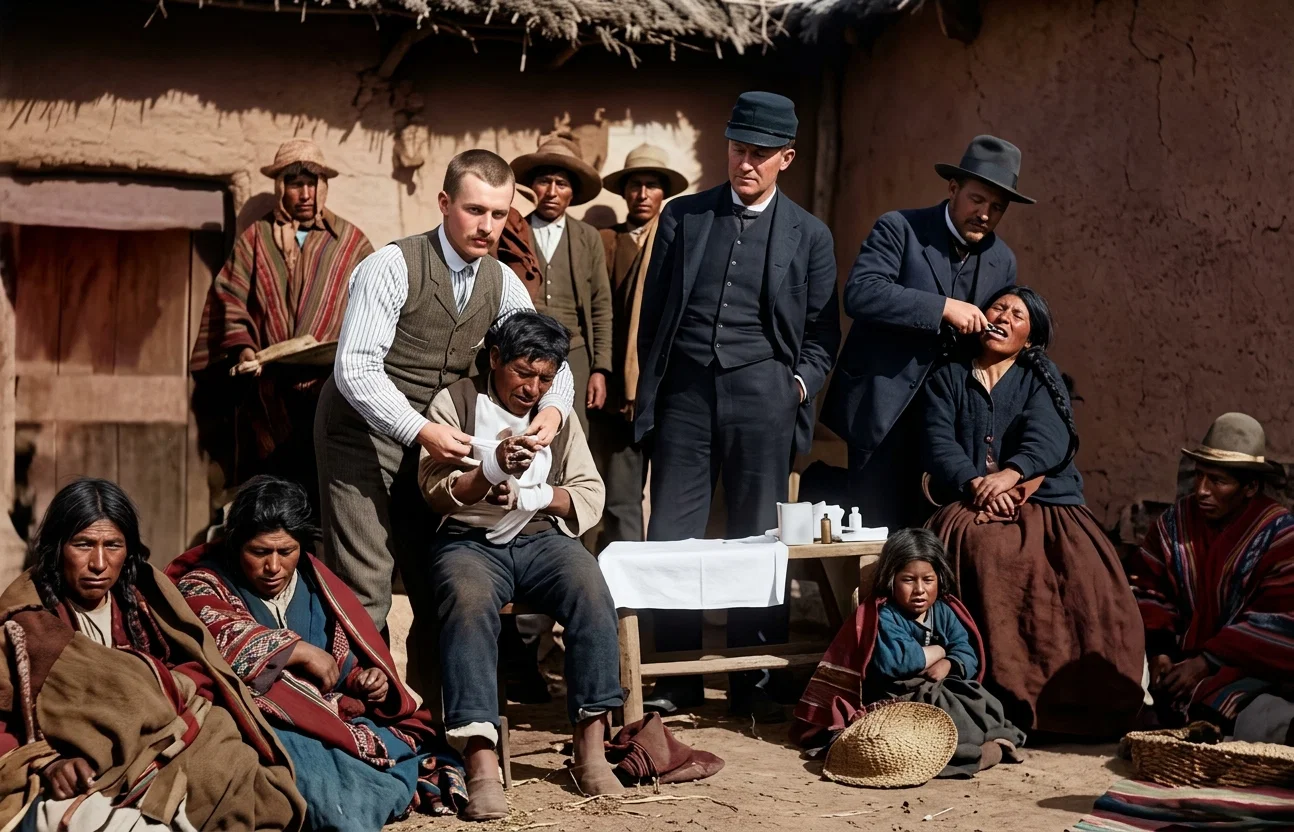
ELDER A. N. ALLEN and the writer were met by Brother F. A. Stahl, of Bolivia, at Puno, Peru, May 20, on their way to visit our Indian brethren about eighteen miles from Puno. Brother Camacho, who was the first among them to accept the truth, and who has been the means in God’s hands of teaching it to many others, secured horses from several of their number, and sent them for our use. The next morning we started for our destination, reaching the home of this brother in the afternoon. Six miles away some of the Indian brethren met us. Their numbers gradually increased until one hundred fifty or more were accompanying us. These, having twenty-five Peruvian flags, formed themselves into two lines, between which we rode. Men, women, and children seemed to have no difficulty in keeping up, whether our horses walked or trotted. They met us with hearty hand-shakes and embraces. From fields and houses along the way, they ran to meet and greet us. I had never experienced such a reception before; surely none more hearty. The scene made me think of pictures I had seen of Indians on the war-path, but here they were in the path of peace. Their heartiness and deep interest did not abate during our week’s stay among them, and when we finally left, twenty-five or more accompanied us a distance of six miles.
Our brethren have recently heard a great deal about this people, and the good work that has been begun among them. I would say that the report has not been exaggerated. What I witnessed among these Indians, who have been kept in ignorance, been exploited and oppressed so many centuries, I shall not soon forget. In many respects they are like children, but in the independent stand they have taken to obey God, and in their firmness, they are men and women full grown. What a change has been wrought in their lives, not only in those who have been baptized, but in scores of others who have been affected by the saving gospel.
As we rode along the street, we met drunken men and women, their mouths foul with coca and blasphemy, their clothing unwashed, and their faces and hands unseemly. Of the hundreds who came to the meetings or to be treated for ailments, none were drunken; coca was seen in the mouth of only one; the faces and bodies of many had been washed; and when they came to meeting on the Sabbath, many were dressed in clean or new clothes, while others were careful to tell us that they, too, would soon have new clothes, as they had not yet finished making them. While we heard of Indian brawls, these dear brethren were as orderly and kind as any company I have ever seen. Instead of carousing and blaspheming, they would gather in the meeting-place and sing (although still imperfectly) hymns of praise, long into the night. “This is the Lord’s doing; it is marvelous in our eyes.”
A door for great usefulness is open here. Other denominations that have tried to do something for the Indians are surprised. For many miles the Indians come to receive help. Some of the cures wrought have been wonderful. The influence of the work is felt by friend and foe. The confidence of the otherwise suspicious Indian seems to be fully won.
To give some idea of the medical work that is being done for them, I will mention the experience of one afternoon, when I kept count of the patients and the character of their diseases. The total number of patients was thirty-five. All but three were really in need of medical care, many of the cases being serious ones. A few were as follows: Gangrene of the hand, broken arm that had been neglected, tumor of the neck, disuse of a finger (which was healed in five minutes with electricity), stiff neck of a year’s standing, rheumatism of ankles, chronic headache, tumor in foot, ulcer of tongue, typhoid fever, constipation, stomach trouble, smallpox (sent for medicine), lumbago, etc. It was a busy afternoon, but not exceptionally so. The morning we left it was difficult for Brother Stahl to get away. By daybreak a horse was waiting to take him to see a patient far up the mountainside. On his return he was busy till he mounted his horse and tore himself away from others who desired his attention. As I saw this, I could not but wonder if there are not hundreds of places where people are suffering, and where, with similar methods, they would be helped, and best of all, scores of souls saved, as has been the case here already. It would be a less pretentious work than to have charge of a grand sanitarium, or be an employee in such an institution, in a country having hundreds of physicians and plenty of hospitals. But when we consider that an Indian’s soul is worth as much as a white man’s, the soul of an ignorant man worth as much as that of an educated man, the soul of a savage as much as that of a civilized man, how shall we compare the good that might be done with that which is done? As I have witnessed this work, I have wondered at our slowness to learn the methods of Christ, even in medical work, in proclaiming the third angel’s message.
TREATING INDIANS,— BROTHER STAHL AT LEFT ATTENDING TO A GANGRENED HAND; BROTHER ALLEN EXTRACTING TEETH
To lay aside pride and comfort and ease, to leave the great world and be swallowed up in some obscure work among an unknown and despised and ignorant people, to make one’s self one of them and be recognized by them as a brother,—this is the great work of the missionary. This is what the Saviour did. This will bring glorious results.
The Sabbath was a day long to be remembered. A goodly number had requested baptism. After a discourse on our work and our duty to it, by the writer, a call was made for those who desired baptism to come forward. Over thirty responded. Several of these were advised not to take this step now. Twenty-nine were accepted. One, on account of sickness, could not be present. After a thorough examination of the candidates by Elder Allen, we repaired to a dam that the brethren had made the day before in a mountain valley, about a thousand feet above, and in plain13sight of, the beautiful Lake Titicaca, where it was my privilege to bury these precious ones with Christ by baptism. This lake, around which so many unrecorded historic events had crowded, which had witnessed so many centuries of pagan and papal idolatry, now saw the unpretentious, humble burial of twenty-nine of its dusky sons. It has witnessed also their resurrection, and may it witness the holy living of these and many others who shall be saved. More than three hundred were present at the meeting and at the baptism. The order maintained and the respect shown were perfect.
I have never baptized a large company that seemed better prepared. It was therefore a privilege to organize a church in the afternoon. Including the fifteen who had previously been baptized, and Brother and Sister Stahl, a church of forty-six members was organized. The only white members are Brother and Sister Stahl. There are one or two who have a little white blood. Brother Stahl was chosen elder, and Brother Camacho deacon.
We have tried to impress these people with the responsibility of helping sustain the work. They brought in a good supply of food while we were there,—potatoes, eggs, mutton, chicken, cheese, chuno, etc. One brought a bag of potatoes as tithe. For the treatments and medicine a charge is made,—twenty centavos, about eight cents in gold,—enough to meet the actual outlay, and they pay it gladly. Brother Stahl does not need to collect this, for one of the brethren always sees to it.
For the purpose of putting the work on a more solid basis, two small tracts of land have been purchased, located on opposite sides of the main road from Arequipa and Puno to La Paz, Bolivia. The one on the upper side of the road is about 115 x 130 feet. On this a small house will be built for Brother Stahl, and as soon as possible a school building. For the present, the school will be held in a room owned by Brother Camacho, who will act as teacher. The other piece is about 130 x 180 feet. At each front corner is a spring, one of which is good for domestic purposes, but the other is mineral water. On this land there will be erected a small dispensary and treatment-room, with a few rooms where the sick, when they come, may stay overnight. A bath-tub will be made, with the mineral water running through it. The land cost thirty dollars gold, which is very cheap, a favor of the interested Indians. The cost of the whole, not including school buildings, will probably not exceed five hundred dollars. It is felt that all our money must not be invested here, for there are other places that should have a similar work done for them.
While this is to be the center of the work for the time being, it is not expected that Brother Stahl will labor exclusively at this place. Bolivia will also demand a part of his attention. We trust that from this center, which is on a much frequented road, the truth will become known in distant parts, and that it may be a permanent beginning of the enlightening of the fifty thousand Aymara Indians, and a door to the millions of the Quichuas.
Each time when Brother Stahl has left them, some effort has been made against the Indians. Just before our arrival, three hundred, from the farm of a priest on a peninsula several leagues distant, incited by the latter, started out to kill Brother Camacho and burn his house. On the way they began talking about why they were going to kill him. They said he had never done them harm. As the result, the mob was broken up. When another attempt was made, only seventy-five of them assembled, and they dispersed in the same way as before. When they came together again, there were too few to do anything. In the meantime, friendly Indians, but strangers to Brother Camacho, spoke with his persecutors. The result was that they cheered him, crying: “Viva Camacho! Viva la libertad de los cultos! Viva el evangelio!”
When Brethren Allen and Stahl went to Chucuito to see about having the papers made for the property purchased, they were insulted by two men, one of whom hit Brother Stahl’s horse over the head with a club.
Brother Stahl and the writer visited the subprefecto at Puno on our way to La Paz. He received us very coolly, and told us plainly that he would do all possible to hinder our work for the Indians. The large gatherings of the Indian brethren were characterized as Indian uprisings. He declared that they needed no new religion, notwithstanding the fact that the Catholic rule of four hundred years has not only not raised them either morally, spiritually, or as men and women, but has positively lowered them. Other authorities were favorable to us and our work.
We trust that nothing will hinder our work for them. Thus far every hindrance has been made a “favoring gale.” Recently the priest went from house to house forbidding the Indians to attend the meetings. The attendance immediately increased, and it is now larger than ever. Pray for the work among this long-neglected people.
New Guinea
By S. W. Carr
S. W. CARR
WHAT is the meaning of “Bisiatabu,” the name of our mission station? The land was dedicated to Bisia, a spirit; and the natives would not even drink of the waters of Bisiarogo, the little streamlet running through the property. Should they do so, they said, they would be sick.
As we employed laborers from other districts, the local natives told them this superstition, with the result that they, too, would not drink or use the water, but got what they wanted about a quarter of a mile away. This we allowed for some time till the boys had become acquainted with us; then we told them that the time of darkness had passed, that the missionaries were bringing them light; that whereas in time past the land and water of Bisiatabu were Bisia’s, now they belonged to the true God, and the water was good to drink, and would not make them sick. The boys, with fear and trembling, began to use the water, but it was at least twelve months before the local natives could overcome their fear.
There is no salutation in the local languages, neither are there expressions for “please” and “thank you.” We have therefore to teach the boys to use the English words.
Government regulation provides for all employers to give weekly to their native laborers one stick of tobacco (there are twenty-six sticks to the pound, and a stick costs four cents). We told the boys that we were pledged not to use tobacco in any shape or form, but that they should receive instead six cents each week, with which they could buy what they liked. One month later they each had twenty-four cents, and being in Port Moresby, where there is a store, they went to spend it. We were glad to learn that not one bought tobacco, all purchasing something useful, or at least harmless. The boys like the plan, and later it was explained to a government officer, who heartily approved of it. At least seven tons of tobacco is used each year by the government alone in British New Guinea, and the amount sold by the stores must be considerably more. Surely the dark races of the earth suffer from many curses, some of which the white man will have to answer for in the judgment.
It is gratifying to see the progress of those boys who have been ten months with us. They now know quite a number of hymns in the Motuan, and are anxious to learn to read and write. This, however, is not the case with all, and recently when school opened, twelve of the boys were too superstitious and fearful to take part, nor could we prevail upon them to join with the others in making lines and circles and letters. We know it will not be easy to wean these children of the forest from their native villages, and induce them to stay long enough at the mission to learn sufficient to arouse in them a desire to teach their fellows the simple school studies and the way to life eternal.
The lads seem to recognize that the Lord is blessing us in things temporal; for when an extra large bunch of bananas or other fruit ripens, they say Dirava sibona (through God’s blessing only); and last week, when a knife was missed, and it was suggested that some one must have stolen it, a boy replied that it could not be stolen, for no one would steal at Bisiatabu. May the Holy Spirit rest upon all who come here is our earnest desire.
God Still Speaks
God does not cease to speak; but the noise of the creatures without and of our passions within confuses us, and prevents our hearing.—Fenelon.
West Michigan
By S. E. Wright
Some may think that in this old territory where so many efforts have been put forth, the people will not listen to the third angel’s message. There is probably not a neighborhood in West Michigan that has not been visited by present truth. Some one has passed that way, and the people know Seventh-day Adventists. While there are a few who will not listen to the presentation of the word, yet the great majority of the people have come to know that Seventh-day Adventists have a message, and there are many who are willing to listen. The workers find but little prejudice compared with other fields. The canvassers, as they go from door to door, find that they can usually sell books as well when they tell the people it is a Seventh-day Adventist book as when they do not.
As a result of the effort put forth in West Michigan during the first six months of the present year, ninety-six persons have accepted the truth and united with our churches. The tithe receipts for this period have increased $3,101.66 over the same period of 1910. The tract society has increased its business fourfold, and we look for greater developments as the Spirit of God leads men from the plow and the workshop to become light-bearers. In looking over the records of the conference, I find that there has been a steady increase in tithes ever since this conference was organized in 1902.
At the present time there are three tent companies in the field, all reporting excellent success. It gives us courage to know that some are accepting the truth in this old territory. God is certainly working upon hearts by his Holy Spirit. S. E. WRIGHT.
Amoy, China
By B. L. Anderson
I have observed that where mission societies have conducted a school for some time in China, a church has been raised up, and the people living near the school are Christians. How did this come about?—Very naturally; the parents sent their children into the school, and the school, in turn, sent the gospel into the home. What has been done once can be done again. Why should we not take advantage of such a golden opportunity?
In one of the out-stations, a good mission school has been started, and about seventy pupils have been enrolled. The teacher in charge is very enthusiastic, and believes the school will bear a rich harvest of souls, young and old. The boys’ school at this place is growing in numbers and also in efficiency. Twenty-three boys have been enrolled this year, and are doing good work in all their studies. They seem especially interested in the Bible studies that I am conducting with them. At present I am giving them special studies in the most important phases of the message, in order to get some of the more advanced boys into the field at an early date. During our general meeting, one of the boys made this statement: “My heart is aching to preach the gospel. I have now been in the school for some time, continually filling in with good things till I can not hold any more; I must publish abroad what I have learned.” We hope to put him into the field soon.
During the past winter a series of meetings was conducted in the Amoy chapel by the teacher of the boys’ school and myself, assisted by the boys of the school. They were very much interested, assisting materially in the singing, and also taking part in the speaking. Not much fruit of the meetings has appeared as yet; but it has been a good training for the young men, and has given them some experience. The students have also been faithful in selling papers and tracts, and taking subscriptions for the Signs of the Times, when they have had spare time from their school work.
B. L. ANDERSON.
Central American Conference
By H. C. Goodrich
THIS meeting was held June 8-18, at French Harbor, on the island of Ruatan, Spanish Honduras. Elder N. V. Willess, president of the conference, and W. E. Hancock were the conference laborers.
The writer left Colon, Panama, June 1, to attend this meeting, but being hindered by poor connections and many calms, did not reach the place until June 12, four days after the meeting had begun. The conference business was then well advanced, and the spiritual interest was very encouraging, and continued to increase from day to day. This led to deep searching of heart, to putting away those things that had grieved the Spirit of God, and to a new consecration of all to him. Especially was this the case among the young people, of whom there is in this conference a large number—bright, intelligent youth of from fifteen to twenty-five years of age. Had every one of them been my own children, I could scarcely have felt more deeply burdened for their salvation, and in this burden all the laborers and some of the parents had a part.
A tender heavenly Parent heard the prayers of his children, and sent conviction to the hearts of these youth, and they gave themselves to him. We pray that the Spirit of God may touch many other hearts, till all that company of young people are united in God's service.
All the business meetings were pleasant and harmonious. Among the subjects discussed in the resolutions were tithing, the Sabbath-school, the young people's missionary work, and the canvassing work. One man who speaks Spanish well decided to make canvassing his life-work, and I believe others will soon follow his example. There is a large Spanish field here, and we must depend on the canvasser to pioneer the work among these people.
In the discussion of the young people's work, the question was raised as to whether it should be a matter of religious entertainment for the church, or an earnest study of Bible truths that we may become workers together with God. In this discussion I believe a new view was obtained of the mission and work of our young people's society.
In the discussion of the Sabbath-school work, all the schools and every delegate, so far as is known to the writer, voted to give all the donations to missions, and I believe it will be done. The first Sabbath the donations were twenty-one dollars, the second Sabbath the thermometer on the blackboard was set to register forty dollars ($16 gold), but the result was $43.60, making a total of sixty-four dollars, or nearly twenty-six dollars gold, with an attendance of 118, every church in the conference being represented.
The burden of the preaching fell upon Elder Willess and the writer, while Brother Hancock took the young people's meeting and the afternoon Bible study. Sunday morning we had a baptism, when twelve candidates were buried with their Lord by Elder Willess. After the Sunday night meeting three others decided to obey their Lord, and were baptized Monday morning. All then separated to their several homes, praising God for the good meeting they had been permitted to enjoy.
Elder Willess was again elected president and secretary of the conference, and Mrs. W. E. Hancock, treasurer. Brother Hancock will work with the Spanish people in Guatemala City. Sister Perry, a pioneer in the work of this conference and now nearly seventy years of age, returns to take up Bible work in Belize.
It has been pleasant for me to attend this conference meeting in a field where I labored several years ago, and while I so greatly enjoy meeting with those whom I have known in the past, even for a few days only, how much more shall we enjoy that other meeting where partings never come!
H. C. GOODRICH.
Work in Maranatha, Africa
By I. B. Burton
ANOTHER month is in the past, and the friends will wish to know what we have done. Well, our meetings have been seasons of great blessing, and to see the heathen natives, grown old under the dark cloud of superstition, listening attentively to the gospel invitation with tears rolling down their cheeks, makes the words of Paul very dear to us. Acts 20:35.
Our school has grown also, its membership now numbering thirty-seven. The night school, which is for adults, is attended by ten, some coming over two miles to learn to read.
We have been ordered away by the native chief of one district, and told to stop work; but I have been to see the magistrate about it, and am endeavoring to obtain government sanction for the school, and also a site. We trust that the Lord will open up the way, and grant our request. I. B. BURTON.
The South Carolina Camp-Meeting
By Francis McLellan Wilcox
THE South Carolina annual camp-meeting and conference was held at Woodruff, about twenty miles south of Spartansburg, July 20-30. Weather conditions were ideal throughout the meetings. Over one hundred were encamped on the ground, comprising more than one half the membership of the conference. Elders C. B. Stephenson, of Georgia, T. H. Jeys, of Alabama, J. N. Anderson and L. A. Hansen, of Washington, D. C., together with the officers and department workers of the Southeastern Union Conference, and the writer, constituted the force of laborers from outside the conference.
As a result of the conference deliberations, Elder W. H. Branson was chosen president; and Elder F. C. Webster, Brethren J. M. Swafford, R. M. Carter, and George Case were the remaining members of the executive committee. Miss Eliza Warner was reelected secretary and treasurer, and Brother R. M. Carter was chosen field agent, in place of A. L. Manous, who connects with the Southern Publishing Association.
The attendance on the part of the citizens of Woodruff was excellent, particularly at the evening meetings, the congregation numbering several hundred each night. The evening services were devoted to an exposition of doctrinal truth, while the day services were largely revival in character. From the first, an excellent spirit existed in the encampment. The people came with tender, receptive hearts, desirous of a greater fulness of the blessing of God. They therefore stood ready to respond to every effort made to bring in a deeper spirit of consecration to his service. They manifested their loyalty to the local work in that over five hundred dollars was quickly and heartily subscribed for the future prosecution of the work. Their interest in gospel work in the world-wide field was quite as manifest, so that altogether nearly one thousand dollars was given and pledged by this little meeting for the furtherance of the work at home and abroad.
This meeting marked also a revival of the interest in the circulation of our literature. A number dedicated their lives to this branch, and it is expected that eight or ten persons will engage in this department of the work in South Carolina during the coming year.
The last Sabbath of the meeting marked a deeper consecration to God, more than fifty going forward in an effort to find victory and overcoming power from sin in personal experience. The tender Spirit of the Lord was present in a marked manner, and the hearts of the entire congregation were melted in his presence. Twenty-three persons were baptized at the close of the meeting. Mr. Smith, superintendent of the Woodruff Cotton Mills, at considerable expense to himself, kindly provided a beautiful place for the baptism in an artificial lake owned by his corporation.
The laborers in this little conference are few in number, but we confidently believe that as they go forth in the power of the Spirit and with the earnest, united prayers of their brethren and sisters, God will abundantly bless their efforts to the salvation of souls, and the work in this State will be rapidly built up. Our brethren and sisters in South Carolina love God, and they are true and loyal to his work, and the Lord will honor this spirit of devotion on their part.
F. M. WILCOX.
In North Basutoland, Africa
By H. C. OLMSTEAD.
HEARING that H. E. V. Pickstone had a large fruit farm near us, at Colocolan, I decided to visit it before planting fruit-trees on the Emmanuel Mission place. Accordingly, a bag was filled with “Christ’s Object Lessons” and Sesuto books to sell on the way.
Reaching Colocolan at dusk, a room was secured; and the natives being off duty, a number of eager customers were found for my books. With a copy of “Christ’s Object Lessons,” I rapped at a door the next morning, and was met by an auctioneer who began scolding me because I came so early. He found fault with subscription books, with our object in selling them, with the price, and with everything I said. However, he could not let such a good book pass, so paid for a copy. Other business men and two gentlemen school-teachers also bought copies.
About two o’clock my stock of books began to get low, so I started for the farm, which was seven miles away. Here I was well received, shown over the large orchards (thirty-six thousand trees), and advised as to many varieties, marketing, prices, etc. I rode back to town in the manager’s cart.
From Colocolan I went nine miles toward home, and visited an isolated Sabbath-keeper. We had a profitable season together. Leaving there, I went some twelve miles to Ficksburg, where I attended to considerable business. Finishing this and selling my last copy of “Christ’s Object Lessons,” I started for home, reaching there at 10 P. M.
I left home with a bag of books, a mind full of questions, and a trust in a loving Father; I returned with no books, but with a pocketful of money, a fund of practical and valuable information, a new glimpse of God’s love and care, and a heart full of praise. May God help us all to arouse and place hundreds of these message-filled books in the homes where they are so welcome and so greatly needed.
H. C. OLMSTEAD.
Western Oregon
By R. D. Benham
The regular quarterly meeting of the Falls City church was held July 1. My wife and I had the privilege of attending this gathering, and a blessed privilege it was; for we were a part of the company that held a tent effort in that place and organized the church there.
Although we had not visited the place for several years, we found quite a number of the old friends still there, with a goodly number of new ones, who seem to love the truth as the others do. During the meeting, the sweet, subduing Spirit of God came in, melting hearts and cementing them more closely together, thus demonstrating that the Lord accepted the work of his people, and we all praised him. This church is a working church, and is respected by the community. There seems to be some interest among the people of the place to know more about the truth.
We also visited the Dallas church, where we had the privilege of burying some precious souls with the Lord Jesus Christ by baptism.
At Newburg we received a telegram to come to Vancouver, Wash., to attend the funeral of a dear old mother in Israel, who had fallen asleep in her eighty-ninth year. We truly felt, as we laid her to rest, “Blessed are the dead which die in the Lord.”
R. D. BENHAM.
Fiji
By A. G. Stewart
SUVA VOU.—It is now some time since we reported our work in this field through the columns of the REVIEW. Since our council in May, we have effected some changes, which we hope will prove a benefit to the work. Among these are the locating of our native workers in places where there have been calls for help, and also the placing of a few new workers from our training-school in the field.
During the past year the European workers have been at Buresala, the present headquarters of this mission. But in counsel with Elder E. H. Gates, who recently spent over a month with us, we decided to complete the mission house at Suva Vou, which had been left unfinished; and it was also thought best that Mrs. Stewart and I should move to Suva Vou, and from there carry on our field work. That place has many advantages for one looking after the interests of the field work, as it is close to the chief port in Fiji, and from there one can reach, by either land or water, almost all the provinces in the group.
In making this change we found our launch very serviceable. This vessel, which is twenty-six feet long, with a seven-foot beam, was donated to the mission by Brother and Sister B. J. Cady, who spent about nine months in this field before they connected with the work in Australia. We now have it driven by an eight-horsepower kerosene engine, and can travel at the rate of from six to seven miles an hour. Only those who have used sailing vessels in traveling among these islands, as some of our pioneer workers have done, can appreciate the convenience of a motor-boat like this.
Pauliasi, our aged native minister, has again gone back to Lau, the most eastern part of the group, to look after the work in that district. Four or five brethren have been awaiting baptism there for some time.
We also decided at the late council to reduce the price of the Fijian “Great Controversy,” and to make a special effort to dispose of the remainder of this edition. We find the book is now selling more readily than ever, and we hope soon to have all these books in the hands of the people. One teacher sold about thirty copies during the past two weeks, having worked only a few days.
In making this short report we wish to express our gratitude to our Heavenly Father for his continual care over his work and workers in this field. In times of danger we have seen his direct interposition, and many times when we have not realized it, his angels have been fulfilling their commission on our behalf. May the Lord help us to be as faithful in fulfilling our sacred trust of warning the people of these islands concerning the great day of the Lord.
A. G. STEWART.
(Department concluded on page twenty)
The Gospel Ministry—No. 4
By Arthur Grosvenor Daniells
(A synopsis of Bible studies given at the Philadelphia ministerial institute.)
For what purpose should a man enter the ministry?—There is only one true motive that should prompt him to do this, and that is to save souls, to give his life for the redemption of men and women who are lost in their sins. He can not rightly enter this work merely to follow a vocation that is pleasant and agreeable to his nature. He should not do it for the salary he may receive, nor even to build up the denomination he favors. He must enter the ministry because he feels that he is called to devote his life to the saving of souls. That must be the great compelling motive.
Jesus was the model minister, the chief shepherd, and of him we read: “The Son of man is come to seek and to save that which was lost.” Luke 19:10. Again, we read: “For God so loved the world, that he gave his only begotten Son, that whosoever believeth in him should not perish, but have everlasting life.” John 3:16. It was to save men that God gave his dear Son to die. Christ gave himself a sacrifice for the world that he might save men from eternal ruin. And that is the great motive that should lead a man to become a minister of Jesus Christ.
The apostle Paul tells us much about his personal experience; the change that was wrought in him, and the great purpose for which all this was done; namely, “to open the eyes, and to turn them from darkness to light, and from the power of Satan unto God, that they may receive forgiveness of sins, and inheritance among them which are sanctified by faith.” Acts 26:18. That is the work to which every minister of Christ is called.
Now that is a great work. It is so great and so important that it demands all there is of every one who engages in it. It demands the whole man and all his time; and when we have devoted all our thought, and strength, and talents to this work, we shall then fail fully to comprehend it, and to do all that we should like to do, and that ought to be done.
I do not believe a minister can do his full duty in the cause with which we are connected, and spend part of his time speculating in business affairs. The greatness of this cause should so press upon the hearts of our ministers that its interests will occupy their whole time and attention, and that they will be on the stretch to do all that is possible for this work. As ministers, we should go into this work so earnestly that we shall have just this one great burden upon our hearts.
Paul said to Timothy: “Till I come, give attendance to reading, to exhortation, to doctrine. Meditate upon these things; give thyself wholly to them; that thy profiting may appear to all.” 1 Tim. 4:13, 15. This is the program we should follow to-day. We should give ourselves wholly to this work. We should not divert our minds from this one great problem. This cause is so great that it calls for the full measure of every man’s ability who gives his life to it.
The minister must continually study to do his work in a way that will win souls. That must be constantly before his mind. He can not perform his work in a formal, mechanical way. While he pitches his tent, advertises his meetings, studies his subjects, and delivers his message, he must do it with the greatest care and burden that all his labors may make a favorable impression upon the people and lead them to obey the truth. If we accomplish what we should in this work, we shall have to pray much, and study the people and their conditions, so that we shall know how to reach their hearts.
We are taught by the Saviour that in our labor for souls we must be as “wise as serpents, and harmless as doves.” In his epistle to the Corinthians the apostle Paul tells how he endeavored to apply the Master’s counsel. He said: “For though I be free from all men, yet have I made myself servant unto all, that I might gain the more.” “I am made all things to all men, that I might by all means save some. And this I do for the gospel’s sake, that I might be partaker thereof with you.” 1 Cor. 9:19, 22, 23.
Paul was no dissembler, no hypocrite. He did not misrepresent things in order to deceive the people. He got close to the people, that he might reason with them from their view-point. He entered into their condition as far as possible, that he might be the better able to appeal to them and win them to the truth. He said: “Who is weak, and I am not weak? who is offended, and I burn not?” 2 Cor. 11:29. He became so well acquainted with them that he understood them, and sympathized with them in their struggles and in their sorrows. This placed him on vantage-ground, and helped him to raise up so many large churches in Asia.
But Paul did more than to get close to the people and secure their confidence; he put forth his highest endeavors to win them to Christ, “whom we preach,” said he, “warning every man, and teaching every man in all wisdom; that we may present every man perfect in Christ Jesus.” Col. 1:28. To those for whom he labored, he said: “I kept back nothing that was profitable unto you, but have showed you, and have taught you publicly, and from house to house.” “By the space of three years I ceased not to warn every one night and day with tears.” Acts 20:20, 31.
This is faithfulness in the ministry. And this is the kind of labor that counts. It appeals to the hearts of the people. It impresses them that the messenger has a message of great importance, and that it will be a perilous thing to reject it. Just such faithfulness in ministerial labor is needed to-day, and that kind will be fruitful now, as it was in Paul’s day.
Paul was a house-to-house worker. Although a great preacher, he understood the value of private, personal effort, and made it. Here is a most important lesson for all gospel laborers.
We must take the time and make the effort to meet men and women personally in their homes, where we can get close to them and earnestly entreat them to make a full surrender to God while there is opportunity. This personal work in the homes of the people will do more to impress them and lead them to obedience than the public effort can do. Many ministers fail at this point, and lose much that might otherwise be gained. A. G. DANIELLS.