Your ShelfYour Projects

Review and Herald, Vol. 66, No. 14.

CONDITIONS OF ACCEPTANCE WITH GOD
Earlier text: IOWA

OLD TESTAMENT HISTORY.

LESSON 15.—THE TABERNACLE.

(Sabbath, April 13, 1889.)
INTRODUCTION.—The construction of the tabernacle, as a central place of worship and sacrifice for the Israelites, very naturally followed the proclamation of the divine law, every violation of which necessitated some act of sacrifice on the part of the transgressor. It was erected on the first day of the second year after the departure from Egypt.

Questions, with Scripture Texts, and Notes.

1. What was the object of the sanctuary which the Lord told the children of Israel to build?
“And let them make me a sanctuary; that I may dwell among them.” Ex. 25: 8.
In this text, as in others that mention the building of a house for the Lord, particular stress is laid upon the purpose; viz., that the Lord might dwell among the people. The New Testament idea is that our bodies are the temple of God, and that the work of sanctification should be so full and complete that the Lord may dwell with us continually. In Heb. 3: 6 Paul states by what means we may be the house of God; viz., by holding fast “the confidence and the rejoicing of the hope firm unto the end.” The Lord wants us to be steadfast; he does not want a dwelling-place for his Spirit that is fickle-minded, and liable to thrust its tenant out at any and all times.
2. Was this an entirely new thought to them?
“Then sang Moses and the children of Israel this song unto the Lord, and spake, saying, I will sing unto the Lord, for he hath triumphed gloriously: the horse and his rider hath he thrown into the sea. The Lord is my strength and song, and he is become my salvation; he is my God, and I will prepare him a habitation; my father's God, and I will exalt him.” Ex. 15: 1, 2.
What more appropriate sentiment could have been entertained by the children of Israel, after their wonderful deliverance, than to prepare a habitation, an abiding place, for their Deliverer? Hereby was indicated their desire that the Lord would continually abide with them. When we reflect upon God's goodness to us, we should be moved to seek that preparation of heart and life-conduct that will render our whole being a fit temple for the indwelling of God's Holy Spirit.
3. Of what was the frame-work of the tabernacle made?
“And thou shalt make boards for the tabernacle of shittim wood standing up.” Ex. 26: 15.
4. How many boards were there on each side?
“And thou shalt make the boards for the tabernacle, twenty boards on the south side southward.” “And for the second side of the tabernacle on the north side there shall be twenty boards.” Verses 18, 20.
5. What were the dimensions of each board?
“Ten cubits shall be the length of a board, and a cubit and a half shall be the breadth of one board.” Verse 16.
6. Then what was the length and the height of the tabernacle?
The tabernacle, when constructed according to the Lord's instructions to Moses, was certainly symmetrical in form. May this not suggest to us that the Lord is well pleased to have us develop symmetrical characters, in our endeavors to provide habitations for his Spirit to dwell in? What more praiseworthy efforts can one make in his Christian life, than to seek to ascertain what his idiosyncrasies are,—at least those that are objectionable,—and then strive to eliminate them from his character? The apostle Peter's exhortation is pertinent in this connection: “Ye also, as lively stones, are built up a spiritual house, . . . acceptable to God by Jesus Christ.” 1 Peter 2: 5. By “lively stones” is meant those that are fitly prepared, and polished so as to be ornamental as well as useful. It is only by the help to be had from Jesus Christ, as the text states, that we may develop symmetrical characters. His was a character perfect in each and every particular.
7. How were these boards kept in an upright position?
“Two tenons shall there be in one board, set in order one against another: thus shalt thou make for all the boards of the tabernacle.” “And thou shalt make forty sockets of silver under the twenty boards; two sockets under one board for his two tenons, and two sockets under another board for his two tenons.” “And thou shalt make bars of shittim wood; five for the boards of the one side of the tabernacle, and five bars for the boards of the other side of the tabernacle, and five bars for the boards of the side of the tabernacle, for the two sides westward. And the middle bar in the midst of the boards shall reach from end to end.” Verses 17, 19, 26–28.
8. Describe the west end of the tabernacle.
“And for the sides of the tabernacle westward thou shalt make six boards. And two boards shalt thou make for the corners of the tabernacle in the two sides. And they shall be coupled together beneath, and they shall be coupled together above the head of it unto one ring: thus shall it be for them both; they shall be for the two corners. And they shall be eight boards, and their sockets of silver, sixteen sockets; two sockets under one board, and two sockets under another board.” Verses 22–25.
9. With what was all the wood-work covered?
“And thou shalt overlay the boards with gold, and make their rings of gold for places for the bars: and thou shalt overlay the bars with gold.” Verse 29.
10. How was the east end enclosed?
“And thou shalt make a hanging for the door of the tent, of blue, and purple, and scarlet, and fine-twined linen, wrought with needlework. And thou shalt make for the hanging five pillars of shittim wood, and overlay them with gold, and their hooks shall be of gold: and thou shalt cast five sockets of brass for them.” Verses 36, 37.
11. What formed the ceiling of the tabernacle?
“Moreover thou shalt make the tabernacle with ten curtains of fine-twined linen, and blue, and purple, and scarlet: with cherubim of cunning work shalt thou make them.” Verse 1; see also verses 2–6.
12. What covering was above this?
“And thou shalt make curtains of goats' hair to be a covering upon the tabernacle: eleven curtains shalt thou make.” Verse 7; see also verses 8–13.
13. What further protection did the tabernacle have above?
“And thou shalt make a covering for the tent of rams' skins dyed red, and a covering above of badgers' skins.” Verse 14.
14. How many apartments were there in the tabernacle? what were they called? and how were they separated?
“And thou shalt make a veil of blue, and purple, and scarlet, and fine-twined linen of cunning work: with cherubims shall it be made: and thou shalt hang it upon four pillars of shittim wood overlaid with gold: their hooks shall be of gold, upon the four sockets of silver. And thou shalt hang up the veil under the taches, that thou mayest bring in thither within the veil the ark of the testimony: and the veil shall divide unto you between the holy place and the most holy.” Verses 31–33.
15. How was Moses guided in building this tabernacle?
“And let them make me a sanctuary, that I may dwell among them. According to all that I show thee, after the pattern of the tabernacle, and the pattern of all the instruments thereof, even so shall ye make it.” Ex. 25: 8, 9.
In the Lord's instruction relative to the construction of the ancient tabernacle, may be discovered a general principle that holds good in the erection of churches, and the preparation of places of worship. Great care was required in the construction and finishing of the tabernacle, and its ornamentation was quite elaborate. While discretion and consistency should always prevail, we should ever be thoughtful in this matter, and not suffer places dedicated to the worship of God to appear untidy, or neglect to keep them in proper repair. It is nothing less than a mark of disrespect to God himself, to be negligent in this matter.
16. Was this tabernacle the real dwelling-place of God?
“But will God indeed dwell on the earth? behold, the heaven and heaven of heavens cannot contain thee; how much less this house that I have builded.” 1 Kings 8: 27.
“Howbeit the Most High dwelleth not in temples made with hands; as saith the prophet, Heaven is my throne, and earth is my footstool: what house will ye build me? saith the Lord: or what is the place of my rest?” Acts 7: 48, 49.
“Thus saith the Lord, The heaven is my throne, and the earth is my footstool: where is the house that ye build unto me? and where is the place of my rest? For all those things hath mine hand made, and all those things have been, saith the Lord: but to this man will I look, even to him that is poor and of a contrite spirit, and trembleth at my word.” Isa. 66: 1, 2.
The meaning of both Solomon and Stephen in the texts here given, says Dr. Clarke, is that “the majesty of God could not be contained, not even in the whole vortex of nature; much less in any temple which human hands could erect.” God dwelt among the Hebrews by a visible symbol of his majesty, in the form of the Shekinah above the mercy seat.
17. What were these “holy places” which Moses made?
“It was therefore necessary that the patterns of things in the heavens should be purified with these; but the heavenly things themselves with better sacrifices than these. For Christ is not entered into the holy places made with hands, which are the figures of the true; but into heaven itself, now to appear in the presence of God for us.” Heb. 9: 23, 24.
18. Then where are the true holy places?
19. Is there a real sanctuary, a special dwelling-place, for God in heaven?
“Now of the things which we have spoken this is the sum: We have such a high priest, who is set on the right hand of the throne of the Majesty in the heavens; a minister of the sanctuary, and of the true tabernacle, which the Lord pitched, and not man.” Heb. 8: 1, 2.
“The Lord is in his holy temple, the Lord's throne is in heaven: his eyes behold, his eyelids try, the children of men.” Ps. 11: 4.
“And hearken thou to the supplication of thy servant, and of thy people Israel, when they shall pray toward this place: and hear thou in heaven thy dwelling place: and when thou hearest, forgive.” 1 Kings 8: 30.
20. In the type, what were pictured on all the curtains within?
“Moreover thou shalt make the tabernacle with ten curtains of fine-twined linen, and blue, and purple, and scarlet: with cherubim of cunning work shalt thou make them.” “And thou shalt make a veil of blue, and purple, and scarlet, and fine-twined linen of cunning work: with cherubim shall it be made.” Ex. 26: 1, 31.
21. What were these to represent in the reality?
“And I beheld, and I heard the voice of many angels round about the throne and the beasts and the elders: and the number of them was ten thousand times ten thousand, and thousands of thousands.” Rev. 5: 11.
22. For what purpose are these angels round about the throne of God in the heavenly sanctuary?
“The Lord hath prepared his throne in the heavens; and his kingdom ruleth over all. Bless the Lord, ye his angels, that excel in strength, that do his commandments, hearkening unto the voice of his word.” Ps. 103: 19, 20.
“Are they not all ministering spirits, sent forth to minister for them who shall be heirs of salvation?” Heb. 1: 14.
“And I beheld till the thrones were cast down, and the Ancient of days did sit, whose garment was white as snow, and the hair of his head like the pure wool: his throne was like the fiery flame, and his wheels as burning fire. A fiery stream issued and came forth from before him: thousand thousands ministered unto him, and ten thousand times ten thousand stood before him: the judgment was set, and the books were opened.” Dan. 7: 9, 10.

Appointments: Meetings and Quarterly Meetings Announced

Appointments.

“And he said unto them, Go ye into all the world, and preach the gospel to every creature.”—Mark 16:15.
I EXPECT to meet with the church at Maiden Rock, Wis., April 12-14. W. W. SHARP.
No providence preventing, some preaching brother from Battle Creek will be with the church in Ceresco, Mich., next Sabbath, April 6.
THE quarterly meeting for Dist. No. 2, Ind., will be held at Akron, Fulton Co., April 13, 14. Ministerial help is expected. D. W. ALBERT, Director.
THE T. and M. quarterly meeting for Dist. No. 2, Ia., will be held at Olin, April 13, 14. We want to see a general attendance at this meeting. J. T. MITCHELL, Director.
PROVIDENCE permitting, some minister from Battle Creek will attend the quarterly meeting at Bedford, Mich., April 6. This is according to the request of the elder of that church.
MEETINGS will be held in Vermont, as follows:— Jamaica, April 13-18 Burlington, “ 20-24 Bordoville, April 27 to May 1 Brownington, May 4-8 P. F. BICKNELL.
THE quarterly meeting for Dist. No. 4, Ia., will be held at Fairfield, April 13, 14. We hope the district will be well represented, that we may better understand how to work for the advancement of the cause in this part of the State. We have received word from Eld. J. S. Hart that he will be with us at this meeting. C. A. WASHBURN, Director.
THE quarterly meeting of the Williamsport, Pa., church will be held Sabbath and Sunday, April 13, 14. First service at 9:30 Sabbath morning. Eld. J. W. Raymond will attend this meeting, and the new church building will be dedicated Sunday afternoon. A cordial invitation is extended to our brethren from neighboring churches to attend. L. C. CHADWICK.
THERE will be a general meeting for the churches of Southwestern Indiana at Farmersburg, April 18-22. This will be an important occasion for all our brethren in this part of the State, and we hope to see a large attendance. Several ministers will be present to assist, including the most of the members of the State Conference Committee. The time for this meeting was at first placed a week earlier than this. Let all notice the change to the date given above. F. D. STARR.
THE quarterly meeting for Dist. No. 5, Neb., will be held at Grand Island Sabbath and Sunday, April 13, 14. It is hoped that all the librarians who can do so, will be present, with a full report from their society; also please bring your books with you. Those librarians who cannot attend, should send their reports to sister Druillard, 1505 E St., Lincoln, Neb., as early as possible, so that she may have them at the meeting promptly. It is very desirable that the members of our local societies, as far as possible, should attend this meeting. We hope one of our ministers will be with us. JOHN CLARK, Director.
I WILL hold meetings in Eastern Iowa, as follows:— Montezuma, April 5-7 Pilot Grove, “ 8, 9 Brick Chapel (near Iowa City), “ 11-14 Atalissa, “ 15 Milton Junction, “ 16 Shoo Fly, “ 17, 18 Brighton, “ 19-21 Richland, (where Bro. Brawlier may appoint), “ 22-25 Sigourney, “ 26-28 Bro. J. W. Adams, the director, is expected to accompany me at most of these places. All important matters will be considered. H. NICOLA.

APPOINTMENT OF INSTITUTES.

LAST week we gave the appointment for three institutes,—one in Chicago, one in Minneapolis, and one in Ottawa, Kan. There will also be a ministerial institute held at Williamsport, Pa., May 23 to June 4. This is designed for the accommodation of New York, New England, Ohio, West Virginia, and other Atlantic coast States, as much as for Pennsylvania. We call attention to these institutes thus early, that Conference, tract society, and Sabbath-school officers, ministers, licentiates, canvassers, church elders, and church clerks may lay their plans to attend. The institutes will not be confined to the classes above mentioned, but all these different classes of workers should be well represented. We would call the attention of church elders and clerks and tract society librarians to the advantages these meetings will afford them for getting instruction in their lines of work. The duties of the church elder are second to none other in importance, although they do not take in so wide a range; but for the local church for which he officiates, his faithfulness and efficiency are indispensable to prosperity. The local elder has many burdens and responsibilities, and needs instruction in his work as much as the ministers or Conference officers do in theirs. The same might be said of the duties of church clerks and tract society librarians compared with higher officers in the same lines of work. These need instruction that the details of the work may be carried out.
At these institutes, especially in Kansas and Pennsylvania, these classes of workers will receive special instruction in their lines of work. We hope many of them will take advantage of this opportunity to get the much-needed instruction about keeping the church in a healthy condition, working up an interest in the local tract society, reporting properly, etc. Those who attend the institutes should go prepared to care for themselves.
DAN. T. JONES, Sec. Gen. Conf.

INDIANA SPRING STATE MEETING.

THIS meeting will be held at Marion, May 1-7. Plans for labor for the season will be laid at this time. Let the churches appoint delegates to this meeting. These could be chosen at the church quarterly meeting, the first Sabbath and Sunday in April, or later. Besides these delegates, we hope to see a large representation of our brethren and sisters from the various churches. Instruction in the different departments of the work will be given. Further notice of this meeting will appear in the REVIEW. F. D. STARR.

SPECIAL COURSE AT SOUTH LANCASTER ACADEMY.

THERE will be a special course at the close of the school year, beginning April 25 and closing May 14. Eld. J. O. Corliss will be with us through the course, and Prof. W. W. Prescott a part of the time. Eld. E. E. Miles will help in the canvassing work. This work in the New England Conference is now in a flourishing condition under his management. The blessing of the Lord was with us in rich measure at our general meeting in January, and has been with the work since. We expect a good meeting at this time, and desire to see many more enter the work. The summer campaign will be planned at the close of the special course. There will be meetings morning and evening during the course. The entire expense, to those who board at the Home, will be ten dollars for the course. We hope to see a large attendance. The work of this course will be of such a nature that our brethren and sisters generally will find it of interest and profit to attend.
G. W. CAVINESS.

Obituary Notices.

“Blessed are the dead which die in the Lord from henceforth.”—Rev. 14:13.
LEONARD.—Died at Spring Lake, Dak., March 16, 1889, of croup, Pearly Aldo, son of John and Mary Leonard, aged 3 years, 10 months, and 21 days. The parents deeply feel this blow, as it takes from them their only child. We trust that when the Lifegiver comes to make up his jewels, this little one may be remembered, and have a place in the coming kingdom. Words of comfort by the writer. W. B. WHITE.
FLORIA.—Died of inflammation of the bowels, near Republic City, Kan., March 18, 1889, Harley, son of brother and sister John Floria, aged 3 years, 1 month, and 2 days. The parents mourn, but not as those who have no hope. By the grace of God, they hope to train their one remaining child in his fear, that they may make an unbroken family in the earth made new. Words of comfort were spoken by Eld. White (Baptist). O. S. FERREN.
McDERMID.—Died of pneumonia, at Lyons, Colo., Feb. 25, 1889, Claud McDermid, in the eighth year of his age. He was the eldest child of Hugh and Melvina McDermid. Claud was a great lover of the Sabbath-school, and learned his lessons well. He tried to please Jesus in all things, and was loved by all who knew him. We believe that when the Lifegiver comes, he will come forth clothed with immortal life. Sermon by the writer. GEO. W. ANGLEBARGER.
JOHNSON.—Died of quick consumption, near Mt. Gilead, Loudoun Co., Va., my sister, M. Katie Johnson, aged 17 years, 10 months, and 28 days. She accepted the Sabbath with her parents during a tent-meeting at Fairfax Court-House, in August, 1883. In April, 1884, she was baptized by Eld. Stillwell. Her last moments were calm and peaceful. She entered the dark valley without fear, looking forward to the time when Jesus will clothe her with glorious immortality. With patience we await the sounding of the voice of the Archangel, when we hope to meet again. C. L. JOHNSON.
YOST.—Died Feb. 27, 1889, at the residence of her daughter, in Leavenworth, Kan., where she had gone on a visit, sister Minerva E. Yost, in the seventy-first year of her age. Sister Yost had attended meeting on the Sabbath previous to her death, at which time she contracted a severe cold, resulting in pneumonia, of which she died in three days. She was for many years a member of the Baptist church of this place, but accepted the views held by our people in the fall of 1882, and joined the church here when organized at that time. Sister Yost has always been a consistent Christian, ever ready to help the cause, both with her time and means. She died, we believe, in strong hope of having a part in the first resurrection. J. C. POWELL.
BARROWS.—Died Aug. 17, 1888, at the residence of his daughter, on Portage Creek, McKean Co., Pa., Bro. C. H. Barrows, aged 75 years, 4 months, and 3 days. His death was occasioned by a fall from his wagon, which broke his leg and caused an internal injury. He bore his affliction with Christian fortitude, and fell quietly asleep. Bro. Barrows was born in Brookfield, Madison Co., N. Y., in 1813. He removed to Pennsylvania in early life, where he embraced present truth under the labors of Eld. W. Ingraham about thirty-five years ago. He loved the truth till he died. He was one of the members of the Port Allegany church, and was always found faithful at his post. He leaves a large number of mourning friends. Funeral services were conducted by Bro. J. P. Hayward. J. G. SAUNDERS.
MAIN.—Died in New London, Conn., Feb. 15, 1889, Emma P. Main, daughter of Mrs. Daniel L. Ray, aged 16 years and 29 days. Her disease was pronounced by the physician typhoid fever. Her sickness was of but one week's duration. Emma was born in Lyme, Conn., where she had lived during the past four years with her grandparents. A little more than one year ago she professed faith in the Saviour, and was baptized by immersion, since which time she had lived a consistent Christian life. Last summer, while the tent-meetings held by Brn. Fifield and Mace in Norwich Town were in progress, she became interested in the present truth, and embraced the Bible Sabbath. The funeral sermon was preached by Eld. A. T. Robinson, in the new Seventh-day Adventist church, to a large and attentive audience. We mourn for our loved one very much, but we trust that the dear Saviour will soon call her forth from the grave clad with glorious immortality. MR. AND MRS. DANIEL L. RAY.
KLASE.—Died at St. Helena, Cal., Feb. 27, 1889, of consumption, sister Isabell E. Klase, aged 58 years, 1 month, and 13 days. Sister Klase was born in Montville, Ohio, but removed, while still young, to Wisconsin, where she was married. In 1877 she went to Battle Creek, Mich., where she resided till 1884, when she came to California, and being in feeble health, went to the Rural Health Retreat for treatment. In the course of a few months she was so far restored as to be able to assume the management of the culinary department of that institution, a position for which several years’ experience in the Sanitarium in Battle Creek had admirably fitted her, and the duties of which she continued to discharge till some five months previous to her death. Sister Klase was esteemed by all who knew her as a most estimable Christian woman, and those who were with her in her last hours testify that she died firm in the faith of a soon-coming Saviour, and with the blessed assurance that she was accepted of God. She leaves two grown-up children, a son and daughter, besides numerous relatives and friends, whose sorrow because of her death is greatly assuaged by the knowledge that she sleeps in Jesus. The funeral services were conducted by Elds. J. Fulton and H. A. St. John, the latter of whom spoke words of comfort to the sorrowing friends, from 1 Cor. 15:55–57.
OLSEN.—Our youngest child, Clarence Henry Nils Olsen, closed his eyes in death Jan. 7, 1889, aged 11 years, 3 months, and 19 days. About the first of May, 1888, he was taken with a very severe attack of acute rheumatism, or rheumatic fever. He suffered exceedingly, every joint in his limbs being affected. The disease soon settled in his heart, and finally resulted in death. On my return home from Denmark, May 15, to attend the annual meeting of the Conference and Publishing Association, I found my family in deep affliction. My wife, who had stood at the bedside and ministered to our sick child almost continually night and day, was greatly worn, and the child was very sick. Bro. Haskell and other brethren were with us. We besought the Lord in behalf of the child, and the Lord heard us. He was much relieved, and we thought he would recover, but this was not to be. We often had these seasons of prayer, and we always had the evidence that God heard. Many a night, when pain and distress could not be relieved by such treatment as was within our reach, we would bow at his bedside and plead with God for his blessing; and in every instance the sufferer would be relieved, and would go to sleep and rest quietly till morning. Thus we pleaded with God, and gained an experience which is very precious to us. For a long time the boy kept his bed continually, but in answer to prayer he was much blessed, and his sufferings greatly relieved, so that during the latter part of his sickness he was up and dressed a part of every day, till the day he died. But while his sufferings were much relieved, he was yet failing all the time. He was being ripened for the sickle. He was always a very kind, affectionate, and obedient child, but the patient resignation and trust in God that he manifested through his long illness, and especially during the last few weeks, was a lesson to us all. He would gently but firmly rebuke any expression of doubt or distrust, or any expression resembling complaint. The last morning of his life he said to his mother: “I think I will keep my bed to-day.” During the afternoon he suffered much, but was fully conscious to the very last, when he fell asleep quietly as one going into sweet rest. His dying words were, “God is so good.” I was absent in Denmark filling my appointments at the time, but returned to be present at his burial. We mourn, but not without hope. We miss his presence, but we have laid him away to rest a little while, and we would not wish to recall him to this world of suffering. If faithful, we shall soon meet again; and from our hearts we can say, “The Lord is so good.” O. A. OLSEN.

THE S. D. A. YEAR BOOK.

I HAVE just completed a careful examination of the Year Book for 1889. To say I am highly pleased with it but poorly expresses my gratitude for possessing a 200-page pamphlet of so neat a “make-up,” and so completely filled with just such matter as is needed for daily reference, and which cannot be found elsewhere in so compact and convenient a form. Here we have a list of the names and addresses of the ministers, workers, and officers of our various organizations and institutions, both home and foreign, the doings of these institutions in their annual meetings, and the constitutions under which they are managed. The pictorial representations of our publishing-houses in various countries, our colleges, schools, and sanitariums, with some account of their founding and development, is alone worth the price charged for the book. Aside from those things already mentioned, the book contains a vast amount of just such information as is needed by every S. D. Adventist.
The book is not simply one for the use of ministers, but all our brethren and sisters should have it on their tables. Scores of questions are constantly arising that are fully answered in this book. It is not a book that is simply to be read once, like a pleasing tale, and then laid aside, but you will want to keep it where you may easily consult its pages for required information. It is also a document par excellence to place in the hands of such persons as desire to know of the rise, progress, and present standing of our cause in home and foreign lands. Let us all show our appreciation of the efforts of those who have prepared this good book, by at once securing copies for ourselves and our friends.
J. N. LOUGHBOROUGH.
Oakland, Cal., March 20, 1889.

Travelers' Guide.

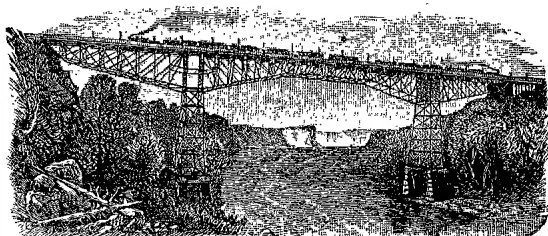
MICHIGAN CENTRAL NEW CANTILEVER BRIDGE, NIAGARA FALLS.

MICHIGAN CENTRAL

“The Niagara Falls Route.”
EAST.
Stations Mail Day Express N. Y. Express Atlantic Express Night Express Kal. Accom’n Local Pass’gr.
Chicago am 6.00 am 9.00 pm 3.10 pm 10.10 pm 9.10 pm 4.40
Michigan City 7.23 11.03 4.54 12.23 11.27 6.57
Niles 8.37 pm 12.10 5.49 1.5? 12.55 8.20
Kalamazoo 10.20 1.40 6.58 3.35 2.27 am 7.10 pm 5.30
Battle Creek 11.15 2.18 7.33 4.25 3.15 7.5? 6.25
Jackson pm 1.20 4.15 8.49 5.15 4.45 9.55 8.20
Ann Arbor 2.43 5.37 9.41 7.50 6.00 10.40
Detroit 4.10 6.45 10.45 9.20 7.30 11.50
Buffalo am 3.35 6.15 4.55 pm 8.05
Rochester 6.50 9.15 8.00 11.45
Syracuse 9.30 11.35 10.15 am 2.15
New York pm 7.00 8.50 7.20 11.15
Boston 10.00 10.50 9.15 pm 2.50
WEST.
Stations Mail Day Express Chicago Express Pacific Express Evening Express Kal. Accom’n Local Pass’gr.
Boston am 8.30 pm 3.00 pm 9.15
New York pm 10.30 6.00 11.30
Syracuse pm 7.40 am 2.10 am 9.00
Rochester 9.55 4.20 11.30
Buffalo am 2.15 6.15 1.30
Detroit am 7.30 9.10 pm 1.20 d 1.10 pm d 3.00 pm 4.00
Ann Arbor 8.55 10.40 2.24 11.35 10.55 5.45
Jackson 10.13 11.45 3.27 12.54 10.55 7.10 am 6.25
Battle Creek pm 12.09 1.16 4.38 2.15 am 12.27 8.6? 7.55
Kalamazoo 12.50 1.55 5.15 3.07 1.20 pm 9.45 8.40
Niles 2.27 3.20 6.27 4.32 3.67 am 4.30
Michigan City 3.48 4.35 7.32 5.48 4.7? 8.03
Chicago 6.10 6.40 9.30 7.45 7.00 10.20
O. W. RUGGLES, General Pass. & Ticket Agent, Chicago. O. E. JONES, Ticket Agent, Battle Creek.

CHICAGO & GRAND TRUNK R. R.

Time Table, in effect Feb. 17, 1889.
GOING WEST STATIONS GOING EAST
Mixed Train Mail Day Exp. Pacific Exp. B. Crk Pass. Mail Land Exp. Atla. Exp. Sun. Pass. Pt. H’n Pass.
am 5.55 am 7.7? pm 8.00 pm 4.10 Dep. Port Huron Arr. pm 10.20 am 1.15 am 7.35 am 10.50
7.28 8.31 9.31 5.40 Lapeer 8.40 11.58 5.17 9.17
8.03 9.10 11.10 6.20 Flint 7.55 11.27 6.40 8.38
8.43 9.58 12.58 7.15 Durand 7.55 12.57 5.02 9.00
10.03 11.30 12.0? 8.26 Lansing 5.20 10.07 4.00 6.35
10.57 11.00 12.00 9.03 Charlotte 4.42 9.37 3.25 6.02
am 11.30 11.45 12.45 1.20 10.05 A BATTLE CREEK D 3.45 8.55 2.35 5.15
6.40 am 12.10 1.20 pm Vicksburg 3.40 8.50 2.30 am
7.55 12.50 2.21 Schoolcraft 2.52 8.11 1.44
8.12 1.00 2.32 VAL. Cassopolis 2.40 1.33 VAL.
9.31 SUN. 1.50 3.19 Acc. South Bend 1.50 7.28 12.45 Acc.
10.50 Pass. 2.30 4.07 am Haskell’s 1.05 6.50 12.00
3.41 5.30 am Valparaiso 11.54 pm 3.40
4.00 5.50 6.55 Chicago 11.40 5.30 10.30 3.40 7.00
am am pm am am Arr. / Dep. am pm pm pm pm
†Stops only on signal. Where no time is given, train does not stop. Trains run by Central Standard Time. Valparaiso Accommodation, Battle Creek Passenger, Mixed Train, Pt. Huron Passenger, and Mail trains, daily except Sunday. Pacific, Limited, Day, and Atlantic Expresses, daily. Sunday Passenger, Sunday only.
GEO. B. REEVE, Traffic Manager. W. J. SPICER, General Manager.

ADDRESSES

THE address of Eld. J. H. Durland will be until further notice, Battle Creek, Mich., care of REVIEW AND HERALD.
The address of the Washington, D. C., mission is changed from 1831 Vermont Ave., to 217 5th St., S. E.

BUSINESS NOTICES.

[Under this head, short business notices will be inserted at one dollar for each notice of four lines or less. Over four lines, twenty-five cents a line. Persons unknown to the managers of the REVIEW must give good references as to their standing and responsibility. Ten words constitute a line.]
WANTED.—A good strong girl to do general house-work this summer, in a family of five persons; three small children. Address James A. Tefft, Peace Dale, R. I.

THE MARVEL OF NATIONS,

BY U. SMITH, AUTHOR OF “SMITH’S DIAGRAM OF PARLIAMENTARY RULES.”
This work embraces the past, present, and future of the United States from a historical, political, and religious stand-point, comparing the past with the present condition of education, science, and religion, and calling special attention to the work of the National Reform Association, and the proposed Amendment to the Constitution of the United States. It needs no other endorsement than a careful reading.
298 pages, 40 illustrations, 15th edition. Muslin, $1.00; gilt edges, $1.25.
Address, REVIEW AND HERALD, Battle Creek, Mich.; 26 and 28 College Place, Chicago, Ill.; or Toronto, Ontario.

LABOR BUREAU.

Help Wanted.

A boy raised on farm, from fourteen to sixteen years of age, for six months. Name wages. Address L. J. Caldwell, Battle Creek, Mich.
A carpet weaver. Mr. Hohewald, 589 25th St., Milwaukee, Wis.

Employment Wanted.

Farm hand. Adolph Kuster, Waukon, Iowa.

THE "BIBLE ECHO."

WE never tear the wrapper from the Bible Echo, our Australian paper, and spread before us its bright, cheerful pages, without feeling to congratulate its managers on their success in producing an attractive, readable journal. It is printed with good type on nice paper, but is especially noticeable for the value and variety, the crisp, vigorous, and entertaining nature of its articles. Eld. G. C. Tenney is the editor, and Miss E. J. Burnham, who worked for many years in this Office on the REVIEW, is assistant editor; while the staff of corresponding editors is composed of S. N. Haskell, E. J. Waggoner, and J. O. Corliss. We learn that but very few copies, comparatively, of the Echo, are taken by our brethren in the United States. This ought not so to be, and we believe would not so be, if they knew the kind of paper which the Echo is. The February number has recently reached this Office. Just look at this table of contents:
Poetry: Truths; The Sinner’s Portion; The Angel of Patience; That Fatal Limb; Truth and Life; Habit. General Articles: Ye Cannot Serve God and Mammon—Mrs. E. G. White; The Sabbath of the Mongols—Crossett; The Future of the Papacy—M. C. Wilcox; That Despised People—Robert Hare; Gigantic Dishonesties; Spiritual Growth—A. G. Daniells; A Parrot in a Deacon’s Meeting. Timely Topics: In France; The Empress Eugenie in the French Capital; The Samoan Difficulty; Death of Prince Rudolph. The Home Circle: A Wife’s Cure; Stop and Weigh; Mirrors; What is in your House? Quality of Speech; Tickets and Commandments. Useful and Curious: Some Big National Debts; A Chinese Funeral in New York; Curious Bibles. Editorial: The Words and Meditations; Immortality; Progressive Nature of Truth; The Papacy; Protestant Admissions Concerning the Change of the Sabbath; The Tender Mercy of God; Riches without Sorrow; To Correspondents; The Spread of Romanism. Bible Student: The 119th Psalm; The Day Line; The Bible. The Missionary: Bohemia; Hobart and Port Esperance; Adelaide; South Africa. News Summary. Health and Temperance: Tobacco; Queer Dishes; Moral Suasion. Publishers’ Department. Editorial Notes
Sixteen pages (size of page nearly that of the REVIEW). Published semi-monthly. Price 5s. 6d. per year. The Pacific Press, Oakland, Cal., is the agent for the United States, to whom orders may be addressed.

CAMP-MEETINGS FOR 1889.

WESTERN.

Place Month Dates
*Kansas, Ottawa, May 21–28
*Iowa, June 4–11
Minnesota, St. Paul, “ 11–18
Wisconsin, “ 18–25
Dakota, “ 25 to July 2

EASTERN.

Place Month Dates
*Pennsylvania, Williamsport, June 4–11
*New York, “ 11–18
Maine, Aug. 20–27
Vermont, “ 27 to Sept. 3
Canada, Sept. 3–10

CENTRAL.

Place Month Dates
Michigan (Northern), June 25 to July 2
Michigan (Southwestern), Aug. 13–20
*Ohio, “ 13–20
*Michigan (general), “ 27 to Sept. 3
Illinois, Sept. 17–24
Indiana, “ 24 to Oct. 1

SOUTHWESTERN.

Place Month Dates
*Missouri, Aug. 13–20
Arkansas, “ 20–27
Texas, “ 27 to Sept. 3
Colorado, Sept. 3–10
Nebraska, “ 10–17

SOUTHEASTERN.

Place Month Dates
Georgia, July 2–9
North Carolina, “ 9–16
Virginia, “ 16–23
West Virginia, “ 23–30
Tennessee, Aug. 20–27

PACIFIC COAST.

Place Month Dates
California (central), April 2–9
North Pacific, May 14–21
*Upper Columbia, “ 21–28
Nevada,

GEN. CONF. COM

The camp-meetings this year will begin on Tuesday evening and close the following Tuesday morning. Those marked with the star (*) will be preceded by a workers’ meeting. Where workers’ meetings are to be held, and they are not thus marked, notice should be given at once. If in any case the date of the meeting does not satisfy those concerned, notice should be promptly given.

GEN. CONF. COM

Colorado Correspondent Praises the Weekly Review

A CORRESPONDENT from Colorado writes: “I cannot refrain from saying that the REVIEW contains a feast of good things, better and better, week by week.”
Continue reading: Praise for the New Year Book