Your ShelfYour Projects

Signs of the Times, Vol. 32, No. 23.

The Mountains of God

Signs of the Times

Jun 13, 1906

Pacific Press Publishing Company · Mountain View, Cal. · Jun 13, 1906

The Mountains of God

It is good to get away from the earthquake and fire, beautiful as they are in picture and interesting as they are in fact, out into the great cool mountains of God, with their pure air, clear skies, long reaches of distance, and sweet awesomeness of strength. God met with His children in the mountains. "Come up to Me into the Mount, and be there;" He said to Moses His servant, "and I will give thee the tables of stone, and the law and the commandment, which I have written, that thou mayest teach them." "O thou that tellest good tidings to Zion," He tells His Gospel herald, "get thee up on a high mountain." And then—"Lift up thy voice with strength; lift it up, be not afraid; say unto the cities of Judah, Behold your God." The psalmist, looking upon the mighty snow-capped Lebanon, lifts his thoughts to God and exclaims, "Thy righteousness is like the great mountains. . . . How excellent is Thy loving-kindness, O God! therefore the children of men put their trust under the shadow of Thy wings." "The strength of the mountains are His." He "by His strength setteth fast the mountains, being girded about with might." So, dear reader, let us look away to the great evidences of God's strength and goodness, trust in His power, and rest in His love.
227 Grindelwald. Mer de Glace

Terms of Subscription.

Per Year, post-paid . . . . . . . . . . . . . . . . . . . . . . . . . . . . . . . . . . . . . . . . . . . . . . . . . . . . . . . . . . . . . . . . . . . . . . . . . . . . . . . . . . $1.50 Six Months, 75 cts. Three Months, 40 cts. To Foreign Countries, per year, $1.75.

SPECIAL TERMS.

  1. One new yearly subscription and one renewal, or two new yearly subscriptions, sent at one time, $2.50.
  2. Two new yearly subscriptions and one renewal, or three new yearly subscriptions, sent at one time, $3.25.
  3. Three new yearly subscriptions and one renewal, or four new yearly subscriptions, sent at one time, $4.00.
Sample copies sent on application.

TO OUR PATRONS.

Please be careful to write all names of persons and places plainly. Send money by Post-office Money Order, Express Order, or Bank Draft on New York, Chicago, or San Francisco. Orders and Drafts should be made payable to the Pacific Press Publishing Co. Paper money or silver should be sent in a registered letter. Registered mail is safe. Unregistered mail is at the risk of the sender. The address label on your paper will indicate the time to which your subscription is paid. In case of non-receipt of papers, or any other irregularity, please notify us immediately. When subscriptions expire, no more papers are sent to the party except by special arrangement. You are requested to watch the date on your label, and renew early, and save the loss of papers. We can not always furnish missing numbers. When requesting change of address, be sure to give both old and new addresses. Important.—If you order SIGNS, Our Little Friend, books, etc., at the same time, use a separate sheet of paper for each. If this request is complied with, it will materially assist in the prompt and accurate despatch of the business. When writing to the editor, be sure to use a separate sheet of paper.

The

Great Earthquake

A Sample of One of the Smaller Views, Showing the Wreck of a Large Wooden Building in San Jose
SUCH is the title of a 40-page booklet containing views of the wreck and ruin caused by the California earthquake and the San Francisco fire. In all there are forty-eight views and eight pages of reading matter. Among these views we will mention the following:
San Francisco's City Hall, as it appeared after the earthquake A View of the San Francisco Fire The San Francisco Bread Line What the Earthquake Did on East Street Three Seismographic Records The Wreck of the New Stanford Library Building Panoramic View of San Francisco April 18 Agnew's Insane Asylum, in which 117 persons were killed Stanford Memorial Chapel The Pacific Press Building, the morning after the earthquake Santa Rosa Court House
The price of the booklet is 25 cents. To those who enter upon a regular canvass for it a liberal discount will be allowed. Write to your Tract Society without delay, secure territory, and join the army of people who are successfully selling it.
Pacific Press Publishing Company Mountain View, Cal.

ISLANDS IN THE PACIFIC OCEAN.

Are you interested in that "Grand Island World of the Great Pacific Ocean"? The immense field encompassed within the boundaries of Oceania, together with many island groups lying beyond its limits, would make an interesting lifetime study.
Charles Marion Tyler has written a 337 large page book concerning the various groups of these islands which he has visited, giving their history, physical features, climate, products; stating the occupations, habits, and religious belief of the natives.
He gives the birth, growth, and death of islands within the volcanic fire-belt, with realistic colored plate showing volcano of Mt. Erebus, in the South Polar regions, in process of eruption while still surrounded by gigantic icebergs.
This handsome, illustrated, cloth-bound book, worth $1.50 of any man's money, will be sent post-paid for only 95 cents. Address Pacific Press, Mountain View, Calif.

SIX HUNDRED THOUSAND COPIES.

To-Day, May 29, orders for the Earthquake number of the SIGNS OF THE TIMES amount to nearly 600,000 copies. This is the greatest circulation ever given a single number of the SIGNS OF THE TIMES. More than thirty-five tons of paper have been used, on this edition alone. Orders are still being received at the rate of about ten thousand a day. Price 3 cents each in less than a thousand lots, 2½ cents each for a thousand or more copies to one name and address.

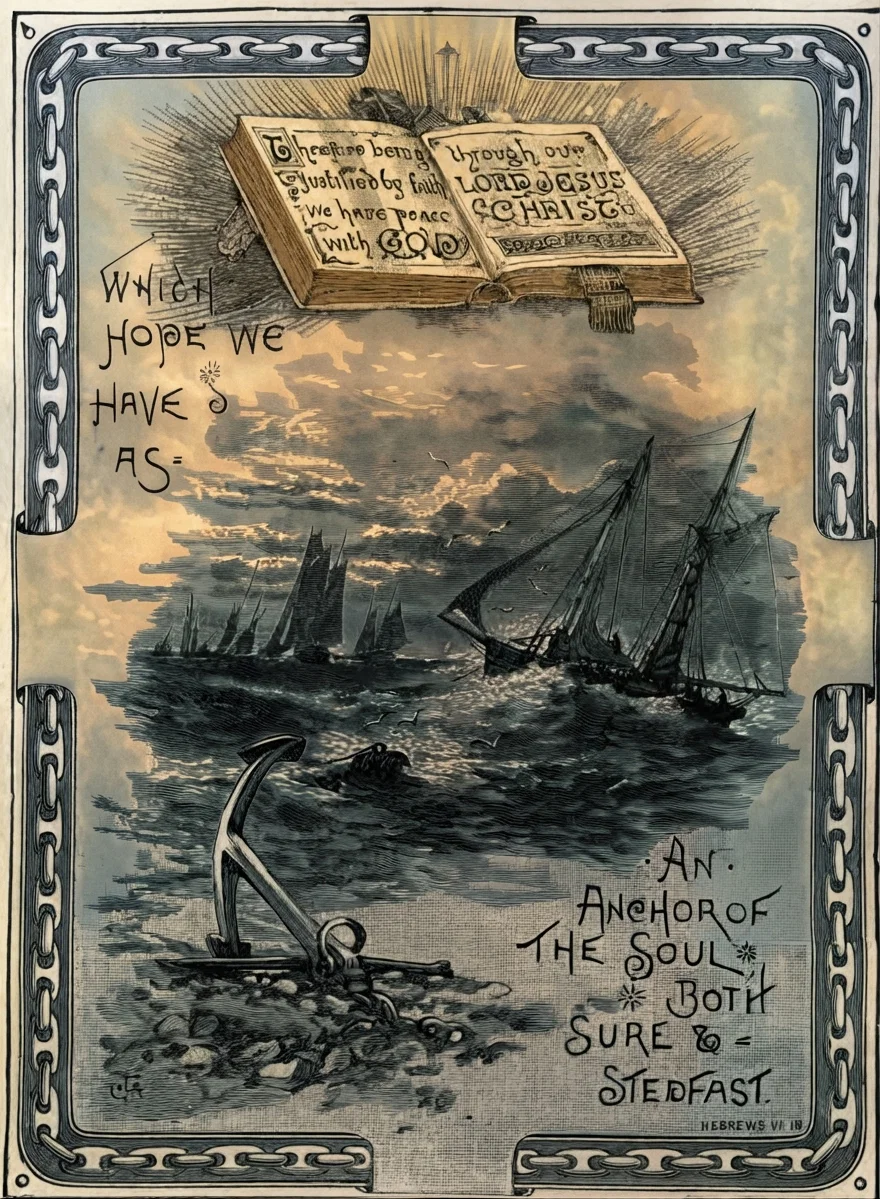
"A HOPE BOTH SURE AND STEDFAST."

HOPE is desire accompanied by expectation, a combination of wish and expectancy. Hope is the boon companion of Faith and Love, and is one of the three abiding Christian graces. It is the one thing which keeps the heavy, hungry, helpless, human heart from despair, and bids it push on despite the failure and defeat. It has been well said: "Hope springs eternal in the human breast."
HOPE is often counterfeited even as is faith. In the place of faith men put presumption, and in the place of hope the mere longing for the thing desired. But presumption ends in defeat and disaster, and "the hope of the hypocrite shall perish."
FAITH is based on the Word of God, whether of precept or promise. Hope is based on God's promise. Faith pertains to the now, and makes the things of God realities. It brings the soul into harmony with God. Hope pertains to the coming better things wished-for by the heart and promised in the Word of God. That is presumption and not faith which attempts to lay hold on God's promises, but ignores His precepts, His conditions. That is mere longing and not hope which expects the better things and ignores genuine faith. On the foundation of true Faith, Hope may build; and in the superstructure of Hope, Love may make a beautiful and delightful dwelling.
MANY indeed are the beautiful figures used in the Bible to illustrate hope and its assurances. The writer of Hebrews, referring to God's promise and oath declares that "by two immutable things, in which it is impossible for God to lie, we may have a strong encouragement, who have fled for refuge to lay hold of the hope set before us; which we have as an anchor of the soul, a hope both sure and stedfast and entering into that which is within the veil; whither as a forerunner Jesus entered for us." Heb. 6:13-20. This is but one of its phases. An anchor holds the ship from drifting, so hope holds the Christian steady amid all the storms of life. But how unlike human anchors it is! There is nothing in men's anchors which will save a ship from going down. The anchor will hold from drifting, but it will not make buoyant nor lift the barque above the breakers. But the Christian anchor lays hold on the eternal and immutable promise and oath of God. He is anchored up and not down. Let the treacherous currents sweep, the wild blasts blow, the tides surge, the waves run mountains high, God's throne is stedfast, and Hope's "Cables passed from His heart to thine Can defy the blast through strength divine." The Rock of Ages is secure. The wild waves waste their strength in beating against its base. Blessed is he who is anchored in its everlasting strength.
HOPE is likened to a helmet. The helmet was the ancient piece of armor which covered the head and preserved the seat of the intellect, the brain. More people in this world lose their reason from discouragement and despair than from any other cause. Hope cheers, comforts, and confirms. Many persons are hopeful when they feel like it,—the smoker after a pipe, the drinker after his dram, the housewife after her good cup of tea, many because some others are cheerful, the superficial Christian after an exuberant service. Hope is based on feeling with all these. In their armor hope ought to be over the heart, the seat of the affections. But God has not placed it there: "For a helmet the hope of salvation." God wants His children to have an intelligent hope, based not on man's feeling, not on appearances, not on human conditions or environments, but on the immutable promises of God. Reader, put on God's helmet.
HOPE is likened to a door opening out of trouble. So He promises Israel: "I will allure her, and bring her into the wilderness, and speak comfortably unto her. And I will give her her vineyards from thence, and the valley of Achor for a door of hope." Hosea 2:14, 15. Unbelieving Israel found no vineyards in her wilderness wandering. "Achor" means "trouble," and the allusion is to the defeat of Israel because of the sin of Achan. Sorely defeated, Israel was humbled; sin was among them; the guilty party was found; his confession came too late, and he was slain. The place was called the Valley of Achor, or trouble. Yet the Lord declares that He will make such a place as this, a time of the revelation and putting away of sin, "a door of hope." Even so it may be to those who are passing through trouble to-day. Is there aught between them and God? Let them humble their hearts, put away the sin, and enter the door of hope in Christ Jesus.
BLESSED be the hope which God has given. It is "the hope of eternal life;" it is "the blessed hope, the glorious appearing of the great God and our Saviour Jesus Christ;" it is "Christ our hope." In hope is there encouragement amid discouragement (Ezra 10:2); there is joy and rejoicing amid the sorrows of earth (Prov. 10:28; Rom. 5:2; Heb. 3:6); there is strength in hope (Ps. 27:14; 31:24); there is patient endurance in hope (1 Thess. 1:3; Rom. 5:4; 8:24; 15:4). Yes, there is persistency, salvation, reward, in hope, because in Christ dwells all the fulness of the Godhead. "Be of good courage, . . . all ye that hope in Jehovah."

“TO OBEY IS BETTER THAN SACRIFICE.”

A Lesson from Saul’s Apostasy.

THE commandment to King Saul to utterly destroy the Amalekites and all they had, was his second great test as to whether he would honor and obey the Lord, who had so highly honored him. And it was his final test. In this he showed that he had “turned back from following” the Lord; his apostasy was complete and settled. The Lord knew that his heart was incorrigible; therefore his probation was closed. The example of Saul, as well as that of the Amalekites, shows that it is possible to pass the line of hope and of divine forbearance while in the full vigor of life, and that the Lord withdraws His Spirit when that line is passed.
THE good spirit of Samuel is manifest in his grief over the downfall of King Saul. It will be remembered that Saul was made king because the people had rejected the government of God as administered by Samuel, and had demanded a king. Had Samuel been a mere politician, actuated by a desire for worldly honors, he would have rejoiced to see the fall of one who had been set upon the ruins of his own rejected administration. But he was grieved to see the once humble young man, whom he had anointed king by command of the Lord, and whom the Lord had so signally blessed and honored, recklessly throwing away, not only his own bright prospects, but also those of his family.
SAMUEL reminded Saul of His humble disposition when anointed king. The prophet had anointed him while he was out hunting for his father’s asses, and when he went home he told about seeing the prophet, but made no mention of his having been anointed king. And when Samuel called the people together to show them who the Lord had chosen for them, Saul hid himself and had to be hunted out from his hiding place in order to be presented to the people as their king. Such was the humility which the Lord chose to honor and bless, and had Saul remained humble and obedient the blessing of God would have abode upon him and upon his family after him. But “pride goeth before destruction, and a haughty spirit before a fall.”
ALTHO in his heart Saul had utterly “turned back” from the Lord, he still professed to keep His commandments. “The heart is deceitful above all things, and desperately wicked; who can know it? I the Lord search the heart, I try the reins, even to give every man according to his ways, and according to the fruit of his doings.” Jer. 17:9, 10. Men may pass the limit of probation while professing faith in God. The self-deception under which many people will be found laboring when the Lord comes is thus expressed by the Saviour Himself: “Many will say to Me in that day, Lord, Lord, have we not prophesied in Thy name? and in Thy name have cast out devils? and in Thy name done many wonderful works? And then will I profess unto them, I never knew you; depart from Me, ye that work iniquity.” Matt. 7:22, 23.
WHEN Saul was confronted with the evidence that he had not obeyed the commandment of the Lord, but had spared of the sheep and oxen of the Amalekites, he laid the blame upon the people. It is very seldom that a backslider does not find excuse for his apostasy in the action of some one else. Self-defense is always the resort of the unregenerate heart when brought face to face with its faults. It is a poor defense, one on which even the righteous dare not rely. David says, “The Lord is my defense;” and of the heathen Joshua said, “Their defense is departed from them, and the Lord is with us.”
THE pretext that the sheep and oxen taken from the Amalekites were for a sacrifice to the Lord was exceedingly lame. The Lord had given express command that all these be destroyed, which was positive evidence that He did not want them. Moreover, it would be an offering by the people of that which did not belong to them, and could not properly be called a sacrifice. The real design was to have a great jollification to glorify their own achievement.
SAUL’s spirit of selfish obstinacy was manifested when he insisted that he had “obeyed the voice of the Lord,” and showed the live king of the Amalekites as proof, when the Lord had told him to destroy every person and every thing. But his attitude arose to the point of defiance when he said to Samuel that the people had taken the sheep and oxen “to sacrifice to the Lord thy God.” This was a bold denial of the God of Israel, and showed that the Lord had judged rightly when He told Samuel that Saul had “turned back” from following Him.
GOD has not commanded offerings and sacrifices because He needs anything. They are tests of loyal obedience. No sacrifice can take the place of obedience. Grace rejected by disobedience can not be purchased by unholy sacrifice. Jer. 6:18-20. God demands obedience first and all the time, and nothing else can take its place. In the spirit of obedience we have the highest example in Jesus Christ, who “became obedient unto death, even the death of the cross.” Phil. 2:8. He could say, “I delight to do Thy will, O My God; yea, Thy law is within My heart.” Ps. 40:8.
DISOBEDIENCE is rebellion, and “rebellion is as the sin of witchcraft.” The sin of witchcraft was punishable with death in Israel (Ex. 22:18); and from the Lord’s rebuke of King Saul we may know how He regards the disobedience of His commandments. We also learn from Mark 7:9 that those who hold to the traditions of men thereby reject the commandments of God.

WHAT SHALL WE PREACH?

The answer of the Spirit is very explicit, “Preach the Word.” The command of the Master Himself is equally plain, “Go ye into all the world, and preach the Gospel to every creature.” Yet the strong tendency of the present time is to substitute something more sensational, more in the line of the world’s affairs. A San Francisco clergyman once expressed it in these words:
“Yes, the pulpit has a duty, a practical duty, and if the supervisors go astray, it is the duty of the pulpit to call them back.”
This is on the erroneous supposition that the pulpit is set for the judgment and correction of the official acts of “the powers that be” in the realm of the world’s affairs. If this be true, then Paul must have misunderstood the duty of the pulpit. He visited and preached in the greatest cities of his time, cities fairly teeming with political corruption, yet in no instance do we read of any “municipal reform” movement on his part, or by any of his contemporary laborers. Corinth was a very wicked city, and Paul lived and labored there at one time for a year and a half, but he made no direct effort at municipal reform. Writing to the brethren afterward, he said:
“I determined not to know anything among you, save Jesus Christ, and Him crucified. . . . And my speech and my preaching was not with enticing words of man’s wisdom, but in demonstration of the Spirit and of power; that your faith should not stand in the wisdom of men, but in the power of God.” 1 Cor. 2:2-5.
The minister of Christ who will have his preaching accompanied by the Spirit and power of God, must give his attention to the one grand theme of “Jesus Christ, and Him crucified.” If he will preach Christ faithfully, he will have no time to devote to the regulation or reformation of the governments of this world, municipal or national; for Christ has expressly said that His kingdom is not of this world. And Paul, with all his diversified gifts, had the one purpose in view, from which he never deviated. That purpose is expressed in these words, “I press toward the mark of the prize of the high calling of God in Christ Jesus.”
The minister of Christ is an ambassador (2 Cor. 5:20), not to civil officials as such, but to individuals as sinners, endeavoring to reconcile them to God. If this purpose can be accomplished, the individual so changed will be a more faithful person in every capacity consistent with Christian duty. But the commission of the Gospel ambassador contains no prerogative to compel any one either in religious duty or civil function. His message to sinful man is, “We pray you in Christ’s stead, Be ye reconciled to God.” He can do nothing further in Christ’s stead, for Christ Himself went no further than to offer salvation to those who would accept it. We have no record of His endeavoring to compel civil officials to perform their duties.
The apostle Paul is also very emphatic in regard to the duty of the minister to continue the work of the Gospel on the principle enunciated by him. Writing to the churches in Galatia, he says:
“There be some that trouble you, and would pervert the Gospel of Christ. But tho we, or an angel from heaven, preach any other Gospel unto you than that which we have preached unto you, let him be accursed. As we said before, so say I now again, If any man preach any other Gospel unto you than that which ye have received, let him be accursed.”
It is the Gospel of the kingdom of God which the ambassador of Christ is to preach, and not the patching up of the corrupt governments of this world, which are soon to be broken in pieces and consumed by the coming and kingdom of our Lord Jesus Christ. This sin-cursed earth and its sin-laden governments are soon to pass away, and “we, according to His promise, look for new heavens and a new earth, wherein dwelleth righteousness.” The only legitimate correction the Gospel minister may have for the civil officer is to warn him as an individual sinner before God; to reason with him, as Paul did with Felix, of righteousness, of temperance, and the judgment. With the regulation of civil office, the “pulpit”—the Gospel ministry as such—has no legitimate concern. “Let the dead bury their dead; but go thou and preach the Gospel.” G.

Question Corner

1831.—Judging Others. Matt. 7: 1.

"Judge not that ye be not judged." Are we judging when we know a fact to say so? or when we only think it to be so from all appearances, and then repeat it as a fact? E. M. H.
Judging does not pertain to facts, but persons. We have the right to say that an act of stealing is wrong; but the judging of the man who did it does not rest with us. The judging prohibited by Christ pertains to person, not act. "Condemn not and ye shall not be condemned." Say the act is wrong if need be, win men from the wrong deeds, but leave the condemnation to Him to whom it belongs.

1832.—Soul and Breath. 1 Kings 17:21.

Does “soul” in 1 Kings 17:21, “Let this child’s soul come into him again,” refer to spirit? E. M. H.
“Soul” here simply means the breath of life. Verse 17 declares, “There was no breath left in him.” Elijah prays that the breath, the life, may come back. The record does not say that the child came into his body again, but that the soul or life of the child came into the child again. Breath in verse 17 comes from neshamah, defined by Strong, “a puff, wind, vital breath, animal, blast, breath, inspiration, soul, spirit.” Soul in verses 21, 22, is from nephesh, a breathing creature, animal, vitality, breath, life, etc.

HOW CAN THEY DO IT?

THE Word of God clearly teaches that good and evil shall exist in this world till Jesus Christ shall come again. This is clearly taught in every great line of prophecy, in the parables of the wheat and tares and the fish net, and in many other declarations of the Scriptures.
Added to this we have the condition of the world at the present time. Note the revelations of such articles as the "Treason of the Senate," by Philipps, in the Cosmopolitan. View the picture drawn in the April issue of the leader of the Senate. This is one revelation among a score of others. Most of the men who do these things are closely affiliated with religious institutions, oftentimes honored, if not honorable, members of a Christian denomination, yet guilty of crimes of such stupendous magnitude, crimes so utterly and absolutely selfish at the core, that the world stands aghast at the audacity and boldness of them. Courts and juries and legislatures are purchased by wholesale, and the professed church of Christ, whose ministers ought to be faithful sentinels for God and righteousness, protests but feebly against the iniquity, and condones it if it happen to strike near home. And yet out of this evil is coming good, the self-called "optimists" would have us believe! "But is it not possible for all these to become converted?" asks one. It is; but the power of regeneration lies in Jesus Christ and His Word, and these are ignored, rejected.
Man never regenerated himself. No people ever regenerated themselves. It can only be done by the supernatural power and life of God in response to humble faith; but faith in the great mass is so enfeebled as to be accounted dead, beaten to a senseless pulp by the bludgeons of Higher Criticism and Evolution. Yet God still lives and His Word is still potent; but men will not have His salvation. Above it all God reigns. Those identified with the selfish unbelief will perish with it. Those who believe in Christ will rejoice at His coming.

THE LACK OF EVIDENCE FOR SUNDAY.

SUPPORTERS of the Sunday-sabbath are wont to refer triumphantly to one instance of the disciples' having held a religious meeting on the first day of the week. This, it is argued, establishes the transfer of the Sabbath to that day. The instance referred to is noted in Acts 20:7-11, and occurred at Troas, on the occasion of Paul's passing visit as he journeyed from Macedonia to Jerusalem. But holding a meeting on a certain day does not establish a weekly sabbath. Paul tarried with the brethren at Troas seven days, and it is more than probable that there were meetings every day. Did they all become sabbath days?
But it is urged that they met that day to "break bread." Verse 7. That was the last meeting Paul was to hold with the church there before continuing his journey, and it was fitting to celebrate the ordinances with them. But even that did not imply that it was the Sabbath day; for we read in Acts 2:46 of the disciples at Jerusalem, that "they, continuing daily with one accord in the temple, and breaking bread from house to house, did eat their meat with gladness and singleness of heart."
The reference to the meeting at Troas as proof of a Sunday-sabbath only proves an utter lack of legitimate evidence. There is not in all the Word of God one command, or recorded incident or example, or expression giving warrant for unprejudiced inference, upon which to base the claim that the Sabbath of the Lord, established at Creation, ever has been changed. Not a reference to the first day of the week, or to any other day, is of such a character as to warrant the assumption that "one jot or one tittle" of the law of God ever has been changed or abolished. "The law of the Lord is perfect, converting the soul." Ps. 19:7. G.

1833.—Self-Devouring Reasons for Sunday-Keeping.

How would you answer this kind of an argument? "I keep Sunday because of Christ's resurrection. The Lord commanded us to keep the Sabbath one day in seven, no one in particular. Every day is a holy day with the Lord." But here is the principal point that troubles me. They say that they believe the resurrection to be greater and of far more importance than Creation. Therefore they keep the first day of the week in honor of Christ's resurrection.
Can you help me out of this? Why should we keep the day of Christ's resurrection any more than we should the day of His crucifixion or any other day? Does it not say somewhere in the Bible that His death meant more than His resurrection? H. C. P.
1. It can readily be seen that the first three positions are self-devouring; for if only a seventh part of time is required, merely one day in seven, it does not matter which day, and Sunday has no special holiness. And this is also true if every day is a holy day. To the first alone we may well inquire in the words of the Lord, "Who hath required this at your hands?" If tradition requires it, it is well to remember that tradition is one of the unsafest guides, and often, as in this case, makes void in its keeping the commandments of God.
2. God commanded not one day in seven, but "the seventh day is the Sabbath of the Lord thy God." He rested on and blessed a particular day. He could not rest on no day in particular. He commanded the observance of the same day on which He rested. Gen. 2:2, 3; Ex. 20:8-10.
3. God only can make days holy. He has hallowed but one—the seventh. He reproves His people because "they have made no distinction between the holy and the common, neither have they caused men to discern between the unclean and the clean, and have hid their eyes from My Sabbaths, and I am profaned among them." Eze. 22:26.
4. Resurrection is recreation. Only God can create; only God can recreate. It is the creative power of God which regenerates. Eph. 4:24. Over and over we are taught that it is the creative power of God which redeems and saves. See Isa. 44:24; 45:17-19; Col. 1:14-20. So God gave the Sabbath as a memorial of Creation (Ex. 20:8-11), and to His people it becomes a sign of His power to sanctify (Eze. 20:12).
It was not a wonderful thing that the Father should raise His Son from the dead; but it was a marvelous thing that He should give Him to die. And we are redeemed by His blood. Eph. 1:7; Rev. 1:5; 5:9. Moreover this work of redemption will not be finished till Christ comes. Luke 21:28.
If, therefore, man should set apart a day as a memorial of redemption, ought it not to be the day when Christ was crucified? But the crucifixion, the resurrection, and the ascension were all necessary. Should there not be a day for each event? God, however, has commanded none of these; and for us to add to His words is to set ourselves above Him.
5. Nowhere does it say in the Bible that Christ's death is more than His resurrection. Every act in our Lord's work was important, infinitely so, and to faithful souls will come the merit of each and all.
6. God has given us a memorial of Christ's death in the Lord's Supper, and of His resurrection in baptism. 1 Cor. 11:25-26; Rom. 6:3-6. And death to sin and the new life in Christ ought ever to be manifest in His followers in the world.

1834.—Was Jesus a Jew?

Was Jesus a Jew? I know He was a Hebrew, but was He not of Jewish descent?
The word “Hebrew” came from Eber, an ancestor of Abraham. Gen. 10:21. Hence Abraham is called the Hebrew. Gen. 14:13. From Abraham sprang Isaac; from Isaac, Jacob; from Jacob, Judah; and from Judah came the term Jew. And the earthly lineage of Jesus is traced through Abraham, Isaac, Jacob, Judah, etc. Matt. 1:1, 2. Hence Jesus was a Jew, and moreover He declares that “salvation is of the Jews.” John 4:22. He came unto His own, and His own received Him not.” John 1:11. These are simple Bible facts.

WARNING AND JUDGMENT.

A FEW weeks ago a servant of God delivered an important message to the people of an Eastern city. Among other things, he told them of the wickedness of San Francisco. Unlike Jonah, who loved not the Ninevites and would have evaded duty, this man, filled with the Holy Ghost, solicited the prayers and offerings of his brethren in behalf of a people among whom he had lived and labored, and who were endeared to him by the most sacred ties. His zeal and devotion along all lines fitly attested the sincerity of his affection for their every welfare in long, well-spent service.
God is long-suffering, slow to anger, and plenteous in mercy and kindliest forbearance toward His erring children. But least of all will He tolerate presumptuous sin, and sinners are growing bolder and more defiant every day. Science, so called, unbelief, and sycophantic, half-hearted Christians may strive to eliminate Him from His works, and relieve Him of responsibility for His actions, but the Scriptures and the events of history will ever confound and rebuke them. "Are not two sparrows sold for a farthing? and one of them shall not fall on the ground without your Father." The grass and flowers of the fields are precious in His sight. "The very hairs of your head are all numbered."
The highest authority thus emphasizes the Father's solicitude and great love for His children. How then are we to reconcile these declarations of Omnipotence with the actions of that power that tossed and shook our stricken city until, first amazed, then in awful helplessness, she was borne to the ground in magnificent but terrible grandeur. Why were the ordinary safeguards—the water mains—destroyed? Why should the horrors of Sodomic fires complete this mighty devastation?
Brother, the king of great Nineveh proclaimed a fast at the preaching of Jonah's sermon embodied in a single sentence of less than a dozen words. Even the beasts were deprived of food while the king and his people prayed in sackcloth and ashes. Not so in San Francisco. They laughed, jeered, and gibed.
Representative bodies drew up resolutions; the press, and even some of the ministry, took Bishop Hamilton to task and almost threatened him in the discharge of duty divine. Nineveh humbled herself, repented, and was saved. San Francisco scoffed, and ere the ink was dry in the self-righteous editorial columns of a leading daily on that ever to be remembered morning of April 18, the beautiful city by the bay was plunged headlong to her doom.
In speechless grief our hearts are bowed in humble submission, while the mangled, charred remains of loved ones are gently lowered into the trenches. Let us hope that prayer was heard, that all were saved who passed from us in that hour. The beautiful spirit of brotherhood, as shown by humanity everywhere, will ever be among the richest treasures of memory. The world beholds with admiration the sublime courage and optimism manifested by many while passing through this fiery furnace, but, O beloved brethren, is there no other consideration than the mere "rebuilding of our city more beautiful and grander than ever before"? Would to God that the Holy Ghost might prevail toward the rebuilding of His own temple, that the Holy Spirit would leap from heart to heart as fire among dry stubble, until not only San Francisco, but California and the world be brought to the Lamb of God, to the glory of His adorable Son Jesus, whose second coming without sin unto salvation is even now at the door.
T. R. GRIFFIN. Berkeley, Cal.
Continue reading: OUR GREAT TREASURE-HOUSE