FROM Alexander our thoughts go naturally to the more recent military hero, Napoleon Bonaparte, who was at the height of his power a hundred years ago, emperor of France, practically of Europe, and not yet forty years old. While there is much to condemn in his life, especially the later years, there are some things to be commended. Born in 1769 on the island of Corsica, which then belonged to France, the only claim he had to being a Frenchman (for his parents were Italian), he was placed at an early age as a sort of a charity pupil at Brienne. Here the first great trials of his life came to him, for his poverty made him the laughing stock of the other students, all better provided for than he. But he soon gave evidence of superiority, becoming a great reader and a diligent student, and on his merit was transferred to a military school in Paris at the age of fifteen. There he remained only a year when he was appointed lieutenant of artillery. During that year he was obliged to practise the greatest economy, and suffer the abuse of the other students as in the former school. But as before he worked and studied hard.
France at this time was stirred with the mutterings of a revolution which soon burst forth in fury, and Napoleon Bonaparte and his older brother Joseph took the side of popular liberty, joining with the Republican faction in the Revolution, sacrificing all and risking their lives in the cause of liberty. Their zeal for France led them on, and Napoleon especially was called to lead in different enterprises, in 1793 being made general of brigade in the artillery to protect France from threatened Austrian invasion; in 1796 taking command of the army of Italy, from which country he soon drove the Austrians. In 1798 he was in Egypt, where he entered Alexandria and Cairo, after the famous battle of the Pyramids. But at sea he was defeated, and an expedition against the Turkish army in Syria failed; soon word came that Italy was lost to France, invasion of Austrians and Russians threatened, and the government itself tottering. Leaving everything, Napoleon hastened to Paris just in time to assume control, being made dictator of France Nov. 9, 1799, at the age of thirty. Sending one army against the Austrians, he went against Italy, bringing them to speedy submission. England herself came to terms in 1802.
"Now we must rebuild, and, moreover, we must rebuild solidly," was the work, which he told his brother Lucien, lay before him. That he was a statesman as well as a soldier is evident from his success. The bank of France, an adequate system of taxation, public works of all kinds, schools, increased manufactures, all attest to his ability. England still gave trouble, breaking her treaty in 1803, and that same year, against the strong opposition of his brothers, he sold the Louisiana Territory to the United States, for he thought that by so doing he gave to the United States a power that would one day humble the pride of England.
With England the great nations of Europe, Russia, Austria, and Prussia, were united against France. These nations were incited by England to take action against her, so in order to defeat England, his greatest rival, Napoleon found it necessary to overcome these powers. In 1805 the campaign proper was begun. Gradually he pushed his way into their borders, fighting desperately, not always victorious in battle, but always successful in a campaign, by brilliant advances and brave attacks, till Austria made peace in the close of the year 1805. The next year Prussia ran to Russia for protection; but early in 1807 the indomitable warrior forced the Russians to sue for peace, and as one has expressed it, "He met the emperor of Russia and the king of Prussia, and the map of Europe was made over!"11
Still he thirsted for greater conquests, but he had reached the height; the young man had accomplished more than the middle-aged man could sustain. Tho for years he kept up the struggle, the united forces of Russia, England, Prussia, Spain, and Sweden were too strong to be resisted. For a time the French were victorious, the grand army was gradually cut down, and in 1814, Paris itself capitulated. Napoleon was made ruler of the Island of Elba, where he remained less than a year, when he crossed to France with a small force, placed himself at the head of the army, and established himself as emperor, one of the most audacious events in history. But his triumph was short-lived, for the Royalists as well as the Liberals, soon regained their confidence, and the war with England was on within a few months, resulting in the complete defeat of Napoleon's last army in the battle of Waterloo, July 18, 1815. Surrendering to England he was exiled with but three companions to the Island of St. Helena, where he lived until his death in 1821.
His self-denial, his perseverance, his oneness of purpose, if placed on the side of peace, would have made him a power for good. Connected with overweening ambition, they wrought ruin to thousands and to himself. These qualities are those which every Christian young man should possess, but let him not pervert them to selfish ends.
QUESTIONS FOR IDLE MOMENTS.
"To understand a proverb, and a figure, the words of the wise, and their riddles."
Prov. 1:6, A. R. V., margin.
WORD SQUARE.
A son of Samuel, A name in 1 Esdras 5, A niece of Abraham, A name in 1 Esdras 5, A Jewish sophist.
BIBLE ENIGMA.
I am composed of twenty-eight letters.
My 1, 11, 18, 16, 12 was a king of Judah.
" 2, 5, 4, 8 was a hairy man.
" 3, 4, 25, 27, 7 is a symbol of the Spirit.
" 6, 4, 20, 9 was one of David's strong men. 2 Samuel 23
" 10, 19, 12, 14, 20 is the name of a noted city.
" 13, 27, 28, 25, 23, 10 is the name of a New Testament king.
" 22, 8, 4, 15, 25, 17, 5 is the name of a Roman brother.
" 21, 18 was a Benjamite. 1 Chronicles 7.
" 24, 28, 23, 26 is a grandson of Jacob. Genesis 46.
My whole is what was done to Christ for us.
BULL DOG SUSPENDERS
BEST FOR COMFORT, WEAR AND ECONOMY.
BEST FOR COMFORT, WEAR AND ECONOMY
FOR EVERY PURPOSE, FOR MAN AND YOUTH
Guaranteed to Outwear Three
of the Ordinary Kind
BULL DOG SUSPENDERS
Not a Harness — Do Not Twist or Tangle — Cannot
Grow Stiff, Bind, Catch or Sag — Will Not Soil Linen.
Are the Standard of True Suspender Economy
Contain more and better rubber and greater elasticity than
any other suspender; have non-rusting, silver nickel metal
parts and imported, unbreakable Bull Dog Leather Ends,
insuring ease and action, longer wear, and better and more
uniform trouser support. They give absolute satisfaction
that cannot be had in any other make of suspenders.
In light weight lisles or heavy weight twills for man
or youth (extra lengths at no extra cost). If they
don't prove the Best 50 Cent investment you ever
made you can have your money back by asking for it.
If your dealer won't supply you, we will, postpaid.
There is no substitute for the Bull Dog
HEWES & POTTER
Largest Suspender and Belt Makers in the World
Dept. 232 87 LINCOLN ST., BOSTON, MASS.
Valuable Booklet, "CORRECT DRESS & SUSPENDER STYLES," free on request.
IMPORTANT TO TRAVELERS
The WASHINGTON-SUNSET ROUTE announce the opening of their through line via New Orleans. Personally conducted cars, San Francisco to Washington, D. C., via Coast Line and Los Angeles, tri-weekly. Tickets at lowest rates to Washington, Baltimore, Philadelphia, New York, New England, and all Eastern points. Through the Old South. Quick time. Best service. Write Phil K. Gordon, 1708 Filmore St., San Francisco, for full information.
Agents Wanted Everywhere
Agents Wanted Everywhere to sell W. H. Wild's beautiful, practical, and instructive chart.
"The Good Way"
Lithographed in nine beautiful colors. The designer has taken over 100 orders for the chart in about two weeks' time. Nearly all paid in advance. Some ordered several. Remember all this was done before the chart was printed. Size 22x30.
Send for outfit which includes a book containing the Third Angel's Message. Only one dollar.
Address, William H. Wild, Hinsdale, Ill.
THE ATONEMENT.—An examination of the remedial system in the light of nature and revelation. By J. H. Waggoner.
This work is a critical and exhaustive treatise on the plan of salvation as revealed in the Scriptures, showing its harmony with the principles of justice and mercy, its consistency with reason, and its final results as affecting the destiny of the human race. Third edition, revised and enlarged, 368 pp. Cloth. Sent post-paid for 90 cents.
Address PUBLISHERS OF THIS PAPER.
Abiding Spirit
By Mrs. S. M. I. Henry
ABIDING SPIRIT.—By the late Mrs. S. M. I. Henry. The object of this book is to show the necessity of having the help of the Holy Spirit in the performance of the common and every-day duties of life. Plain, cloth . . . . . 40c.
Gilt edges . . . . . 75c.
Address PUBLISHERS OF THIS PAPER
Southern Pacific
Whether going East or coming West, do not fail to take advantage of the most essential features of traveling
Speed, Comfort, Safety
Which are given the greatest attention in the equipment of the
Overland Limited
Running over the Southern and Union Pacific. Secure tickets and make reservations for berths from any
Local Agent
Southern Pacific Company
--- OR ---
City Ticket Office,
Ferry Bldg., San Francisco, Cal.
Millennial Text-Book
MILLENNIAL TEXT-BOOK.—Every known reference, over 500 arranged according to events, adapted for instant reference or profound Bible study; result of 12 years' search. Mailed for 10 one-cent stamps, or a dime. Eugene A. Brown, Phoenix, Ariz.
Practical Lessons from Israel
By F. C. Gilbert
PRACTICAL LESSONS FROM THE EXPERIENCE OF ISRAEL FOR THE CHURCH OF TO-DAY.—By F. C. Gilbert, a Hebrew Christian. The prominent thought is to present Jesus Christ as He is,—Saviour, Messiah, Prophet, Priest, King,—which was the specific mission God had for the Jewish nation. The condition of the Jews at Christ's first advent on the earth and their refusal to accept Him as the Saviour are presented in a very practical way. Many of the customs of the Jews existing at the time of Christ are vividly portrayed. 400 pages; illustrated. Cloth, plain edges .................... $1.00
Cloth, gilt edges ........................................................... 1.25
Half morocco, gilt edges ................................................ 2.00
Address PUBLISHERS OF THIS PAPER.
ANSWERS TO PUZZLES OF LAST MONTH.
By Editor
Bible Enigma: Thomas, Solomon, shave, feet, seethe, kind, stain, saw, coat, K. "The Son of Man is come to seek and to save that which was lost."
Word Square:
P A U L
A U R A
U R I M
L A M B
We received a good many answers to the puzzles of last month, but all had one or more errors. In solving word squares and diamonds, be sure you get the idea contained in the definition before writing down the word.
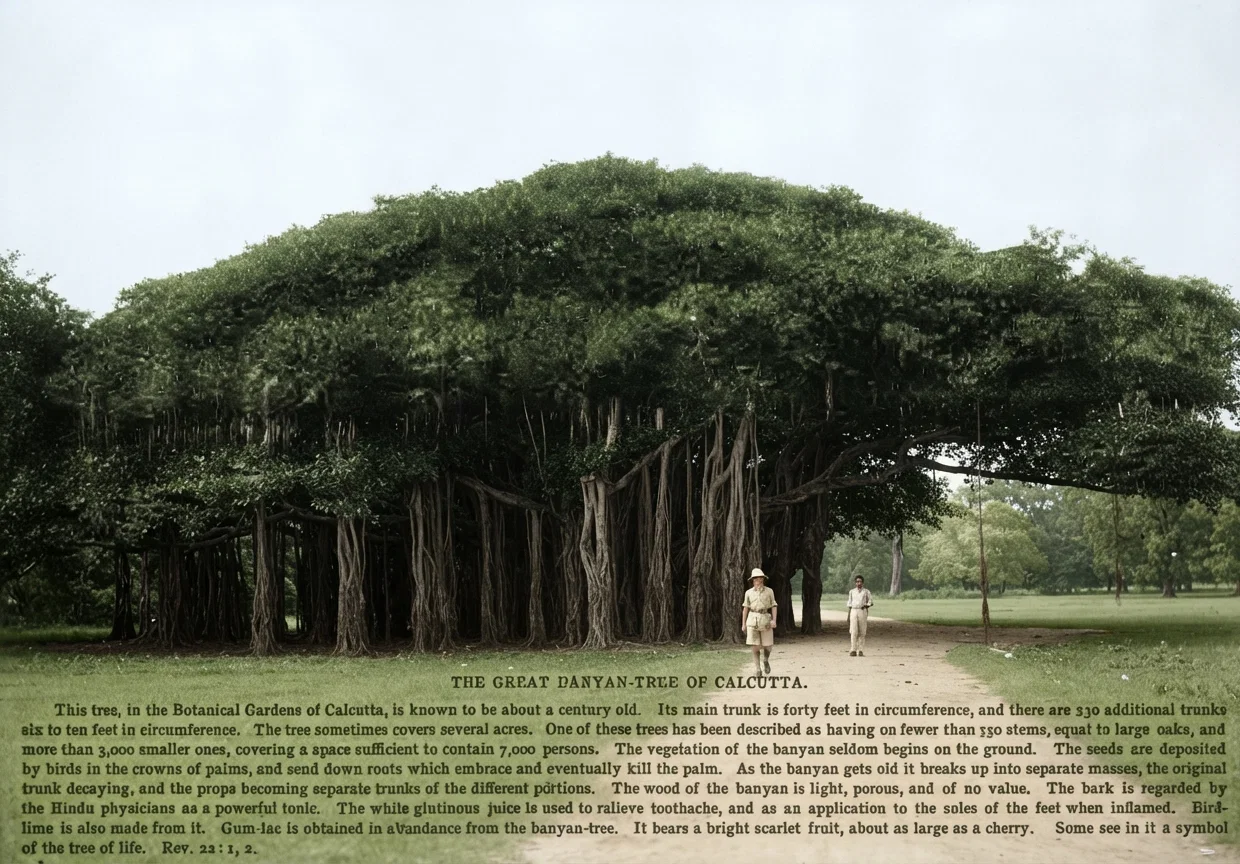
THE GREAT BANYAN-TREE OF CALCUTTA.
INDIA.
By J. L. Shaw
LANDED in India, we are surrounded with a new life in a new world. Wherever we turn our eyes, we are greeted with things never seen before. An array of different faces, a chatter of strange voices, a land covered with a new and varied vegetation, with multitudes of men and women and children, differing in color, clothes, and customs, convince us that we have placed our feet in a strange country.
Tho Indians are not historians and have scarcely written a page of history, preferring rather to delve into philosophy and write credulous tales and questionable legends, India has, we all know, made many volumes of history.
When our forefathers were uncivilized, Aryans had governments, laws, and schools, and encouraged art and literature. The book of Esther mentions India. Scholars in the dark ages divided the world into three parts, of which India was said to be one. Peter the Great of Russia appreciated her and her wealth. In his will, he said: "Take every possible means of gaining Constantinople and the Indies, for he who rules there will be the true ruler of the world. Advance to the Indies which are the great depot of the world. Once there we can do without the gold of England."
This mighty empire, for such it may well be called, comprises Asia's south central peninsula, and extends some distance into the Indian Ocean. From the Himalayas in the north to Cape Comorin in the south is a distance of 2,000 miles; and from Quetta in the northwest to the southernmost point of Burma, a province of India, is about 2,500 miles. The area of India is 1,559,603 square miles, or more than three-fifths of the United States, not including Alaska; comprising fully one-fifteenth of the habitable part of the globe.
Forming its northern boundary are the lofty Himalaya Mountains, whose many snow-covered peaks appear to the beholder as a wall of snow mounting into the heavens. The grandeur and beauty of this range of mountains can not easily be surpassed. Their lower slopes have a wealth of vegetation, which to the eye of the traveler is beautiful to behold. To go up into these cool refreshing mountains, from the monotonous burning plains is a delightsome pleasure to the European, who possibly for several months has been sweltering in the heat of the plains. Not only are the Himalayas a retreat from the heat for the multitudes of India, they are also her great fortress in the north. Russia might easily have swept down upon the quiet people of India, had not these many mountain monarchs in the north presented an insuperable barrier. There are passes here and there among these mountains, and it is in these that England has placed fortifications, and stationed men at great expense to prevent invasion. All India is benefited by these mountains. When the monsoon winds blow across the peninsula and strike the mountains, their moisture is condensed and sent back to the plains in refreshing showers, which causes a wealth of tropical vegetation to spring forth and grow.
On the west of India lies the Arabian Sea, which together with Baluchistan and Afghanistan form its western and northwestern boundary. Stretching eastward a distance of more than 2,000 miles across the Bay of Bengal and the province of Burma, we come to China, which is13the eastern boundary of the Indian empire.
The three most important rivers of India are the Indus, from which India gets her name; the Brahmaputra, which in Sanskrit means the son of Brahma or god; and the Ganges. These with many of their tributaries have their sources in the Himalaya Mountains. The Indus and Brahmaputra rise not far from each other, and flow almost in opposite direction, emptying, one into the Arabian Sea, and the other into the Bay of Bengal.
In the rainy season, the rivers of India are filled to their utmost capacity. Along the Ganges, the heavy rains cause the river to break from its bed. Many times a poor farmer sees a beautiful crop taken from him, and the very ground itself washed away, and his small farm become the river bed, while on the other side a fellow farmer adds to his land as the river changes its channel. Perhaps in no place in the world is there so heavy a rainfall as in parts of India. Cherra Punji, in Assam, has an annual rainfall of 523 inches. In the year 1861, as much as 805 inches is said to have fallen. Such pouring rains make the clouds very heavy. We have been in Darjeeling, a hill station in the mountains, which has a heavy rainfall, when the clouds were so low and heavy for days that we could almost dip water from them.
If there were even distribution of rain there need be no famines in India. As a whole the land is productive, and where rain is plenty crops are large. To be sure the implements for farming used by the natives are crude and primitive. When the rain begins to fall in Bengal, the farmers with their poor wooden plows begin to stir the mud in their paddy (rice) fields. Round and round with a yoke of tawny oxen and wooden plow, the Indian ryot wades through mud, stirring his muddy soil preparatory to planting rice. The westerner watches almost with disgust such seeming child play. Unmindful of the white man's deriding smile the Aryan muddles on in his muddy mud. In a few weeks the rice is planted, and miles and miles of the beautiful green rice appears, which, with an abundance of rain, yields a bountiful harvest.
It is not that India lacks in natural resources that her people are poor. The wealth of India is immense, and the 40,000,000 who are said to go to bed hungry every night, might have plenty if the tillable land were cultivated. Nearly one-fourth of the land lies idle, which if cultivated, would produce two and three crops a year. Among the chief products are: rice, wheat, cotton, oil seeds, sugar cane, indigo, tobacco, and tea. The fruits are many and varied, and some have a delicious taste. Any one visiting Calcutta will see perhaps as large and varied display of tropical fruits as can be seen anywhere in the world. Oranges, pomelos, mangoes, pomegranates, guaras, kalas, limes, bales, custard apples, leaches, and many other varieties of fruit, come each in their season to satisfy the craving for fruit in the tropics.
The reader may ask why it is, with rich soil and land uncultivated, there should be so much poverty. We need not look far for the cause. Hinduism probably more than anything else has brought the multitudes of India to their present condition of wo and misery. Departing from God, their foolish hearts have become darkened. Useful employment such as tilling the soil is looked down upon as degrading, and is left almost entirely to poor ignorant ryots. Mann's code, which has some of the chief injunctions of Hinduism, contains the following:
"83. A Brahman (the highest caste) or even a Kshatriya (a high caste) when living for a life (enjoined) for a Vaisya should carefully avoid agriculture (as it) causes great pain (and) is dependent on other (creatures)."
Dr. Murdock's conclusion that according to Mann, the Hindu people ought to starve is not wide the mark. In fact, if the woes of the Hindu people were summed up, their troubles could largely be spelled in the one word Hinduism. Known only to God are the results of this fatalistic philosophy. It has brought a cry of hunger in the land and downright poverty is on every hand. No power of man can free these millions from the Hinduistic shackles which bind them. Nothing but the Gospel of Jesus Christ can bring freedom. "Christ, only Christ" can break the bands of idolatry and raise these people to the liberty there is in Jesus Christ. We are thankful that some have turned to Christ. When we look back over a hundred years in Christian missions and see what God hath wrought, we have every reason, as followers of Christ, to be devoutly thankful. There are now more than 3,000 missionaries of different societies working in India where a hundred years ago there were scarcely a dozen. We are not speaking of impossibilities when we say that the final Gospel will go to all these people in this generation. Those who are watching the hand of God among the heathen can see many and manifest evidences that Providence is going on before and preparing the way for a short and speedy work among these people.
J. L. SHAW.
OUR WORK.
By Helen G. Rice
LORD, when we pray, "Thy kingdom come!"
Then fold our hands without a care
For souls whom Thou hast died to save,
We do but mock Thee with our prayer.
Thou couldst have sent an angel band
To call Thine erring children home;
And thus through heavenly ministries
On earth Thy kingdom might have come.
But since to human hands like ours
Thou hast committed work divine,
Shall not our eager hearts make haste
To join their feeble powers with Thine?
To word and work shall not our hands
Obedient move, nor lips be dumb,
Lest through our sinful love of ease,
Thy kingdom should delay to come?
—Helen G. Rice.
OUR WORK AND WORKERS.
By Editor
A CAMP-MEETING has been appointed for Oakland, Cal., July 19-29.
THE Montana state camp-meeting will be held at Basin, June 21 to July 1.
THE Wisconsin Reporter notes the baptism of six candidates at Oshkosh, May 19.
THE West Michigan Conference has placed two new Gospel tents in the field this season.
THE permanent headquarters of North Pacific Union Conference have been located at Spokane, Wash.
IN the Southern Illinois Herald, Brother E. L. Cardy, reports the baptism of ten persons at Herrin, May 5.
BROTHER J. F. Pogue, one of Minnesota's experienced workers, has gone to Tennessee to engage in labor.
THE Welcome Visitor notes the baptism of twelve candidates at Columbus, Ohio, by Brother W. H. Granger.
A DANISH camp-meeting is announced for "the last part of June and first two days of July," at Milwaukee, Wis.
AMONG a number who recently took their stand for the truth at Ponsford, Minn., are three former Roman Catholics.
THE addition of seven members to the church at Sheridan, Mont., is reported in the Bivouac, by Brother W. F. Martin.
THE Religious Liberty Bureau has made arrangements with the various conferences by which the monthly journal, Liberty, will be supplied to every legislator in the country.
A NEW church building was dedicated at Fayette, Ark., May 19. Brother Clarence Santee, president of Southwestern Union Conference, and Brother U. Bender conducted the exercises.
THE addition of seven members to the church at Corsicana, Texas, is noted in the Southwestern Union Record by Brother D. U. Hale. A building is in progress for church and school purposes.
A NEW house of worship was recently dedicated at Independence, Kansas. The services were conducted by Brethren E. T. Russell, president of Central Union Conference, L. F. Trubey, and J. W. Lair.
BROTHER GEORGE M. BROWN, superintendent of the Mexican Mission, reports that they are now printing 3,500 copies of our missionary paper, El Mensajero de la Verdad, and 1,500 copies of the health journal, La Salud. Our colporteurs are having increased success.
IN circulating religious liberty literature remember that the Watchman of May 1 is still a live issue on that topic. It contains an excellent symposium comprising a variety of articles on various phases of the subject. Single copy, 5 cents; reduction for quantities. Address your tract society, or The Watchman, Nashville, Tenn.
A REPRESENTATIVE in Congress from Kansas writes to Brother A. R. Ogden concerning the Sunday bills now pending in that body, and says: "I doubt if these proposed laws will get out of committee. If they are reported to the House I do not think they will receive favorable consideration. As I understand the matter, I am opposed to such legislation." Another member writes: "I note fully what you say regarding certain pending bills before Congress on religious questions. I quite agree with you in what you say in this matter, and do not see the necessity for such legislation."
WANTED FOR MISSIONARY WORK.
(Always prepay postage.)
ANY of our denominational papers and tracts. Address, L. Schmidt, 4223 Lorain, West Cleveland, Ohio.
SIGNS, Instructor, Little Friend, and tracts. Address, Chas. W. Grundy, Pansy, Douglas Co., Mo.
OUR GERMAN PAPER.
By Editor
ON the first of April we changed our German missionary paper, the Christlicher Hausfreund, from a 16-page weekly at $1.25 to a 20-page semi-monthly, including the cover, at $1.00 per year. Our purpose will be to make it more saleable, so that our workers in our large cities can sell it.
We have also changed our German church paper, Deutscher Arbeiter, from a small 8-page monthly at 25 cents to a larger 8-page semi-monthly at 50 cents per year. These two papers will be issued alternately.
The Hausfreund will contain the senior Sabbath-school lessons, as before, while the Arbeiter will contain the intermediate lessons. Thus both papers will be a help to every family, and we believe our German brethren and workers will appreciate the change.
Order of your tract society, or of the International Publishing Association, College View, Neb.
LAST CALL OF THE TEXT-BOOK COMMITTEE.
THERE will be a meeting of the General Conference Text-Book Committee at College View, Neb., during the week preceding the Educational Convention. The object of this meeting is to complete the examination of text-books and manuscripts, and to prepare a report for the Convention. The date for the opening of this meeting is June 22.
The addresses of the committee are as follows: C. C. Lewis, M. E. Kern, B. E. Huffman, all of College View, Neb.; M. E. Cady, College Place, Wash.; Sarah E. Peck, Sanitarium, Cal.; Fannie Dickerson Chase, 222 North Capitol St., Washington, D. C.; Mrs. Sara J. Hall, South Lancaster, Mass.; Mrs. N. H. Druillard, Madison, Tenn.; Mrs. Flora H. Williams, Battle Creek, Mich., Industrial Academy.
We hope the most, if not all, of the members of this committee will be present at the special meeting of the committee June 22. If there are still any persons who have manuscripts of text-books which they would like to submit to the committee, or if any have information or counsel which might be of assistance to the committee, they are invited to correspond with any member of the committee.
C. C. LEWIS, Chairman,
M. E. KERN, Secretary.
ANNUAL MEETING NOTICE.
The ninth annual meeting of the California Medical Missionary and Benevolent Association, for the purpose of electing four or more members of the Board of Directors, and transacting any other business that may properly come before the meeting, will be held at Sanitarium, Napa Co., Cal., on Wednesday, June 20, 1906, at 12 o'clock M.
E. E. PARLIN, Secretary. L. M. BOWEN, President.
BANK OF MOUNTAIN VIEW
By Editor
WE contracted to take this space for a year, and our idea was to give the readers of the Signs of the Times a chance to get acquainted with the
BANK OF MOUNTAIN VIEW
so that when you come to Mountain View you will feel acquainted with us. Before you come, of course you want to know something about the place. The Bank is willing to give you reliable information. If you want it write us, and we will be glad to furnish it.
ADDRESS
Bank of Mountain View
Mountain View, Santa Clara County, California
EUROPEAN LETTER.
By Jean Vuilleumier
The “Father-in-law of Europe.”
THE European powers have one well-known, tho peculiar, feature, that is, they constitute really but one family, notwithstanding the fact that they form ten or a dozen different and rival nations. The ancient custom, already practised by Solomon, of marrying some princess of royal blood, is one of the most stringent rules of good conduct in reigning families. To depart from it is a sufficient indication that one has forfeited the throne. Such is the case with Oscar Bernadotte, son of Oscar II. of Sweden, who has taken, and is still taking, a personal part in mission work at home and abroad.
The fact just mentioned is vividly illustrated by the family of Christian IX., the good old king of Denmark, who died recently at the age of 88, and who was known as the “father-in-law of Europe.” One of his daughters is the wife of Edward VII., king of England; another was the wife of Czar Alexander III.; one of his sons is king of Greece; one of his grandsons recently ascended the throne of Norway, while another is sitting on the tottering throne of Russia.
This very fact is one of the leading features which identifies the kingdoms of modern Europe with the “ten kings” mentioned in the prophecy of Daniel as the last link of universal history before the establishment of the eternal reign of Christ on earth: “And whereas thou sawest the iron mixed with miry clay, they shall mingle themselves with the seed of men; but they shall not cleave one to another, even as iron is not mixed with clay.” Dan. 2:43; 7:24.
Affairs in Russia.
The most unfortunate of European monarchs at present is no doubt the grandson of this deceased king, the czar. “The internal situation of Russia,” says the Bibliothèque Universelle, “is not growing better. On the one hand, there is no more safety for persons or property. The police are powerless in repressing the many cases of assassination, especially of government officials, occurring daily in all parts of the empire. Cases of robbery are more numerous still, most of the robbers being allowed to escape unpunished. On the other hand, the political reaction is complete. The autocracy of the czar is being affirmed and confirmed more than ever. Elections for the Douma (Congress) are vitiated by the interference of the police, and many men that are likely to be elected, and whose influence the government has reason to fear, are sent to jail.” What will be the end of this would-be movement for liberty in Russia? and how soon will a similar state of anarchy ripen in more favored lands?
Bad Symptoms in France?
The great disaster at Courriere, which has thrown 1,200 French miners into a sudden and horrible death, has shown that there are sympathetic hearts for suffering humanity. Perhaps the most touching case was that of the German miners’ rescue band who came, uncalled, to lend a helping hand to an unfriendly but afflicted neighbor. On the other hand, a Paris journalist remarks with surprise and sadness that no signs of sorrow could be detected on the public showing of a national cause for mourning. The eventful quarter which France has just passed through, he says, has left no serious impression on the minds or faces of the people. The frightful misfortune at Courriere was, however, laid to the separation of church and state, by the Catholics, the same as was done by the pagans against the early Christians when some earthquake or famine occurred.
Churches Learning Self-Support.
Since the first of January, both Protestant and Catholic churches are trying hard to look calmly into the new situation made for them and to learn self-support. What a pity that these self-styled churches of Jesus Christ should have waited to be forcibly cast out by their worldly consort, instead of asserting with joy their God-given liberty to rule and support themselves! Rich Catholic parishes have but little to do to adjust themselves to their new situation. Accustomed as they are to make charges for many church ceremonies, such as baptisms, funeral services, etc., some of them raise as much yearly as 60,000 and 100,000 francs; whereas each parish was entitled only to 900 to 1,200 francs. But this paltry sum was the main support of poor country priests. Special funds are being created to help these. The diocese of Paris has just decided to establish a system of proportional taxes in all rich parishes with that end in view. This new era into which Protestant and Catholic churches are entering is well calculated to infuse a new life into their dormant energies. Will it be a life from above or below? The future will show.
Riots in Churches. What Shall the Future Be?
The wild scenes which accompanied the inventories of church property made by the government during the last few months would seem to indicate on the part of Catholics a spirit of blind hatred. These inventories were a simple and necessary measure. They were but a consequence of the law and a part of it. The separation having put an end to all public church establishments, their property is to pass into the hands of new church organizations provided for by the law, and to be organized immediately upon its enforcement. While these new church societies are being formed, this property, some of which has great artistic value, is liable to loss or ruin. In view of this, the law asked the government to extend over these church valuables a paternal protection. Hence the inventories. Catholics and their political leaders took advantage of the unpopularity of the new law to raise the cry of robbery and persecution. Of course there was no lack of fanatics who were ready to fight for their faith. But this was not all, this opposition was successful in causing the fall of the cabinet.
The new cabinet is as decidedly anti-Catholic as the former; but how long will it last? This depends on the kind of majority brought as the Palais Bourbon by coming elections. Will it be clerical or anti-clerical? This is the question which politicians are asking themselves with great concern. The anti-clericals have now enjoyed a long reign. They have well improved their time. They have decatholicized the French Government and disestablished the Catholic Church. And they fear lest they may not enjoy their triumph very long. The elections! universal suffrage! Here is where the Roman church can take her avenge. Here is the means whereby she can hope again to rule the realm of politics and then undo all that has been done against her in the past. The church herself boasts of this. Careful lookers-on see it, and call this possibility “a great disaster” which would “make the future of France look dark and threatening.” One writer speaks of the coming elections as follows:
“Never, perhaps, have the French people been called upon to decide questions so vital as to its future.” Who knows but we are to see the pendulum take its swing backward, and “the earth and them which dwell therein,” France included, “worship the first beast, whose deadly wound was healed”? Rev. 13:12.
Algeciras and the European Conflagration.
The famous conference has come and gone. It succeeded in forestalling a European war. But the situation is only patched over for a little while; the causes of conflict have not been removed at all. France has decided to wait for better days, when her cherished plans on Morocco can be carried out; and Germany has received little comfort and no real help for her distressed situation. Under the significant title, “Frenchmen, Englishmen, and Germans Facing the European War,” an able writer in the Revue of Paris says some startling15things which seem quite self-evident. He shows that Germany's world's colonial policy—which seems to her a necessity for its economic prosperity and even its very existence as a nation—has been recently brought to a stop through two political coalitions, the secret Anglo-French alliance, and the open Anglo-Japanese alliance. Germany is thus confronted with the dire dilemma of ruin or war. And this war can only be a “starvation war” (hunger-krieg). This is the outlook as the kaiser considers it.
One year ago at this time, when he threw his gauntlet at France by his visit to the sultan of Morocco, the German nation was not ready to follow its emperor. The people did not see the reason for a desperate fight for bread. Since that time, the education of the nation has been going on, and the fears entertained by the most patriotic of rulers have become the fears of his people. And when all are agreed that the time has come to choose either one of two horns of this lamentable dilemma, there is little room for doubt as to which choice will seem more in accordance with the temperament and pride of the great Teutonic nation. At any rate, William II. has made his choice—war before hunger.
“The imperial policy,” adds the writer quoted above, “considered from the standpoint of German national welfare, has been logical, tho, so far, unpopular. Historical reasons drive that policy toward the general conflagration. . . . Notwithstanding the clamors of the peace-loving multitudes, the inexorable course of events seems to lead us toward bloody adjustments of affairs.”
And here again we are confronted with prophetic fulfilments which belong to the final consummation, and the ushering in of the glorious reign of our Lord Jesus Christ. Rev. 16:12-16. May we be among the happy lot who shall be found looking for His coming! JEAN VUILLEUMIER. Gland, Switzerland, April 20, 1906.
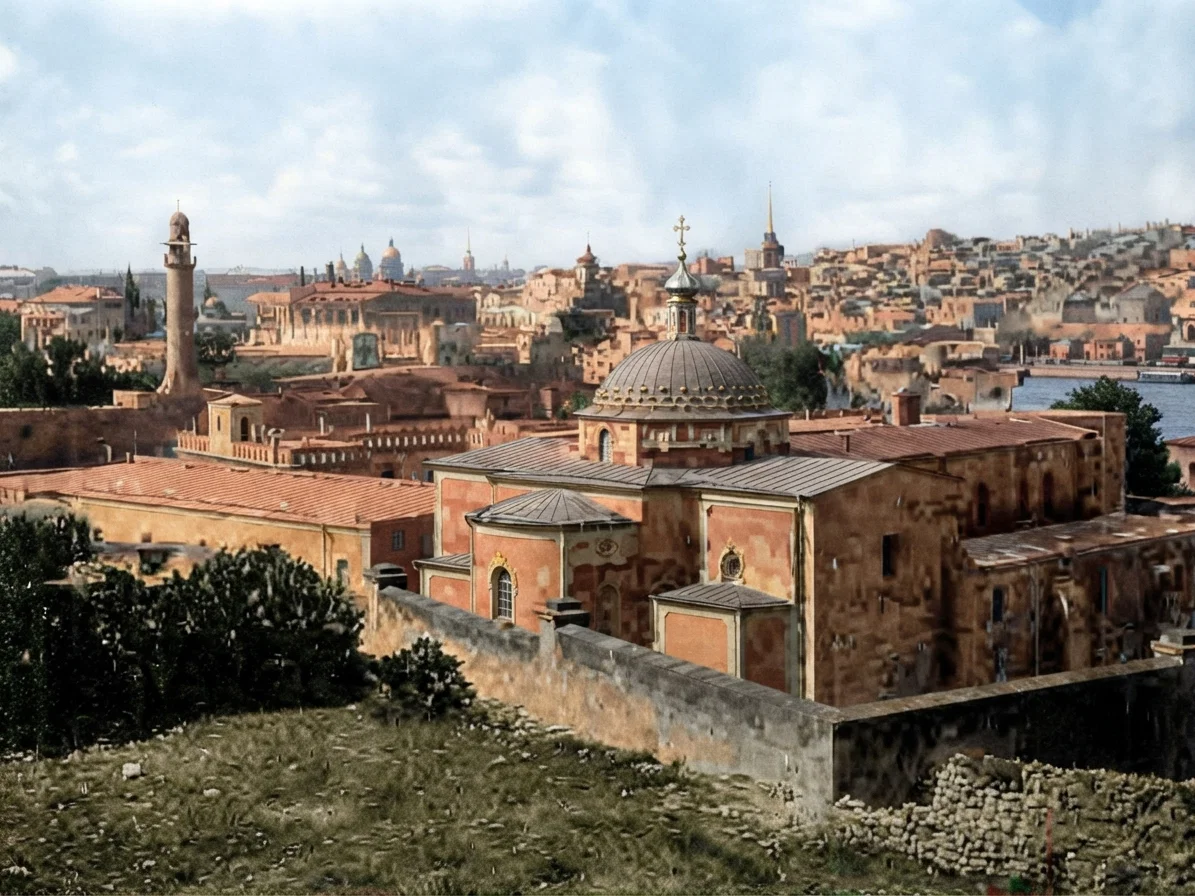
Palace of Paul I, Czar of Russia, Assassinated 1801.