— Austria plans $25,000,000 worth of public works, to relieve the depression in that country.
— The President decides to confine the official season at the White House to the month of January.
— The window-glass-trust factories, employing 15,000 men, resumed operations the 31st ult., after an idleness of five months.
— An Anglo-Russian alliance is urged “by writers in the National Review, who are conversant with the views of British Cabinet members.” In such an event, where would the United States come in?
— The ant, it is said, should receive much credit for the great fertility of Egypt. If these little creatures did not break up the alluvium deposits of the Nile into very minute particles, the soil would not be nearly so valuable for agricultural purposes.
— Dispatches from Manila state that the 700 school-teachers recently sent there from this country “find that without the commissary privileges their salary of seventy-five dollars per month cannot keep them in food. Very few, if any, of them can speak Spanish, and there is no prospect that they will ever learn to understand Tagalo.” Captain McLean, surgeon of the United States hospital at that place, writes that “it will be cheaper for the government to bring all the Filipinos to the United733States than to carry out this scheme,” and, to use his exact words, the teachers have raised “more powwow and disturbance than the whole army did during the palmy days of the insurrection.” Of course this is only one side of the story.
— A London dispatch of the 24th states that the British War Office “has distributed to the police offices throughout the kingdom, bills ordering all reservists, militia, yeomen, and volunteers to report themselves without delay to headquarters, with the view of active service.” A letter accompanied the bills, ordering them to be “kept in a safe place until telegraphic orders to post them up” were received. However, “the police of Lancaster overlooked the letter and posted the bills, causing wide-spread perturbation.” England is thus preparing for all emergencies.
— According to the Truth Seeker, of New York, a Baltimore woman has been obliged to apply to the police “for protection from her neighbors, who accuse her of being a witch, and persecute her accordingly.” “Baltimore,” says the same journal, “is the hotbed of Catholicism, and no outbreak of delusion should excite wonder.” While this is true, yet who shall undertake to say that there are not, in our day, persons who are possessed of the devil, as in the days of Christ? But no man should attempt the impossible task of driving out the evil spirit with carnal weapons. The Spirit of God alone can do that good work. A. J. B.
ILLUSTRATIONS OF ACCEPTABLE SERVICE.
By David Paulson
DAVID PAULSON, M. D.
(November 17-23.)
THERE is no one who has carefully examined the foundation stones which God laid for this entire reformatory movement, but must be convinced that Providence intended this whole people to stand before the world as a medical missionary denomination. Although the path of the early pioneers in this message was not illuminated with such brilliant rays of light as now dazzle our eyes, they eagerly caught the few rays of light that came to them, and passed them on to their fellow men by voice, pen, and act.
Our leading workers in those days wrote just as stirring articles in reference to the gospel of physical salvation as they wrote upon that phase of the gospel that pertains to the soul. Those men dug deep into the mine of truth, and consequently they both preached and lived reform. At a Western camp-meeting over twenty years ago while Elder James White was preaching the truth from the platform, the word was passed to him that a man had just been drawn out of the river, apparently drowned. He left the desk and repaired to the spot, and without a moment’s delay put the patient into precisely the proper position, and administered artificial respiration just as intelligently as he preached the life-saving gospel a few moments before to saints and sinners.
These old pioneers have either died or have become too feeble to continue the work which God committed to their hands, and which should have long ago lightened the whole earth with its glory. Almost a new generation has arisen, but many of them apparently do not “know Joseph.”
The most scientific singing or talking is not positive evidence of a spirit of true service. These may be cheap fruits that are easily tied on, and which the unconsecrated heart can readily imitate, and sometimes they have been passed off for the genuine for a considerable length of time.
It is now becoming extremely popular on the part of many to perform all their services through the agency of various boards or committees, or, in other words, by proxy. There are thousands of people who feel perfectly satisfied when they have shifted the personal responsibility that they owe to their fellow man upon the shoulders of some one else. It is not without significance that it is said of almost every man with whom Christ came in contact in His ministry that He touched him. He might have appointed a committee for the purpose of relieving the distressed, but in that case His work could never have been such a perfect illustration and example of what acceptable service really is,—that service in which the reliever comes into contact with the one to be relieved.
There are three great armies marshaling in the field. The largest of these is marching toward the graveyard, another is directed toward the prison cell, while the third is on its way to the lunatic asylum. The numbers that make up each of these armies are appalling. If the Lord did not especially raise up this people to labor to disperse these three armies, and out of them organize another army which is to march with triumphant step toward the city of God, then we have absolutely no excuse for existence.
It is a great thing to raise a person from the dead, but it is a still greater thing to impart to a well person certain life-saving principles, which, if adopted, will prevent him from dying. If we hold our peace at this time, then shall deliverance arise from another place, but we and our father’s house shall be destroyed, for who knoweth but that we are come to the kingdom for such a time as this? The world needs to know something that they are not receiving; and if we, like Hezekiah, fail to be true to our trust, then the Lord will raise up Daniels who will be faithful exponents of the reformatory truths that the world must have at this time.
Nehemiah’s work is a good example of acceptable service. He built a wall in troublous times. This is precisely what we, or some one else if we fail to do our work, must do. His enemies scoffed at his efforts to “revive the stones out of the heaps of the rubbish,” and we shall meet with scoffing when we begin our work for the outcast and the downtrodden. There will be those who will indulge in slighting remarks in reference to those who are trying to do their duty toward lost humanity. Nehemiah’s workmen wrought with one of their hands in the work, and with the other hand held a weapon. This is unlike some workers to-day, who leave their Bibles at home. Half of the laborers worked while the others held the weapons of warfare. Very menial service, indeed, but it was just as acceptable in the sight of God as was the service of those who had the more practical work of building the wall. Such a spirit of intense earnestness had taken possession of these workmen that they did not put off their clothes “saving that every one put them off for washing.” Neh. 4:23. No one would have needed to camp in the vicinity of this work for several weeks in order to discover that these people had a special work on their hands.
Gideon had only a comparatively few men to begin with, and from a human standpoint they were not too many, but he had too many of the wrong kind. When the proclamation had been given for those who were fearful, to return, the largest number of those who remained, although they possessed enough bravery, did not have enough of the real self-sacrificing spirit to make their service acceptable. As they passed down by the water, a small number of them hastily scooped up to their mouths a few handfuls of water, and passed up over the hill, filled with the spirit of battle; while the greater number, undoubtedly, carefully and cautiously gathered grass and leaves to put under their knees so as to make it as comfortable as possible for themselves as they drank, thinking that they might not have such a good chance again, and had better get as much comfort out of life as they could while it lasted. But there were a few who had so entirely forgotten themselves that in the great crisis the only thought that filled their minds was “the sword of the Lord, and of Gideon.” It did not occur to them to mention anything in reference to themselves; they needed neither credit nor flattery to inspire them to perform their services.
David declared of Jonathan that his love “was wonderful, passing the love of women” (2 Sam. 1:26); nevertheless, he was so imbued with the spirit of acceptable service that in a national crisis, he, with only his armor-bearer, was willing to brave what must have appeared as certain death before the enemy. But as a result of this personal effort, the Scriptures declare that “there was trembling in the host, in the field, and among all the people: the garrison, and the spoilers, they also trembled, and the earth quaked: so it was a very great trembling.” 1 Sam. 14:15. This remarkable object lesson of personal service inspired the backslidden Hebrews who had gone over to the Philistines, to return and take their places with their brethren, and also those who had been so timid as to hide among the mountains, came and followed hard after the Philistines into the battle.
Like causes always produce like effects. When the Spirit of the Lord shall have had an opportunity to take similar possession of our lives so that we shall be led to move against the enemy in the same effective manner as Jonathan did, then the multitudes who have become discouraged by the prevailing lethargy, shall receive fresh courage again to take their position in the ranks of God’s people.
We do not have to fight the Philistines as Jonathan did. We have a greater work than that. Our work is to fight those wrong habits that laid twenty-seven millions of people in this nation on beds of illness last year. With the help of God we must contend against the prevailing indifference that exists in regard to God’s claims upon humanity, not only physically but also spiritually; and when we become mightily stirred in regard to our duties, then we shall see a wall again reared, because it can then be truthfully said that the people have a “mind to work.”
QUESTIONS.
1. After studying carefully the origin of this work, in what light was it their privilege to have it set before the world?
2. Compare the Christian with the worldly method of dispersing charity, and state your own convictions as to the relative merit of each plan.
3. Into how many great armies is society to be enlisted? In which of these are you enlisted?
4. From a practical standpoint, which is the greatest gift to possess—the ability to raise the dead, or a disposition to teach the people methods of living which prevent unnecessary deaths?
5. How many helpful truths have you succeeded in extracting from the fourth chapter of Nehemiah?
6. What purpose do you think God expected to accomplish by having the seventh chapter of Judges placed on record?
7. What beautiful example do we have in the Bible which illustrates the fact that a man’s heart may be full of the tenderest love, and yet he have sufficient moral courage to do personal work for others?
8. Try to estimate how many premature deaths would have been prevented, and how many of those who are now wretched invalids would be rejoicing in physical and spiritual health, if each one of us had been true to the trust God has committed to this denomination.
9. Are you going to permit God to raise up others to do your work, and then eventually wear your crown?
THE GIRL WHO SMILES.
By Mary A. Gillette
The wind was east, and the chimney smoked,
And the old brown house seemed dreary;
For nobody smiled, and nobody joked,
The young folks grumbled, the old folks croaked,
They had come home chilled and weary.
Then opened the door, and a girl came in;
Oh, she was homely — very;
Her nose was pug, and her cheek was thin,
There wasn’t a dimple from brow to chin,
But her smile was bright and cheery.
She spoke not a word of the cold and damp,
Nor yet of the gloom about her,
But she mended the fire, and lighted the lamp,
And she put on the place a different stamp
From that it had without her.
Her dress, which was something in sober brown,
And with dampness nearly dripping,
She changed for a bright, warm crimson gown,
And she looked so gay when she so came down
They forgot that the air was nipping.
They forgot that the house was a dull old place,
And smoky from base to rafter,
And gloom departed from every face,
As they felt the charm of her mirthful grace,
And the cheer of her happy laughter.
Oh, give me the girl who will smile and sing
And make all glad together!
To be plain or fair is a lesser thing,
But a kind, unselfish heart can bring
Good cheer in the darkest weather.
— Mary A. Gillette.
ACCUMULATED INFORMATION.
By Kate Bailey
KATE BAILEY. (Brainerd, Minn.)
When the REVIEW comes to hand, I always turn to the Home department first, and then the General Articles. I am always grateful to our brethren and sisters who contribute their articles to the REVIEW.
I found a few useful things, and also other things that come handy, the knowledge of which I always take a pleasure in bringing to my friends with whom I come in contact. I have been for a long time impressed to write about these things for the REVIEW, but being a deaf-mute, I shrank through the lack of my command of language. I became encouraged to take this step when the REVIEW extended its invitation to us to write something, assuring us that even a line of valuable information would be accepted.
What would become of the dear REVIEW if our people would follow their inclinations to keep silent through shyness, as I did? I believe this to be selfishness.
I was interested in Sister Priddy's article on “Care of the Hair.” Let me add one thing to it by telling that the tar soap has cured me of the itching scalp, and also my nieces. I had been more or less troubled with this for about fifteen years. I often washed the scalp with Castile and Ivory soap, and rubbed it with some lotions, such as alcohol and castor oil, sulphur and water, glycerine and kerosene oil, etc. Sometimes they gave me but a temporary relief, and often failed. Last fall I asked the druggist in Brainerd for a remedy for that trouble. He showed me a bar of tar soap. After a second wash with it, I was relieved for a long time. Since the third wash I took last winter, I have not had the itching scalp. My niece was relieved not only of the itching scalp, but also of falling hair. Having met some friends who have this trouble, I am led to think there may be others among the readers of our paper who have the same. Don't ask for tar soap of a grocer, but of a druggist. It is fifteen cents a bar.
When you are stung by bees, make a good mudball, apply it to the sting, and the pain will cease.
I found a way to make blueberries last twice as long by using cornstarch. In one quart of the berries, pour one quart of water. Moisten some cornstarch—about two heaping tablespoonfuls to two quarts—in the same way as for starching clothes, and be careful not to make it too thin. Stir it into the boiling berries, and boil a few minutes. Thin cornstarch does not thicken them very well. Berries of other kinds, when prepared in this way, do not always look as well as blueberries, which are of a dark color.
One cup of prunes, two of raisins, half a cup of tapioca, and one of sugar will make two quarts of fruit soup, or sauce. Steam the tapioca till it is dissolved, cook the prunes till nearly done, and cook the raisins half an hour. They may be steamed. Take more than two quarts of water. Dried plums may be substituted. When they were plentiful, I dried them after cooking and sweetening them. This is better than drying them raw. Squashes and pumpkins are excellent when dried after being cooked or baked, and when soaked, are ready for use.
Last summer pin-cherries were plentiful. Berries of all kinds were killed by the drought in May and June, but pin-cherries thrive better in dry weather than they do in rainy weather. To preserve the cherries for winter, I boiled them about one hour in water enough to cover them. Then I drained the juice through a colander, and put in sufficient sugar to make it sweet. After the sugar was dissolved, I canned the wine. In winter when butter was scarce, I thickened it with cornstarch in the same way I did the blueberry sauce. It looked like jelly, and did not taste too strong and sweet, as does the genuine jelly in which “one pound of sugar to one pound of fruit” is used. I made wild grape wine in the same way. It is less expensive than jelly. Some people prefer to dilute the wine with a little water.
I read in the Farm, Stock, and Home a recipe for canning fruits with cotton batting, and tried it. Apples, grapes, wine, and berries have been canned with good success, but tomatoes failed. The wine in some bottles was perfect, and in others there was mold on the top. In the berries there was mold always, but below the mold the fruit was all right. Can the fruit as hot as for sealing in glass jars, put into any vessel or bottle, and quickly cover the mouth with a piece of stiff paper (never newspaper), and lay on it a piece of cotton batting, such as is used for comforters, cover it with another piece of paper, and wind all together around the neck very tightly a dozen times, so as to exclude microbes. The pieces of these materials should be larger than the mouths of the vessels. I found this method very handy when glass jars were all used, and berries were plentiful, and the bottles and vessels without sealing caps were many.
I read Elder Butler's letter to the REVIEW with deep interest and sympathy. I have always believed the Testimonies and read them all. Every time I have slighted or deviated from any of them, I have felt a loss of God's blessing, and failed in more points. Surely, blessed are they that give heed to the Testimonies. Which of the Ten Commandments did King Saul disobey?—None directly, but the testimony of God through Samuel. “For rebellion is as the sin of witchcraft, and stubbornness is as iniquity and idolatry. Because thou hast rejected the word of the Lord, He hath also rejected thee from being king.” 1 Sam. 15:23. Are we not in danger of being rejected of God for rejecting the Testimonies for our Church?
Lately I have read “Power for Witnessing” with great interest and profit, and recommend it to all the readers of the REVIEW.
Trailing Skirts and the Health Warnings Against Them
By L. A. S.
THE truths which were pointed out many years ago to Seventh-day Adventists concerning the evils of wearing long dresses which drag in the dust of the streets and walks, are now fully recognized by the world, and in some places this unhealthful style of dress is discouraged by society, and even by the civil authorities. For example, this is how they do in Germany, as mentioned by the Springfield (Mass.) Republican:—
“The campaign against women’s trailing skirts as communicators of disease is lively in Germany735many, and municipalities are prohibiting them. Women wearing such skirts are not allowed to enter the gardens at Ems, and the decision as to the proper length rests with the keeper. Dresden puts notices on the trees that wearers of trailing skirts will be fined.”
Long before the important part played by germs in the communication of disease was known and established in sanitary science, Seventh-day Adventists were warned against the danger of wearing trailing skirts. It is now seen that they enjoyed the privilege, which perhaps they did not all appreciate, of being years in advance of the scientific world in this important matter. L. A. S.
COW'S MILK AND TUBERCULOSIS.
By L. A. S.
The opinion of the eminent Dr. Koch, of Berlin, that tuberculosis is not transmissible from the milk or flesh of cows to human beings, comes far short of meeting with universal acceptance. Many contradictory views are expressed, and among these is one which comes to us from the Michigan State Board of Health, in the Teachers' Sanitary Bulletin. The subject of the “Infectiousness of Milk of Tuberculous Cows” is quite fully considered, and examples are cited to sustain the conclusions reached. The following conclusions were arrived at:—
“ 1. Milk of tuberculous cows is liable to be infected with tubercle bacilli.
“ 2. Milk is especially liable to be infectious when from a cow that has tubercular disease of the udder.
“ 3. Milk infected with tubercle bacilli is known to cause the death of calves fed on it; also the death of pigs fed on it.
“ 4. There is reason to believe that milk infected with tubercle bacilli causes the death of many children, and tubercular disease of many other children, fed on such milk. The great proportion of deaths from tubercular disease of the bowels, and from tubercular meningitis, in children at the ages when usually fed on cow's milk, is corroborative evidence of this.
“ 5. Tuberculosis is not usually transmitted from cow to calf by heredity.
“ 6. At the present time tuberculosis is not caused by the timothy bacillus, nor by any saprophyte; the disease is caused by the bacillus tuberculosis, which is a true parasite; and the disease is spread (directly and indirectly) only from infected animals and persons.
“ 7. Tuberculosis in cows is easily restricted.
“ 8. As a measure of pecuniary economy to citizens of the State, and also in the interest of the public health, it is the imperative duty of the State to promptly take such action that tuberculosis in cows shall be restricted; and that the present very considerable and unnecessary waste of human life because of infected milk shall be stopped.”
Although doctors disagree on this subject, it is certainly best to be on the safe side, and heat all milk not positively known to be free from tubercular germs, to the boiling point, before using.
L. A. S.
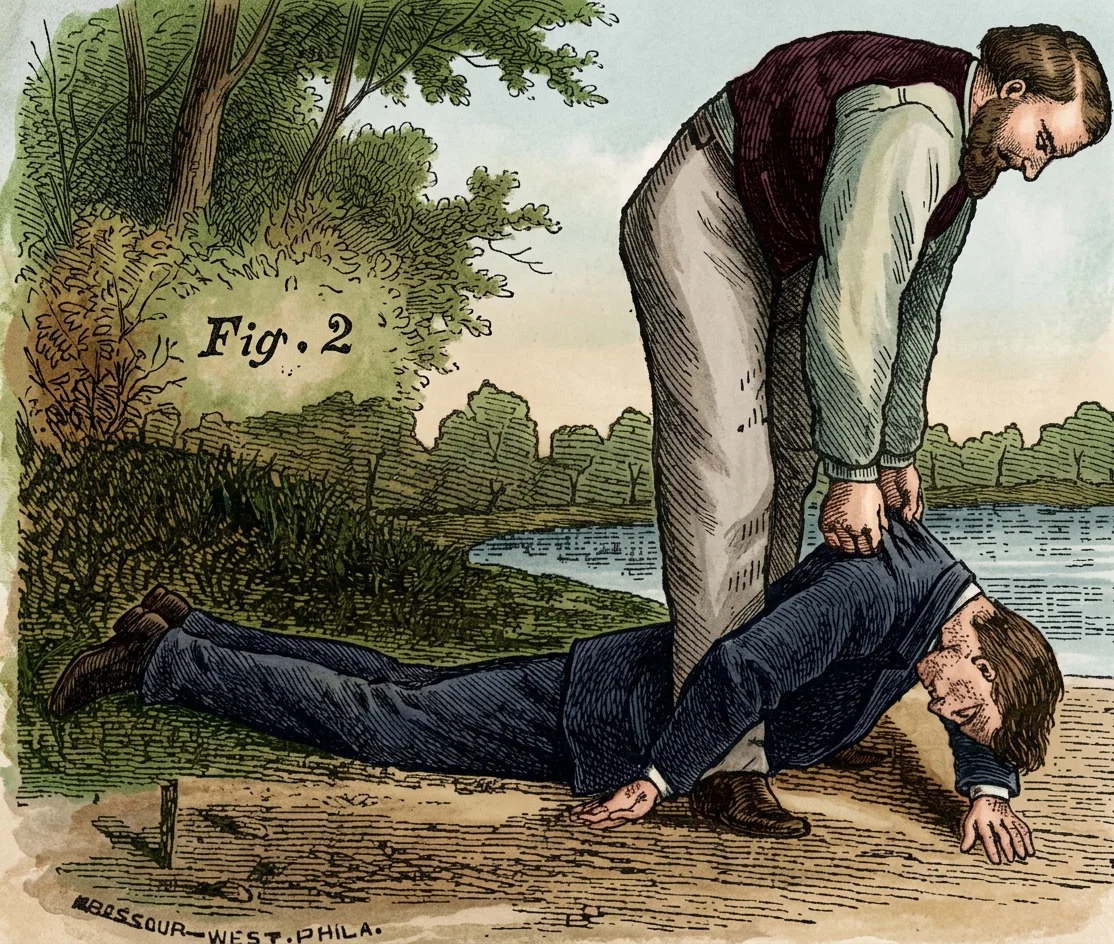
TREATMENT OF THE DROWNED, SUFFOCATED, OR ELECTRICALLY SHOCKED.
Restore Breathing; Restore Animal Heat; Restore the Circulation of the Blood.
The following method and rules, devised and prepared by the Committee on Accidents, etc., being a modification of rules furnished by Dr. Beech, of Coldwater, and of those published by the Life Saving Society of New York, have been adopted and printed by the State Board of Health of Michigan, for distribution throughout the State, as a life-saving measure. Any communication upon the subject may be addressed to Office of State Board of Health, Lansing, Mich.
Fig.1.
RULE 1.—Remove all obstructions to breathing. Instantly loosen or cut apart all neck and waist bands; turn the patient on his face, with the head downward; stand astride the hips with your face toward his head, and, locking your fingers together under his belly, raise the body as high as you can without lifting the forehead off the ground (Fig. 1), and give the body a smart jerk to remove mucus from the throat and water from the windpipe; hold the body suspended long enough to slowly count one, two, three, four, five, repeating the jerk more gently two or three times. Then act by Rule 2.
Fig. 2
RULE 2.—Keep the patient face downward, and maintaining all the while your position astride the body, grasp the points of the shoulders by the clothing, or, if the body is naked, thrust your fingers into the armpits, clasping your thumbs over the points of the shoulders, and raise the chest as high as you can (Fig. 2) without lifting the head quite off the ground, and hold it long enough to slowly count one, two, three. Replace him on the ground, with his forehead on his flexed arm, the neck straightened out, and the mouth and nose free. Place your elbows against your knees and your hands upon the sides of his chest (Fig. 3) over the lower ribs, and press downward and inward with increasing force long enough to slowly count one, two. Then suddenly let go, grasp the shoulders as before, and raise the chest (Fig. 2); then press upon the ribs, etc. (Fig. 3). These alternate movements should be repeated from ten to fifteen times a minute for an hour at least, unless breathing is restored sooner. Use the same regularity as in natural breathing.
Fig. 3.
Do not give up too soon. You are working for life. Any time within two hours you may be on the very threshold of success without there being any sign of it.
RULE 3.—After breathing has commenced, restore the animal heat. Wrap him in warm blankets, apply bottles of hot water, hot bricks, or anything to restore heat. Warm the head nearly as fast as the body, lest convulsions come on. Rubbing the body with warm cloths or with the hand, and slapping the fleshy parts, may assist to restore warmth, the circulation of the blood, and the breathing also. The rubbing of the limbs should always be from the extremities toward the body. If the patient can surely swallow, give hot coffee, tea, milk, or a little hot sling. Give spirits sparingly, lest they produce depression. Place the patient in a warm bed, and give him plenty of fresh air; keep him quiet.
Avoid delay. A moment may turn the scale for life or death. Dry ground, shelter, warmth, stimulants, etc., at this moment are nothing,—artificial breathing is everything,—is the one remedy,—all others are secondary.
Do not stop to remove wet clothing. Precious time is wasted, and the patient may be fatally chilled by exposure of the naked body, even in summer. Give all your attention and effort to restore breathing by forcing air into, and out of, the lungs. If the breathing has just ceased, a smart slap on the face, or a vigorous twist of the hair will sometimes start it again, and may be tried incidentally, as may, also, pressing the finger upon the root of the tongue.
Before natural breathing is fully restored, do not let the patient lie on his back unless some person holds the tongue forward. The tongue by falling back may close the windpipe, and cause fatal choking.
If several persons are present, one may hold the head steady, keeping the neck nearly straight; others may remove wet clothing, replacing at once clothing which is dry and warm; they may also chafe the limbs, rubbing toward the body, and thus promote the circulation.
Prevent friends from crowding around the patient and excluding fresh air; also from trying to give stimulants before he can swallow. The first causes suffocation; the second, fatal choking.
In suffocation by smoke or any poisonous gas, as also by hanging, proceed the same as for drowning, omitting effort to expel water, etc., from windpipe.
In suspended breathing from effects of chloroform, hydrate of chloral, electric shock, etc., proceed by Rule 2, taking especial pains to keep the head very low, and preventing closure of the windpipe by the tongue falling back.
SOME RECIPES CALLED FOR.
By L. A. S.
A correspondent writes us from Virginia, asking if we cannot tell him how to obtain some homemade substitutes for some of the foods manufactured in Battle Creek, which cost more than some people can afford to pay. He says:—
“I notice with pleasure several recent articles, formulas, etc., in the REVIEW, calculated to encourage common folks in the practice of health reform. It seems to me that the objections to a diet of mush should be kept ever before our people. I find but few who are not still eating their grains in that form, and nearly all seem surprised that I do not consider oatmeal and grits an ideal diet.
“There must be homemade substitutes for the more important high-priced sanitarium foods. It has been so stated at General Conference and other public gatherings of our people. The essential directions for making such substitutes have been published over and over in Good Health, we are told, but they have been overlooked by the most of us; so you will be doing real service to your readers if you can make it clear that one can be a reformer and yet not eat foods from Battle Creek.
“We get peanuts here at from three to four and one-half cents per pound; corn, rice, wheat, etc., at farmer’s prices. It seems absurd that we should be urged to buy prepared wheat, corn, and nuts at ten times (more or less) these prices. The prepared foods are good. People who are accustomed to high-priced hotels, etc., can no doubt be reached, and in many instances the whole gospel in this manner be set before ‘the neglected rich;’ but I protest against teaching no one but the rich. So I say to you, Give us precept upon precept, fact upon fact, to wean our people from meat and mush, and to show them the better ways of cooking. W. C.”
We have no recipes at hand for making the substitute preparations here called for, but it is probable that many of our readers could give valuable information in this line, and we have printed this to set the matter before them, and invite them to contribute such information for the columns of the REVIEW. We shall hope to have a number of responses to this invitation.
L. A. S.
Dangers of Impure Antitoxine in Diphtheria Treatment
By L. A. S.
The necessity for great care in the use of antitoxine for the treatment of diphtheria is shown by the report of the death of eleven children in St. Louis, Mo., from tetanus, or “lockjaw,” as it is commonly called, as the direct result of having been inoculated with this preparation. The pure antitoxine is harmless; but in this case it was impure and contained the germs which speedily brought on the fatal malady. L. A. S.
Asking Everything of God in Prayer
“It is our wisdom to believe ourselves permitted and encouraged to ask anything and everything of God, with the single reserve of submission to His wiser and better will. Are you poor? Ask your Heavenly Father, and He will either give you riches or make poverty a greater blessing. Are you sick? Ask God; and He will either grant you recovery or give you reason to praise Him forever for every pang you suffer. Are you embarrassed and perplexed in your worldly affairs? Ask God, and He will either deliver you from trouble or make it the means of bringing peace and joy into your soul. Are you in want of anything? Go to your best Friend, pour out the full tale of your sorrows into His attentive ear, and be not afraid to believe that He will give you to drink of the infinite river of His own pleasures.”
Growing Distaste for Coarseness in the Believer
“IN one who is learning of Jesus there will be manifest a growing distaste for careless manners, unseemly language, and coarse thought.”