The Youth’s Instructor, Vol. 37, No. 24.

SITTING AT JESUS’ FEET

The Youth’s Instructor

Jun 12, 1889

S. D. A. Publishing Association · Battle Creek, Mich. · Jun 12, 1889

SITTING AT JESUS’ FEET.

“And she had a sister called Mary, which also sat at Jesus’ feet and heard his word.” Luke 10:39.
In far Palestine, in Bethany’s home, Where the Saviour paused on his toilsome way, A loving woman crept close to his side, To wait for the precious words he would say As she sat at his feet in the twilight.
The words, as they fell from his holy lips, Brought joy and hope to her trusting heart; He blessed the service she lovingly gave For she had chosen the better part, As she sat at his feet in the twilight.
There’s a blessing for all who sit at his side When the sun’s gone down, and the day is done; In the fading light comes a ray in the soul, Like the gleam of his stars as they come, one by one, While we sit at his feet in the twilight.
When the day has been filled with worries and cares, The body is weary, the heart seems crushed With murmurs that come, at the evening hour The achings will cease, and the murmurs be hushed. If you sit at his feet in the twilight.
As the sunset’s glow fades softly away, It carries the thoughts where the light is borne, And the spirit takes the heavenly things, Bringing back a message to those who mourn When they sit at his feet in the twilight.
To the sufferer, weary with constant pain, Watching the light as it fades from the sky, Bright visions will come of the painless land The Master’s home they will reach by and by, When they sit at his feet in the twilight.
In the bright summer days, as you pass to and fro, On mountain or hamlet, or by the deep sea, In the midst of the crowd, or apart and alone, As you watch the light fade, where’er you may be, Sit awhile at his feet in the twilight. —Faith Holden.

MORE ABOUT GEYSERS.

YOU have already had printed in the INSTRUCTOR many interesting things about geysers, though to describe them all would require many pages of this paper; for they are to be found in various parts of the earth, and in some places are very numerous. The first published record of this phenomenon was in Iceland, some hundreds of years ago, and was a description of a spouting spring near Haukadal. It was named the Geyser, this word meaning, in the Icelandic language, “rager,” or “spouter.” For a long, long period there was no record of any other than the Icelandic geyser. Since others have been discovered, this has been the generic name for all intermittent spouting springs.
In the southwestern part of Iceland there are, one writer has said, “in a circuit of two miles, over a hundred hot springs, fifty or more of them in a space of a few acres. They are of different sizes, and exhibit various degrees of activity.” The principal ones among them are the Great Geyser and the Strokr. There are, besides, many vast, extinct geysers there, the water having forced a passage elsewhere, perhaps to build spouters in other localities.
It would interest you to know the “mechanism and development” of geysers; but it would require more space to explain them than can be used for this purpose in one article. I will simply say they are their own architects, as you may have opportunity to learn at some future time.
In the North Island of New Zealand, in the celebrated Lake District, is a region of hot springs, exceeding by far in extent and variety any except those of our own country. There is also in their vicinity a collection of boiling mud-pools very similar to those on the Yellowstone River above the falls; and the gay colors of the Yellowstone mud springs are sometimes seen in the New Zealand mud springs. The principal group of the New Zealand mud springs are located in a ravine about a quarter of a mile long. Dr. Hochstetter says of them:— “Inside, this ravine looks like the inside of a volcanic crater. The bare, rocky walls, threatening every moment to break loose, loom up like dismal specters. The bottom of the ravine is of fine mud, scattered with blocks of silicious deposit, like cakes of floating ice after a thaw. Here a big caldron of mud is simmering; there lies a deep basin of boiling water; next to this is a terrible hole, emitting hissing jets of steam and further on are mud-cones from two to five feet high, vomiting hot mud from their craters with dull rumblings, and imitating on a small scale the play of large fire volcanoes.”
As I have told you in a former article, it is not a quarter of a century since it was discovered that in the northwestern part of Wyoming Territory there exist some of the most beautiful, wonderful, and stupendous natural phenomena yet discovered. This is the grand geyser region of Fire Hole River, included within the Limits of our Great National Park. One writer has said that, “in a valley of a dozen miles long and two or three wide is an exhibition of boiling and spouting springs on a scale so stupendous that if all the corresponding phenomena of all the rest of the world could be brought into an equal area, the display would be as nothing in comparison.”
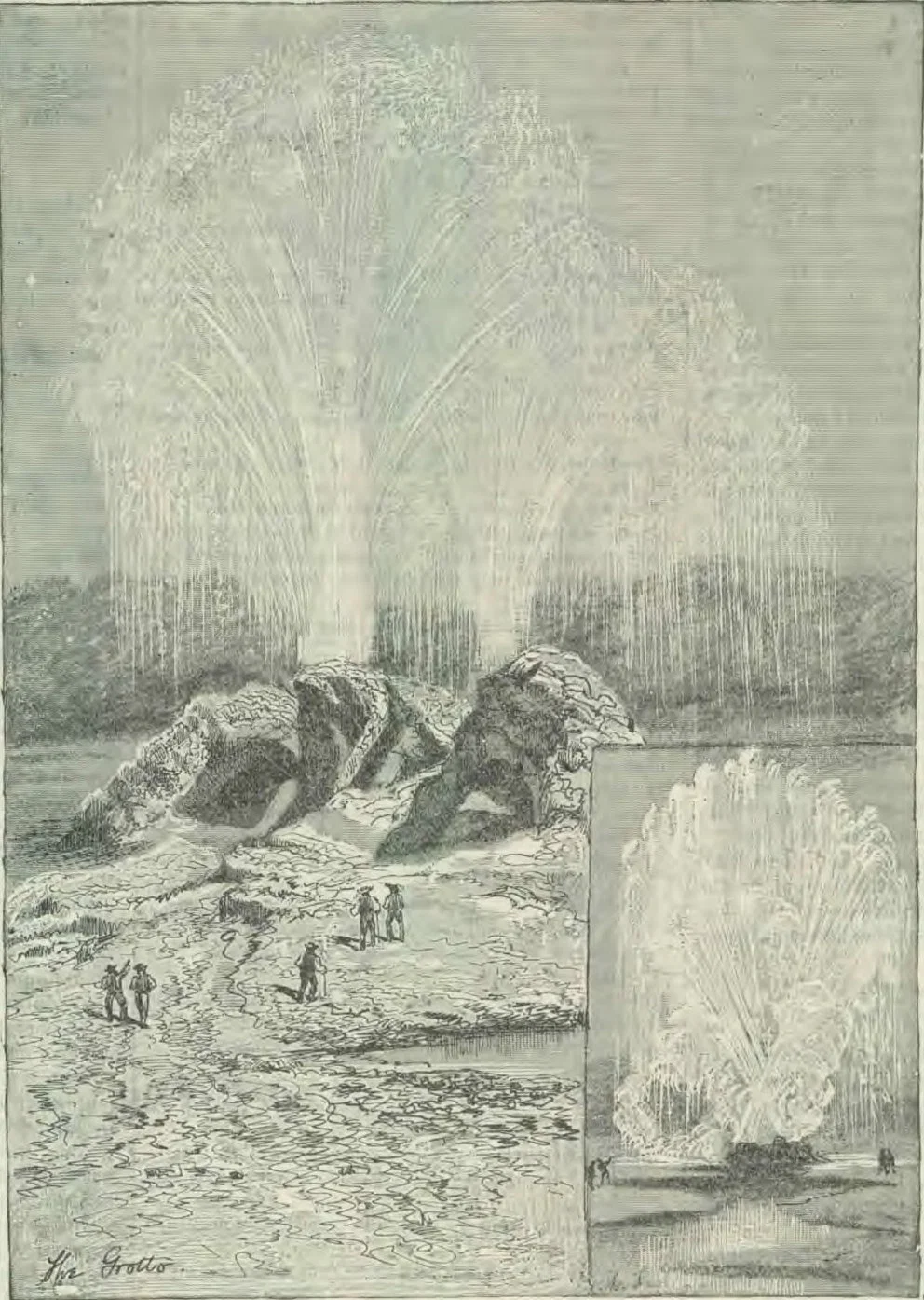
Each geyser has some characteristic that suggested a name to its discoverer, and they are called by such names as Old Faithful, Grand Geyser, Sentinel, Beehive, Saw-mill, Comet, Punch Bowl, Soda Geysers, Horn Geyser, The Grotto, Fan Geyser, etc., etc. Of the spoutings and maneuvers of some of these you have already had a description. I will only give you a word picture of the Fan Geyser, the one represented in our engraving, which is situated on the opposite side of the river, a little below the Grotto. It is stated of this that, “it has a double orifice, which discharges five radiating jets to the height of sixty feet, the falling drops and spray giving the appearance of a feather fan. The effect is very beautiful. Its eruptions are frequent, lasting usually from ten to thirty minutes.
“A vent connected with this geyser, about forty feet distant, expels dense masses of vapor fifty or sixty feet high, accompanied by loud, sharp reports, during the time the geyser is in action. Lieutenant Duane describes the curious action of these vents as follows:—
“‘First the steam would rush from the upper crater, roaring violently; then this would suddenly cease, to be followed by a fan-like jet of water rising from the lower crater to the height of over forty feet, playing perhaps two minutes; then this would suddenly stop flowing, and the steam would rush forth again for a time. Occasionally the small crater threw a transverse stream, alternating with the others; and thus they played on for hours, after which all would subside to a gentle bubbling.’”
What wonders the book of nature reveals to us! and what pleasure it would afford most any of us to behold with our own eyes the wild, the curious and beautiful, the grand and sublime scenes therein displayed. Although but few have this privilege, we all have the assurance that if we reach the immortal shore, we shall have an eternity to look upon the glory of God’s creation. May it be your lot and mine to be there. M. J. C.

A Dozen Good Rules.

WE were struck lately by the orderly behavior of a large family of children, particularly at the table. We spoke of it to their father; and he pointed to a paper pinned to the wall, on which were written some excellent rules. We begged a copy for the benefit of our readers. Here it is:—
1. Shut every door after you, and without slamming it.
2. Don’t make a practice of shouting, jumping, or running in the house.
3. Never call to persons upstairs or in the next room; if you wish to speak to them, go quietly to where they are.
4. Always speak kindly and politely to everybody, if you would have them do the same to you.
5. When told to do or not to do a thing by either parent, never ask why you should or should not do it.
6. Tell of your own faults and misdoings, not of those of your brothers and sisters.
7. Carefully clean the mud or snow off your boots before entering the house.
8. Be prompt at every meal hour.
9. Never sit down at the table or in the sitting-room with dirty hands or tumbled hair.
10. Never interrupt any conversation, but wait patiently your turn to speak.
11. Never reserve your good manners for company, but be equally polite at home and abroad.
12. Let your first, last, and best confidant be your mother.—British Juvenile.

EDISON'S WORK-SHOP.

THERE is so much said just now about that wonderful little talking-machine called the phonograph, that our young folks may like to know something of its inventor. Thomas A. Edison, when about fourteen years of age, was a train-boy on the Grand Trunk Railroad of Canada. He also edited, printed, and published a little paper of his own (called the Grand Trunk Herald), which shows that he must have been a lad of ability and energy.
Edison lives in Llewellyn Park, Orange, N. J., where a few years ago he bought a handsome house, situated on a side-hill commanding a fine view of the country between Orange and New York. Not far from his home is his work-shop. The main part is two hundred feet in length, fifty wide, and perhaps fifty feet high. There are four one-story wings, and in the rear may be seen the tall brick chimney, at the base of which are the engine-buildings.
One room in the main building is a library, elegantly furnished, and the books are scientific works intended for the use of those employed in the establishment. Lectures are also given once a week, for the benefit of the employés, in the lecture-room, which is over the library.
The room next the library would perhaps be the most interesting to us; for here in closets, drawers, and bottles are to be found samples of almost “everything imaginable.” All kinds of feathers and furs, snake-skins, bones, and teeth of such creatures as narwhals, rhinoceri, and sharks; gums and spices, etc. The reason for having such a collection is that Mr. Edison has to try a great many things in his experiments before he finds the right one; and he does not wish to wait to send to Africa for an ostrich feather, or to Labrador for a seal’s tooth, when he happens to need one.
There are rooms where machinery is made, a chemist’s room, testing-rooms, and many others which we have not the space even to mention; but we must speak, in closing, of the photographer’s studio. Here may be seen pictures of the phonograph as it was fifteen years ago, by the side of the perfected machine of to-day, and many other interesting things. But the most wonderful thing about this room is that the pictures of patented inventions that hang on these walls, though numbered by hundreds, are all the work of one man.—Sel.

MAMIE'S INFLUENCE.

LOUISA was by no means a model girl when she first came to Miss Greyson's school. She stared, she laughed in people's faces, she was rough in her ways and untidy, and what was far worse, idle, impertinent, and willfully disobedient.
But Mamie Kendall became her seatmate, and before they had been many weeks together, there began to be a change in Louisa, which went on until some of her faults had disappeared altogether, and others were greatly mended.
What was the reason of this improvement?
Mamie was a Christian. But did she rebuke her seatmate for her faults by telling her every day, “The Bible says, ‘Be courteous,’ and it is not being courteous to stare and laugh in people's faces; the Bible says, ‘Be gentle,’ and you must not push and elbow and make uncivil speeches; the Bible says, ‘Whatsoever things are lovely and of good report, think on these;’ if you do, you will try to be neat; the Bible says, ‘Honor to whom honor is due,’ and ‘Obey them that have rule over you,’ therefore you must respect your teacher, and mind what she says”?
No; she did not. She would not have dared to reprove Louisa for her faults; she would not even have dared to quote Bible verses to her; but she did something better—she lived the Bible before Louisa.
Mamie tried to be gentle and gracious and considerate in all her ways. She tried to be neat in her appearance, because she knew that she was God's temple. She was industrious and respectful out of love to God and those whom God had set over her. All this Mamie did day by day; for God has bidden us thus to live, and she asked for his help, and received it.
Her conduct had great effect upon Louisa. First, it surprised her; for poor Louisa had never before come in close contact with a genuine Christian child; then Mamie's life became a mirror to her, in which she saw how unlovely was her own behavior. Louisa began to be ashamed of some of her actions and to try to leave them off. So the good influence went on all winter; and who can say how far it may reach into her future, or how it may alter her whole life?
There is power in a right example; and there is no little girl who may not, in the school-room or the home circle, or among her acquaintances, help some child, as Mamie did, toward gentleness and obedience and Christ-likeness.—Ex.

The Little Martyr of Smyrna.

It was in the fateful ages when the Christian martyrs died, And the gods of high Olympus in their glory were defied,— When, throughout the Roman Empire, there were festivals and feasts, Where great Jupiter was lauded by his pontiff and his priests,— It was in these tragic ages, that with Bacchanalian songs, Through the streets of fair Smyrna surged one day the maddened throngs. “Find us Polycarp, the Christian!” rose the wild, discordant cries: “To the lions with the Christian! By the gods of Rome, he dies! Drag him forth to the arena! Let the beasts devour their prey, Lest he swear by Rome’s great Caesar, to forsake the Christ this day!”
So the mob, in growing fury, surged the streets with swelling roar, But the Bishop of Smyrna found they not at any door.
It was then a soldier pointed to a sunny-headed child, On whose boyish face the beauty of his dozen summers smiled. “Ask of him,” the ruffian shouted; “ask the lad; he knows him well; In his home the man sought refuge. Ask the lad, and he shall tell.”
So they turned like wolves upon him, fierce for prey, and hunger-mad. And he stood a lamb among them, though a lion-hearted lad.
“Knowest thou of any Christians? or where Polycarp be found?” Cried a Roman soldier fiercely, as upon the child he frowned. And the boy his pale face lifted, with his fearless, fair blue eyes, In whose depths life’s hopes were dawning, like the morn in cloudless skies; And there seemed a sudden halo round the brave but youthful head, “If thou seekest but for Christians, I am one,” he fearless said.
“What! oh, ho! thou bold-tongued nursling!” cried the first with fiercer frown. “Make no boastings, or, by Olympus, thou shalt burn ere sun goes down!” “Lead us hence. We seek thy bishop, Polycarp, that evil knave. Dare refuse, and to the lions thou shalt go, and naught shalt save!”
Then the boy’s face flushed indignant; “Call him not a knave!” he cried, “He is Bishop of Smyrna, servant of the Christ that died.”
Then a cruel arm uplifted, smote him sudden to the ground, And the soldiers, mad with fury, gathered eagerly around.
“Fool! Thy hasty blow hath slain him,” cried a guard. “It was too soon!” “Nay,” another sneering answered, “drag him forth: he doth but swoon. Doth he think to move our pity by his tears and weakling cries? Drag him forth! His lips shall answer, or from worse than this he dies! See! he moves: he was but fainting. He shall tell us all he knows. What! defeated by this youngling, we who brave the fiercest foes? Now, then, speak, thou stubborn traitor, where shall Polycarp be found? Say the truth, lad, or thou diest as thou liest on the ground.”
Then a gleam of saintly beauty lit the simple, childish face, And the look of pain and anguish to a heavenly calm gave place. “Him ye seek to slay is noble, and he serves the Christ that died. Kill me if you will, but never will I tell where he doth hide!”
Turn away, O ye that witnessed, ye who saw that deadly blow, Was it man who struck, or demon? Answer not—God’s angels know. So the awful lot was chosen; so the cruel fate was told: And that even, when the sunset crowned Smyrna’s hills with gold, On his weeping mother’s bosom, with the smile that death had given, Lay the bruised and martyred body. And God noted all in heaven. —Youth’s Companion.

HOW SHE CONQUERED.

George Paul, a young civil engineer, while surveying a railway in the Pennsylvania hills, met a plain, lovable little country girl, and married her. After a few weeks, he brought her home to his family in New York, and left her there while he returned to camp.
Marion had laid many plans to win the affections of her new kinsfolk. She had practiced diligently at her music; she was sure they would be pleased to hear her stories of her beautiful sister and her brother; she imagined their admiration of her new blue silk gown and winter bonnet.
But the Pauls, one and all, were indifferent to her music, her family, and her gowns. They gave “George’s wife” a friendly welcome, and then each went on his way, and paid no more attention to her.
After the first shock of disappointment, Marian summoned her courage.
“If I have nothing to give them, they have much to give me,” she thought, cheerfully.
She listened eagerly while Isabel sang, and her smiles and tears showed how keenly she appreciated the music. She examined Louisa’s paintings every day with unflagging interest, discussed every effect, and was happy if she could help mix the colors or prepare the canvas. She questioned grandma about her neuralgia, advised new remedies, or listened unwearied to the account of old ones day after day.
When Uncle John, just returned from Japan, began to describe his adventures, Marion was the only auditor who never grew tired nor interrupted him. After a two hours’ lecture, in which her part had been that of a dumb, bright-faced listener, Uncle John declared that George’s wife was the most intelligent woman he had ever met.
When George came home, the whole family were loud in her praises. She was a fine musician; she had unerring taste in art; she was charming, witty, and lovable; but George soon saw that she had won them unconsciously, not by displaying her own merits, but by appreciating theirs.
This is a true story in fact; but the truth of its meaning is repeated wherever a woman is found who has the intangible quality called “charm.” She may be deformed or pock-marked, but will win friendship and love by the lack of self-consciousness, by her quick sympathy with others.
Many an unattractive girl would save herself much anxiety and vain effort at her entrance into the world of society, if she understood that it was made up of individuals, each of whom desired to find not the beauty, wit, or talent of others, but the cordial recognition of their own.
If you can honestly forget yourself, and take an interest in others, you will soon find yourself surrounded by hosts of friends; but if you dishonestly affect this interest, you will deceive no one. Your dullest companion will recognize you as a snob and a toady.—Companion.

TONG WING.

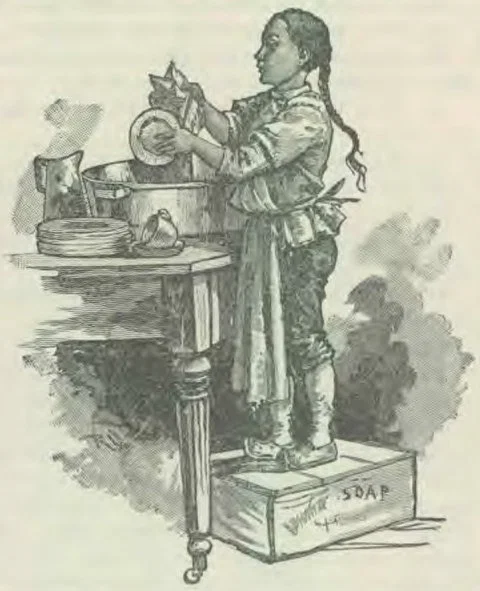
TONG WING is a little Chinese boy. He has long, narrow eyes and a round face. His hair is shaved off his head, except on the crown, where it grows long, and is braided with red silk into a long queue.
Tommy's mother keeps Tong to wash dishes, and help her about the house. He is only eight years old, and so small that he has to stand up on a box to reach the dish-pan; but he is very quick and handy, and hardly ever breaks anything.
He says he has a dear mother away off in China, and he hopes to save enough money some time to go back and see her.
Nobody seems to care for him except a tall, cross-looking Chinaman, that he calls his cousin.
This cousin comes to see him every Sunday, and little Tong always looks glad when he goes. I do not wonder; for he always says to Tommy's mother: “This boy no good, play, bleak (break) dishes, you tell me; I whip him.” And then he scowls until poor little Tong trembles in his wooden shoes.
But Tommy's mother always says, “Oh, no! he's a very good boy;” and she wonders how her own Tommy would get along washing dishes in some rich Chinaman's kitchen.
When his work is done, Tong loves to play with Tommy; and a very pleasant playmate he makes, too.
He once made a wonderful kite for Tommy. It was the best kite in town, until it fell in love with the telegraph wire, and refused to come back to earth. Tong and Tommy were in despair.
Tong made a new one, in the form of a bird. It had gold eyes, and red, blue, and yellow feathers. It was done on Tuesday, and on Wednesday morning the wind was just right. Tong wanted to go right out; for the wind might go down; but he had his dishes to wash, and it would take him an hour.
“Leave ’em on the table, Tongy; ma won’t care!” said Tommy.
But Tong shook his head, and looked sad.
“You go upstairs; me do ’em welly (very) quick,” he said. And when Tommy had gone, he piled them up in the closet, on the floor, and covered them over with the big clothes-basket. Then he coiled his queue around his head, called Tommy, and off they skipped, holding the kite between them.
When Tommy's mother came downstairs to see about lunch, she saw the basket in that unusual place. She was very much surprised to find the dirty dishes underneath.
Tong stayed out longer than he intended, and when he came in, he was frightened to find the basket gone, and the dishes washed.
His round face was very long, as he said to Tommy's mother, “You tell my cousin?”
“No,” said his kind mistress, “but you must not do that again, Tong.”
And Tong never has been naughty since.—Our Little Ones.

NELLIE'S NEIGHBORS.

“It seems to me, mother,” said little Nellie Fox, “that I haven't any neighbors to do anything for. Anything, I mean, like, ‘I was thirsty, and ye gave me drink; naked, and ye clothed me.’”
Mrs. Fox did not answer in a hurry.
“Well, little daughter,” she said presently, “I have often heard my mother say that our work was not pushed into our hands; it is our business to look for it, asking every day, ‘Lord, what wilt thou have me to do?’”
There was a little silence, and then the mother spoke again: “I don't think the poorest people are always the ones who need help. For instance, I think that Miss Temple is very poor.”
“Do you, mother?” said Nellie in surprise. “She lives in such a beautiful house!”
“She lives alone; she does not know how to make anybody, even her own servants, like her; and, so far as I know, nothing sweet and homelike ever comes into her life.”
“Do you think I could help her, mother?” asked Nellie timidly. She did not like this idea at all, but she tried to face it bravely.
“You might try,” said Mrs. Fox.
I am afraid Nellie's footsteps were very slow and lagging that afternoon, as she set out to carry Miss Temple a big bunch of purple lilacs. She was almost sure she would be turned away from the door. She rang very gently, but she had to ring many times before the door opened.
There stood Miss Temple herself, with such a frown on her face that Nellie forgot, for a minute, what she had come for.
“Well,” said the lady impatiently.
“I have brought you some lilacs, ma'am,” said Nellie, “but if you don't like them,” for she thought Miss Temple was frowning, “I'll take them back.”
But who can resist lilacs? Who is not carried back to childhood and sweet memories by the dear old-fashioned scent? Nellie presently found herself in Miss Temple's elegant drawing-room, and before she remembered it was time to go home, a shower came up, and she was quite alarmed to think that she must stay so long.
But a sight from the window made her forget herself and her nervousness about her hostess.
“O Miss Temple,” she cried, “look at that little boy and his funny umbrella!” For the small boy outside the fence had turned his coal basket over his head, and, with his hands in his pockets, was sauntering along, stopping every now and then to look about him. The raindrops and he seemed on the best of terms.
“Is he one of your neighbors?” asked Nellie, eagerly: “I wish he was one of mine.”
“What would you have such a dirty little boy for a neighbor for?” asked Miss Temple reprovingly. She had no interest in dirty little boys.
“Oh, he looks as if he would be somebody to help,” sighed Nellie; “and I haven't got any neighbors to fit that verse you know about,—‘I was naked, and ye clothed me.’”
When the rain was over, Nellie went home. “No, I didn't get wet, mother, and I had a nice time; and Miss Temple asked me to come and take tea with her next Friday, and bring Susie White with me. Instead of my having her for somebody to help,” added Nellie, laughing, “I think she's going to have me.”
But Nellie had left something at Miss Temple's that evening—a precious thing, and yet she never missed it, nor knew she had left anything. It was a tiny little desire, as small as the first leaf an acorn puts up, but a desire that would grow in the heart of the lady, and spread its leaves over Nellie herself, over the little boy under the coal-basket, and over many others—a desire to help somebody.—Morning Star.

TOMMY'S CABBAGE.

“O Uncle Peter,” said Tommy, “I do wish I could earn some money.”
“Well, why not?” said Uncle Peter. “A boy eight years old can earn money if he really wants to.”
“Yes, but how? I believe I can, if you'll only tell me what to do.”
“Well, let's see,” said Uncle Peter, as he sat down by the kitchen window and took Tommy on his knee. And what did he see? Why, two or three old, dried-up cabbage stalks in last year's garden-row. So said he, “Why not raise cabbages, Tommy? I'll pay you ten cents for every good, solid head. I'm very fond of them, and you know we can't raise them in town.”
“Hurrah!” cried Tommy. “Oh, won't I raise a pile of 'em! How many good, solid heads will make one dollar and seventy-five cents?”
“Just seventeen heads and a half, Tommy.”
“And then I could 'scribe for that paper,” said Tommy. “I shall go to work, and stick right to it, Uncle Peter. You'll see!”
And sure enough, next time Uncle Peter came to visit at the farm, Tommy had set out his cabbage plants. “I raised them myself in a little box,” he said. “I watered them and tended them, and I did have more than a hundred; but the mice ate some. And then I set out twenty-five, and most half of them wilted right down, 'cause I didn't do it careful enough. And I pulled them up, and set fresh ones in place of them, and now you see I've got twenty started anyway, Uncle Peter.”
Uncle Peter was pleased to find Tommy so much in earnest, and promised to come again next month to see how the cabbages prospered.
Well, when he came again, he found there were only ten little plants instead of twenty. Tommy was digging for cut-worms. “I shall stick right to it,” said he, “till I dig them all out!”
And the next time he came, Tommy was picking off cabbage-worms. There were only five plants left now; for the worms got a good start before Tommy noticed them. “Dear me,” said Uncle Peter, “raising cabbages seems to be up-hill work!”
“I shall stick right to it all the same,” said Tommy, “even if I don't raise but one head!”
And it turned out just that way. One thing and another kept happening, till there was only one good, solid head left. Tommy did feel discouraged sometimes, but papa told him it was worth a great deal to learn so much about raising cabbages. Besides, papa had promised to subscribe for the paper he wanted, and that eased the matter somewhat.
“I mean to stick right to it just the same,” said Tommy. “I can get something from the ten-cent counter, anyway.”
The one cabbage now had all the care that had once been given to the twenty, and it grew and grew and grew,—as big as your fist, as big as your two fists, as big as your head, and at last it was as big as a cabbage can grow. “It is so large, you shall take it to the fair, Tommy,” said his papa. And when the fair opened, Tommy was there with his cabbage, and got the premium, a whole dollar!
Uncle Peter was too busy to go to the fair, but as soon as he could spare time, he drove out to the farm. He took pains to go when Tommy was in school, and he busied himself some time with the prize cabbage.
“Hullo, Tommy!” said he when his nephew arrived, “what ails this cabbage? There seems to be something among the leaves.”
“Dear me,” cried Tommy, “some new kind of worm, I suspect!”
But it wasn't—it was a new, bright nickel shining under the edge of a leaf, then another, then a dime. He began to laugh, and turned the cabbage over carefully, when out came two dollars in small change, rolling and clattering on the floor!
“Oh, ho!” cried Tommy; “I never supposed I could raise such a cabbage as that!”
“A boy of your size,” replied Uncle Peter, “can do almost anything when he ‘sticks right to it.’”—Youth's Companion.
[It is not often that a cabbage brings in so much money as Tommy's did, so you must not build your hopes up on his fortune. It is this little boy's spirit that makes the story good. You see how much he had to discourage him; but he would not give up trying one bit. He did not once think of such a thing. No, indeed; every time, he said, “I shall stick to it just the same.”
Now, you little people who have missionary gardens, will you not put some of the same “stick to it,” into your work, even though the worms, and the bugs, and the chickens, and the dry weather, are all trying to ruin it?
As Tommy said, “Stick right to it until you dig them all out,”—I mean all the things that try to spoil your work, whether it be gardens or something else.—Ed.]

WORKING TIME.

THE skies are all fair, There's perfume in the air, The blossoms float by, Like sail-boats to the sky, And the trees are all white And pink with delight. Oh! it's blossoming time in the earth and the sky, And when other things bloom, shouldn't I? Shouldn't I?
All the buds are awake, And the pretty things break From caskets of green, Just the daintiest seen; And our old Biddie's eggs Have walked off with pink legs, And turned into down Of soft yellow and brown. Oh! it's waking up time in the earth and the sky, And when other things spring, shouldn't I? Shouldn't I?
There are lambs in the meadow, And brown calves in the shadow, And all the cows low, And the chanticleers crow, And every young thing Is a-thrill with the spring; Birds warble and sing, And the branches all swing. Oh! it's glad playing time for all things 'neath the sky, And when the lamb's skip, shouldn't I? Shouldn't I?
There's a stretch to each root, And the buds promise fruit, And the little brown nests, Under all the bird's breasts, Promise singing some day, And the lambs now at play Will give fleece by and by: And everything's useful Beneath the blue sky; And all the bees hum, As with honey they come. Oh! it's glad working time in the earth and the sky, And when other things sing at their work, shouldn't I?
FANNIE BOLTON.

THE WIDOW'S MITE.

“Mamma, I thought a mite was a little thing. What did the Lord mean when he said the widow’s mite was more than all the money the rich men gave?”
Mamma thought a minute, and then said: “Lulu, I will tell you a story, and I think you will understand why the widow’s mite was more than the other gifts.
“There was once a little girl whose name was Kitty, and she had ever so many dolls. Some were made of China, and others of wax, with real hair, and eyes that would open and shut; but Kitty was tired of them all, except the newest one, which her auntie had given her at Christmas. One day a poor little girl came to the door, begging, and Kitty’s mother told her to go and get one of her old dolls, and give it away. She did so, and her old doll was like what the rich men put into the treasury. She could give it away just as well as not, and it didn’t cost her anything.
“The poor little beggar was delighted with her doll. She never had but one before, and that was a rag doll; but this one had such lovely curly hair, and such an elegant pink silk dress on, she was almost afraid to hold it against her dirty shawl for fear of soiling it; so she hurried home as fast as she could. Just as she was going upstairs to her poor rooms, she saw through the crack of the door in the basement her little friend, Sally, who had been sick in bed all summer, and who was alone all day, while her mother went out washing, trying to earn money enough to keep them from starving. As our little girl looked through the crack, she thought to herself, ‘I must show Sally my new dolly.’ So she rushed into the room and up to the bed, crying, ‘O Sally, see!’ Sally tried to reach out her arms to take it, but she was too sick, so her little friend held up the dolly, and as she did so, she thought, ‘How sick Sally looks to-day! and she hasn’t any dolly.’ Then, with one generous impulse, she said, ‘Here, Sally, you may have her.’
“Now, Lulu, do you see? The little girl’s dolly was like the widow’s mite; she gave her all.”—Golden Words.

LITTLE BITS OF DIAMONDS.

Little bits of diamonds Shining in the sky, Make the night so pretty, Make me want to fly.
Little bits of snowflakes, Make the ground all white, Little bits of sunshine Make the day so bright.
Little bits of naughty Spoil the nicest day, A sprinkling in of sweetness Keeps the bad away. —Our Little Ones.

CAN'T CATCH IT.

CHILDREN, what is it you can never catch, even if you were to chase after it as quick as possible with the swiftest horse in the world?
You can never catch the word that has gone out of your lips.
Once spoken, it is out of your power; do your best, you can never recall it.
Therefore, take care what you say: for, “In the multitude of words there wanteth not sin; but he that refraineth his lips is wise.” Prov. 10:10.
Continue reading: OLD TESTAMENT HISTORY