The Youth’s Instructor, Vol. L, No. 9

A VINEYARD OF OLDEN TIME

The Youth’s Instructor

February 27, 1902

Review and Herald Publishing Company · Battle Creek, Mich. · February 27, 1902

A VINEYARD OF OLDEN TIME
Come, turn the hands of your clocks back a little over two thousands years. We’ll visit a vineyard among the hills by that grand old river that flows from Galilee—the Jordan.
It is a crisp morning in September, the time of the grape harvest. Towns and villages have given forth their life to the country; and now as we pass hurriedly along, we see tents and verdant booths in the groves by the way. On the morning air floats the sweet chant of Hebrew song, and blue columns of smoke rise where maid and matron prepare the morning meal.
Here is the vineyard we seek. This hedge of thorns growing so thickly over a stone fence is a splendid protection from wild bears and jackals; and even the little foxes, cunning and nimble though they be, need the patience of Job, and the perseverance of Elisha to get inside. In fact, it reminds us of the hedge which God planted around Job’s place, so thick that even Satan had to keep out. The foxes do get through this one sometimes, however, and a merry time they have then. Not content with one bunch, they nibble at this cluster and that, till great damage is done.
THE WINE-PRESS AND TOWER
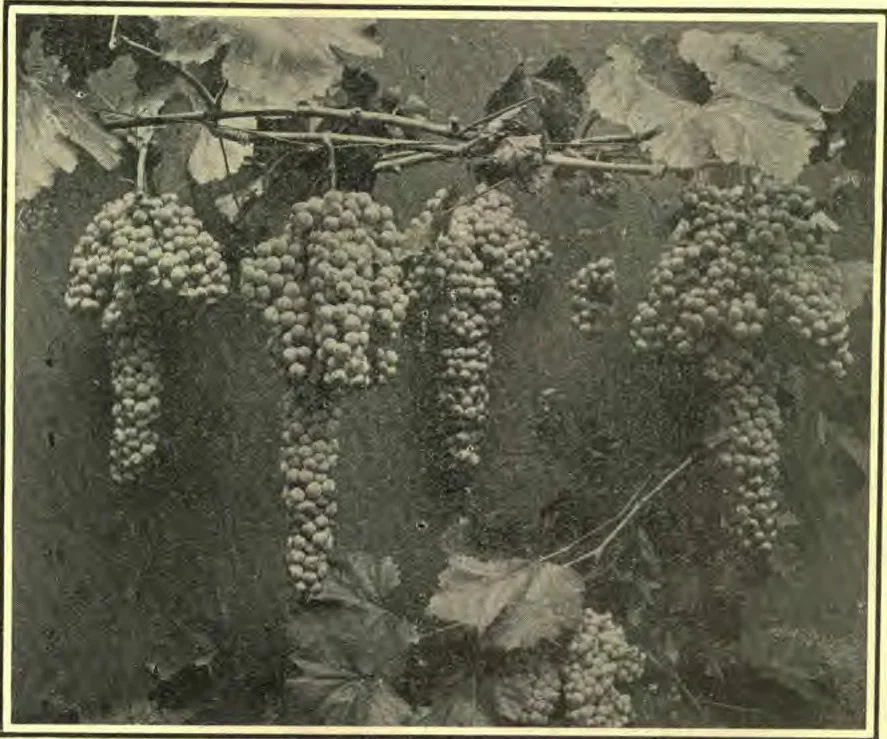
Do you see those women and children among the high-staked vines? They are the poor and the feeble. The law of Moses declares: “Thou shalt not glean thy vineyard, neither shalt thou gather every grape of thy vineyard; thou shalt leave them for the poor and the stranger.” That is why these folks are here. They are gleaning where others have gathered. See what great bunches they have in their baskets, some purple and some yellow! The immense clusters of the yellow grapes make us think of that great cluster the spies brought back to the waiting people; and, strange to say, they are of the same variety. Look at that little girl,—she has found a bunch so large that she asks the woman by her side to pick it, lest it slip from her fingers.

A FEW CLUSTERS

The Tower and the Wine-Press

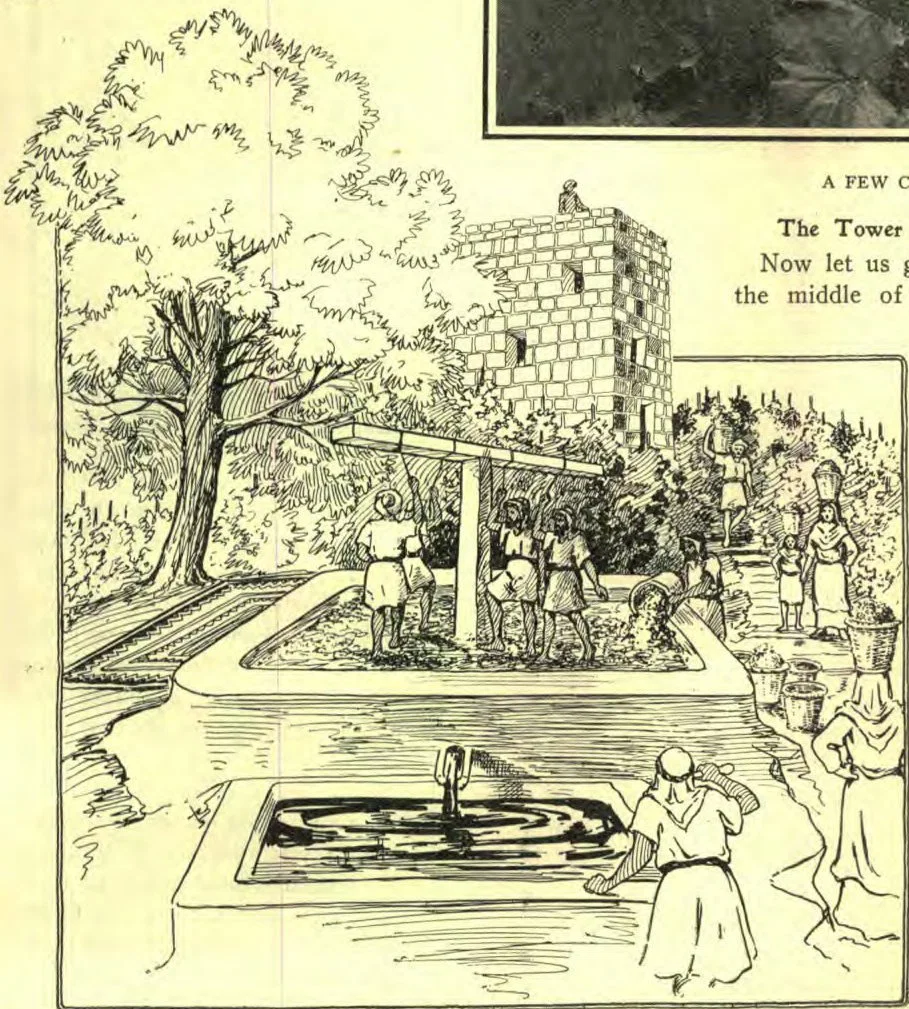
Now let us go up to the tower in the middle of the vineyard. How beautiful! you exclaim. Yes, it is lovely indeed, as it rises from the sea of vines and trees; but don’t think that it was built for ornament. No, no! as the Lord “is a strong tower” for the protection of his people, so this tower is a protection to the vineyard. The vine-dressers live in the top, from which they can watch the whole place, while the lower rooms are used to store away the crops.
I wish we had time to go through all the rooms, and indeed to take dinner with the owners; for we should learn many curious things. But time flies—let us take a peep at the wine-press.
It is here, near the tower, under great fig-trees which cast such refreshing shade. Both press and vat are square holes cut in the solid rock, one lower than the other, so that the juice will run into it as the grapes are mashed. Just now these men are drawing off the juice into earthen jars, and bottles made from the skins of sheep and goats. Notice that the juice is clear and limpid, having settled overnight. Some of it will soon be heated, sealed in the jars by means of wax or pitch, and then buried in the cool earth to keep sweet and fresh till wanted for use. Some will be boiled to a sirup, and eaten as we eat honey. Still other will be fermented, and made into strong wine and vinegar.
It is now time for work to begin in the press. Several gatherers have arrived with baskets of clusters. The women and children always carry the baskets on their heads, without the aid of their hands to balance them; but the men carry a heavier load on their broad shoulders. Basket after basket, the grapes are handed to the man who stands by the press, and empties them in as the treaders are ready for them. All along one side of the press you notice a matting, on which the treaders may stand when tired. But just now they are holding to straps which swing from a beam, and treading away, barefooted, amid the spattering juice and slippery skins. A muddy stream of greenish tint soon makes its way into the vat below; and now and again a thirsty picker, coming in, will take up the gourd dipper, and sample the cool, sweet fluid.
Now we must take our leave. We go through the gate in the hedge; wind in and out among the orchard and vine-clad hills; step over babbling brooks lined with ferns; stop here and there to pick a fragrant blossom, or listen to the peaceful cooing of the turtle-dove; and a sense of peace and contentment steals over us, and we exclaim, Was there ever a land like this!

Alas, It Brought Forth Wild Grapes!

Though God had indeed made it a delightsome land, the joy of the whole earth, a place in which to show forth his love and power,—though he had fenced it with his own presence, cleared it of nations as men clear a field of stones, planted it with the choicest vine, and set in the midst of it his own strength as a mighty tower, still—it brought forth wild grapes! He had planted Israel as a missionary nation for the whole earth; and it had disappointed him, it had failed altogether to bring forth good fruit. Now he said: “I will tell you what I will do to my vineyard: I will take away the hedge thereof, and it shall be eaten up; and I will break down the wall thereof, and it shall be trodden down: and I will lay it waste: it shall not be pruned nor digged; but there shall come up briers and thorns: I will also command the clouds that they rain no rain upon it.”
Was ever prophecy more sure? How soon the change came! To-day the traveler walks over the sunburned plains and the desolate hills of that most desolate of lands, and exclaims, Behold here a page in God’s lesson-book for men! They planted disobedience and selfishness; and now behold its fruit—ruin and desolation! Shall we not learn a lesson from this vineyard of olden time? EDISON DRIVER.

THE BLESSING OF LABOR

ONE of the first laws of the being is that of action. Every organ of the body has its appointed work, upon the development of which depends its strength. The normal action of all the organs gives vigor and life; inaction brings decay and death.
God placed our first parents in Paradise, surrounding them with all that was useful and lovely. In their Eden home nothing was wanting that could minister to their comfort and happiness. And to Adam was given the work of caring for the garden. The Creator knew that Adam could not be happy without employment. The beauty of the garden delighted him, but this was not enough. He must have labor to call into exercise the wonderful organs of the body. Had happiness consisted in doing nothing, man, in his state of holy innocence, would have been left unemployed. But he who created man knew what would be for his happiness; and no sooner had he created him, than he gave him his appointed work. The promise of future glory, and the decree that man must toil for his daily bread, came from the same throne.
To-day thousands are sick and dying who might get well if they would; but imagination keeps them sick. Self-made invalids, they think that to work would make them worse, when work is just what they need to make them well. Without labor, they can never improve. When the body is inactive, the blood flows sluggishly, and the muscles decrease in size and strength. Rising above their aches and pains, forgetting that they have aching backs, sides, and heads, they should engage in useful employment. Physical exercise, and a free use of air and sunlight,—blessings which heaven has abundantly bestowed on all,—would give life and strength to many an emaciated invalid.
When not actively engaged in preaching, the apostle Paul labored at his trade as tent-maker. Before he accepted Christianity, he had occupied a high position, and was not dependent upon his trade for support. But among the Jews it was customary to teach children a trade, however high the position they were expected to fill, that a reverse of circumstances might not leave them incapable of sustaining themselves. In accordance with this rule, Paul learned the tent-maker’s trade; and when his means had been expended in advancing the cause of God and in his own support, Paul resorted to his trade in order to gain a livelihood. Although feeble in health, he labored during the day in serving the cause of Christ, and then toiled a large part of the night, and frequently all night, that he might provide for his own and others’ necessities.
Work is a blessing, not a curse. Diligent labor keeps many, young and old, from the snares of him who “finds some mischief still for idle hands to do.” Let no one be ashamed of work; for honest toil is ennobling. While the hands are engaged in the most common tasks, the mind may be filled with high and holy thoughts.
Drowsiness and indolence destroy godliness, and grieve the Spirit of God. A stagnant pool is offensive; but a pure, flowing stream spreads health and gladness over the land. No man or woman who is converted can be anything but a worker. There certainly is and ever will be employment in heaven. The redeemed will not live in a state of dreamy idleness. There remaineth a rest for the people of God,—a rest which they will find in serving him to whom they owe all they have and are.
MRS. E. G. WHITE.

TALKS WITH OUR BOYS

One of the most important things to be learned by boys who expect to become real men, is to see. Few people have ever learned that God gave them their eyes to use. I don’t mean that they are blind, but that they do not see one-tenth part of what they should see. Men spend thousands of dollars every year for books that tell them things they could learn for nothing if they would use their eyes.
In one of our talks, you remember, we spoke of the great importance of learning to think, and of how few people do learn thus to use their minds. I believe we decided that the sooner we learn to think, the better is our chance of becoming men. Now, I wish to say the same thing of seeing, only to make it more emphatic if possible; for of what value is the ability to think, if one can see nothing to think about? Ruskin has truthfully said that there are a hundred men who can talk well where there is one who can think, and that there are a thousand men who can think to one who can see. So you can readily see what a vast advantage you will have if you only begin to use your eyes.
God has placed all manner of beautiful and interesting things about us, for our pleasure, and to teach us of him. Do we show our appreciation very well when we do not even see them? Many men travel thousands of miles every year to see wonderful sights, when they would find just as wonderful things in their own back yards if they would only look.
Thousands of persons used to go to hear Agassiz lecture on a grasshopper, or something else as common, and go away and say, “How wonderful!” when they might have learned the same things for themselves if they had used their eyes.
Some time ago, as I was walking through a pasture with a young man, I happened to remark: “A brown-winged hawk ate one of mother’s chickens on that stump a few days ago.” In some surprise he asked how I knew. I asked if he did not notice the feathers we had walked over; and he answered: “I do now; but how do you know whose chicken it was? and how do you know it was not a skunk or a mink or an old owl?”
I replied that skunks and mink do not make themselves conspicuous by getting on a stump to eat their prey, while a hawk does, that he may see anything that may approach. Owls do not care, for they work in the night. There are feathers on the stump as well as on the ground, so I know the chicken was eaten there. None of our near neighbors have chickens the color of this one, but mother has, so I know where it came from. All the feathers show they were wet by the rain two days ago, but they were not under the heavy snow of two weeks ago, or they would be matted into the grass more. I know the kind of hawk, because here is one of his wing-feathers.”
Instead of wasting time cooped up in the house playing games, get out and study spiders, ants, birds, flowers, trees; in short, see everything you can, and as well as you can. Be much with nature. Don’t try to ramble over too much ground. Mary Treat saw enough under some maples near her home to make her famous, though hundreds had probably visited the same place, and seen comparatively nothing.
You will be helped greatly in learning to use your eyes if you will carry a magnifying-glass in your pocket, and use it every day. For twenty-five or thirty cents, you can get one that will answer nicely for this purpose.
You may not be able to buy books to read in your spare time, but God has given you the best and most interesting book in the world,—the wide, beautiful book of nature,—and he allows, yes, urges, you to use it freely.
FLOYD BRALLIAR.

OVERHEAD NATURE STUDY

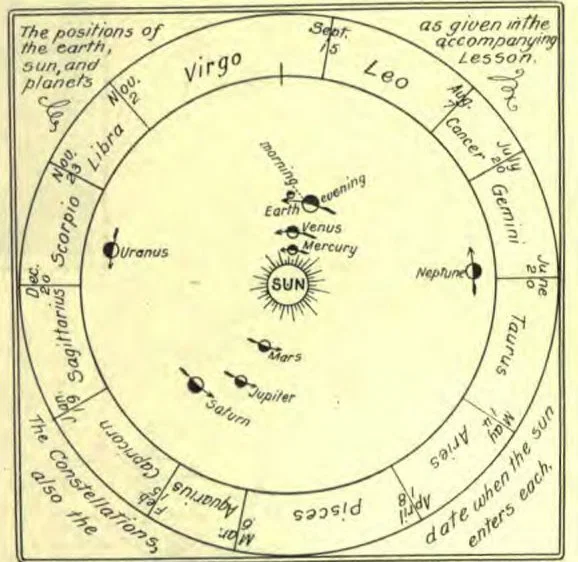
THE accompanying diagram presents a comprehensive view of our solar system; that is, of our sun and his attending planets, as they will be related to one another about March first. Bear in mind that all the worlds are revolving about the sun in the same direction, but not all at the same rate of speed.
Those nearer the sun than Earth (Venus and
Mercury) not only have less distance to travel to complete their yearly journey around the sun, but they travel in their respective circuits more rapidly than Earth. Consequently their years are correspondingly shorter, according as their paths lie nearer that orb. The worlds whose paths lie beyond the course of Earth travel correspondingly slower in their journey about the sun, as their distance from the sun is greater than ours.
We should become so familiar with these worlds, not only as represented on the chart, but in the heavens themselves, that we shall know just when to expect their visits, where to look for them, be able to recognize them by name when we see them, and tell which way they are traveling, and how long they will stay with us.
While we can not, with our other duties, promise a study of this kind exactly on time each month, we will try to prepare these diagrams from time to time, so that our class may keep up with the changes constantly going on in the heavens, also to help you obtain some of the rudiments of this, the most beautiful and ennobling of all sciences.
In the early evening, stand facing the south, and so hold the accompanying diagram that if you were really standing on the sphere marked “Earth,” at the point indicated by the dotted line marked “Evening,” the sun in the diagram would be at your right hand, or to the west, which is actually the case.
Now how many of the other planets are you in a position to see? Uranus is certainly out of sight; for the whole earth is between you and him. Mars, Jupiter, and Saturn are all in the far distant west, millions of miles beyond the sun, and so also out of sight. Venus, which twice during the past winter so beautifully bedecked our evening sky, has, in company with Mercury, passed in between us and the sun, and now sinks in the west even before the sun withdraws his shining; so we can not see either of these planets. Neptune alone is above our evening horizon; but unfortunately Neptune, like Uranus, is so far away from our little world that without a good telescope we need not expect to make his acquaintance. Thus we have nothing whatever to see in the planetary line from our evening point of view. But this will not long be the case; for “the world moves,” and so do all the other worlds. Lay the diagram carefully aside until March 15; then get up just before daybreak, and observe the eastern heavens. If you are sharp-eyed, and the weather is clear, you will be rewarded by getting the first glimpse of Venus as she begins her rôle as a morning star. You may also catch a glimpse of Mercury, as he will be at his greatest eastern elevation above the sun, March 16. It will pay you to watch for him, as he is so near the sun that but few have ever obtained a good look at him. He is in too much of a hurry to stay long, and you will have only four or five chances to see him before he leaves.
Venus does not travel so fast, and also gets farther away from the sun, so we can see her plainly. March 20 she will be at her brightest.
In making your morning observations, hold the diagram so that you may imagine yourself standing on the earth at that point marked “Morning,” with the sun to your left, or in the east, and you will see where to look for these worlds of light. If you are acquainted with Saturn, you will see him also, very low down in the eastern sky, just before the sun rises; but he will look much smaller than when we saw him last as an evening star. This is because he is so much farther away than during the summer evenings.
Dr. O. C. Godsmark.

NEVER FAIL

THERE is a brave, sweet-tempered knight Whose name is Never Fail. His trusty sword is Do the Right; I Will, his coat of mail. And naught his purpose can withstay When once he says, “I’ll find a way.”
To be on time with Never Fail Is just to learn the way, Like him, each little height to scale, All through the busy day; And never let an hour go by Without a nobly said “I’ll try.”
Frank Walcott Hutt.

A REPORT AND AN APPEAL

From recent reports we learn that in eighteen Conferences a beginning has been made in the young people's work. One Society has also been organized in England, and one in Jamaica. Some of the Societies are small, but are doing good work. Nearly all that have been heard from are using, in their young people's meetings, the lessons in the INSTRUCTOR. The members of these Societies are doing almost all kinds of missionary work. A list of some of the things that the young people are actually doing, may be a help to some of the more recently organized Societies:—
  1. Distributing literature on the envelope plan.
  2. Visiting, and reading, and singing for the sick, the lonely, and the aged.
  3. Piecing quilts for the poor.
  4. Selling the Life Boat, Signs, and Good Health.
  5. Holding branch Sabbath-schools.
  6. Jail work.
  7. Writing missionary letters.
  8. Sending out literature.
  9. Distributing papers and tracts.
  10. Christian Help work.
  11. Canvassing for small publications.
A number of conversions are reported as the direct result of the young people's work. In places where the work of the Society has been most successfully carried on, the churches are beginning to feel the impetus of the movement, and seem to have awakened to new life.
Once more we wish to appeal to our young people everywhere to consecrate themselves to the Lord. We have again reached the time when the message is due, “Choose you this day whom ye will serve.” There is no time to delay longer. Once more we quote the definite call in the words of the Testimonies:—
“Young men and young women, can not you form companies, and as soldiers of Christ enlist in the work, putting all your tact and skill and talent into the Master's service, that you may save souls from ruin? Let there be companies organized in every church to do this work. Will the young men and young women who really love Jesus organize themselves as workers, not only for those who profess to be Sabbath-keepers, but for those who are not of our faith?”
“Let young men and women and children go to work in the name of Jesus. Let them unite together upon some plan and order of action. Can not you form a band of workers, and have set times to pray together, and ask the Lord to give you his grace, and put forth united action? You should consult with men who love and fear God, and who have had an experience in the work, that under the movings of the Spirit of God, you may form plans and develop methods by which you can work in earnest for certain results.”
It is certain that here is a definite call to our young people to do a certain work. The success of this movement requires that they commit themselves definitely to it. It is a call to activity, — a call for burden-bearers. There should be a clear enrollment of those whose hearts respond to the call that is made, and who are willing to enlist in active service. If you are interested in this movement in any degree, write to your State Sabbath-school Secretary, or to the undersigned at 705 Northwestern Building, Minneapolis, Minn. MRS. L. FLORA PLUMMER.

MARCH STUDY OF THE FIELD

Suggestive Program for Young People's Meeting
(March 8)
I. OPENING EXERCISES.
2. Bible Reading: Reasons for Awakening to Active Service. (See outline below.)
3. Remarks by the Leader: An Awakening Needed. (See suggestive outline.)
4. Field Study:—
(a) The work in Europe and Asia Minor. With a good map of the world, let some one outline the trip described by Brother Dail and Elder Conradi, pointing out the location of our churches, noting the difficulties in Constantinople, the work among the churches in Asia Minor, the calls from Macedonia, and the visit to Smyrna. (The outline of Elder Conradi's visit will continue for several months, and may be followed in several meetings with interest.)
(b) The condition of the work, and call for help from the South American mission field.
(c) The message in Belgium, Holland, and Finland.
(d) The items of progress from India, Japan, and Australia.
(e) Map exercise. (Let the leader or some other individual point out on the map the different fields mentioned in the March study, calling for volunteers to give some item of special interest or need, also the names of the workers in each field called for. This will give a good idea of the scope of our work and our knowledge of the same. In this exercise it would be of interest to call attention to the unentered fields also.)
(f) The Missionary Heroine. (This little incident from the life of Mrs. Judson is worthy of repetition. All may not have read it.)
5. Closing Exercises.
NOTE.—Material for the field study will, as usual, be found in the current number of the Missionary Magazine. Fields can sometimes be dealt with more fully by referring to back numbers.
We are indebted to the Christian Endeavor World for the outline of the address for the leader, which has been adapted to our need. If this little outline is followed, do not fail to make the thoughts your own before passing them on.

Reasons for Awakening to Active Service

1. The great commission. Mark 16:14-20.
2. The last message. Rev. 14:6-9.
3. Extent to which it will be preached. Matt. 24:14.
4. Time in which we are living. Matt. 24: 32-35.
5. Power for service. Acts 1:1-8.
6. Event immediately to follow preaching of message to all the world. Matt. 24:14, 29-31; Rev. 14:14-16.

An Awakening Needed

The topic of our Bible study to-day implies that we have reached a time in this world's history when there should be a great awakening along missionary lines. It also implies that many of us are asleep in regard to missions. Is that too harsh a statement to make?—No; for if we Seventh-day Adventists were wide-awake on this subject, we should know more about missions, and give more, and pray more, and go more.
How many here can tell who has the oversight of our own missionary work in the distant fields? In what parts of the world has the message been planted? Can you name twenty-five of our own leading missionaries? Who were ten of the world's greatest missionaries during the last century? and where did they work? How many have ever read ten missionary books treating on different phases of general missionary work, or the lives of some noted missionaries, or on missionary incidents? Do you read regularly and thoroughly our own missionary journal, the Missionary Magazine? An answer to these questions will betray our real interest in the world-wide work and the extent of our information on the subject.
Are you regularly laying aside a definite portion of your income for missions? An excellent plan is to keep a record of all your expenditures, and regularly compare your gifts to the world-wide work with personal expenditures. These will show, again, how definitely our interest in missions has taken shape.
Next, does the carrying of this gospel of the kingdom to earth's remotest bounds form a part of our earnest and persistent prayers? Are our prayers all for ourselves and our personal family interests? or do we carry upon our hearts an interest in the giving of this message in that way that will bring the speedy return of our Lord? Do we really long to see it go quickly in Europe, in China and India, in Japan, and the islands, in Africa and South America? or do we give it little thought? A conscientious answer will show the place that the return of our Lord, and the giving of the gospel to the world in preparation for that event, occupy in our prayers.
And, finally, what is your duty and mine in connection with this work? Why should not the larger number of us dedicate our lives to carrying this gospel to the most needy fields,—India or China or Japan, Latin Europe or Africa or South America? Have we ever honestly considered this question in the light of the great need, the nearness of our Master's return, and the binding obligation upon each of us who know this truth to hasten it to earth's remotest bounds? If the question were decided in the fear of the Lord, many of the little experiences that come to us from day to day would be looked upon, not as crosses, but as precious opportunities to gain a broader experience for the great work before us.
A candid answer to these questions will place a different phase upon our connection with this work.
The study of the field to-day brings to us some of the calls that are coming continually from those who stand at the front. It also shows some of the blessedness of going with our Lord where there is greatest need. Let us consider our relation to this work to-day in the light of the soon return of our Lord. E. H.

OUR THOUGHTS

That which we call our secret thought Speeds to the earth’s remotest spot, And leaves its blessings, or its woes, Like tracks behind it as it goes.
It is God’s law. Remember it In your still chamber as you sit With thoughts you would not dare have known, And yet make comrades when alone.
These thoughts have life, and they will fly, And leave their impress by and by, Like some marsh breeze, whose poisoned breath Breathes into homes its fevered death.
And after you have quite forgot, Or all outgrown some vanished thought, Back to your mind to make its home, A dove, or raven, it will come.
Then let your secret thoughts be fair, They have a vital part and share In shaping worlds and molding fate, God’s system is so intricate.
— Ella Wheeler Wilcox.

Young People's Societies Report from Healdsburg School

FROM week to week our hearts are made glad to receive the encouraging reports from the Young People's Societies that are organized and at work. It is with special pleasure that we call your attention to the report this week from our school at Healdsburg, California. Though it is a little long, we feel sure that you will agree with us that there is not a line to spare. And we are glad for the opportunity that this work affords for those in our schools, and those who can not attend them, to come into closer touch with one another. The work is one and the same, whether it is carried forward by a large, well-organized company, or by a small group in some country place, or even by one or two working almost alone; and the same God of all blessing and help is watching to bless every one who will enlist in his army for service.

College Missionary Society at Healdsburg College

FROM HEALDSBURG COLLEGE

EARLY in the present school year we organized our College Missionary Society. Our purpose was to study mission fields and the lives of missionaries, to distribute our literature through the mails and from house to house, and to gain an experience in lines of practical missionary work as the way might open in this vicinity.
Instead of taking an hour outside of our regular school session for our meetings, we decided to use the chapel hour on Thursday morning of each week for this purpose. Our programs have been of unusual interest, and have been enjoyed by the whole school. Miss Gertrude Grainger, who, with her parents, spent several years in Japan, gave us an interesting picture of that field, its needs, and opportunities for work; Elder Hibbard told us of city mission work in Chicago; Elder Loughborough spoke of the development of our publishing work; and Professor Rine gave a particularly inspiring talk on what Healdsburg College has done, during the sixteen years of his connection with the school, to prepare workers for the field.
We take a club of twelve copies of the Review to be used in the college home, so that our students may all have an opportunity to know of the progress of the cause. We are also taking one hundred copies of the Signs of the Times, one hundred of the Life Boat, forty of the Sentinel, and sixty of the Pacific Health Journal. After our general program, we separate into divisions to wrap and address the papers, and to report to the division leaders the work done during the week. There are fourteen of these divisions. Several of our students have used the paper in house-to-house work. The Health Journal and the Life Boat sell readily, and are appreciated. Others deliver the Signs to regular subscribers.
In connection with the work of the Society, Elder Hibbard, with student helpers, has been holding meetings at Windsor, six miles away, on Sabbath and Sunday afternoons. Brethren in the church, who are interested in this work, have furnished conveyances, and a company consisting of a teacher or older student, as leader, and of several students to assist in the singing, have gone there regularly. A good interest has been aroused by this work, and some definite results have already been seen, one family having accepted the truth. A similar work will be begun in other small towns in this locality.
One of our vacation days was improved by our young men in providing for the poor in our locality; about thirty spent the day in the woods cutting wood. A similar work was done last year, and proved a great benefit to many needy families. Last year our Society assisted two worthy students to attend school, and we are helping in the same work this year.
When our work was fairly started, we were asked to organize the young people of our church into a Young People's Society, in harmony with the recommendation of the General Conference. Since many of the young people in our church are not students in the school, and could not attend the Thursday morning meetings, we decided to do this, making the College Missionary Society a branch of the same. We organized according to the plan suggested, but did not settle definitely upon departments of work, preferring to let these develop as the need was found to exist; and to appoint for leaders of those departments those who, by their willingness and faithfulness in voluntary service, proved their fitness for the work.
In addition to the department carried on at the college, we have two other departments organized at present,—the Christian Help work, under the supervision of Dr. G. H. Heald, and the Mission Department, with Brother McCord in charge. Brother McCord has had a wide experience in the field, especially in city mission work, and enters into this work heartily. Our mission is in a hall down-town, and was fitted up by our young people. Two meetings are held each week, and already some outcasts and dissipated ones have been converted, and are being helped to lead a better life. Notices of the opening of the mission and its work have been posted, and invitation cards have been scattered among the people. The attendance is usually very good, and we feel sure the Lord is richly blessing this branch of the work.
Our college orchestra has rendered invaluable help in our meetings, praising the Lord with instruments as the congregation praise him in song. We also make frequent use of the cornet and violin in our gospel meetings, and the subduing influence of the Spirit of God seems to accompany the efforts of these consecrated players.
Elder A. C. Bourdeau spent one Sabbath afternoon with us, telling us some of the thrilling experiences connected with the opening of our work in Central Europe. Recently Elder Loughborough gave us a most interesting account of how the work began in California, and of his connection with it. His story of how the Lord by his providence opened the way for the entrance of the truth, and guided those who had been impressed to come to this field, seemed almost too wonderful to be true, and we listened to it with hearts full of gratitude.
As we have heard from these pioneer workers the story of the consecration and self-sacrifice of those who were connected with the rise of the message, we have been inspired with greater zeal and devotion to the cause which our society represents, and we feel to join heartily with our young people similarly organized in declaring our aim to be, “The Advent Message to the world in this generation.”
JESSIE O. BARBER.

Do What Is Worthy of Reward

Do what is worthy of reward, and desire none.

UNION COLLEGE

SOME weeks ago I received a letter from the editor of the INSTRUCTOR, requesting that we send a report of our college work to that paper. We take great pleasure in doing this, since a large proportion of the INSTRUCTOR family are those who either have been, or should be, receiving an education in some one of our educational institutions. Union College stands for the education and training of all young men and women of sober minds and willing hearts. The curriculum is broad enough to take in every phase of work in which Christians should be engaged. It does not stand as a competitor with the world in the acquirement of a worldly education, but as a school where the pupil may obtain the knowledge of God in every branch of study that is taken up. We do not exclude those not of our faith, provided they are willing to comply with the regulations which govern those attending the school.
In connection with the school there is a missionary society, conducted in the English, German, and Scandinavian languages. The interest in these several divisions of missionary work is very gratifying indeed; in fact, almost every phase of missionary work is carried on as far as it is possible in the school. The foreign missionary work is considered, and a goodly number are preparing themselves especially for work in distant fields.
Just at this time the Special Course of eight weeks, for the training of workers, is in progress. There are thirty-one members of this class who have come fresh from the field. They have brought an excellent spirit with them. It is gratifying indeed to see so many who are giving themselves wholly to the work of the Master. We trust that as they go out into the field, they may inspire many others who have not as yet joined our school family, to come and take a short course of training with us.
L. A. HOOPES.
Continue reading: TRUE TO MOTHER'S TRUST