Promptly at four o’clock of a blustery March afternoon, the door of the little country schoolhouse opened, and a line of children filed out.
“O Rob! look at the mill-pond,” said Phil, a brown-eyed boy of twelve, who led the line.
“Whe-e-e!” exclaimed Rob.
“Now for a good skate,” cried Phil. And away the two boys rushed. With a bound they cleared the fence, and soon reached the edge of the pond, which had frozen with that smooth “glare” so pleasing to the eye of a skater.
It took but a moment to don their skates, and soon the boys were curveting gracefully over the ice.
In a few minutes Phil glided up to Rob, and said, “I oughtn’t stay here any longer.”
“Oh, don’t go, Phil! Why can’t you stay?”
“Father went to mill to-day, and he’ll not be home till late, and there’ll be all the chores to do.”
“Yes, but you can skate a while, and then get home in time to do them,” pleaded Rob.
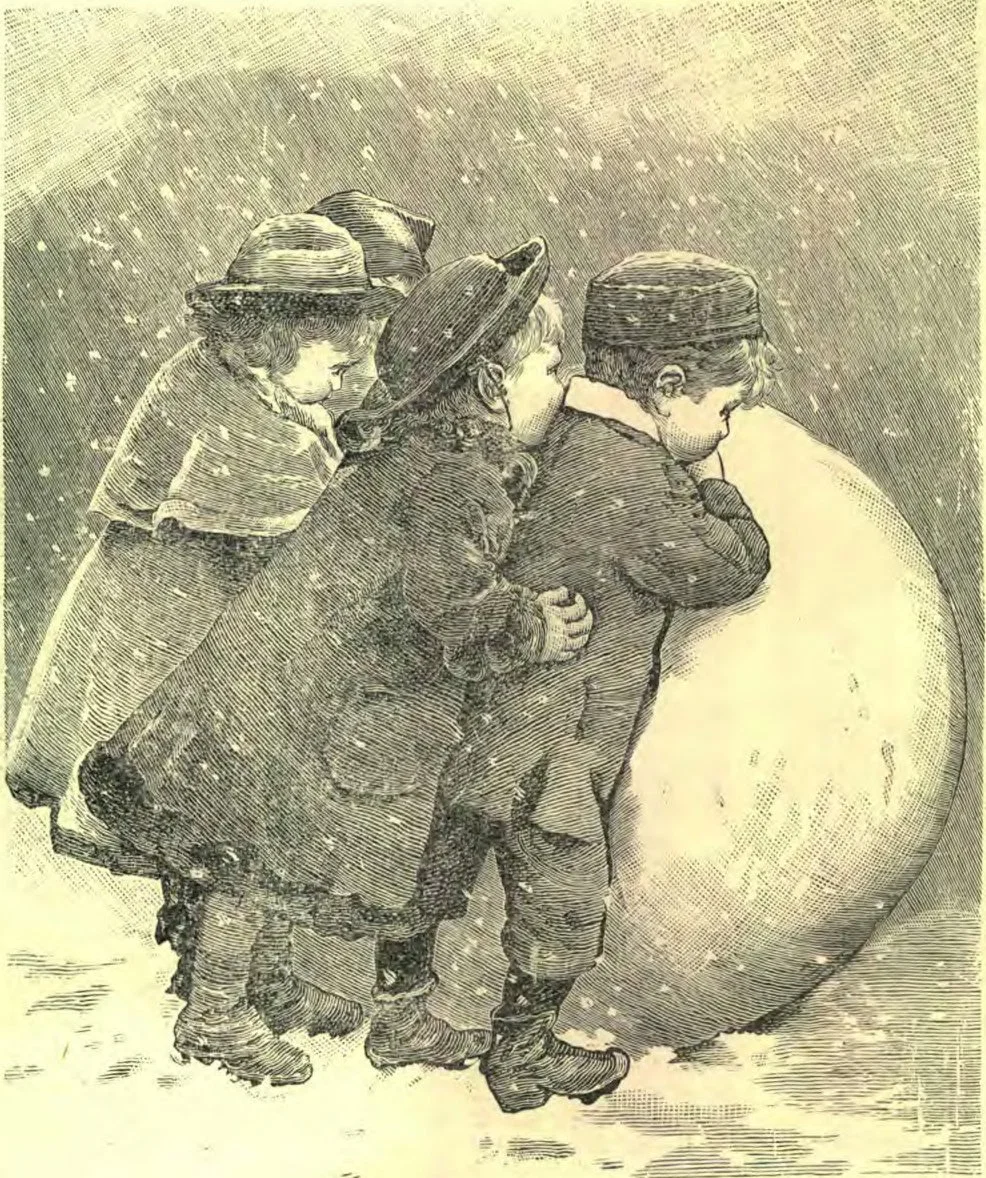
THE BIGGEST YET!
“No, I know mother. She would begin to do the chores herself; for she always likes to have things attended to before dark. Then there is the colt to lead out to water. So I’ll have to go,” he said, slowly. “Mother says she can always depend on me, and I’d hate to disappoint her,” he added.
“Well, I suppose you’ll go,” said Rob, in disappointed tones, as Phil began unclamping his skates.
For a moment Phil lingered, watching his companion. “The ice looks so tempting. Couldn’t I spend just half an hour longer here? It is not every day one can find ice like this,—and this is likely to be the last, too,” he thought, regretfully. But soon he turned resolutely away, whistling bravely; and when he reached the main road, he struck a sturdy gait, which soon brought him in sight of home. Somehow there was an air of loneliness about the place, which made him think mother was not there. The curtains were down; and as he drew nearer, he saw a piece of paper tacked on the door, which he knew meant a note for him.
“Dear Boy,” he read; “Mother was called away this afternoon. Your little cousin is ill, and Aunt Kate wished me to be with her. I could not have gone, but I knew I could depend on you. Father will not be home till late. Don’t let yourself be lonely, but remember God will take care of you. MOTHER.”
Phil felt the warm blood in his cheeks as he thought how he had been tempted to disappoint his mother’s trust. More than once that evening he was grateful for his victory at the mill-pond.
Reaching the key from its place under the eaves, he entered the house, and was preparing to build a fire in the kitchen stove, when he remembered the colt. “Guess I’ll go out and see how Billy boy is getting on before I build my fire,” he said to himself. On opening the barn door, no familiar whinny greeted his ear, but instead a heavy thundering sound. There lay poor Billy on his back, helplessly pawing the air. When he heard Phil near him, he made a great effort to rise, only to fall back again. The halter rope was drawn so tightly that it seemed choking him. Stretching far over the side of the stall, Phil quickly cut the rope, and the frightened colt sprang to his feet, uninjured save for a few bruises. Rob smeared these with horse-salve; and after giving Bill his drink and an extra feed of oats, did the other chores.
By the time he reached the house, it was quite dark. What a lonely feeling came over him as he entered the cold kitchen! But it seemed much more cheerful when the lamp was lighted, and the fire burning. Phil busied himself by cracking some nuts, and studying his arithmetic lesson for next day; but in spite of his efforts, the hours did seem long. It was not until nearly nine o’clock that he heard the squeak of the sleigh runners on the drive, and the well-known voice of his father as he called, “Whoa!” to the horses at the door.
Catching up the lantern, Phil ran to help put out the horses. After looking Billy over, his father said, “You did just the right thing by the colt, my boy. Before long he would have become so discouraged that he would not have tried to hold his head up, and then he would have strangled to death.”
It was not until the next afternoon that Phil saw his mother; and then, big boy as he was, she kissed first one rosy cheek and then the other, saying, “I hope I may always be able to depend on my boy, and that he will always be true and trustworthy.”
Vina M. Sherwood.
DUMPKINS
By Lillian L. Price
“Seems to me, Willis,” said mama, soberly, “I haven’t seen Freddie here for several days.”
“No, you haven’t, mama,” returned Willis, dropping his eyes, and digging the gravel with his toe. “He lost his sand-lizard while I was there, and he said ’twas my fault. He said I left the box open. I s’pose he thinks I ought to give him my sand-lizard, but I won’t.”
“Did he really say he thought you should, Dumpkins?” asked mama, sitting on the porch seat, and looking down seriously upon Willis’s clouded face.
Willis looked uneasy. “Dumpkins” was what papa called his “bad-weather” name. He wriggled, but looked up frankly to mama.
“No,” he said. “Freddie only made me feel as if I ought to. But Uncle Jack’s just finishing that beautiful wire cage with a glass door for my little Jinks, and how could I give him to Freddie just because his Jimmy got away while I had the box in my lap, and forgot to shut the door?”
“That’s true, Dumpkins, dear,” returned mama, with suspicious sympathy. “I dare say you will enjoy Jinks in his new home quite as much as Freddie would.”
That night Uncle Jack brought the new cage home. Such an airy, beautiful cage it was, strewn with fresh white sand, and with tiny branches snugly fitted in. Jinks was delighted with his new quarters, but Willis watched his antics silently. In the morning mama saw him chasing a fly for Jinks, and shortly afterward both Jinks and Willis disappeared.
About noontime there was a whistle, a loud,70buoyant, joyous whistle, sounding up the side-porch path, and a moment later Willis came into the sitting-room.
“Mother!” he cried, tossing his hat and smiling, so that he was nearly all teeth and dimples. “What do you think? Fred found Jimmy on the big rose-bush as snug as you please, and he said he called me twice to tell me, only——”
“Only you were Dumpkins,” finished mama, serenely.
“Ye-es,” said Willis, reluctantly. “But, mama, listen. We put Jimmy in the cage with Jinks, and they’re tickled to pieces with the house and each other. We’re going to let them live in it together, and Fred keeps them one week and I the next. Isn’t that a jolly plan?”
“It is,” said Uncle Jack’s voice in the doorway. “I didn’t grudge the time I put on the making of that cage when I saw you offer it, Jinks and all, to Freddie.”
“Yes,” admitted Willis. “I knew I never should be happy till it was good-by Dumpkins, so——”
“Good-by Dumpkins it was,” said Uncle Jack.
— Lillian L. Price, in Youth’s Companion.
CAN YOU?
Can you make a rose a lily—just one?
Or catch a beam of the golden sun?
Can you count the rain-drops as they fall?
Or the leaves that flutter from tree-tops tall?
Can you fly like a bird, or weave a nest,
Or make one feather on robin’s breast?
Can you build a cell like the bee, or spin
Like the spider, a web so fine and thin?
Can you lift a shadow from off the ground?
Can you see the mind or measure a sound?
Can you blow a bubble that will not burst?
Can you talk with echo and not speak first?
Oh, my dear little boy! you are clever and strong,
And happy and busy the whole day long,
Trying as hard as any boy can
To do big things like a grown-up man!
Look at me, darling! I tell you true,
There are some things you never can do.
—Selected.
A HEAVEN TO GO TO HEAVEN IN
By David Paulson
ONE who lives in this world without receiving in his soul the great thoughts of God, as conveyed to him in the Bible and nature, would be incapable of receiving the thoughts of God if he were taken over into heaven. Therefore we see that it is not an arbitrary decree that keeps sinners out of heaven. God gives us as large an installment of heaven as he can intrust us with each day. By and by he will transplant us into heavenly soil; and then we shall have in full what now we enjoy only in part.
We are to get accustomed to the atmosphere of heaven now. One who is out of harmony with what God is trying to do for him to-day, would be still more miserable if he should be allowed in heaven. God makes all things work together for good to the Christian here below; in fact, he surrounds us with just the heaven that is best adapted to our present condition. Perhaps some will say that this might be true if Satan were destroyed: such forget that he started on his sinful career over in heaven,—but yet it was heaven. If the Lord could maintain a heaven while Satan was in it, he certainly can manage a heaven on earth for his children, even if Satan is alive.
Those who finally enter the kingdom of heaven will not cease to sin because Satan is dead, for sin broke out there in the first place: it will be because their disposition to sin will have been everlastingly cured. We are here to get thoroughly sick of sin,—to get the notion of working contrary to God taken out of our heads.
It is all right to tell sinners about the heaven that we are to have by and by, but it is worth more to introduce them to the heaven that they may have now if they will only yield to the divine Spirit that dwells within each human soul.
It is true that we are to sing the song of Moses and the Lamb when we stand on the sea of glass, but it is our privilege to rehearse it now. And it is high time, too, that we were beginning to learn a few snatches of it; but we shall not be likely to practice it unless we know it as a matter of personal experience.
The young person who has learned to do whatever he does “as unto the Lord,” and not to man, will enjoy such happiness in this service that the cheap temptations of sin will lose their fascination; and he will experience the truth of that divine statement, “The kingdom of God is within you.”
Of one thing we may rest assured,—the Lord will never trust us with a heaven outside of us until the principles of heaven have blossomed in the soul.
DAVID PAULSON, M. D.
GOSPEL WORK IN THE CHICAGO HARRISON STREET POLICE STATION
By Della Hinshaw
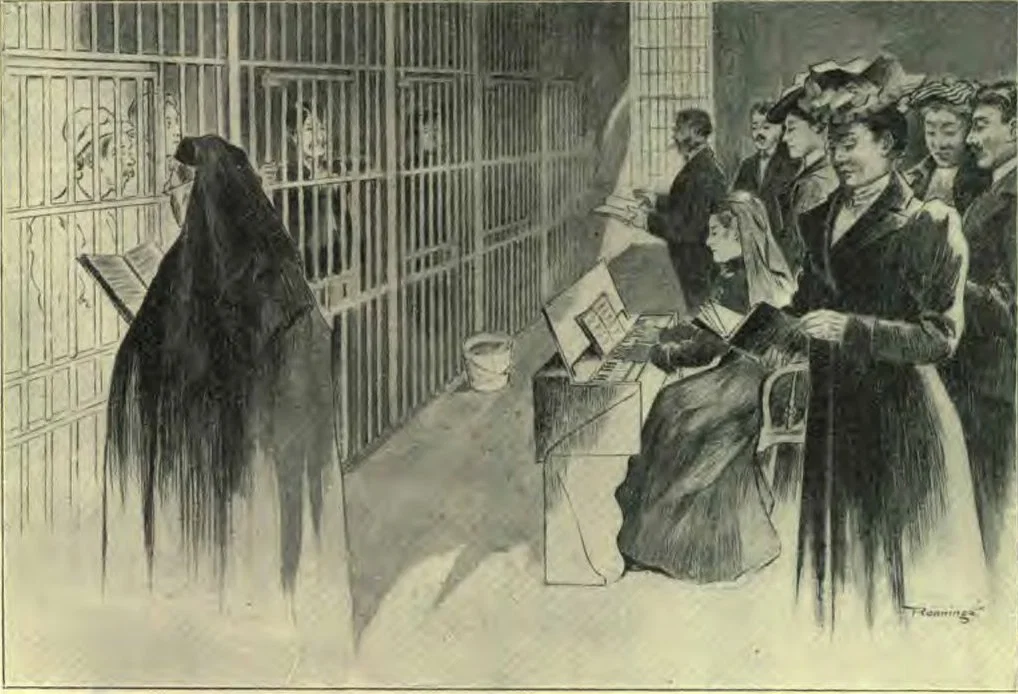
Every Sunday morning a little band of medical missionary students, and other workers from the Life Boat Mission and the Life Boat Rest, go to Harrison Street Police Station for the purpose of holding gospel services with the prisoners. These services consist in singing and prayer, and usually a short Bible reading, followed by a brief exhortation. In order to reach all the prisoners, it is customary to hold about four such services in different parts of the building. In passing from one division to another, some of the workers remain behind to do personal work with any who seem interested. This is allowable except in the criminals’ corridor.
During a recent Sunday morning visit at the Station, thirty-two prisoners were talked with personally, and twenty-seven of these expressed a desire to be remembered in prayer. In one of the cells was a girl who had been in the depths of sin for eight years, a professed infidel, having never been taught to believe in God or heaven, who said, “But if there is such a being as the God in whom you believe, pray for me, that I may believe also.” One man sixty-five years of age was converted in his cell; and an old woman who had lived an irreligious life for eighty years, expressed a desire and determination at once to make her peace with God, and to live her few remaining years for him.
During another Sunday morning visit, after the usual song service with the prisoners in the criminals’ corridor, one of the workers told in a most impressive manner the old story of the prodigal son. He closed by saying: “Now, friends, we can not open these bars, and give you liberty; we can not give you what is perhaps the desire of your hearts; but we have come to offer you something better. Peter of old said to the poor cripple who held out his hand for alms, ‘Silver and gold have I none; but such as I have give I thee: In the name of Jesus Christ of Nazareth rise up and walk.’ And so this morning we bring you this loving Saviour, and invite you in his name to ‘rise up and walk.’ We can not come and talk with you personally, but we shall be glad to pray for you. Is there not a man here who will hold out his hand as an indication that he desires the prayers of God’s people?” With one accord, and, as it seemed, moved by a single impulse, five hands were extended through the bars; and then, amid the audible sobs of these men, some one began singing:—
“O soul! hast thou forgotten the tender word and sweet,
Of Him who left behind him the print of bleeding feet?
‘I never will forsake thee; O child, so weary grown,
Remember I have promised never to leave thee alone!’
No, never alone! No, never alone!
He has promised never to leave me,
Never to leave me alone.”
SCENE IN HARRISON STREET POLICE STATION
A copy of the Life Boat was, as usual, left in each cell; and as these men pass to the State penitentiary, as will no doubt be the fate of some of them, it is to be hoped that this little journal may serve as a message of constant goodwill and fellowship from the Christian workers who stand at the head of this missionary effort. Who can tell the results of thus faithfully sowing the seeds of the comforting gospel of Christ in the hearts of these prisoners, who, young though many of them are, have yet lived to experience that “the way of the transgressor is hard”?
DELLA HINSHAW.
LITTLE THINGS
Ah, the world's little things, how great they are!
How the June day would miss the daisy's star!
With what soft grace the wild rose's cheek is prest
Against the pasture's gaunt, forbidding breast!
And we can well believe the rocks are glad
To be with little clinging lichens clad.
What heart among us could afford to let
The spring go by without the violet?
How keen our joy to welcome, as we pass,
The old earth's ways, her new upspringing grass!
A traveler hastening through the starless night,
Is glad to see the little glowworm's light.
Though tired and late, he slacks his hurried tramp
A moment by the tiny silver lamp.
A learned scholar leaves his darling books
To watch with thrilling heart and eager looks
The velvet softness of the summer dark
Embroidered by the firefly's golden spark.
Ah! the world's little things, how great they be!
How rich, how manifold, their ministry!
A little love oft proves a potent leaven.
A baby's hand leads many a heart to heaven.
— Selected.
PARABLE OF THE TALENTS
(March 8)
MEMORY VERSE: “For I say unto you, That unto every one which hath shall be given; and from him that hath not, even that he hath shall be taken away from him.” Luke 19:26.
14. For the kingdom of heaven is as a man traveling into a far country, who called his own servants, and delivered unto them his goods.
15. And unto one he gave five talents, to another two, and to another one; to every man according to his several ability; and straightway took his journey.
16. Then he that had received the five talents went and traded with the same, and made them other five talents.
17. And likewise he that had received two, he also gained other two.
18. But he that had received one went and digged in the earth, and hid his lord’s money.
19. After a long time the lord of those servants cometh, and reckoneth with them.
20. And so he that had received five talents came and brought other five talents, saying, Lord, thou deliverest unto me five talents: behold, I have gained beside them five talents more.
21. His lord said unto him, Well done, thou good and faithful servant: thou hast been faithful over a few things, I will make thee ruler over many things: enter thou into the joy of thy lord.
22. He also that had received two talents came and said, Lord, thou deliverest unto me two talents: behold, I have gained two other talents beside them.
23. His lord said unto him, Well done, good and faithful servant; thou hast been faithful over a few things, I will make thee ruler over many things: enter thou into the joy of thy lord.
24. Then he which had received the one talent came and said, Lord, I knew thee that thou art a hard man, reaping where thou hast not sown, and gathering where thou hast not strewed:
25. And I was afraid, and went and hid thy talent in the earth: lo, there thou hast that is thine.
26. His lord answered and said unto him, Thou wicked and slothful servant, thou knewest that I reap where I sowed not, and gather where I have not strewed:
27. Thou oughtest therefore to have put my money to the exchangers, and then at my coming I should have received mine own with usury.
28. Take therefore the talent from him, and give it unto him which hath ten talents.
29. For unto every one that hath shall be given, and he shall have abundance: but from him that hath not shall be taken away even that which he hath.
30. And cast ye the unprofitable servant into outer darkness: there shall be weeping and gnashing of teeth.
Synopsis
It was midnight. Christ was upon the mount of Olives with his disciples. He had just been giving them the signs of his coming, and had bidden them watch and be ready. A second time he repeats the warning, “Watch therefore.” Then in a parable he shows what it means to watch for his coming. No time for idle waiting, but one of diligent working! As a man traveling into a far country, Christ was about to depart from this earth to heaven. The disciples, his own servants, were before him, and to them he was delivering his goods. While he should be absent, they were to trade with his goods, double their talents, that when their Lord should return, they might give to him his own with profit. “After a long time,” says Christ, “the lord of those servants cometh, and reckoneth with them.” It has indeed been a “long time,” and the Lord of those servants is soon to come. What about your talents, my young friend? Have you doubled them? or is that one little talent hidden in the earth, where it can benefit neither God nor man?
Questions
1. To what does Christ again compare the kingdom of heaven? See note.
2. Who is this man? Who are the servants? What are the goods? See quotations 2 and 3.
3. How many talents were given to the servants? How were they apportioned?
4. Then what did the man do?
5. What did the servant who received five talents do with the same?
6. The one who received two talents did what? What became of the one talent?
7. When does the Lord come to reckon with his servants? What does the Bible call this time of reckoning? Read Heb. 9:27.
8. What glad words are said to the one who has gained five talents?
9. What is said to the one who has doubled his two talents? (Notice that the same words are spoken to both.)
10. What excuse was offered by the servant who had one talent, for not improving it?
11. Of what was he afraid? See quotation 1.
12. What did the lord call his servant? Says one: “A slothful servant is a withered member of the body, a barren tree in the vineyard, an idle drone in the hive; he is good for nothing.”
13. Instead of hiding the talent, what ought this servant to have done? Why?
14. What did the lord therefore command concerning the misimproved talent?
15. What comforting words are spoken of every one who has made a right use of his talents?
16. What warning is given to those who do not improve them?
17. In the great day what is done with the unprofitable servant?
Note
The kingdom of heaven and the kingdom of God mean the same thing. A Bible explanation of what this is may be seen by comparing Luke 9: 2 and 6. Here we read that the disciples were sent out to preach the kingdom of God; but when they departed, they went through the towns preaching the gospel. This shows that preaching the kingdom of God, and preaching the gospel, is one and the same thing.
Quotations
1. Notice the following explanation of verses 24–30: “Then he which had received the one talent came and said, Lord, I knew thee [he professes to be acquainted with his lord], that thou art a hard man, reaping where thou hast not sown, and gathering where thou hast not strewed: and I was afraid [afraid of what?—That all my improvements would not be mine, but that you would claim them], and went and hid thy talent in the earth [where neither God nor man can be benefited by it]; lo, there thou hast that is thine. The lord answered and said unto him, Thou wicked and slothful servant, thou knewest that I reap where I sowed not, and gather where I have not strewed: thou oughtest therefore to have put my money to the exchangers, and then at my coming I should have received mine own with usury. . . . Take therefore the talent from him, and give it unto him which hath ten talents. For unto every one that hath [made a right use of my goods] shall be given, and he shall have abundance [for I can trust him, knowing that he will make right improvement of what is lent him]; but from him that hath not [trusted me] shall be taken away even that which he hath. [I shall deprive him of what he claims as his; he shall forfeit all right of trust; I shall take away his talents, and give them to one who will improve them].” See “Testimony,” No. 32, page 38.
2. “The man traveling into a far country represents Christ, who, when speaking this parable, was soon to depart from this earth to heaven. The ‘bondservants’ (see Revised Version), or slaves, of the parable, represent the followers of Christ. We are not our own. We have been ‘bought with a price.’”—“Christ’s Object Lessons,” page 326.
3. “To his servants Christ commits ‘his goods,’—something to be put to use for him [“Every man hath his proper gift of God.” 1 Cor. 7:7]. He gives ‘to every man his work.’ Each has his place in the eternal plan of heaven. . . . Not more surely is the place prepared for us in the heavenly mansions than is the special place designated on earth where we are to work for God.”—Id., pages 326, 327.
4. “Those to whom rewards are given will impute no merit to themselves for their diligent trading; they will give all the glory to God. They speak of that which was delivered to them, as ‘thy pound,’ not their own. When they speak of their gain, they are careful to state whence it came. The capital was advanced by the Master.”—“Testimonies,” Vol. II, pages 284, 285.
5. “In dispensing his gifts, God has not dealt with partiality. He has distributed the talents according to the known powers of his servants, and he expects corresponding returns.”—Id., page 282.
SPECIAL NOTICE
SUBSCRIPTIONS to the Advocate of Christian Education should be sent to H. M. Mitchell, Treasurer of the General Conference, 267 West Main St., and not to Berrien Springs, as directed in a recent number of the INSTRUCTOR.
Second Edition of the Meteoric Shower Luxotype
A SECOND edition of the 22 x 28 luxotype of the meteoric shower of 1833 over Niagara Falls has just been printed, with enlarged and improved descriptive booklet. For a short time all who order at the old price, thirty-nine cents, will receive six copies of this new booklet. Address all orders and inquiries to F. E. Belden, Battle Creek, Michigan.
SHORTHAND BY MAIL
Your spare time can be well improved by studying shorthand, and this can be done at small expense to you by taking a mail course at your home. We are using “The Rogers Compendium of the Graham System of Shorthand,” a method arranged especially for home study, and giving an epitome of a system of shorthand acknowledged to be the best, the briefest, and the most complete. The only presentation of Standard Phonography in which all shorthand outlines are written as first learned, thus greatly abbreviating the work on the part of the student. A complete course in thirty lessons, illustrated by facsimile notes, with key. The correction of all students’ papers given special attention by experts. Reasonable tuition rates. If interested, write for full particulars. Practicing stenographers wishing to prepare for rapid reporting work should secure the last twenty lessons.
FIRESIDE CORRESPONDENCE SCHOOL, Battle Creek, Mich.
GRAND TRUNK R’Y SYSTEM.
Taking Effect June 2, 1901.
Trains leave Battle Creek.
WEST-BOUND.
No. 9, Mail and Express, to Chicago — 12.15 P. M.
No. 7, Limited Express, to Chicago — 7.10 A. M.
No. 3, Lehigh Valley Express, to Chicago — 3.50 P. M.
No. 5, International Express — 2.17 A. M.
No. 75, Mixed, to South Bend — 7.30 A. M.
Nos. 9 and 75, daily, except Sunday.
Nos. 3, 5, and 7, daily.
EAST-BOUND.
No. 10, Mail and Express, East and Detroit — 3.45 P. M.
No. 8, Limited Express, East and Detroit — 4.14 P. M.
No. 4, Lehigh Express, East and Canada — 8.22 P. M.
No. 6, Atlantic Express, East and Detroit — 2.10 A. M.
No. 2, Express, East and Detroit — 7.00 A. M.
No. 74, Mixed (starts from Nichols yard) — 7.15 A. M.
Nos. 10 and 74, daily, except Sunday.
Nos. 4, 6, 8, and 2, daily.