The Youth’s Instructor, Vol. 33, No. 29.

THE HILLS ARE GIRDED WITH JOY

The Youth’s Instructor

Aug 5, 1885

S. D. A. Publishing Association · Battle Creek, Mich. · Aug 5, 1885

THE HILLS ARE GIRDED WITH JOY.

Psalms 65, Revised Version.
WHAT is the secret of all the gladness Stirring the world to-day? Dumb things are finding a voice for their pleasure, The leaves and the flowers praise and pray: And this is the source of the jubilant feeling Giving all lips employ, God has visited earth with blessing, And “the hills are girded with joy.”
Oh, mighty mountains! Surely the strongest Of all things God has made! Storms and tempests may beat upon them, And they are undismayed. Turbulent seas could never disturb them; Are they not made for strength? But the giants are covered with graceful beauty And “girded with joy” at length.
Beautiful blossoms are nestling closely Up to the mountain-side; Silver streamlets with gentle touches Sing as they downward glide. Myriads of leaves are waving their banners Over the bright green sod; And because they are guided by hands that love them, The hills give praises to God.
“As the mountains are round Jerusalem,” So does the Father’s love Shelter his people from harm and danger, And rock and fortress prove. So are they safe, and nothing can touch them To injure or to destroy; Hills of his making are all about them— “And the hills are girded with joy.”
Glad is the song which the whole world singeth, Now in these summer days; And we who rest in the love of the Father Bring him our heart’s best praise. For field and forest, for sea and river, And beauty without alloy, We give him thanks; he has made us blessed, And girded the hills with joy. —Marianne Farningham.

NAZARETH

PERHAPS in no part of Palestine are so many places of historical interest crowded together, as in the mountainous country of Galilee. Near the Sea of Gennesaret lie Chorazin and Bethsaida, where Christ performed so many mighty miracles, and Capernaum, where he at one time dwelt. Just south of the Sea rise the mountains of Tabor and Gilboa, famous for the battles that have occurred on their slopes. Near them lie Nain, Endor, Shunem, and Jezreel; and farther toward the north and west, Cana, the scene of Christ's first miracle.
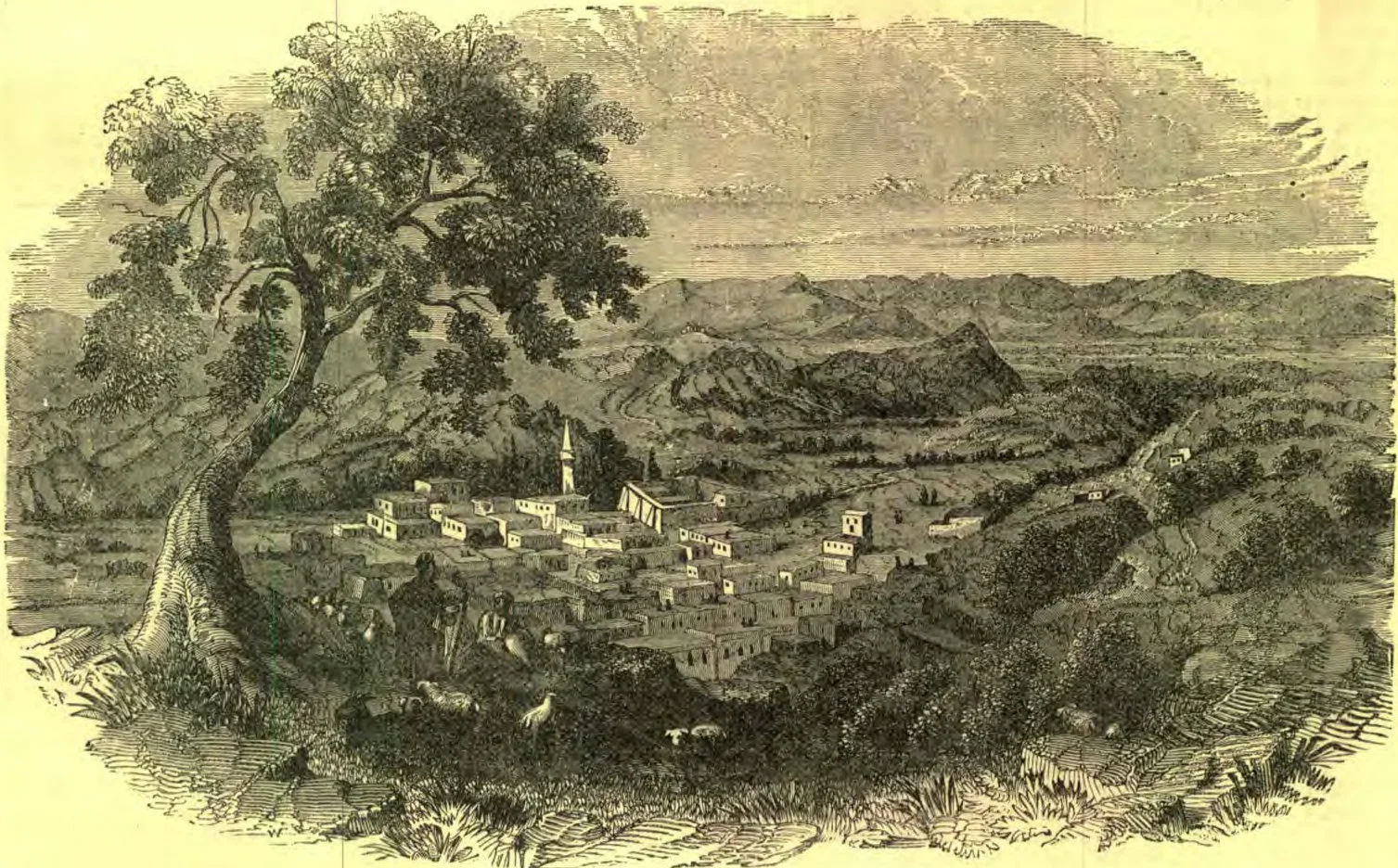
But the most interesting place of all is Nazareth, where Christ spent thirty of the thirty-three years of his earthly life. It lies in a little valley about a mile long and a quarter of a mile wide, and shut in from all the busy world without by a circle of rounded hills. The little village clings to the hillside, while out before it spreads a green valley. A spot better fitted for prayerful meditation it would be hard to find. Christ must often have wandered among the glens in the hills, that then, as now, were filled with the beautiful creations of his Father's hand. Upon these hills he often walked at evening, viewing in the heavens those greater works of the Creator, and lifting his heart in prayer to his Father for help in the coming years.
We are not told much of his boyhood, only that he dwelt at Nazareth with his parents, and “was subject unto them.” So brief is the record that I fear the children sometimes forget he left an example of perfect obedience for them to follow. He knows every step of the way from boyhood up to manhood; he met with all its temptations, and overcame them.
Among the many places of interest which the Nazarites show to the travelers who visit their town, is a kitchen, where they say Mary, the mother of Jesus, toiled, and a carpenter's shop fitted with tools, where Joseph and Jesus worked. But of course this is not true, for the oldest houses in the town have not stood more than a hundred years. But there is one place we may be certain about, and that is the fountain just outside of the town. Springs are slow to change their places, and we may be sure that to this very fountain Mary and Jesus often came, with their water-jars, as do the women and children of the present day.
The houses of Nazareth are solidly built of yellowish limestone, with flat roofs. The gardens around the houses give the town a fresh, inviting look. But the streets are like all Syrian streets, narrow and ill-paved, with a gutter in the middle.
Here rises the tall minaret of a Mahometan mosque, but there are Protestant churches in Nazareth as well. It is estimated that out of the six thousand inhabitants, four thousand are Protestants. Nazareth has a Protestant orphanage for girls, and also a Protestant hospital. Christianity has left its stamp on the inhabitants. The women have an air of freedom, intelligence, and self-respect unseen elsewhere in Palestine, unless we except the village of Bethlehem, the birth-place of the Saviour.
One of the finest sights in Nazareth is the view obtained from the top of the high hill on which the town is built. “This is one of the views,” says a traveler, “which may be coveted. The eye sweeps slowly around the horizon, longing to rest at every point, yet eager to turn to the next. Mountains and plains replete with sacred history are about you—Hermon, Tabor, Gilboa, Gilead, Esdraelon, and Jezreel. And off to the west glitters in the sunlight the ‘Great Sea,’ in a wide, extended surface, whilst purple Carmel runs out to bathe its feet in the blue waters. From the base of Carmel a long sandspit seems to form the Bay of Acre, on whose smooth waters the sails of vessels float like winged water-fowl. Jesus must often have looked out upon this scene; and from this spot, up from earth to heaven. Oh, how blessed were it if we might ever look at the world through the eyes of the sinless Christ!”
W. E. L.

THE LORD'S SHARE.

The brook wound clear and dark among its great rocks under the hill. The boys could hear its murmur as they came down the road.
“I hope we'll catch lots,” said Charley. “Say, Joe, don't you think we might get 'most a dollar apiece?”
Joe looked at his little brother with something of scorn. “Shouldn't wonder if I'd get a dollar. I know just how to fish, and I spoke for the pine-tree pool before we started. I mean to get more in my box than anybody in Sabbath-school. I told my teacher I was goin' to, and she said she wished everybody was as interested.”
“But I'm interested,” said Charley wistfully; “I'd like to get my box full. Made me feel real bad to think about those children with no schools or anything. I thought about 'em last night till I went to sleep. How much you goin' to put in if you get a dollar?”
“Oh, a good deal!” said Joe magnificently. “I'll take out a fair share, just as the minister said, and then I'll put the rest in my own bank. Heaps of money in my bank, there's getting to be.”
Charley gave a little sigh by way of answer. Such wealth was discouraging. He wished he were like Joe. He said so aloud, and Joe responded that he was three years the elder, and that perhaps Charley “would learn how” by the time he was ten years old.
“Anyhow, I'll put all I get into my missionary box this time,” said the little boy. “I'm goin' a-purpose. Only there ain't many fish to be caught except in the pool, and I can't catch 'em as easy as you can, anyhow. I wish I'd get a quarter. Don't you think I might get a quarter, Joe?”
“May be,” said Joe loftily.
Louder grew the rippling murmur. The brook with its overhanging trees was in sight. The boys separated, Joe going to the pool, and settling himself with his back to the great pine that grew almost on the edge, and Charley taking his place on one of the rocks where the water went whirling by at his very feet.
It was a beautiful place. Charley thought the woods had never looked so pretty. The bank above him was rosy with wild phlox, and there were ferns along the waterside. He gathered a bunch, and laid it in a little pool to keep fresh until he went home. Mother liked ferns and wild phlox. There were birds calling from one tree to another, and the wind in the pines was like another song. It was very pleasant.
“If they'd only bite!” sighed Charley.
Not a fish came to his bait. Up the stream he could see Joe under the pine tree, staring into the pool. Now and then he called to his brother:— “Splendid luck up here! Caught anything?” and Charley always answered “No.”
He was somewhat sober as they started for home, Joe carrying his string of speckled beauties, and he with empty hands, except for the pole and the bunch of rose-color and soft green which he carried carefully across his arm.
“You an't got a thing to show,” said Joe, in triumph.
“Only the flowers for mother,” said Charley sorrowfully. “Seemed as if the fish wanted you to catch 'em all. But I'm glad you got so many. There's 'most enough for two on that string, so I suppose the missionaries'll get just as much. Only I did want to help.” Joe said it was too bad, rather faintly. They walked along in silence for a little.
“Anyhow, I guess the Lord knows I wanted to help,” said Charley, half aloud. “I was goin' to put it all in,—all I got.”
“Well, there wasn't any need,” said Joe, gruffly. “All you have to do is to give a fair share; the minister said so! I'll get a dollar and a quarter for this string, and I mean to put the quarter into the mission-box. That's fair enough for anybody. You wouldn't have got more'n that if you'd fished in the pool all day. That's plenty.”
Charley looked doubtful.
“Seems 's if you couldn't 'xactly call it the Lord's share, when he made the fish, and gave folks the money to buy 'em and all. Seems 's if it belonged to him any way, and you ought to divide more even than that. Besides, those children must need lots, I should think. If 'twas me”— “Well, 'tain't!” returned Joe crossly. “You keep still!”
Charley “kept still” for the rest of the way. They stopped and sold the fish at the tavern on the hill as they went home. Joe scowled fiercely all the way, as he jingled the money in his pockets, and both faces were so dismal when mother came out to meet them, that she laughed outright at the sight.
“Didn't you catch anything?” she asked, taking Charley's flowers with a kiss of thanks. “Never mind. You'll find some way to earn money, and the Lord knows you wanted to help.”
“That's what I said,” said Charley, brightening. “And you will help think of some way, won't you, mother? cause I can't catch a thing. But Joe's got some.”
Joe scowled more than ever, as he brought out his money.
“He couldn't have caught what I did if he'd had the pool,” said he. “Besides, what's the use of giving away every cent you get? Ain't twenty-five cents a fair share, mother?”
Mother's own face grew sober, as she began to understand.
“You must think it out yourself, Joe,” she said. “The Lord doesn't want one cent more than you want to give, or one cent that is earned the wrong way.”
Joe thought a long time that evening. After Charley was asleep, he lay staring out of the window, and “thinking it over.” The dollar and the twenty-five-cent piece lay beside him on the table, for he had not been able to decide about them. Charley's empty mite-box stood there too. Joe sat up at last, and looked from it to his little brother's face.
“I suppose the Lord counts it to him just as if 't was in there,” he thought. “Charley's a great deal nicer than I am!”
Then a sudden idea came to him,—an idea which made his face grow bright. He caught up the dollar, and tossed it into the air with a laugh. “He'll be too astonished to live,” he said, “and I sha'n't feel mean any longer. And next time I'll let him fish in the best place, and help him land 'em, and everything. It'll do more good in his box than mine this time, I do believe.”
He leaned over and dropped the dollar into Charley's box and the quarter into his own, and then lay down to sleep, with the smile still on his face.—The Well-Spring.

Having the Mind of Christ

To copy Christ's life, we must have Christ's mind; the transformation must begin within.

A WOMAN'S FIGHT WITH THE INDIANS.

RIGHT here in Haverhill, where I am now writing, there took place, many years ago, a remarkable fight between the Indians and the early settlers. I will now tell you of some of the things that happened here at this time. Have you ever heard how Hannah Dustin killed ten Indians, and then escaped? You will see a picture of the scene in almost every early history of America. And it happened right here on the banks of the Merrimac River, nearly two hundred years ago. The country was very new then, only a few settlers here and there, and the Indians everywhere.
One day in the year 1697 a party of twenty painted savages crept suddenly and stealthily upon the little settlement. With a horrible war-cry, they set fire to nine houses, killing twenty-seven persons, and carrying thirteen captive.
While in the field at work, Mr. Dustin saw the savages coming to attack his house, and he ran to protect his family. He had eight children; one of them was a little babe only six days old. He soon saw that it was impossible to contend with the Indians, or to save his house or wife; so he gathered his seven children, the eldest of whom was seventeen and the youngest two years old, and hurried with them down the road in the opposite direction from the Indians. Then he seized his rifle, and sprung upon his horse; but the Indians were close upon him. It looked as though they would kill him and all his children, so he decided to take one on his horse with him, and flee. But when he came to make a selection, he could not do it, while each one looked pitifully up to him, and cried for help; to leave them, he knew, was certain death. Who can imagine the terrible sufferings of the father's heart in that fearful hour? How could he leave his children to be thus butchered? No, he decided he would not do it; he would die with them before he would leave one of them.
So he hurried his children on before him, as fast as they could go, while he himself stayed behind, between them and the Indians. His faithful rifle did him good service, bringing down a redskin at every fire. Thus he fled for over a mile, keeping his little folks ahead of him; and finally he reached a place of safety, with his children unharmed. It seems as though God must have helped them.
But the poor mother and the babe did not fare so well. The savages ordered her to go with them. It was in the month of March, and the weather was cold. They would not give her time to fully dress, so she went with one foot bare. They robbed the house of everything valuable, and then burnt it in her sight. But they did a deed more cruel than that. They did not want the babe, so they dashed its brains out against a tree. Oh, how sad that must have been for the poor mother!
She and others were then taken with the Indians; there were thirteen prisoners in all. They had to travel fast, and endure great privations. Some could not keep up, and these were immediately killed by the Indians. Finally they arrived at a place near Concord, New Hampshire, and here the prisoners were divided up among the Indians. Mrs. Dustin and her nurse fell to the same Indian. He took them with his family, and, with other Indians, started up the Merrimac River for Canada. You can well imagine the terrible sufferings of that poor mother; her babe was dead, her house was burnt, she supposed her husband and children were killed, and she was among the savages, far off in the lonely woods. You can hardly think of anything that was worse. But she was a faithful Christian, and believed that God would take care of her.
On they traveled day after day, getting farther away from civilization all the while. After some fifteen days, they had got so far from the whites that the Indians did not watch their prisoners very carefully. They let them go out and gather wood. There was also another prisoner with them, a boy, making three persons in all; these were a great comfort to each other. The company of Indians numbered twelve; two men, three women, and seven children. Mrs. Dustin persuaded the others to make an attempt to gain their liberty. The boy had been with the Indians a good while, and understood their ways. One day he asked an Indian where to strike a man to kill him quickly, and the Indian told him to hit him on his temple; and then he told the boy how to scalp a man.
That night they all lay down to sleep as usual, but the three captives kept awake, though pretending to be asleep. Mrs. Dustin, with the other woman and the boy, carefully toward morning, when all were sleeping the soundest, arose, and each of them took a hatchet. They meant to kill the Indians. That was a brave deed for those women to undertake. But they killed ten out of the twelve. One squaw succeeded in getting away after she had been struck several times; also a little Indian boy woke up, and ran off into the woods. The captives then destroyed all the canoes but one, in which they started down the river for home. It was about one hundred and fifty miles there, through a country filled with dangers. They feared that the alarm would be given, and that the Indians would follow them, or that they might meet with other Indians, or that some wild beast might devour them. But on they went down the river, only one sleeping at a time, day or night. They took with them the scalps of the ten Indians, to prove that they had really killed them. What a joyful meeting that must have been when they reached the settlement, and the mother found the rest of the family! The providence of God protected them. They lived here many years in peace and safety.
This brave deed of Mrs. Dustin has been told the world over. On the common in Haverhill is a beautiful monument commemorating this event. On the top of the monument is a figure of Mrs. Dustin, with a tomahawk raised to strike her foes. On the shaft are four pictures, showing the father flying with his children and fighting the Indians, the mother leaving the burning house with her little babe, the killing of the Indians, etc. As this is indeed a historical event, I hope that all the children will remember it.
D. M. CANRIGHT.

GOOD NATURE.

A CHARM to banish grief away, To free the brow from care, Turn tears to smile, make dullness gay, Spread gladness everywhere; And yet 'tis cheap as summer's dew That gems the lily's breast: A talisman for love as true As ever man possessed. —Charles Swain.

REAL BOYS.

The Christian boy in actual life will find it very easy to do wrong, far easier than to do right oftentimes, for the good resolutions made to-day will not last for to-morrow, and the temptation overcome this week will not make it safe for him to walk carelessly next week. What of that? He is called to be “a good soldier of Jesus Christ;” and that very word “soldier” means that there will be fighting.
So he must be brave. He may not have a chance to plunge into the water and save a drowning school-mate, or rush into the road and stop runaway horses, after the fashion of the story-book boy; but he will find call enough for heroism in stopping his own temper when it is running away with him, and in picking himself out of many a bog of discouragement and carelessness. And it demands far higher courage to conquer self and hold steadily to some duty when there is no one but God to see, than it does to perform some brilliant deed that those around us will praise.
The real boy, too, will be a boy—a Christian boy, and not a man. He will like marbles, tops, skates, and sleds, and care as much for fun as he ever did. Why should he not? “Whatsoever ye do, do it heartily, as unto the Lord and not unto men,” means play as well as work. But the “unto-the-Lord” part of it will make him kind and generous in sharing the skates and sled, and entirely fair and honest in the games of ball and marbles. The word “honest” is a very broad one when we come to think of it; it means far more than not stealing. It means no shamming in lessons, no slighting in work, but good full measure in all that we do. It is hard to be thoroughly honest with our neighbor, harder to be honest with our God, and hardest of all to be honest with ourselves; but the earnest effort to be all three will be the best kind of preaching a boy can do; a little example has more weight than a great deal of advice.
Probably the real boy may not get ahead quite so fast in winning everybody’s admiration and confidence as does the boy in the book; but as his character grows steady, strong, and noble, his reputation will surely grow with it, and a good name is no small capital in any business. No matter if wonderful events do not happen so constantly, nor unexpected fortunes appear so plentifully, in actual life. God is the best and wisest Author, and he sees that such things would not be good for us.
Yes, the boys can be true and brave, they can have for their steadfast friend and helper the One who was once a boy at Nazareth, and who knows every hard step of the way from boyhood up to manhood.—S. S. Visitor.

A MOTHER'S COUNSEL.

The great men of the world have generally owed much to the character and training of their mothers. If we go back to their childhood, we see there the maternal influences which form the aims and the habits of their future life.
Bayard, the flower of French knighthood, the soldier without fear or reproach, never forgot the parting words of his mother when he left home at fourteen to become the page of a nobleman. She said to him, with all the tenderness of a loving heart:—
“My boy, serve God first. Pray to him night and morning. Be kind and charitable to all. Beware of flatterers, and never become one yourself. Avoid envy, hatred, and lying, as vices unworthy of a Christian; and never neglect to comfort widows and orphans.”
When Bayard was foremost in battle, confessedly the bravest warrior in the field, or when, in his own great thirst, he was giving water to a dying enemy, he was only carrying out his mother’s counsel, and striving to be worthy of her name. The memory of a mother’s love is a talisman against temptation, and a stimulus to a good life.—Sel.

Sincerity Does Not Save

SINCERITY doesn’t save. One may be sincerely wrong.

IMPORTANT BIBLE SUBJECTS.

LESSON 56.—INHERITANCE OF THE SAINTS.

(Continued.)

OVERTHROW OF THE ANCIENT KINGDOM OF ISRAEL.

[NOTE TO THE STUDENT.—Do not consider the lesson learned until you can give at least the substance of every text, with the correct reference for each. The references in black letters indicate those texts that should be committed to memory. A little diligent application each day will enable you to do this.]
1. Who succeeded David as king of Israel?
2. How long did he reign? 1 Kings 11:42.
3. Before Solomon’s death, what had been prophesied concerning the kingdom? 1 Kings 11:29-31.
4. To whom did the prophet say ten parts of the kingdom should be given?
5. How much was to be left to the house of Solomon? 1 Kings 11:32.
6. Why was this division to be made? 1 Kings 11:33.
7. Then what kind of kingdom did the Lord design the kingdom of Israel to be?
8. When was this division to be made? 1 Kings 11:34-36.
9. For what reason was the kingdom kept entire during Solomon’s lifetime?
10. How many instances can you cite, in which wicked people received blessings because of the goodness of others?
11. Who was Solomon’s successor? 1 Kings 11:43.
12. After he had been made king, who came to him? 1 Kings 12:3.
13. Relate the conversation that passed between them and the king. 1 Kings 12:3-5.
14. When they came the third day, what answer did King Rehoboam make? 1 Kings 12:12-15.
15. When the people saw that their plea was disregarded, what did they do? 1 Kings 12:16-20.
16. When was this division effected?—About B. C. 975.
17. What was the subsequent history of the kingdom of Israel, now divided into two kingdoms? (See note.)
18. Yet what positive promise had the Lord made? 2 Sam. 7:10, 16.
19. In view of the final complete overthrow of the kingdom of Israel then in existence, to what must we conclude that the Lord referred in the text last quoted?

NOTES.

The student will note that the kingdom which God designed, was one in which his commandments were to be kept. Few will have any difficulty in connecting this with that kingdom referred to in Matt. 6:10, in which the will of God is to be done as it is in heaven.
The history of the kingdom of Israel after the division, may be found from the 12th chapter of 1 Kings to the close of the book. The two divisions were called the kingdoms of Israel and Judah. The kings of Israel, or the northern kingdom, were all wicked, many of them to the very extreme. Because of this, their history is not recorded in the books of Chronicles; those books contain only the history of the kings of Judah. In the year B. C. 721, the kingdom of Israel was totally destroyed, all the people being carried to Assyria and adjacent countries, from which other people were taken to fill their places in their own land. See the account in the 17th of 2 Kings. Several of the kings of Judah were eminent for their piety, but the greater number were bad. Finally the priests, as well as the people, began to practice the abominations of the heathen, even in the house of the Lord; and when faithful men were sent to reprove them, “They mocked the messengers of God, and despised his words, and misused his prophets, until the wrath of the Lord arose against his people, till there was no remedy.” 2 Chron. 36:14-16. Then they were taken captive to Babylon, and the city and the temple were laid in ruins. This captivity began B. C. 606, and continued seventy years, till B. C. 536; but it was not till nearly a hundred years later that the people were fully restored to their own land. At no time, however, subsequent to the captivity, were the Israelites ever an independent nation. They were subject or tributary successively to the Babylonians, Persians, Grecians, and Romans. To the last-mentioned people they were subject in the time of Christ, and it was the Romans who, in A. D. 70, again demolished the city of Jerusalem, and dispersed the inhabitants. Since that time, the Jewish people, even as a tributary nation, have had no existence.

FORM AND POWER.

“HAVING a form of godliness, but denying the power thereof; from such turn away.”
Sound advice! For what is a body, be it ever so beautiful in form, if it be without life? What is a tree without sap? What is a locomotive without steam? Machinery may be most ingeniously contrived, skillfully wrought, highly polished, each part adjusted to its place with the greatest nicety and exactness; but what of all that, if it lacks the power to run and accomplish something? It is but little more than a costly bauble, or an expensive toy, a decided failure. The fault is not in the construction, or the polish, or the mechanical skill in the contrivance—all these were necessary to make a good machine; the fault lies in the simple fact that it lacked the necessary power to accomplish the work it was designed for. Apply the proper power, and the work will be done.
The same is true in the preaching and teaching of the gospel. We have no lack of machinery either in church or school, and we have some splendid machinery, too. But a sad disappointment has come to many hearts. The work is not progressing as it should. What do we lack? Why this failure in so many places? The machinery is there, the same as in other places where success has blessed the workers. The answer is at hand. The successful workers have sought for, and applied the power, and their work has been rewarded with rich results.
What is that power? The preacher’s and the teacher’s power is the Holy Spirit! What the sap is to the tree, the steam is to the engine, the life is to the body, such is the Holy Spirit to the lesson or the sermon. Preparation is necessary; system is indispensable; form is essential to all intelligent attempts to do the work of Christ; but the crowning point of excellence, and the only guarantee to success, is by being “endued with power from on high.” It is not only having our sermons or our lessons ready, but it is also in having ourselves ready by the baptism of the Holy Spirit.
Let your heart be filled with the Holy Spirit, and you will cease to be a failure, and become a success. Get the “form” and the “power.”—S. S. World.

THE TULIP CRAZE.

A SPECULATOR is one who buys goods or property of some kind with the expectation that the price will rise, when he can sell to some one else at the higher price, and so make a profit. You know of people who make what money they have in this way, don’t you, boys?
The speculator deals in provisions, clothing, gold and silver, stock and bonds, in fact, most anything that is salable. He watches home and foreign markets to be guided in prices, and he learns generally to tell pretty well when to buy and when to sell. But he cannot always tell what the demand for a thing will be; and if prospects are flattering, the glitter of an imaginary pile of money sometimes blinds him, and he rushes on and gets terribly bitten. And so the rich speculator of to-day may be a poor man to-morrow.
But one of the most foolish speculations that the world has ever witnessed occurred in Holland about the middle of the seventeenth century. This country, which ever has a constant struggle with the waters to maintain an existence, had now reached a height of prosperity that made the more wealthy inhabitants free to enjoy some of the luxuries of life. Instead of their previous simplicity in dress, they arrayed themselves in silks, velvets, pearls, etc. Their simple cottages had been superseded by little palaces, which they had adorned with paintings, hangings, and precious things from all parts of Europe and Asia. And now the rich merchants of some of the Dutch cities began to spend large sums of money in ornamenting their gardens with tulips, a favorite flower with the Hollanders. And so it was that everybody began to cultivate the tulip. The following is De Amicis’s description of this wild excitement in his “Holland and its People”:—
“Everywhere gardens were laid out, and new varieties of this favorite flower sought for. On every side there swarmed unknown tulips of strange forms and wonderful shades or combinations of colors. Prices rose in a marvelous way, a new variety obtained in these leaves was an event, a fortune. Thousands of persons gave themselves up to the study with the fury of insanity; and all over the country, nothing was talked of but petals, bulbs, seeds, etc. The mania grew to such a pass that all Europe was laughing at it.”
“Bulbs of the favorite tulips of the rarer varieties constituted a fortune. One bulb of a tulip named Semper Augustus was bought at the price of thirteen thousand florins. A bulb of the Admiral Enkhuizen cost two thousand dollars.” Other instances are recorded of still greater prices being paid for them. “They trafficked in them as in State bonds and shares. “They sold for enormous sums bulbs which they did not possess, engaging to provide for them for a certain day; and in this way a traffic was carried on for a much larger number of tulips than the whole of Holland could furnish. It is related that one Dutch town sold twenty millions of francs’ worth of tulips, and that an Amsterdam merchant gained in this trade more than sixty-eight thousand florins in the space of four months. These sold that which they had not, and those that which they never could have. The market passed from hand to hand, the differences were paid, and the flowers for and by which so many people were ruined or enriched, flourished only in the imaginations of the traffickers. Finally matters arrived at such a pass that many buyers refused to pay the sums agreed, and the government decreed that these debts should be considered as ordinary obligations, and payment should be exacted in the usual legal manner.”
The prices suddenly fell, the Semper Augustus as low as fifty florins, and speculation in them ceased.

WORKING AND WAITING.

A MIGHTIER Hand, more skilled than thine, Must hang the clusters on the vine, And make the fields with harvest shine; Man can but work; God can create; But they who work, and watch, and wait, Have their reward, though it come late.

BLOCKS OF MILK.

IRKUTSK is a city of central Siberia. A correspondent of the Boston Commercial Bulletin, in writing about the place, says:—
“The markets of Irkutsk are an interesting sight in the winter time, for everything on sale is frozen solid. Fish are piled up in stacks like so much cord-wood, and meat likewise. All kinds of fowl are similarly frozen and piled up.
“Some animals brought into the market whole are propped up on their legs, and have the appearance of being actually alive; and as you go through the markets, you seem to be surrounded by living pigs, sheep, oxen, and fowls, standing up and watching you as though you were a visitor to the barnyard.
“But stranger yet, even the liquids are frozen solid, and sold in blocks. Milk is frozen into a block in this way, with a string or a stick frozen into or projecting from it. This is for the convenience of the purchaser, who can take his milk by the string or stick, and carry it home swung across the shoulder.
“So in a sense which is unknown in other countries, a man can buy his drink ‘with a stick in it.’”

Nicknames of American Cities.

Here is a list of the nicknames of some of the principal American cities, which it might be well to keep for reference; for sometimes, in print, cities are referred to by the nickname only, which, if you do not know it, will leave you ignorant of what city is meant. It would be an interesting study for the boys and girls to hunt up what gave each its name.
“Belle City, Racine, Wis.; Bluff City, Hannibal, Mo.; City of Churches, Brooklyn, N. Y.; City of Elms, New Haven, Conn.; City of Figs and Sawdust, Minneapolis, Minn.; City of Magnificent Distances, Washington, D. C.; City of the Plains, Denver, Col.; City of Rocks, Nashville, Tenn.; City of Roses, Little Rock, Ark.; City of Spindles, Lowell, Mass.; City of the Straits, Detroit, Mich.; Corn City, Toledo, Ohio; Cream City, Milwaukee, Wis.; Crescent City, New Orleans, La.; Delta City, Alexandria, Va.; Falls City, Louisville, Ky.; Forest City, Cleveland, Ohio; Frisco, San Francisco, Cal.; Garden City, Chicago, Ill.; Gate City, Keokuk, Iowa; Gem City, Quincy, Ill.; Gotham, New York City, N. Y.; Modern Athens, the Hub, Boston, Mass.; Monumental City, Baltimore, Md.; Mound City, St. Louis, Mo.; Bluffs City, Kansas City, Mo.; Paper City, Holyoke, Mass.; Quaker City, Philadelphia, Pa.; Queen City, Porkopolis, Cincinnati, Ohio; Railroad City, Indianapolis, Ind.; Shell City, Mobile, Ala.; Smoky City, Pittsburg, Pa.; Star City, Lafayette, Ind.; Tusselburg, Alton, Ill.; Tunnel City, North Adams, Mass.; Zenith City, Duluth, Minn.; City of the Angels, Los Angeles, Cal.; Splinterville, North Braddock.”

PUTTING THE EYES TO USE.

An amusing story was popular, years ago, called “Eyes and no Eyes.” It told a number of curious incidents where two persons saw precisely the same things. On the one no impression was made, and what was seen was soon forgotten. The other noticed carefully, was led to think and to act, and won either fame or fortune. Mr. Ruskin says genius is only a superior power of seeing. Great discoverers see a little farther than other people.
Columbus, when his men were in mutiny to return to Spain, saw weeds and plants drifting by his ships, and knew that land was near. Watt saw the steam lifting the lid of his mother’s tea-kettle. But he saw, beyond that fire-place, the steam-engine propelling ships and drawing cars.
Newton saw an apple fall in an orchard. But looking beyond the orchard, he saw the wonderful law of gravitation, by which the sun and the earth and other planets are kept in their appointed places. Galvani saw a frog’s leg twitch when two metals touched it, and he saw at the same time, the possibilities of the galvanic battery.
Sir Samuel Brown saw a spider’s web floating across his path one summer’s morn, and he saw, also, the possibility of a suspension bridge spanning a river. It is well to train the eyes to see all that may be seen.—Youth’s Companion.

THE HUMAN HEART.

The human body is so full of structural wonders that the science of physiology is one of the most delightful of studies. Take, for instance, the heart. With each stroke, it projects about six ounces of blood into the conduits of the system, and as it does so some 70 times every minute and 4,200 times in an hour, this implies that it does the same thing 100,800 times in 24 hours, 36,000,000 times in a year, and more than 2,500,000,000 times in a life of 70 years.
The force it exerts is sufficient to lift one hundred and twenty tons one foot high every twenty-four hours. Yet the piece of living mechanism that is called upon to do this, and do it without a pause for three-score years and ten without being itself worn out by the effort, is a small bundle of flesh that rarely weighs more than eleven ounces.
It is in the nature of the case also, it must be remembered, that this little vital machine cannot at any time be stopped for repair. If it gets out of order, it must be set right as it runs. To stop the beating of the heart for more than the briefest interval, would be to change life into death.—Selected.

Origin of the American Emblem.

The eagle is as widely known throughout the world as the emblem of American liberty, as the lion is as the emblem of British power. Yet few of us know that the emblem once belonged to a single family.
The great seal of the United States was adopted in 1782, when the emblem of the Custis family was selected as our national sign. The crest of Gen. Washington contained a raven; that of Mrs. Washington, who had been Mrs. Custis, an eagle, and it was decided to borrow the eagle.
Dr. Franklin proposed a turkey; but he disliked all such things as crests, and he probably was trying to make sport of the matter.
Some one else suggested the buffalo; but those in favor of the eagle were in the majority.—Selected.
Continue reading: VIC'S LILIES