School was dismissed, and the boys and girls came rushing out with merry shouts and laughter. The voices had that musical ring peculiar to uncultivated colored lads and lassies. They were a comely, thrifty looking set, and the instinctive hopefulness of their race looked from the bright eyes and shone in the cheery faces. Life had gone hard with some, but had failed to quench their faith in the good time yet to come.
As they neared the corner of the street and came in sight of a large, handsome white house, a girl's voice called, “Hush! hush!”
“Lor', now, Vic!” her brother Phil said, “what nonsense!” But every voice took a lower tone, and the house was passed almost in silence. The blinds of the house were closed, and from the door knob hung the black-and-white token of mourning. Vic was saying, “Yes, sick just two days; taken Sunday and died this morning. When I tol' the teacher, she said: ‘Death loves a shining mark.’”
“I'm awful sorry,” said Nan; “he was a mighty peart little 'un, and he al'ays looked up and smiled when we passed.”
“You don't s'pose that little pink and white chap will go to our heaven, do you?” said Phil. “All the first class 'commodations b'longs to the white peoples, ye know.”
“Hush, Phil,” said Vic; “everything will be all right, honey, when we gets up dere. Old Dinah says she's awfully broken hearted—his mother, you know. You see they're strangers here, came for the mammy's health; and Frankie, he was the only chile. 'Pears like I want to comfort the po' mammy. My lily has three blossoms. I mean to take 'em all to her.”
'Pears like you'd better min' your own business. She may be a stuck-up white lady, if she do come from the norf. Like as not she'd turn up her nose at your lilies. I'll 'low the little un was cute, but you'd better let his mother 'lone.” This was Phil's advice.
But although Victoria Porter had a black skin, she had a tender, loving heart, and she had pored over the Christ-life until she had unconsciously imbibed its spirit. She was always yearning to comfort some one. Later in the day she stood at the door of the white mansion, holding her precious lilies. “They're for his mother,” she said to Dinah. “Tell her we chil'ens loved Frankie, and we'se all mighty sorry.”
It was a simple message and a simple offering, and the giver was a poor little black girl; but behind the gift was sincerity and love, and the heart of the poor, sorrowing mother was touched and comforted.
And Vic's lilies had a mission of which she knew not. They preached a lovely sermon on the high privilege and duty of comforting others. We may be poor and very humble; but if we try, we may make life brighter and sweeter to some one. What a glad surprise it will be to Vic when the Saviour honors her many kind acts by the words: “Ye have done it unto me.”—Selected.
KING AND QUEEN OF THE SANDWICH ISLANDS.
Sixty years ago the Sandwich Islands was the home of a pagan people. To-day it is a Christian land, and this great change has been brought about by the labors of missionaries.
The native women of these Islands wear a loose gown, something like the Mother Hubbard gown. But the Queen and many others wear the American or European dress.
King Kalakaua, at his coronation in 1874, wore a gorgeous feather cloak that had belonged to King Kamehameha I. This cloak is made of feathers of a bright golden color, and is worth many thousand dollars. Only kings, or chiefs of high rank, were permitted to wear the cloaks of golden feathers. The bird that furnishes the feathers for these cloaks is the Oo, or royal bird. It is a species of honey-sucker, and is glossy black. Concealed under either wing is a single feather of pure gold. Each feather is an inch long, and only think how many of these feathers it must have taken to make this gorgeous cloak, which is eleven feet wide, and five feet long! Formerly each bird was caught and killed in order to secure its two golden feathers, and what a slaughter of these pretty innocents there must have been!
But King Kamehameha I., who, although a pagan, seems to have been a man of noble spirit, ordered that no more of these birds should be killed for their two golden feathers. So, since that time, the fowler sets up his traps—long poles well baited, and smeared with bird-lime—catches the birds, plucks the two feathers, and sets the birds free again.
This cloak of King Kalakaua’s is always spread over the throne at the opening of Parliament.
The native Sandwich Islanders have a pretty fashion of wearing necklaces of flowers, called lei. Men and women both wear them. Flowers are plentiful in this tropical land. They often toss these leis over the heads of strangers; it is a pretty greeting.
The only heir to the throne is a little princess born in 1875. She has a long list of names very hard to pronounce, but her first name is Victoria. She was named for the good Queen of England. King Kalakaua was chosen by the people, instead of Queen Emma, who has since died.—Little Men and Women.
Letter Budget.
We have two letters from the same post office in Gage Co., Neb.,—one from LUELLA SNOWDON, and one from MINNIE LANNING. Luella writes: “I am eight years old. My mamma, sister, and I keep the Sabbath. My sister is six years old. My papa and little brother are dead. We hope they will have a place in the new earth. We mean to do God’s will, and have a home in the kingdom, where we hope we may meet our dear papa and brother again.”
MINNIE says: “I and my brothers, Charlie and Alvah, are trying to keep the Sabbath. Ma has been dead five years, and I have kept house for pa ever since. I am now fifteen years old. My father don’t keep the Sabbath, and I ask you all to pray for him. He has a kind heart, and would keep it, but he says he must make something to live on. I hope we will all meet in the new earth.”
Luella has lost father and brother, and Minnie, her mother. These girls have both had sorrow enough to teach them the uncertainty of life, and we hope they are making a choice of “that good part, which shall not be taken from them;” and that their families, though broken here, may be reunited in the new earth, to continue forever.
BERTHA and GERTIE DAVIS, two sisters, send letters from Wexford Co., Mich. Bertha is twelve years old, and Gertie is ten years of age. Bertha writes: “I have two brothers and one sister. I go to Sabbath-school and learn my lessons in Book No. 2. My parents attend Sabbath-school, and my papa teaches my class. There are four members in it. My sister studies in Book No. 1, but my brothers are not old enough to be in a class. I used to go to Sunday-school, but I like the Sabbath-school better. I want to overcome all my sins. I send my love to the INSTRUCTOR family.”
Gertie says: “Bertha is my sister. Papa and mamma have been members of the church four months. I have been to Sabbath-school every Sabbath but one since I began to go. I like to go. I am trying to be a good girl, so I can meet the INSTRUCTOR family in heaven.”
In the envelope with the letters from Wexford County was one from WARREN PERRY, a member of the same Sabbath-school. Warren writes: “As a small company have met with us to-day, we have a good chance to write, and we hope our letters will be printed in the Budget. I am fifteen years old. I have kept the Sabbath about eighteen months, and I intend always to keep it, and to gain a home with the INSTRUCTOR family. We take the INSTRUCTOR. I think I shall get three subscribers for it, so as to get one of ‘Webster’s Practical Dictionaries,’ for I need one in school.”
We are glad to hear from three in one Sabbath-school who are battling with sin. May none of you get weary in well-doing; for in “due season you shall reap, if you faint not.”
HATTIE M. NEWCOMB, of Volusia Co., Florida, writes: “I am a little girl twelve years old. I live in Florida. It is very beautiful here, there are such lovely orange groves, fragrant flowers, beautiful clear lakes, and springs of water. There is a spring near us called Green spring, which is circular in form. It has been sounded ninety-five feet without touching the bottom. A stream of pure water flows from it, which has sulphur in it. Invalids claim to receive benefit from drinking the water and bathing in it. There are no Sabbath-keepers living near us. I take the YOUTH’S INSTRUCTOR, which I like to read very much. It is truly an instructor. As I cannot attend Sabbath-school, my little sister Jessie and I learn the lessons in the paper and recite them to mamma. I love to read the Bible, and then have mamma explain it to us. I want to be a Christian and so have a home in the earth made new. I have two little mocking birds, which sing very beautifully.”
Hattie’s description of her Florida home will give all a desire to visit it. But though we cannot, we can let our thoughts go from it to the Eden home, which all may share in who will. Somebody will walk the streets of the New Jerusalem, partake of the fruit of the tree of life, and drink of the river of the water of life; will it be any or all of our letter-writers? Now is your time to decide that matter.
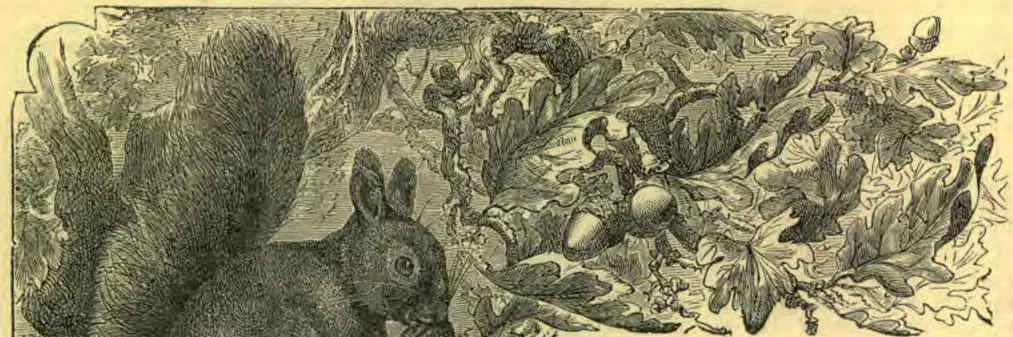
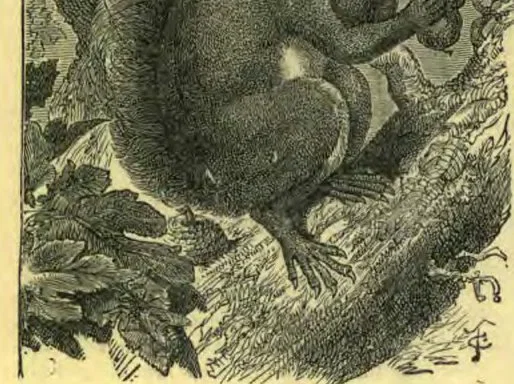
The Squirrel.
Oh, there's the squirrel perched aloft, That active little rover; See how he whisks his bushy tail, Which shadows him all over.
Now view him seated on that bough To crack his nuts at ease, While blackbirds sing and stock-doves coo, Amid the neighboring trees.
With cunning glance he casts around His merry, sparkling eye; In yonder hazel by the brook, Rich clusters he can spy.
And then he flies much more alert Than butterfly or bee; No lamb or kid is half so light, So swift of foot, as he. —Selected.
FORGIVE AND FORGET.
“Love suffereth long and is kind,—what does it mean by love suffering, mamma?”
“Not the kind of suffering you are thinking of, little daughter, not pain and trouble. It means being forbearing and gentle and kind when we think we have great reason to be out of patience. To bear many cross words and unkind deeds without giving up to feelings of anger.”
“But the girls at school say: ‘If you spite me, I’ll spite you.’ They say that’s fair.”
“Jesus Christ doesn’t say so; he says: ‘Love one another,’ and you have just seen how he adds, ‘Love suffereth long.’”
“I do believe I’ll try how it works,” said Bessie to herself, as she walked to school next morning. It was well she had made such a good resolution, for she found plenty of chances for practicing it. Her dearest little friend Susie got angry with her because she would not whisper to her a word she did not know of her spelling lesson, and she had to go to the foot. Bessie’s mother had told her it was not honest to tell words in the class.
But Susie was deeply offended and would not walk with Bessie at recess; and when the girls were choosing sides for a game, she chose another girl, for the first time in her life. And she divided her banana with some one else, although she had expressly agreed the day before to divide with Bessie in exchange for some sweet crackers.
All this was very hard to bear, especially when Susie walked home without as much as a look at Bessie, although their houses were side by side, and they had always walked together. Bessie went to her mother, half heart-broken.
“Forget it, dear,” said her mamma, cheerily. “That’s the best way to suffer long and be kind. Put it all out of your mind as soon as you can, and try to think only of the pleasant things Susie has done for you.”
An hour later, Susie walked along Bessie’s fence. She wanted to go in and play, but she felt ashamed. Bessie opened the gate and ran and took her hand.
“Come in, Susie. Let’s have a game of croquet.”
“Why!” said Susie in great astonishment, and then hanging down her head, “I didn’t think you’d want me to play with you when I’ve been so mean to you all day.”
“Never mind,” said Bessie, laughing, “I’ve forgotten all that; I only remember about the time you gave me your prettiest kitten, and when you stayed in the house with me when I sprained my foot, and when you gave me half your pansy seeds.”
“Oh,” said Susie, putting her arm around her friend, “I shall always remember the time you forgave me when I thought you never could.”
“It works very well indeed,” said Bessie to her mother that evening as she wished her good-night.
Try it, little children. Try how the spirit of loving-kindness and gentleness which leads you to bear long and then to forget, works in your school and in your home. Be sure it will make sunshine for yourself and others wherever you are. —Selected.