The readers of the Review will be interested in knowing the fate of the Memorial which was to be presented to the National Woman’s Christian Temperance Union. The document was prepared and kept at hand for use at any moment when the opportunity was given to present it, as Mrs. Henry had been informed that she would not be obliged to wait for the post executive, but could go before the committee at almost any time that suited her best. She informed the ladies that she could not be present at any business sessions on the Sabbath, and as Monday was given to other work, and there were no executive meetings, we did not make any special preparation for this part of our work until Tuesday; but from that time the Memorial was kept in hand, ready to be taken to the room in Ellicott Square Building, where the executive sessions were held, at a moment’s notice.
First of all we wish to express our gratitude to the women who have so nobly aided in this work, and who have name by name rolled up the list until it numbered nearly thirteen thousand names, making a roll as large as a woman could very well carry.
We must leave you to imagine the anxiety of those hours which were spent in waiting for an opportunity to go before the executive, as we felt that the hour must be as opportune as possible. Tuesday in the executive was given to the discussion of the Temple, and Mrs. Henry was advised that she would better wait until this matter was off the docket. Meanwhile matters of interest occurred in the body of the Convention, which caused us to feel that this arrangement was providential for us; for, on Tuesday afternoon the committee on resolutions submitted their report, in the preamble of which occurred the following:—
We deprecate the wide-spread and increasing desecration of the Sabbath, and call attention to the word “remember” in the fourth commandment. We believe all citizens should be protected by law in their right to one day of rest in seven without opposing any who conscientiously observe any other than the first day of the week.
The order of procedure was to consider the report seriatim, and to act on the resolutions first, taking the preamble later. Mrs. Henry requested of the president the privilege of speaking to the above section of the preamble, and Miss Willard gave her the floor for that purpose, saying to her that the resolutions would be first disposed of. “But,” she said, “you take this chair right by me, and be ready when we come to the discussion of the preamble.” The discussion of the resolutions was prolonged to such an extent that Miss Willard had been obliged to retire, leaving Mrs. L. M. N. Stevens, of Maine, in the chair. Mrs. Stevens, not knowing that Miss Willard had given Mrs. Henry the floor, and it being732continually demanded by others, and Mrs. Henry not wishing to claim it by violence, the time passed on, the hour grew late, and many of the delegates were obliged to leave early, unconscious of the fact that anything of very great importance was about to occur. Mrs. Henry at last claimed the floor, and moved that the discussion of this report be closed for the present, and be made the special order for the next morning, as it was of too much importance to be considered in the rush of the afternoon, with so many general officers, leaders, and delegates absent. This, however, was very strenuously overruled, especially by the chairman of the resolution committee, who wished to have the matter disposed of at once. Accordingly, the discussion went on, and continued long past the hour of adjournment.
Mrs. Henry then offered the following amendment to the section in question:—
We deprecate all desecration of the Sabbath, and would call especial attention to the word ‘remember’ in the fourth commandment. We believe that every individual should be protected in his right to one day of rest in seven, from any power which would attempt to wrest it from him, while we would refrain from opposing in any way the right of the individual to choose his own rest day.
Mrs. Babcock, president of the W. C. T. U. in Rhode Island, arose and seconded this amendment, upon which a delegate arose and moved that the amendment be laid over, and made a special order for the morning session, as the hour was late, the remaining delegation weary, and it was considered a matter of too much importance to be acted on by only a part of the delegates. Mrs. Henry replied: “You will recall that a short time ago I requested that this entire report be deferred, and made a special order for the morning, but it was overruled. But you will see that I have not really made any great change which would involve us in discussion, but that my amendment makes more clear what I am sure was in the thought of the committee, and I would like to state my reasons for making this change either now or to-morrow.”
The motion to lay the matter over until the following day was opposed, the committee being desirous of getting the resolutions out of the way, and it being urged that it would require but a few moments for Mrs. Henry to state her reasons for the amendment. The motion to proceed was carried, but immediately a woman arose and made a motion to adjourn. As a motion to adjourn is not debatable, and takes precedence of everything else, of course the matter was at a standstill; but cries of, “No! no! Don’t do that!” met the motion from every side of the house, and especially from the platform. Since, however, the motion had been seconded, and the only way to open the door for further proceedings was to vote it down, it was put on its way, promptly disposed of by a large and spirited negative, and Mrs. Henry was permitted to proceed. She said: “The clause which I would strike out is this: ‘We believe all citizens should be protected by law’ There is a question as to what citizenship means. I believe that every individual should be truly protected, whether he is considered a citizen, or not; and further, I would call your attention to the inconsistency of quoting the commandment which enjoins the remembrance of the Sabbath, which is clearly stated to be the seventh day, as a reason for affording legal protection to those who prefer to keep the first day of the week.” She then made an appeal for carefulness in dealing with this question, and urged the substitution of her amendment for the original resolution. Considerable discussion ensued before the vote was taken. This vote was interesting as showing that although the majority were against the amendment, there was a sufficiently large number who recognized the principle involved, to make a very gratifying minority.
This matter being settled on Tuesday, early Wednesday morning one of the members of the committee gave notice that we could go before them at any time, and accordingly we left the convention, and proceeded to Ellicott’s Building. We took seats in the corridor outside the committee room. Mrs. Henry’s card was taken in to Miss Willard, and it was not long before the corresponding secretary appeared at the door and called us in, although there were others besides us waiting to go in. Miss Willard received Mrs. Henry very graciously, stating that she had been called at once, as they felt it would not be right to keep her waiting; and considering the pressure of burden and anxiety which was upon us, you can understand how thoroughly we appreciated this kindness.
Mrs. Henry addressed the committee by saying: “Madam President, and dear sisters, I bring you to-day greetings from twelve thousand six hundred and sixty-seven Christian women;” but before reading the greeting, Mrs. Henry said that she wished it understood that this greeting was from these women, many of them members of the Woman’s Christian Temperance Union, and others who would gladly work with that society if they could conscientiously do so; and that there was no organization or body back of what she was going to present,—no one but herself and these women. She then read the Memorial, after which she expressed the reasons which had actuated its preparation and presentation. She referred to the fact that the Sabbath Observance Department made the organization sectarian, in spite of all protestations to the contrary; and that through this department, other organizations were making the Woman’s Christian Temperance Union to appear as a party to the enforcement of Sunday laws, even to the extent of giving aid and comfort to those who prosecute Christian men who conscientiously observe the seventh day as the Sabbath, and therefore work on Sunday, according to the other portion of the commandment, which requires that man should work six days, as well as rest on the seventh. She said: “I know that all the women in our organization would denounce such proceedings,—at least they would never endorse it; and still they are, by this department, made to stand in the light of those who give such endorsement.”
Mrs. Henry then called for the distribution of the copies of letters from several Christian workers—missionaries and ministers—who had been in prison during the past few years for the violation of Sunday laws. She said she had determined not to bring printed communications concerning these prosecutions, but that she had written to these persons suffering persecution, and had received personal, endorsed statements, which she entreated them carefully to consider, saying that if it were possible for even one Christian man or woman to be prosecuted in this manner for obeying what he believed to be God’s law, when it came into conflict with the law of man, it was time for the organization known as the Woman’s Christian Temperance Union at least to pause, and give the matter most careful consideration.
She made a strong and earnest plea in the name of the petitioners for the acceptance of this Memorial, that this menace to the individual right of conscience might be removed, and that many women who have been compelled, by conscientious scruples, to withdraw from the W. C. T. U., and many others who had refrained from uniting with it, but who were in the most hearty sympathy with its work in every other way, might have freedom to work with that organization.
She spoke of her long association with the work, dating from crusade days, before the beginning of the organization; and of the origin of the Evangelistic Department, for which she sent the name which it at present bears to the first Baltimore Convention in 1876 or ’77; of how the office of “National Evangelist” had been created for her personally; that she and Miss Willard “cooked up” the title together as they sat at their lunch at a convention; how she had never until now failed to stand with the organization in all its plans and methods; and how all through the years of illness she had been strengthened and helped by the prayers of her sisters; and how she believed that it was largely in answer to these prayers that she had been able to come to the point where she had been instantaneously raised from a life of helplessness to her present health and strength. She referred to the night which followed the revelation of truth concerning the Sabbath, during which she was made to understand the Woman’s Christian Temperance Union as never before, and the work which it has yet to do; that she stood in their presence believing in the organization as she never had been able to do until she saw it in this new light. She also referred to the sweet and sisterly letters which had come from the members of the committee in whose presence she stood, as well as from W. C. T. U. women at large, in response to the leaflet which she had sent out, this being made necessary by her change of belief and her relation to them as National Evangelist; and added that because of these things she felt that she had the right to urge upon them a careful, earnest, and prayerful consideration of the subject brought before them in the Memorial, and could do no less than thus set it before them.
Mrs. Henry concluded by saying: “Whatever shall be your action, I shall remain convinced of your conscientiousness and purpose to do what seems to you to be right, and shall have the most perfect assurance of your love and sympathy.”
Upon this, Miss Willard reached out her hand, and said: “Well, my dear, you have had a proof of our love and confidence this morning, you may be assured,” intimating that the fact that Mrs. Henry had not been limited in time in the slightest degree, while so large a budget of business was waiting to be disposed of, was the most perfect proof which could have been given of this love and confidence. Mrs. Henry had probably occupied half an hour, when five minutes would have been considered a good proportion of the valuable time at their disposal.
The utmost cordiality and many manifestations of sympathy characterized the entire interview, and we withdrew, feeling that whatever should be the outcome, the Lord had himself been manifest in very great power to us all.
That same evening one of the members of the executive committee said to Mrs. Henry, “Why do you not remain over, and go before the executive board again? The action on the petition had to be deferred until the post executive, because so many others had matters to bring before them.” “Do you think I could do that?” asked Mrs. Henry; and the other replied, “Certainly; and they would, I am sure, give you another five minutes.” But after thinking the matter over, and discussing it a little more, realizing how great a sacrifice of time had been made for her the previous day, she concluded that it would be better to leave the matter just as it was; consequently she did not again speak upon this subject.
All sessions of the executive committee are reported by the recording secretary to the general convention; and when this especial session was reported, the facts involved in the subject that were of interest to us were very plainly brought out by the secretary; so that, standing as it did on the minutes, it, in itself, made an appeal for that which we believe to be right and consistent. The large number753of names—nearly thirteen thousand—carried with it great weight, and made a very great impression upon the convention, so that many leading women came to Mrs. Henry, and talked with her about it, asking what they could do to forward what they believed ought to result from this effort. Many said frankly that while they believed in Sunday as the Sabbath, they did not believe that this question should come into the work of the Woman’s Christian Temperance Union, since it must involve denominationalism, and was provocative of unprofitable discussion.
One State president said, “I can see the effect of this department in the work in my State. Many unions have been weakened very much by it, as the women come more and more to believe that the seventh day is the Sabbath.” She also said, “It is surprising how this belief grows in the minds of the people; and when they see that, they do not work with us as they have done heretofore, and consequently the work is weakened because of this department.” Although a Sunday-keeper, she was much in favor of the Memorial.
It is evident that a great deal of sentiment was made in the organization by this effort. For the conclusion of the matter I refer you to the letter from the National Corresponding Secretary, which is published on the last page of this paper. We earnestly unite in asking that our people will still most earnestly pray that this seed of truth may grow and increase until it shall permeate the entire body.
Grace Durland.
LOCAL CAMP-MEETINGS IN MINNESOTA.
By C. W. Flaiz
HEWITT, CROW WING, FRAZEE, AND MARSHALL.—These meetings were held as appointed, during the month of September. The attendance of our people at the first three was good, but at Marshall it was very small. It is a matter of real encouragement when our people show an appreciation of the efforts made in their behalf, and a commendable zeal in attendance at such meetings. The attendance and interest manifested by those not of our faith at all these meetings was good. Books to the value of nearly $100 were sold.
At some of these places, additions were made to our force of workers in the canvassing field. The labor bestowed at these meetings was mostly distributed among our ministers from these localities. Elder D. Nettleton and the writer were in attendance at all the meetings; Elder H. F. Phelps attended the Hewitt and Crow Wing meetings; Elder A. Mead was present at the Crow Wing and Frazee meetings; and Elders Scoles and Parker were at the Marshall meeting. Elder J. F. Pogue labored in the interest of our literature, and Elder Fred Johnson attended all but the Hewitt meeting, in the interest of the cause among the Scandinavians.
The instruction given was of a close, practical nature, the central thought of which was, Christ, consecration, and work,—work as never before. Four candidates were baptized at Crow Wing, also four at Frazee. Three at Marshall who desired to receive baptism were recommended to their home church.
Taken all in all, we believe that these meetings were profitable for the cause in this State; and if the brethren go to their homes to live out and impart to others the instruction given, they will retain that which they received; but if not, they will, in the end, be the losers. May the blessing of God be with his dear people. C. W. FLAIZ.
SOUTH DAKOTA.
By John Norton Loughborough
BOWDLE, SUTLEY, EUREKA, AND LONG LAKE.—Leaving the Fremont, Neb., camp-ground, October 5, I went the same day to Sioux City, Iowa. Labor was suspended for the week in the town, and the people were having a “carnival,” whatever that may be. A few of us met in a prayer-meeting that evening at the home of Brother Peabody, while the action of the masses in town strikingly reminded one of the scripture intimating that the last days would be full of pleasure-seeking, like “the days of Noah.”
On the 6th I journeyed on to Hurley, S. Dak., the home of Brother N. P. Nelson, president of the Dakota Conference. In the evening I spoke to a full house in the Swan Lake meeting-house, on the “Harvest of the Earth.” The next day, accompanied by Brother Nelson, I started for Bowdle. In that north central portion of South Dakota are nearly three hundred German Sabbath-keepers who are so situated that they have not the privilege of attending the camp-meetings in the State, but who desired to have the benefit of such instruction as was given in the camp-meetings. These people have been led to the truth chiefly through the labors of Elder Valentine Leer. Brother Leer joined us at Bowdle, the terminus of the railroad, and from October 8-24 we held nearly thirty meetings in the places mentioned at the head of this article. Brother Leer interpreted for Brother Nelson and myself when we spoke. In the four different places I gave, in all, eighteen talks on the gifts and the rise of the work. The brethren expressed many thanks for what they had heard of the Lord’s hand in the great advent movement.
These brethren are in harmony with the body; but those more favorably situated may be better prepared to sympathize with them, and pray for them, if we say a few words respecting their situation. In our labors in these four places we traveled by team over two hundred miles. In all this journey I saw only two places where there were any trees. One of these was on a claim of Brother Wagner’s, at Sutley, and the other on Brother Binder’s place at Long Lake. All the timber on both places combined would not make more than three large oaks of a Michigan forest. For over two weeks we lodged in houses made of clay, one story high, with walls about two feet thick, and roofs of six inches of clay. Inside, these walls are whitewashed. In many instances the floors are made by spreading plaster on the bare earth. Our German friends keep these places scrupulously neat. Their fuel is composed of manure from their sheep and cattle, mixed with short grass, thoroughly trodden together by horses, then cut into pieces about one foot square by three inches thick, and thoroughly dried in the summer sun. It makes good fuel. When used in a stove to bake bread, one can say (as we can) that he has eaten of nice bread “baked” somewhat after the style spoken of in Eze. 4:15. This bread of Ezekiel’s was not “mixed” with the article specified, as infidels claim; but according to verse 12, “baked” with it.
In our last place of meeting—Long Lake—our people have built a neat clay chapel, thirty by twenty feet in size inside, with plastered floor. I told them that our preaching from this pulpit of earth was from one of the oldest pulpits in the world; for it has existed ever since God brought the earth into form.
The Lord came near to bless his people assembled for his worship in these humble houses. As I left them to come East, and Brethren Nelson and Leer went on to North Dakota to visit some fifteen more companies, my heart went up with thanksgiving to God that I had been privileged to associate with our devoted German brethren in that part of Dakota. May the good Lord make them efficient in leading many others to the light.
J. N. LOUGHBOROUGH.
THE ALLEGAN INSTITUTE.
By J. H. Durland
THIS meeting convened at Allegan according to appointment. There was a good attendance, and everything passed off pleasantly.
The instruction given was intended to create a spirit of work in our churches. All entered heartily into the spirit of the meeting, and the Spirit of the Lord was present. As we studied the Word in regard to the promise of the Holy Spirit, and the power that is ready for the people with the last message, all were encouraged to engage in the work as never before. Five were baptized at the close of the meeting, and several decided to canvass for our books during the coming season.
We believe the effects of this meeting will be seen in the western part of the State the coming winter. We hope all our church officers will carry the spirit of the institute into their churches, and get every member to engage in some part of the work.
J. H. DURLAND.
COLORADO
By J. M. Rees
The local camp-meeting for the Western Slope of Colorado was held at Montrose, October 5–11. There were thirty tents pitched, and about one hundred encamped on the ground. The presence of the Lord was manifest in the first meeting, and the interest grew until the close. In fact, it was one continual feast of good things all the way through. The subjects that were dwelt upon, and which brought much comfort, were, the closing work of the message, the supper call, going into the hedges and highways, the latter rain, and the reception of the Holy Spirit.
Eight were baptized, fourteen entered the canvassing work, and three brethren started out to declare the message, not looking to the Conference for support, but trusting in the Lord. Such help will always be recognized. All over the Conference we see evidences of the Lord’s hand, for which we take courage and press on, knowing we are nearing the heavenly portals. Elders Leland and Marsh assisted the writer in the meetings. J. M. REES.
ARIZONA
By Geo. O. States
PHŒNIX.— October 16 we began tent-meetings in this city. We secured a location on the main street, just outside of the business part, and have had a fair interest, some coming nearly every night. The weather here is such that by putting in a stove, we can hold meetings all winter.
This is a large city, and we think of moving the tent to different parts, and so remaining for some time. I very much regret to say that Elder W. L. Iles has been obliged to cease labor for a time, and has gone to the Boulder, Colo., Sanitarium for treatment. Brother Williams, who holds a license from the General Conference, has joined me in the work here. GEO. O. STATES.
MINNESOTA
It has been some time since I have reported to our dear REVIEW, but I have never been more busy. Much of my time is given to correspondence for the secular press upon the various lines of religious freedom, with continued success. Ninety articles in four months, and twenty articles in eighteen days, is the highest record of published articles from my pen. This by no means indicates the amount of work in this line; for many fall into unappreciative hands,—into the hands of editors who do not understand the situation.
(Continued in Supplement, page 1.)
EARLY WRITINGS
....OF....
Mrs. E. G. White.
A COMPILATION AND REPRINT OF THE FIRST-PUBLISHED WORKS BY THE AUTHOR.
As a Seventh-day Adventist you cannot afford to miss reading this book, containing, as it does, a full and complete account of Mrs. White's first visions and experiences. A careful and unprejudiced perusal of “Early Writings,” will lead the seeker after truth to rejoice in these words: “And it shall come to pass in the last days, saith God, I will pour out of my Spirit upon all flesh; and your sons and your daughters shall prophesy, and your young men shall see visions, and your old men shall dream dreams.” Joel 2:28.
Bound in Fine Cloth, 154 pages, — 75 cents.
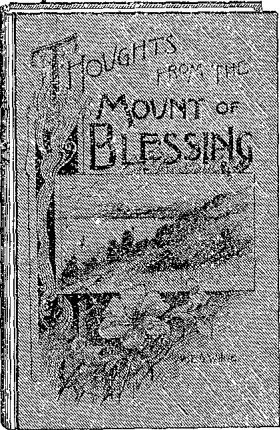
THOUGHTS FROM THE MOUNT OF BLESSING.
By MRS. E. G. WHITE.
A graphic presentation of the Sermon on the Mount, written in the chaste, yet eloquent language characteristic of this author. The reader quickly finds himself transported to the mountainside, where, with the vast multitude, he listens to wonderful lessons, fraught with tender pity and divine love, from the lips of Him who spake as never man spake.
An excellent companion volume to “Steps to Christ,” by the same author. “Thoughts from the Mount of Blessing” contains 15 original half-tone illustrations, printed on enameled paper.
Bound in Cloth, Embossed in Gold, 209 pages, - - - $ .75
“ ” 1-2 Calf, Marbled Edges, “ ” - - - 1.00
Testimonies for the Church.
... BY ...
MRS. E. G. WHITE.
NUMBERS 1-33 are bound in Five Volumes of about 700 pages each, each volume containing a complete index of subjects. Volume I contains a brief sketch of the early life and Christian experience of the writer of the Testimonies. This sketch of her early experiences, together with the story of her triumphs of faith, is among the most valuable matter from her pen. It should be read and studied often. But while these first paragraphs of Volume I are worthy of special note, great stress should be placed upon the fact that every Seventh-day Adventist should be a constant student of every part of all these volumes of the Testimonies. They are a special message from God to the church, and any one who is troubled with doubts concerning them, will find the evidence of the divine source of these writings in the books themselves. Whatever else you fail to read you should not neglect these volumes in connection with your study of the Bible.
Bound in Muslin, per volume, — $1.00
" " Library, " — 1.50
Complete Set of Five Volumes, Bound in Cloth, — 5.00
" " " " " Library, — 7.50
Books that Every Seventh-day Adventist Should Read this Fall and Winter.
Both the Young and the Old Should Carefully Study Them.
Do not pass this matter by lightly. You cannot keep up with the rapidly advancing work amid the perils of these times unless you are a careful and faithful reader of our literature. How many of these books do you already have? How many have you read? Plan for a course of systematic daily reading of these books. Send for the ones you do not have. Begin your study at once.
Two Wonderful Books
BY MRS. E. G. WHITE.
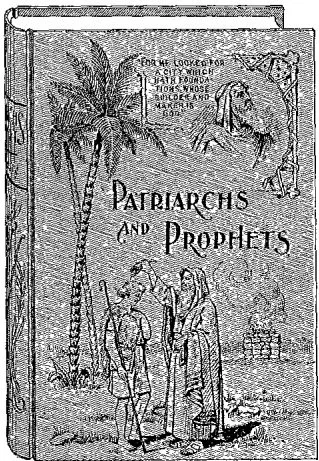
Patriarchs and Prophets
OR
The Great Conflict between Good and Evil as Illustrated in the Lives of Holy Men of Old.
Beginning with the rebellion in heaven, the author shows why sin was permitted, why Satan was not destroyed, and why man was tested; gives a thrilling description of man's temptation and fall; and rehearses the plan of redemption devised for his salvation. This volume traces the great conflict between good and evil from its inception down through the centuries to the time of David's death, and shows God's wonderful love for mankind through his dealings with the race.
“Now all these things happened unto them for ensamples; and they are written for our admonition, upon whom the ends of the world are come.” Therefore this book is most timely now. If you simply glance it through you will see why it is so necessary and important that you should study it carefully.
PRICES.
Drab English cloth, emblematical design in jet and gold, marbled edges ... $2.25
Light green English cloth, emblematical design in jet and gold, gold edges ... 2.75
Library style, full sheep, combed marbled edges ... 3.00
Full Turkey morocco, gold side and back, gold edges, extra finish ... 4.50
Also issued in Danish, Swedish, German, and Dutch at same prices.
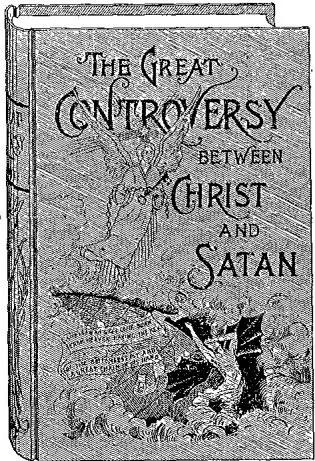
Great Controversy
Between Christ and Satan During the Christian Dispensation. A Companion Volume to “Patriarchs and Prophets.”
This volume presents the most wonderful and intensely interesting history that has ever been written of the great conflict between Christianity and the powers of darkness, as illustrated in the lives of Christian martyrs and reformers on the one hand, and wicked men and persecuting powers on the other. Beginning with our Lord's great prophecy given while viewing Jerusalem from the Mount of Olives, this book graphically, and in an intensely interesting manner, outlines the history of the whole dispensation down to the time when “sin and sinners are no more; God's entire universe is clean;” and the great controversy is forever ended.
If you have not read the chapters on the “Agency of Evil Spirits,” “The Snares of Satan,” “Spiritualism,” “The Character and Aims of the Papacy,” “The Impending Conflict—Its Cause,” “The Scriptures a Safeguard,” “The Final Warning,” and “The Time of Trouble,” you should read them at once, and study them again and again. The intensely real, and vividly clear description that is given of the times upon which we are entering, cannot fail to stir the mind and soul to the very depths. The salvation of yourself and others that God designs to reach through you hinges upon your properly understanding the themes and heeding the instruction presented, especially in the closing chapters of this book. The work is illustrated, and contains 700 pages.
PRICES.
Cloth, marbled edges ... $2.25
Cloth, gilt edges ... 2.75
Library, marbled edges ... 3.00
Half morocco, gilt edges ... 3.50
Full morocco, gilt edges ... 4.50
Also issued in Danish, Swedish, German, and French at same prices.
RISE AND PROGRESS OF SEVENTH-DAY ADVENTISTS.
By John Norton Loughborough
By Elder J. N. Loughborough.
Commencing with the early experiences of the Advent movement of ’43 and ’44, the writer—who has been actively engaged in proclaiming the doctrine since ’49, and is therefore able to say, “I speak the things which I have seen and heard”—here presents a graphic account of the struggles and difficulties through which the pioneers were safely carried by their unwavering faith in God, and their unfaltering loyalty to the cause they had espoused.
Due attention has been given to those agencies which, in the providence of God, have aided in building up and preserving the work represented by this people, until now we see the earth encircled with the message proclaimed by the missionary, and heralded by numerous publications in a multitude of languages.
No one can read this book without having his faith in the message very much strengthened. The book will interest your children, and give them confidence in our work. The book contains 392 pages, interspersed with numerous cuts, besides 20 full-page illustrations; is printed on fine calendered paper, and bound in cloth, silk finished; prices: plain edges, $1.25, gilt edges, $1.50.
The Rights of the People OR CIVIL GOVERNMENT AND RELIGION.
By Alonzo T. Jones
BY ALONZO T. JONES.
This is One of the Very Best Books that has Ever Been Written on the Relation of the Civil Government to Religion.
It shows how Christianity advanced in the Roman Empire, not only without the aid of the state, but in the face of the bitterest opposition from the state; it discusses what the Christian should render to God, and what to the state, and how the powers that be are ordained of God. It discusses the history and principles of the movement so active now in the Republic to accomplish the national establishment of religion, in contrast with the history and principles of the government of the United States as originally established. You cannot afford to miss reading this book; you cannot afford to be without the documents and other material in it.
CLOTH, 378 PAGES, POST-PAID, - - $1.00
PAPER COVERS, - - - - .40
☞ Our complete Catalogue sent free on application.
HERE AND HEREAFTER
. . . . OR . . . .
Man in Life and Death,
The Reward of the Righteous,
AND THE
Destiny of the Wicked.
BY U. SMITH.
A THOROUGH canvass of the great question of a future existence, and the nature of man. Every text in the Bible which has any possible bearing upon these points, is carefully considered, thus giving the most comprehensive view of the subject that has yet been presented. The work has just been carefully rewritten.
In view of the great importance of properly understanding the subject of Spiritualism every one should study this book, and so be able to know for himself that the conscious state of the dead—the foundation of Spiritualism—is a myth. 357 pages. Revised to 1897.
PRICE, - - - $1.00
Health is the Greatest Boon to Mankind!
If you wish to know how to preserve it, or how successfully to regain it, send at once for our
HOME HAND-BOOK OF
Domestic Hygiene and Rational Medicine.
BY J. H. KELLOGG, M. D.
A Vast Cyclopedia of Physiology, Hygiene, and the Treatment of Disease. Thirtieth thousand, rewritten and enlarged. Illustrated with 500 engravings, including 27 full-page colored plates, and a colored manikin. Contains nearly 1,700 pages. New edition, 1896.