“If the prophet had bid thee do some great thing, wouldest thou not have done it?” How many men there are who are anxious to do great things! If they can do some great work, and write their record on high; if they can attract the attention of the world, and have their names inscribed upon the scroll of fame or printed in the papers, then they will be content.
The Lord has many little things to do, and but few great things. He sometimes sets small men to do great things, and great men to do little things. What most men need in these days is to be ready to do anything God requires; to do little things,—things which anybody could do, but which nobody does do. And those who do such work for God, heartily and lovingly, grow great in his sight, and prosper beneath his blessing.
The little boy’s five barley cakes and two small fishes fed the multitude. The widow’s mite outweighed the rich man’s treasures. The cup of cold water given to a disciple shall never lose its reward. The visit to the sick or imprisoned, the bread dealt to the hungry, the clothing to the naked,—all these little things the Lord looks on, and weighs and counts and remembers.
What can we do? If we can not preach sermons, we can speak words of cheer to sorrowing and stricken hearts. If we can not travel on journeys to far-off lands, we may go across the road and around the corner to carry comfort to a stricken heart. If we can not reach the heathen in China, we may perhaps reach the heathen in our own back yard or around our front door. If we can not write books, we may perhaps give away a tract. If we can not organize great meetings, we may speak to one or two by the wayside, or by the well-side, as the Master did. If we can not deliver learned orations, we can say, “God bless you!” from an honest heart; and the little things which we do may be so blessed of God that they will be more useful and more fruitful than the great things which we desire to do, but never are able to accomplish.
Let us do our little! Let us begin to-day, and let us to-day finish up some little work which the Lord may accept and bless, and which his providence may make greatly useful to the souls and the bodies of men.—The Christian.
Keep Your Doubts to Yourself
I WILL listen to any one’s convictions, but pray keep your doubts to yourself. I have plenty of my own.—Wolfgang Von Goethe.
The Bible in the Home
By M. E. Olsen
M. E. OLSEN
In this enlightened country, probably every home that can properly lay claim to the title is provided with a Bible. Our need is not more copies of the printed Word, but its application to the problems of the every-day life. The Bible on the shelf can neither comfort, enlighten, nor save. It must be taken into the heart and mind of man before it can do its work.
Some people, even professed followers of Christ, seem to treat the Bible much the same as they would disagreeable medicine. A small dose is taken on Sunday, and then the bottle is carefully corked and put away until a week later, unless some member of the family should become dangerously ill in the meantime. Of course the Bible is always supposed to be on hand in the death chamber, and often people who have shown no interest in its teachings with reference to the present life are willing to accept it as a sort of passport into the life to come. Poor, deluded souls! They have entirely missed the true purpose of life from neglect to study the Word which reveals it. In some few cases they may be able to grasp the promises even at this late date, and lay hold on eternal life; but in the vast majority of cases the life which has been lived in darkness, apart from the bright rays of the Sun of Righteousness, goes out in utter obscurity. Death-bed conversions do sometimes occur, but they are the exception, and not the rule.
If the Word is to exercise an influence in your home, give it a chance to speak. Talk is cheap, we say; vain words, thoughtless words, cruel words,—how they swarm all about us; but the priceless Word of truth, the Father’s message from on high, is but rarely permitted to raise its voice. Therefore, religion languishes in our midst, and the home, instead of being as it should be a heaven upon earth, a haven of rest and peace and joy, becomes a mere stopping place where one eats and drinks and sleeps; sometimes it becomes a veritable babel of jangling and discordant voices.
Suppose we regarded the Bible a real factor in the home life, and gave it an opportunity to do as much of the talking as any other member of the family; what contrasts would we not see! After the next-door neighbor has doled out the latest gossip, read the third chapter of James. After the head of the family has discussed the low wages and hard times generally, read the twelfth chapter of Luke. If there has been altercation, let the Word talk for a few moments about the soft answer that turneth away wrath. If there are expressions of unrest and anxiety, read the beautiful chapter, beginning: “Let not your heart be troubled.”
Why should we not give the Word of God a place in our family conversation? If the Saviour were to make us a personal call, we would hardly want to silence him entirely, and do all the talking ourselves. Yet that is just what we do when we neglect to listen to his Word. It would not matter especially if we did not stand so greatly in need of the divine counsel. Man is by universal consent weak and helpless in himself, ignorant alike of the present, and of what may be in store for him in the future. The problems of life are to his finite gaze inscrutable, its burdens weigh heavily on his spirits. But our loving Heavenly Father knew all this from the beginning, and has therefore given us his Word, which, read in the light which the Holy Spirit throws upon it, makes everything perfectly clear. It is in very fact what David called it, a lamp unto our feet, and a light unto our path.
We plead with the Christian fathers and mothers, Give the Bible a larger place in the family life. Read it morning and evening at family worship; not hurriedly, as a sort of business transaction which must be brought to a close as quickly as possible, but leisurely, lovingly, prayerfully, with hearts open to receive its divine truths. Find time also during the day to consult this divine guide-book. If you are weary, it will give you rest. If you are anxious and troubled, it will bring peace. If you will only believe the fact, it is Jesus himself talking with you and imparting to you of his own wondrous life.
How it would lighten the cares of housekeeping if the Bible were to form a part of the kitchen furniture! Let it be strongly bound and printed on good paper, in large type. A few loving glances now and then between those covers will give to the mind food for contemplation all the day. In the light of the cross the ever-recurring tasks of home life lose their painful monotony. Life takes on new meaning and beauty. Heaven is no longer a shadowy place beyond the grave, but something very near, and real, and tangible. In short, humanity is joined to divinity; the wandering, wayward child has returned to his Heavenly Father. This is the purpose for which the Word of God was given, and it will accomplish its purpose in every home where it is allowed to bear sway.
The Responsibility of Motherhood
By Mrs. J. A. Corliss
MRS. J. A. CORLISS
For almost every calling in life, whether to till the soil, to build a house, to make a garment, to teach a school, or whatever it may be, there is required a preparation in order that successful work may be done; and abundant opportunities are afforded everywhere for this training. But for the mother’s work no course of study has been required, no school has, as yet, been opened for her instruction, to prepare her for her work. But it may be thought that hers is not so important a work as to need such a preparation. For a moment let us consider her calling, and see what her responsibilities are.
Some one has said that “the hand that rocks the cradle is the hand that moves the world.” But is this true? Surely in her hand is the rising generation, and it is her mold that is placed first upon every child that is given to her. It is her privilege, yea, her duty, to mold it to become a strong, healthy, noble citizen of the world, one who will be capable of casting an influence that shall be true, elevating, grand. It is the mother’s privilege to educate her children so that all their words shall be pure words, so that the name of the Lord shall not be taken in vain, no falsehood ever be spoken; so that all their actions shall be lawful and pure, every one having respect for the rights of others. But she may be negligent, and give to the world only those who will tear down, instead of lifting up society,—those who will be a stain and blot, not only to her name, but to the human race. But if the mother does her work faithfully, as was designed by her Creator, her influence will not only be felt in her own home, where reign love, peace, and good-will toward all, but the out-circlings of its undulations will be realized in the neighborhood, in the city, in the state, and so out into the great world.13
But too sad is the story that this high and noble calling, this great responsibility of motherhood, is so little understood by very many of those who enter into this important and sacred state. Many a young mother, though sensing somewhat its sacredness and importance, has so little knowledge and ability for this great work, that her best efforts result in little more than failure. So little do these mothers realize that they should be molders of character, that they seem to feel no responsibility whatever, but send out from their very presence these precious little ones to be led and fashioned by those who may be vile and degraded. In such homes the idea seems to prevail that to feed the child sufficiently on something to keep it from starving, and to clothe it enough partially to hide its nakedness, is about all that duty requires of the parent, leaving nature to do all the rest. But the tendency of nature is always toward irregularity, and a child left alone to the molding of nature is sure to develop a lack of symmetry in disposition and character.
Children left to grow up in this way despise their parents, to a greater or less degree, and bring a reproach upon them. They are a grief to the parents, and a curse to the world. How is it that our cities are flooded with the rowdy element? Do they come from the homes of those parents who have had a diligent watch over their children from the cradle to well-grown youth? Are they not rather those who have had no training in the home, but have been left to the drifting of nature, and to the influence of evil companions on the streets? Their cases well illustrate the words of a certain clergyman who said to a neglectful mother: “Madam, if you do not educate your children, the devil will.”
Too much can not be said about the importance of the education of mothers for their work. Had all mothers been wisely instructed for generations in the past, we should now see a better race of men and women in the world. Could all the mothers of the generations past have been such as was the mother of the Wesleys, of whom it is said, “She was a model mother of a family,” we might have seen the world filled with model sons and daughters. Another author says of her, though she charged herself with the early education of her large family, and was, most of the time, in very straitened circumstances, yet “she did not neglect the improvement of her own mind.” It is possible that to this last fact, that she educated her own mind, may be attributed the success that attended her effort in rearing her large family.
It is to be regretted that so little has been preserved and handed down to us of the methods of those mothers of the past who have reared families that have held distinguished positions in the world. Even in the Bible there is little told us of how the mothers of the ancient worthies trained their children. Paul simply states that the grandmother and mother of Timothy were women of unfeigned faith. It is said that the mother of John the Baptist was “righteous before God;” and Hannah, the mother of Samuel, was a woman of prayer; but we are left to infer how such women must have trained their children.
But in our own generation, especially in recent times, much is being written, said, and done in behalf of the children of the rising generation; and could every mother in the world be awakened to her duty, we might expect large results in the immediate future. But until mothers are awakened to their responsibility, the world will go on as it ever has done.
The one great reason why disobedience to the laws of the land, as well as of the Lord, is so prevalent to-day, is because children are not taught obedience to parents in the home. Mothers should feel under the most binding obligation to the Lord to train their children to implicit obedience. If children are not taught to obey father and mother, whom they see every day providing for them the necessaries and comforts of life, how can they be taught to obey their Creator, whom they have not seen, and to believe in him as the provider of all that we have to enjoy in life? If they are allowed to have their own way instead of yielding to the wishes of godly parents, the same unyielding spirit will be seen in them when the time comes that the Spirit calls upon them, saying, Son, daughter, give me thy heart. They have loved to have their own way in the home, in seeking pleasures best suited to their tastes; and now it is hard to submit to bear the cross of the self-denying Saviour, and follow in his lowly footsteps. It is very much harder for a disobedient child to become a Christian man or woman than it is for one who has had his character shaped to meet the standard of righteousness by a conscientious mother.
Face Pictures
We write our lives upon our faces, deep,
An autograph which they will always keep.
Thoughts can not come and leave behind no trace
Of good or ill; they quickly find a place
Where they who will may read, as in a book,
The hidden meaning of our slightest look.
Reach for the things above — to those who climb
Steps ne'er are wanting; ever the sublime
Allures us onward, and our lives will be
Just what we make them, to eternity.
What they now are the face will surely show
Like footprints on a field of untrod snow.
Time deepens all the lines, or dark or fair —
Lines carved by grief or chiseled deep by care.
Thoughts into actions very quickly grow;
Actions are seeds which every one must sow.
They reap the richest harvest of good deeds
Who sow by loving words, most precious seeds.
— Presbyterian Banner.
The Loneliness of Age
By Washington Morse
WASHINGTON MORSE
How few think of the loneliness of age, and treat with tenderness and consideration those who have outlived their generation, and whose early companions and friends have been taken from them. Unable to engage in the activities of life, they are no longer brought into contact and sympathy with those around them, and no tie of common interest and mutual dependence binds them together. They necessarily to a great extent live in a world of their own, with which those around them are not familiar.
Their thoughts dwell largely upon the scenes of the past and the companions of other years, who long ago passed away. Lover and friends have been taken from them, and their acquaintances laid in the grave. The forms they admired and loved are gone, the eyes that looked into theirs with the tenderest affection are sightless, and the voices that cheered their souls have long been silent. Their early world of hope and joy has become a desolation, and they sit in silence, contemplating the ruin that has been wrought, only waiting till the shadows are a little longer grown, hoping to pass on to the reunion that awaits them, and the glad greetings of those they love. Who would not do what he can to cheer the loneliness of the aged, to smooth their pathway and comfort them in their declining years?
Running Barefoot
ONE of the delights of childhood is that of running barefoot. There seems to be an instinct which impels a child to throw off the foot-covering and walk about in all the delightful freedom of unshod feet.
Mothers who indulge their children in this respect are wise. Many of our instincts may safely and even beneficially be yielded to in moderation; and this is one of them. One of our “weak spots” is the foot, and we are, perhaps, oftener predisposed to colds and other maladies by damp and chilled feet than by anything else. Whatever tends to toughen the feet, therefore makes the individual so much the less liable to disease.
Mothers are often perplexed as to how far they may safely indulge their children in this longing for going barefoot. They can not feel that it is safe to let a boy or girl run barefooted on wet grass, play with bare feet in damp sand, or continue to go without shoes and stockings when a cold and wet day breaks a hot spell. It might not be prudent to let a child begin in this way in the early spring, after having been in shoes and stockings, and perhaps galoshes, all the winter. But before the summer is over, all such anxiety may be put aside.
Of course there are certain precautions that should always be taken; for the human foot can not safely be neglected, like the well-protected paws of a dog or cat. The child should not be allowed to run about in the neighborhood of barns, blacksmiths' and carpenters' shops, and other places where there are likely to be rusty nails, splinters of wood, broken crockery, and the like; nor should he go far afield over rough ground where he would probably get stone bruises.
When first beginning his barefoot holiday, the boy should put on thin socks and light, easy shoes or slippers at dusk, and should go foot-clad on really cold days. After tramping in mud and wet, his feet should be bathed in cold water, dried and “socked” as soon as he comes into the house.
A summer of this freedom from shoes, with its toughening of the feet and the system in general, will insure for the child a winter practically free from the “snuffles”—but he will need shoes of a larger size in the autumn.—The Present Truth.
The Upward Path
By J. G. Holland
We rise by the things that are under our feet;
By what we have mastered of good and gain;
By the pride deposed and the passion slain,
And the vanquished ills that we hourly meet.
— J. G. Holland.
A Trip Through Santa Catharina and Parana, Brazil
By John Lipke
JOHN LIPKE
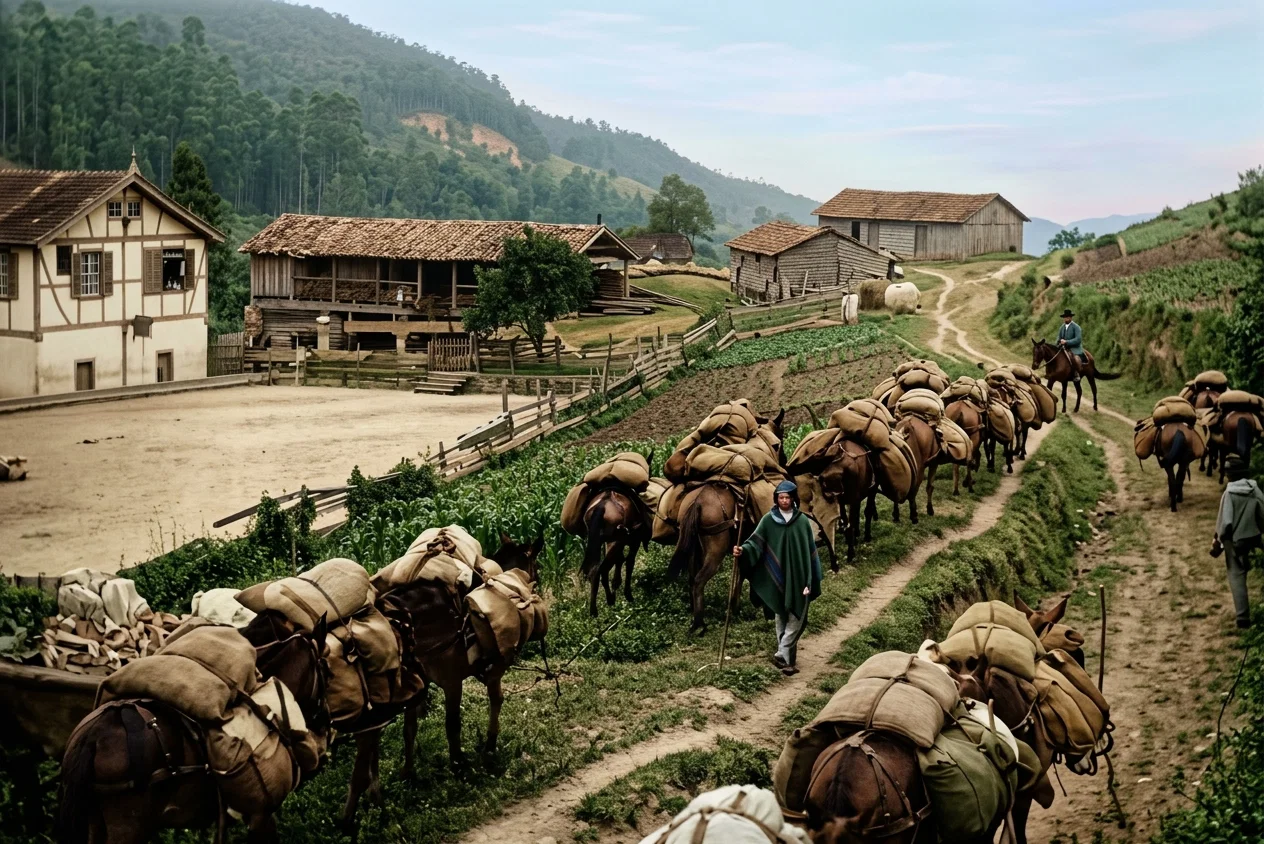
As it was thought best, and arrangements could be made, the writer, accompanied by one of his students, made a trip on horseback through the states of Santa Catharina and Parana, in order to visit Brother Kramer, who is conducting quite a large school in Curityba, Parana.
We started from Brusque, Santa Catharina, the seventh of October. The next day—Sabbath—we spent with Brother Bergold at Timbo, where the Spirit of God came very near to us in our afternoon meeting.
After a journey of about a day and a half, we reached the Hansa-Kolonic, a section of land which has been bought by a German company, to be colonized by German emigrants. The company lends land to them, for which, after a certain time, they have to pay. A great many Germans have emigrated and secured land, and after hard work and overcoming many difficulties, can supply the wants of their families. There we have a little company of believers, who were glad to see us. The Bible studies given were a blessing, and seemed like the much-looked-for rain on dry ground.
A MULE PACK TRAIN
This company of believers has received very little instruction, because we lack the laborers. After remaining with them about two days, we continued our journey, although they wanted us to stay longer.
It is indeed sad that we have so few laborers to give the bread of life to hungering souls. But we earnestly pray the Lord to send more laborers into the harvest. Here we found a very intelligent brother, who had owned a printing office in Germany, ready to come to our school and work and teach printing for his board and clothing.
After one day's journey, we reached another small company, near Sao Bento, where we stayed also about two days. On this journey we saw how the Lord takes care of his children. We had to ride until about eleven o'clock at night. Our guide was not quite sure of the way. It was dark and raining. Passing a house, where we inquired about the distance, we were asked: “Do you want a lantern?” This we gladly accepted, but I wondered that the person made such an offer to strangers. After half an hour's ride, our guide stopped suddenly, and lo, quite a steep bank and a broken bridge were before us.
I do not know what would have happened to us if we had not had the lantern. Now I knew that the Lord put that question, “Do you want a lantern?” into the mouth of that person.
Again this stay was a blessed one. The rolling tears, when we left, and the request that we stay longer, showed us the hunger of these dear people for the bread of life. Though there were interested people, those not of our faith, time did not permit us to stay longer. O, if we only had more workers!
Four and one-half days more brought us to Curityba, where we stayed about a week, holding meetings and interchanging thoughts with the teachers. Brother Kramer had in his school at that time about one hundred and sixty children. This school has been the means of bringing people to the truth.
Returning home, we had to overcome some difficulties, which we will state, to show how we have to travel in Brazil.
The first day we came to a river, which was so high that we could hardly get on the ferry. We led our horses over two boards to the ferry. We felt thankful when we had reached the other side.
The second day was the hardest of our whole journey. A very heavy shower wet our clothes. Then we came to another small river. The bridge was broken in the middle, and was carried away from the bank, and caught fast in the brush a little farther down. The river bank was so steep that we could not let the animals go through the river, and as the bridge was not connected with the land, we could not lead our horses onto it. The nearest house we had passed an hour before, and the rain was pouring down. But the Lord had provided a few boards, over which our horses had to go to get on the bridge. We thanked the Lord when we had passed this dangerous place. A rain in the afternoon again wet our clothing. We reached a mule pass, that is, a way that is not used by wagons, which led us over the so-called “ninety-nine hills.” For about seven hours we had to go up-hill and down-hill, over a very bad road. Our food consisted mainly of dry bread for some time.
Our fellow laborers here in Brazil have similar and even worse experiences. For three days one brother had nothing to eat but grass. We ask you, brethren in the States, to come over and help us. But when you come, expect to endure hardships.
After a little more than three days, we reached our home, the eighteenth of November, where we were glad to see the healthy, spiritual condition of our students, who had received instruction from Brethren Spies and Yankowski during our absence.
We see the great necessity of more laborers in Brazil. We are working with all our might to get more young people educated to fill the necessary openings.
Brusque, Santa Catharina.
A Bit of Reformation History
By H. F. Schuberth
H. F. SCHUBERTH
'ON a missionary tour through South Germany, it was my privilege to visit our small church in the ancient imperial city of Worms. While there are no more remarkable councils of state such as were held in that day, yet on the other hand, in the year 1868 a grand monument of Luther was erected here, in commemoration of a wonderful event of those stirring times. [See first page. —ED.] The following words give a good description of this monument:—
“Above and in the midst of his surroundings, stands Martin Luther, with his hand clinched upon the Bible, as if he were saying a second time, before emperor and kingdom, his world-shaking words: ‘Here I stand; I can not do otherwise; so help me, God!’ At his feet are the heralds, and a little farther removed are the comrades, the fellow workers, the guardians and protectors of the Reformation.”15
That we may more closely observe this fortress of statues, in which there are sixteen hundred cubic feet (Luther’s monument is twenty-seven feet high), we will approach it from the east, on which it fronts, and admire the twelve statues, each one of which is a work of art in itself. On the wall, facing the pedestal, stands twenty-four pinnacles bearing the coat of arms of these states: Braunschweig, Bremen, Constance, Eisenach, Eisleben, Emden, Erfurt, Frankfurt-on-the-Main, Schwäbisch-Hall, Hamburg, Heilbronn, Jena, Königsberg, Leipzig, Lindau, Lübeck, Marburg, Memmingen, Nördlingen, Riga, Schmalkalden, Strasburg, Ulm, Wittenberg. These principalities had a leading part in the work of the Reformation.
The chief pedestal on which the Luther statue rests, is made of one socle of polished syenite. On this stands a smaller cube of bronze, with its four sides decorated with bas-reliefs, as follows: Luther nailing the ninety-five theses on the door of the Wittenberg castle church, by which he threw down the glove to the indulgence-venders and their defenders, is on the west. Naturally enough, Luther’s defense before the Diet at Worms, on the 17th and 18th of April, 1521, appears on the east, or front side of the monument. The Bible translation and preaching of Luther to the masses, are commemorated on the north side; and on the south, we find Luther serving the Lord’s Supper (including the giving of the bread and the wine), and Luther’s marriage with Katharina von Bora, the ceremony performed by his friend Bugenhagen.
Upon this cube rises a second cube of bronze, whose sides are decorated with portrait medals of men who had an acting part in the work of reformation: Ulrich von Hutten, Franz von Sickingen, John Calvin, Ulrich Zwingli, the electors of Saxony, John ‘The Constant,’ and John Frederick ‘The Magnanimous,’ and, farther, Justus Jonas and John Bugenhagen, the intimate friends and co-laborers of Luther, whose advice he sought while translating the Bible.
On the front side of Luther’s statue we read: “Here I stand; I can not do otherwise; so help me, God, Amen!” On the south is inscribed: “Faith is nothing else but true and righteous life in God himself; the Spirit of God is given us that we may understand the Scriptures rightly.” On the west is written: “The gospel which the Lord put into the mouth of the apostles is the sword with which he smites the world as with lightning and thunder.” Lastly, we read on the north: “Those who rightly understand Christ can not be bound by man-made enactments. They are free, not after the flesh, but in conscience.”
On the southwestern pillar of the chief pedestal we find Peter Waldus, with a sack hanging by his side, his feet covered with wood sandals, holding a Bible in his left hand, and pointing to that blessed Book with his right. Next to him on the northwest pillar, we see a statue representing John Wycliff. On the northeast pillar we come to John Huss. On the fourth pillar appears Savonarola, with the index finger of the right hand threateningly lifted up. On the four outward pillars we see Frederick ‘The Wise,’ elector of Saxony; Philip ‘The Magnanimous,’ of Hessia; Philip Melanchthon; and John Reuchlin. Among these are three statues, representing the protesting Spires, the peace-pronouncing Augsburg, and the mourning Magdeburg.
The influence of the whole is inspiring; but whither has the time flown, which could display such men?
The recent transactions of the German Reichstag show us to what Protestantism has come. That very government which formerly in the so-called Culture Controversy withstood the bad doings of the Jesuits, is to-day going hand in hand with the Catholic party, to again reinstate the Jesuits.
May this little bit of Reformation history remind us of that time, and may we be inspired with the courage and faith that should characterize true reformers, who are seeking to hasten the glorious appearing of our Lord.
Feeling After God
By Mrs. J. N. Anderson
MRS. J. N. ANDERSON
OUT in the country two or three miles from the village of San-li-tien, we came across a home having over the entrance of its enclosure, in large Chinese characters, this inscription: “May the great truth come to this door.” It is quite common for these people to express their wish for the New Year in proverbs over the doors of their dwellings. Such expressions as, “May riches enter here,” “May peace reign within,” “May the five blessings [long life, riches including sons, a sound body, love of virtue, and a peaceful end] enter this door,” are common. The house referred to was much like the other dwellings of the fertile plain, with walls of sun-dried brick and mud, sheltered by a thatched roof of rice straw laid on bamboo rafters. Inside were all the necessities of this simple country life, despite the absence of a floor. As usual, no flue had been provided the big brick stove, where the two daily meals were cooked over a fire fed with twisted straw, and the interior walls and the roof were brown with smoke; but an atmosphere of thrift and neatness prevailed, not common in these homes, while the blue cotton garments and white cloth stockings of the inmates were cleanly beyond what one might expect under such circumstances. But, as might be known from the mute witness over the gateway, these temporal things were not the chief concern of the occupants of this home, or, at least, were not so with the wife, who at her first visit related her experience to the missionary.
She said that her husband was a very good man, and although she had never borne him a child, yet he never scolded her, and they lived in peace. Still, being childless, she felt that she really had nothing to live for, and wished to die. Some time last summer a portion of Scripture had fallen into her husband's hands, and through his reading, the suggestion of a new and fuller life had come to her. But how to obtain it, how to follow to its source this ray of light, was what baffled her. She could not read, and her husband would not be troubled to grant her earnest request to hear all that the book contained. Besides, some things she did hear were so foreign to her mind that she could not believe that she understood aright. She did so earnestly desire to know of this heavenly doctrine, as she called it, that she had committed to the arch of the gateway the longing she knew not how to satisfy.
No one who was present to see how eagerly she pressed to the side of her new teacher, gazing almost rapturously into her face as she read from the beautiful words of Jesus, her own large expressive countenance radiant with the light kindling within her soul, and saw how tenderly she stroked the New Testament given to be her very own, could for a moment doubt the sincerity of her words. Long ago she and her husband had ceased to worship idols directly, but knowing no better way, had sent out their petitions to earth, sea, and sky, into the vast universe of the vaguely known, in search of the Great Unknown. Feeling after God, she had found him, and now, past the meridian of life, for the first time she knelt in reverent thankfulness before the Creator of earth, sea, and sky.
At the second visit a number of women from the neighboring villages and hamlets flocked into the house, eager to see the foreigners. They chatted like magpies, and were interested in our speech, our clothing, our complexion, everything but our teaching. The hostess remonstrated with them, begging them to hear the good Book, to which they replied, “O we do not understand her words.” “But if you really desire to know, you may know,” she replied. “Your hearts will be opened to understand. I understand all that she speaks.” As the interruption continued, we decided to go on to the next village. Taking in the situation, she whispered to the missionary, “Please stop when you come back. They all will have gone to the dragon show in the city, and we can be quite alone.”
As we left the village to return, we could see her in the distance, standing by the winding path through the fields, watching for our coming. As our wheelbarrow which carried the children came to a halt before her door, she, with the friend whom she had called to share in our visit, escorted us into the house, and seating themselves, one at the side and the other on a stool directly in front of my companion, signified their readiness to hear. When the reading was over, we all bowed together on the beaten earth with the smoky rafters overhead, but the King of glory came in.
Perhaps we in more enlightened lands often pray for God to bless his workers in foreign fields, and even for the poor heathen themselves, but they are far16away across the sea, and at best the prayer is but general. It is in such experiences as these that our sympathies are quickened, and we are awakened to find that that distant heathen is our own lost sister, possessed of the same spiritual longings and capable of the same mental suffering that we ourselves have known. The story of the cross inspires in her the same joyous faith with which our own hearts are blessed. No more faithful or devoted Christians may be found than these confiding Chinese women become when once their apparent childishness gives place to the simplicity of faith.
Hongkong, China.
Mission Notes
ELDER B. G. WILKINSON writes concerning his recent trip to Spain, that the country is decidedly more open to receive the message than he had thought. He urges that this field have special attention.
DURING the year 1901 no less than 3,106,295 Bibles, Testaments, and Scripture portions were, not given away, but sold in China by the two great Bible societies, the British and Foreign and the American.—Exchange.
AT the recent Decennial Missionary Conference held in Madras, one thing was made prominent—the urgent and immediate need of more missionaries, at least nine thousand, for India. The present force of three thousand, or about one for every one hundred thousand of the people, is totally inadequate to cope with the work waiting to be done.
A RUSSIAN woman has undertaken the arduous work of reclaiming the convicts at the penal settlement of Saghalien, where only the worst type of criminals is sent. The czarina is keenly interested in her work, and is taking all pains to have it continued. Eight thousand murderers are among the convicts, and this brave woman lives among them entirely unprotected save for the courtesy shown her by the officials in charge. It is said that the conditions of life at this settlement are such that even the keepers become brutalized through association with so hardened a set of criminals.