Your ShelfYour Projects

The Youth’s Instructor, Vol. 43, No. 14.

THE FIRST SONG-SPARROW

The Youth’s Instructor

Apr 4, 1895

S. D. A. Publishing Association · Battle Creek, Mich. · Apr 4, 1895

THE FIRST SONG-SPARROW.

Sunshine set to music! Hear the sparrow sing! In his note is freshness Of the new-born spring; In his trill delicious Summer overflows — Whiteness of the lily, Sweetness of the rose.
Splendor of the sunrise, Fragrance of the breeze, Crystal of the brooklet Trickling under trees, Over moss and pebbles,— Hark! you have them all Prophesied and chanted In the sparrow's call.
Resurrection-singer! Gladness of the year! In thine Easter carol Bringing heaven so near That we scarcely know it From the earth apart; Sing immortal summer To the wintry heart.
Waft us down faith's message From behind the sky, Till our aspirations With thee sing and fly. “God is good forever! Nothing shall go wrong.” Sunshine set to music— 'T is the sparrow's song. — Lucy Larcom.

IN TWO PARTS.—PART I

FROM BAY ISLAND.

IN TWO PARTS.—PART I
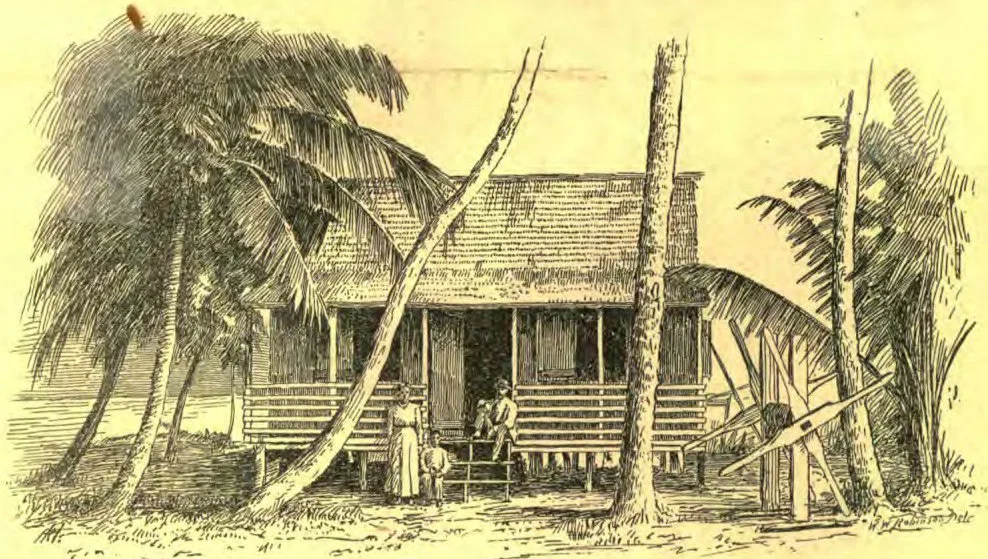
MISSION HOUSE AT BAY ISLAND.
We are now fairly settled in our new home, which at first seemed so utterly strange. One of the strangest features to me was that of living on so small a spot of land; but now I feel quite at home, having no fears of being submerged by the neighboring ocean.
About one hundred yards to the south of us lies another little spot of earth of about the same size as our Shin Cay, but enjoying a less reputable name—“Hog” Cay—the two being connected by a board wharf, upon which people are passing almost continually.
For a few weeks after reaching our little island home, we occasionally went for a sail. This is a pleasant experience, especially when old schoolmates reunite on a foreign shore, and with heart and voice swell the familiar hymn, “How Cheering is the Christian’s Hope.” After reaching the island, Mrs. Hutchins and myself would climb along the rock-bound shore, and gather pretty shells. Perhaps before returning we would visit Sandy Bay, a favorite bathing resort. There we would all plunge into the salt water, which caused us to feel much refreshed. These pleasant associations were short-lived. Soon Elder Hutchins and his wife were gone to their new field of labor in Belize, and we were busily engaged with the school, and various other duties.

THE “WEE-WEES.”

The little island of Bonacca has a reasonably productive soil, and it is chiefly from the yield of the plantain and banana plantations and cocoanut walks that the people obtain a livelihood. Although the climate and soil of the Bay Islands are adapted to the raising of nearly all kinds of fruits, vegetables, and grains, not more than half a dozen kinds of eatables can be successfully matured; in fact, the planters claim that there are but few garden products which the “wee-wee” will allow to grow unmolested. They are sugar-cane, pineapples, and plantain suckers. These “wee-wees,” or ants, are especially fond of watermelon vines, squash and pumpkin vines, peas, beans, corn, and indeed almost everything that is eatable. We have thought that it would be so pleasant, as well as conducive to our health, if we could raise a few such eatables, as melons, sweet corn, etc.
In harmony with the thought, we sent to the States, and got a nice variety of garden seeds. And O, how they did sprout and grow! They grew night and day until they were about two weeks old, when out came a great army of “wee-wees”—millions of them. They are perfectly organized companies of workers, having leaders, and are all governed by a queen. She remains deep down in the nest under ground, which they burrow for their home.
Well, out they poured on our thrifty plants, and after cutting them down, bore them triumphantly away to molder in their subterranean camp. They marched along their trail with their green-foraged banners standing high, being firmly held at the lower edge by their jaws. Indeed they looked orderly and destructive. They live close by the growth they like best, and work at night if the planter troubles them during the day. Otherwise they labor during the daytime and rest at night. I am glad that our tomato-plants have not been taken, as they will bear the year round here, and we are so fond of tomatoes. I think the ants do not like the odor of this plant. I hope they will never learn to like it. These wee-wees are not so small as their name indicates, but are fully twice as large as the common ant of the States. It is almost impossible to hinder their work so that the cassava can grow at all, as they are especially fond of it.

OUR DIETARY.

About sunrise nearly every morning you see men in skiffs and dories leaving the cays, and paddling to the island to their work. They always go armed with their machete (masheet’), with which they plow the ground, cut wood, hoe weeds, plant their seeds, cut their cane, and do nearly all kinds of farm work. They use the hoe and ax but little, and have never seen a plow or harrow. When they intend remaining on the island all day, they usually take dinner with the people there. Likely the dinner will consist of fish and plantain. You may think this a very poor luncheon, but it is palatable when nicely cooked. The fish is fried; then with the rich brown gravy, it is boiled with green plantains or green bananas. This we call fish stew, and Mr. Miller and myself have learned to eat it with a relish.
Not every one here can afford wheat-flour bread, but fortunately we have what is called “bread-kind,” including cocoa, cassava, plantain, bread-fruit, yam, sweet-potato, and a few other products. These are prepared for table use in a variety of ways, some of which I shall relate to you later. Most of the island women understand so thoroughly how to prepare these different foods that a person with a good appetite can scarcely fail to like them after trying them a few times. Having learned to relish bread-kind, one finds that his desire for bread has, in a measure at least, vanished. While there are some whose circumstances will not allow them to use bread, there are others who use it every day. The bread of the island cooks is as good as that made by American cooks. It is nearly always sweet, light, and fine grained. I think the addition of a little cocoanut milk which they use improves it not a little. Neither compressed nor potato yeast is used, but yeast cakes manufactured by themselves. Thus nature provides for us healthful food. Ada B. Miller.

THE JAPANESE LANGUAGE.

Not infrequently the question is asked, “Is the Japanese language the same as that of the Chinese?” It might not be in vain to bring out a few of the differences and the relations of these two languages.
The Chinese have no alphabet, but they have more than twenty thousand characters, each one of them representing a word, and having one or more meanings. It is said that the very learned Chinese estimate the number of these characters at fifty thousand. To read the very simplest book it is required to know twelve hundred of these intricate characters; but to read the Bible necessitates mastering four thousand. In point of fact, these characters were originally hieroglyphics, appealing to the eye by a rude picture of the object to be described. Not only are there a countless number of characters, but each one of them is composed of many strokes, some having fifteen, some twenty, and the most difficult ones as high as thirty or more of these strokes.
These troublesome characters were introduced into Japan during the third century, with the name of the sacred Chinese classics. They were welcomed, and their use has been gradually increased, until they reached the important place which they hold to-day.
Before the introduction of the Chinese, according to the opinion of Professor Hirala, the great scholar in the Japanese and Chinese classics, some antique form of writing, now consigned to oblivion, is supposed to have existed.
Prior to that it is supposed that it was customary to use knotted ropes, or cords. The cords were tied into knots, and the forms thus described, whether circular, triangular, or square, were used as symbols or signs of the ideas to be conveyed from one to another.
In the middle of the eighth century, a new series of alphabets, which is called “Katakana,” consisting of forty-eight letters, was invented by a nobleman, named Kibi Daishi. This is called “square-hand,” and is used in the same hand with the Chinese characters, in the official writings, etc. Another series was invented about the middle of the ninth century, by a prominent Buddhist priest named Kuhai, who was for a long time in China to study Chinese and Buddhism. He is still familiarly known among the people as the founder of the “Shingon” sect of Buddhism, and was one of the best writers of Japan. This syllabary, called “Hiragana,” is composed of forty-eight letters. This style of writing is cursive, that is, in a running hand, and is used generally for writing letters, etc. The Japanese have no “v,” “l,” and “t” sounds, and their “d,” “f,” and “r” sounds, somewhat differ from the corresponding English sounds.
School children are taught to read and write first in the Katakana and next in the Hiragana style. After they make some progress, they are required to study the Reader, which contains a few quite easy and very useful Chinese characters. According to the degree of advancement they make, their Reader is found to contain more of the Chinese, which is a terrible task for both sight and memory to the children not only, but also to adults. The writing and speech of the educated contain more of the Chinese element than those of the less cultured. The pure Chinese classics are taught in the schools, which facilitates communication with the Chinese by writing, though they cannot understand each other’s speech, as their pronunciation of the same characters is quite different.
The Chinese characters are used for the principal words, while the Japanese letters are used for auxiliaries, or terminations. I transliterate the following sentence in illustration of this: Kami tenchi o hajimeni tsuku ri tama eri,—Kami (God) tenchi (heaven, earth) o (a Japanese letter used for the objective case), hajime (the beginning), ni (in), tsuku (create), ri (the termination of the past tense of the verb “create”), tama (a deferential term of “do”), eri (the termination of the past tense of “tama,” or “do”). In thus examining this sentence, we find that the subject comes first, the object next, and the verb last; and auxiliary verbs come next to the principal verb. The preposition is placed after the noun to which it refers. Arranging the sentence in the English order we have: “In the beginning God created heaven and earth;” in the Japanese order it becomes: “God heaven and earth the beginning in created;” while the order of the letters in the Chinese is almost the same as in the English. The English: “In the beginning God created heaven and earth;” the Japanese: Kami tenchi o hajime ni tsukuri tama eri; the Chinese: Gun ji shin goku tson zo hen de.
This language is one of the most complicated of languages. Some scholars complain of the introduction of the Chinese characters into Japan, because their complications make the language more cumbrous, thus retarding the progress of the Japanese. The difficulties of the language are one of their misfortunes, and cannot be fully understood by their Western and American neighbors. And it is a great check to the propagation of the gospel, being too difficult to learn easily by the missionaries. Generally they spend three years or more before they can learn the language sufficiently to preach to, and speak with, the people at all.
Two parties exist among scholars that aim to reform the language: the sentiment of the one is in favor of discarding the Chinese characters and the Japanese alphabets altogether, and using the Roman letters. The other party advocates the use of the Japanese letters only, discarding the Chinese elements entirely. But neither of them has as yet sufficient influence to carry out their ideas. Lastly, I will mention that both the Japanese and Chinese write in perpendicular columns, reading from the top downward. Columns go from right to left. Therefore the first page of their book corresponds to the last page of an English book.
I. M. KAWASE.

GLIMPSES OF ANIMAL LIFE.

2. — PROTOZOA.
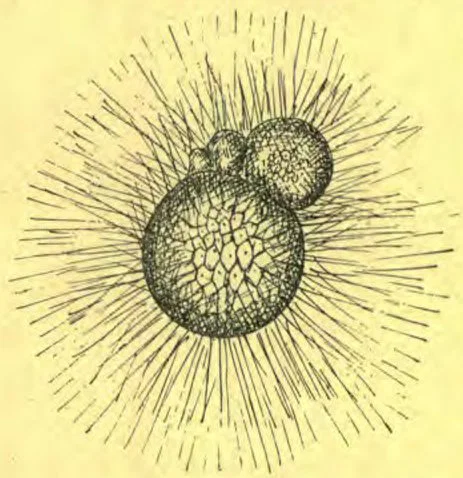
In “Glimpses No. 1” we studied the amœba, one of life’s simplest forms. These were homeless and unprotected, gulped down by the thousands and millions by one another and by other animals.
We will now lay aside our powerful microscope, that we were compelled to use in our study of the amœba, and use only a strong magnifying-glass while we examine the Protozoa, a little higher type of life. These little animals take out of the water, particle by particle, the lime dissolved in it, and build around their bodies the solid shell, or skeleton, in which they live.
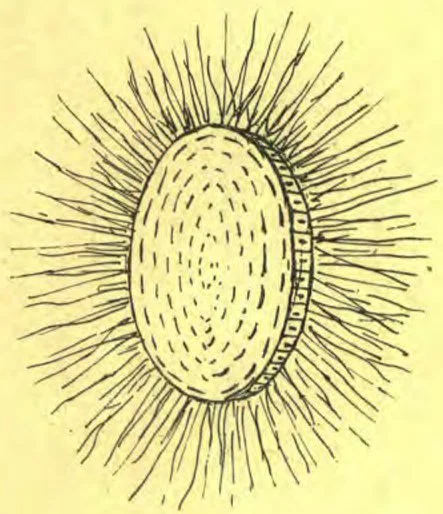
FIG. 1. Globigerina, or chalk-builder. Magnified 100 diameters.
Not only are these little creatures beautiful and interesting, but they are very useful. There are a great many forms of the Protozoa, but I will mention only a few of the most common of them; namely, those with which we all are familiar, and which add to the list can do.
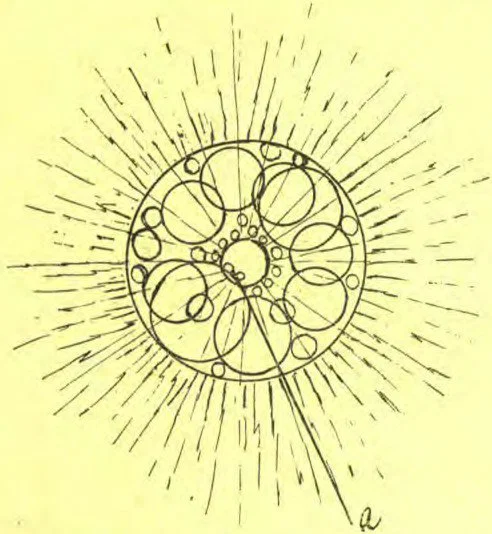
Fig. 2. Orbitolite, or lime-builder. Greatly magnified.
Strange as it may seem, it is nevertheless true that the vast chalk beds stretching from Ireland to the Crimea and from Sweden to Bordeaux, France, are in great part formed of the dead shells of the Globigerina (Fig. 1); and if we rub down some ordinary chalk,—not the manufactured kind, but that taken from beds like the above named,—and examine it under a strong magnifying-glass, we can readily see these little shells for ourselves.
Then we have the limestone, from which the lime is made that we use in building. Beds of this limestone are found thousands of feet thick, stretching for hundreds of miles, and made entirely of the shells of the Orbitolites (Fig. 2). The great pyramids of Egypt are built of stone of which every inch was made of the shelly palaces of these little creatures, constructed with a skill and ingenuity far surpassing that of the builders of the pyramids.
We have paused so long over the lime-builders, that we can only glance at the minute creatures which build flintstone. These animals are a little higher in the scale of life than the lime-builders. In the center of the body is a small bag buried in the soft parts (Fig. 3); in this bag the solid grains lie very thick, and scattered throughout the body are little floating oil globules, which give to the flintstone its glistening appearance. This form of Protozoa is called Radiolaria, from its ray-like appendages. It differs from the lime-builders also in its means of protection. The lime-builders construct solid shells, having openings only where necessary to secure their food; but the flint-builders have large holes all over the flinty skeleton, a poor protection indeed against other animals. We must notice, however, how they send out sharp spikes (Fig. 4), which must make it uncomfortable for the animals trying to devour them; yet the amœbas often suck their bodies out of their shells.
FIG. 3. Flint-builder (Physimatium). (a) capsule. Natural size about like a mustard seed.
FIG. 4. Radiolaria (Flint-builder), showing spikes. Immensely magnified. Natural size like a tiny pinhead.
Though we may see and know nothing of these wonderful little creatures, we yet owe them something; for not only do their shells aid in forming our marble, limestone, and flintstone, but those now living purify our waters by feeding upon the living and dead matter in them. They are the invisible scavengers of the ocean and the pool, and in earning their living they thus also work for others.
Now as to their habits and manner of growth: Each secures its food in the same way that the amœba does, only it thrusts its pseudopodia out through openings provided in the shell. In the beginning, when quite young, it is merely a round drop of protoplasm surrounded by a delicate, transparent shell. Then, as the creature outgrows this chamber, it draws its false feet together, making a little ball, called a bud; around this bud it forms another shell chamber, out of which it again puts forth its thread-like feet in search of food. It continues thus until a complete shell is formed, which usually consists of seven chambers, arranged in a spiral form, each chamber overlapping the preceding one. The only communication it has with the outer world, is through the minute false feet which stretch out through the holes in the last chamber, and the middle portion of the body can get food in no other way than by passing from the outside through all these chambers. Some forms make provision for this inconvenience, by leaving the pseudopodia out all the time while they are laying down their lime houses. The consequence of this is that wherever a thread has been, a minute hole, like a pin point, is left in the shell; and while the creature can draw itself quite in out of danger, it can also come out all over the shell, and take its food. (See Fig. 2.)
Beautiful and wonderful as these forms are, they are very low in the scale of life. They live and increase in multitudes, reproducing their kind by dividing as does the amœba, and casting the parts out of the mother shell to become new animals. The mother breaks itself up into its little children; but myriads die and are devoured. They are delicate, frail, and helpless, and seem like but first attempts at the grand results which life can compass; but they faithfully perform the part in this world for which a wise Creator has put them here.
T. J. ALLEN.

Japan as the Leading Sulphur Exporter

JAPAN is the greatest exporter of sulphur.

Electric Light Reaches Afghanistan

The electric light has invaded Afghanistan.

Early British Steamboat Built in 1802

The first British steamboat, a tug, was built in 1802.

Polar and Equatorial Ocean Currents Compared

The polar currents contain less salt than those from the equator.

The Largest Tree and Its Tiniest Roots

The largest tree in the world cannot spare even its tiniest roots without loss to it in some way.

Prevailing Southwest Winds in England

THE southwest wind is the most prevalent in England. It blows on twice as many days as any other.

Careful Management of Dutch Railways

RAILWAYS in Holland are very carefully managed. Accidental deaths on them average only one a year, for the entire country.

French Conscription and Military Losses, 1791–1813

From June 1791 to November 1813 the French government enrolled four million five hundred and fifty-six thousand men, nearly three fourths of whom died in battle, of wounds or of diseases contracted in the field.

Ireland's Peat as a Source of Energy

Reckoned at one sixth the value of coal, the total supply of peat in Ireland is thought to be equivalent to four hundred and seventy million tons of coal. Here is a vast store of energy, points out J. Munro, which, like the power of Niagara, may be converted into electricity, and applied to many industries—especially those of manufacturing various possible products from the peat itself—in factories established near the bogs. Neighboring towns, moreover, could be lighted from the dismal moors, and railways worked.—Electricity.

Argon: A Newly Confirmed Atmospheric Constituent

“ARGON” is the name for the new constituent of the atmosphere which is now said to be beyond all doubt, although the facts have as yet not been brought forward in the most desirable shape for publication. Nitrogen was regarded as a very inert form of matter, and argon is said to be very much like it.

Nautilus Shell Inspires Air-Tight Ship Compartments

The air-tight compartment theory for building ships has no doubt been copied from a provision of nature in the case of the nautilus. The shell of this animal has forty or fifty compartments, into which air or water may be admitted to allow the occupant to sink or float, as he pleases.

Population Density of France Compared With America

In France the population averages about one hundred and eighty-seven to the square mile. In this country the average is twenty-one to the square mile.

The Velocity of Light

THE velocity of light may be taken as about one hundred and eighty-six thousand and three hundred miles a second.

THE CONIES.

“The conies are but a feeble folk, yet make they their houses in the rocks.” Prov. 30:26.
They are feeble, or very weak, and have no strength to defend themselves against the larger animals. But they are wise, and build their houses among the rocks. These conies belong to the rabbit family, but are smaller than the rabbit. They are very easily frightened, and when startled, they scamper away into their homes in the rocks, and hide there, free from all danger.
There is a lesson for us to learn from the conies. You remember Christ’s sermon on the mount, and how at the close of it he said that the person who believed the words of the Lord, and built upon them, was like the man who built his house on a rock, where the floods and storms could not shake it. When one hears the word of the Lord and does not receive it, he is like the man who builds on the sand; and every one knows that a house built on the sand is not a safe place in a storm. A little while ago a fisherman’s house just round the coast of Totnes was washed off the sands, and the owner lost his fishing tackle. It was not founded on the rock.
Now, when Jesus himself was on earth, he was tempted to do wrong. You know how he was tempted in the wilderness, and he met each of Satan’s temptations by telling him what was written in the word of God. Read the story in the fourth chapter of Luke, and see how he found a safe place every time in the Scriptures. If whenever we are tempted to do wrong we will only hasten to bring to our minds the word of God, and say, “No, I cannot do that; for God says in his Book that it is wrong,” we shall find safety—just as the conies run to the rocks, and are safe.
And we are feeble, or weak, like the conies, and are not able to keep ourselves when in danger. The Bible tells us that Satan is going about seeking to destroy us. Every time we are tempted to speak crossly, or do anything we ought not, he is helping us to do wrong. What we need is a place where we can hide.
The Lord has given us all we need; for we are told, “Trust ye in the Lord forever: for in the Lord Jehovah is everlasting strength.” That Rock is a safe place, and Satan cannot reach us there. And the best of it is that Jesus wants us to come to him now, every day, and hide ourselves in him, the Rock of Ages. King David said, “The Lord is my Rock,” and every one of us may say it.
So, just remember that the conies are “exceeding wise” because they choose to dwell in a safe place amongst the rocks. We are to be wise also by trusting the Lord, and living by what he tells us in his word. That is building upon the rock, where danger cannot harm us. There is a good prayer in Ps. 143:9: “Deliver me, O Lord, from mine enemies: I flee unto thee to hide me.” He will be a “strong habitation,” another psalm says, which means a place to live in.
We are weak, like the conies, but the Rock is strong. Let us be wise, and build upon “the Rock Christ Jesus.” Then we can sing from the heart,—
“In the Higher Rock I’m trusting, Restful, peaceful, saved, and free. ’T is the tested Rock of Ages; Its dear shadow shelters me.”
— F. P. Fisher.

The Ingenuity of the Spider

The ingenuity of the spider, to catch its prey by spreading a net for him, taught both hunters and fishermen the use of nets.

THE ALTAR OF INCENSE.

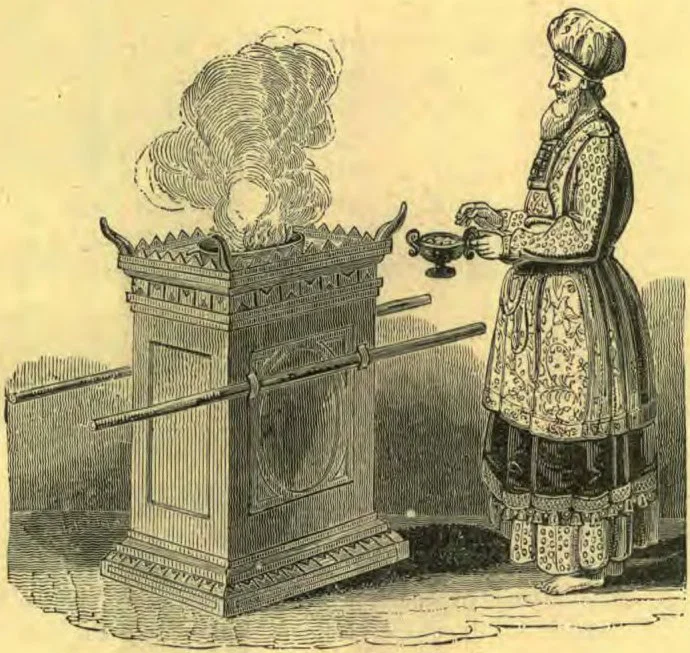
Just before the inner veil of the sanctuary was an altar made of wood, and covered with gold. It was about three feet high, and about one and one half feet in width and breadth. It was frequently called the golden altar, and its service was one of the most important parts of the daily ceremonies; and the priest who had the duty of attending to that work would never forget the solemnity of the hour. It was at such a time that the angel appeared to Zacharias, and announced to him the birth of a son. The angel stood at the right of the altar, and no doubt came as the smoke of the incense arose from the burning coals.
The fire upon this altar was kindled by God himself at the dedication of the temple, or sanctuary, and it was divinely preserved.
Incense, a perfume arising from resins and gums as a base, and other substances having a sweet perfume, and compounded “after the art of the apothecary,” was kept in the basins used in the holy place. With the spoons made for that purpose, the priest would throw some of the perfume on the burning coals, and from them a cloud would arise that no doubt was very sweet to the senses,—a sweet smelling savor. The compound could be used for no other purpose than the one named, and under the severest penalties the people were forbidden to make a similar mixture. Only the costliest balsams and oils entered into it, showing that the service of the true God is worthy of the best that can be given.
We read in “Great Controversy”:—
“In the offering of incense the priest was brought more directly into the presence of God than in any other act of the daily ministration. As the inner veil of the sanctuary did not extend to the top of the building, the glory of God, which was manifested above the mercy-seat, was partially visible from the first apartment. When the priest offered incense before the Lord, he looked toward the ark; and as the cloud of incense arose, the divine glory descended upon the mercy-seat and filled the most holy place, and often so filled both apartments that the priest was obliged to retire to the door of the tabernacle. As in that typical service the priest looked by faith to the mercy-seat which he could not see, so the people of God are now to direct their prayers to Christ, their great high priest, who, unseen by human vision, is pleading in their behalf in the sanctuary above.
THE ALTAR OF INCENSE.
“The incense, ascending with the prayers of Israel, represents the merits and intercession of Christ, his perfect righteousness, which through faith is imputed to his people, and which can alone make the worship of sinful beings acceptable to God. Before the veil of the most holy place was an altar of perpetual intercession, before the holy, an altar of continual atonement. By blood and by incense, God was to be approached,—symbols pointing to the great Mediator, through whom sinners may approach Jehovah, and through whom alone mercy and salvation can be granted to the repentant, believing soul.
“As the priests morning and evening entered the holy place at the time of incense, the daily sacrifice was ready to be offered upon the altar in the court without. This was a time of intense interest to the worshipers who assembled at the tabernacle. Before entering into the presence of God through the ministration of the priest, they were to engage in earnest searching of heart and confession of sin. They united in silent prayer, with their faces toward the holy place. Thus their petitions ascended with the cloud of incense, while faith laid hold upon the merits of the promised Saviour prefigured by the atoning sacrifice. The hours appointed for the morning and the evening sacrifice were regarded as sacred, and they came to be observed as the set time for worship throughout the Jewish nation. And when in later times the Jews were scattered as captives in distant lands, they still at the appointed hour turned their faces toward Jerusalem, and offered up their petitions to the God of Israel. In this custom, Christians have an example for morning and evening prayer. While God condemns a mere round of ceremonies, without the spirit of worship, he looks with great pleasure upon those who love him, bowing morning and evening to seek pardon for sins committed, and to present their requests for needed blessings.”
Connected with the altar of incense was the golden censer. It was a sort of fire-pan, with a perforated cover.
From the earliest days of history, censers have been used as utensils in which fire was placed, and then as they were swung from side to side, incense was placed on the coals, and the smoke would assist in the worship.
This practice has been continued in many religions even until now, and in the Roman Church, many services require the swinging of the censer by the altar boys.
In the Levitical service, however, the golden vessel was used to carry fire from the brazen altar to the altar of incense, and not to burn incense upon or in it. Only on the day of atonement did the priest take coals from the altar, and setting the censer in the most holy place, he would put some of the incense on the coals, and the cloud would fill the room, as the priest, once and again, entered the most holy in the service of that important day.
The use of the censer for the burning of the incense, and the swaying and swinging back and forth, are purely of heathen origin, unless all that practice can be taken from the one day of atonement. It was probably this special use of the censer that caused Paul to use the words found in Heb. 9:4.
Though the word is many times used in the Old and New Testaments, in no case is it connected with the idea of incense, but denotes the fire-pan in which the glowing charcoal was carried about in the service of the altar. It was upon the altar itself that the incense was burned.
All the services of the sanctuary were typical, and it is a glorious study to find out the relations that exist between the worship in the days of the earthly tabernacle, and the worship of the Christian to-day, who by faith now enters the throne of grace, which is within the second veil, through Christ, the living way.
May we devote our choicest gifts to the Creator; may we yield our whole bodies unto God; may our prayers ascend with that incense,—the righteousness of Christ,—which God will impute to us if we through faith approach his throne.
J. G. LAMSON.

THE PROMISES.

THE word of God is food to the spiritual part of our natures; but the promises seem like the meat that strengthens.
Many Christians lose much of the enjoyment of religion because they do not think often enough of the promises, and rely on them in every hour of temptation, danger, or sorrow.
There are promises for every condition and circumstance of a Christian's career, and if we only know of them, understand and believe them, we must always be happy, knowing God will not fail to keep his word.
The Bible, that most wonderful production, contains interesting and valuable history, profound philosophy, and poetry grand in conception and inimitable in expression; but a Christian sifts the promises from each and every part, and feasts on them with eager, rapturous joy. MRS. F. A. REYNOLDS.
Continue reading: Parents' Sins and the Inheritance of Children