SUPPOSE you go to visit a friend, and find him taking a wet pack. He is lying in bed, wrapped up in blankets so that he can not move hand or foot; a fly settles on his nose, and he begins making faces to try to remove it. You do not like to see him make faces, and wish him to stop. Which is the more rational method of making him stop? Is it to exhort him to summon all his fortitude to keep his face still notwithstanding the annoyance, or is it better for you to drive the fly away? No doubt it would be an excellent moral training for him to use his self-control and keep his countenance placid notwithstanding the irritation, but the simpler and more effective method would be to drive the fly away. Moreover, in nine cases out of ten his power of self-control would be insufficient to enable him to maintain an undisturbed countenance under such circumstances.
Likewise, many people are wondering why it is they feel so harsh and unkind toward their neighbors, why they are irritable in their homes, and do not experience a deeper work of grace in their hearts. They are spending all their energies trying to remedy the effect and paying little attention to the cause. God wants us to go back to the cause, to “lay the ax at the root of the tree.” When chloroform is administered to a person, he is not to blame for saying foolish and unwise things; and when the internal organs that should be right in place at the waist are being pushed down, each of the hundreds11of nerves stretched just as severely as the nerves of the ear would be if the ear had weights attached to it, and if the feet are cramped by tight and ill-fitting shoes, need we be surprised if there are aches and pains and irritable nerves? Such an individual certainly needs a special miracle of divine grace wrought, in order to keep the temper sweet and placid.
Condiments and spices cause a feverish state of the system; they inflame the delicate coating of the stomach and irritate the nerves. By way of experiment I once sprinkled a little mustard on the back of a person's hand, and then placed a hot bag over it for a few moments; the result was a blister as large as a dollar. It did not get well for a long time, and very likely the scar is still there; yet I did not put half as much mustard on that person's hand as people often put on a single piece of meat which goes directly into the stomach. And when highly spiced food, which is virtually a mustard plaster, is put on the inside of the delicately-lined stomach, creating such a condition of irritation, how can we expect to endure with tranquillity the ordinary annoyances and inconveniences to which the life here below subjects us?
The same principle holds good, only to a greater degree, with the child; for just as a child's mind yields so readily to favorable and unfavorable circumstances, so the physical structure of the brain in the early years is in such a plastic condition that it responds in an exaggerated manner to the effects of eating, irritating and indigestible food. “Be not deceived; God is not mocked; for whatsoever a man soweth, that shall he also reap.” Are not parents mocking God when they put before their children impoverished, stimulating, and irritating food, which inflames the coating of the stomach, and perhaps ferments, creating poisons that are taken up by the blood and carried to the brain, thus resulting in disorder?
Wrong diet lies at the very foundation of a large share of the physical, mental, and moral degeneracy which we see all around us. “Whether therefore ye eat, or drink, or whatsoever ye do, do all to the glory of God.” I Cor. 10:31. The Bible tells us that our bodies are the temple of the Holy Ghost. When we remember how sacred all the vessels connected with the temple were, and remember what a terrible thing it was to defile any of these in any way, then we shall learn a lesson as to how God regards any neglect on our part in sacredly guarding our bodies. Do not try to walk on the angel plane spiritually, and the carnal plane physically.
DAVID PAULSON, M. D.
CHOOSE THOU FOR ME.
By Jno. Wm. Stein
I YIELD my choice to Thee,
Choose Thou for me;
With all the pains I take,
I easily mistake;
I might of wrong partake,
I might the right forsake,
Thou canst make no mistake;
Choose Thou for me.
I yield my life to Thee,
Choose Thou for me;
It is a spark of Thine,
A principle divine,
A gift, gracious, benign;
And since it is all Thine,
It to Thee I resign;
Choose Thou for me.
I yield my way to Thee,
Choose Thou for me;
On Thee I can depend,
Thou art a constant friend,
Thou canst protect, defend,
Sufficient help wilt send,
Wilt guide me to the end;
Choose Thou for me.
I yield my work to Thee,
Choose Thou for me;
Thy purpose: I respect,
Thy plans are all correct,
My thoughts Thou wilt direct,
My efforts wilt protect,
Till I my work perfect;
Choose Thou for me.
I yield my wage to Thee,
Choose Thou for me;
It is all Thy bequest,
With life eternal blest,
Thy love my constant guest,
In exercise or rest,
I know Thou wilt do best;
Choose Thou for me.
I yield my all to Thee,
Choose Thou for me;
Author of destiny
And of infinity,
And of immensity,
And of eternity,
I yield my all to Thee;
Choose Thou for me.
Battle Creek, Mich. JNO. WM. STEIN.
MASCULINE CANDY FIENDS.
That candy has become the basis of a bad habit—like tea, tobacco, alcohol, or ice-water—has long been admitted by medical men; that its worst victims are not women, however, is not so well known, except to the owners of candy shops. The fact that one man bought and devoured 400 pounds of the richest chocolates in one summer, and that this gastronomic feat was not looked upon as anything unusual by the candy clerks, will give some idea of the slavery to which the habitual candy-eaters are committed. The man who consumed “confectionery” by the hundred-weight is young. He generally yields to temptation immediately after luncheon—although the craving sometimes becomes unendurable at an earlier hour. He estimates that the candy he bought for personal consumption cost him $250 last summer. He has been an unwilling victim for years, and has frequently “sworn off”—or attempted to. The last time was for three months; and when the self-imposed embargo was raised, he bought two pounds of mixed chocolates and ate them between lunch and dinner. —New York Post.
The candy habit is on a par with the tea and coffee and liquor and tobacco habits—all unfitting the mind and body for the work the Creator designed they should do. A very little good candy may not be harmful to most people; but most people are using much more of it than is good for them, and millions of dollars are squandered on that habit every year which could be used in very much better ways.
A COPPER PICKAX FOUND.
An extremely interesting relic of bygone ages has just been dug up on the shore of Lake Gogebic, Northern Michigan, by A. C. Hargraves of that locality. It is a pickax of tempered copper that had apparently been used in prehistoric times by people dwelling along the lake. The metallic part of the pick is twenty-three inches long and about half an inch thick. It tapers to a point at either end, and is as finely tempered as a piece of tool steel. At the center is a place where the tool was bound by thongs to a handle of wood. It is so hard that a steel file makes no impression on the copper. The art of tempering the red metal is unknown at the present day. Occasionally tempered copper knives have been dug up in this region, but this is the largest tool ever found.
CAST YOUR CARE ON JESUS AND LEAVE IT THERE.
By Phillips Brooks
The little sharp vexations,
And the briers that catch and fret,
Why not take all to the Helper
Who has never failed us yet?
Tell Him about the heartache,
And tell Him the longings, too;
Tell Him the baffled purpose,
When we scarce know what to do.
Then, leaving all our weakness,
And carrying away the song,
Forget that we bore the burden
With the One Divinely strong.
—Phillips Brooks.
WITHOUT BLEMISH.
It is said that one of the largest stones ever quarried in America was provided for a monument to an American soldier. It weighed three hundred and fifty thousand pounds, and was dressed and polished with great care. When ready to be set in its place, it was discovered that one defect in the stone rendered it unfit for the use for which it was intended, and it was rejected. Here was a great waste of time, skill, labor, and money. This stone was designed for an honorable position. It was to have commemorated the deeds of a hero, but at last it was thrown away. It was right except in one place. One flaw spoiled all.
Is it not so with many a distinguished character? God has designed our souls to commemorate His grace and glory throughout the ages of eternity. He has made ample provision for our purification and preparation for this great honor. If we shall stand before Him at last with some flaw, how can He accept us? How shall we be fit for the honor? Here is a character which is all right except one thing. That one flaw is fatal. Sometimes the flaw is secret. The world knows it not. But it will come to light at last.
Who has not known a man who lived a good life to all outward appearance, and yet lived a double life? He was a model in his home, in the church, and in business. He kept his secret till the last. Then like a clap of thunder came the awful revelation, and his son went down behind a dark cloud. Another may have died before his dark secret came to light. He was buried and covered with honors. But afterward it came to light that the life which seemed to men so noble was corrupt and base.
There is no need that such a calamity should happen. Ample provision has been made in Jesus Christ for our thorough preparation for the high honor for which God has designed us. If we will avail ourselves of this provision, we shall be presented before the throne of His glory without blemish. He who takes God with him in everything will be able to sing at last,—
“It is well, it is well with my soul.”
—Christian Advocate.
Removing Brown Streaks from Bathroom Bowls
A SOLUTION of soda and water applied with a whisk broom kept for the purpose, will remove brown streaks in bath-room bowls made by sediments in the dripping water.
Expect Great Things of Boys
“TREAT boys as if you expected good and great things of them. Such treatment is an inspiration to them.”
LITERARY NOTICES.
“THE COLOR OF HIS SOUL.” By Zoe Anderson Norris, 3¾ x 7½ inches, 220 pp., deckle-edge paper, bound in white Japan vellum. Cover designs and title page by J. K. Bryans. Price, $1.00, net. Postage, 6 cents. Funk & Wagnalls Company, New York and London.
It is a series of brilliant sketches or pictures of Bohemian life in New York. The principal character is an enthusiastic disciple of Professor Herron, the color of whose soul is in doubt till the last, when he is revealed as a heartless, ruthless destroyer of woman. It is a strong presentation of an evil type of humanity that needs exposing.
“THE SANDALS.” By Z. Grenell. Small, 12mo, cloth, 59 pp., price 45 cents. Funk & Wagnalls Company, New York and London.
This is a tastily printed and nicely bound bit of Oriental fiction, purporting to give the story of our Lord’s sandals from the time they were taken from His feet at the cross until they came into the possession of His mother. The book belongs to a class of fiction which is very plentiful to-day, but whose absence would not retard in any degree real Christian progress. The history of the Lord’s sandals is not known by any one, and the only purpose this story can serve is to entertain those who can be entertained by reading what they know to be simply the fruit of man’s imagination, visionary and untrue. It is important that we know the Lord. Even the true history of the garments that He wore is not essential to us; how much less an imaginary story such as this. The religious novel is a stepping-stone toward the deadly novel of the world, and the literary pathway of our youth to-day is largely made up of just such stepping-stones.
“THE COW PEA” is a pamphlet published by the Supervising Committee of the North Carolina State Horticultural Society, Southern Pines, N. C. It contains 64 pages, with striking illustrations showing the various varieties and its possibilities, together with a description of its value as a stock food and fertilizer. The stalks and leaves are said to make fine hay, the best of temporary pasture, and most excellent green manure; its seeds, green or ripe, are as nutritious as beans, and are relished as food for man or beast. Farmers who have worn-out land in pasture or field would do well to look into the possibilities of the cow pea, and to obtain the excellent instruction found in this neatly prepared pamphlet. Address Experiment Farm, Southern Pines, N. C.
Two pamphlets have reached us from Mr. F. J. V. Skiff, Director of Exhibits of the World’s Fair, St. Louis, 1903, namely, “Rules and Regulations,” and “Official Classification of Exhibit Departments.” Fifty-three pages are required simply to enumerate in general the groups and classes of exhibits. There are 144 groups and 807 classes, each class making possible a multitude of exhibits. The grounds will cover 1000 acres; and the floor space in the buildings will equal 200 acres. These pamphlets will be mailed free by addressing as above.
Ladies! If you haven't tried E-Z Washing Tablets
you have missed something. You can do a wash in half the time if you use them, and without injury to your hands or clothes. A new discovery. Absolutely free from acids or alkaloids. Samples for 3 large washings for 10 cents. Agents wanted Everywhere.
ALFRED MALLETT, 710 East 171st St., New York City
Living by Faith
“Living by Faith.” (Spanish.) A translation of Bible Students’ Library No. 75; 16 pp.; price, 2 cents. Address, PACIFIC PRESS PUBLISHING CO., Oakland, Cal.
THE ABORIGINES OF NORTHERN EUROPE.
By C. Castberg
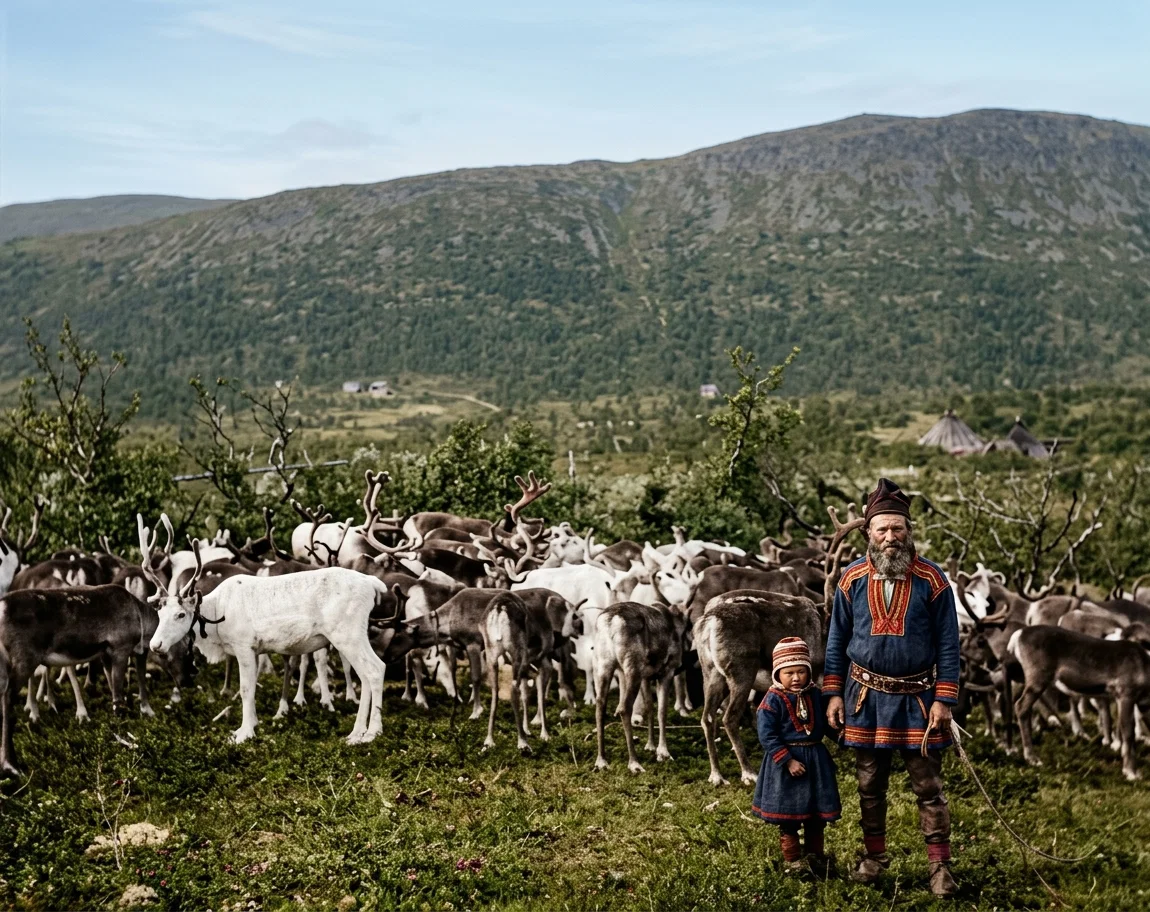
SETTLED in various parts of the most northern territory of the Scandinavian peninsula lives a singular people generally called Lapps, or Laplanders. In the mythical sagas of Scandinavia the Lapps are represented as an inferior race, distinguished only for craft and treachery, and addicted to practises of sorcery. They are regarded, in accordance with the same authorities, as the original occupiers of the whole of Scandinavia, from the fertile and more southern portions of which they were in ancient times driven forth by the superior, god-descended race of Odin, who banished them to the inhospitable regions in which they are now circumscribed.
Typical Lapland Family and Summer Residence.
A Lapland Herd of Reindeer.
It is a wonderful country—this home of the Lapps. The ocean roars along its rock-bound coast, and during the long, dark winter the storms howl and rage, and hurl the waves in white showers of spray against the sky. Great swarms of sea-birds drift like snow over the waters, and circle, screaming, around the lonely cliffs. The aurora borealis flashes like a huge shining fan over the northern heavens, and the stars glitter with a keen frosty splendor through the long winter nights. But in the summer all this is changed, suddenly, as by a miracle. Then the sun shines warmly; innumerable wild flowers spring up; the swelling rivers dance, singing, to the sea; the birches mingle their light-green foliage with the darker needles of the pines; the ocean spreads like a great burnished mirror under the cloudless sky; the fishes leap, and the gulls and eider-ducks rock tranquilly upon the heaving bosom of the deep, shining through an endless day.
The Lapps, who are classed in the same family as the Finns, Esthonians, and Livonians, are distinguished in accordance with the nature of their pursuits, as Sölapper (Sea Lapps), Elvelapper (River Lapps), and Fjeldlapper (Mountain Lapps). They are a physically ill-developed, diminutive race, with small eyes, low forehead, high cheek-bones, pointed chin, black, coarse hair, and scanty beard. They are, however, wanting neither in mental capacity nor manual dexterity; and in the seminary for Lapp teachers at Trondenes, in the district of Senjen, Norway, several of the students have distinguished themselves by their extensive acquirements.
The tendency of the Lapps to deceit is probably in a great measure to be attributed to the inferior position in which they are kept by the Norwegians, Swedes, and Russians, near whom they live; for they are honest and attached to their own people and country; and altho they are still superstitious and credulous, they are not devoid of religious sentiment. The Bible has been translated into their own language, which is divided, like the languages of all nomadic tribes, into numerous dialects, whose many affinities and differences have of late years attracted much attention among philologists.
They were originally all nomadic, but the difficulty of finding sufficient food within the limited space to which the increasing civilization of the neighboring peoples had gradually restricted them, has compelled some of the tribes to settle near the large rivers and lakes, where they follow the pursuits of fishing and hunting with considerable success. The number of the Lapps probably falls below 30,000, of whom about half are included in the population of Norway and Sweden, and half within the Russian dominions.
The reindeer, somewhat similar to the American caribou, is the chief source of wealth, supplying the people with most of the articles of food, clothing, and tools which they use. This species of the deer is very inferior in gracefulness to the stag, being of a rather heavy appearance, with comparatively short and stout legs, the withers much elevated, as in the elk, and the neck carried almost straight forward. The tail is very short. There is little or no mane, but the hair on the lower parts of the neck is very long and shaggy. Both sexes have large horns, which are more or less branched. From the base spring one or two branches, comparatively short, in old animals much palmated, so that the armature of the head is of a very peculiar appearance.
The flesh of the reindeer is excellent, as is also the milk, which is much used. The skins are made into clothing, tents, and bedding, and the antlers are made into all sorts of domestic utensils and ornaments. The reindeer is also extremely valuable as a draft-animal, for which purpose it is harnessed to a sleigh (pulkha). It is capable of maintaining a speed of nine or ten miles an hour for a long time, and can easily draw a weight of nearly two hundred pounds besides the sleigh. With their large antlers the reindeers remove the snow from the lichens, which form a great part of their winter food; they also scrape away the snow with their feet, and turn it up with the nose. Many Laplanders possess herds of two thousand and upwards, which they feed chiefly in the mountainous tracts in summer, and in the lower lands in winter.
The dwellings of the Lapps consist either of conically shaped huts, raised on stakes (gammer), and almost impervious to light and air, or of hide-covered tents. Towns and villages are unknown among them. The contempt with which the Lapps are regarded by the tall, well-developed Norwegian and Swede prevents the amalgamation of the races, while their other peculiar habits, and the tenacity with which they cling to their own customs, tend still more to isolate them from neighboring peoples.
C. CASTBERG.
MONKS AND NUNS IN FRANCE.
ACCORDING to the Interior there are 16,000 monastic establishments in France, with something like 400,000 inmates, or 1 to every 100 inhabitants. If to these 400,000 celibates who form the army of the Catholic Church, we add the 600,000 men in the army, and the three or four hundred thousand men and women who form the army of the civil service, we find that every 25 Frenchmen have to maintain a monk or a nun, a soldier or a civil servant or his family. Thus every citizen has to support one twenty-fifth of a member of these three categories, and as of the 40,000,000 Frenchmen only 8,000,000 at most earn or possess money, each of these 8,000,000 has to maintain13one-fifth of a monk, nun, soldier, or civil servant. The cost of the soldier and civil servant appears, of course, in the budget, but that of the monk or nun is a charge which must in some form be added to the taxation. It may be presumed, moreover, that only one-eighth of the population can be counted on as able to bear the public burdens, while there are certainly not more than 4,000,000 to face the cost of the 200,000 “religious.” Thus every 5 persons possessing an income have to maintain a monk or nun with the proportionate share of keeping up the establishment.—Missionary Review.
MY REDEEMER.
By Gertrude Emmerson
I know that my loving Redeemer
Keeps watch of me hour by hour;
And when I am tempted to leave Him,
He shelters me still by His power.
I know that my loving Redeemer
Still teaches me just what to say;
And when I’m not sure of my journey,
He lovingly shows me the way.
And O! what a loving Redeemer,
To keep us from every dark sin;
I know if I follow Him closely,
A home in His kingdom I’ll win.
GERTRUDE EMMERSON.
Sauk Center, Minn.
BLESSINGS IN GIVING.
By John H. Egbert
[John H. Egbert, D. D., in Christian Advocate.]
GIVING in a right spirit will bring temporal blessings. The sacred writings abound in exhortations in evidence of this. Not to give to the support of the work of God is to help pull it down. “He that gathereth not with Me scattereth abroad.” The fabled eagle that robbed the altar of its sacrifice, set fire to her own nest and destroyed herself and young. It never was loving that emptied the heart, or giving that emptied the purse. The rose-bush that gives its bright and fragrant blooms to gladden the eyes and hearts of those, who, shut in by age and afflictions can not look upon it in its glory or breathe its perfume where it grows, is far more productive both in the quality and quantity of its blossoms than the plant whose flowers run to seed upon the stalk, while their petals fade and fall, unblessing and unblessed.
No church ever died from too much giving; many have died from covetousness. The old darky preacher said: “If I should hear of a church that died from too much giving, I would gladly go any distance to preach its funeral sermon, and I would take for my text, ‘Blessed are the dead which die in the Lord.’” It is the liberal soul that shall live and grow fat. Covetousness is antifat. But spiritual blessings are also promised. Passage upon passage from God’s Word might be quoted in proof if it was necessary. Paul said to Timothy: “Charge them that are rich in this world, that they be not high-minded, nor trust in uncertain riches, but in the living God, who giveth us richly all things to enjoy; that they do good, that they be rich in good works, ready to distribute, willing to communicate; laying up in store for themselves a good foundation against the time to come, that they may lay hold on eternal life.” On the other hand, poverty of spirit will be caused by a withholding more than is meet.
He who is always receiving and never giving is like the Dead Sea. Its brackish waters are never changed, tho constantly receiving the fresh waters of the Jordan. So all the streams of God’s bounty can not sweeten a heart that has no outlet in gifts of charity.
“The hour draws near, howe’er delayed and late,
When at the eternal gate
We leave the words and works we call our own,
And lift void hands alone.
For love to fill. Our nakedness of soul
Brings to that gate no toll.
Giftless we come to Him who all things gives,
And gives because He lives.”
A PLEA FOR MEXICO.
By Editor
Under the above heading last week’s SIGNS OF THE TIMES presented a special plan and plea for opening missionary work in Mexico. This plan was to establish in that country a small printing plant for the publication of papers and books in the Spanish language. While this article was still in proof, it was read at a meeting of the stockholders of the Pacific Press Publishing Company held April 29, and the question, “Who will be the first to respond?” was answered as follows:—
A. T. Jones . . . . . . . . . . . $ 10 00
A. Papworth . . . . . . . . . . . 10 00
E. G. Fulton . . . . . . . . . . . 10 00
Mrs. C. L. Taylor . . . . . . . . 10 00
M. Alice and Geo. Bennie Taylor . . 10 00
J. R. Reed . . . . . . . . . . . . 20 00
J. Figer . . . . . . . . . . . . . 10 00
Mrs. S. Baker . . . . . . . . . . . 10 00
John Church . . . . . . . . . . . . 10 00
P. R. Albrecht . . . . . . . . . . . 10 00
Mrs. S. C. Stickney . . . . . . . . 10 00
D. W. Barr . . . . . . . . . . . . . 10 00
Wm. Saunders . . . . . . . . . . . . 10 00
Mrs. J. Gotzian . . . . . . . . . . 20 00
G. E. Johnson . . . . . . . . . . . 10 00
Mrs. A. M. Loughborough . . . . . . 10 00
D. T. Fero . . . . . . . . . . . . . 10 00
H. A. St. John . . . . . . . . . . . 10 00
Mrs. W. C. White . . . . . . . . . . 10 00
J. N. Loughborough . . . . . . . . . 10 00
Mrs. M. C. Wilcox . . . . . . . . . 10 00
J. S. Howard . . . . . . . . . . . . 10 00
Geo. Manuel . . . . . . . . . . . . . 10 00
M. E. Cady . . . . . . . . . . . . . 10 00
W. C. Gage . . . . . . . . . . . . . 10 00
H. H. Hall . . . . . . . . . . . . . 10 00
C. E. Frisbie . . . . . . . . . . . . 10 00
R. A. Blackwood . . . . . . . . . . . 10 00
Lynn and Barbara Stickney . . . . . . 10 00
Cash donations . . . . . . . . . . . . 18 21
Total . . . . . . . . . . . . . . . . $ 328 21
The following additional donations have also been received:—
For every one who gives ten dollars one share of stock will be issued if desired; and this share of stock will entitle the holder to one vote in any meetings of our publishing association.
We feel thankful for the above hearty response to this published request; but as there is a great work before us, and many large books to prepare, a still greater sum will be needed. Donations will appear in these columns from week to week as they are received. Address SIGNS OF THE TIMES.
HOW CAN I HELP THAT SOUL ON THE ROAD TO THE HEAVENLY CANAAN?
By Robert S. Greaves
There are a great many people in the world who are sighing and longing for an opportunity to do missionary work for the Master, whose hearts are craving for active work, yet unknowingly grand opportunities are passing them by many times each day, without being taken advantage of. They may see the result of consecrated work done by some brother or sister, in bringing a troubled and weary soul near to Jesus, and their hearts may grow very tender as they behold the penitent confessing his sins, and pleading with the newly-found Saviour; and they think how fortunate the brother was to happen to meet with the repentant sinner who wanted to be saved. With yearning hearts they may think how willingly they themselves would have sacrificed to be able to bring a similar soul to the throne of mercy, to be able to save a soul from death.
Brethren, would we not all like this privilege? Then why do we sit down and wait for some poor wanderer to come to us? Perhaps it is because we do this that so many of us have to wait so long a time.
People are often very sensitive on this point; and tho the Spirit of God may be earnestly striving within them, yet outwardly they show only a cold reserve. The world seems to hold them in its thrall, and perhaps in spite of knowledge they may have decided to run in the old rut to the end of their lives.
The battle-cry is sounding; let us gird on the whole armor of God, and in His strength invade the enemy’s ground. Let us search, earnestly search, for lost souls, who are his captives, and not wait until they come to us to be rescued. Can we but gain one, our life will not have been spent in vain; for we shall have gained something of more value than all the world. Do not let us sit pining and regretting that we can not go into some foreign mission field, or be a minister of the Gospel; but let us ever be on the watch, and the first unconverted person we come in contact with, whether in the house, on the street, or on the prairie, remember that there is a poor mortal soul, and let the language of our hearts always be, “How can I help that soul on the road to the heavenly Canaan?”
The right opportunity may not always occur for us to speak of what is nearest to our heart, so let us lift our spirit in earnest prayer to the One who is able and willing to guide us (James 1:5); and if it is best not to speak at the moment, we can be kind and courteous. Even a bright smile will sometimes go further than we think, and in this way we can witness for Jesus. Keep ever on the watch, and many golden opportunities will be gained, and turned to the glory of God’s name, that are now lost and will so remain until brought up at the judgment and registered against those who have wasted them.
ROBERT S. GREAVES.
Hamiota, Manitoba.
OUR WORK AND WORKERS.
Five members were added to the church at Killbuck, Ohio, April 5. Brother J. O. Miller was present on this occasion.
Sixty sanitariums and eleven academies and colleges are now conducted by Seventh-day Adventists in the United States.
The Missionary Magazine for May notes the death of two of our foreign missionaries—Brother A. M. Fischer in Porto Rico, and Brother Charles Grin in Belgium.
Through the Worker, Brother W. H. Wild reports thirteen persons keeping the Sabbath of the Lord as a result of distributing literature in Minneapolis, Minn.
Notwithstanding the extensive drought in Arkansas during the year 1901, our canvassers sold books to the amount of $1,835 in excess of sales for the previous year.
The Nebraska Reporter says that six persons have decided to keep the Sabbath of the Lord at Hill City, S. D., where Brothers Johnson and Nethery have been holding a series of meetings.
After a series of meetings in Auburndale, Wis., Brother C. A. Telyea and wife report that fourteen adults and twelve children are now rejoicing in the Lord. They have also organized a Sabbath-school.
In this city, on the 3rd inst., after a discourse by Brother J. O. Corliss, Brother Charles T. Everson was ordained to the Gospel ministry. Brethren J. O. Corliss, J. N. Loughborough, M. C. Wilcox, and M. H. Brown officiated.
The Nebraska Conference at its recent session decided to donate $500 to the work in Central Africa, $75 to pay the fare of W. O. James to the English field, and $50 to help forward the work in New York City, where Brother Luther Warren is now laboring.
At Hong Kong, China, March 1, six young sailors belonging to the British man-of-war Terrible were baptized by Brother J. N. Anderson, who had but recently gone there from America. They had learned the truth from a Brother W. J. Young, while on the voyage to that country. At the same time an old resident of Hong Kong was also baptized.
Brother G. G. Rupert, president of Oklahoma Conference the past year, has been elected president of Southwestern Union Conference, and Brother C. McReynolds has been chosen president of Kansas Conference, vice E. T. Russell, now president of Central Union Conference. Brother H. G. Haffner has been chosen president of the Oklahoma Conference.
We have a little mission school in Basutoland, South Africa, with but one white laborer, Brother J. M. Freeman. He reports that four have been baptized, two of whom were the wife and daughter of an old chief. The chief himself, who used to be a drunkard, now attends all the meetings. His wife died not long after her baptism. The teacher of the school is a native, Brother David Kalaka, who attended our college at Claremont, near Cape Town.
Another one of our early California members has passed away, Mrs. Mary C. Chapman, who fell asleep in Jesus Sabbath morning, May 3, at the age of 72 years, 4 months, and 27 days. She was the mother of E. A. Chapman, the treasurer of this institution, and E. C. Chapman, missionary to the islands of the Pacific, now in the printing and publishing work at Cooranbong, Australia. She accepted the Sabbath truth at Petaluma, where she is buried beside her husband. Their home, when they were living, was ever a pilgrims’ arbor. The bereaved children, three sons and two daughters, are all Christians.
The isolation, as well as the faith, of the Pitcairn Islanders, is well illustrated by the following paragraph from a letter in the Missionary Magazine, written by Brother J. R. McCoy while on a visit to Tahiti:—
Last year we received but one paper from a passing ship. It was a copy of the SIGNS OF THE TIMES of March 6, 1901. I can assure you that it was treasured and read with much interest in the meetings and at home. Our last regular Sabbath-school lessons were the ones that I carried with me when I left California in 1898, but this did not stop our Sabbath-school. We selected portions from the Word of God. Working on Pitcairn Island is like working in a little world all our own.