'Tis a beautiful Bible story,
And teaches a lesson grand,
Of the lonely Hebrew widow,
And the damsel from Moab's land.
For devotion to filial duty,
With reward reaped even here,
As told by the sage, on the sacred page,
It stands without a peer.
When she left her home and kindred,
To lift and bear the cross
With God's peculiar people,
She did not suffer loss;
For the lot all women longed for
Was hers — to bear a son
In the line of birth, when He came to earth,
Of that wonderful Coming One.
She gleaned in the fields of Boaz,
Who took her to be his wife,
Buying again the possession
Of the husband who lost his life;
For thus reads the law of Moses,—
That the one who was next of kin
Should redeem his land, and receive the hand
Of her who his wife had been.
Of JESUS, the hope of ages,
The Jews by these laws were shown;
For they were the chosen nation,
And God will instruct His own.
He has purchased the lost possession
We have forfeited by our sin.
O, wonderful plan to redeem lost man
Through Jesus, our next of kin!
He took not the form of angels,
But lowered Himself to be
Our Kinsman and Elder Brother,
For the love that He had to me.
His compassion for me in my darkness
Sent Him down from His throne on high
To take my place, and die in disgrace,
That I might not have to die.
He was born with a sinful nature,
But He did not yield to sin.
He can succor the weak and tempted,
For He is our next of kin.
He will save us if we but let Him;
He'll comfort us day by day;
He will bear our cares, and answer our
prayers,
For He has passed by this way.
All ye who are sad, take courage;
For Jesus, the Son of God,
Is also the son of a woman,
And the human path has trod.
He gave His own life to purchase
Our pardon, and save from sin.
He conquered the grave, and has power to
save,
For He is our next of kin.
Our Bible Reading
Man Redeemed
1. Why is it necessary that man should be redeemed?
"Now we know that what things soever the law saith, it saith to them who are under the law: that every mouth may be stopped, and all the world may become guilty before God." "For all have sinned, and come short of the glory of God." Rom. 3: 19, 23.
2. What is the penalty, or the reward, for sinning?
"For the wages of sin is death; but the gift of God is eternal life through Jesus Christ our Lord." Rom. 6: 23.
"Then when lust hath conceived, it bringeth forth sin: and sin, when it is finished, bringeth forth death." James 1: 15.
3. How complete and far-reaching is God's plan to redeem man from sin?
"For as by one man's disobedience many were made sinners, so by the obedience of one shall many be made righteous. Moreover the law entered, that the offense might abound. But where sin abounded, grace did much more abound: that as sin hath reigned unto death, even so might grace reign through righteousness unto eternal life by Jesus Christ our Lord." Rom. 5: 19-21.
"Wherefore He is able also to save them to the uttermost that come unto God by Him, seeing He ever liveth to make intercession for them." Heb. 7: 25.
4. How anciently was this plan of redemption laid?
"And all that dwell upon the earth shall worship him, whose names are not written in the Book of Life of the Lamb slain from the foundation of the world." Rev. 13: 8.
"Forasmuch as ye know that ye were not redeemed with corruptible things, as silver and gold, from your vain conversation received by tradition from your fathers; but with the precious blood of Christ, as of a lamb without blemish and without spot: who verily was foreordained before the foundation of the world, but was manifest in these last times for you." 1 Peter 1: 18-20.
5. What is the first promise that was made after sin entered the Garden of Eden?
"And I will put enmity between thee and the woman, and between thy seed and her seed; it shall bruise thy head, and thou shalt bruise his heel." Gen. 3: 15.
6. What great general invitation is given to receive this full and complete redemption?
"And the Spirit and the bride say, Come. And let him that heareth say, Come. And let him that is athirst come. And whosoever will, let him take the water of life freely." Rev. 22: 17.
Vegetarianism or Flesh Eating
The diet question is not a matter of experiment for a day, or a week, or a month. A mere experiment with a few rats is a poor criterion with which to decide. A system is not built up in one day, or ten days, but back of it for years are the tested materials of which it has been built. We see very little in the journey of the Buffum brothers across the continent. The vegetarian gained more and was stronger at the end of the journey, but it is contended that he was in a little better health. That brief experiment proves little. The mere statement of some flesh-loving physician is of the same order. Dr. Wiley's declaration that the race would deteriorate without meat, rests simply on his supposition. He believes that a certain amount of meat is necessary as both body and brain food, and would not like to trust his progeny to a vegetable diet.
Nor is it an argument for meat that the flesh-eating nations have been the world conquerors. That does not rest so much upon the food which they ate as upon the peoples themselves. We certainly had a decided reversal of that theory in the Japanese-Russian war. The Russians are great meat eaters, while the Japanese are almost wholly vegetarian. The result in every way favored Japan, not simply in the matter of the fighting or the conflict itself, but as regards the health of the soldiers and those who survived gunshot wounds.
Personal Experience
The writer of this article speaks from experience. At times in his life he has eaten largely of animal food. For years he followed a mixed diet. And for nearly half his life he has followed what may be called a vegetarian régime. The only practical exception is that of milk, and eggs very rarely, and milk not in great quantities.
In his early years the larger part of his flesh dietary was pork, with occasionally beef, mutton, and fish. Later the pork was abjured. During his pork-eating days he spent most of his life in the open air and in hard manual labor, the most favorable conditions. He suffered greatly from catarrh and catarrhal headache. His blood was corrupt, skin rough and scaly, pimples and small boils in constant evidence. Cuts and abrasions would invariably suppurate, and be long in healing. "Heartburn" and other troublesome dyspeptic symptoms were almost daily companions. A busy life, interesting work and studies, and a varied companionship made life barely endurable.
He was led to see the positive harmfulness of pork eating, by his own experience and its effect upon others, and these observations were strengthened by the prohibition of swine's flesh to the Jews in the Levitical law and by reading the "Health Reformer" published at Battle Creek, Michigan. And the question arose, Why did God prohibit the use of swine's flesh as food? It was no arbitrary act on the part of Divine Wisdom. Evidently it was because of the inherent nature of the swine itself. The beast was unhealthy, hence unwholesome, and God forbade it for the physical as well as the spiritual good of His people. Thus the writer reasoned, and pork was banished from the dietary, and beef and mutton took its place.
Improvement followed, clear and decided for a time, but it was slow and unsatisfactory. The entire food question was studied in the Biblical, physiological, hygienic, and economic phases. The result was that flesh foods were placed on the retired list, and fruits, grains, nuts, and milk in almost endless variety became the regular bill of fare. As a result, the catarrhal conditions have almost wholly passed away. It is a rare thing indeed to have a cold. Cuts, bruises, abrasions, heal, if given any proper treatment, by first intention, but if given no care rarely or never suppurate. The mind is clearer, the body more vigorous; in fact, there is a decided improvement in every particular.
When living on the mixed dietary and working hard, three meals a day was a necessity, and it was not an infrequent thing that there were four or five; but he finds it a very easy thing now to work until noon with nothing, and it is easier to work all day long without food than it was formerly to go without one of the three meals a day. He has demonstrated that one can work longer and harder on a vegetarian diet than he could on a flesh diet. He has seen its demonstration in hundreds and hundreds of cases besides his own. He knows of many children and young people, all the way from five to strong manhood, who have never, or practically never, tasted meat, who present every evidence of health, stanchness, endurance, resistless energy. Children in vegetarian schools will be found to be, other things equal, superior to those who live on the mixed diet.
Economy
One thing which should commend the vegetarian diet is that it is cheaper. These are days when living has soared high. This is especially true of flesh foods. A cartoon before us represents a lean, bony bovine, composed of skin and bones, hoofs and horns, brought to the beef trust. It is killed and hung up, and then the next scene presents the beef trust inflating it. It is blown up by hot air. The next thing its blued carcass is being sprinkled with chemicals which will give it color. In the next scene it is being treated with embalming fluid by the beef trust. The next is a visit by the government inspectors, who pronounce it "O. K." And in the last scene a little girl comes to a butcher shop and buys of the beef trust some of the treated meat at forty cents a pound. The picture tells an exaggerated story, but there is truth in it nevertheless.
Disease Breeding
Secondly, it is a simple fact that the animal kingdom is becoming more and more diseased. This is brought about to some extent by high breeding, lowering the resistance of the animals to disease germs to some extent; by the herding of a multitude together and easily spreading infection; and doubtless there are other causes. At any rate, we know that disease is spreading among the meat-producing animals.
A clipping before us tells us that not long ago homeless men in Germany sought, with decayed smoked herring from a market garbage pile, to add to a frugal meal of bread and soup; fifty died, and many others were seriously ill. The decided difference between fresh vegetables and decayed vegetables would have been noted immediately, but in the gradual deterioration of animal foods this was not understood.
The "Daily Drovers' Telegram" of December 16, last year, gave the number of animals which were inspected before slaughter as 53,000,000 (we give round numbers only); 7,800,000 cattle, 2,200,000 calves, 29,900,000 hogs, 13,000,000 sheep, 45,000 goats. Most of these were inspected after slaughter, and of these there were condemned for disease, or other unwholesome conditions, 117,000 entire carcasses, and 1,010,000 parts of carcasses, making a total of 1,127,000 carcasses and parts condemned. Tuberculosis was the cause of by far the greater part of these condemnations, nearly 47 per cent of condemnations of adult cattle, and over 96 per cent of condemnation of hogs, being due to this disease, and the total was 7½ per cent greater than during the preceding year. There was condemned in meat and meat products under official inspection over 21,000,000 pounds, and the provisions of the meat inspection law do not apply to animals slaughtered by farmers on the farm, or to retail butchers and dealers.
The "Journal of the American Medical Association" says that charges have been made by competent and unbiased observers that the federal meat inspection laws are administered in the interest of the packers rather than for the protection of the public, and that meat that would not be accepted at the ports of entry of Europe is passed by the federal meat inspectors for home consumption.
Statement of One Who Knows
Before us lies a letter from a large cattle dealer, a butcher in the Middle West, an old correspondent and friend, whose name we withhold, but one in whom we have perfect confidence. He says:
"The general public no doubt rests secure in the belief that all meat passed by the inspectors is good and wholesome, when, as a matter of fact, the larger per cent of it is just passed, especially in the hogs. It is so rare for a hog to be free from tuberculosis that a government inspector told the writer a few years ago that if they condemned every hog that showed signs of tuberculosis, there would be no pork in the market. He further said, 'A hog has to be about rotten with tuberculosis before we condemn him entirely.' This information was given to the writer as he introduced himself as a butcher who had found some signs of disease in about twenty per cent of the cattle he had slaughtered.
"Twenty-seven years ago the writer started to ride the range as a cowboy, when the country was open from Montana to Texas, and the cattle roamed over the prairies by the millions. Had I then run across an animal with the 'big jaw' such as we commonly see every day now in the stock-yards, it would undoubtedly have made a strong impression on me. It is therefore my opinion that the big jaw is comparatively a modern development of disease, and is on the increase.
"There are men nowadays who make a specialty of buying young cattle with the big jaw who ship them to their feed lots, arrest the outward growth of the disease with medicine, fatten the stock, and return them to market. Fat animals, however, with the big jaw are slaughtered, and infected parts cut out, and the rest sold over the block the same as any meat. I have seen a whole car-load of this kind, with the big jaw so far developed as to give the appearance of a double-headed beast, going to the slaughter-house, being hustled and jostled together until the blood and pus was streaming down their necks and bodies. If the general public think that butchers and stockmen can see these sights and then sit down and eat beefsteak by the pound, they are mistaken. Some can, but a good many others do not.
"About a year ago the president of the stock-yards and a wholesale butcher sat down to dinner at the writer's table. There was a yearling roast for dinner. The writer said, 'Gentlemen, I can recommend this.' The wholesale butcher, who was the picture of health, said, 'Excuse me, I never eat meat.' The other cattle dealer said, 'Just a little, a very little.'
"The question may arise in some minds, Why are we allowed to buy meat that may have come from some diseased animal? Why is not every diseased animal destroyed?—Because the law of supply and demand as measured by dollars is far too powerful; and it may be added, in justice to the government inspectors, that they know it is impossible to be overexacting in their inspection without injuring materially a vast industry. The general public has to bear all the loss, as the packing industry exacts its toll regardless of quantity or price, and is little interested in the condemnation of diseased animals, for as in the case of hogs, they only pay for those passed after slaughter. And in the case of cattle, they discount the chance of loss by their own expert inspection when buying."11
A Better Dietary
This truthful letter from an experienced man speaks for itself. We present a better thing to our readers, vegetarianism. The vegetables, grains, fruits, nuts, which God has given us in great abundance and variety, meet all the needs of the human family. And we can see in the ox and the horse both the strength and intelligence which come from vegetarian eating.
The Christian can find ever a higher motive. Animal food feeds the animal in man; vegetarian food fosters and aids truest spirituality. In the words of an old motto: 'Eat ye that which is good. Custom will make it most delightful.'
Roman Catholic Claims for Recognition
By Editor
It seems quite evident that Roman Catholicism will demand or is demanding recognition not granted in the past. For instance, it is stated by Marquis de Fontenoy, a European newspaper correspondent, a part of whose article was printed in the Boston Pilot, that a cardinal is not necessarily a priest—he is not a mere member of an ecclesiastical body, he is not to be compared with ministers of the gospel—but a great personage, who is regarded and treated everywhere abroad, not as a dignitary of any church, but as a prince of the blood, and therefore, under the circumstances, he should be regarded as a foreign prince of the blood to whom the United States, as one of the great powers of the world, is under obligation to concede the same honors that they receive abroad. Thus, if Cardinal Farley were to visit an American man-of-war, he would be entitled to the salutes and to the naval honors reserved for a foreign royal personage, and at any official entertainments at Washington the cardinal would not only outrank any cabinet officer, the speaker of the House, and the vice-president, but also the foreign ambassadors, coming immediately next to the chief magistrate himself. And it is also stated that when a royal personage not of sovereign rank visits New York, it is his duty to make the first call on Cardinal Farley. And the Boston Pilot says that “this country would be showing a contemptible and narrow littleness which does not become it, and which will never be manifested, if it endeavored to set at naught the century-old rank which all nations accord to their eminence.” Well, we will see whether the United States will yield to the old régime, or will still hold to the “new order of things” of 1776, which set aside the old-time practises which grew out of a union of church and state.
What a Dog Did
THAT title may be a little too strong. It probably should be said, What women did; for the dog was a poor, innocent, helpless thing. But a dog luncheon was held in New York by a lady of wealth, in honor of her $5,000 Chinese Chow dog Vi Sin; given at the Vanderbilt Hotel, and cost about $75.00, at which eight dogs sat, or were held by eight society women who chaperoned them. It stirred New York papers to some extent. One minister said:
"It sometimes seems as if New York were passing through some of the vices of decadence that were observed in Rome just before the fall of the empire. The test of the city and its civilization is the attitude of its women toward life. When women become thoughtless toward the little children of the tenement houses, and give banquets in hotels with dogs as their guests, it would seem as if vices that once crawled as serpents over the threshold of Nero's palace, are now leaving a little slime on the marble steps of the American home."
A Catholic priest truly said:
"People who would do such a thing as to give a dinner in honor of a pet dog, and those who attend such a function, are the enemies of society, and the provokers of Socialism and anarchy. Surely better means can be taken to procure notoriety and publicity than by fashionable dinners in honor of a dog. Why not go into a poor neighborhood and select a dozen of the poorest children to be found there, and give them a dinner? There are many poor people out of work, or perhaps sick and in need, who become embittered, dissatisfied, and opposed to those who possess such wealth as enables them to lavish it on a dog, or a monkey."
A newspaper said:
"This manifestation of degenerate extravagance flares out against the growing discontent of the time like a torch in darkness. . . . Society reports of affairs of this kind serve as campaign documents and topical lessons for all forms of discontent. Socialists and anarchists and rebellious spirits of poverty, or of misunderstood talent, read of these dog luncheons and monkey banquets with as much interest as society itself, and they do not forget them. . . . If plutocracy has not already gone mad with prosperity, it will not flaunt its Pekingese spaniels too often in the face of a food-taxed people."
And one woman of fashion said:
"The idea of people talking so! and poor little Vi Sin to have caused all that trouble."
It is a sad, sad commentary that with all the needs and wants and demands of this great, big, suffering world, women can find nothing better to employ their time. But it probably was just as respectable and proper as some of the wretched drinking bouts in which men engage. Would that they could get a vision of the eternal judgment of God, for which an account will be given of the time and money and talents thrown away, or worse than wasted.
Sunday Laws in Oregon and California
OREGON and California are among the states that have the new plan of the initiative, referendum, and recall. And in both of these states there is much agitation by those who favor Sunday laws. They are seeking to have laws placed before the people of both these states to be voted upon at the elections this fall.
Then in addition to these plans for state-wide laws, they are now beginning to get counties to initiate laws, so that if the law fails to carry in the state as a whole, it may have the chance to carry in numerous counties.
Sunday laws may appear very harmless. But Sunday laws are religious laws, no matter how much the attempt may be made to cover up the fact. And there are always enough bigots in any community to start persecutions when they have the law on their side. It is perfectly easy for us to see the bigotries and the persecutions of the past. But one of the curious things about humanity is that it will engage in doing the very thing it condemns in the past. When attention is called to it, the reply is, 'O, that thing back there was wrong, but this is different.'
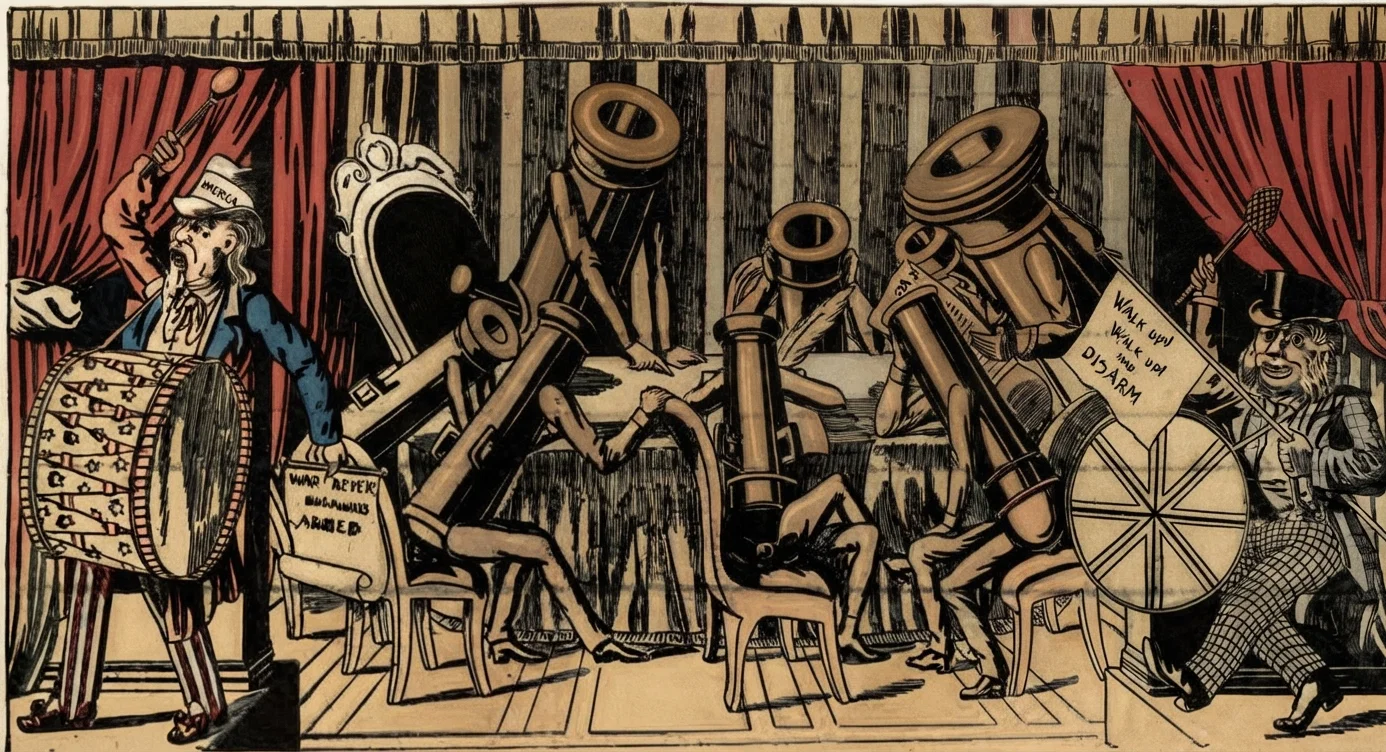
The talk in favor of peace while the world goes on preparing for war is a favorite topic for the cartoonist. The above is one of the very many suggestive sketches that are published almost daily.
So far as we know, the first county in California to invoke the initiative for a Sunday law is Colusa. That county has already sent in her petition entitled a 'Weekly Rest-Day Act.' The proposed law seeks to do away with liquor selling, all unnecessary work, and sports, on Sunday. 'Some of the exceptions listed are operation of railroad-trains, loading and unloading perishable goods and freight, running street-cars, telephones and telegraph, the operation of hotels and restaurants, lodging-houses, and such places as are necessary for health, such as drug stores.'
According to this proposed law, then, certain work may be all right on one day of the week, but the same thing is a crime if done on another day; certain sports are a crime on one day of the week, but are all right on all other days of the same week. If the day on which the thing is done is that which puts the criminal coloring matter into the deed, and furthermore, if that day is the one that is commonly regarded as the Sabbath day, it ought to be easy to see that the law is a religious one. It is the religious character of the day that makes the demand for the law, and not the desire to help some poor laboring man, as the advocates of the measure would fondly have us believe. If the desire, as they express it, is to help free the laboring man from the constant grind of seven days of toil, why prevent him from having games and sports on that day? If the law is purely a secular one, and only designed to give freedom from toil, why does it prohibit play? The thing is sufficiently transparent. Men ought to be able readily to see through it.
Then above all things, why exempt the street-car lines and the railroads? The corporations that conduct these lines of business are said to be among the most exacting. It is claimed that they are among the very worst to demand ceaseless toil. Why exempt the very worst offenders? If the law is all right in itself, Why not make it general? That would at least remove from it the appearance of class legislation, and it has been universally conceded that class legislation is wrong.
Pope’s Swiss Guard Strike
The Pope's Swiss guard has presented a demand for three holidays each week. The demand seems to have grown out of the fact that the new commander, Colonel Repond, insists upon strict discipline, and that they shall be real soldiers instead of ornamental ones. Twenty of the guardsmen have deserted, and the deserters have presented the ultimatum. Unless the demands are granted, the whole regiment say they will go on a strike.
National Progressive Party Convention
The new "National Progressive Party" has called its national convention to convene in Chicago, August 5.