The Youth’s Instructor, Vol. 33, No. 32.

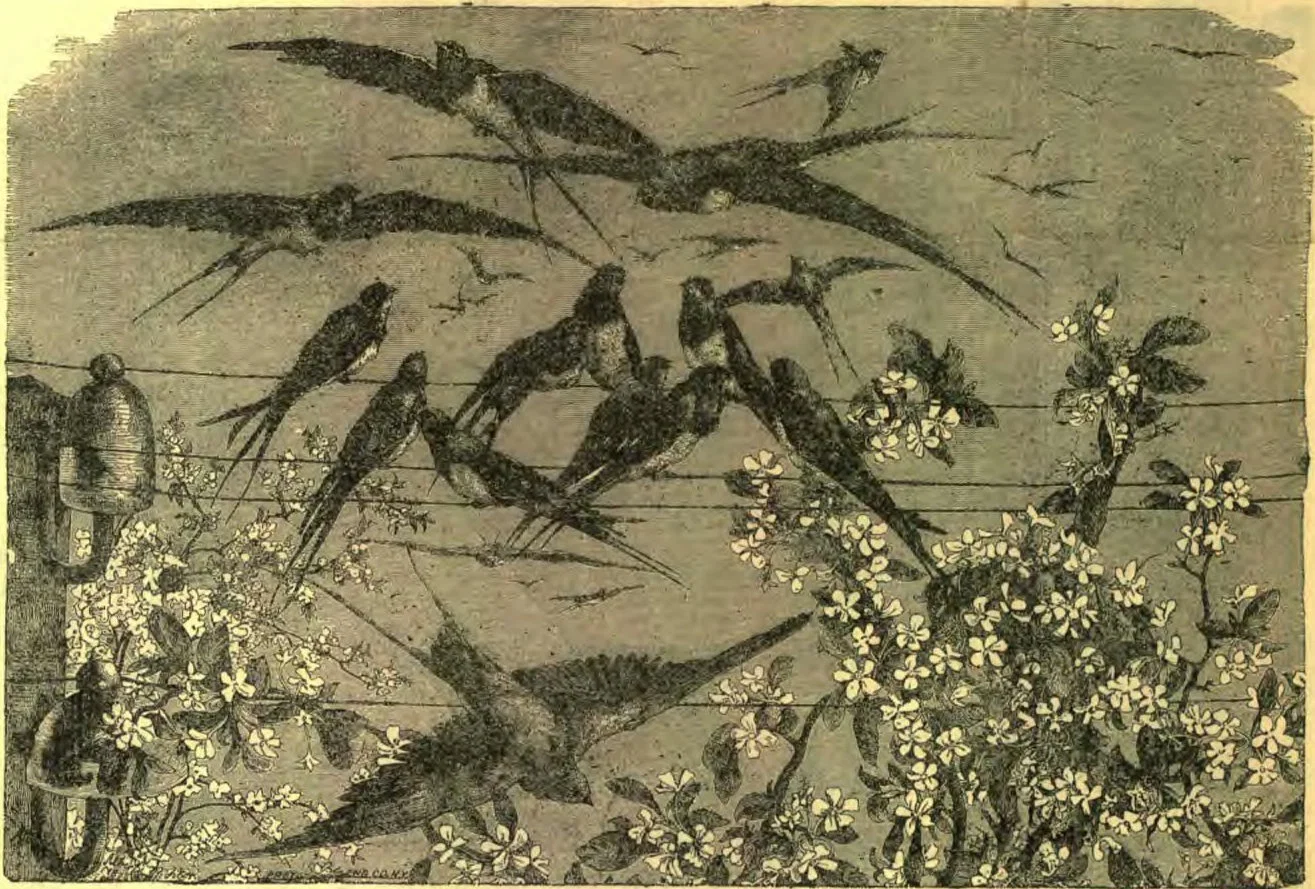
HE PLANNED FOR THE BIRDS

The Youth’s Instructor

Aug 26, 1885

S. D. A. Publishing Association · Battle Creek, Mich. · Aug 26, 1885

HE PLANNED FOR THE BIRDS.

LITTLE birds sit on the telegraph-wires, And chatter, and flitter, and fold their wings; May be they think that for them and their sires Stretched always, on purpose, those wonderful strings; And perhaps the thought that the world inspires Did plan for the birds, among other things.
Little birds sit on the slender lines, And the news of the world runs under their feet; How value rises, and how declines, How kings with their armies in battle meet; And all the while, ’mid the soundless signs, They chirp their small gossipings, foolish-sweet.
Little things light on the lines of our lives,— Hopes, and joys, and acts of to-day; And we think that for these the Lord contrives, Nor catch what the hidden lightnings say; Yet from end to end his meaning arrives, And his word runs underneath all the way.
Is life only wires and lightnings then, Apart from that which about it clings? Are the thoughts, and the works, and the prayers of men Only sparrows that light on God’s telegraph-strings, Holding a moment, and gone again? Nay! He planned for the birds, with the larger things.
—Mrs. A. D. T. Whitney.

DAVID GLASGOW FARRAGUT.

The portrait of Admiral Farragut presents one of the finest faces I have ever seen; it is a face I would choose to hang upon the walls where you boys could look upon it every day of your lives. Even the pictures upon our walls are our educators; they help to make us what we are; then let us hang up the faces of the good, the noble, and the true. Let us choose carefully, that only pure and ennobling influences may be thus shed into our hearts.
David Glasgow Farragut was descended from an old Spanish family, one of the conquerors of earlier times, a Don Pedro. His mother was of a good old Scotch family, and it may be that he inherited from one side that adventurous, fearless nature which carried him through so many victories, and from the other that sturdy independence and grand faith which were so characteristic of him. When quite a boy, he entered the United States Navy as a midshipman. His father was an army officer, and Admiral Farragut tells the story of his own greatest victory in life in this way. He had accompanied his father, upon one occasion, as cabin boy. He says:—
“I had some qualities which I thought made a man of me. I could swear, drink a glass of grog, smoke, and was great at a game of cards. One day my father said to me, as we were alone in the cabin, ‘David, what do you intend to be?’”
“‘I mean to follow the sea!’”
“‘Follow the sea! Yes, be a poor, miserable, drunken sailor before the mast, kicked and cuffed about the world, and die in some fever hospital in a foreign clime.’”
“‘No,’ I said; ‘I’ll tread the quarter deck and command as you do.’”
“‘No, David; no boy ever trod the quarter deck, with such principles as you have and such habits as you exhibit. You’ll have to change your whole course of life if you become a man.’”
“‘My father left me and went on deck. I was stung with the rebuke and the mortification—was that to be my fate, as he had pictured it? I said, “I’ll never utter another oath! I’ll never drink another drop of intoxicating liquor! I’ll never gamble!”’”
And those vows he kept until his dying day. This was when he was ten years old; and though he lived to be a great naval commander and won many victories, I think you will agree with me that this was the greatest of all. You know that “he that ruleth his spirit is greater than he that taketh a city.” And, too, without this triumph over his own spirit, do you think he would have won those other battles which have made him famous?
During the civil war he was put in command of an expedition against New Orleans, and soon compelled that city to surrender. For this service he was promoted to the rank of rear-admiral. It was two years later that, as has been said, “he filled up the measure of his fame by the victory of Mobile Bay.” In the heat of the conflict the admiral lashed himself high in the rigging of his flag ship, so that he could overlook the scene and direct the movements of his fleet. If you wish to see the brave old man in the supreme moment of his life, you must read the account of the battle. He himself said, in speaking of the moment when to hesitate was to lose all and to go forward seemed destruction, he had prayed, “O thou Creator of man, who gave him reason, guide me now. Shall I continue on, or must I go back? A voice then thundered in my ear, ‘Go on!’ and I felt myself relieved from further responsibility, for I knew that God himself was leading me on to victory.”
He was honored by receiving the thanks of Congress for his services and by promotion. But worn out with his severe labors in the service of his country, he was soon called to rest. His work was done. He died the death of the Christian; the God whose guidance he invoked in the midst of the smoke and din of battle, gave dying grace to the old hero. He was born in East Tennessee, in 1801, and died at Portsmouth, N. H., in 1870. We are told that from boyhood he was thoughtful, earnest, and studious. He was one of the best linguists in the Navy; and whenever his duties took him to foreign ports, he spent his spare moments in acquiring the language of the natives. His eyes were somewhat weak, and the members of his family were kept busy reading to him, in those times when he was off duty. He was thoroughly versed in all matters relating to his profession. The study of the character of a man like Admiral Farragut will be a help to any boy in the formation of his own character. The grandeur and nobility of mind, the bravery and steadfastness of soul manifested in his public life are an example to the boys of the present day.—The Pansy.

HOW JESSIE MADE A BEGINNING.

“It’s very different with you, Emma. If I had a mother, I’d do anything in the world for her; or if Aunt Jennie should be sick, I’m sure I should try to take care of her and the house, the very best I could. O dear! I do so often wish something would happen—I don’t much care what! Things go along in such a humdrum, every-day sort of way, it doesn’t give a body a chance to rouse up and do something that’ll put one all aglow!”
“That’s the trouble, Jessie,” said Emma, as they walked a little more slowly before reaching Jessie’s gate; “you’re waiting for something remarkable to come about, before you can feel enterprising enough to wake up and go to work. Do you suppose I don’t find it a humdrum and every-day work, sometimes, to tend my sick mother, year in and year out? I don’t believe there’s any sort of life in this world that doesn’t grow drearily humdrum at times; and you may be sure it requires a good deal more bravery and courage to live such a one faithfully, than it does to stand up occasionally and do some great, fine-sounding thing, while the commoner acts of kindness are neglected.”
“Well, I never could talk with you but what you got the better of me. But when a body is really sick abed, as your mother is, it makes you feel that the responsibility is all on you; and if one must, why you know she really can, much easier than she expected!”
“Ah! that’s it, is it? You are waiting to be driven to it! I’m not sure but you will be, before long; and you will find, perhaps, that one gets very weary of the ‘must,’ sometimes, when it comes to be perpetual.”
“How shall I be driven to it? What do you mean?” asked Jessie.
“Partly because we almost always are sooner or later, and chiefly because I see how pale and tired your Aunt Jennie looks whenever I am at your house. I should think she must find it very hard to have all the care of three such little children as hers, besides sewing for them and having the care of the house also.”
“She has Martha in the kitchen, who does most all the work.”
“That may be; but Martha only does what she is told, so all the care and planning come on Aunt Jennie.”
“Yes, I know it; but how can I help it? She doesn’t let me do much; and though I’ve asked her sometimes, she says I needn’t. She can see to it.”
“I shouldn’t wait to ask about common things that I knew must be done every day about the house.”
“And then I sometimes think she doesn’t like to have me help, or she’s afraid I’ll not do it right.”
“I suppose you never thought of looking at the other side of the question.”
“What do you mean?”
“That your aunt may not feel as free to ask you to help as she would her own daughter. You probably show—unbeknown to yourself—that you hope she will not want you to help her, or that you’ll find it rather a nuisance; and she doesn’t want to compel you.”
“O Emma, do you suppose she thinks so? I haven’t meant to show it; but I believe I have felt so ’most always!”
“You try it awhile. Keep your eyes open with a good will, and you’ll be surprised to see how many chances you’ve missed every day, to lighten her cares. I think you’ll be doing a much better deed of heroism to prevent her from being sick by giving her more rest, than you would by taking ever so good care of her after she was fairly in bed!”
Jessie went into the house, reflecting to herself, “I wonder if it is all as Emma says. She is always so pleasant and quiet, no one would think she had any such discontented times as I have; but I remember now, I have heard that her mother has become so feeble she is often very cross and hard to get along with. And then, too, Emma does some kind of work to earn money—sewing, I believe—besides studying to keep up with us girls. Oh, dear! I never can be as good as she is; but I mean to make a real honest trial, any way, if it isn’t just what I want. There are the children screaming at the top of their voices—just the time to begin. I do so hate their clatter; it makes my head tired. However, it’s likely to make Aunt Jennie’s head very much more tired—I’ll go!”
Down went Jessie, with her face full of bright resolves. Johnny had thrown Susie’s doll into a pail of water to “play drown” it; and Susie, running wrathfully to the rescue, had turned the water all over herself. Martha was administering a vigorous shake upon unrepentant Johnny.
Susie was mournfully standing in a large puddle of water, shedding quick drops, no less from her eyes than from elbows, nose, and the skirt of her pretty dress; while two-year-old Willie was sitting on the floor, valiantly joining in the chorus!
Just as Jessie came into the room, Aunt Jennie opened the door to the sitting-room, where she had evidently been trying to get a rest while the children were in the kitchen with Martha. She looked so tired that Jessie’s heart smote her.
“Well, well!” Jessie cried, gaily, “this is a regular inundation! Johnny, run for the mop as quick as ever you can. We shall have to wring this little girl out and hang her up to dry! There, Aunt Jennie, I’ll fix this up, and you go lie down again,—please do—I want to!”
Aunt Jennie looked wonderingly at Jessie’s bright face, but turned away, saying, “Thank you, dear, it’s very kind of you.”
“Dear me!” continued Jessie, “dolly is nearly drowned, too! Why, what a catastrophe!”
Here Susie found voice to explain the case, and sobbed out brokenly:—
“He was going to drown her—Johnny was, and I tried—to—save her.” Here the tears came afresh at the recollection of her struggles to save the doll.
“Well, here he comes with a mop. Now, sir, we shall sentence you to help Martha wipe up all this water that is running over her nice clean floor, and then bring in two more pailfuls of fresh water for her. Never mind about the dolly, Susie; we can dry her all up, and play she’d only been in bathing. Come and get on dry clothes yourself.”
So Jessie kept the children busy until supper was ready and Uncle Marvin came home.
“Put on your hat, Jes,” said he after tea. “I’m going to ride over to Lawton’s Mills to see to some business there. Jennie says she can’t go, as it will be time to put the chickens to bed before she would get back.”
“That will be splendid,” cried Jessie, with a clap of her hands, for she very often had pleasant rides in this way because “Aunty couldn’t go.” But all at once she changed her mind, and dancing into the sitting-room, said: “Aunt Jennie! Uncle is going to ride. Now you just put on your things—here, this is your shawl, I’ll put it on for you. I do believe you’ve forgotten how, it’s so long since you’ve been out to have a good time!”
“But—” began Aunt Jennie.
“Never mind the ‘buts,’” laughed Jessie, “I’ll take care of them. You see if the babies are not all snugly in bed and asleep by the time you get back,” and she hurried the bewildered lady out into the buggy.
“Jennie going?” asked Uncle Marvin; “that’s a real treat! It seems like old times when we used to ride so often—only you didn’t look so tired then, my dear,” he added gently, as he helped her to her seat.
Jessie’s heart was full of joy as she sped back to the house; and when they came home an hour or two later, and she saw her aunt’s brightened face with the tired look nearly gone, she did not need her loving kiss and whispered words—“I had such a nice, refreshing ride, dear!”—to assure her that she had at least made a good beginning.—Mrs. M. Leonard.

LOST ON THE PRAIRIES

Written for the Instructor.

LOST ON THE PRAIRIES.

“Papa, can’t you tell us a story to-night?” said Freddie, as he climbed upon my knee.
“Well, what shall it be about?” said I.
“Oh, about bears or wolves, or something that way. A real, true story, that happened to those you know about,” said he.
“I suppose,” said I, “that you want something that will be a lesson to a little boy; one from which he can learn something.”
“Oh, yes, but I want a story, too,” said Freddie.
“I will tell you a true story, then, of how I myself got lost out on the prairies in 1862, during the war.
“I was out West in Wisconsin, and I had occasion to get off the cars at Broadhead, and go out in the country several miles to find a friend. It was just sundown when I started. I was not used to the prairies at all, so I inquired the direction as carefully as I could. They told me about how far it was, and which way, right across the prairie. I was anxious to get there as soon as possible, and so thought I would venture to go out that evening, supposing I could find the way well enough. But after I got out of town a mile or so, I got beyond the houses or fences; it was all open country. I soon came to several roads, running in different directions. I did not know which one to take, and there was no one of whom I could inquire. So I started on in the direction that I thought was right, but it soon began to be dark, and my road did not lead me by any house. On I went, and as I began to be afraid, I went faster. But I only found myself away out on the prairie in the dark. I lost the road entirely, so that I had not even a path to go by. The grass was thick and tall, and there were little hollows, and then small rises of ground. After wandering around for a good while, I concluded that I was lost. There I was in the pitch dark, and it began to rain some, too. I was not acquainted with the prairie, and I did not know but there might be wild beasts; but what could I do? I wanted to find some way out, for I did not like to stay there all night. By and by I saw a little light way across the prairie, about two miles off. It was just a little, faint light; but how glad I was, for I knew that that was a candle in a window. I knew that it was near bedtime, and then that light would be put out. So I started for it just as fast as I could through the tall grass; sometimes I fell down, but I got up and ran again, keeping my eyes fixed on the light. I tell you, Freddie, that light looked good to me; I would not have had it go out for many dollars. I was afraid every moment that they would put it out. One would not think it made very much difference whether the candle shone or not, but you see that it was very important to me.
“Finally I reached the house and rapped, and they let me in. I told them I was lost, how tired I was, and they agreed to keep me all night. So you see, Freddie, that little candle saved me from sleeping out in the rain, and perhaps from the wolves that night. What do you think that little candle might be like?”
“I guess you mean that it is like a little boy,” said Freddie.
“Well, you have guessed it about right; but how is it like a little boy?”
“You see,” said he, “a little boy can’t do much, can’t shine very big, but he can make a little light like that candle, and if it is very dark, it may be seen by some one a good ways; and then some one might get good from it. Mamma says we can do a little, any way, and I think that is what you told the story for.”
“Yes, you are right, my boy. If we let our light shine, even if it is but a little light, it may do some one great good when we least think it will; and remember when it is darkest around you, the more good your little light will do.” D. M. CARRIGHT.

THE MINISTRATION OF ANGELS.

ARE THEY NOT ALL MINISTERING SPIRITS, SENT FORTH TO MINISTER FOR THEM WHO SHALL BE HEIRS OF SALVATION? Heb. 1:14.
We read in the Book that our Father has given That angels come down from the city of Heaven, All robed in bright splendor and radiant with beauty, To help us to walk in the straight path of duty. Oh! would we might look on their perfect, pure faces, Unshadowed by evil, where sin hath no traces; Fair brows, crowned with radiance, deep eyes, soft and tender, And robes snowy bright with the heavenly splendor.
When the earth was created in marvelous glory, The angels repeated in song the great story; Before death or sorrow came into the world, The angels their bright wings of beauty unfurled; Excelling in strength and made higher than mortal, They wing to the earth from the heavenly portal. Oh! love great and tender, they came to befriend us; From Satan's dark angels they fly to defend us.
From the courts of the King come these messengers holy, Their hearts, like the Saviour's, are gentle and lowly; But high and benign, with a heaven-given power, They visit the loved ones of God every hour. And wherever we go, they will strengthen and cheer us; We know that the angels of heaven are near us. How pure should we be and how gentle and sweet, To be for the friendship of angels more meet.
The jest, the coarse word, the sharp look of the eye, May grieve the sweet angels of God that stand by; But if we strive daily to be like the Saviour, The angels will love our meek, lowly behavior. They will guard us by day with their bright wings to cover, And at night o'er our slumbers will tenderly hover, Our homes should be fragrant with sweetness and order, To invite these high guests from the heavenly border.
They always will comfort and never will grieve us; Our actions alone make the good angels leave us. Oh! would we might keep every thought in sweet union With the thoughts of the angels in blessed communion; And when Jesus comes with the great angel chorus, Each angel who now keeps a loving watch o'er us, Will bear up his charge to our Saviour and King; We'll see them then always and hear their harps ring.
The image of all that is earthly must vanish, The thought that is evil we surely must banish; And change day by day to a heavenly molding, And the Saviour has said we shall change by beholding. The sculptor chips long at his block. The ideal Must be wrought, day by day, to the tangible real; E'en so must we work, that the angel who sees us May find brightening in us the image of Jesus.
FANNIE BOLTON.

HOW HE LOST HIS SITUATION.

“EXPERIENCE keeps a dear school.” It is a pity that young people will not believe it when others tell them so, without going to the expense of testing it for themselves. A gentleman asked his nephew, “How came you, James, to lose your place?”
“Well, I'll tell you,” was the reply, “I had an easy berth; got my seventy-five dollars a month; had an assistant; didn't have to get down till eight in the morning; left at five; had a chance to take life easy, but gradually began to take it too easy—didn't get down until nine in the morning instead of eight; waited to smoke two cigars instead of one; grew careless of my money, used four dollars where I had been using two.
“First I knew, my salary was cut down a little, and then a little more; but I couldn't take the hint, but fretted about my poor situation, and one morning I waked up, after a night's spree, and lo! I didn't have any situation at all. But I tell you what I did have, uncle, I had my experience.”
“That youth is working at forty-five dollars a month now instead of seventy-five, but he already has six hundred dollars in the bank. Would that more of our youths might be profited by his experience.

ALWAYS LATE.

Half the value of anything to be done consists in doing it promptly. And yet a large class of persons are always more or less behindhand. Their work is always in advance of them, and so are their appointments and engagements.
They are late, very likely, in rising in the morning, and also in going to bed at night; late at their meals, late at the counting-house or office, late at their appointments with others. Their letters are sent to the post-office just as the mail is closed. They arrive at the wharf just as the steamboat is leaving it. They come into the station just as the train is going out.
They do not entirely forget or omit an engagement or duty, but they are always behind time, and generally in a hurry, as if they had been born a little too late, and were forever trying to catch up with the lost time. They waste time for themselves and waste it for others, and fail of the comfort and influence and success which they might have found in systematic and habitual punctuality.
A good lady, when asked why she was so early in her seat in church, is said to have replied that it was her religion not to disturb the religion of others. And if it were with all a part both of courtesy and duty, not to say of religion, never to be tardy, they would save much vexation of spirit.—Exchange.

NO STOOL FOR THE DEVIL.

A FRIEND once asked Lizzie Laird, a poor, bed-ridden Scotch woman,—
“Lizzie, do you ever grumble?”
“Oh,” said Lizzie, “at first I thought myself gey sair bestead, and ill thoughts wad come; but when the devil seeks to come into oor hearts, we dinna need to gie him a stool to sit doon on.”
It makes a great difference with visitors how they are treated. If we welcome them, take them in, give them a stool, and bid them make themselves at home, they are very likely to stay; but if you give them no welcome and no stool, their visit will be very short.
The spirit of murmuring, fault finding, and complaining should find little hospitality in any Christian’s heart. It is far better to challenge such guests as intruders than it is to welcome them as friends. If we look our troubles and trials in the face, and bring all our sorrows and temptations to the Lord, we shall not only find help and comfort in the time of need, but those doubts which encompass us will soon vanish and give place to holy confidence.—Sel.

Advice to Hit the Nail

“My son,” said an old Quaker to his boy, who was about to leave home, “if thee ever wants to drive a nail in any place, my advice to thee is, to hit the nail.”

DESTRUCTION OF CURRENCY.

You have refused paper money in trade sometimes because it was badly worn; so you know that in time it, like everything else, wears out. In such instances, must the owner of the mutilated currency lose the amount? No, a genuine bill is as good as a note; for the government promises to redeem it. The owner has but to send it to Washington, when its equivalent in greenbacks will be returned.
But the worn-out money must be destroyed to prevent any one's getting hold of it and claiming payment again. The difficulty which arises from doing this with government notes is because there are so many worn out. It involves a great deal of labor to “receive, sort, and count” several tons of money every year, ready to be destroyed. The Youth's Companion once published an article on the “Destruction of Currency,” from which we quote as follows:—
“The work of destruction must be thorough, because there are persons who would not have any scruples about gathering the fragments of these notes and patching them together again. And it must be done by wholesale, because otherwise it would take too long time to destroy so much paper.
“The cancelled notes were formerly burned. But this did not satisfactorily accomplish the purpose intended. Whether the notes were thrown into the furnace, in packages or singly, there was danger that they would not be wholly burned. If any of you have ever had the misfortune to have a book thrown into the fire by a mischievous little brother, you may have noticed that while the beauty and usefulness of the book were soon gone, it was not wholly consumed. If you took out what remained of it, after the fire had gone out, you would have seen that the inner leaves were only burned near the edges.
“In fact, it takes a great deal of pains to burn a book or a packed mass of paper to ashes or cinders; and sometimes a stray leaf, hardly burned at all, will fly up the chimney in a strong draught. The difficulty was met two or three years ago by the use of a grinding-machine, instead of the furnace. This machine is an ingenious invention of a Maine mechanic, which is coming into somewhat general use in paper-mills for grinding rags into pulp.
“There is an immense iron shell, in shape much like that part of an ordinary kerosene lamp which holds the oil. At the bottom, inside, are fixed stationary knives, and an upright shaft coming down through the top of the shell has other knives which revolve with the shaft. The worn-out paper money is thrown in, and water is added. The top of the shell is covered, locked and sealed, and then the shaft is caused to revolve. The knives tear the paper into bits. The whole mass is set in motion by the centrifugal force given to it by the revolving shaft, and every part of the matter is brought under the vigilant knives. This movement is kept up for hours, until what was lately paper money has become nothing but pulp. Then the cover is unlocked and the contents taken out.
“This plan has worked admirably. It is perfectly sure in its operation, is less expensive than burning, and requires less watching by the ‘destruction committee.’”

IMPORTANT BIBLE SUBJECTS.

LESSON 59.—INHERITANCE OF THE SAINTS.

(Continued.)

SETTING UP OF THE KINGDOM ON EARTH.

[NOTE TO THE STUDENT.—Do not consider the lesson learned until you can give at least the substance of every text, with the correct reference for each. The references in black letters indicate those texts that should be committed to memory. A little diligent application each day will enable you to do this.]
1. REPEAT a promise concerning the gathering of Israel.
2. When will this gathering take place? Give proof.
3. Who are they who will be gathered?
4. What did Ezekiel say of the gathering of Israel to their own land? Eze. 37: 21-23.
5. What will take place before the Lord does this? Eze. 37: 12, 14.
6. When will this coming up out of the graves take place? 1 Thess. 4: 16, 17.
7. Did the ancient Jews understand that the promise of their being gathered would be fulfilled only by the resurrection? Acts 26: 6-8; 23: 6.
8. When the righteous are raised, upon what work do they immediately enter? Rev. 20: 4.
9. How long will be this special reign with Christ?
10. During this time, where are the wicked? Rev. 20: 5.
11. After the thousand years are ended, what takes place? Rev. 20: 5, 6.
12. What have we learned must be done before the meek can inherit the earth? Ps. 37: 9-11.
13. Then is it possible that the thousand years’ reign spoken of in Rev. 20: 4 can be upon this earth?
14. Upon what judgment are the saints engaged during the thousand years? 1 Cor. 6: 1-3.
15. When this work is completed, and the second resurrection takes place, what do the wicked proceed to do? Rev. 20: 8, 9.
16. What then becomes of them?
17. What else will be done by the same fire that devours the wicked? 2 Pet. 3: 7, 10.
18. Is the earth to be annihilated or simply melted? Eccl. 1: 4; 2 Pet. 3: 11.
19. After this earth has thus been melted, and the works that are in it burned up, for what may we look? 2 Pet. 3: 13.

A TEACHER'S GREATEST DIFFICULTY.

It is very easy to speak of difficulties. A person will fold his hands and be dumb over the subject of encouragements. Say “difficulties” to him, and his tongue will run like a mountain brook in spring. To some persons, life is a long sigh over the obstacles heaped in their path. If some Sabbath-school teachers should be called on to mention their “difficulties,” they could pile one upon another like Mount Washington bowlders.
But the greatest is the teacher himself. “Here is the biggest bowlder right here in this breast,” each one may say. Be right yourself.
Let the teacher be prompt, and that will stimulate the class to promptness. To be always there will make a full class. “If you want berries, stick to your bush,” was the advice of a successful berry picker. If you want scholars, we may say, stick to your class.
If a teacher aims at it and pushes for it, he will find time to study his lessons. If he has a mind to dig, out of the dullest lessons he will spade up something to interest his class. Earnest to meet their wants, he will have their attention. An eye looking and an ear listening for interesting things all through the week, will have the eyes and ears of the scholars when Sabbath comes. Baptized with love for souls, fired with prayer, aiming at conversions, the teacher will have conversions. A teacher slow to pray will never make a scholar swift to run to the cross.
Take out of the way, teacher, that bowlder of a cold heart. A teacher’s greatest difficulty, I am convinced, is with himself.
If a visitor at the “Centennial” had gone into Machinery Hall and seen the wheels and shafts moving slowly, he wouldn’t have said, “Get at those and push them about more vigorously.” No, get at the big engine in the center, swinging lazily its huge arms of steel. Get at that. Start it up. Drive it, and you drive the whole.
The teacher is the “Corliss” engine. Effectiveness is not gained by going at the difficulties and remedying them in detail, but by taking hold of the teacher himself, and first of all improving there.
God is saying to each one of us in Sabbath-school work, “Be right thyself.” May our response be, “Yes, Lord, it is this poor heart within that is my greatest difficulty. Bless me, even me!”—S. S. World.

Answered Prayers for Christ-likeness and Their Costs

How surprised and injured some of us would be, if our prayers for Christ-likeness were suddenly answered, and we all at once found ourselves doing things that would injure our business, deplete our purses, and destroy our selfish ease, simply because we were doing the things which Christ would have us do!

GOOD DEEDS REPAID.

Good deeds in this world done Are paid beyond the sun, As water on the root Is seen above in fruit.
Oriental, translated by W. R. Alger.

LOGGING IN NEVADA.

The following interesting description of their manner of conveying logs to market in Nevada is from the California Architect, which says:—
“A chute is laid [probably with logs] from the river’s brink up the steep mountain to the railroad; and, while we are telling it, the monster logs are rushing, thundering, flying, leaping down the declivity. They come with the speed of a thunderbolt, and somewhat of its roar. A track of fire and smoke follows them—fire struck by their friction with the chute logs. They descend the 1700 feet of the chute in fourteen seconds. In doing so, they drop 700 feet perpendicularly. They strike the deep water with a report that can be heard a mile distant. Logs fired from a cannon could scarcely have greater velocity than they have at the foot of the chute. The average velocity is over 100 feet a second throughout the entire distance; and at the mouth, their speed must be fully 200 feet per second. A sugar pine log sometimes weighs ten tons. What a missile! The water is dashed into the air like a grand plume of diamonds and rainbows; the feathery spray is hurled to the height of 100 feet. It forms the grandest fountain ever beheld. The waters foam and seethe, and dash against the shore. One log, having spent its force by its mad plunge into the deep waters, has floated so as to be at right angles with the descending monsters. The mouth of the chute is perhaps fifteen feet above the surface of the water. A huge log hurled from the chute cleaves the air and alights on the floating log. You know how a bullet glances, but can you imagine a saw-log glancing? The end strikes with a heavy shock, but glides quickly past for a short distance; then a crash like the reverberation of artillery, the falling log springs vertically into the air, and with a curve like a rocket, falls into the water a long distance from the log it struck.”

HOW GLOBES ARE BUILT.

Artificial globes are meant, such as are used in the library and school-room as helps in our studies. Haven’t you often wished to know how they are made with such nicety and accuracy? The following, from an exchange, gives the process of globe-making:—
“The material of a globe is a thick, pulpy paper, like soft straw-board, and this is formed into two hemispheres from disks. A flat disk is cut in gores or radial pieces, from center to circumference, half of the pieces being removed, and the others brought together, forming a hemispherical cup. These disks are gored under a cutting press, the dies of which are so exact that the gores come together at their edges to make a perfect hemisphere. The formation is also done by a press with hemispherical mold and die, the edges of the gores being covered with glue. Two of these hemispheres are then united by glue and mounted on a wire, the ends of which are the two axes of the finished globe. All this work is done while the paper is in a moist state. After drying, the rough paper globe is rasped down to a surface by coarse sand-paper, followed by finer paper, and then receives a coat of paint or enamel that will take a clean, smooth finish. The instructive portion is a map of the world printed in twelve sections, each of a lozenge shape, the points extending from pole to pole, exactly the same as though the peel of an orange were cut from stem to bud in twelve equal divisions. These maps are obtained in Scotland generally, although there are two or three establishments elsewhere which produce them. The paper of these maps is very thin, but tenacious, and is held to the globe by glue. The operator—generally a woman—begins at one pole, pasting with the left hand and laying the sheet with the right, working along one edge to the north pole, coaxing the edge of the paper over the curvature of the globe with an ivory spatula, and working down the entire paper to an absolutely smooth surface. As there are no laps to these lozenge sections, the edges must absolutely meet, or else there would be a mixed up mess, especially among the islands of some of the great archipelagoes and in the arbitrary political borders of the nations. This is probably the most exact work in globe making, and yet it appears to be easy because the operator is so expert in coaxing down the fullness and in expanding scanty portions, all the time keeping absolute relation and perfect joining with all the other sections and to their edges. The metallic work—the equators, meridians, and stands—is finished by machinery. A coat of transparent varnish over the paper surface completes the work, and thus a globe is built.”
Continue reading: THE HUMMING BIRD’S NEST