The Youth’s Instructor, Vol. 33, No. 32.

HE PLANNED FOR THE BIRDS
Earlier text: HE PLANNED FOR THE BIRDS

THE HUMMING BIRD’S NEST.

COSILY seated in the very tiniest little nest, so soft and elastic that even her delicate plumage is unruffled by contact with its moss-covered sides, we find the humming-bird. High on the gnarled and twisted branch of a dogwood she has built this fairy home, and therein, with the overhanging leaves for a canopy, the little sylph is brooding. How shall I describe the cunning little structure? A few weeks ago the building was commenced, but on such a small scale that the foundation was laid ere we discovered the site. Soft puffs from the blossoms of oak and chestnut, bits of the softest fungus, and scraps of gray mosses that grew in secret places known only to these little fairies, were worked into the walls, and gradually the little cup-like house approached completion. Little flakes of lichen and bark, veritable diminutive clapboards, were next added, and the task was finished. There it rests, its mossy covering harmonizing so well with the tree bark as to conceal it from all but the closest observer; and often, though knowing its location so well, I have missed it for an instant, so cunningly is it placed. A dead twig projects from the branch a few inches to one side, and here the little wood sprites frequently perch. There is the male now, his ruby throat all ablaze as a sunbeam covers him for an instant with gold.
And now, as he snuggles close beside his mate, he is evidently telling her that breakfast is waiting in the trumpet-flower he tapped for her last night, and which is half filled with nectar this morning, accumulated drop by drop during the cool hours of darkness. Like a flash she is off, and he takes her place to keep the chill from the tiny eggs. These frail little creatures have gradually become accustomed to my presence. At first they were nervous, and would cease work, while one or the other would dart down to within five or six feet of me, and there, poised on its whirring wings, closely inspect the intruder, uttering the while sundry peeps and curious little cries. Now that they are convinced that no harm is intended, they do not even leave the nest at my approach. What a dream-life is theirs!—gliding in zigzag lines over the flower-beds, now suspended almost motionless over a lily-bloom, now racing with the bumble-bee for a honeyed prize, or dashing at the sparrows or robins, and speedily putting them to flight with the fury of their onset. What they do or where they go when it storms I do not know; but at the first returning gleam of sunshine they are back again, with the rapidity of thought, sipping the raindrops from the flowers. And when bed time comes, what wonderful stories of the sunlight the little things must tell each other, as cuddling close up there in the dark, they listen to the croon! croon! croon! croon! of the insects, and watch the fireflies guiding the moths among the trees by the light of their torches.—Forest and Stream.

Setting the River on Fire.

Doubtless many of our readers have heard the expression, “Setting the river on fire,” and may not know its origin. It is used in reference to people who do not accomplish much, either through ignorance or indolence. Of such a person it is said, “He’ll never set the river on fire;” that is, he will never work hard enough or wise enough to bring out any useful or brilliant results.
But why say of such a man that “he will never set the river on fire,” when the same thing might truly be said of any man, no matter how industrious or how wise he is? For no man can set a river on fire, unless it be a river of oil.
The fact is, that this is an altered form of an old English saying, which originally was, “He will never set the temse on fire.” The word “temse” was used to signify a sieve for sifting meal. Several men at work with their sieves would cause competition. Some one, with quicker motion than the rest, would strike the wooden frame of his “temse” so hard and so often against the receptacle into which the sifted meal fell, that he would set his “temse” on fire. Hence it would be said of a slow man, “He’ll never set the temse on fire.”
After a while, the word became corrupted to “Thames,” and it is a saying to this day in England, “He’ll never set the Thames on fire.” This transition was very easy, as the name of the river is usually pronounced “temz.” But in this country we have no Thames of such prominence as the Thames of London. Hence we use the word “river,” and we say of a slow man, “He’ll never set the river on fire.”—S. S. Classmate.

Decimal Currency of the Solomon Islands

The inhabitants of the Solomon Islands have a curious system of decimal currency. A cocoanut seems to be the unit. But the circulating medium consists of strings of white and red shell beads, dog's teeth, and porpoise teeth. One string of white money is equivalent to ten cocoanuts or one flat stick of tobacco. Ten strings of white money make one string of red money, or one dog's tooth; ten dog's teeth make one “isa” (or fifty porpoise teeth); and ten isas are equivalent to “one good quality wife.” So that a wife in good society is worth ten thousand cocoanuts.

Letter Budget.

Probably there were never so many missionary gardens planted by the INSTRUCTOR family as have been made this season; certainly there was never so much said in our paper about missionary gardens before; and hardly a week has passed since planting time but we have thought of the planter and of his garden, with a wish to know the prospects of the harvest. We dare not hope all have succeeded; for some are trying for the first time, it may be with but few helps, and with much to discourage them. Others may have lost their crops by storms or drought, or some destructive insect. We query whether any failures will result from neglect. We shall like to hear from the “little laborers in the vineyard.” When we do missionary work, we are at work for the Lord, and should be very careful not to become weary in well-doing; for you know Luke says, “No man, having put his hand to the plow, and looking back, is fit for the kingdom of God.” Should any fail in their work after having done their best to succeed, it will be said of them, They “have done what they could.” We trust failures will cause none to lose courage, but that with every opportunity, all will enter into their work with new zeal. Now for the letters to which we devote the remainder of the space. We are glad for them all.
Charley F. Thurber, a little boy nine years old, writes from Orange Co., Vt. He says: “I have no sister, and only one brother. I have taken the INSTRUCTOR two years, and like it much. I thank the editors for making such a nice paper. I send my love to them, and to the INSTRUCTOR family.”
Minnie Gulick writes from Weld Co., Col. She says: “I am a little girl nine years old. I have two brothers and two sisters. We want to be good children, and pa and mamma want us to be good, so when the Lord comes we shall all have a home in heaven. I go to Sabbath-school every Sabbath and study in Book No. 1. I go to school every day, when the weather is nice, and read in Third Reader. We have three miles to go to Sabbath-school. We take the INSTRUCTOR, and I get pa or ma to read it to me when we get home from Sabbath-school.”
Bert Bearss, of Waushara Co., Wis., writes: “I am nine years old. My father is dead. I am stopping through vacation with my grandfather. I go to Sabbath-school every Sabbath, and like it very well. I learn my lesson every week. Our school takes five copies of the INSTRUCTOR every week. I like to read the paper very much. I want to be a good boy and meet the INSTRUCTOR family in heaven.”
Thomas L. Weatherford writes from Ellis Co., Texas. He says: “I am fourteen years old. This is my first letter for the Budget. I keep the Sabbath with pa and ma, one brother and two sisters. I go to Sabbath-school every Sabbath. I am in the INSTRUCTOR class, and my two sisters are in Book No. 1. Brother is in the class with me. Eld. R. M. Kilgore was here last April, and organized a church of eight members. I am trying to be a Christian, so I can meet the INSTRUCTOR family in the kingdom of God.”
Minnie and Addie Thornton, two sisters, write from Garfield Co., Wash. Ter. Minnie writes: “This is the first time I ever wrote for the Budget. I am thirteen years old. We try to keep the Sabbath with ma. I learn the lessons in the INSTRUCTOR. Eld. Colcord was up here last winter and stayed over a week. We had some very good meetings; and how sorry we were to have him go away; perhaps we shall never see him again. I am trying to do some missionary work. Ma would like to sell her farm and go to Healdsburg, Cal., and keep us in school. She wants us to have good society, and grow up to be useful in our Master's cause. There are only three families and part of another that keep the Sabbath. We want a home in the new earth, where all will keep the Sabbath. Pray for us.”
Addie says: “As I have never seen a letter from this part of the country, I thought I would try to write one. Our pa has been dead over five years. I have three brothers and three sisters. My oldest brother is in the U. S. army. My next oldest brother does not keep the Sabbath. We go to Sabbath-school and try to get good lessons. We got ready to go to camp-meeting, expecting to sell some barley for money, but there is so much barley in the country we could not sell for money, and so we could not go to camp-meeting, which was at Milton, Oregon, seventy miles from here. Elds. Loughborough and Decker were here in March, and preached several times. Eld. Decker baptized eleven persons, and ma and my sister Minnie were among the number. I am eleven years old.”

A LITTLE BIRD TELLS.

IT'S strange how little boys' mothers Can find it all out as they do, If a fellow does anything naughty, Or says anything that's not true! They'll look at you just a moment, Till your heart in your bosom swells, And then they know all about it— For a little bird tells!
Now, where the little bird comes from, Or where the little bird goes, If he's covered with beautiful plumage, Or black as the king of crows; If his voice is as hoarse as a raven, Or clear as the ringing bells, I know not; but this I am sure of— A little bird tells!
The moment you think a thing wicked, The moment you do a thing bad; Are selfish, or sullen, or hateful, Get angry, or stupid, or mad; Or tease a dear brother or sister— That instant your sentence he knells, And the whole to mamma in a minute That little bird tells!
You may be in the depths of the closet Where nobody sees but a mouse; You may be all alone in a cellar, You may be on the top of the house; You may be in the dark and the silence, Or out in the woods and the dells— No matter! wherever it happens, The little bird tells!
And the only contrivance to stop him, Is just to be sure what you say— Sure of your facts and your fancies, Sure of your work and your play; Be honest, be brave, and be kindly, Be gentle and loving as well, And then you can laugh at the stories The little birds tell!
—Selected.

THE BEAVER.

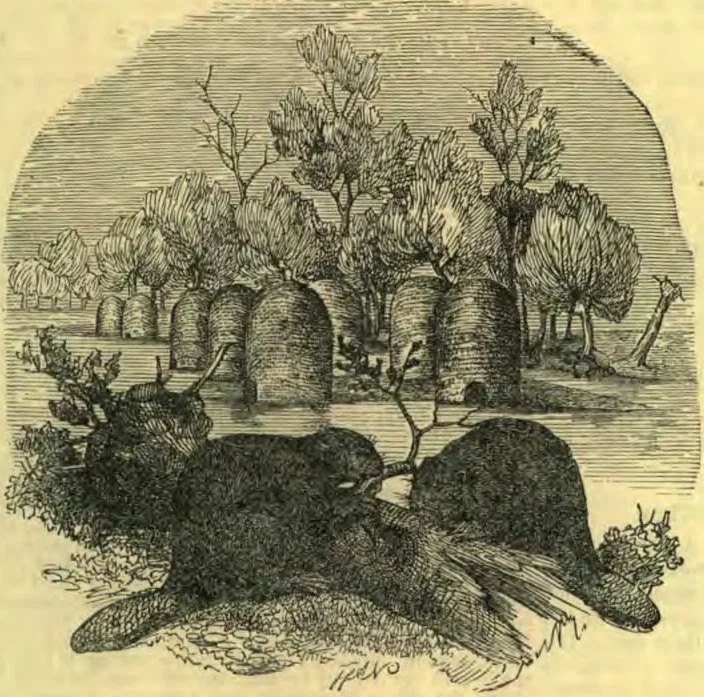
DID you ever think of the many trades carried on by animals? In our picture we see two of them at their work. How busy they are in gnawing the limbs and bark from that fallen tree! Let us take a look at them.
They are covered with reddish brown fur. Their eyes are small. The beavers cannot see very far, but their sense of smell is wonderfully acute. The first thing you would notice about a beaver, however, is his tail, which is broad and flat, nearly a foot long and half a foot wide, and covered with black, horny scales.
These beavers live together in little villages, such as you see in the picture. They choose for a building spot small, clear rivers or creeks, or the margin of a lake. They cannot travel on land very well, so they like to make sure of plenty of water. In order to do this, they set to work to build a dam across the stream. This is quite an undertaking for such small animals, yet they can build as good a dam as could be asked for. Now how do they go to work to do it?
Away up above the place of building, the beavers swim, and pick out a tree six or eight inches thick, and suited to their purpose. Then they gnaw, gnaw, through the tree, close to the roots, until it falls over into the water. Now it is floated down the stream to the place of building. Then the beavers heap stones around it to hold it in place, and paw up dirt and mud to chink in between the stones. They use their broad tails in pounding the mud in between the stones, and making the mason-work solid. Just think what a lot of logs and stones and mud it must take to build these dams; for they are usually ten feet broad at the bottom, and two feet at the top, and reach clear across the stream. The beavers are very industrious animals. Near these dams they build their houses, made of branches, moss, and mud. These huts are nearly three times as large on the outside as on the inside. The roof is covered with a thick coating of mud, laid on smoothly and evenly. In the winter time, this house freezes up so hard that it is difficult to break into it, even with iron tools.
The beaver always lays up, near the door of his house, a store of small logs for food. When he feels hungry, he dives down, and fetches out a log; and going to some sheltered spot, he nibbles off the bark, and floats the log down to the dam.
The beavers’ fur is quite valuable, and for this reason they are hunted by the trappers. Once there were many more beavers than now; they have been hunted so much for their fur that now they are somewhat scarce.
W. E. L.

THE BIRD'S LESSON.

“Try! try!” chirps mother bird to the little ones in the nest. “You can fly if you only try. Do as I do.”
So the birdies spread their weak little wings, and flutter and fall to the ground; but they try again and again, until they learn to mount up in the free air and fly far away.
“Try! try!” is what other mothers say too, and little children hear it in their homes, as well birds in their nests.
Try to be pure! Try to be loving! Try to be true!
Right thoughts and deeds are like wings that lift our lives higher. God, who gives the birds power to fly, gives far more to his dear little children—the power to rise to a good life, and to happiness here and hereafter.—Selected.

Nettie's Motto: Just for Christ's Sake

Very softly Nettie answered, “Living just as God wants us to, and being kind to everybody, just for Christ’s sake.”
The teacher’s eyes filled with tears at the words, “just for Christ’s sake,” and she tried to tell the girls how Nettie’s words revealed the whole meaning of the text. “And now, girls,” said she, “for some time we have been trying to find a motto for our class, something we can take with us wherever we go. How would you like to have Nettie’s words, ‘Just for Christ’s sake?’”
“But I don’t understand it,” said Ada Randall, “could we use that at home, or at school, or at any place we go to?”
And then Miss Wilmot enlisted the sympathy of six little hearts by telling them the beauty of doing unto others as you would have them do unto you; and even Lulu seemed to forget all about the pink sash and plain dress, as she whispered to Nettie, “Won’t it be nice if we all have the same motto?”
“Yes,” said the teacher, who had overheard the remark, “and you can find a dozen ways of using it every day. When mamma asks you to do something you don’t want to do, just think of the motto, and say, ‘I’ll do it just for Christ’s sake;’ or if you want to go to the park, or take a walk, or go to see a little friend, when mamma wants you to go to school, there you can use the motto again; so you see it can be used at any time or any place.”
Just then Nettie was taken to the library to select a book, and Miss Wilmot improved the opportunity by saying, “Girls, I would like you to begin using the motto this very afternoon by welcoming Nettie to our class; if you can’t do it for her sake, or for my sake, do it ‘just for Christ’s sake.’” And at the close of school, as the girls crowded around to kiss their teacher good-bye, Nettie was warmly welcomed by all; and all her timidity seemed to vanish when Ada Randall put both arms around her neck, and as she kissed her, whispered, “We’re all so glad Mr. Holt put you in our class; and we’re glad you thought about the motto, for we want to begin working right away, and we’ll do it ‘just for Christ’s sake.’”—Selected.

“JUST FOR CHRIST’S SAKE.”

“Miss Wilmot, have you room for another little girl?”
The speaker was Mr. Holt, the assistant superintendent of one of the largest Sabbath-schools in Philadelphia. Miss Wilmot was a teacher, with six little girls grouped around her. At the sound of Mr. Holt’s voice, she looked up, and with a pleasant, “Oh, yes, plenty of room, and plenty of welcome,” she moved aside, and made room for the timid little stranger. Miss Wilmot’s girls all loved their teacher very dearly, and she loved them; but when Nettie Stone took her place in the class, six little faces clouded over, and showed their disapproval as plainly as if they had said, “We don’t want another scholar; the class is large enough.”
To be sure, there was quite a contrast between Nettie’s plain chintz dress and brown straw hat, and the fine embroidery and feathers and ribbons worn by the others; and a pained look came across the teacher’s face, as she saw Lulu Lyster move down, and draw her pretty sash closer to her, as if afraid to have it come in contact with Nettie’s plain dress.
The “Golden Text” for the day was: “Be ye doers of the word, and not hearers only.” After the girls had repeated it to Miss Wilmot, she asked, “Now will you tell me what it means?”
Bessie Ferris thought it meant “to be a foreign missionary, and tell heathen people about Jesus.” Lettie Shaw thought it also meant “to hunt up poor children, and bring them to Sabbath-school.” Each one expressed her opinion as to its meaning, and then, turning to the new scholar, Miss Wilmot asked, “Nettie, what do you think it means?”

The Happy Action of Doing Good

Doing good is the only certainly happy action of one's life.—Sir P. Sidney.

You have reached the end of this edition.

The Youth’s Instructor · Aug 26, 1885