Some years ago I was living in the house of a widow lady, whose lodgers for the most part boarded themselves, or else ate at a restaurant. One of these was a most unfortunate semi-invalid, who won my sympathy by her pitiful condition,—partially deaf, slightly crippled, wholly blind in one eye, and nearly so in the other. She was homeless and well-nigh friendless; for people wearied of her complaints; and, like many another solitary woman with time all her own, she gave it and her company rather more freely than was always convenient to those whose business was more pressing.
On the particular Sabbath morning of which I write she came into my room immediately after breakfast. I then was engaged in canvassing, and hence the hours of my one rest day were exceedingly precious to me; and I am afraid I had scant welcome to give my poor visitor, tho I strove to be kind and polite, notwithstanding.
We spoke of various topics, more or less suited to the day, but she did not manifest much interest in them. Still it was late church time before she left; and when I returned from meeting, somewhat to my surprise, and a little to my annoyance, I found her awaiting my return.
Feeling perplexed, I unlocked my door, and reluctantly asked her in; for, fancying that she might be in distress or difficulty, and needing advice or craving sympathy, I wanted, in any case, to do by her as I under similar circumstances would wish to be done by.
She sat perfectly noncommittal till the hour for dinner arrived, which, at my invitation, she shared, I having by this time made up my mind that the Lord’s hand was in it.10
So, receiving the interruption as part of his plan for that day, I strove to turn the conversation to his glory, tho without results of any kind, as far as I could discover. After sundown, as she still lingered, I took her out for a walk, as I thought the exercise would be beneficial.
It was 9 o’clock when we returned, and, to my astonishment, she followed me uninvited into my room, and helped herself to a seat. I then laid my hand on her shoulder, and said quietly:—
“What is it? Can I help you in any way?”
“Nothing—not at all,” she replied briefly. “I just thought I would sit with you till bedtime, if you don’t object.”
“It is nearly that now,” I answered frankly, “and you know that I have to keep early hours at night as well as in the morning. But you needn’t go quite yet, unless you wish to,” I added, relenting, on seeing how reluctantly she rose to take her leave.
Instantly she sat down again; and we talked in desultory fashion till the clock struck 10. I then said to her gently:—
“Now, dear, I am afraid I shall have to retire.”
She rose promptly, when an unaccountable impulse made me inquire:—
“You will, also, won’t you?”
“No; I shall sit on the porch till it grows cooler.”
Again I was impelled to speak, and this time to authoritatively say:—
“Don’t do that. Go to bed at once.”
She hesitated, and then going to the open door, said hurriedly:—
“Good-night.”
As I watched her turn away, an inexplicable wave of commingled pity and apprehension seemed to surge up in my heart, and instinctively I put my arms around her, and, kissing her tenderly, said kindly:—
“If you love me, go to bed at once.”
At this she gave an inarticulate cry, returned my kiss impulsively, and hurried off without a word.
But I heard her go to her room, and felt a sense of relief, tho I knew not why.
Bright and early the next morning, just as I was starting out, back came Miss A. At first I was annoyed; for, I reasoned to myself, she knows my occupation, and that I am dependent on it for a livelihood. But presently, accepting the situation, I tried to make the best of it, and, sitting down, took my Bible and began to read to her, as I often did, as elsewise she would have had nothing of God’s word.
She listened in absent-minded fashion; we read and talked till noon, when she again dined with me, and spent the whole afternoon and evening. The late summer night fell, and bedtime once more came; but I dared not send her away; for I felt that something was at stake, tho what I little dreamed.
Not until 11 o’clock did she make any move to go. Then she came, and very solemnly taking my face between her two hands, gravely kissed me, first on one cheek and then on the other, saying earnestly as she did so:—
“You don’t know how I thank you for the kindness of these two days. I am going to bed now. You don’t understand it, I know, but you will some day. I will tell you all about it—some day.”
Not until several months later did the explanation come. I then learned, to my horror, that she had fully determined upon suicide as her only way of escape from a painful combination of circumstances, and having received small kindnesses from me in the past, thought that she would like to spend her last day in my company.
Her intention had been that first night, as soon as the streets were clear and all quiet, to go to the river and throw herself in from the bridge near by. But on my urging her so affectionately to retire, her purpose altered, and she put it off one day longer, fearing lest I might think that she did not care for me if she failed to comply with my request.
She then decided to leave the house the next day during my absence, and wander around till time to make the fatal plunge. But, imagining me to be the only person in the place who cared for her, she again wanted to take a last look at me—with what result the reader knows. Our Scripture reading turned her thoughts in an entirely different channel, and inspired her with hope and courage to live, instead of cowardly putting an end to her existence. So she permanently gave up her plan, and tried to trust in the Lord, whom she once had known and served.
Friends, let us never be ashamed of manifesting our affection for one another. Love is the salt of life, which keeps this great, seething world from absolute corruption. Love—Christ’s wondrous love—saves the sinner, and by exercising Christlike love we, too, may win forlorn humanity to nobler deeds and happier ways. And the more we learn to hate sin, yet love the sinner, the more godlike we become.
Friends, it is blessed to rest quietly in the hands of the Master, ready to be used by him, when, where, and as he pleases, for the glory of our Father in heaven.
DANIEL'S PROPHECY.
By W. L. Iles
BY W. L. ILES.
Great World Empires.
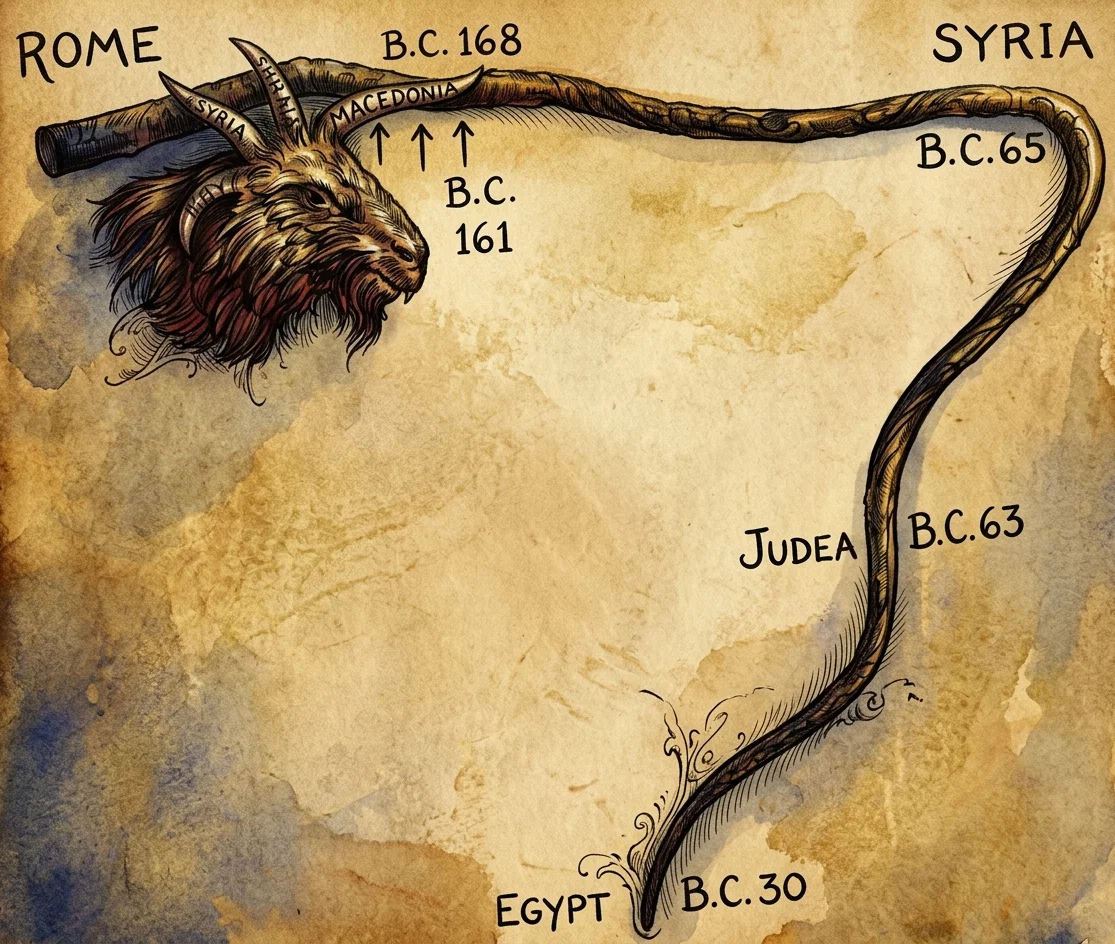
THERE is a most remarkable line of prophecy found in the eighth chapter of the book of Daniel. The all-wise God has declared “the end from the beginning” (Isa. 46:10), and here, in the eighth chapter of Daniel, the world's history is foretold by means of symbols.
Daniel was at Shushan in the palace when God gave him this vision. Dan. 8:2. He thus states the matter: “Then I lifted up mine eyes, and saw, and, behold, there stood before the river a ram which had two horns; and the two horns were high; but one was higher than the other, and the higher came up last.”
In verses 15 and 16 the angel Gabriel, who “stands in the presence of God” (Luke 1:19), was commissioned to make Daniel understand the vision. We do not need, therefore, to accept of man's interpretation, but listen to the words of the angel: “The ram which thou sawest having two horns are the kings of Media and Persia.” Dan. 8:20. The Medo-Persian Kingdom existed from B.C. 538 to B.C. 331. This kingdom was composed of two nationalities, the Medes and the Persians, symbolized by the two horns. One of the horns preceded the other; and so the Medes first ruled in the kingdom, and then the Persians. The latter horn was higher, and the Persians were the stronger element.
The ram (Medo-Persia) was seen “pushing westward, and northward, and southward.” Verse 4.
The Persians extended their conquests to the west, to the north, and to the south, conquering all held by Babylonia. Daniel continues:—
“And as I was considering, behold, a he goat came from the west on the face of the whole earth, and touched not the ground; and the goat had a notable horn between his eyes.” Verse 5.
What is the meaning of this symbol? The angel answers, “And the rough goat is the king of Grecia.” Verse 21. The goat had a “notable horn between his eyes,” and the angel continues, saying, “and the great horn that is between his eyes is the first king.” Grecia, under Alexander the Great, overthrew the Medo-Persian power in B.C. 331, and thus became a universal kingdom. The first king, represented by the “notable horn,” was Alexander the Great, who, in eight years, conquered the world, and wept that there were not other worlds to conquer.
The Conflict.
The battle which took place between the Grecians, symbolized by the goat, and the Medo-Persians, by the ram, is well represented in this prophecy.
“And he [the goat, or Grecia] came to the ram [Medo-Persia] that had two horns, which I had seen standing before the river, and ran unto him in the fury of his power. And I saw him [Grecia] come close unto the ram [Medo-Persia], and he [Grecia] was moved with choler against him [Medo-Persia], and smote the ram [Medo-Persia], and brake his two horns; and there was no power in the ram [Medo-Persia] to stand before him [Grecia], but he [Grecia] cast him [Medo-Persia] down to the ground, and stamped upon him [Medo-Persia]; and there was none that could deliver the ram [Medo-Persia] out of his [Grecia's] hand. Therefore the he goat [Grecia] waxed very great; and when he was strong, the great horn [Alexander the Great] was broken [Alexander died]; and for it came up four notable ones toward the four winds of heaven.”
The Grecian army, under Alexander, completely overthrew the kingdom of Medo-Persia at the battle of Arbela, as history records. The kingdom of Grecia became strong with Alexander at its head, but, after his death, the kingdom of Grecia was divided into four divisions. Let the angel Gabriel tell us what the four horns, which came up in the place of the great one, which was broken, represent.
“Now that being broken, whereas four stood up for it, four kingdoms shall stand up out of the nation, but not in his [Alexander's] power.” Verse 22.
After the death of Alexander, his four leading generals, Casander, Lysimachus, Seleucus, and Ptolemy, divided the Grecian Empire between themselves. These divisions were known as Macedonia, Thrace, Syria, and Egypt.
The vision of Daniel continues: “And out of one of them [the horns, or kingdoms into which Grecia was divided] came forth a little horn, which waxed exceeding great, toward the south [Egypt], and toward the east [Syria], and toward the pleasant land [Palestine].” Verse 9.
This important prophecy will be considered further in our next number.
Profession and Practice
“THERE is something wrong with the man who talks like a saint in prayer-meeting and then goes home and scolds his wife.”
A Minister’s Pride in Learning
“It never does a minister much good for the impression to get out that he is proud of his learning.”
THE BABY.
By Mrs. A. P. Jarvis
BY MRS. A. P. JARVIS.
Grasping at sunbeams and shadows,
Hands outstretched for the moon;
Heeding not snows of December,
Heeding not roses of June;
Clutching at all things illusive,
Sobbing when shadows they prove;
Hushed in the arms of its mother,
Soothed by caresses of love.
Laughing, and cooing, and crying,
Sweet as the heart of the rose;
Trembling all over with mischief,
From its head to its chubby wee toes;
Filling our hearts with new sunshine,
Cheering our wearisome way;
Teaching us that the dark shadows
Conceal the sun’s beautiful ray.
Blessing of heaven the dearest,
Our hearts by thy smile are made glad;
The touch of thy soft, dimpled fingers
Has made us forget to be sad.
In thy smile we are basking in sunshine,
Thy prattle all gloom has beguiled;
There’s nothing that’s nearer to heaven
Than the innocent heart of a child.
—The Housekeeper.
THE BACK YARD EXAMINED
By John Harvey Kellogg
A BACK YARD EXAMINED
BY J. H. KELLOGG, M.D.
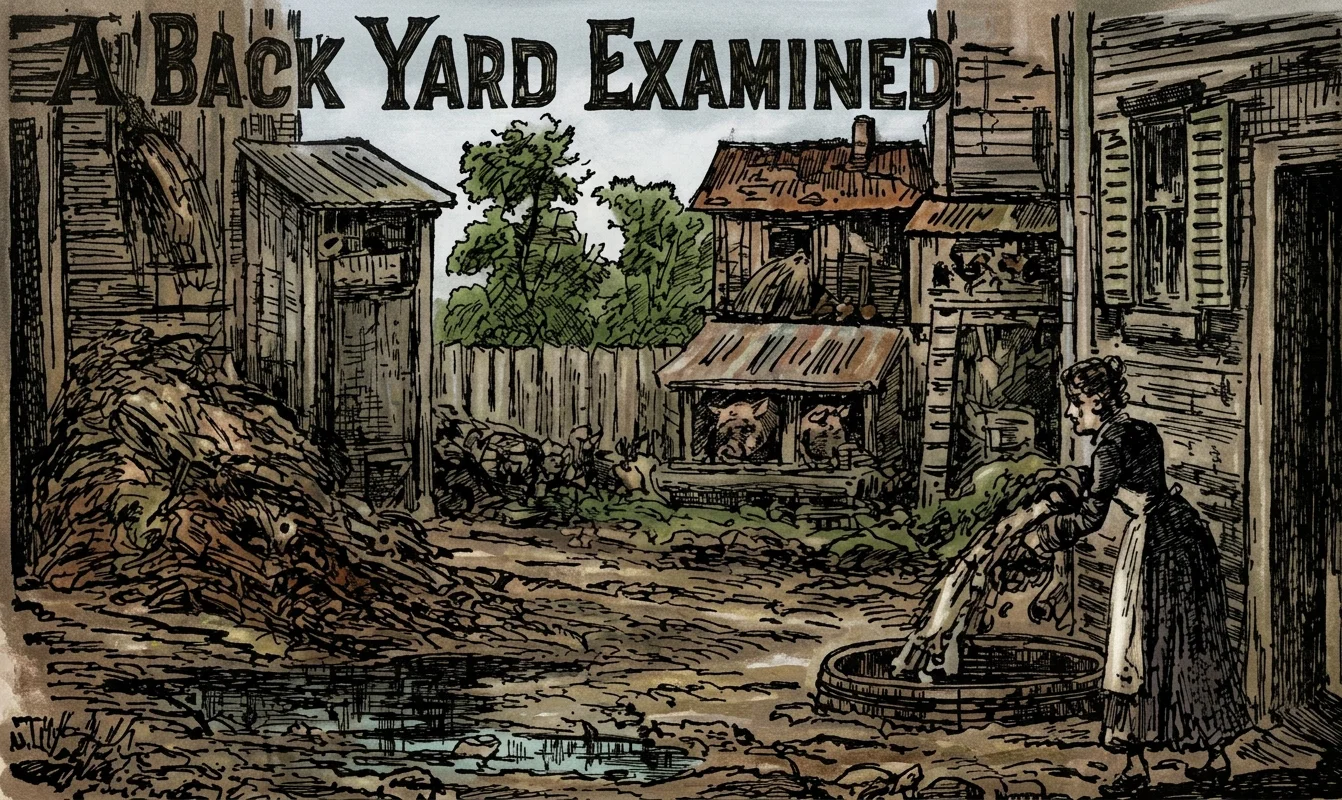
The front yard of the average house is likely to be orderly, cleanly, and not obnoxious to either good taste or good sanitation. Graveled walks, a smoothly cut lawn, a few elegant shrubs and evergreens, all suggest the highest degree of neatness and good taste. Let us step around to the back yard. What a contrast! Close by the door stands a garbage barrel, which testifies to at least two of the senses that its history goes far back into the dim past. Once a week the milkman comes with a cart, and empties the unsavory receptacle, stirring to the bottom its reeking contents. (Let me whisper in parenthesis that some of the same comes back in tin cans and earthen jars. Swill milk is not an unknown article, even in rural districts, where hay and grain bring a good price.) At all hours of the day and night this half-rotten receptacle of decomposing organic matter sends out upon the air its filthy emanations.
Near by is a brown-looking spot of earth, over which are eagerly crawling myriads of the first insects of the season, and from which ascends a noxious vapor, visible in the cool morning air, but not difficult to discover if not visible by its pungent, nauseating odor. This, the gardener explains, is the dumping place for the dish-pan and the wash-tub since the drain-pipe became clogged, a few months ago. Frozen up during the winter, it was annoying only by its unsightly appearance, but now that the vernal sun has come, the accumulation of months sends forth a constant stream of noisome smells, which are too often experienced to need further description.
A rod or two from the house we notice a little depression in the ground. This, we learn, is the location of the cesspool. The boards which once formed its roof have rotted away and allowed the overlying earth to drop into the receptacle beneath, which originally consisted of a bottomless box or barrel, half filled with stones, and connected with the kitchen sink by means of a long wooden box. The wood has now nearly disappeared, a few rotten fragments only remaining. Out of this putrescent hole rises a stench which finds no counterpart elsewhere than in a similar contrivance for domestic poisoning.
A few feet distant is an edifice which we are at a loss to know how to describe. A correspondent was in the same predicament when he sent us a clipping for publication which he said was “rescued from the place consigned to infamy.” The edifice referred to probably ought to have been consigned to infamy, if it had not been, and the same should be said of most others of the same class. Though carefully guarded from observation by a close lattice, covered by clambering vines, its presence is easily detected, and that without close proximity. How often, as we walk along the streets at night, does the air, which heaven sends us pure, sweet, and potent with life-giving energies, come laden with poisonous exhalations from dozens of such sources, and freighted with the agencies of death! The vault of an out-house often becomes a much more dangerous enemy to human life than a powder magazine or a nitro-glycerine factory; yet the latter are by law required to be located far apart from human habitations, while the former is tolerated in the closest proximity to human dwellings, often even under the same roof with human beings.
Death in the Well.—In the midst of all these sources of the most dangerous filth is located the well, from which is to be daily drawn one of the most essential of the necessaries of life. Is it any wonder that the cup of life is often transformed into the cup of death? Only think of the conditions of a family with death enthroned in the well, and daily dealing out his poisonous draughts to its members! The mysterious Providence which deprives a family of its loved ones through the agency of typhoid fever, may, in the majority of instances, be proved to be a mysterious connection between the well and a privy vault or cesspool.
A settler in a new country generally digs two holes in the ground after erecting his humble cottage. Into one goes all the filth, offal, and slops; out of the other comes all the water for family use. These holes are usually so near together that the contents mingle, so that what goes into one comes out of the other. In an old settled country, a man in making a home digs two or three holes for filth and one for water, so that the latter is often surrounded by the former. As most of the water from the wells is returned to the holes for the reception of filth, a very large share of it may find its way back to its original source.
At no great distance we may find a stable, with its filthy accumulations, which are drenched at every rain, and contaminate the soil for many feet around, and to an unknown depth. Here is another probable contributor to the water supply. We have seen scores of wells located in the barn-yard, so as to be convenient for watering the stock, but used for culinary purposes as well, if not in any other way, in the form of milk, beef, pork, or mutton.
Some one may imagine that this picture is highly colored; but the experienced sanitarian will certainly say we have not told half the truth.
Virginia Bans Liquor Sales to Students
Virginia has just enacted a law prohibiting the sale of liquor to students, no matter what age. The penalty is not more than $300 nor less than $25.—Pacific Ensign.
Couldn’t Carry Coal Upstairs
“He could box and run and kick the ball
With fine athletic airs;
But he couldn’t heed the family call
To carry coal upstairs.”
GLEANINGS FROM SOUTH AMERICA.
By John M’Carthy
BY JOHN M’CARTHY.
In these days of “advanced theological views,” we hear much talk about the “liberty” of the Church of Rome, and the wisdom of seeking shelter beneath the covert of her ecclesiastical wings. Those who reside in Protestant countries, we assert without fear of contradiction, know nothing of the “inner workings” of Romanism. The writer can well remember, only six years ago, during “holy week,” a great Roman Catholic procession, composed of the archbishop, different other prelates, priests, and orders of the Catholic Church. A great cross and a large image of the virgin Mary preceded the “host,” or body of Christ. As soon as the archbishop sounded a gong, some thousands of people knelt down in the streets (as in the plain of Dura) to worship the “wafer god” as it passed. Some few there were, however, who absolutely refused to bow the knee to Baal. But a zealous policeman, anxious (as our Maryland and Tennessee friends are) to make the people religious by law, went up to a small group of Englishmen and knocked off their hats. They promptly resented this Dark Ages method of enforcing obedience, and things were made somewhat uncomfortable for the policeman.
Some people maintain that the days of papal tyranny are now in the past, but permit me to inform them that they occur but too frequently for the comfort of dissentients, as some thousands can testify. Go to Sucre, Callao, La Paz, Lima, Quito, and other cities throughout Ecuador, Peru, and Bolivia, where people are imprisoned for even purchasing the word of God. One friend of ours, a faithful servant of God, was cast into prison (a former pigsty) for nine months, being reckoned as a criminal of deeper dye than murderers or thieves, because he was guilty of the outrageous crime(!) of selling Bibles in Peru. If it had not been for the diplomatic intervention of England and the United States, he undoubtedly would have met with the fate of his Bibles, namely, that of being publicly burned. Truly “Rome never changes.” That diabolical spirit of tyrannical ages still burns within her bosom; and now and again (as in the case of a volcano) there is an eruption, and the “heretics” fall victims to her revengeful enmity.
Only three months ago, in a city of Ecuador, a colporter’s Bibles were sequestrated, and, pending the judgment of the bishop, who is also minister of state, he ordered the books to be publicly burned as indecent literature. Not content with this punishment of the “heretic,” one of the leading priests led on a rabble, “to lovingly chastise” the erring one who had dared to beard the lion in his den. Of course when the more liberal papers stood up for tolerance and condemned this action, it was urged that the priest had acted in his judicial capacity—being also a judge—and only desired “to correct” disturbers of the peace. Thus it is that Rome deceives the unwary. But any person with but an ordinary faculty for reasoning can see that the one object of papal prelates in seeking these high governmental offices is to severely punish all who dare dissent from Roman Catholic dogmas, and then boldly aver that such punishment was inflicted by the “civil authorities” upon disturbers of the peace. Yet there are thousands of so-called Protestants who are blinded by the dust of Rome, and forget the past black records of the Catholic Church. They solace themselves with the thought that “Rome is more liberal now than ever before.” How false the hope, and how false the foundation of such hope!
Let us come a little nearer home to demonstrate the intolerance of the Papal Church. The Methodists of the different conferences here have petitioned the governments to exempt their young students now studying in their colleges and theological seminaries from military service. This privilege has long been granted to the Catholic Church. But as soon as it came to the ears of Rome that the Methodists claimed equal rights with them, a most bitter article appeared in La voz de la Iglesia, the organ of the Catholic archbishop, which said, among the other harsh things, that it was greatly surprised at the imprudence of Protestants claiming equal privileges with them (the Catholics) in Roman Catholic countries. Of course this aroused the Methodists, who, in a well-written article in the Estandarte, reminded the archbishop of the pope’s last encyclical letter, which urges the Catholics to treat the Protestants as brethren, and not as enemies. This is causing a great deal of discussion; but it will have but one result long foreseen, namely, that Rome will carry her point.
Let us return to Peru. That country is looked upon as a model daughter of the Church of Rome, being held up as exemplary and worthy of imitation. In this delightful republic no marriage is recognized as legal unless contracted according to the canons of the Council of Trent, by the “Holy Catholic Church.” This means to indicate that if one is married by a Protestant minister, the marriage is not only invalid, but that such an one would be unable to claim any property that might be forthcoming, because he is unable to produce the legal marriage certificate. To obtain such a certificate one is first required to go to the auricular confession, do whatever penance is appointed, and then pay an enormous sum to the priest for the legalization of the marriage through the required ecclesiastical ceremony. This is but another specimen of Romish intolerance.
In Costa Rica, where the priests are looked upon as gods, 200 men, armed with stones and sticks, headed by the priest, caused a great disorder, threatening to burn a Protestant mission house, while the missionaries were pleading for their lives. Eventually the missionaries were compelled to flee to the capital.
In Temuco, Chile, a Protestant chapel was attacked by the fanatical members of a Catholic Circle, who broke all the windows and lamps, while the service was being held.
In the Argentine House of Congress a bill has been passed augmenting the salary of the archbishop from $600 to $1,000 per month. The bishops in partibus, that is to say, of the dioceses of Asia, instead of $150, now receive $200 per mensem. Also, the $5,000 which has been formerly given annually for the construction of churches, has been augmented just recently to $10,000. It appears from the discussion of the municipal proposition, that it is proposed to give $67,000 to different sisterhoods of the Catholic Church.
Thus we see that Rome is advancing on every hand. Theologians, and others of the optimistic turn of mind, declare that Adventists are too pessimistic, and are always in search of the unlucky star in the social horizon; but we need scarcely say that such is quite void of truth. The more one studies the prophecies from the standpoint of advance truth, the more resplendent is the light which enables us fully to grasp the fact that every word of God is true. Despite man’s assertions to the contrary, the prophecies must be fulfilled, to the upheaval of man-devised theories and vain philosophies. All the world will yet worship the beast, except those whose names are written in the Lamb’s book of life. Altho Protestants declare that Protestantism is gaining ground, we must take our stand upon the immutable word. That and that alone can pilot us through the creeds of creedism, formalism, and dogmatism, into the ocean of truth. Let us beware of compromising principle, and seek not unity with men, but unity with Christ.12Then we shall have no difficulty in knowing what is right, neither shall we lack the courage to step out upon the promises of God.
Buenos Ayres.
THE STORM OF LIFE.
By M. M. M.
BY M. M. M.
Darkness broods over the waters,
So turbid, dark, and deep;
And the clouds are hurrying fast,
As tho in haste to keep
Pace with the waves, which leap and dash
High and yet higher still,
Lashed and torn and lashed again
By the wind at its will.
And my frail bark is tossed and driven,
By the fierce wind and tide,
Helplessly hither and thither
Over the waters wide.
Long, with weak and fal'ring hands,
I've tried to guide my bark
Into a fairer, calmer sea;
But it has grown so dark.
Not a ray of light to guide my way,
Not even one stray gleam,
Only the lightning's fitful flash,
Which makes it darker seem.
And now I hear the breakers roar
A little way ahead,
Which fills my sad and fainting heart
With nameless fear and dread.
No friendly hand stretched out to help
Now, in my sore distress;
Alone I struggle 'gainst the tide,
In pain and weariness.
'Tis the tide of sin, stronger far
Than waves on a storm-tossed sea,
With relentless determination,
Seems fast o'erwhelming me.
Tho in my weakness I have tried,
Again and yet again,
Back the treacherous waves to beat,
I find 'tis all in vain.
Recoiling they return again,
Thrice stronger than before;
My strength and courage are all gone;
I must give the battle o'er;
For I feel I am weakly sinking
Beneath the murky foam.
'Tis useless longer to struggle
Against such odds alone.
Then, 'midst the raging of the storm,
Above the ceaseless din,
Come the words so well remembered
Of a sweet olden hymn.
Repeating it over wearily,
In anguish and despair,
Then o'er again more earnestly,
It is at last a prayer.
No prayer more fitting there could be:
O "Lover of my soul,"
It is my last and only hope,
While billows near me roll.
“While the tempest still is high,” Lord,
“Hide me till the storm is past,”
Then “safe into the haven guide,
“O receive my soul at last!”
And now the Lord doth hear my cry,
And doth no longer wait.
I have learned to know my weakness,
And my need is great.
Ah, see! the cloud is lifting now,
A light shines o'er the main;
I now can see where I must go;
The way is made so plain.
I could not find the way alone;
For a narrow space is seen
Where I must pass, to gain the shore,
Whirlpools and rocks between.
The waves may thunder, rage, and leap,
They can not now o'erwhelm;
For I trust in my Redeemer,
His hand is at the helm.
For my drenched and soiled garments,
He gives a robe so clean,
'Tis the robe of his righteousness,
Of pure and spotless sheen.