The Youth’s Instructor, Vol. 50, No. 1.

The King of the Storm
Earlier text: The King of the Storm

Peace, Be Still: Faith Amid the Tempest

Master that can still the tempest that rages within the fallen nature of man. However fierce may be the struggle of the tempest-tossed soul, if he will but turn to Jesus, and cry, “Lord, save!” he will not be disappointed. Jesus arose, and after alluding to their unbelief, he rebuked— his disciples? — No; he rebuked the winds. Another lesson of God’s long-suffering and loving-kindness, even with the unbelief of his doubting children. He had compassion on them. “If any of you lack wisdom, let him ask of God, that giveth to all men liberally, and upbraideth not.” James 1:5.
Peace, Be Still.— The soul that has perfect faith is absolutely free from worry. “Perfect love casteth out fear.” Christ’s mind was in perfect harmony with that of his Father. His faith was complete; and so the humble, praying soul who exercises “the faith of Jesus” is one who can, like him, sleep peacefully when the angry billows dash high, and the winds blow fiercely.
There Was a Great Calm.— In our personal experience, when everything is raging, and all is like a tempest within, what a help it would be if we could only remember that we may come to the Master just then, and say, “Lord, save, or I perish.” All our doubts, troubles, and perplexities should be brought to him. If he appears to be asleep, let us wake him. His ear is not deaf, that he can not hear, nor his hand shortened, that he can not save. It is our faith which sleeps, not the world’s Redeemer.
To behold the waters become so quiet immediately following the Master’s words, was certainly a new experience to his fishermen-disciples, as well as to those who accompanied them on the voyage. Usually it required some time for the sea to calm down after being in such a rage. To-day the Master is able to speak the word that will soothe the raging tempest within the soul, and make the ruffled temper as smooth as the sea of glass.
Why Are Ye So Fearful?— Oftentimes God does a greater thing for us in sustaining and upholding us in the time of our trial and affliction than if he immediately delivered us by his mighty hand from the difficulties and sorrows that constitute our trial. The disciples, in fear for their safety, and in questioning the Master as to whether he cared if they perished, evidenced the shallowness of their faith in the divinity of Christ. Could he who was God, the Creator, forget his children? — Never! How kind and considerate was the Master, that he did not sternly rebuke the disciples for their words of doubt and unbelief in asking, “Carest thou not that we perish?” His rebuke of their unbelief was conveyed in the simple question: “Why are ye so fearful? how is it that ye have no faith?” Then, without further upbraiding, he rebuked the winds and waves, and ushered in the miraculous calm. W. S. SADLER.

THE PARABLE OF THE PARSONAGE

THE parsonage is an old-fashioned house, with a cupola above, and a roof sloping down on four sides to a wide gutter. When we have a heavy fall of snow, the water from the roof above, melting and running down, soaks the snow in the gutters on the side where the rain-pipes are, and would cause the water to back up under the shingles if it were not attended to promptly. So, just at the stage when melting begins, I ascend to the cupola with forty feet of rope and a boy,—the parsonage family is rich in boys. I make the rope fast under the arms of one of them, put him out of the cupola window, and have him chop away the ice and snow from the gutters. It is a merry task for the boy, and a time of rather thoughtful vigilance for his father.
Even so, and at the end of a longer line, God has let me down into the perilous responsibilities of life, with slippery places about me, and sheer descents which wait upon a false step or disobedient act. I am not here at my own behest; God has let me down, and he will help me up again. But I may not cast all responsibility upon him. I must see to my own footing, and calculate the risks which I assume. But he is holding the rope.—Selected.

THE GREAT SUPPER

(January 11)
(January 11)
16. Then said he unto him, A certain man made a great supper, and bade many:
17. And sent his servant at supper time to say to them that were bidden, Come; for all things are now ready.
18. And they all with one consent began to make excuse. The first said unto him, I have bought a piece of ground, and I must needs go and see it: I pray thee have me excused.
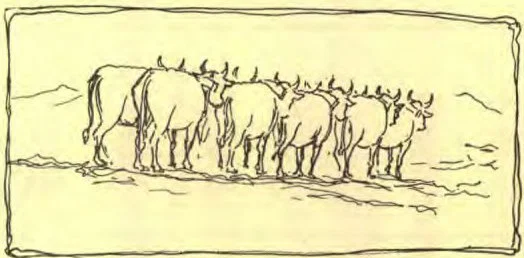
19. And another said, I have bought five yoke of oxen, and I go to prove them: I pray thee have me excused.
20. And another said, I have married a wife, and therefore I can not come. Mark 14.

Questions

1. To whom did Christ speak the parable of the Great Supper? What had this man just said?
2. Who made the supper?
3. What kind of supper was it?
4. How large a number were bidden?
5. At supper time to whom did he send his servants?
6. What were they to say to them who had been bidden?
7. How was the invitation received?
8. What excuse did the first offer?
9. Instead of coming to the supper then, what had this first man in mind to do?
10. What excuse did another man offer?
11. Although he had already bought the oxen, yet what did he plan to do?
12. What excuse was offered by a third man?
13. What, therefore, did he say that he could not do?
14. Could this man have come? What then did he mean by “I can not”? Please read the first quotation.
15. What is represented by the “Great Supper”? Rev. 19:9. Please read the second quotation.
16. In the parable what things absorbed the attention of the invited guests so that they would not come?
17. How is it in the days of the coming of the Son of man? Luke 17:26–28.

Quotations on the Lesson

1. “None of the excuses were founded on a real necessity. The man who ‘must needs go and see’ his piece of ground, had already purchased it. His haste to go and see it was due to the fact that his interest was absorbed in his purchase. The oxen, too, had been bought. The proving of them was only to satisfy the interest of the buyer. The third excuse had no more semblance of reason. The fact that the intended guest had married a wife need not have prevented his presence at the feast. His wife also would have been made welcome. But he had his own plans for enjoyment, and these seemed to him more desirable than the feast he had promised to attend. He had learned to find pleasure in other society than that of the host. He did not ask to be excused, made not even a pretense of courtesy in his refusal. The ‘I can not’ was only a veil for the truth,—‘I do not care to come.’” —“Christ’s Object Lessons,” page 222.
2. “By the great supper, Christ represents the blessings offered through the gospel. The provision is nothing less than Christ himself. He is the bread that comes down from heaven; and from him the streams of salvation flow. The Lord’s messengers had proclaimed to the Jews the advent of the Saviour; they had pointed to Christ as ‘the Lamb of God, which taketh away the sin of the world.’ In the feast he had provided, God offered to them the greatest gift that Heaven can bestow,—a gift that is beyond computation.” —Id., pages 222, 223.
In “Early Writings,” page 15, is given a description of the Lord’s supper table spread for his people.

THE HIDDEN HEART

THE heart-shaped wedge of iron, which was to form part of the new machinery, had been carried away almost red hot from the furnace,—stolen by those opposed to the new invention, and buried in the ground. Search was made at once, but snow had fallen, and all trace of the hiding-place was lost. But the hot iron warmed the earth above it, and melted the snow; and when morning came, there was an odd little patch of bare ground that told its own story to observant eyes.
“Did they really suppose they could hide that red-hot heart under snow, and have it stay hid?” said a foundryman, as the wedge was dug out.
And yet so often we are gravely told of the warm heart hidden under an icy exterior, of the affection, tenderness, and general kind-heartedness, that never manifest themselves in words or deeds. Forms of expression may vary, but some expression there must be; love can not exist, and throw no warmth round it. The heart that is aglow with tenderness and sympathy for others will send some sign to the surface. If it never does, we need not flatter ourselves that we are “really warm hearted under a cold exterior.” If the inner warmth does not thaw its way outward, the outer cold freezes its way inward.—Well-Spring.

Our Peerless Red-Letter Combination Offer.

If you are a subscriber to GOOD HEALTH, and desire to avail yourself of any of these offers, you may send GOOD HEALTH to a friend. All magazines sent to one or different addresses.

Red-Letter Offer No. 1.

Magazine Term Regular Price
Review and Herald, one year, $1 50
Signs of the Times, “ 1 50
Youth’s Instructor (new) “ 75
Advocate of Christian Education, “ 50
Missionary Magazine, “ 50
Sentinel of Christian Liberty “ 1 00
GOOD HEALTH, “ 1 00
Total $6 75
Our Red-Letter Price: $5.10

Red-Letter Offer No. 2.

Magazine Regular Price
Review and Herald, one year, $1 50
GOOD HEALTH, “ 1 00
Worth $2 50
Our Red-Letter Price: $2.00

Red-Letter Offer No. 3.

Magazine Regular Price
Signs of the Times, one year, $1 50
GOOD HEALTH, “ 1 00
$2 50
Our Red-Letter Price: $1.75

Red-Letter Talk for Offer No. 4.

Do not forget to subscribe for Good Health and the Advocate of Christian Education, the strongest health and educational reform journals published. GOOD HEALTH stands for advanced reform in diet, rational methods in the treatment of disease, social purity, temperance, dress, etc.

Red-Letter Offer No. 4.

Note the remarkably low price of 85c for both for one year. Regular price $1 50. Those who have been accustomed to receive the Advocate of Christian Education and the Sabbath School Worker will note that the two journals have been combined, and make a much larger magazine than either of the former journals.
Magazine Term Price
Advocate of Christian Education, one year $ .50
GOOD HEALTH, one year 1 00
$1 50
Our Red-Letter Price only 85c.
THE ADVOCATE OF CHRISTIAN EDUCATION, now combined with the Sabbath School Worker, stands for reform in education; in the home school, church school, State school, college, and Sabbath school.
Ministers, Sabbath-school superintendents, Sabbath-school teachers, Sabbath-school scholars, and parents, ALL should be readers of Good Health and the Advocate of Christian Education, as you will need both, especially for the advancement of your medical missionary and Sabbath-school work during the next year.

Red-Letter Offer No. 5.

Magazine Regular Price
Youth’s Instructor, (New subscriptions only) $ .75
GOOD HEALTH, 1 00
$1 75
Our Red-Letter Price: $1.00

Red-Letter Offer No. 6.

Magazine Regular Price
Sentinel of Christian Liberty, $1 00
GOOD HEALTH, 1 00
$2 00
Our Red-Letter Price: $1.10

Red-Letter Offer No. 7.

For additional combinations see over.
Magazine Regular Price
Missionary Magazine, $ .50
GOOD HEALTH, 1 00
$1 50
Our Red-Letter Price: 90c.
For additional combinations see over.
Order from GOOD HEALTH PUB. CO., Battle Creek, Mich.; REVIEW AND HERALD PUB. CO., Battle Creek, Mich., PACIFIC PRESS PUB. CO., Oakland, Cal.; or from your Tract Society.

Additional Red-Letter Offers.

Regular Price Our Special Price
GOOD HEALTH, Review and Herald, Signs of the Times, Youth's Instructor (new), Advocate of Christian Education, Sentinel, and Missionary Magazine $6 75 $5 10
GOOD HEALTH, Review and Herald, Signs of the Times, Youth's Instructor (new), Advocate of Christian Education, and Missionary Magazine 5 75 4 50
GOOD HEALTH, Review and Herald, Signs of the Times, Youth's Instructor (new) and Missionary Magazine 5 25 4 15
GOOD HEALTH, Review and Herald, Signs of the Times, and Youth's Instructor (new) 4 75 3 75
“ “ “ “ “ and Missionary Magazine 4 50 3 65
“ “ “ “ “ and Advocate of Christian Education 4 50 3 60
“ “ “ “ “ and Sentinel 5 00 3 85
“ “ “ and Missionary Magazine 3 00 2 40
“ “ “ and Advocate of Christian Education 3 00 2 35
“ “ “ and Youth's Instructor (new) 3 25 2 50
“ “ “ and Signs of the Times 4 00 3 25
“ “ “ and Sentinel 3 50 2 60
“ Signs of the Times, and Advocate 3 00 2 10
“ “ “ and Youth's Instructor (new) 3 25 2 25
“ “ “ and Sentinel 3 50 2 35
“ “ “ and Missionary Magazine 3 00 2 15
“ Advocate of Christian Education, and Youth's Instructor (new) 2 25 1 35
“ “ “ “ and Missionary Magazine 2 00 1 25
“ “ “ “ and Sentinel 2 50 1 95
“ and Review and Herald 2 50 2 00
“ and Signs of the Times 2 50 1 75
“ and Advocate of Christian Education 1 50 85
“ and Missionary Magazine 1 50 90
“ and Youth's Instructor (new) 1 75 1 00
“ and Sentinel 2 00 1 10
“ and Life Boat (new) 1 25 65
Order from GOOD HEALTH PUB. CO., Battle Creek, Mich., REVIEW AND HERALD PUB. CO., Battle Creek, Mich., PACIFIC PRESS PUB. CO., Oakland, Cal., or from your Tract Society.

PLEASE USE THIS BLANK IN ORDERING

To ______________________________
CITY ______________________________
STATE ______________________________

MAGAZINE CLUB - ORDER BLANK

Inclosed find $____________ in full payment for subscriptions to GOOD HEALTH and other periodicals, as per offers on opposite side, to be mailed direct from the offices of the respective publishers to the following addresses: . . . . . . . . . . . .
The magazines will be sent to one or several addresses, if so desired
Mo. to Begin Name of Periodical Subscriber’s Name Post Office and Street Address State
In this space write only the name and address of the remitter, to whom a receipt for the money will be mailed
See the Complete List of Our Wonderful Clubbing Offers on Opposite Side

OUR MISSION FIELD

Jesus says, “Lift up your eyes, and look on the fields.” John 4: 35. Do you inquire where the fields are, that you may look on them? The answer given is: “The field is the world.” Matt. 13: 38.
Then to look on the field is to look on the world, and to look on the world is to look on the field. Any part of the world is some part of the field. The whole world is the entire field. When you look on a human being, you look on some of the field.
“God so loved the world, that he gave his only begotten Son, that whosoever believeth in him should not perish, but have everlasting life.” John 3: 16.
The apostle Paul’s eye was covering the entire field when he wrote, “I am debtor both to the Greeks, and to the barbarians; both to the wise, and to the unwise.” Rom. 1: 14. This takes in all men everywhere. John Wesley’s vision swept the field when he exclaimed, “The world is my parish.” And from Pisgah’s height Count Zinzendorf surveyed the field when he described the boundary lines of his missionary territory in these words: “The whole earth is the Lord’s; men’s souls are his; I am debtor to all.”
Now, more than at any other time in the history of the church, should the followers of Jesus realize that this whole lost world is their mission field. “God that made the world and all things therein, . . . hath made of one blood all nations of men for to dwell on all the face of the earth.” Acts 17: 24, 26.
Every nation in the world has the same divine origin. Every person alike is the offspring of God. He is the Father of all. His love encircles all. To him “there is no difference;” for he “is no respecter of persons; but in every nation he that feareth him, and worketh righteousness, is accepted with him.” Acts 10: 34, 35.
From this it is clear enough that “this gospel of the kingdom shall be preached in all the world, for a witness unto all nations.” Matt. 24: 14. From this we can understand why Jesus said, “Go ye into all the world, and preach the gospel to every creature.” Mark 16: 15.
Above all people, Seventh-day Adventists should possess breadth of vision and largeness of heart. To them is given great light, and solemn responsibilities. They must give to the world the last call to the supper. Luke 14: 16, 17. They must proclaim the “everlasting gospel . . . to every nation, and kindred, and tongue, and people, saying with a loud voice, Fear God, and give glory to him, for the hour of his judgment is come.” Rev. 14: 6, 7.
Seeing, then, that we have this mission, let us pray the Lord to open our eyes to the vastness of the field we are to occupy.
Next week we will look at some of the needs of the field. A. G. DANIELLS.

THE CHRISTIAN'S HEREDITY

PEOPLE hear a great deal nowadays about “heredity.” Children are told from babyhood that they have “mama’s eyes and hair,” “grandma’s smile,” “auntie’s dimples,” “grandpa’s forehead,” and so on. If a child learns easily, he is like some admired member of the family; a love for music is declared to be the gift of some musical genius, near or remote; and a special interest in his physiology lessons shows at once that he has fallen heir to his father’s skill as a surgeon. But that is not all. Very many children hear their outbursts of temper, their rudeness, their careless, thoughtless ways, their negligence, even their cruelty, excused because they “inherited” these undesirable traits from some ancestor.
Now while it is undoubtedly true that we do inherit from our ancestors certain traits of character, certain tendencies, certain gifts, let me tell you that that is not all the truth there is on this subject. If it were, no one would be really responsible for his acts. But God has put within every person’s grasp the power to rise above his heredity, to overcome his tendencies to evil, to govern his temper, to conquer himself.
But there is still more for the Christian; that is, he accepts more. He is “born again.” Wonderful experience! By this new birth he becomes an heir,—an heir of God, a joint heir with Jesus Christ, who, in spite of his earthly ancestry, lived a perfect life on earth. Think of the heredity of one who has this experience,—unselfishness, meekness, temperance, patience, wisdom, love, peace,—all the qualities that his Father has may be his!
Then of his acts it might truthfully be said: “Oh, it is natural for him to do that way! He was born so. His Father is faithful and just, merciful to his enemies, loving and kind to the ungrateful and unthankful; and he is like his Father.”
The best part of this is that it is all true. We see it worked out in the lives right around us,—an earthly heredity conquered, rooted out, displaced, by the divine. And when this blessed heredity has been provided, and is freely offered to each one, we can not excuse ourselves—and certainly God will never excuse us—because of our evil earthly inheritance.

THE INSTRUCTOR MISSION FUND

We are glad to acknowledge this week the receipt of another dollar from Brother Brice Morrow, of Lead Hill, Neb., for the INSTRUCTOR Mission Fund.

WHAT ONE READER THINKS

In sending a dollar to renew his subscription to the INSTRUCTOR for fifteen months (a good idea, by the way), “to begin as soon as possible,” a friend in North Dakota writes: “It is a dear friend of mine, and I feel lonely without it. It brings refreshment to my soul, fills my heart with more love for the Saviour, and makes me think more about ‘the blessed hope.’”

BE POLITE TO THE CHILDREN

In cultivating courtesy of manner, dear girls, do not forget the children,—all who are younger than yourself. Of course, you will remember grandmother’s likes and dislikes; you will see that she is carefully attended,—that the easiest chair and the warmest corner are always hers; you will be as attentive and thoughtful of your parents as a daughter should; you will gain your brother’s heart and your sister’s confidence by your gentle influence; but with all this kindly thought, do not overlook the children. Their sense of injustice is very keen, and with them the memory of unkindness lasts long. Their depth of feeling is by no means to be measured by their ability to express it. Not long ago, in speaking of this subject, an accomplished and beautiful woman said that when she was a very little girl,—shy and shrinking of manner, plain of face and poorly dressed,—a popular young woman spoke with uncalled-for rudeness when told that the child resembled her. The sensitive heart of the little girl bore the hurt for many years. “But,” she added, “that experience taught me one thing that I have never forgotten,—always to be considerate of the feelings of children, and to treat them with the same courtesy I would wish to receive myself.”

SHORTHAND BY MAIL

YOUR spare time can be well improved by studying shorthand, and this can be done at small expense to you by taking a mail course at your home. We are using “The Rogers Compendium of the Graham System of Shorthand,” a method arranged especially for home study, and giving an epitome of a system of shorthand acknowledged to be the best, the briefest, and the most complete. The only presentation of Standard Phonography in which all shorthand outlines are written as first learned, thus greatly abbreviating the work on the part of the student. A complete course in thirty lessons, illustrated by facsimile notes, with key. The correction of all students’ papers given special attention by experts. Reasonable tuition rates. If interested, write for full particulars. Practicing stenographers wishing to prepare for rapid reporting work should secure the last twenty lessons.
FIRESIDE CORRESPONDENCE SCHOOL, Battle Creek, Mich.

GRAND TRUNK R'Y SYSTEM.

Taking Effect June 2, 1901.
Trains leave Battle Creek.

WEST-BOUND.

No. 9, Mail and Express, to Chicago. 12.15 P. M.
No. 7, Limited Express, to Chicago. 7.10 A. M.
No. 3, Lehigh Valley Express, to Chicago. 8.50 P. M.
No. 5, International Express. 2.17 A. M.
No. 75, Mixed, to South Bend. 7.30 A. M.
Nos. 9 and 75, daily, except Sunday.
Nos. 3, 5, and 7, daily.

EAST-BOUND.

No. 10, Mail and Express, East and Detroit. 3.45 P. M.
No. 8, Limited Express, East and Detroit. 4.14 P. M.
No. 4, Lehigh Express, East and Canada. 8.32 P. M.
No. 6, Atlantic Express, East and Detroit. 2.10 A. M.
No. 2, Express, East and Detroit. 7.00 A. M.
No. 74, Mixed (starts from Nichols Yard). 7.15 A. M.
Nos. 10 and 74, daily, except Sunday.
Nos. 4, 6, 8, and 2, daily.
W. C. CUNLIFFE, Agent,
BATTLE CREEK.

FOR EVERY DAY OF THE WEEK

Sunday:

A friend is most a friend of whom the best remains to learn.—Lucy Larcom.

Monday:

“All habits gather by unseen degrees; As brooks make rivers, rivers run to seas.”

Tuesday:

Books about religion may be useful, but they will not do in place of the simple truth of the Bible.—William Wilberforce.

Wednesday:

The conditions of conquest are always easy. We have but to toil a while, endure a while, believe always, and never turn back.—Simms.

Thursday:

“As the smallest bit of ivory may be made exquisite and precious by skillful carving, so may the obscurest life be made nobly beautiful by skillful living.”

Friday:

“When we love our neighbor as ourselves, we are in a position, for the first time, to judge him justly. ‘But then we would not want to judge him!’ Quite true; and, therefore, the command of Christ, ‘Judge not,’ is an easy one for a true Christian to keep.”

Sabbath:

“In all thy ways acknowledge him, and he shall direct thy paths.” Prov. 3:6.

You have reached the end of this edition.

The Youth’s Instructor · Jan 2, 1902