A LITTLE more than a score of years ago this disease was practically unrecognized. The disorder existed, but it was left to a later time to be studied and properly labeled. To-day, when a man has pains in his abdomen, they are not all monotonously denominated by a single term.
But there is more to the study of this affection than merely giving it a name. There is a practical importance in understanding its nature, so that we can to a certain extent guard against it.
The word appendicitis means an inflammation of the vermiform appendix, which is a blind pouch opening into the head of the large bowel, called the cæcum. The small intestine enters the large not at the very end, but about two and one-half inches above, and this portion below is the cæcum. To this the troublesome appendix is attached as a small, finger-like projection. From the head of the colon, situated in the lower part of the right side of the abdomen, the course of the bowel is up toward the liver, then across, and down on the left side. These three parts are called the ascending, transverse, and descending portions of the colon. When the contents of the small intestine are carried into the colon, there would be a tendency to accumulate matter in this pouch, or cæcum, were there no force to lift it up and carry it on.
This is a wise provision of the Creator, and is so arranged for a definite purpose. As the food passes through the small intestine, the process of digestion is being carried on, and it is thus prepared for absorption. By the mechanism above described, the progress of the intestinal contents is slowed; and thus the more complete absorption of the nutritive material is facilitated.
If all goes well, the intestinal contents are passed on without producing any trouble. But if from any cause they remain in this absorption chamber too long, the watery portion is absorbed; the dry material remaining is handled by the bowel with difficulty; and finally it acts as a foreign body, and irritates the delicate lining membrane. Thus is begun a mild inflammation, which readily extends to the appendix.
When in a healthy condition, the appendix can expel its contents by muscular contractions; but when its vitality is lowered by repeated irritation or inflammation, it is not able properly to force along even normal intestinal contents. When to these is added the embarrassment of dealing with hard, dry, and irritating substances, it gives up the task; and the particles remain within its lumen, soon causing ulceration of the surface against which they lie. The way is now open for the entrance of the germs which inhabit the intestine, but8under ordinary conditions do no harm. They set up active inflammation, and produce poisons which are absorbed into the circulation, causing fever. The sufferer has severe pain, with vomiting, and we say he has appendicitis.
Fortunately, in the majority of cases, by the combined action of the muscles of bowels, stomach, and even abdomen, the irritating material is removed, the ulcer heals, and the attack is over.
But this is not always the end of the trouble. When tissues of the body have been damaged by ulceration, the repair material is quite different from the normal. It contracts more or less, and produces deformity just as it does after a burn on the surface of the body. So if the ulcer in the appendix has been close to the bowel, there is a contraction of its lumen after healing; and if material accumulates even in small amounts, it is very difficult for it to be forced out. Repeated irritation, lowered resistance, new offending material in position, cause other attacks probably more serious than the first. This may go on even to the formation of an abscess, and then the pus must be removed. This sometimes occurs by rupturing into the bowel; but often surgical interference is necessary.
How to Guard Against Appendicitis
From the foregoing it is obvious that we must—
Avoid irritation of the sensitive mucous membrane by irritating foods.
Keep the bowels active.
Use every means possible to keep up the general tone of the entire digestive system.
We should of course avoid condiments, indigestible foods of all kinds, and especially anything cooked in grease. Rich pastries cause torpidity of the bowel.
On the other hand, the bowels may be kept active by the use of whole-wheat bread and biscuits, thoroughly cooked porridge, or prepared cereal food, as flakes, which, after the digestible portion is absorbed, leave a residue acting as a healthy stimulus to the muscular action of the intestine. Plenty of fruit also may be used; but acid fruits should not be taken with coarse vegetables, as the combination may cause acidity of the stomach. Acid fruits are best eaten with cereal foods only.
If the above precautions do not secure regular daily action of the bowels, one might make one meal of the day entirely of fruit,—apples, pears, etc. Either the morning or the evening meal may be of this nature, preferably the latter. A glass of cold water taken early in the morning before breakfast is also helpful.
As to means of a general nature, regular, systematic exercise is of great value to those who lead a sedentary life. Various exercises help to strengthen the abdominal muscles, affecting those of the intestinal wall also. Again, all exercise should be taken in the open air. If this is impracticable, let the windows and doors be opened wide, so as to get the benefit of the outside air.
Suggestions as to Treatment
Severe pains in the abdomen, associated with vomiting and fever, always suggest conditions which should influence the sufferer to call a competent physician without delay, as in these cases early attention often means the saving of life.
For the relief of the pain there is nothing of a simple nature better than the use of hot fomentations, applied frequently over the painful part. These may be used with perfect safety at any time during the illness. Take a flannel cloth, fold it to the desired shape, wring out of boiling water, and spread over two thicknesses of dry flannel upon the abdomen of the patient, a little more to the right side than the left. The fomentation should be covered with a dry flannel, and allowed to remain three or four minutes, when it should be reheated and again applied. Repeat the treatment three times. When the flannels are removed, the skin should be cooled for a moment by rubbing lightly with the hand, or a cloth, first dipping in cold water. Then dry thoroughly with a coarse towel.
By means of rest, liquid diet, and the use of the enema, and by vigorous fomentations in the early stages of the disease, the necessity for an operation may be avoided.
Takoma Park, D. C.
God Bless Mother
A LITTLE child with flaxen hair,
And sunlit eyes so sweet and fair,
Who kneels, when twilight darkens all,
And from those loving lips there fall
The accents of this simple prayer:
“God bless! — God bless my mother!”
A youth upon life's threshold wide,
Who leaves a gentle mother's side,
Yet keeps, enshrined within his breast,
Her words of warning, still the best,
And whispers, when temptation-tried:
“God bless! — God bless my mother!”
A white-haired man, who gazes back
Along life's weary, furrowed track,
And sees one face with hope alight,
Hears words of love that led aright,
And prays, with reverential brow:
“God bless! — God bless my mother!”
— Brooklyn Magazine.
Cottonseed-Oil
COTTONSEED-OIL is not a compound, but the pure product of the cotton plant. The seed of this plant looks much like a small black bean. When the fluffy balls of cotton are picked in the fall, they are carried to the gin,—the machine that takes the cotton fibers from the little clusters of seed within, and while the cotton is used to clothe the outer man, the most precious gift of all the South is to be found within those little bean-like seeds, which furnish our tables with a food fat that chemists now tell us is very nutritious, and more easily digested than olive-oil itself.
After the removal of the fiber from the seed of the cotton, the oil-bearing seed is then put through a scalper,—a machine that removes the dark skin from the meat of the seed. This is carefully done, so that no dust nor germs can come in contact with the meats, which are now ready for the crushers. After passing through the heavy steel rollers that crush the seed into an oily pulp, the mass is subjected to intense heat, by the use of superheated live steam, which deodorizes and sterilizes the entire mass. The oil is then pressed out and filtered through fullers' earth. It is then drawn off into immense vats, and stored ready for shipment.
The whiter and cleaner the oil looks, the longer it will keep in hot weather, under favorable circumstances. But really, it is not so rich in vital units of strength and heat as the brands that contain only a slight shade of the white or yellowish tinge.
In comparing the better grades of cottonseed-oil with other food fats, Professor Moore, of the Arkansas University, gives the percentage of digestibility in the following table:—
PER CENT
Pure cottonseed-oil
93.37
Olive-oil
88.81
Corn-oil
86.47
Peanut-oil
85.87
Lard
73.88
Beef suet
73.66
This places cottonseed-oil, as a healthful food fat, at the head of the list. Dr. George Brown, ex-president of the Anti-Tuberculosis League of America, says of the oil: “Put it on your tables and in your drug-stores, and give it to your children to eat, and you will raise fleshy children, who will be absolutely free from tubercular and scrofulous diseases.”
It is true that olive-oil is the most popular salad-oil known; but the truth is that, with many to-day, the use of the better grades of cottonseed-oil has already superseded that of olive-oil. Best of all, thousands to-day are giving up the use of animal fats, compounds, and solid shortenings, and are using the better grades of the pure cottonseed-oil, which is, indeed, the coming food fat of the better classes.—Selected.
In Safety Dwell
By Marianne Farningham
Be not afraid;
All will be well;
Those whom God keeps
In safety dwell.
Fear no to-morrow,
Time ends all sorrow;
Do well thy part,
Lift up thy heart.
Take the next step,
Light is the way,
Moonlit at night,
Sunlit by day.
Forward be pressing,
God give thee blessing;
Where he shall lead,
Fear not to tread.
Jesus is near,
Be of good cheer.
— Marianne Farningham.
Extraordinary Population Increases
“THE extraordinary facts in the new census of population are the increase in the population of the State of Washington, from 518,103 to 1,141,990—more than 120 per cent; of Oklahoma, from 790,391 to 1,657,155—more than 109 per cent; of California, from 1,485,053 to 2,377,549—more than 60 per cent; of Oregon, from 413,536 to 672,765—more than 62 per cent. The large percentage of the increases in Colorado (48 per cent), in South Dakota (45 per cent), in North Dakota (80 per cent), in Montana (54 per cent), in Idaho (101 per cent), in Arizona (66 per cent), and in Nevada (93 per cent), was expected, for the population of these States is yet small. Texas shows a growth of a little less than 28 per cent.”
Despair and Hope
“DESPAIR is reliance upon self; but—a hope is reliance upon God.”
Through the Andes
By L. R. Conradi
From Buenos Aires to Santiago
L. R. CONRADI
LEAVING Buenos Aires, November 13, in a comfortable second-class carriage, we crossed the vast pampas of Argentina, extending some six hundred fifty miles from the coast to the mountains, in about twenty-two hours. One third of this distance was made with not so much as a curve in the track. As one crosses the fertile prairies of Argentina, covered with innumerable groups of horses, cattle, and sheep, with here and there also a flock of ostriches, and as he sees the occasional broad acres of wheat and Indian corn, he is reminded of the prairies of Kansas and Nebraska. However, there is one exception,—one may ride for hours, see fields of waving grain, and thousands of cattle, but one looks in vain for the hundreds of comfortable farmhouses one would see in covering the same distance in the States. Only now and then does one see a small farmhouse, surrounded by a few trees, where the farm-hands live. Barns and stables do not seem to be necessary. These large ranches are in the hands of wealthy landlords, whose estates run up to from twenty to a hundred thousand acres, and who prefer to live in city palaces rather than in country farmhouses. Thus one fourth of Argentina’s population lives in the cities, and its capital, Buenos Aires, has a population of a million and a quarter. It is thus the largest city in the southern hemisphere, the largest Spanish city in the world, and ranks fourth among the cities of America. As to its extent, it is surpassed only by London. Its architecture and fine buildings vie with those of any of the great world-cities. In crossing the prairies, we found that fair Argentina has also its curses. Again and again we met large swarms of grasshoppers darkening the sky.
At six o’clock the next morning, November 14, we reached the city of Mendoza, at the foot of the Andes. Vast vineyards, where excellent grapes and delicious fruits grow, covered the foothills everywhere; and as the workmen were nearly all Italians, one could almost fancy himself transported into Italy. Here we changed cars, as the mountain railway is a narrow-gage pinion railway. For miles it wound its way upward, closely following a mountain stream. Soon the lovely vineyards disappeared, and there was scarcely anything to be seen but bare rocks. After a run of about eighty miles, the grade became so steep that the powerful engine advanced only slowly, now using the pinion rail.
Soon the majestic, massive giants of the Andes came into sight, dipping, as it were, their snow-covered peaks into the very clouds. Now and then the highest of all South American peaks, the Aconcagua, burst into full sight, resting on the broad shoulders of this immense range, and reaching the lofty height of nearly twenty-three thousand feet. At Las Cuevas, about one hundred ten miles from Mendoza, we reached the long tunnel which pierces the summit of the Cumbre Pass at an altitude of twelve thousand feet, and which connects the Atlantic and the Pacific. Near the center of this pass the border-line is crossed; consequently as we came out of the tunnel, we found ourselves on Chilean soil. The first sign of this was the Chilean soldiers clothed in German uniform. The narrow strip of coast-line which extends some two thousand five hundred miles along the Pacific, forms the Chilean republic. Our train quickly descended a very steep grade. In less than forty miles we arrived at Los Andes, where we again exchanged the narrow-gage railroad for the Chilean broad-gage.
All the way down from the pass, we could see the many zigzag paths over which travelers formerly had to ascend and descend these barren mountains. The Chilean coaches are built on the American plan, and their locomotives are of German make. In less than forty hours we had made the trip between Buenos Aires and Santiago; and as our train stopped, some thirty Chilean brethren and sisters welcomed us, among them Elder F. H. Westphal. They took us to their hospitable homes, and after one day’s rest, we again took the train to go four hundred miles farther south to attend the general meeting.
All the way, as our train passed through well-irrigated valleys covered with fields of grain and with orchards, the mighty Andes loomed up on our left, some of their peaks emitting smoke from time to time. The farther south we went, the cooler it became, and the more moist was the climate. By the time we arrived at Pua, where the school is located, we had entered the temperate zone, being fully four hundred miles south of Cape Town, South Africa.
One of our brethren awaited us with a two-wheeled buggy; so Elder Westphal and I climbed into it, and drove over somewhat rough and stony roads through fenced-off farm land, some three miles from the station, the other brethren following on foot. After passing a grove, which we had already seen from the station, a three-story frame building came in sight; and as our buggy drew near, a number of schoolchildren came out to meet us. Seemingly, we had arrived a bit too early; but the welcome was just as much enjoyed. After a good meal, the students sang, gave recitations, and made some addresses in Spanish, English, and German.
We had a two days’ general meeting here, all the members of the Chilean Conference Committee being present. Quite a number of our own people and strangers were there also, among them some of the Indians of the neighborhood. The brethren have a farm of about forty acres in connection with the school and there are about fifty students, mostly children, in attendance. Prof. G. W. Casebeer is the head teacher.
We then hurried back to Santiago, to spend Friday, Sabbath, and Sunday with the church there. The Chilean Conference has a membership of nearly four hundred. While there is quite a sprinkling of Germans among them, they are mostly natives. At Santiago, the capital, there is a growing church of nearly a hundred members. Their meeting-hall has a direct entrance from the street, and is thus rather noisy. How to secure suitable halls in the large cities of South America, with their expensive rents, is10quite a problem.
Santiago itself is a beautiful city. On account of earthquakes, the buildings are mostly one story high; and yet there are fine public edifices and churches. Some of them, however, still show signs of the great earthquake which so seriously affected Valparaiso. The chief attraction here is a large isolated rock, rising five hundred feet in the very heart of the city. The sandy soil surrounding this rock has been made fertile by skilful gardeners, and it has been transformed into a beautiful park, which is illuminated at night by hundreds of electric lights. As Santiago lies in the plain, one can here obtain an excellent view of this large and extended city, with its four hundred thousand people.
Photo by Dr. H. C. Menkel
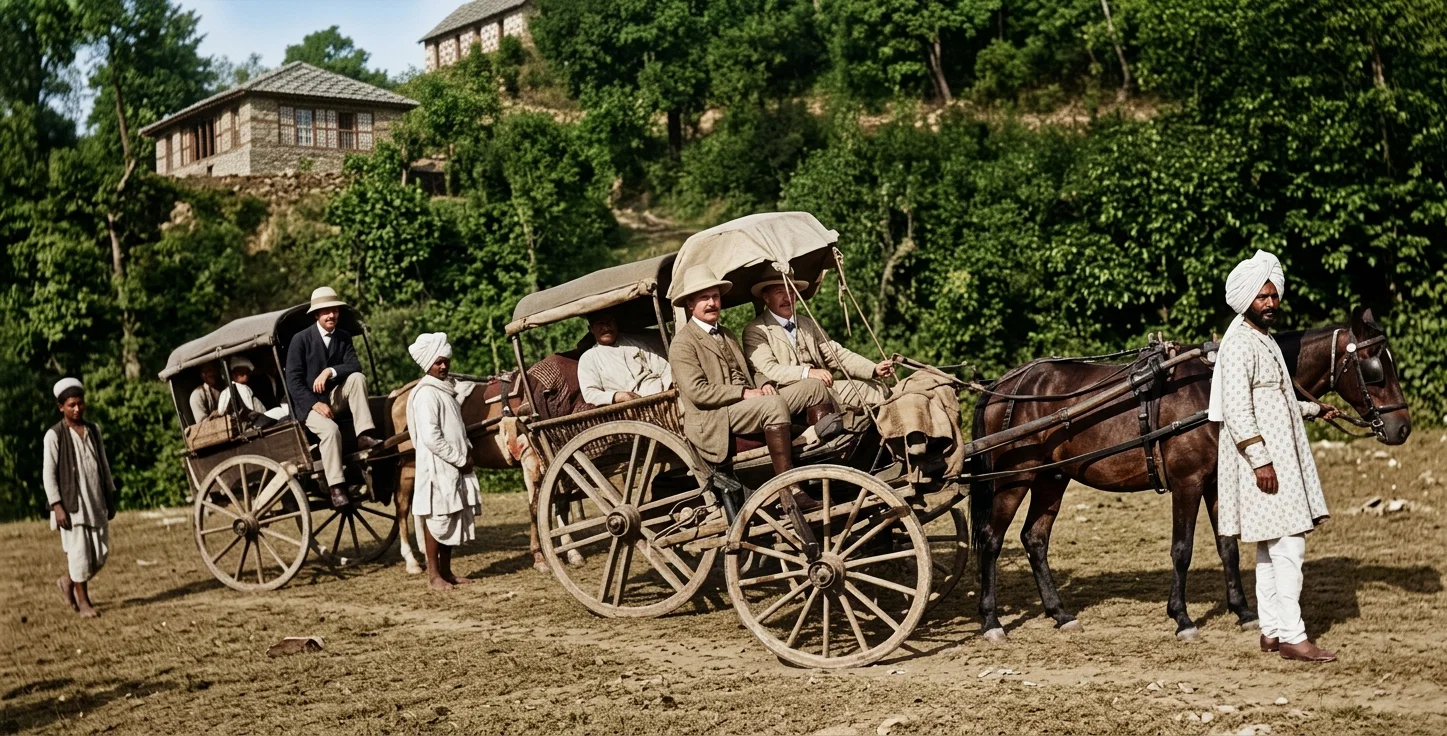
PARTY VISITING GARHWAL SCHOOL; BRETHREN W. W. PRESCOTT AND
L. J. BURGESS ON THE CARTS
One mountain near by has on its summit a large monument of the madonna, overlooking the city as its patron saint. There are not only many large Catholic churches, but also some fine Protestant buildings here. The Presbyterians have a beautiful school, and the Methodists have a college for girls. Our own growing church in that city testifies that it is good soil for Protestant missions, which truly are needed in this country. When we think of the extent of Chile, with its four millions of people, its handful of workers, and its many openings, we are constrained to say, The fields are indeed white for the harvest, but where are the reapers?
The World's City Population
By S. A. CARNAHAN
S. A. CARNAHAN
A few statistics, based upon the census of 1900, showing where the people of the world dwell, may be of interest.
One third of the population of the United States lives in cities; while one fourth is in fourteen cities.
Of South America's population, one fourteenth is in ten cities; and thirty cities contain one tenth.
Three cities contain one sixth of the inhabitants of Australia.
One sixth of Central America's population is found in twelve cities; and nearly one eleventh of Mexico's in five cities.
About one ninth of Africa's benighted souls lives in seven cities. Nearly one fifteenth of Egypt's population is crowded into two cities.
On the continent of Europe about eight and one-third per cent of her human beings are found in eighty of her largest cities, with an average of 365,325 persons each.
In Great Britain and Ireland, fifteen cities contain over ten million souls, or over twenty-four per cent of the entire population.
Nine cities in British India have nearly one and one-half per cent of one sixth of the population of the world.
The remainder of Asia has in twenty-eight large cities an average of over 388,000, or one and two-thirds per cent of its six hundred eleven million souls.
By the above we see what must be done for the cities. From them goes to the rural districts the news of all great movements. Besides, in all these cities are to be found honest souls who will respond to the truths of God's Word.
The Garhwal School
By S. A. Wellman
S. A. WELLMAN
THREE or four years ago, while Brother and Sister L. J. Burgess were spending the hot season at Almora, North India, a deputation came to them from the Garhwal district, asking them to open a school among the heathen people of that district near Dwarakhal. For some time the matter was held back; but the situation opened so providentially that it was felt it could not be refused, and last year the school was opened. A building had been partially completed, and seventy boys enrolled in the school. Some of these came from villages twenty miles away.
The school is beautifully situated on the crest of a ridge, twenty-six miles into the Himalayas from the railway. In full view to the northward are the eternal snows of the Himalaya Mountains, extending over one hundred miles unobstructed to the eye.
The school property consists of about three acres of land, on which is a small bungalow. The past year this has served both as living quarters for Brother and Sister Burgess, and as a school assembly room. During the year two other buildings for dormitories have been in process of erection, and they will be completed in time for school work another year.
I visited the school near its close, and so had opportunity to examine the work. Nearly all the students show good ability, and some had made excellent progress. They are taught the gospel in connection with other studies, and the effect is already seen. Over one hundred students are confidently expected during the coming year.
An interesting part of the work is that the students do their own cooking, washing, etc. In a single room 12 x 12 feet, seven or eight boys live and look after their own needs. In the past they have had only the native shop and serai in which to live, but with the addition of the new dormitory buildings, with three rooms 12 x 12 feet each, they will have more comfortable quarters during the coming school year.
We ask the prayers of God's people in behalf of this school.
Lucknow, India.
Mission Notes
At Emmanuel Mission, South Africa, a well thirty-five feet deep has been put down at a small cost, which will prove invaluable during the dry season. Over at the Barotseland Mission, the school has reopened, with an enrolment of fifty-five students. They are having plenty of rain, with all crops in splendid condition. Brother W. H. Anderson reports that their out-stations will all be self-supporting this year, according to present prospects.
At our newest South African mission, Tsungwesi, where Brother M. C. Sturdevant and his helpers have begun work, a school has been opened with an enrolment of twenty-three.
VERY heavy rains are reported from our Solusi and Tsungwesi mission stations. Brother Sturdevant writes that everything is flooded on his station. Brother W. C. Walston started the boys to market with a load of grain. A heavy shower came on when they were a few miles out from the station; and before they could outspan, the water rushed down, and the wagon had to be abandoned in midstream. The wagon and load went rolling over and over down the stream. The boys reported the catastrophe to Brother Walston, and the next day he went with them to recover, if possible, the lost property, or what was left of it. The wagon was found in good condition, and twenty bags of grain were saved out of thirty-two.
DESPITE all attacks upon the Bible, including Higher Criticism, there is today throughout the world a growing demand for God's blessed Word. Only about twenty-eight per cent of the British and Foreign Bible Society's output is shipped from London, the greater part being printed in other places more convenient for circulation; but the past year 2,845 cases of the Scriptures, weighing 333 tons, were sent out from London. On one day, Jan. 17, 1911, consignments of Bibles were being packed for Seoul, Madras, Colon, Adelaide, Sydney, Rio, Buenos Aires, Callao, Barbados, and Rangoon. The next day, January 18, the warehouse had orders on hand for 205,000 copies of the Bible in sixty-four different languages and dialects. This shows that the demand for God's Word is good throughout the habitable world.
BROTHER HAROLD MAYER, a Jew, laboring for his people in Boston and vicinity, expresses the conviction that the general sentiment among Jews is changing regarding Christianity. While they bitterly opposed the first work among them by our people, they now eagerly receive our literature where they are best acquainted with us as a people, and listen with more attention and interest to the story of the Christ. They seem astonished and ashamed that there is really a body of Christians who keep the Sabbath better than they do, also refuse swine's flesh, and beyond all this will, for the love of souls, instead of for money, come among them to labor. This brother tells how easily he can set a whole community of Jews discussing about the Messiah by entering a fish market or butcher shop, distributing some literature, and beginning to talk about Jesus to one or two. When a knot of listeners gathers, he leaves them to discuss the subject, while he goes into another place to do likewise. From among this nation, Jesus will surely gather a company to stand with victors' palms on the sea of glass.
Editorial
By Editor
“WALK worthy of the vocation wherewith ye are called, with all lowliness and meekness, with long-suffering, forbearing one another in love; endeavoring to keep the unity of the Spirit in the bond of peace.”
To build up the believers in this unity, the gifts of the Spirit are placed in the church. All the gifts are needed, and no one gift is independent of the others. They are all set in the church to build it up “till we all come in the unity of the faith, . . . unto the measure of the stature of the fulness of Christ.”
ALL through the early years of the message our brethren had experiences with factions that drew off, some on one thing, some on another, with the one similarity that they all seem to have raised the cry of popery when they could not dominate the body of believers, and attacked the spiritual gifts in the church, usually both the spirit of prophecy and the administrative gifts by which the work was kept moving forward harmoniously.
IN one such experience, in 1857, Elder R. F. Cottrell wrote:—
If it is a fact, as we fully believe it is, that the third message of Revelation fourteen is now being given, the Lord is now doing a special work, equal, at least, to that of leading the Israelites through the desert to the land of Canaan. This message will consummate the work of preparing the remnant of God’s people for translation,—a people in whose mouth will be found no guile, being without fault before the throne. The importance of the work, and the fact that the Director of it is “excellent in working,” are a sufficient guaranty that it will be accomplished as harmoniously as any in which he anciently engaged. Poor, fallible, human instruments may fail. A Moses or an Aaron may be tempted to speak unadvisedly with his lips, and die on this side of Jordan. In such case the garments of Aaron will be put upon Eleazar (Num. 20:26), and Moses will lay his hands upon Joshua (Deut. 34:9), and thus the work move on harmoniously ; but the sons of Korah will perish in their gainsaying. Numbers 16; Jude 11.
God has not sent the third angel’s message into the world without choosing the means and instruments by which to send it. Men, as instruments, are liable to err, or even to fall away from the truth. Even the apostle Paul, who had not only a special but a miraculous call to preach the gospel to the nations, was still obliged to keep his body under, and bring it into subjection, lest when he had preached the gospel to others, he himself should be a castaway. But the operations of God can not be subverted. He is not divided in these operations against himself. He does not fail in the first attempt, and have to begin again. There is no such precedent upon record—no such failure written aforetime for our learning; but all the reverse. Therefore we may confidently come to this conclusion: that if the same God that led Israel through the desert has set his hand to fulfil the prophetic message of the third angel,—the last merciful warning to the world before the coming of the Son of man,—he never will be driven to the necessity of perfecting the work by means of a rebellion in the camp, taking sides with the rebels and thus destroying the harmony of his own work. But God will overrule such factions for the good of his children, as Paul wrote aforetime for our learning, saying, “There must be also heresies [sects, margin] among you, that they which are approved may be made manifest.” 1 Cor. 11:19.
This Year in the Mission Fields
By William A. Spicer
On another page is the report of the treasurer of the General Conference on the estimates and appropriations for 1911, as passed upon in the recent committee sessions. That column of figures is one of the cheering and stimulating signs of the times.
Year by year the boundaries of this threefold message have enlarged. And the missionary gifts from the believers in the message have enlarged; and somehow, under the blessing of God, this advent people, small as they are, have seen their work extending to the ends of the earth. Outside observers are often surprised to see so small an organization extending its influence so widely. We know that the secret of it is the expanding power of the leaven of truth. The prophecy has marked out the way of this message to every nation and people, and a power beyond our human strength is continually pressing our boundaries outward. It is for this very gathering time that the prophet says:—
“Enlarge the place of thy tent, and let them stretch forth the curtains of thine habitations: spare not, lengthen thy cords, and strengthen thy stakes; for thou shalt break forth on the right hand and on the left; and thy seed shall inherit the Gentiles.” Isa. 54: 2, 3.
We not only see it, but we feel it. The pressure comes upon every soul in the ranks of this message. It is a call to work harder, to do more, to make greater sacrifices. Every person, every church, every conference, must give the response to the divine call.
We may almost tremble at the call to still enlarge. But the voice cries: “Fear not; for thou shalt not be ashamed.” Verse 4. By the blessing of the Lord the third angel’s message, which is the last gathering call to the children of God, will be sounded in all the world.
This year the appropriations provide for few new workers. This will be hard news for the fields; but the missionary force will accept it courageously, and the work in every field will go forward. The fact is, with the opening of many lands to the message, heathen lands particularly, the growth of native work and the increase of stations and out-stations require a continual increase of funds, regardless of increase in the number of missionaries sent abroad.
Now, during 1911 it is for every soul to carry the burden of this expanding work upon his heart, to see if by the blessing of the Lord the gifts for the current year will not enlarge until the fields as they stand are not only supplied, but assurance given of ability of the mission treasury to sustain a stronger movement of fresh missionary helpers in 1912. The cords are lengthening; now we must strengthen the stakes.
Just how the expanding work presses to-day is shown by the calls which the Mission Board had spread before it in the recent meetings. Here are but a few of them:—
Japan called for a printer first of all, and for two or three evangelists to join young Japanese laborers, newly coming out of school, in tent and other lines of field work. Wherever the evangelists have gone the last season, they have reaped fruitage; and now is the time to work in that empire. Only the printer, however, could be provided for in the estimates.
China called specifically for twelve workers, to engage in evangelistic, school, and canvassing work; and also for a superintendent for the field. The estimates provided for three of these workers only, the superintendent to go forward as soon as secured, the other two laborers to be put under commission, if possible, in the autumn.
As to the Philippines, the call for another minister and one or two bookmen, already long deferred, had to be passed over once again.
Mexico’s plea for one or two ministerial laborers, and for several canvassers, was agreed to as most moderate: but the supplying of Mexico’s need was deferred.
In the West Indian Union it was agreed that the call for a superintendent12for British Guiana must be responded to, but that the canvassers for Porto Rico, the French-speaking canvasser for the French islands, and another French worker for Haiti, would have to be deferred, as also a man for a new division of the Central American field, unless the local field itself has the resources.
As to the South American Union calls, it was agreed that if possible several more canvassers should be placed in the field, in addition to the two nurses and the bookman and wife who are now on the ocean sailing for Uruguay and Argentina. Other calls from Chile, Peru, and Ecuador had to be deferred.
The new Brazilian Union had three posts where local funds were ready to support additional workers. In fact, two self-supporting conferences were without presidents, and one state with scores of Sabbath-keepers was absolutely without any laborer. Therefore the estimates provided for the transportation of three ministerial laborers, two to go from Europe, and one from the North Pacific Union. Further requests from Brazil for help in the way of appropriations for native training work and for nurses and Bible workers, had to be deferred.
Word was sent to South Africa that the calls for help for additional stations and expansion would have to be cut down, much as the workers in practically every division of the mission fields wanted to see advantage taken of opening doors.
India called earnestly for two ministers for the English-speaking field, two canvassers, a family for South India, a family for the Hindustani work, a lady Bible worker for English work, a family to work among the Karens in Burma, two nurses—man and wife—for a call from a native state hitherto unentered, and a teacher. In this list the committee was able to make appropriations for one family, that of an English-speaking preacher, to take up the long-neglected work in the great English-speaking centers of India. Surely the springing of the receipts will make it possible for one or two other of these urgent calls to be filled toward the close of the year.
This list of calls is incomplete; but it suffices to show the needs unsupplied. Every request deferred means disappointment in the fields. But the workers will be not at all discouraged. They will hold the fort and still pray for re-enforcements. Our confidence is not in the number of laborers nor in the means available, but in the Lord, who can save by few as well as by many.
Nevertheless, it is the Lord who calls us to give and go; and this Macedonian cry from all the four quarters of the earth will surely ring in our ears all through 1911. The flight of the third angel toward every nation and people calls for a cutting loose and a consecration of every available resource to the cause of God.
The key-note of the correspondence from the populous fields is that the Lord is mightily working in behalf of this truth, and the end is near.