“WELL, Tommy,” said Dr. McDougall, “I think you’re off the sick-list at last, and I shall not come to see you again unless mother sends for me to give you a good whipping.”
Tommy smiled, and held out a little thin hand to the doctor. “I don’t b’lieve you’d whip me!” he said, confidently. “I’m quite well again now, fank you, Dr. McDougall, but I’d like you to come and see me some day, and give me a ride on your horse.”
“All right, old man; now you’ve got to keep quiet, and eat all that mother and Ayah give you, and grow strong as fast as you can.” And the doctor strode away from Tommy’s nursery; for he was in a hurry, as usual.
But he turned back to speak to Mrs. Mostyn, Tommy’s mother. “You’ve got to go out for a drive this evening, my dear lady, or I shall be having you to attend next! You have been nursing that young man very closely, and look quite worn out; now you can make yourself quite easy about Tommy, so get Mostyn to take you for a drive. Get two hours at least in the open air. Your Ayah can look after the boy, can’t she?”
“I suppose so,” hesitated Tommy’s mother; then, seeing the doctor’s frown, she added, hastily: “I know I mustn’t get ill, and I do want the fresh air after this fortnight in the bungalow. I’ll just give Tommy his supper, and then I’ll get Captain Mostyn to bring me down to see the tennis.”
Dr. McDougall hurried off, and Mrs. Mostyn returned to the nursery. Tommy had fallen asleep with the suddenness of great weakness; she sat and watched him, and thanked God in her silent, overflowing mother’s heart that he had been spared to her through his recent sharp attack of illness, her youngest child and her only boy, and the only one who remained to her of her flock in India; for his sisters had all been sent back to England long ago. When he woke, there was a little faint color in his cheeks, and he was quite hungry for tea; and tea was a little festival, with real cow’s milk instead of goat’s milk, and sponge biscuits, and mother pretending to be an elephant come to spend the afternoon, which was one of Tommy’s favorite games.
“Be a polar bear, muvver, be a polar bear, and say, ‘What a vewy hot day!’ and fan yourself wiv’ your paws!” Tommy was so like his old self again that his mother felt easy about him, and inclined to take Dr. McDougall’s advice. “I am going out with father for a little while, Tommykins; what would you like to do while I am away?”
The little boy’s eyes were very bright and alert. “May I have whatever I like?” he asked, eagerly.
“Surely, my son —”
“Then I’d like your big Picture-Bible all to myself,” Tommy said, decidedly, “the one wiv’ the animals in it, and Jonah, an’ the men carrying the grapes on a stick. I’d like to have it on my own knee, and look at it all by myself. May I, mummy? wiv’ clean fingers?” he finished persuasively.
The Picture-Bible was a book that Mrs. Mostyn valued, and her little boy knew that he was asking a favor; it was an old-fashioned illustrated volume, with rare colored prints, which had belonged to Mrs. Mostyn’s mother’s family. Tommy had never had it “all by himself” before, but then, never before in all his life had he been so ill.
“If you’ll take great care of it,” said Mrs. Mostyn, wavering.
“Of course I will! My hands is ever so clean!” protested Tommy, giving one thumb that seemed a trifle sticky a surreptitious lick; “I’ll take the most drefful care of your book, an’ not let anybody touch it but me, not even Ayah!”
So, as it would make him quite happy in her absence, she lent him the book.
It was a pretty picture that Tommy’s mother looked back upon as she rode away: her little son, seated among a pile of cushions and durrees on the floor of the veranda, from which the great heat of the afternoon had now subsided, the big book open on his knee, and his rapt, smiling face and tumbled yellow curls bent over its pages, as with reverent fingers he turned from one favorite picture to another. His parents drove slowly past in the Norfolk cart, and he looked up gravely. “I’m taking care of your Bible wiv’ all my might,” said Tommy, and even Captain Mostyn, who was not imaginative, suggested, “He reminds one of an infant Samuel, eh, dear?” when they were out of hearing.
“Or a Timothy searching the Scriptures,” answered his wife. “Of course, I know that it is the pictures that attract him most, but he has a real reverence for the Bible, dear little lad, and I am quite sure nothing will happen to my precious book while it is in Tommy’s charge.”
Down at the tennis-ground every one was pleased to see Mrs. Mostyn out again, and there were many inquiries for Tommy. “We have missed you so, dear Mrs. Mostyn, during the fortnight you have been shut up; and Tommy, too! the station isn’t itself without Tommy!”
“It has been an anxious time,” said the mother, “but, thank God, I believe we are out of the wood now!”
“Apropos,” cried little Mrs. Daventry, who had the reputation of never thinking before she spoke, “has your second cobra come out of the wood yet?”
“Our second cobra?” asked Mrs. Mostyn, mystified. Mrs. Daventry did not notice, nor heed, the frowns and anxious glances that her careless words provoked among those standing near; she did not know of Mrs. Mostyn’s special horror of snakes, and was eager to engross the conversation.
“Hasn’t Captain Mostyn told you of the exciting cobra hunt in your compound the other evening? A tremendous fight, wasn’t it, Mr. Smith? You were there, and Major Harrison too, and the cobra was enormous, wasn’t he? Our kansamah told me that —” And the loquacious lady rambled on with a string of details about the almost fabulous snake, winding up with, “and where one cobra comes, a second is certain to follow; the natives call it the wife looking for her husband, you know!” Mrs. Mostyn had turned rather a white face toward her husband.
“You never told me, Charles, about this horrible thing! You know the terror I have of all snakes, and of cobras especially. When was it? and what happened?”
Captain Mostyn made light of the incident; he had not mentioned it to his wife at the time, and he did not choose that she should be alarmed about it now. “We killed the snake in the compound the other evening,” he explained. “Harrison and Smith and I were coming across from mess, and we saw the beast lying on the stones, for coolness, I suppose—the drought brought him out. There was nothing wonderful about it; we killed him, and that’s the end of the business!”
“Not if his wife comes looking for him!” cried Mrs. Daventry, shrilly.
“I think I should like to go home, Charles,” whispered Mrs. Mostyn to the captain; “you know I have not been out for so long, that a little of this chatter makes me quite tired.”
She would not have confessed it, but the mention of the cobra had spoiled her pleasure for the afternoon.
Little Tommy was supremely happy with the big Picture-Bible. Hitherto mother had always shown him the book, keeping it in her own hands, and turning the leaves herself, but to-day he was allowed to have it all to himself, to hold and turn as he chose, and he felt it a very high responsibility. The book was God’s Book,—mother had told him that,—and mother read it to him on Sabbaths; it wasn’t a common picture-book, like his alphabet or his nursery rhymes that lay on the floor with their backs torn! He murmured softly to himself as he searched for his favorite pictures, telling himself as best he might the stories that he remembered, and wondering over the ones that he had partly forgotten.
“That’s poor Daniel in the lion’s den,” said Tommy, softly. Ayah had slipped away to gossip with the tailor-man who was cutting out hot-weather clothes at the other side of the veranda, and was her own sister’s husband. “Those lions has vewy kind faces! I s’pose God made them kind so as Daniel shouldn’t be frightened. An’ there’s Joseph’s bwethren all sitting down to dinner, and Benjamin wiv’ five plates all to hisself! I’m sure I shouldn’t want five plates of food, I should give it all to the poor people what haven’t got any!” decided Tommy, in the feeble state of his tiny Indian appetite.
“An’ there’s Adam and Eve, and the naughty snake!” went on Tommy, drowsily; the big book was heavy, and the Ayah’s monotonous drone a few yards away made him strangely sleepy.
It was the first day since his illness that he had been up and dressed for any time, and the exertion had fairly tired him out.
“The naughty snake told ’em stories about the fruit, and they was disobedient,” remarked Tommy, drowsily. “I’m vewy tired, but I must take care of mummy’s best Bible-book, ’cos I promised,” and taking one of the cushions from his heap, he carefully laid the volume upon it; then toppling over beside it, he fell fast asleep in a moment.214
Perhaps he had slept long enough; perhaps it was the noise of the Norfolk cart returning that waked him suddenly. Tommy’s mother saw the little white figure sitting up among the cushions, with a look of horrified determination stamped on the small pale face; some terror of the truth flashed to her mind as she realized the meaning of her child’s expression.
“Tommy, don’t stir! don’t move!” she called, flinging herself free of the Norfolk cart, but the warning came too late. “You told me to take care of your bestest Bible-book, mummy,” cried Tommy’s weak little voice back, “and I s’pose I was asleep, an’ let the old snake sit upon it;” and with his little shoe for a weapon Tommy struck out fearlessly at something in front of him. There was a low hissing sound, that, once heard, can never be forgotten; something slim and dark reared its hooded head from the cushion at the little boy’s side, and the cobra darted its fatal fang at his bare, white neck.
Captain Mostyn killed the “cobra’s wife” a minute later with the butt of his driving-whip; Tommy’s mother had lifted her son into her arms. She put her lips to the small wound at his throat, and began sucking it with all her might, but the child wrenched himself out of her embrace, and struggled into a sitting position. “I was taking care of your best book, muvver,” he said, earnestly, “on’y I’m afraid I went to sleep, an’ the nasty snake came an’ sat on it. I don’t mind him biting me, on’y I hope the book isn’t spoilt.”
“Drink this!” said Tommy’s father, holding something burning to his mouth. Tommy spluttered and choked, for the medicine was raw brandy, and then more drowsiness crept over him, and he slipped away into unconsciousness. But always the faithful, fearless mother-lips were pressed to that wound at his throat.
Tommy, wonderful to relate, did not die! Dr. McDougall said that his mother, by sucking the wound, saved his life; she always maintained that his father, with the repeated antidote and the ceaseless rubbing all through the night, fought the poison and conquered it. Anyway next morning a very exhausted and wan little Tommy turned his languid eyes upon his parents and the doctor gathered round his bed, and murmured some question very faint but no longer incoherent. His mother stooped her head to catch it: “Was your book spoilt, mummy, or did I break his ugly head?” asked Tommy.
“You and father broke his ugly head, and my book is quite safe,” answered his mother.
Tommy and his parents live in England now, and Tommy is a Winchester schoolboy, and remembers or troubles himself to think very little about his former life in India. But he has a hazy recollection of seeing a big snake curled round mother’s favorite Bible,—coils on coils of glistening, ringed skin, and a cruel head darting forward,—and he likes to think that he “had a shy,” as he calls it now, at the fellow, to defend from degradation the Holy Book that mother had left in his care; and Tommy’s mother likes to think that, child, or boy, or man, the Holy Book is safe in the hands of her son Tommy.—Bible Society Gleanings.
Finding the Way
By Frank Walcott Hutt
I CAN show papa the way, I know,
Out to the meadows and up the hill,
Over the fields where the daisies blow,
Off to the woodland so far and still.
I could show papa the way, if he
Cares to go visiting them with me.
I’d find the way, O, I could, indeed,
Down through the paths where the squirrels play,
Over the pastures where cattle feed,
While the glad robin keeps holiday;
Under the cool of the shady trees,
Into the homes of the birds and bees!
But when we’d seen all the wonderland,
And we were ready at last to go,
I should be glad to take papa’s hand;
For I’m afraid that I shouldn’t know
Nearly so well, after all, as he,
Just what the safest way home would be.
— Frank Walcott Hutt.
Weaving with Warp and Woof
By J. Edgar Ross
BRAIDING hair, as well as weaving with a needle, is so simple that practise-work will hardly be necessary; so I have simply described the making of practical articles. Weaving with warp and woof, however, is more complicated, and I would advise my readers to practise covering a few small, round sticks before they attempt to make any of the articles that will be described later. Nothing will be lost by this; for practise will give dexterity of movement as well as familiarity with the method of making the various figures into which hair of different colors can be woven.
I do not wish to convey the impression that this method of weaving hair is really difficult. It is so simple that I learned it without other instruction than I received from watching, for a few minutes, a Mexican at work upon a simple piece of weaving. Making the figures, splicing the threads, and hiding the ends when the work was finished, I studied out for myself. No doubt my readers could do likewise if they could obtain samples of the work to copy from, as I did. But where this work can be had, its cost is considerable, and even then a few simple directions would save many troublesome experiments.
The hair must be woven around some suitable base. This need not be round, but square, flat, or any desired shape, provided the material of which it is composed is sufficiently firm to retain its shape when lightly wrapped with the warp. If the base has sharp corners; as, for example, a square block of wood, they should be slightly rounded. Otherwise they will crowd the woof to either side, and leave the warp exposed.
The warp used is, preferably, smooth, soft cord, strong enough so that there will be no danger of its breaking with the strain that it must constantly bear during the progress of the work. Common white twine will answer the purpose admirably. If it is not large enough, it may be doubled, or even quadrupled, but in that case the strands must not be twisted together. The proper size of warp to use will depend upon the article to be covered as well as upon one's taste. The larger the warp, the more rapidly the work will progress. A little practise with warp of different sizes will enable one to make an intelligent selection.
The woof is composed of threads of hair twisted according to directions given in the second article of the series. The size of these threads may also be varied to suit the taste or the article to be covered. They ought not, however, to be more than one half nor less than one fourth the size of the warp.
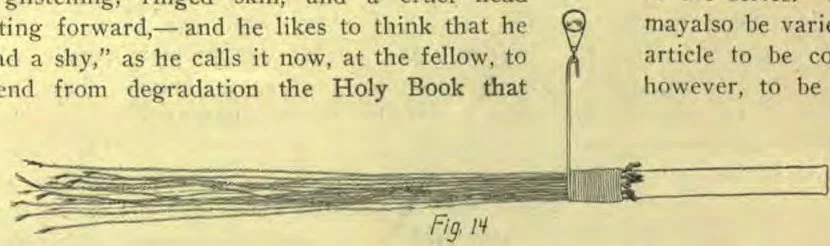
Fig. 14
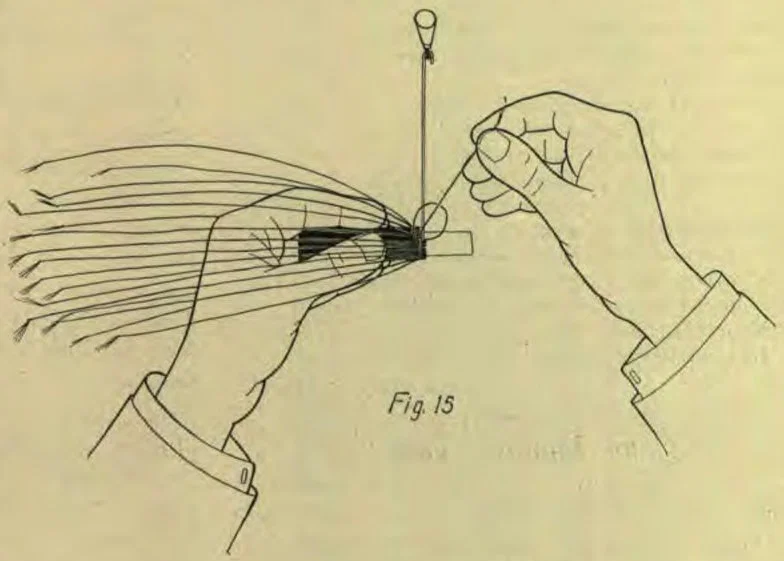
So much for theory; now let us begin to practise. Take a stick about as large around as a lead-pencil to serve as a base. The length of this stick is immaterial, but it need not be more than one fourth the length of the threads that make the woof, as hair will weave only about one fourth of its length. Around this base place a sufficient number of threads of hair to cover it loosely, and bind them in place by wrapping the warp around them. Begin wrapping the warp about half an inch from one end of the base, and wrap it toward that end. When it has been wound three or four times around, pull the threads of hair, one at a time, toward that end, till the knots on the ends are drawn against the warp. Then continue wrapping the latter until the end of the base is reached. The work will now look like Fig. 14, except that the threads of woof have here been placed farther apart than they should be, in order that their arrangement may be more readily seen. Now fasten the loose end of the warp to some convenient support, hold the base in the left hand, and with the right, take a thread of woof, pass it over the warp, then under, and bring it up so as to form a loop, as shown in Fig. 15. Draw this loop taut, and proceed with the next thread, and the next (working from you), and continue to work around and around the base until it is all covered.
MEMORY VERSE: “The wages of sin is death; but the gift of God is eternal life through Jesus Christ our Lord.” Rom. 6:23.
(The chapter given as the Lesson Scripture is the lesson to be studied. Read this carefully every day, and think over it until you know just what it teaches. Then the following notes, which should be read carefully several times, will help to a fuller understanding of the lesson. Lastly, go over the questions carefully, and be sure that you can answer each one in the words of Scripture.)
In Adam’s Eden home was the tree of life. So long as he could eat freely of this tree, he would not die. But when they sinned, Adam and Eve were sent out of Eden, and God placed at the east of the garden, cherubim and a flaming sword which turned every way, to keep the way of the tree of life.
All the results of having the tree of life taken from them were not seen at once. In the book of Genesis, which gives the record of the birth and death of the first nine generations,—from the days of Adam till the time of the flood,—we read nothing about illness. Old age was always the cause of the deaths that are recorded there.
Learn the names of the men whose life-story is told there in so few words:—
You will see that the average length of life of the first generations was over nine hundred years; but the story of each down to the days of Enoch closes with the words, “And he died.” But it was not so with Enoch215walked with God: and he was not; for God took him.” Enoch is spoken of in other books in the Bible, and we are told a little more about him. From the book of Jude we learn that Enoch, the seventh from Adam, prophesied, saying, “Behold the Lord cometh with ten thousands of his holy ones, to execute judgment upon all.” So we see that Enoch looked for the coming of Christ, and taught the people about it.
This was about one thousand years after the earth was created, and Adam and many of his children had fallen asleep and returned to the dust, the righteous and the wicked together. Perhaps some of the people were beginning to wonder what was the use of serving God, since death seemed to be the end of all alike. But Enoch taught them of the coming of the Lord to wake the sleeping saints, and take to heaven without dying those who are living when he comes.
The book of Hebrews tells us that it was “by faith Enoch was translated that he should not see death; and was not found, because God had translated him: for before his translation he had this testimony, that he pleased God.”
By faith Enoch walked with God for three hundred and sixty-five years on earth, doing always the things that pleased him; and then “God took him,” to walk with him in heaven. He was the first of the children of men to be taken to heaven. By this God showed the people that his preaching was true, and that all who walk with him and please him and look in faith for his coming, will be taken to live with him.
The son of Enoch, Methuselah, lived to the great age of nine hundred and sixty-nine years,—the longest life ever lived by man on this earth, so far as recorded. For the lives of men have been gradually getting shorter since the fall, which removed them from the tree of life, and planted the seeds of death within them.
Questions
Who was born when Adam was one hundred and thirty years old?
Where else in the Bible are we told about Enoch? Jude 14.
To what did Enoch look forward?
What will the Lord do when he comes?
How did God show that Enoch’s teaching was true, and that he will reward those who trust him?
How long did Enoch live on the earth?
What was the name of Enoch’s son? How is he distinguished from other men?
Opening Your Heart to Christ Each Morning
OPEN your heart every morning to Christ. Let him enter, and repair the strings that sin has broken, and sweep them with his skillful fingers, and you will go out to sing through all the day. Only when the song of God’s love is singing in our heart, are we ready for the day.—Selected.
II— From Hezekiah to the Captivity
(July 12)
MEMORY VERSE: “What could have been done more to my vineyard, that I have not done in it? wherefore, when I looked that it should bring forth grapes, brought it forth wild grapes?” Isa. 5:4.
SCRIPTURE REFERENCES: Study carefully 2 Chronicles, chapters 33–36 inclusive.
Synopsis
The Lord tried Hezekiah to show him all that was in his heart (2 Chron. 32:31); and when the king saw the pride that was there, he humbled himself, “both he and the inhabitants of Jerusalem, so that the wrath of the Lord came not upon them in the days of Hezekiah.” 2 Chron. 32:26.
But Manasseh was a very wicked king. He was only twelve when he began to reign (2 Chron. 33:1), and he made the people do worse than the heathen. Verse 9. Moreover, when the Lord reproved him, he would not hearken (verse 10), and therefore he was carried to Babylon in fetters. Verse 11. Then Manasseh was humbled: he besought God, and prayed earnestly unto him that he would forgive all his sins and his trespasses in setting up graven images for idol worship. Verse 19. The Lord heard Manasseh’s prayer, and brought him again to Jerusalem into his kingdom. Then Manasseh knew that the Lord he is God. Verse 13.
Manasseh’s long course of wickedness brought his kingdom into such a condition that even though he entreated the Lord for the high places and graven images which he had set up before he was humbled (verse 19), still they were not torn down, and his wicked son Amon followed in his footsteps. Verse 22. He would not be influenced by his father’s humility.
But the effect of Manasseh’s repentance was not to be lost. The last six years of his life must have prepared the youthful Josiah for his great work; for while Josiah “was yet young, he began to seek after the God of David.” Josiah came to the throne when he was only eight years old; in the twelfth year of his reign he began to purge Judah and Jerusalem of their high places, and the altars of Baalam were broken down in his presence,—a brave king he was at twenty years of age! 2 Chron. 34:3, 4.
The eighteenth year of Josiah’s reign brought his reform to a climax. The land having been purged, he began to repair the temple (verse 8); and while the men were working, they found the Book of the Law. Verse 14. This was indeed a wonder to Josiah, and he rent his clothes when he heard what the law required of him. Verse 19. He sent at once to the prophetess Huldah for instruction, and then gathered all the men of Judah and Jerusalem at the temple. Verse 30. “And he read in their ears all the words of the book of the covenant that was found in the house of the Lord. And the king . . . made a covenant before the Lord, to walk after the Lord, and to keep his commandments, and his testimonies, and his statutes, with all his heart, and with all his soul.” Verses 30, 31.
The passover which Josiah kept that same year (2 Chron. 35:19) there had been none like since the days of Samuel; neither did all the kings of Israel keep such a passover as Josiah kept. All Judah and Israel were present, and the inhabitants of Jerusalem. Verse 18.
Because Josiah was a good king, the Lord told him that he should not see the evil which had been prophesied of Jerusalem (2 Chron. 34:28); but a continued course of evil followed his death. 2 Chronicles 36. The people of Israel lost their independence, and a foreign king appointed their ruler, and finally Jerusalem came under the power of Babylon.
“What could have been done more to my vineyard, that I have not done in it?” says the Lord, speaking of that time. Isa. 5:4. He looked for righteousness, but behold a cry. Verse 7. The people honored him with their lips, but their hearts were far from him. Isa. 29:13. Thus their service was a mere form, and the Lord told the prophet Isaiah to say to his Sodomite rulers and his people of Gomorrah that he hated their forms of worship. “They are a trouble unto me,” he declared, “I am weary to bear them.” Isa. 1:10–14.
Questions
What was the result of Hezekiah’s repentance?
Describe the wickedness of his son, Manasseh. 2 Chronicles 33.
Why was it necessary for him to be carried to Babylon in fetters?
What effect did this have upon him?
When Manasseh returned to Jerusalem, what did he know?
What influence did Manasseh’s wickedness have upon his kingdom?
Who followed in his footsteps, and how long?
Who accepted the influence of Manasseh’s repentance?
How old was Josiah when he began to reign?
In the twelfth year of his reign what courage did he show?
What reformation followed?
How did Josiah find out what was required of him by the Lord?
What did he then do? what covenant did he make?
What is said of the passover which he kept?
What was the result of Josiah’s good reign?
Tell briefly what happened to the kingdom after his death.
What prophets lived and prophesied during the time of Israel from Hezekiah to the captivity? You will find an answer to this question by looking up the first verses of all the various prophecies of the Old Testament.
How does the Lord look upon his efforts for Israel at that time?
When he looked for righteousness, what did he find?
What kind of service did the people render?
What message did the Lord send them by Isaiah?
Is there, or is there not, a similar state of things now?
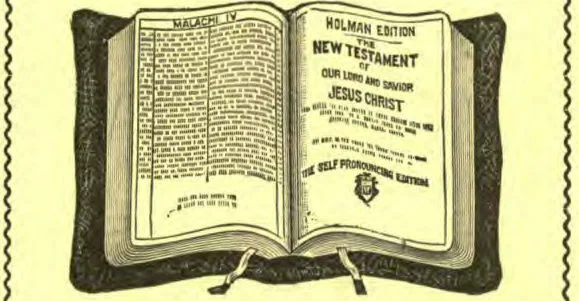
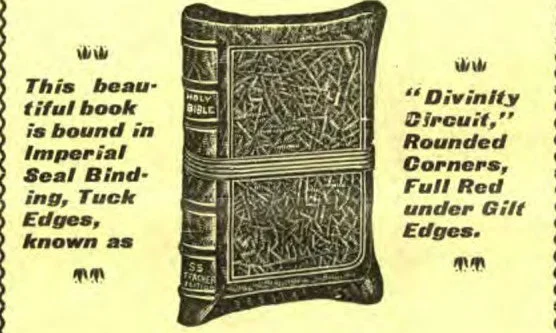
THE INSTRUCTOR PREMIUM BIBLE.
By Editor
A Self-Pronouncing Teachers' Reference Bible, containing the celebrated Teachers' Helps, and comprising nearly 400 pages. Also a complete series of 15 new maps.
This beautiful book is bound in Imperial Seal Binding, Tuck Edges, known as
“Divinity Circuit,” Rounded Corners, Full Red under Gilt Edges.
We offer this Bible, postpaid, for only six new yearly subscriptions at 75 cents; or twelve new six-months' subscriptions at 40 cents.
We will also send it, postpaid, with the INSTRUCTOR one year for $2.25. For 20 cents extra we will stamp your name in gold upon the cover. Address—
THE YOUTH'S INSTRUCTOR, BATTLE CREEK, — — — MICHIGAN.
Keep at Work
Do not stop work to become an expert stenographer. We successfully teach by correspondence the Graham System of Shorthand by a new method, which enables the stenographer more quickly to attain practical speed than by any former method. Easy to learn, easy to retain. Highly recommended by oldest official court reporters. Complete course for beginners. Special course for advanced writers, who desire to become expert. Write to-day for full particulars to the —
FIRESIDE CORRESPONDENCE SCHOOL, Battle Creek, Mich.
SOLID THROUGH TRAINS OF
WIDE VESTIBULE COACHES and PULLMAN SLEEPING CARS BETWEEN
Battle Creek and Chicago, Buffalo, New York, Philadelphia, Toronto, Montreal, Boston
For time-tables, descriptive matter, and information, apply to any representative of the company.
The True Motive
“THERE isn't very much satisfaction in helping old Mr. P. I would not advise you to worry over his case,” said a philanthropic woman, one to whom the sorrows and poverty of an old man in the neighborhood had appealed with special force.
It was a thoughtless speech; nevertheless it voices a feeling which is likely to grow up in any heart, unless carefully guarded against,—the desire to have a sense of “satisfaction” for whatever is done to help others.
Of course gratitude is a beautiful thing, and very soothing and pleasant to receive; nevertheless it has sometimes happened that even comfortable folk, well fed and warmed, sheltered and clothed, are none too well supplied with this virtue.
It was the need of man that drew Jesus to the world; and that same need will still draw out the loving, unselfish service of all in whose hearts his Spirit dwells. He never set the price of gratitude on his blessings—“without price,” they are offered to all; he healed and fed and taught the multitudes freely. His sunshine and rain are bestowed upon all, and to grateful and ungrateful alike the provisions of his grace are extended. Is it possible that those who serve him will ever so lose sight of his example and teaching that they shall serve others only for the sense of “satisfaction” received by themselves for so doing? And if that should be the case, could such service be anything more than self-serving?
We need to study the life of Jesus, to read again and again his own words to us, and to come close to him in prayer, that we may go about his work in his own gentle way, and so win souls to his kingdom.
A Faithful Witness
By Editor
THE article, “A Faithful Witness,” the first part of which is printed on the second page of this issue, is a solemn call to every young person. Read it carefully. The second division will appear next week. The complete article will make an excellent reading for a young people's meeting.
The Best Gifts
THE world is spending time and money, sacrificing health and happiness and peace, in seeking the things it regards as prizes. It is wise to have an aim in life; it is well to work and plan and seek in every right and honest way to improve; it is essential that we strive, indeed, to win. But in his word God, who created us, who knows our hearts, has told us the things we may properly seek.
“Seek ye the Lord,” he commands,—and with every command there is a promise,—“seek righteousness, seek meekness; it may be ye shall be hid in the day of the Lord’s anger.”
“Seek me, and ye shall live.”
“Seek, and ye shall find.”
“Seek ye first the kingdom of God, and his righteousness; and all these things shall be added unto you.”
“Seek those things which are above.”
The advice of Paul to the Corinthians sums up in a word the things to be sought, to be striven for: “Covet earnestly the best gifts.” The best gifts include the best Gift; and having him, we shall have all.