“For if I build again the things which I destroyed, I make myself a transgressor. For I through the law am dead to the law, that I might live unto God.”
What is it that is referred to in the words, “If I build again the things which I destroyed”? There are at least two special thoughts involved in these words.
1. The one great idea of those who had turned back the Galatian Christians was justification by LAW. Whereas the truth of the gospel, which Paul had preached to the Galatians, and which even “an angel from heaven” could not contradict, is justification by FAITH.
Paul has already shown, in verses 15, 16, that even they who were Jews by nature, and so had all the laws that the Lord had given, had believed on Christ in order that they might be justified by faith and not by works of law: and this for the accepted reason that by works of law no flesh can be justified.
This was the utter abandonment and destruction of all idea of justification by law. And having abandoned all idea of justification by law, in order, by believing in Jesus, to be justified by the faith of Christ, now, being justified by faith, shall I set up again the idea and the hope of being justified by law? Having abandoned the idea of justification by law, in order to find justification by faith, having found justification by faith, shall I again adopt the idea of justification by law?—God forbid; for when, to be justified by faith, I must abandon all idea of justification by law, if I now adopt again the idea of justification by law, I must abandon justification by faith. But when I abandon justification by faith, I make myself a transgressor; for “whatsoever is not of faith is sin.” Therefore, if I build again the structure of justification by law, which I destroyed by justification by faith, I make myself a transgressor; because by the law is the knowledge of sin.
2. That which I destroyed by abandoning all idea of justification by law, and adopting justification only by the faith of Christ, is “the old man,” “the body of sin.” And to build again that which I destroyed is only to bring back from the dead that old man, is only to make alive the body of sin, and that can only make me a transgressor.
Justification by the faith of Christ means in itself the total abandonment of all sins committed, the remission of all “sins that are past,” and also the destruction of the body of sin, so that “henceforth we should not serve sin.” Therefore while seeking to be justified by faith, we must not be found sinners. For if I build again the body of sin which I destroyed, I make myself a transgressor. And in again adopting the idea of justification by law, I do build again, in works, what I destroyed by faith; because all seeking of justification by law is seeking justification by our own works, and our own works are simply works of the flesh, which are all sin; for “the works of the flesh are manifest, which are these: Adultery, fornication, uncleanness, lasciviousness, idolatry, witchcraft, hatred, variance, emulations, wrath, strife, seditions, heresies, envyings, murders, drunkenness, revelings, and such like.”
And in building again the structure “of justification by law, which I abandoned in order to be justified by faith, I make myself a transgressor; “for I through the law am dead to the law, that I might live unto God.” Since abandoning the idea of justification by law and adopting justification by faith caused me to become dead to the law and alive unto God, then adopting again the idea of justification by law, which, in itself, is the abandonment of justification by faith, would cause me to become alive to the law and dead unto God. But to be dead unto God is nothing but to be dead in trespasses and in sins. And as to be dead unto God is to be dead in trespasses and in sins, and to be dead unto God is to be alive to the law, then to be alive to the law is only to be a transgressor.
Therefore, my brethren, justification by faith forever, without any works of any law of any kind whatever,—this is the only ground of hope of salvation.
WHEREFORE DIDST THOU DOUBT?
By Uriah Smith
“And immediately Jesus stretched forth his hand, and caught him, and said unto him, O thou of little faith, wherefore didst thou doubt?” These words were spoken to Peter, on an occasion of very great interest to him, and of great importance and instruction to us; for it was a question which is applicable to our time, and to all the world. This is clear from the words of the Saviour, when he says, “When the Son of man cometh, shall he find faith on the earth?” implying that there will be scarcely any to be found in all the world. Then there will be a whole world of doubters to whom the Lord will come; and even the elect will be in danger of falling into the same spirit; for the last days are mapped out as emphatically dangerous to God’s people for the very reason that unbelief abounds in that time, and every form of iniquity prevails, even among those who maintain a form of godliness. 2 Tim. 3:1-5.
Consider the pertinence of this question in the case of Peter, on the occasion referred to: The Lord had just said to the disciples, as they were troubled at his presence, walking on the sea, “It is I; be not afraid.” Matt. 14:27. Peter then proposed to go to the Lord, to test the matter: “If it be thou, bid me come unto thee on the water.” And he said, “Come.” The way was all open. Not only was permission given, but a hearty invitation was extended to him. And there was his Lord before him, demonstrating the possibility of such a thing as walking on the sea. Peter then had faith. He did not doubt, but stepped boldly down upon the water, and walked to go to Jesus. How far he walked we do not know; but it was far enough to put some boisterous waves between himself and the ship.
And when he saw the billows rising, and the waves dashing around him, then he became afraid, and forgot his faith. His fears grew stronger than the presence of the Lord and the promises he had given him. For when the Lord said to him, Come, he thereby engaged to do for him all that was necessary to enable him to come, so long as he trusted in him. He began to sink; and then a new danger confronted him. He saw at once that something must be done, and that speedily, or he would perish in the waters. Fortunately, he turned to the Lord, from whom alone help could come, and exclaimed, in the energy of his soul, “Lord, save me.” It was a short prayer, but it was full of sincerity; and it was long enough to accomplish its purpose. Immediately the Lord stretched forth his hand and caught him. No wonder the Lord upbraided him as possessing but little faith, and asked him, “Wherefore didst thou doubt?” Reduced to the last extremity, his faith revived, and he laid hold of the help within his reach, and was saved. But wherefore had he doubted? Oh, he lost sight of Jesus; and he lost sight of the help his Lord was waiting all the while to bestow. Anybody in such circumstances will begin to sink.
But what about the doubters in the last days, those who compose the mass of the people when the Lord’s words apply: “When the Son of man cometh, shall he find faith on the earth?” The faith here referred to pertains, of course, to faith, or belief, in the doctrine of his immediate second advent, and the faith that will accompany that belief; and he inquires (Luke 18:8), in a way that indicates a sad anticipation, Will he find any of this in exercise in that day? and find any people waiting for him when he appears? Alas, that there should be any necessity for such a question. And in the same sentiment of the question addressed to Peter, we may ask, Wherefore should the people have any doubts on this point? As Christ told his disciples at the sea, “Be not afraid,” so he has told his people to-day, “Fear not, little flock; for it is your Father’s good pleasure to give you the kingdom.” But the prophecy is that as it was in the days of Noah, so now, the world will not know till the foretold evil comes and sweeps them all away.
The statement that Christ is coming again, and the fact, no believer in the Bible will, or does, for a moment question. But that he is now at the door, and is accomplishing his last work among men on the earth, and for men in heaven, who realizes, and how few believe! And when the Lord has declared what phenomena will appear to indicate the approach of his coming, is it because these have appeared that they do not believe? When he says that there would be strange and unaccountable occurrences in the sun, moon, and stars, and these have come to pass, is that why they do not believe?
And when he has said that occurrences equally strange and unaccountable should appear on the earth,—flood, fire, storms, earthquakes, pestilences, famines, wars, and destruction, not only from the unchained elements, but from the actions and death-dealing weapons of men whose hearts are fired with the fury of demons,—and they see all these things surging around them, till the very hearts of men are failing them for fear,—is this why they can not believe the Lord is coming? Is this why they say, “All things continue as they were from the beginning”? Is this why they throw away the Bible, the only light for this world, and grope their way along in blindness and unbelief?
And further, what conditions in the political world, in the religious life of the people, in social circles, and in the general disposition and condition of mankind, were to characterize the last days? It can not be mistaken. And what do we behold in all parts of the land to-day? No picture can be painted so dark that it does not find its counterpart in actual life before our eyes. Political corruption; perversions of justice; officers of the law conspiring with criminals, with whom they are in active league, to prey upon a helpless public; judges on the bench bought and sold; statesmen selling themselves to their ambition; covetousness and bribery controlling high places; and the moral integrity and stamina of the people vanishing away,—in view of all these things, shall we say, “Where is the promise of his coming?” Shall we not rather say, “Wherefore didst thou doubt?” Have we not surely reached the time of which the prophet speaks, “And judgment is turned away backward, and justice standeth afar off; for truth is fallen in the street, and equity can not enter”? Isa. 59:14.
Earth groans with convulsions; the sea lifts up its waves on high (the “sea and waves roaring,” says the prophet); evil men and seducers wax worse and worse; distress and unsolvable perplexity spread from nation to nation; iniquity abounds, and the love of many waxes cold; the world is going into its aphelion from God, nations are at their wit’s end to know how to avoid calamities that threaten their destruction; strange and new forms of diseases, before which the medical world stand aghast, are fast making a Golgotha of this earth: and God’s word makes it as emphatic as language can make it that these signs and conditions are just what will characterize the last days of human history. What, then, do these things tell us in reference to the end? Why, then, do men throw away faith in the only living volume, the only blazing light, the only voice that makes known their danger, to a world carelessly, peacefully, wickedly slumbering on the dividing line that separates the devouring fire from the stores of explosives reserved unto the destruction of the great day? Wherefore didst thou doubt?
Why are men mad after pleasures and mammon, and dead—and blind as to eternity? Why can any one doubt that the end of all things is at hand? Does the sight of a world bristling with bayonets and other implements of destruction, and the conviction that only some unseen power is holding men back from flying with deadly intent at one another’s throats, lull us into security and indifference? We see the gospel of the kingdom going to all the world, and remember that Christ said that it should thus be preached for a witness to all nations, and then the end should come. Wherefore didst thou doubt?
We see a church coming forth bearing all the marks that the prophet says will characterize a company making ready for translation when the Lord appears. Wherefore didst thou doubt?
Shall we doubt because we see labor and capital getting into such a feverish state of antagonism that the prophecy of James must surely come to pass speedily,—that prophecy which says to the unjust wealthy, “Go to now, ye rich men, weep and howl for your miseries that shall come upon you”? And this is when “the Judge standeth before the door.” Never was there such a crisis in commercial and financial circles as we see before us to-day: on the one hand, all-devouring greed, and callous heartlessness; on the other, cruel tyranny and blind dictation.
The coils are tightening everywhere. Lawlessness, violence, and the boycott will drive the rich into the strongholds of their iron-barricaded palaces, and the poor into unlawful associations, or starvation. At the time of the harvest, the prophetic command to the angel reapers is, “Gather ye together first the tares, and bind them in bundles to burn them,” and then the concluding command is, “but gather the wheat into my barn.” Matt. 13:30. The danger of the world to-day is expressed in the words, “O thou of little faith, wherefore didst thou doubt?”
What one feature is lacking to fill out, in the most striking manner, the picture of the very last and final days of time? But there is danger that these facts will be overlooked; hence the stirring warnings and exhortations pertaining to the last days, on this very point: “When the Son of man cometh, shall he find faith on the earth?” “Now the just shall live by faith;” and if we draw back, it is “unto perdition;” but if we believe, it is “to the saving of the soul.” “Let us lay aside every weight, and the sin [of unbelief] which doth so easily beset us, and let us run with patience.” Heb. 12:1. For as a snare, and as a thief, shall that day come upon all them that dwell on the face of the whole earth.
There was one encouraging feature connected with the experience of Peter on the sea; and that was that before Christ began to chide him for his unbelief, he had stretched forth his hand, and caught him. And let it be noticed that the power of Peter then lay, not in something that he was doing or was going to do, but in something that was going to be done for him; not in the fact that he had hold on Christ, but that Christ had hold of him. So, before we are swept off our feet by any of the currents or eddies of unbelief that threaten now to engulf even the very elect, let us so appeal to our Lord, and exercise that living confidence in him, that will give him the opportunity to stretch forth his hand and lift us up to walk the waves with him, into his very kingdom. Let a stanza from one of the good hymns of Dr. Doddridge be our motto:—
“Almighty God, thy grace impart;
Fix deep conviction on each heart;
Nor let us waste on trifling cares,
The life which thy compassion spares.”
U. S.
WHAT IS WAR?
By B. E. S.
WHILE the vast majority of mankind hold themselves ready to engage in war, there is no lack of expert testimony against such a course. Even men who have made warfare a business advise others against following it. General Sherman, after a life spent in the military profession, in his bluntness, made the statement that “War is hell,” a conclusion which he could not avoid. Grant, one of the greatest generals of history, held the motto, “Let us have peace.” Admiral Dewey, too, has been trained all his life for the same profession, and has attained the highest honors military greatness can bestow. New York has bestowed on him a reception such as few men ever meet. Circumstances, of which we are all more or less the results, have shaped themselves to give a much-coveted honor, in the eyes of men, to the “hero of Manila.” But for all this, the admiral’s son is engaged by choice in a mercantile business, which the papers say is much more pleasing to his father than to see him pursuing a course at West Point or Annapolis.
These are the opinions of men on the desirability of war merely from a worldly standpoint. Many men who are well known for their piety have also given us their ideas concerning war, not based, like Sherman’s or Dewey’s, on their experience in it, but on their observations of it. John Wesley asks: “Shall Christians assist the prince of hell, who was a murderer from the beginning, by telling the world of the benefits of war? Shall Protestant publications proclaim to the nations that war is a blessing670of Providence?” These questions admit only a negative answer.
Thomas Scott says: “War in every case must be deemed the triumph, or the harvest, of the first great murderer—the devil.” Ward, the missionary, says: “Either our religion is a fable or there are unanswerable arguments against war and the profession of arms.” Adoniram Judson, one of the pioneer missionaries to Burma, wrote: “I have for some time determined to make whatever efforts were necessary to comply with the dictates of conscience, and wash my hands of the blood that is shed in war—a measure which appears to me to be the indispensable duty of every Christian.”
War is the opposite of peace. It is the expression of selfishness, and originates with the source of all evil. Theodore Parker says: “War is utter violation of Christianity. If war be right, then Christianity is wrong, false, a lie. But if Christianity be true,—if reason, conscience, religion, the highest faculties of man, are to be trusted,—then war is the wrong, the falsehood, the lie.” There seems to be a wrong idea with many, even among professed Christians, regarding war and the propriety with which a Christian may enter into it. The world in general may with propriety be expected to engage in its pursuit. The people of the world know no other power but that of force which is always upheld as a last resort by war. But Christians are not to maintain their rights by force. This being so, how can they enter into war to help others fight for either real or fancied rights?
Christ said, “Blessed are the peacemakers: for they shall be called the children of God.” He that gave this title to the peacemakers said also, “Put up again thy sword into his place: for all they that take the sword shall perish with the sword.” This testimony of Christ himself is enough to settle all questions regarding the propriety of engaging in the destruction of one’s fellow men. B. E. S.
Why the Levitical System Was a Shadow of Christ
By Ellet Joseph Waggoner
We have seen that the Levitical priesthood, the sacrifices offered under its administration, and the law prescribing and regulating both the priesthood and the sacrifices,—all must fall together when the priesthood is changed. We have seen that the reason for all this is that perfection was not attained through them.
The thought will now arise, and that naturally enough, Why did the Lord ordain such a system as a remedy for sin, since it did not, and could not, “take away sins”? The answer is not hard to find, as it is given in the exact language of the Scripture: “For if he [Christ] were on earth, he should not be a priest, seeing that there are priests that offer gifts according to the law: who serve unto the EXAMPLE and SHADOW of heavenly things.” Heb. 8:4, 5.
Again: “For the LAW having a SHADOW of good things to come, and not the very image of the things, can never WITH THOSE SACRIFICES which they offered year by year continually make the comers thereunto perfect.” Heb. 10:1. Being but a shadow of good things to come, the obvious reason for their existence must have been that of an object-lesson; the real remedy being Christ, the substance.
Wherefore, since “it is not possible that the blood of bulls and of goats should take away sins,” “when he [Christ] cometh into the world, he saith, Sacrifice and offering thou wouldest not, but a body hast thou prepared me.” Heb. 10:5.
Here the body of Jesus is spoken of as being prepared, and that because “sacrifice and offering thou wouldest not.” It was not possible that the Son of God, in his condition previous to entering this world, should be made a sacrifice for sin, since he could not die. And so it is written, “Forasmuch, then, as the children are partakers of flesh and blood, he also himself likewise took part of the same; THAT THROUGH DEATH he might destroy . . . the devil.” Flesh and blood, a body like ours, was necessary before Christ could die. Therefore, “A body hast thou prepared me,” says Christ, and that because “sacrifice and offering thou wouldest not.”
Who, then, can say that after that ‘body’ has been prepared and offered, the sacrifices consisting of animals, which were but shadows of that “body,” should still be continued?—Truly no honest, intelligent Christian would so affirm. Sacrifices, the shadow; Christ, the substance. Whenever the sacrifices were offered in faith, those who offered them saw Christ in them; for “faith is the substance of things hoped for.”
Christ continues: “In burnt offerings and sacrifices for sin thou [Father] hast had no pleasure.” “Then said I, Lo, I come (in the volume of the book it is written of me), TO DO THY WILL, O God.”
In the scripture last noted before this, the “body” of Christ was spoken of in contrast with the sacrifices, which were a shadow of himself, the true sin offering. Now, “To do thy will, O God,” is used in contrast with the same offerings.
We all remember the language of Samuel to Saul: “Hath the Lord as great delight in burnt offerings and sacrifices, as in obeying the voice of the Lord? Behold, to obey is better than sacrifice.” 1 Sam. 15:22. This shows that God wishes his “voice” to be obeyed, his “will” to be done. This is the object of sacrifice for sin—to enable us to do his “will.” If, therefore, Christ did not accomplish this, and provide a way whereby we may do the will of God, then his life and sacrifice were as vain as the Levitical priesthood and their offerings of “bulls and of goats.”
“Above when he said, SACRIFICE AND OFFERING AND BURNT OFFERINGS AND OFFERING FOR SIN THOU WOULDEST NOT, . . . which are offered by the law: then said he, Lo, I come TO DO THY WILL, O God.” Now what is the first thing mentioned in this quotation?—“Sacrifice and offering and burnt offerings and offering for sin.” What is the second?—The doing of the will of God. “He [Christ] TAKETH AWAY the first, that he MAY ESTABLISH the second.” Heb. 10:8, 9. Then sacrifices and offerings are taken away, and that forever, in order that the will of God may be established through the offering of Christ, the true sacrifice, once for all. “By the which WILL we are sanctified through the offering of the body of Jesus Christ once for all.” Heb. 10:10.
“He taketh away the first,” namely, “sacrifice and offering and burnt offerings and offering for sin, . . . which are offered by the law.” They were offered BY THE PRIESTS. So, then, these offerings being all taken away, there is no work for the Levitical priesthood. Having no work, there is no reason for the existence of that priesthood any longer. It, then, is also taken away. This, then, leaves the law, which made the priesthood and defined its work, without any one to operate it.
Again: this law of remedies, this law that prescribed the offerings for sin, the offerings that were but “shadows,” has now no REASON for being operated since these “shadows” of things to come have been supplanted by the “substance.”
And yet, since all these things were “examples and shadows” of “Christ, his sacrifice and priesthood,” the law defining them still remains in the Bible, although the “priesthood” and “sacrifices” have long since ceased. Since “Christ crucified” is the very core of the gospel, and since these things were types of him, therefore we may still study the Levitical law, and by so doing, study the gospel in type. But the doing of those things prescribed by the Levitical law is now out of the question, since type has met antitype.
Now what was included in that which was done away?—(1) The Levitical priesthood in every feature of it; (2) “Sacrifice and offering and burnt offerings and offering FOR SIN, . . . which are offered by the law;” (3) “The priesthood being changed, there is made of necessity a change also of the law.”
Now we have seen that that which told who should be priests, and how they should dress and work, was “the law [that] maketh men high priests.” We have also seen that that which prescribed the offerings and all the rest of the service for sin, is the law concerning the offerings. Consequently, all outside of this IS NOT affected by the change here referred to.
First, the law defining righteousness is distinct from the one prescribing a remedy for unrighteousness. Also the sanitary laws, etc., could not be included in that which was made inoperative at the death of Christ; for they in no way shadowed forth his death; nor were they used, in type, as a remedy for sin. ONLY that which was remedial, a shadow of the true remedy, ended when the substance came.
But before we conclude the subject, we must look again at that which was “established.” “He taketh away the first [the sacrifices, etc.], that he may establish the second,” the will of God.
What is the will of God thus established? It is written of Jesus (Ps. 40:8), “I delight to do thy will, O my God; yea, THY LAW is within my heart.” It is written of the Jews, even at a time when they came far short of doing God’s will: Thou “knowest his will, and approvest the things that are more excellent, being instructed out of the law.” Rom. 2:18. From these two scriptures, it is plain that the will of God is expressed in the law of God.
Christ, by the sacrifice of himself, changed, discontinued, a law. The discontinued law was “the law having a shadow of good things to come,” the one which “can [could] . . . never with those sacrifices . . . make the comers thereunto perfect.”
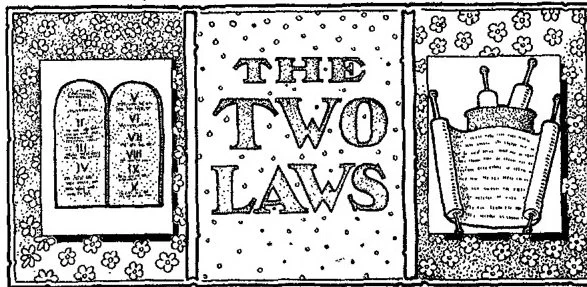
The established law is the one revealing the will of God. One law discontinued, another established,—“two laws: the one changeless and eternal, the other provisional and temporary.” And “the distinction between the two systems is broad and clear.”
E. J. HIBBARD.671
[The following is Article No. 1 in the series on the Two Laws; which must be reprinted to supply subscribers whose names were received after that issue of the REVIEW was exhausted in which it was first printed.—EDITOR.]
The Bible mentions two laws—the “one changeless and eternal, the other provisional and temporary.” “There are many who try to blend these two systems, using the texts that speak of the ceremonial law to prove that the moral law has been abolished; but this is a perversion of the Scriptures. The distinction between the two systems is BROAD AND CLEAR.”—“Patriarchs and Prophets,” chap. 32, pars. 25, 6.
In the foregoing quotations we are told that “there are many who try to blend these two systems, using the texts that speak of the ceremonial law to prove that the moral law has been abolished.” Now since “the distinction between the two systems is broad and clear,” it will not be a very hard task so fully to discover this distinction that any one can easily see it. Then when any man tries to prove the abolition of the moral law by using texts that refer to the ceremonial law, it will not be difficult to see the error.
In Heb. 7:12 we read: “For the priesthood being changed, there is made of necessity a change also of the law.” Here we are informed that some law is changed, and that it is changed of necessity. Some, who try to blend these two systems, assert that this means the law of ten commandments; or, that it at least includes it. Great stress is laid on the word “necessity.” This word shows that there can be no mistake about it. The law is therefore most certainly changed. I am glad, indeed, to lay stress upon the same word. Now, as a matter of fact, when the change of one thing makes it a necessity to change another, that second thing must depend upon the first for its existence. This is evident in the matter of law, if nothing else. Take, for instance, the United States for example: If the city of Battle Creek should change its municipal laws, would that change the State or national Constitution? Or if this, or some other, State, through its legislature, should alter some law of the State, would even that alter the United States Constitution? You know full well it would not. But why?—Plainly because the United States Constitution, being the fundamental law of the nation, does not depend upon the constitutions or laws of States for its existence. The exact reverse of this being true,—the constitutions and laws of the States being required to conform to the national Constitution,—how would these be affected by a change of the Constitution of the United States?—Logically, every one of them would “of necessity” have to be changed. Therefore, the law that was changed “of necessity” when the priesthood was changed, must have depended upon the priesthood for its existence. It must have been so interwoven with it that the change of one could not be effected without the change of the other.
Since it is the change of the priesthood that causes the change of the law, it will be in order, first to consider the place that the priesthood had in the plan of God, and then its change, and the reason for it. “Every high priest taken from among men is ordained for men in things pertaining to God, that he may offer both gifts and sacrifices FOR SINS.” Heb. 5:1. It therefore must have been sin that made the priesthood necessary. Sin had separated, alienated, all men from God. Priests were ordained as mediators between the two parties. A priest, then, is a mediator. SIN caused the separation that made the priesthood a necessity. Since sin made the priesthood necessary, it must have entered before the priesthood was appointed. “Sin is the transgression of the law.” 1 John 3:4. “Where no law is, there is no transgression.” Rom. 4:15. “Sin is not imputed when there is no law.” Rom. 5:13. Since sin is the transgression of the law, the law defining it must have existed before sin. Law before sin. Sin before priesthood. Therefore the law that existed before sin could not be affected by the change of the priesthood.
There was a law by which men were made priests. “For the law maketh men high priests which have infirmity.” Heb. 7:28. All their gifts and offerings were prescribed and regulated by law. “For if he [Christ] were on earth, he should not be a priest, seeing that there are priests that offer gifts according to the law.” Heb. 8:4.
In the first five chapters of Leviticus, we find mentioned respectively: (1) burnt offerings; (2) meat offerings; (3) peace offerings; (4) sin offerings; (5) trespass offerings. In the sixth and seventh chapters there is a summary of the whole five, and a definite mention of the law that regulates them. We will notice the verses in which we find reference to each offering, and call attention to the introductory clause in each case:—
Lev. 6:9: “This is the law of the burnt offering.”
Verse 14: “And this is the law of the meat offering.”
Verse 25: “This is the law of the sin offering.”
Lev. 7:1: “This is the law of the trespass offering.”
Verse 11: “This is the law of the sacrifice of peace offerings.”
Then, after following these introductory clauses with a clear statement of the law in reference to the several offerings, we come to a final summing up of the whole matter, in Lev. 7:37, 38. One might suppose from the foregoing references that there were many independent laws, but in verses 37, 38, we find, “This is the law [not these are the laws] of the burnt offering, of the meat offering, and of the sin offering, and of the trespass offering, and of the consecrations, and of the sacrifice of the peace offerings; which the Lord commanded Moses in mount Sinai, in the day that he commanded the children of Israel to offer their oblations unto the Lord, in the wilderness of Sinai.” It was then but one law that regulated the whole system of offerings required during the existence of the Levitical priesthood.
Now one text to show the relation of this law to the law that existed before sin: “And if any one of the common people sin through ignorance, while he doeth somewhat against any of the commandments of the Lord concerning things which ought not to be done, and be guilty; or if his sin, which he hath sinned, come to his knowledge: THEN he shall bring his offering, . . . and the priest shall make an atonement for him, and it shall be forgiven him.” Lev. 4:27–31.
In sinning, what did he do?—“Somewhat against any of the commandments of the Lord concerning things which ought not to be done.” When it came to his knowledge—what then?—“The wages of sin is death.” How did he avoid the penalty?—Oh, bless the Lord! God had provided a remedy. The repentant sinner accordingly brought the offering required by law, to the priest, who was ordained according to the law, and it was offered as the law directed. Then what?—His sin was forgiven him. Cleansing goes with forgiveness, as we see in 1 John 1:9. In the case before us, the wrong was remedied, so far as the sinner’s guilt was concerned, and the Lord regarded him the same as he did before the wrong was committed.
We have now found two distinct laws,—one existing before sin entered the world, the transgression of which is sin; the other entering after sin had appeared, ordaining a priesthood and a system of offerings for sin,—the first, the law of righteousness, revealing sin; the second, the law of sacrifices, offering a remedy for sin.
“Adam and Eve, at their creation, had a knowledge of the law of God; they were acquainted with its claims upon them; its precepts were written upon their hearts. When man fell by transgression, the law was not changed, but a remedial system was established to bring him back to obedience.”—“Patriarchs and Prophets,” chap. 32, par. 1. A “remedial system” is a system of remedies. Therefore the result of our present study is found to be in harmony with the plain statement of the word and Spirit of God.
One word more: Physical law transgressed results in sickness. Physicians and nurses discover and apply remedies for the diseases thus produced. These remedies are for the purpose of removing the result of transgression. There is the same distinction between the law revealing sin and the law prescribing a remedy as there is between natural law and the physician’s prescription for the person who has transgressed it. Therefore, “the distinction . . . IS broad and clear.” E. J. HIBBARD.
REFLECTIONS FROM THE TRUST CONVENTION.
By David Paulson
TO INDICATE what a monstrosity the modern trust has become, it is only necessary to call attention to the fact that this was the sole cause for the gathering together in a convention, perhaps the largest number of notable and eminent men ever assembled in Chicago for the study of any great question.
A few months ago the Civic Federation conceived the idea of inviting the governors of all the States to send several of their ablest men from their respective States, to Chicago, to spend four days in studying all phases of the trust question, especially its cause and cure. When the convention assembled, representatives from thirty-five States were present. The fact that several governors accompanied their delegates indicates the intense interest manifested in this modern commercial creation.
Scarcely two men held the same opinion on this complicated question. Some of the brightest minds in America attempted to prove beyond a doubt that the trust is almost an unmixed blessing; others, as talented, and in an equally masterly manner, tried to show that it is an unmitigated curse. Some prophesied that the day is not far off when all private corporations will be swallowed up in the trusts, and when the various trusts will combine into one huge trust, and by that time all the laboring unions will have combined to fight this monster.
As I listened to the discussions, how frequently the words of the prophet rang in my ears, “Associate yourselves, O ye people, and ye shall be broken in pieces.” Isa. 8:9. How thankful we ought to be that the Lord has shown us that these vast human organizations must eventually be crushed by the immensity of their own weight. It is our duty to work as never before to snatch brands from the burning before the great wreck takes place. There is already such a tension in the machine of human affairs that it is creaking and groaning at every joint. Nothing but the simple gospel of the Lord Jesus Christ will remove these evils. If we are fully surrendered to God, he will use us to incorporate it into every strata of human society.