Your ShelfYour Projects

Review and Herald, Vol. 67, No. 1.

CHRIST REVEALED THE FATHER
Earlier text: From Australia: Tent Meetings Face Licensing Obstacles

APPEAL TO MICHIGAN.

THE week of prayer is now in the past, and no doubt all our people have received a rich blessing from the Lord. We certainly cannot fail to see the importance of the times in which we live. That a crisis is before us is evident, and what is to be done must be done soon; for “the night cometh, when no man can work.” The object of the week of prayer was to seek God for an individual blessing, and that means might be given to help in the foreign work, and laborers be raised up to engage in the different branches of the cause, to carry the truth to our fellow-men. I believe God has heard the united prayers of his people; that plans will be devised in which we all can have a part in the blessed work if we will. I can but feel that we can do much to help answer those prayers by fitting ourselves for some branch of the work, and by taking hold at the first possible opportunity.
I know of no branch of work for which a person can prepare himself so quickly, and with so little expense, as the canvassing work. We read in the “Testimonies” that “very much more efficient work can be done in the canvassing field than has yet been done.” “The canvasser is engaged in an honorable business, and he should not act as though he were ashamed of it.” “The canvassing work is God’s means of reaching many that would not otherwise be impressed with the truth. The work is a good one, the object high and elevating, and there should be a corresponding dignity of deportment.”—Testimony No. 32, pp. 152, 160, 161. All these expressions show us the importance of the canvassing work, and many of us can testify to the truthfulness of the same. Many dear souls have become interested in the truth from reading the books the canvassers have sold; besides, it is a more rapid way of getting the truth before the people.
A small company of canvassers were placed in Kalamazoo, Ionia, and Oakland counties the past summer, and in a few weeks these counties were thoroughly canvassed for “Bible Readings.” Hundreds of books were placed in different homes, and in many places were delivered before the ministers prejudiced the minds of the people against the work. One minister, in writing to a friend in another county, to warn him against the book, said: “It is so cunningly arranged that any common person can become so thoroughly posted on the subjects contained in the work that it is hard to refute it, or disabuse his mind after studying them.”
This is a very applicable statement concerning this book; and not only of this one, but of all our subscription books. They have been carefully arranged, and will do a great work. I have just been rereading “Great Controversy.” The way the subject is taken up, and treated in that work, cannot fail to wield an influence for good. Any one possessing true discernment, can see from past history the terrible results of a union of Church and State, and what the doom of our country will be if oppressive laws are enacted. I believe the work will do much to educate our fellow-men upon this all-important subject. A copy should be placed in every family as far as possible. I hope a company can be formed in every county this year, to work with that book.
Brethren and sisters, get the book and read it. It will do you good. With our present knowledge of the bills to be introduced in Congress, it cannot fail to show what is before us as a people; and, like Wycliffe, Huss, Jerome, Luther, and later reformers, we all ought to be imbued with the spirit of the Master, and carry the printed pages of truth to enlighten our fellow-men concerning the terrible deceptions of these last days. Much valuable time has been lost heretofore in Michigan, by simply going over a district at a time, and stopping to instruct and drill a company, and get them started in the field. By the time we get over three or four districts in that way, the best part of the summer is gone. This year we hope to make greater progress.
In consulting with the presidents and Conference committees, we have concluded to have a general canvassing class, or institute, in this State, to meet sometime in the spring, where all our old and experienced canvassers, with all the new beginners that can be induced to enter the work, can come and have a thorough drill and course of instruction. We shall endeavor to have some competent instructors, to give the class a thorough knowledge of all parts of the canvassing work. The aid the old canvassers can give us by their practical experience, will do much to help make this drill a success. It will be a rare chance for beginners to learn from the experience of those who have been in the field during the past year, thus saving time and means in experimenting.
It takes but little longer to drill a class of 100 than it does a class of six. By having all our workers together, we can arrange our companies, appoint our leaders, map out their territory, and start them all out at once. The tuition and board will be free to all who will give themselves to this branch of the work for one summer. We shall be disappointed if we have less than 100 at this institute. There ought to be 150 or 200 canvassers in this State the coming summer, on our different works. To board and care for such a class will be no small expense, but it will pay. To my knowledge there has not one attended a class and become fitted for the work, who has failed to sell some books the past year. This teaches us that a little time spent in preparing is time and money saved, besides having better work done.
One of our leaders writes: “I wish you could have been at our meeting last Sabbath. It would have done you good to hear my company tell the brethren how the Lord blesses them while trying to sell the precious truth to the people. The universal testimony of all the workers is ‘that it is good to work for the Lord.’”
I hope all our ministers, directors, and church elders will encourage our young people to give themselves to the work, and help us in getting a large class for the spring drill. Announcement will be given through the REVIEW when and where the institute will be held. Let all our people from fifteen years and upward, that can, begin now to arrange to attend the drill and prepare to give at least one summer’s work to the Lord. “When I say unto the wicked, Thou shalt surely die; and thou givest him not warning, nor speakest to warn the wicked from his wicked way, to save his life; the same wicked man shall die in his iniquity; but his blood will I require at thine hand. Yet, if thou warn the wicked, and he turn not from his wickedness, nor from his wicked way, he shall die in his iniquity; but thou hast delivered thy soul.” Eze. 3: 18, 19. J. N. BRANT, State Ag’t.

INDIANA STATE MEETING.

This meeting, to be held at Waldron, Ind., Jan. 16–22, will be an important occasion. Eld. O. A. Olsen, President of the General Conference, will be with us, and give us needed instruction and advice in regard to the work. We have reached an important crisis in the history of our work, and we need to counsel and seek God together for wisdom to know how we can best advance the cause of God. The present advanced condition of the work of the National Reform party calls for diligence on our part in circulating the petitions for Religious Liberty, and in doing other missionary work. This, with other important matters, will be considered at this meeting. We hope to see a good representation of our people, especially from the part of the State where the meeting is located. We trust the tithes for the past quarter will be paid at or before this meeting.
We have secured reduced rates on the railroads. Those who obtain certificates showing they have paid full fare to this meeting, will be returned for one-third fare. We shall hope for a profitable meeting.
F. D. Starr.

CANADA SABBATH-SCHOOL ASSOCIATION PROCEEDINGS.

The tenth annual session of this Association was held in connection with the camp-meeting at Fitch Bay, P. Q., Sept. 3-10, 1889.
FIRST MEETING, SEPT. 4, AT 4:30 P. M.—President, J. L. Martin, in the chair. After singing, prayer was offered by J. B. Goodrich. The reading of the minutes of last session was waived. The President was empowered to appoint the usual committees, which were announced as follows: On Nominations, A. Blake, Geo. Taylor, H. McClary; on Resolutions, G. W. Morse, J. B. Goodrich, R. S. Owen.
Instructive remarks were made by G. W. Morse, showing us that the object of the Sabbath-school is for the study of the Scriptures, to lead souls to Christ, and perfect in them a Christian character, and train them for greater usefulness in the cause of God. Instructions were also given by him in regard to securing officers, manner of electing them, their duties, etc.
Adjourned to call of Chair.
SECOND MEETING, SEPT. 8, AT 4:30 P. M.—After the reading of the minutes of the last meeting, the Committee on Resolutions submitted the following report:—
Resolved, That we recognize as never before the value and importance of the Sabbath-school, and that we will earnestly endeavor to secure a full and regular attendance and improved methods of work.
Resolved, That we recommend the Sabbath School Worker as a journal of special value in this branch of the work, and that we urge all our teachers and officers to become readers of the same.
Resolved, That we express our approval of the present system of Sabbath-school contributions, and that we urge all to participate weekly in the same, giving liberally, in order to have a generous surplus to contribute to such missionary enterprises as may be recommended by the International Association.
Resolved, That we request the Secretary of this Association to supply each school with a general letter once each quarter, giving instructions and suggestions upon Sabbath-school work, and such general information regarding the same as will be of interest and value.
After being freely discussed by Eld. R. S. Owen, Bro. G. W. Morse, and others, the resolutions were unanimously adopted.
The Committee on Nominations reported as follows: For President, J. L. Martin, Dixville, P. Q.; Secretary and Treasurer, Mrs. Carrie Marsh, Dixville, P. Q. The report was adopted, the names being acted upon separately.
Adjourned sine die.
J. L. MARTIN, Pres.
EMMA DINGMAN, Sec.

TO THE BRETHREN IN TEXAS.

There is a young man, Ben Jenkins by name, who has been living about among our people for some time, but has shown by his conduct that he is unworthy of our respect and confidence. We advise our people to have nothing to do with him. Information respecting him can be had by writing to W. S. Greer, Savoy, Tex.; J. M. Huguley, Plano, Tex.; or to the writer at Denton.
W. S. HYATT.

THE WESTERN SCHOOL.

Meeting of the Managing Board.

At a meeting of the majority of the Board for the Western school, at the close of the General Conference, in November, it was voted that the next meeting should be held in connection with the meeting of the locating committee. It will be seen by a notice in this issue of the REVIEW, that that committee will meet at 603 East 12th St., Des Moines, Iowa, Jan. 13, 1890. It is very desirable that every member of the Board be present, as there will be important matters to decide. We therefore hope to see a full Board there at that time. Brn. O. A. Olsen and A. R. Henry will be present if no providence hinders. E. W. FARNSWORTH.

NOTICE FOR INDIANA.

In sending money to the State treasurer of the Conference, or to the State secretary of the tract society, or to any one else, let our church treasurers, church and tract society officers, and others be sure to procure a bank draft or post-office order or express money order; or, where this cannot be done, send by registered letter. Do not in any case send money loose in a letter that is not registered. Money has been lost several times the past season in this manner. This is a source of regret when means is so much needed in the cause. The cost of the draft, order, or registering may be charged to the society. It is not an uncommon thing to read of persons being arrested for robbing the mails they have been employed to handle. Their dexterous fingers too easily detect the cash contained within the thin envelope. We should use every means not to imperil the Lord’s money.
F. D. STARR.

The Sabbath-School.

“The entrance of thy words giveth light.”—Ps. 119:130.
[NOTE.—In accordance with a resolution passed during the late session of the General Conference, the Sabbath-school lessons will appear hereafter in the Review with Scripture texts omitted. It is the judgment of those having the especial charge of Sabbath-school interests that this plan will be more likely to give the best results than the one previously followed.]

LETTER TO THE HEBREWS.

LESSON 15.—HEBREWS 8:2-6.

(Sabbath, Jan. 11.)
1. In the Mosaic dispensation, did God have a dwelling-place among his people?
2. Where was it made? and by whom?
3. What were its two rooms called?
4. Who were permitted to go into the sanctuary? Num. 18:1-7.
5. How often did the priest go into the holy place? Heb. 9:6.
6. Who was permitted to go into the most holy place? Verse 7.
7. In what does our Priest minister? Heb. 8:2.
8. Where is the sanctuary in which he ministers? Verses 1, 2.
9. Who made that sanctuary? Verse 2.
10. Where was the blood of the sin-offerings presented before the Lord? Lev. 4:7; 16:14, 15.
11. Could Christ have any priesthood on earth? Heb. 8:4. (See note.)
12. Who were the priests that served according to the law? Id.; Ex. 28:1.
13. What was the nature of their service? Heb. 8:5.
14. What is meant by the example and shadow? Ans.—They were typical.
15. How was the pattern or example obtained? Same verse, last part.
16. Of what is Christ the mediator? Verse 6.
17. How does this compare with the old covenant? Id.
18. What was the old covenant? (See Ex. 19:5-8; 24:3-8.)
19. What is a covenant? (See note.)
20. Upon what was the better covenant established? Heb. 8:6.
21. What was the condition of the covenant in Ex. 19:5-8? Ans.—It was that which the Lord called his covenant.
22. What was his covenant which he required them to keep? Deut. 4:12, 13.

NOTES.

At first glance it might seem that the reasoning is not good, which decides that Christ could have no priesthood on earth; for if the law which confined the priesthood to the family of Aaron were abolished, what would hinder one serving though he were of another tribe? But it must be remembered that the priesthood and the law ordaining the priesthood stood and fell together. The only law for an earthly priesthood was that law which gave the office exclusively to the family of Aaron, and if any would act as priest on earth he must conform to the law of the earthly priesthood. It was impossible for one of another tribe to act as priest on earth. Further, it must be borne in mind that the service in the temple was still kept up by the Jews at the time when this letter was written, so that the words in this verse were conformable to the facts as they existed, as well as to the facts concerning the change of dispensations. For no one could possibly have then officiated as priest unless he were of the family of Aaron.
Webster gives two principal definitions to the word “covenant.” The first is, “A mutual agreement of two or more persons or parties, in writing and under seal, to do or to refrain from some act or thing.” The second is, “A writing containing the terms of agreement between parties.” But neither of these definitions is extensive enough to cover all the uses of the word in the Bible. For instance, in Gen. 9:9-16, the word “covenant” is used with reference to a promise of God, given without any condition expressed or implied. The common idea of a covenant more nearly fits the transaction recorded in Ex. 19:5-8; yet even here we shall find that the thing called a covenant, which God made with the people, does not in every particular correspond to a contract made between two men. It is only another instance of the impossibility of a perfect comparison between divine and human things. In other places in the Bible the word “testament” or “will” is used with reference to the same transaction, although a contract and a will are greatly different. The transaction between God and Israel partakes of the nature of both. But it is of little consequence that a human covenant does not perfectly represent the affair, or that the Bible uses the word “covenant” in so widely varying senses. The main point is to understand just what is meant in each instance, and this the Scriptures themselves enable us readily to do.
Still another sense in which the word “covenant” is used in the Bible, is found in the text under consideration. Ex. 19:5-8. The condition of the covenant which the Lord made with Israel, was that they should keep his covenant. Here was something already existing, which God calls “my covenant,” concerning which he was about to make a covenant with the people. What God’s covenant is, may be found from Deut. 4:12, 13. It is the ten commandments. God’s law— called his covenant—was the basis of the covenant between him and Israel. The matter is so plain that there is no necessity for confusion. It makes no difference that the same term is applied to both; it is sufficient to know that God’s covenant—the ten commandments—antedated and is entirely distinct from the transaction at Horeb—also called a covenant. That to which the apostle refers as the first covenant was, therefore, simply this: A promise on the part of the people to keep his holy law, and a statement on the part of God, of the result to them if they should obey him.

LESSON 16.—HEBREWS 8:8-13.

(Sabbath, Jan. 18.)
1. What was the old covenant that was made with Israel? Ex. 19:5-8; 24:3-8.
2. How does the second covenant compare with the first? Heb. 8:6.
3. What was the necessity for the second covenant? Verse 7.
4. Since the second covenant is better than the first, in that it is founded upon better promises, wherein must the first have been faulty? Ans.—In the promises.
5. What were the promises of the first covenant? Ex. 19:8; 24:3, 7.
6. What was God’s covenant which the people promised to perform?
7. What is said of the nature of those commandments? Ps. 19:7; 119:172.
8. What of those who do them? Ps. 119:1-3; Eccl. 12:13.
9. Then could the children of Israel have promised anything better than to keep God’s commandments?
10. Wherein, then, was the fault? Heb. 8:8, first part.
11. What did the people really promise to do? Ex. 19:5, 6, 8. (See note.)
12. What cannot the law do? Rom. 3:20.
13. What renders the law thus powerless? Rom. 8:3.
14. What is all human righteousness? Isa. 64:6.
15. What is the only true righteousness? Phil. 3:9.
16. In the terms of the first covenant do we find any mention of faith, or of divine assistance?

NOTES.

Let the student note that the promises in the old covenant were really all on the part of the people. God said, “If ye will obey my voice indeed, and keep my covenant [the ten commandments], then ye shall be a peculiar treasure unto me above all people, . . . and ye shall be unto me a kingdom of priests, and a holy nation.” God did not say that he would make them such, but that they would be such a people if they obeyed his commandments. It could not be otherwise. The keeping of God’s holy law would constitute them a holy people; and as such they would indeed be a peculiar treasure, even as are all who are zealous of good works. All that was set before them was simply what would result from obedience to the law, and that covenant contained no promise of help in doing that. Therefore the first covenant was a promise on the part of the people that they would make themselves holy. But this they could not do. The promise was a good one; with it alone there could be no fault; the fault lay with the people. The promise was faulty, through the weakness of the people who made it; just as we read in Rom. 8:3, that the law was weak through the flesh.
The first thought in the minds of many, on learning that in the first covenant the people made a promise which they could not possibly fulfill, is that God was unjust to require such a promise. And since they know that God is not unjust, they conclude that the first covenant must have contained pardon and promise of divine assistance, although it contained no hint of it. If the student will wait until the subject of the covenants is concluded, he will see the justice and the mercy of God’s plan. But right here let us fasten these two thoughts: First, if the first covenant had contained pardon and promise of divine assistance, there would have been no necessity of any other covenant. Pardon and divine aid are all that any soul can get, and if the first covenant had had these, it would not have been faulty. But, second, let it not be forgotten that the fact that there was no pardon and no Holy Spirit’s aid, in that covenant does not imply that there was no salvation for the people who lived under it. There was ample provision for them, but not in the first covenant. What the provision was, and why the first covenant was given, will be learned later.

NOTICE!

I WOULD like to have the members of the Bristol, Vt., Tract and Missionary Society send in their reports of labor and their general church reports. Address me at Bristol, Vt. C. W. SMITH.

NOTICE TO ARKANSAS.

ALL persons doing business with, or writing to, the T. and M. secretary in Arkansas will hereafter address Emma J. Buck, Lock Box 249, Little Rock, Ark. The above is also the address of the writer.
J. G. Wood, Pres. Ark. T. and M. Soc.

GENERAL MEETING FOR SOUTHWESTERN MISSOURI.

AFTER counseling in the matter, we have decided to hold a general meeting at Nevada, for Southwestern Missouri, Jan. 16-21.
We trust there will be a good representation from all the churches in this part of the State. Instruction in church work and the duties of church officers will be given; also in the tract work. The interests of the N. R. L. Association, and canvassing for the Religious Liberty petition will be considered.
The Nevada church extends a cordial invitation to her sister churches in this part of the State, to come and study the work of God together, and earnestly seek his face and a living connection with Jesus, that we may understand what the will of the Lord is, and become more efficient workers for the Master. Perhaps it would be well for those who can, to bring bedding with them. Eld. Covert and other laborers will be present.
Mo. Conf. Com.

THE IOWA STATE MEETING.

It is well known that our appointment for the State meeting was withdrawn until after the location of the Western college. We have thought that Jan. 22-28 would be as soon as we would dare appoint it again, and get the other business out of the way. We want to see the largest gathering we have ever seen at our State meetings. We trust that our brethren all over this good State are now preparing for, and anxiously waiting to see, the appointment for this meeting. There was never any enterprise among us of more importance to the West, than this school question. We hope to have it settled by that time.
The locating committee will meet about Jan. 13 or 14, at Des Moines, to begin their work. We confidently expect to have this committee, which is composed of the presidents of these nine Western States, remain with us at our State meeting. Brn. Prescott and E. W. Farnsworth, and perhaps others, will be with us. We want to lay our plans for the winter's work, divide up the field, and organize our forces. We shall expect all our ministers, licentiates, directors, workers, and officers of the churches and tract societies, present at the beginning of the meeting. J. H. MORRISON.

STATE AGENTS’ CONVENTION

Appointments.

“And he said unto them, Go ye into all the world, and preach the gospel to every creature.”—Mark 16:15.

STATE AGENTS’ CONVENTION.

A State agents’ convention will convene in Battle Creek Thursday, Jan. 30, 1890, at 9:30 A. M., and continue for one week. It is earnestly desired that every State and district agent be present. Questions of importance and interest will come up for consideration, and such plans be developed as will give the canvassing work an impetus which will be felt throughout the civilized world. C. Eldridge, General Canvassing Agent.

DEDICATION AT MOLINE, KAN.

The church building at Moline, Elk Co., Kan., will be dedicated Jan. 19. Meetings will begin Friday evening, the 17th. We hope to see a general attendance of our people in that and adjoining counties. The church quarterly meeting will be held, and it is expected that the district T. and M. meeting will be appointed for the same time.
Eld. M. H. Gregory and myself will be present. Matters of vital importance will be considered. Come praying for God’s blessing. C. McReynolds.
I will be at Bloomingdale, Mich., Sabbath and Sunday, Jan. 18, 19. T. S. Parmelee.
The quarterly meeting for the Ways Mills church will be held at Ways Mills, Sabbath and Sunday, Jan. 11, 12. R. S. Owen.
The quarterly meeting for Dist. No. 11, Kan., will be held at Lone Elm, Jan. 11, 12. We hope for a full attendance. Rufus Baker, Director.
The general meeting for the Province of Quebec, Canada, will be held at So. Stukely, Jan. 24–27. We hope for a full attendance. Laborers from abroad are expected. R. S. Owen.
The new church at Hollandsville, Del., will be dedicated Sunday, Jan. 12, at 2:30 P. M. This will be a season of especial interest, as this will be the first church dedicated in the Atlantic Conference by S. D. Adventists. J. E. Robinson.
The quarterly meeting for Dist. No. 9, Kan., will be held at Wichita, the second Sabbath and Sunday in January. All librarians are requested to be present or send their books, for we wish to settle all accounts with the State society as far as possible. All are invited to come who can. T. B. De Wing, Director.
The district quarterly meeting for Dist. No. 4, N. Y., will be held at Buck’s Bridge, N. Y., Jan. 18, 19. We hope to see the district well represented. Ministerial help is expected. Come, brethren and sisters, let us show our interest in the cause of God by our co-operation in his work. S. M. Cobb, Director.
The Michigan Conference Committee have decided to hold general meetings as follows:— Orleans, Jan. 10-14 Wright, “ 16-21 Hillsdale, “ 24-27 The Hillsdale meeting will be mostly in the interest of the Sabbath-school work. All the Sabbath-schools in that part of the State should be represented. We hope for a general attendance at all these meetings. The crisis is upon us, and there is much important work to do. I. D. Van Horn.

News of the Week.

FOR WEEK ENDING JANUARY 4.

DOMESTIC.

—Five hundred cases of influenza are reported at Salina, Kan.
—An avalanche fell, Friday, on Sierra City, Cal., wrecking a church and other buildings and killing eight persons.
—East and West Dallas, Texas, were merged into one city, Tuesday, by an act of the legislature. The city now has a population of over 60,000.
—During the year 1889, failures in the United States numbered 10,882, with liabilities of $148,784,337. The failures during the last seven days numbered 322.
—Eighteen car-loads of provisions and clothing left Wichita, Kan., Wednesday, for distribution among the sufferers in Stevens, Morton, and Hodgeman counties.
—A substitute for natural gas is being tried in Bellefonte, Pa. It consists of a cheap fuel gas that can be manufactured at the rate of 100,000 feet an hour, and it is said to give entire satisfaction.
—Governor Melette says that South Dakota will be obliged to close up some of her institutions. The receipts of the State will fall far short of the expenses, and there is apparently no other alternative.
—A call for the purpose of organizing a national association has been issued by the provisional committee of the non-partisan W. C. T. U. The meetings will begin Jan. 22, in Music Hall, at Cleveland, Ohio.
—The Liberty Silk Works, on West Fifty-second St. at New York, were destroyed by fire Wednesday. The loss is placed at $225,000, covered by insurance. It is thought that the engineer perished in the flames.
—The Montana Legislature is experiencing a stubborn dead-lock, the Democratic members of the senate absenting themselves from that body, and the Republican and Democratic members of the House holding separate sessions.
—Immigrants arrived at Castle Garden last year to the number of 315,228, which is a falling off from the year before of 68,367. The character of the immigrants, however, is much superior to that of those who landed in 1888.
—The floods at Los Angeles, Cal., have changed the channel of the river below the city, and turned the water on the fruit lands. The owners state that damage has been done to the amount of $500,000, and claim that the city of Los Angeles is responsible.
—A meeting of prominent colored men of the State was held Thursday night at Columbia, S. C., at which resolutions were passed condemning the Barnwell massacre, but advising negroes to remain quiet and let the authorities vindicate the law. The colored people were advised to abandon Barnwell County and the lawless section, and move to other parts of the State.
—Henry W. Grady, the brilliant Southern orator and editor of the Atlanta Constitution, died at his home in Atlanta, on the morning of Dec. 28, of pneumonia, contracted during his recent visit to Boston. The funeral took place on Christmas day, and was the largest ever witnessed in the city. Throughout the North as well as the South the sorrow is universal.
—A State official who has just returned to Topeka from a trip through the northwestern parts of Kansas, reports that thousands of bushels of corn are being burned for fuel. In some counties the market price of corn is less than fifteen cents per bushel, while coal is from twenty-five to thirty-five cents per bushel. The corn crop on hand is immense. In all the principal corn-producing counties it is stacked up in great racks without protection of any sort, it having been impossible for the last thirty days to obtain cars to move it in.

FOREIGN.

—John Ruskin is again very ill.
—Rev. C. H. Spurgeon, the great London preacher, is said to be very seriously ill.
—Dom Pedro’s wife, ex-Empress of Brazil, died in Oporto, Dec. 28, from heart disease.
—Charles Mackay, LL.D., the well-known journalist and author, is dead. He was seventy-five years of age.
—Fire in a pauper’s school near London, England, Tuesday night, resulted in the suffocation of twenty-six boys.
—Prince Bismarck is ill, and has been compelled to give up almost entirely his efforts to transact his official business.
—The ceremony of proclaiming his Majesty Dom Carlos I. as king of Portugal and Algraves, took place in Lisbon Dec. 28, 29.
—The total eclipse of the sun was observed Dec. 23, at St. Paul de Loanda, Africa, and 110 photographs were taken through the 40-foot photoheliograph.
—The report has reached Halifax, N. S., that 150 families are in a destitute condition on the west coast of Newfoundland, with a prospect of speedy death from starvation.
—It is reported that the dispute between England and Portugal regarding their African possessions, will be submitted to Duke Ernest of Saxe-Coburg Gotha for arbitration.
—The rapid increase in the number of cases of influenza at Wurzburg, has rendered necessary the erection of several temporary hospitals. There are 40,000 cases of the disease in Munich, and the epidemic is spreading in Dresden.
—At a firemen’s exhibit at Havana, Cuba, Sunday, twenty-two firemen were injured, three of them fatally. After a wooden structure which had been erected for the occasion had been set on fire, it was found that the water supply had been tampered with, and the men were obliged to jump for their lives.

Travelers' Guide.

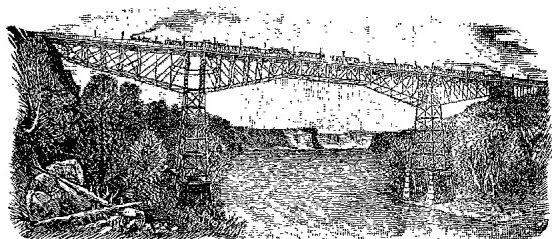
Michigan Central New Cantilever Bridge, Niagara Falls.

MICHIGAN CENTRAL

“The Niagara Falls Route.”
EAST. 2Mail. 2Day Express. 1N. Y. Express. 1Ath’ntic Express. 3Night Express 2Kal. Accom’n 2Local Pass’g’r.
STATIONS.
Chicago am 7.55 am 10.35 pm 3.10 pm 10.10 pm 9.25 pm 4.50
Michigan City 10.05 12.28 4.52 12.23 11.33 6.58
Niles 11.25 pm 1.30 5.45 1.50 am 12.55 8.17 3.45
Kalamazoo pm 12.55 2.45 6.58 3.35 2.27 am 7.10 5.29
Battle Creek 1.40 3.23 7.33 4.25 3.10 7.55 6.14
Jackson 3.30 4.47 8.52 6.15 4.45 9.35 7.55
Ann Arbor 4.52 5.45 9.41 7.50 6.00 10.43
Detroit 6.35 6.50 10.45 9.20 7.30 11.50
Buffalo 8.30 am 4.25 am 7.15 pm 5.55 9.05 pm 8.05
Rochester 6.50 9.15 8.00 11.45
Syracuse 8.10 11.35 10.15 am 2.15
New York pm 4.30 pm 8.50 am 7.20 11.15
Boston 10.00 10.50 9.35 pm 2.50
WEST. 2Mail. 2Day Express. 1Chicago Express. 1Pacific Express. 3Evening Express. 2Kal. Accom’n 2Local Pass’g’r.
STATIONS.
Boston am 8.30 pm 3.00 pm 7.00
New York 10.30 6.00 10.00
Syracuse pm 7.40 am 2.10 am 8.00
Rochester 9.55 4.20 10.45
Buffalo 8.30 am 12.25 6.35 1.20
Detroit am 9.10 8.0 pm 1.20 am 10.15 pm 3.00 pm 8.50
Ann Arbor 10.25 8.59 pm 2.20 11.55 9.15 5.17
Jackson pm 12.05 10.05 3.20 12.54 10.55 7.11 am 6.25
Battle Creek 1.45 11.36 4.30 2.15 am 12.27 8.8 7.55
Kalamazoo 2.50 pm 12.13 5.07 3.07 1.20 pm 9.45
Niles 4.20 1.30 6.22 4.32 3.00 am 6.00 8.40
Michigan City 5.42 2.7 7.20 5.43 4.35 7.30 10.15
Chicago 7.55 4.35 9.00 7.45 7.60 11.20
O. W. RUGGLES, General Pass. & Ticket Agent, Chicago. GEO. J. SADLER, Ticket Agent, Battle Creek.
Continue reading: THE MARVEL OF NATIONS,