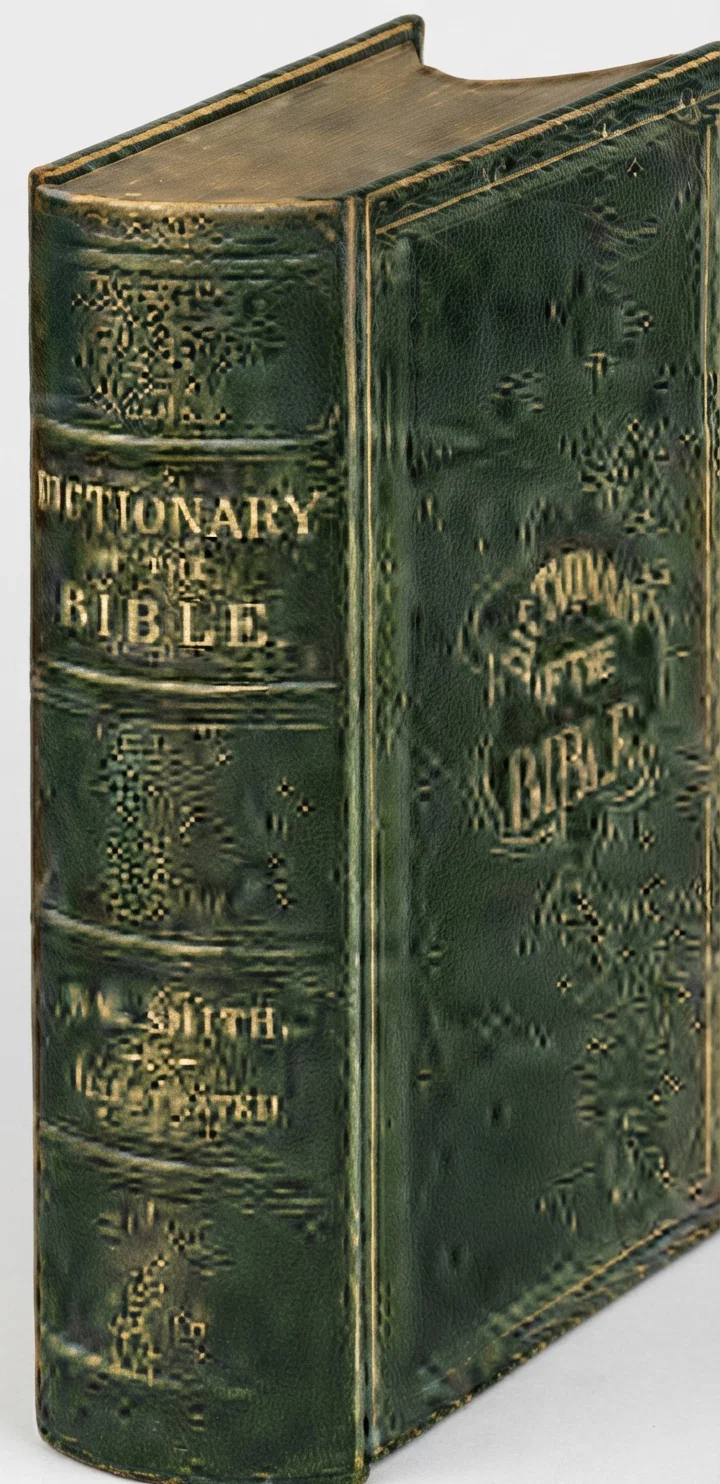
It contains a full description of every custom, place, plant, mineral, animal, etc., and a biographical sketch of every individual mentioned in the Bible
Publishers' price, bound in cloth, $4.50
Our price, post-paid, with the SIGNS, one year, $2.25
Book sent free for five new yearly subscriptions and one renewal at $1.00 each
LEARN TO SAY "I."
By G.
How MUCH better a confession of faults would sound if the personal pronoun "I" were used instead of "we." It would be more pointed, more influential, more exemplary, and would not have the appearance of trying to hide under the real or imaginary faults of others. For instance, we read in a contemporary, over an individual signature, "We live far beneath our privileges." Why did he not say, "I live far beneath my privileges"? An individual confession can be reached, and helped; it shows a desire for help. But to lump all the brethren into an individual confession is simply a general accusation. The "accuser of the brethren" is Satan. How often we hear the complaint, "The whole church is dead;" or, "The whole church needs converting;" or, "We, every one of us, are backslidden"! If the personal pronoun "I" comes in at all, it comes apologetically: "I can't live a Christian life in such a church; I just feel like going off by myself, where I can live right;" or, "I can't do any good where the church is in such a deplorable condition," etc., etc. The judgment is a personal matter between the individual and God. "Every one of us shall give account of himself to God." Rom. 14:12.
G.
Prophetic Lights
If you want a real help in the study of prophecy, you will find it in Dr. E. J. Waggoner's book,
"Prophetic Lights"
Heavy paper-cover edition - $0.50
SIGNS, one year - - - 1.00
Both, post-paid, $1.25
Book free for one new yearly subscriber and one renewal at $1.00 each
The Parker Jointless Fountain Pen
Is a constant comfort
A continual source of satisfaction
A thing of beauty
A joy forever
Having no shoulder where the fingers and thumb hold it, but gently tapering, it handles like an ordinary penholder, and is fitted with a good gold pen
NO
screw to break
nozzle to get "stuck"
joint to leak
ink on your fingers, and
chance for the buyer to rue his bargain
Makers' price for pen, $2.50
Our price for pen and SIGNS one year, $2.50
Sent free for five new names
Address
SIGNS OF THE TIMES
Oakland, Cal.
The Influence of Tracts in China
In twenty-three years the Central China Religious Tract Society has circulated over three million publications. Its tracts are in most cases sold, not given away, which fact indicates the desire of the people to obtain them. Some of them have been reprinted by the Chinese themselves and distributed at their own expense. At the recent anniversary of this tract society Dr. Griffith John gave some striking illustrations of the influence of these tracts upon persons of all grades in society. One case was mentioned of a man named Chang who found a tract in the basket of the waste-paper collector, the result being that he became a Christian and was the means of bringing nine persons into the Christian church.
THE MEANING OF DISEASE SYMPTOMS.
By David Paulson, M.D.
An illustration or two may be cited to show that the symptoms of disease are friendly, and that the thing to fight is the cause of the disease rather than the disease itself. Let us take fever, for an example. For hundreds of years it had been supposed that the thing to do in fever cases was to reduce the temperature of the patient at any cost, and by any means whatsoever; and when, by the use of some drug, the temperature of the patient was brought down from 103 degrees to 99 degrees, it was thought that a very wise and a very wonderful thing had been accomplished.
During the last few years it has been discovered that this is not the thing to do in fever cases. Dr. Hare, an eminent American investigator, and others who have made a study of this subject, have found out that the blood has greater antiseptic power at a temperature of 103 degrees than when at 99 degrees to 100 degrees. Dr. Hare experimented on guinea-pigs. He took some blood serum, inoculated it with fever germs, and injected it into the pigs, and by this means produced an artificial fever, the temperature promptly going up from 99 degrees to 104 degrees, and in some cases higher, just as it would in a man. Then he reduced this fever by administering some drug,—one of the products of coal-tar, which always tends to bring down the temperature,—and this quickly brought the temperature to 99 degrees or 100 degrees. He tried this experiment upon some of the guinea-pigs, and with others he let the fever run its natural course. The guinea-pigs in which the fever had been artificially reduced, died; the others lived.
We are not to conclude from this that there is nothing to do in fever, but our treatment must be of such a nature as to remove the cause of the disease, and then the disease will disappear; we want to take away the fuel, and then the fire will go out.
There are other things that nature does for the fever patient, one of which is the taking away of the appetite; the mouth is dry, and the stomach is equally dry. Nature seems to have "gone on a strike;" she refuses to produce gastric juice and support digestion, and at the same time fight the fever, so she does a wise thing by taking away the appetite, and thus saves a little recuperative energy in that direction.
But the neighbors come in with something which they think the patient can eat, and say, "Here are some preserves for poor Johnie, which I made myself, last winter." Perhaps nearly all of it is sugar; it is ready to ferment, and is full of germs, but "poor Johnie" takes it, and his mother says, "I am so glad that he is able to take a little nourishment!"
Nature takes away the appetite for a good purpose, but at the same time makes the patient extremely thirsty. There are plenty of gray-haired men who remember the time when the fever-patient was refused water; they were given nothing but beef tea and brandy. I recall hearing my father tell that water was never allowed in fever cases, but that they were given a little brandy and beef tea, beef tea being simply the wash water which is left after soaking the beef, and containing therefore the poisons and waste matter of the beef. So in giving this beef tea they were giving just the things in which germs would flourish, and thus adding a little more fuel to the flame.
Nature made the man thirsty, for a good purpose. Nature has something to do besides digesting food; she economizes her energy for curative purposes; but water does not have to be digested; it soaks through, as it were, the membranes, and washes out the ptomains and various poisons which really cause the trouble.
I remember a case of this kind in which the patient was not allowed any water; one night the patient, in his delirium, got up while his nurse was sleeping and went to the well, and, with the old-fashioned windlass, drew a bucket of water and drank nearly half a gallon. It was predicted that he would die, but he recovered, because by drinking an abundance of water he was really given an additional chance to live. Physicians now let a fever patient have all the water he wishes to drink. There is practically no disease in which the use of water would be injurious.
Another thing that nature does for the fever patient: she causes his skin to become warm and to sweat so as to carry off in this way some of the accumulated waste matters and poisons. It is the best thing that could be done under the circumstances, and the thing for us to do is to co-operate with nature by bathing and stimulating the skin so as to encourage it to eliminate more of these poisons and waste matters. You know we sometimes hear it said of a fever patient, "Don't let a drop of water touch him; if you do, he will catch cold and die."
We often see cases of fever in children where bathing has been a terror to their parents, especially to the mothers, who have been educated in this manner, and they will say: "What! going to give my boy a bath! Don't you think it will kill him?" Such a patient might jump into a snow-bank briefly without any definite injury, because his high temperature would protect him; there is no chance for him to be seriously chilled while his temperature is up to 103 degrees to 105 degrees. So you need not be afraid of brief cold sponging, etc., in fever cases.
It was the old style of medical practise to avoid the use of water in fevers, and there are some traces of the old style of treatment still remaining; but the best men in the profession stand for the principle of encouraging nature, by the use of water and all other rational measures, so that the patient may be safely towed into the harbor of health.
Again, nature makes the fever patient breathe fast, so as to throw off as much poison and waste matters as possible through the lungs. They are the most important eliminating organ in the body. If a person did not breathe for a few moments, his face would become blue, and he would soon die, because of the large quantity of poisons and waste matters which would accumulate in the system. It used to be said that the windows of the sick-room must never be opened, for, if they were, the patient might catch cold and die; no matter what the disease was, they must be kept closed, and, in addition, screens were often put around the bed of the patient, so that but little air could reach him.
The fact should also be mentioned that nature makes the heart of the fever patient pump fast, so as to exchange the blood rapidly and bring it to the lungs and kidneys and other organs as quickly as possible, and assist in saving the man. The old-time doctor used to say of such a case, "The pulse is too fast; we must bring it down." And so they did bring it down, just as the highwayman's club brings down the man who is opposing him. But we are now living in a better day.
In second-hand bookstores works can be found which teach these old-fashioned theories. Yet we are told of the superior health of the people of those early days; it is true that there was less degeneracy and sickness in those days than at present, but that was because there was more vital power in the human system, by which it was able to cope with these things, than there is to-day.
To sum up, then, the proper principles to keep in mind in treating a fever patient is to keep the skin in the best possible condition for the elimination of poisons; give the patient plenty of pure water, instead of giving him morphine or some drug to bring down his temperature arbitrarily, and which tends to put his stomach and skin in such a condition that they can not perform their functions. We should do everything possible that will encourage normal digestion, by the use of fruits and other things not difficult to digest, and which will, at the same time, stimulate the production of the digestive fluids and the activity of the bowels. By these methods it is not difficult to treat the fever patient, because nature heals him when the obstructions are removed.
It is not such a desperate thing to treat many of the ordinary diseases, if we only get hold of a few fundamental principles; nature works along simple lines in disease, as well as in everything else. When you come to examine the facts and principles which govern the proper treatment of disease, you will find the same simplicity as in the principles of spiritual health when they are understood.
DAVID PAULSON, M.D.
MATURITY'S LULLABY.
By Fred T. Elkin
SLEEP; yes, sleep in blest assurance,
Curtain'd with the cloak of God;
Angels with divine endurance
Guard unseen and silence-shod.
Sleep; 'tis not in vain He cradles
Thee, the least within His plan;
Sleeping, thou art peer to angels,
Waking, thou art but of man.
Sleep; for day shall surely find thee,
Pride of flesh itself assert,
Chains of weighty sin shall bind thee,
Wayward soul shall work its hurt.
Sleep; for nightly dear compassion
Taketh heart to touch the Lord.
Sleep; day breaks in sterner fashion,
Justice readeth from the Word.
Sleep; for day is swift in coming.
Sleep; too soon is respite through;
Angels heavenward must be homing,
Purified in baths of blue.
Hark! through morning's golden portal
Strays the song so dear to them,
Burden'd with the love immortal
Of the Babe of Bethlehem.
Denver, Colo. FRED T. ELKIN.
Our Higher Heredity
By Ursula N. Gestefeld
OUR heredity from God is more than our heredity from the flesh. We have but to gain the knowledge of what our higher heredity is,—health, joy, peace, wholeness,—and choose to act with it instead of with the other, and so gain the mastery of the fleshly heredity.
HINTS ON ECONOMY.
By Aunt Mary
THOUSANDS of men are out of employment, which means that unless they are fortunate enough or provident enough to have saved something from their former earnings, their families are without means of support. Such a state of affairs is not desirable, and sometimes we are disposed to join the army of grumblers, and to wonder why things do not happen otherwise. But adversity often has its uses, and many a housewife is learning lessons in economy that will help her over many rough places in life. It behooves wives and mothers, however well supplied their wants may be, to exercise their ingenuity in preventing waste, so that there may be a surplus to use in assisting those who are in need. It is astonishing how much could be used that is often put in the rag-bag or burned.
Large cotton or woolen stockings can be made over for the children when the feet are worn out. Good patterns can be obtained for a trifle, or one can cut a pattern of cloth, sew it up, and try it on the child. After the necessary alterations are made to secure a good fit, take it apart, and keep it for future use. Lay the pattern on the stocking and cut it out, using the best parts for the feet. After the seams are sewed, press them open, and catstitch down on either side, so they will not hurt the tender feet. An extra piece, put on like a patch and darned down at the heel and knee, will help them to wear longer.
Another item of interest to many mothers is the small boy's pants. They wear out so much faster than the coats that an extra pair or two must be provided to make the suit "come out even." Buy a good pattern, and use the discarded clothes of father, cousin, or uncle, as the case may be. There is almost always enough good material left in a pair of long pants to make a pair of short ones. If they are faded they may be made to look fresh and new by the use of diamond dye after the cloth is ripped and washed. Navy blue, black, and seal brown are the colors usually used for that purpose, and they will never fade.
Patchwork quilts have fallen into disfavor of late years; and while it is not advisable to cut large pieces of goods, just for the satisfaction of putting them together again, nice bed coverings may be made of scraps that could not be used for anything else. It is an excellent way to teach little girls to sew, for they will become interested in joining the light and dark colors. Flour sacks make good linings, so the quilts will not cost anything except for the batting and thread. Nice woolen quilts may be made of the best parts of old woolen dresses.
Warm skirts for children can be made of the lower parts of women's knit vests, the best parts of men's summer suits, and woolen dresses they have outgrown, if the sleeves are taken out and the neck cut low and bound. A woman's nightdress that is worn about the shoulders and sleeves will make a good nightdress for a child. Make a yoke and sleeves of new muslin, cut off the worn parts of the nightdress, and gather the lower part to the yoke. Faded light gingham may be bleached out white by the use of chloride of lime, and after the sleeves are taken out and the neck cut the proper shape, they will make nice aprons and underskirts. If for aprons, trim the neck and armholes with ruffles or lace; if for underskirts, they may be left as they are or have a lace edge put around the bottom.
A woman can often make dresses for the little girls out of very unpromising material. My little daughter needed a new dress to wear to Sunday-school, and I did not feel able to buy it. So I dyed an all-wool gray brocade dress of my own with wine-color diamond dye, and made the dress of it. It has a full skirt, with a deep hem, and three rows of gilt braid four inches from the bottom. The waist is plain, with a ruffle around the shoulders in the shape of a round yoke, and a row of braid one inch from the lower edge. The sleeves are full, and are gathered into cuffs. From the pieces that were left I made a tam-o'-shanter cap, with braid around the band. The braid had been used for trimming once before, and was turned over, so that the side that was soiled did not show.
Other economies will suggest themselves to the mother who is anxious to save the dollars and make the little ones comfortable.—Aunt Mary.
The Walla Walla College
Offers Practical Courses for those
who wish to prepare for
MINISTERS MEDICAL
NURSES MISSIONARIES
BIBLE WORKERS COMMERCIAL
MUSICIANS WORKERS
TEACHERS STENOGRAPHERS
A TRAINING-SCHOOL FOR WORKERS
ONE YEAR will be sufficient to prepare consecrated young men and women of average ability, and having a common school education, to take up work in the above lines. Rates very reasonable. Board is given on the European plan, thus affording opportunity for reducing expenses.
DO YOU WANT AN EDUCATION? DO YOU WISH TO PREPARE YOURSELF TO TAKE AN ACTIVE PART IN THE CLOSING WORK OF THE THIRD ANGEL'S MESSAGE? Our schools are being conducted for the training of young people to engage in the work. They are training-schools.
The Walla Walla College has a liberal offer to make to canvassers who wish to take a special course in any of the above lines.
For full information address W. R. SUTHERLAND, College Place, Washington
FLY SHUTTLE GARPET LOOM
The best, handiest, easiest running, cheapest, and most durable
FLY SHUTTLE GARPET LOOM
In the world,—100 yards a day. Catalogue free.
EUREKA LOOM CO.
501 S. Main St., Battle Creek, Mich.
When you write, please mention the Signs of the Times.
90% OF AMERICAN WOMEN
wash dishes three times each day. If you are one of these, wear a pair of "Goodyear" Rubber Gloves and always have soft, white hands. Sent by mail, post-paid, on receipt of $1.50. Agents wanted. Address, M. O. Dept.,
M. F. Reese Supply Co., Setauket, N. Y.
COVER YOUR OWN UMBRELLA
Don't throw away your old one—make it new for $1.00. Recovering only takes one minute. No sewing. A clumsy man can do it as well as a clever woman.
TEN DAYS' FREE TRIAL.
Send us $1.00 and we will mail you, PREPAID, a Union Twilled Silk, 26-inch "Adjustable Roof" (28-inch, $1.25; 30-inch, $1.50). If the "Roof" is not all you expected, or hoped for, return AT OUR EXPENSE and get your money back by return mail—no questions asked.
WHAT TO DO.—Take the measure (in inches) of your old umbrella. Count the number of outside ribs. State if the center rod is of steel or wood. Full instructions for putting on the cover will be sent with all orders. Our special price-list of different sizes and qualities mailed on request.
Send for our free book, "Umbrella Economy," anyway. Your umbrella will wear out some day, and you will be glad that you know about
THE JONES-MULLEN CO., 396-398 Broadway, New York
$1.00 for a new UNION TWILLED SILK Adjustable Roof
23 "And when He was come into the temple, the chief priests and the elders of the people came unto Him as He was teaching, and said, By what authority doest Thou these 24 things? and who gave Thee this authority? And Jesus answered and said unto them, I also will ask you one question, which if ye tell Me, I likewise will tell you by what 25 authority I do these things. The baptism of John, whence was it? from heaven or from men? And they reasoned with themselves, saying, If we shall say, From heaven; He will 26 say unto us, Why then did ye not believe him? But if we shall say, From men; we fear the multitude; for all hold John 27 as a prophet. And they answered Jesus, and said, We know not. He also said unto them, Neither tell I you by what 28 authority I do these things. But what think ye? A man had two sons; and he came to the first, and said, Son, go work 29 to-day in the vineyard. And he answered and said, I will 30 not; but afterward he repented himself, and went. And he 31 came to the second, and said likewise. And he answered and said, I go, sir; and went not. Whether of the twain did the will of his father? They say, The first. Jesus saith unto them, Verily I say unto you, that the publicans and the harlots 32 go into the kingdom of God before you. For John came unto you in the way of righteousness, and ye believed him not; but the publicans and the harlots believed him; and ye, when ye saw it, did not even repent yourselves afterward, that ye might believe him.
33 "Hear another parable: There was a man that was a householder, which planted a vineyard, and set a hedge about it, and digged a winepress in it, and built a tower, and let it 34 out to husbandmen, and went into another country. And when the season of the fruits drew near, he sent his servants to the husbandmen, to receive his fruits. And the husband-35 men took his servants, and beat one, and killed another, and 36 stoned another. Again, he sent other servants more than the first; and they did unto them in like manner. But afterward 37 he sent unto them his son, saying, They will reverence my 38 son. But the husbandmen, when they saw the son, said among themselves, This is the heir; come, let us kill him, and 39 take his inheritance. And they took him, and cast him forth 40 out of the vineyard, and killed him. When therefore the lord of the vineyard shall come, what will he do unto those hus-41 bandmen? They say unto Him, He will miserably destroy 42 those miserable men, and will let out the vineyard unto other husbandmen, which shall render him the fruits in their seasons. Jesus saith unto them, Did ye never read in the scriptures,
The stone which the builders rejected,
The same was made the head of the corner;
This was from the Lord,
And it is marvelous in our eyes?
43 Therefore say I unto you, The kingdom of God shall be taken 44 away from you, and shall be given to a nation bringing forth 45 the fruits thereof. And he that falleth on this stone shall be 46 broken in pieces; but on whomsoever it shall fall, it will scatter him as dust. And when the chief priests and the Pharisees heard His parables, they perceived that He spake of them. And when they sought to lay hold on Him, they feared the multitudes, because they took Him for a prophet."
17 "But He looked upon them, and said, What then is this that is written,
The stone which the builders rejected,
The same was made the head of the corner?"
NOTE.—The texts inclosed in marks of parentheses, while not essential to the lesson study, will be found to throw much light upon the lesson, and are suggested for those who wish to study further.
SUGGESTIVE QUESTIONS.
When Jesus arrived at the temple, and began to teach, what question was asked Him by the priests, scribes, and elders? Matt. 21:23. Note 1. (John 2:18; 3:1, 2.)
What reply did Jesus make to the question? Verses 24, 25. (John 1:19-27.)
What did they finally say in reply? Verse 27. Note 2.
Knowing their craftiness, what reply did Jesus make? Verse 27, last part.
Having brought His adversaries to confusion by His wise answer, how did Jesus begin to put them in their true light before the people? Verses 28-30. (2 Sam. 12:1-7.)
When the priests were asked which of the two sons did right, and they had rendered their verdict, what application of the parable did Jesus make? Verse 31. (Luke 7:37-39, 47-50.)
What two alternatives were then set before all the people? Verse 44. (1 Peter 2:6-8.)
When the priests saw that this parable was spoken against them, what prevented them from laying hold on Christ? Verses 45, 46.
Side Lights.—"Desire of Ages," chapters 65, 66; "Spirit of Prophecy," vol. 3, chapters 2 and 3.
NOTES.
1. Chief priests, etc.—Of these three classes the highest council of the Jews was composed. They were constituted the keepers of the temple, the only public building left by the Romans entirely under Jewish control. They believed their rights to have been invaded by One who was neither priest nor Levite, scribe nor elder, and who had taken possession of the temple as tho it were His own. During the absence of Jesus since the evening before, there had evidently been a council of the Sanhedrin (Mark 11:18), and their plans had been definitely marked out, but, as will be seen, they failed to execute them.
2. We can not tell.—While the authorities had never acknowledged John's mission, they had never openly condemned him; indeed, they did not need to, because they saw from John's course that Herod would put him out of the way. So they were willing to have it understood that they participated in the popular sentiment. Had they acknowledged John's mission as heaven-born, they would have had no excuse for rejecting Christ, whose forerunner he was. They could, on the present occasion, have told what they believed about John, but dared not do so before the throng of people listening to the controversy. Christ's answer to their question was wholly unexpected by them, and they were completely discomfited.
3. The publicans.—This was to compare them most unfavorably with the lowest people of that day,—those whom the Jews themselves affected to despise. It was tearing aside their vail of hypocrisy in the presence of those whose leaders they were, and whose good opinion they coveted. But the Saviour was not yet done with them; He would yet reveal what they, in their hearts, purposed to do to Him.
4. They say.—By reference to Luke 20:9, it will be seen that this parable was directed to the people, in order that they might render judgment against the priests, whom they would see had been leading them astray. It must have been they, therefore, who gave the decision as recorded by Matthew; for Luke goes on to say (20:16) that when the decision was spoken, those who heard it said, "God forbid." This exclamation of the priests was probably uttered because they thought that the parable was spoken against them, and they could not consent to the conclusion reached.
5. The stone.—This was a quotation from Psalms 118, which was familiar to the Jews, as referring to the Messiah. It was also a part of the "great Hallel," which had been shouted by the people two days before while waving the palm branches, also that which the children had sung in the temple immediately after its cleansing.
1 "LORD, Thou hast been favorable unto Thy land;
Thou hast brought back the captivity of Jacob.
2 Thou hast forgiven the iniquity of Thy people,
Thou hast covered all their sin. Selah.
3 Thou hast taken away all Thy wrath;
Thou hast turned Thyself from the fierceness of Thine anger.
4 Turn us, O God of our salvation,
And cause Thine indignation toward us to cease.
5 Wilt Thou be angry with us forever?
Wilt Thou draw out Thine anger to all generations?
6 Wilt Thou not quicken us again;
That Thy people may rejoice in Thee?
7 Show us Thy mercy, O Lord,
And grant us Thy salvation.
Little Priced BOOKS
By Editor
If enough acceptances of the offer made at the bottom of this column are received before November 1, we will publish paper-covered editions of
THE STORY OF PITCAIRN ISLAND
By Editor
POLITICAL SPEECHES and DEBATES
and send BOTH BOOKS post-paid to subscribers for only 85 cents.
These editions will be limited to the actual number of acceptances received before the above-mentioned time, and the completed books will be ready before the holidays.
. . Description . . .
Both volumes are too well known to make an extended description necessary, therefore we only give a very brief notice here, but will send further information if desired. The first title is