The Youth’s Instructor, Vol. 31, No. 51.

LIFE IN NORWAY

The Youth’s Instructor

Dec 19, 1883

S. D. A. Publishing Association · Battle Creek, Mich. · Dec 19, 1883

LIFE IN NORWAY.

NORWAY is full of picturesque scenery, and were it not for the shortness of its summers, the country would be no mean rival to Switzerland in the homage received from travelers. The long coast is everywhere indented by fiords, or deep, narrow inlets from the sea, many of which reach into the land for many miles. These fiords, which are usually bordered either by hills or precipitous cliffs and rocks, varying from one thousand to four thousand feet in height, so intersect and cut up the country that the interior is best reached by water.
The voyage up the coast gives a view of much grand and beautiful scenery. The shore is studded with innumerable islands of all sizes, varying from a few yards in diameter to several miles; and among these the steamer makes its way with difficulty. Sometimes the channel is as narrow as a river, and again it spreads out into a mighty lake; and the ever-varying forms of the islands, the fiords, and the mountains, are constantly opening new and magnificent prospects to the view. As we go northward, the scenery becomes more wild and grand. The islands are often high and broken, rising like towers and pyramids from the water, and grouped together in strange confusion. Between these jagged pinnacles may be seen the hills of the mainland, while in the background stretches the high snowy tableland. The Seven Sisters, seven majestic peaks, four thousand feet high, seated closely side by side, with their night-caps of gray fog and their feet in the water, are spoken of as one of the most majestic sights of the coast.
But bleak and desolate as the coast appears, the back country has its fertile districts,—its pasture-grounds and forests, its corn lands and pleasant homes, of which the traveler sees nothing; and he might therefore gain a wrong impression of Norway unless he sailed up some of the narrow fiords into the heart of the country. So tranquil is the water of these inland fiords that they seem like long narrow lakes. The scenery from the shores is varying,—now wild and grand, and now beautiful and tranquil as a picture. Here are precipitous, wooded shores, gashed with sudden ravines; there rocky peaks, with cliffs of dark red rock, over which rush foaming torrents from the snows melting on the summit, into the fiord below. And ever and anon the voyager gets a view, through the openings, of green fields and red farm-houses. Occasionally, too, a sloping hillside or sunny valley finds its way down to the edge of the fiord, and opens up a pleasant picture indeed,—a little village with its snug-built houses and church-spire (for scarcely a village in Norway is without a church), fields of grass and barley, and farm-houses, and goats and cows grazing on the rocky slopes. Sometimes, too, villages look down from the top of the cliffs, which stretch back into land that is tillable, though not so fertile as that of the valleys.
If the traveler tires of the water, he may leave the fiord at some of the villages along the shore, and proceed by land until he is again stopped by another fiord. He travels overland in a cariole, the national Norwegian vehicle, which is some like the American sulky, and carries but one person. It has usually no springs, however, and the rider gets the benefit of all the spring of the road. This cariole he usually takes with him, but he has to depend on the country through which he passes, for horses. The farmers along the way are obliged by law to furnish horses and guides for a stipulated sum per mile to send travelers from one “post-station” to another. These stations are usually from ten to fifteen miles apart, according to the roughness of the way and the distance between the fiords. Sometimes it is necessary to wait several hours at the stations for horses to be brought from a neighboring farm. This gives the traveler a good chance to study the customs of the country people, as well as an opportunity of cultivating his patience.
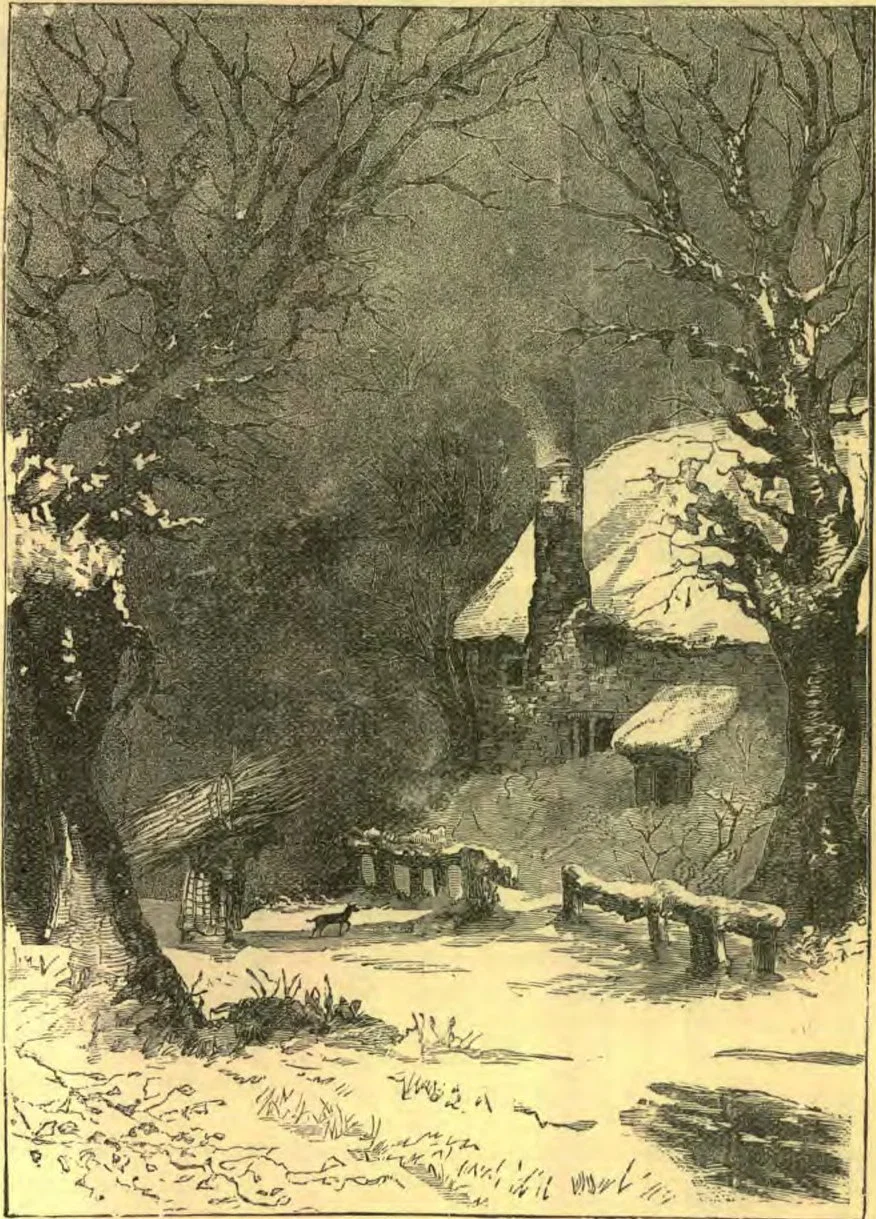
Passing through Norway during the short summer, and seeing the beautiful scenery, the snug little homes, the men and women working gaily in the fields, one might think it a very romantic place to live in. But the long, cold winter, which there covers so great a portion of the year, tells a very different story. The soil is generally rocky and sterile; and the people have to toil very hard for what little they have. The women and children take fully their share of the rough, hard work, and a woman laden with a great sheaf of wheat or a huge bundle of sticks for fire-wood, is no uncommon sight. The summer is so short that but few kinds of produce can be raised, and were it not for the abundance of fish which the lakes, streams, and fiords furnish, many must suffer for food during the long winter. The life of the farmers in the more secluded districts must be very lonely in winter. The farms are confined to the small patches of more fruitful land along the fiords and at the foot of the mountains; and being frequently many miles from neighbors, the stormy winter cuts off all communication between them.
The native Norwegian is open-hearted, truthful, and hospitable, and loves his country devotedly. A Bible is found in almost every hut, and there seems to be generally a profound and sincere respect for it. Public education is well cared for, even among the poorer classes. There is an elementary school in every village, and where the people are thinly scattered, the school-master goes from farm to farm, so that all may have the benefit of his instruction.
The Norwegian people are very fond of music and poetry; and the songs and stories, or sagas, in which the old scalds, or poets, of the Northland have preserved the deeds and exploits of their Viking forefathers, are handed down from generation to generation.
“And then the blue-eyed Norseman told A saga of the days of old. ‘There is,’ said he, ‘a wondrous book Of legends in the old Norse tongue, Of the dead kings of Norway,— Legends that once were told or sung In many a smoky fire-side nook, By wandering saga-man, or scald.’
  • *
“And in each pause the story made, Upon his violin he played, As an appropriate interlude, Fragments of old Norwegian tunes, That bound in one the separate runes, And held the mind in perfect mood.”
The principal cities of Norway are Christiana, the capital and largest city, on the southern coast, and Bergen and Drontheim, on the western. Drontheim, the oldest of these cities, and once the capital of Norway, is the cradle of ancient Norwegian history and the residence of a long line of kings. It was founded by king Olaf I. who in the tenth century destroyed the pagan temples and undertook to introduce Christianity into Norway by force. As the saga runs:—
“Olaf, the king, one summer morn, Blew a blast on his bugle-horn, Sending his signal through the land of Drontheim.
  • *
“And king Olaf cried, ‘I command This land to be a Christian land; Here is my bishop, who the folk baptizeth.’
  • *
“So all the Drontheim land became A Christian land in name and fame, In the old gods no more believing and trusting.”
Bergen is described as a prosperous looking town on the slope of a long green hill crowned with woods; and with its large square houses and suburban cottages and gardens, reminds the traveler of a Swiss town. Christiana has a pleasant situation at the head of the beautiful fiord of Christiana. The ancient citadel of Akershus, perched upon a rock, commands the approach to the city, fine old linden trees rising above its white walls and tiled roofs. The principal street of the city is the broad Carl Johansgade, which leads directly to the imposing white marble front of the Royal Palace. The environs of the city are said to be remarkably beautiful. From the quiet basin of the fiord the land rises gradually on all sides, dotted with smiling country-seats and farm-houses, while beyond rise the dark evergreen forests to the summits of the mountains in the distance. And with this glimpse of its capital, we must bid goodbye to Norway.
E. B. G.

Christmas Hymn Verses on the Star of Bethlehem

But the star that shone in Bethlehem Shines still, and shall not cease; And we listen still to the tidings Of glory and of peace. —Adelaide A. Proctor.

Christmas Bells: Verse on Hope and Peace

Then pealed the bells more loud and deep, “God is not dead! nor doth he sleep! The Wrong shall fail, the Right prevail, With peace on earth, good-will to men!” —Longfellow.

Christmas Rhymes

Breaking on the twilight stillness, Listen to the Christmas chimes; They have brought the same glad tidings More than eighteen hundred times— Peace on earth!
Let the bells ring out the joy of the nations, Jesus the babe of the manger is King; He is the highest who once was the lowest, Let all the children be joyful and sing, “Peace and good will, strife shall be still, The babe of the manger is King.”
Ring, ye bells! ’tis sweet to listen; Sing, ye friends, outside the door, Echoes of that wondrous music That was heard in days of yore. Dress the house with holly, Let the bright red berries shine, While we celebrate the birth-night Of our gracious Lord divine.
There’s a song in the air, there’s a star in the sky, There’s a mother’s deep prayer and a baby’s low cry; And the star rains its fire while the beautiful sing, And the manger of Bethlehem cradles a King. —J. G. Holland.
Sound over all waters, reach out from all lands, The chorus of voices, the clasping of hands; Sing hymns that were sung by the stars of the morn, Sing songs of the angels when Jesus was born! —Whittier.

LITTLE DUTIES.

A LETTER-CARRIER in one of our large cities, a few months ago, found on reaching the post-office, after a long round of delivery, a letter in his bag that he had overlooked. It would have taken him half an hour to return and deliver it. He was very tired and hungry. The letter was an ordinary, unimportant-looking missive. He thrust it into his pocket and delivered it on his first round next day.
What consequence followed? For want of that letter a great firm had failed to meet their engagements; their notes had gone to protest; a mill was closed, and hundreds of poor workmen were thrown out of employment.
The letter-carrier himself was discharged for his oversight and neglect. His family suffered during the winter for many of the necessaries of life, but his loss was of small account compared to the enormous amount of misery caused by his single failure in duty.
Another case. A mechanic who had been out of work a long time in New York, went last September to collect a small sum due to him. The gentleman who owed it, being annoyed at some trifle, irritably refused the money. The man went to his wretched home, and, maddened by the sight of his hungry wife and children, went out to the backyard and hanged himself.
The next day an old employer sent to offer him a permanent situation. Here was a life lost and a family left paupers because a bill of a dollar or two was not paid at the right time.
The old Spanish proverb says, “There is no such thing as a trifle in the world.” When we think how inextricably the lives of all mankind are tangled together, it seems as if every word or action moved a lever which set in motion a gigantic machinery, whose effect is wholly beyond our control. For this reason, if for no other, let us be careful to perform promptly and well the duties of life—even the most trivial.—Selected.

THE TWO DAUGHTERS.

THERE was once a mother who was separated from her two daughters when they were little children, and did not see them again until they were nearly grown up. When the time came for her to live with them once more, her heart was full of wonder and longing, and strange hope and fear combined. What would they be, the two girls who had been children when she saw them last? Would they love her? would they obey her? would they make her happy or sad by their behavior to her? A thousand questions she asked herself about them, and at last came the time when she could have them answered.
The oldest daughter, Rosa, rushed into her mother’s arms.
“Oh, how I love you!” she cried. “Dear, dearest mamma, how glad I am that you have come back! Now I will make you so happy that you will never leave us again.”
The younger daughter, Ruth, stood apart, shy and silent. She had barely a word of welcome for her mother; she was awkward, and plain, and stupid in appearance; her mother looked at her with grief and disappointment.
“I shall have no comfort in Ruth,” she thought; “it is Rosa who will make me happy.”
She delighted in Rosa’s sweet words and caresses, in her bright eyes and blooming cheeks, in her merry laughter and conversation. But by and by she began to discover that while Rosa hung about her neck with kisses, it was Ruth who did without waiting to be told, or expecting to be rewarded, all the little tasks that insured her comfort. It was Ruth who took care of the canaries, and tended the flowers, and saw that the fire was bright, and ran to do an errand, or give a message, and never was tired or impatient when anything needed to be done.
Rosa dressed herself in her pretty frocks, and sang sweet songs all full of loving words, to her mother; but Ruth dusted the piano, and kept the music in order, and stood over the hot fire to make the toast that her mother liked crisp and brown. If she was sick, or tired, or anxious, Rosa would call her “darling mamma,” and say how sorry she was; but Ruth would think of something, and quietly do it, to make her feel better. Before many days the mother found out that her awkward, plain daughter, who had so little power to express her affection, loved her far more tenderly and truly than the pretty Rosa, who had so many sweet words at her tongue’s end.
So, perhaps, our Father in heaven learns which of his children love him best. There are some who will sing the Sabbath-school hymns with loudest voices, and take the prize maybe for learning the largest number of verses; and yet they will go home, and be so rude, and selfish, and unkind! Be ye doers of the word, and not hearers only, the Bible tell us. And to go to Sabbath-school, and to learn hymns and verses is very well indeed; but unless we practice the good lessons they teach us, and try to make others happy by kind acts as well as words, we can never truly please our heavenly Father. Let us pray that we may love him with our hearts, and serve him with our lives, and then we shall be his children indeed.—Selected.

THE CLOSE OF THE YEAR.

Dropping, dropping, dropping, Slowly dropping away: Like the silent sands of the hour-glass Drops the old year day by day.
Dropping, dropping, dropping, No sound of a spoken word; But every day had a tale to tell, Which only God has heard.
Dropping, dropping, dropping, Swiftly dropping away: So go the years of our early life On their appointed way.
Dropping, dropping, dropping, Oh! joy to see them go, If they tell a tale in our Father's ear Of a holy life below.

THE BURNING BUSH.

BEYOND the desert pastures, closely grazed By Midian's myriad flocks, even to the foot Of Horeb's sacred mount, the man of God Had led his sheep. Here, undisturbed by cares, Save that his flocks strayed not, he mused alone, And, while reclining in some friendly shade Whose ever changing, ever varying form Serves to remind him of the changes sad From years long gone, he lives his life again. The favorite of Egypt's princely court And captain of her mighty men, once more He wields the sword of power at the head Of armed hosts, or with his chariot, fierce Descending, spreads confusion and dismay Among his enemies. Again he sees His brethren groaning 'neath the oppressor's hand; And then, impatient for the time to lead Them forth from bondage to the promised land, He metes swift vengeance on the man who wronged An Israelite, and for his daring deed, He flees the wrath of an offended king.
And now, the years of his humility He lives again. Long had he thought to see His kindred and his friends once more, and bring Them out from Egypt's cruel servitude; But hope deferred has made him sick at heart, And he has yielded to the stern decree Of fate, content to lead a shepherd's life, And in his solitude, commune with God.
His raven locks and flowing beard are whitened with the flight of years, His softened heart, no longer young, finds sweet relief in bitter tears.
A startling sight disturbs his reverie—A fierce, consuming fire in a bush Is burning with a steady flame, and yet The bush is not consumed. “This is most strange,” The prophet said; “I will now turn aside And see this sight, and why the bush burns not.” With cautious steps the holy man draws near, When, lo! the voice of God calls from the flame. With trembling, Moses answered, “Here am I.” Again the voice directs him, “Draw not nigh, But put thy shoes from off thy feet, for where Thou standest now is holy ground. I am Thy fathers' God, the God of Abraham, The God of Isaac, and of Israel.” But Moses feared, and hid his face from God. Once more the voice speaks to the trembling man: “The great affliction of my people I have seen, And I have heard their cry, and I am come To bring them up out of that land unto A good land and a large, a land with milk And honey flowing. Come, now, I will send Thee unto them, that thou mayst bring them forth.” But Moses answered: “Who am I, that thou Shouldst send by me! I am not eloquent; I speak with broken words and faltering tongue.” Then said the Lord to him: “Who made man's mouth? Who made the dumb? Is it not I, the Lord?” But Moses said, “I pray thee, O my Lord, That thou wilt send by him whom thou wilt send.” Then was God angry with the man, because He had no faith, when he had seen the signs And wonders great which God had wrought for him. “Go,” said the Lord. “Behold, thy brother I Will give to be a mouth for thee; and thou Shalt be as God to him.” And Moses went.
EUGENE LELAND.

NEW-TESTAMENT HISTORY.

LESSON 166.—EXHORTATION TO CHEERFUL GIVING.

CONTINUING his exhortation to purity of life, Paul says, “Having therefore these promises, dearly beloved, let us cleanse ourselves from all filthiness of the flesh and spirit, perfecting holiness in the fear of God.”
Some time had now elapsed since Paul at Ephesus began his first letter to the Corinthians. He had passed through many trials, and had suffered no little anguish of spirit. From Ephesus he went to Troas, where he says a “great door and effectual” was opened unto him. Yet even here he was much troubled because Titus did not come to him as he expected. His own words are, “My spirit found no rest, because of Titus, my brother.”
On leaving Troas, he crossed the Ægean Sea, and came to Philippi, where he found Timothy, and other fellow-workers. He was still very anxious about his Corinthian brethren. He says: “When we were come into Macedonia, our flesh had no rest, but we were troubled on every side; without were fightings, within were fears. Nevertheless, God, who comforteth those that are cast down, comforted us by the coming of Titus; and not by his coming only, but by the consolation wherewith he was comforted in you, when he told us your earnest desire, your mourning, your fervent mind toward me; so that I rejoiced the more.”
The report brought by Titus must have been very encouraging, and very satisfactory to Paul; for he writes to the Corinthians, “In all things ye have approved yourselves to be clear in this matter.” And again, “Great is my boldness of speech toward you, great is my glorying of you, I am filled with comfort, I am exceeding joyful in all our tribulation.”
Paul’s first letter had wrought a good work in the church at Corinth. It had produced a godly sorrow that led to sincere repentance.
The apostle speaks of the generosity of the churches in Macedonia, and urges that the same grace be cultivated among the Corinthians. The Macedonian brethren had set a worthy example in first giving themselves to the Lord, and then consecrating all they had to his service. Paul says to the Corinthians: “As ye abound in everything,—in faith, and utterance, and knowledge, and in all diligence, and in your love toward us, see that ye abound in this grace also; . . . for ye know the grace of our Lord Jesus Christ, that, though he was rich, yet for your sakes he became poor, that ye through his poverty might be rich.”
For the encouragement of those who have but little in this world, the apostle shows that it is the liberal spirit that is prized of God, rather than the gifts bestowed. He says, “For if there be first a willing mind, it is accepted according to that a man hath, and not according to that he hath not.” He praises the Corinthians for their willingness to pledge in the past, and calls on them to fulfill their pledges promptly and cheerfully. They need have no fear that a well-guided liberality will bring them to want; for, “He that soweth sparingly shall reap also sparingly, and he that soweth bountifully shall reap also bountifully. Every man according as he purposeth in his heart, so let him give; not grudgingly, or of necessity: for God loveth a cheerful giver. And God is able to make all grace abound toward you; that ye, always having all sufficiency in all things, may abound to every good work.”
In his tender solicitude for their obedience and prosperity, the apostle appeals to their love for himself, as well as for the Saviour, saying, “Now I Paul myself beseech you by the meekness and gentleness of Christ.” He acknowledges that he is lowly among them; but the words he has to speak are powerful; they are from God himself. He says, “The weapons of our warfare are not carnal, but mighty through God to the pulling down of strong holds; casting down imaginations, and every high thing that exalteth itself against the knowledge of God, and bringing into captivity every thought to the obedience of Christ.”
In speaking of his care for the Corinthians, the apostle uses these words: “I am jealous over you with godly jealousy; for I have espoused you to one husband, that I may present you as a chaste virgin to Christ. But I fear, lest by any means, as the serpent beguiled Eve through his subtilty, so your minds should be corrupted from the simplicity that is in Christ.”

QUESTIONS.

1. In continuing his exhortation to purity of life, what words does Paul use? 2 Cor. 7:1.
2. Where did Paul begin his first letter to the Corinthians?
3. What had befallen him since then?
4. When he left Ephesus, to what place did he go?
5. How had he once been prevented from preaching at that place?
6. What does he say about the opportunity now afforded him there?
7. What troubled him?
8. How did he speak of this trouble?
9. On leaving Troas, where did he go?
10. Whom did he find there?
11. For whom was Paul still very anxious?
12. How does he speak of the state of mind caused by this anxiety?
13. How was he comforted?
14. What must have been the nature of the report brought by Titus?
15. How does Paul express the satisfaction that this report had given him? Verse 11.
16. How does he rejoice because of it? Verse 4.
17. What was the effect of Paul’s first letter to the church at Corinth?
18. In what had the Macedonian brethren set a worthy example?
19. How does Paul exhort the Corinthian brethren with reference to the same? Chap. 8:7.
20. What does he say about the example of our Lord Jesus Christ? Verse 9.
21. How does he encourage the poor? Verse 12.
22. For what does he praise the Corinthians? Chap. 9:1, 2.
23. What does he call on them to do?
24. Why need they have no fear that giving will bring them to want? Verse 8.
25. By what figure does he illustrate this? Verse 6.
26. How must we give if we would please God? Verse 7.
27. In what words does Paul make an earnest appeal to the Corinthians? Chap. 10:1.
28. What does he acknowledge?
29. What is the character of his words?
30. Why are they so?
31. What does Paul say about the weapons of his warfare? Verses 4, 5.
32. What words does he use in speaking of his care for the church? Chap. 11:2, 3.

Love for Parents.

Many years ago, there was a frightful eruption of Mount Etna, which obliged the inhabitants of the surrounding country to run in every direction for safety.
Amidst the hurry and confusion of this scene, while every one was carrying away what he thought most precious, two sons, in the midst of their anxiety for the preservation of their goods, recollected their father and mother, who, being both very old, were not able to save themselves by flight. “Where,” exclaimed the generous youths, “shall we find a more precious treasure than our parents?” This said, the one took up his father on his shoulder, the other his mother, and so made their way through the surrounding smoke and flames.
They were rewarded by the respect and affection of their neighbors, by the thankfulness and the tears of their parents, and by their own subsequent prosperity and happiness.

Things Seen Are Mightier Than Things Heard

Things seen are mightier than things heard; and example is tenfold more powerful than precept.

How They Kept Christmas.

“Susie! Susie!”
But Susie didn’t answer; she was sitting on a low footstool, looking earnestly at the coals in the grate, and did not hear.
“I say, Susie!” said her brother Ben, going up to her and laying his hand on her shoulder.
“Well, what?” said she at last, looking up.
“Do you know it’s only two weeks till Christmas?” he said, throwing himself down on the rug beside her.
“Yes; and I was just trying to think what we would have, and what we could do.”
“Can’t have anything,” he said crossly. “You know father’s been sick this winter, and mother says it is all we can do not to run in debt now. What chance is there for Christmas presents?”
“I have a little money in my bank,” Susie replied, “and you boys have some too, and Grace. Now I was thinking how nice it would be if we could give something instead of always getting all the things ourselves.”
“Capital!” cried Ben, “Let’s tell the rest about it.”
So they went out to the wood-house, where Rob and Will were piling up the wood, and told them their plan. The boys thought it would be just the thing, and when the evening’s work was done, and their mother was in the bedroom with their father, they gathered in a knot beside the grate to decide what they would give.
“I haven’t got much money,” said Rob. “I have only twenty-five cents.”
“Neither have I,” said Ben.
“Why not make something?” said Susie.
“Good,” they all cried.
“You remember that piece of black walnut in the shop? I’ll saw out a bracket for mother from that. Won’t she be pleased though!” and Will gave a low whistle at the thought.
“Just the thing,” said Susie. “What will you make, Ben?”
“I don’t know. I’ve got some boards that I might make a work-box out of. Do you suppose she’d want that?”
“To be sure,” his sister replied. “Why, I heard her say just yesterday that she did wish she had a new work basket, for her old one was all worn out.”
Will and Ben had a bench and a few tools up in the loft of the barn, and this they called “the shop.” They had become quite skillful in using these tools, and there was hardly a boy in the neighborhood who did not have a windmill or something of the sort that had been made in this shop.
“I’m sure,” said Rob, who was the youngest of the boys, “I can’t think of a single thing that I can do. I don’t know how to use the tools, and what would I make if I did?”
“I’ll try to think,” said Susie. “And now Grace—”
“I know,” said Grace; “I’ve been a-thinking. Don’t you see mother’s kitchen apron has most got a hole in it? I know how to hem, and I can make another. I’ve got money enough in my bank to buy the gingham.”
“Capital! little sis,” cried Ben. “Who ’sposed you could do anything?”
“And I,” said Susie, “I will make some slippers for father to wear when he gets up again, and I’ll work a tidy for mamma’s hair.”
“I’ve got it, Rob,” said Ben, who had been looking into the fire.
“Got what?” asked Rob.
“Why, thought of something for you to make. Don’t you remember how mother burned her hand the other day stirring the pudding with a spoon? ’Spose you whittle out a long-handled pudding stick for her.”
“She’ll like it so well, Rob,” said Susie.
And at last they had decided just what each one was to give, and all how it was to be made. Then, bidding their father and mother good night, they went to bed, eager to set to work on the morrow.
Those were very busy days. There was much whispering and talking to be done, and many sly meetings were held in Susie’s room, where they often went to show each other their work. They made things for one another, too. Ben was hard at work on a box for Susie, just like the one his mother was to have, only a little smaller. And Susie was also busy making wristlets, mittens, penwipers, and such things for the boys.
It lacked but two days of Christmas, when Ben rushed in one day, and said, “O mother, mayn’t we have a Christmas tree?”
“I have no objection if your father is willing; but there’ll not be very much to put on it,” she added, rather sadly.
Ben was out of hearing before his mother had hardly finished talking; and as his father was willing, he ran up stairs to find Susie.
“Susie, Susie,” he cried, “we’re going to have a tree!”
“Oh!” said Susie, stuffing a mitten in her pocket, and tipping over the work-basket in her haste. “And I’ve thought of another thing, Ben, if mother will only let us do it.”
“Well?” said Ben.
“To have Mrs. Bennett, our washer-woman, and her little girl and boy come up here to the tree. You can make him a top, and—”
“I’ll mend our old sled and paint it up for him, too,” said Ben. And away they both ran to ask mother, who very gladly gave her consent.
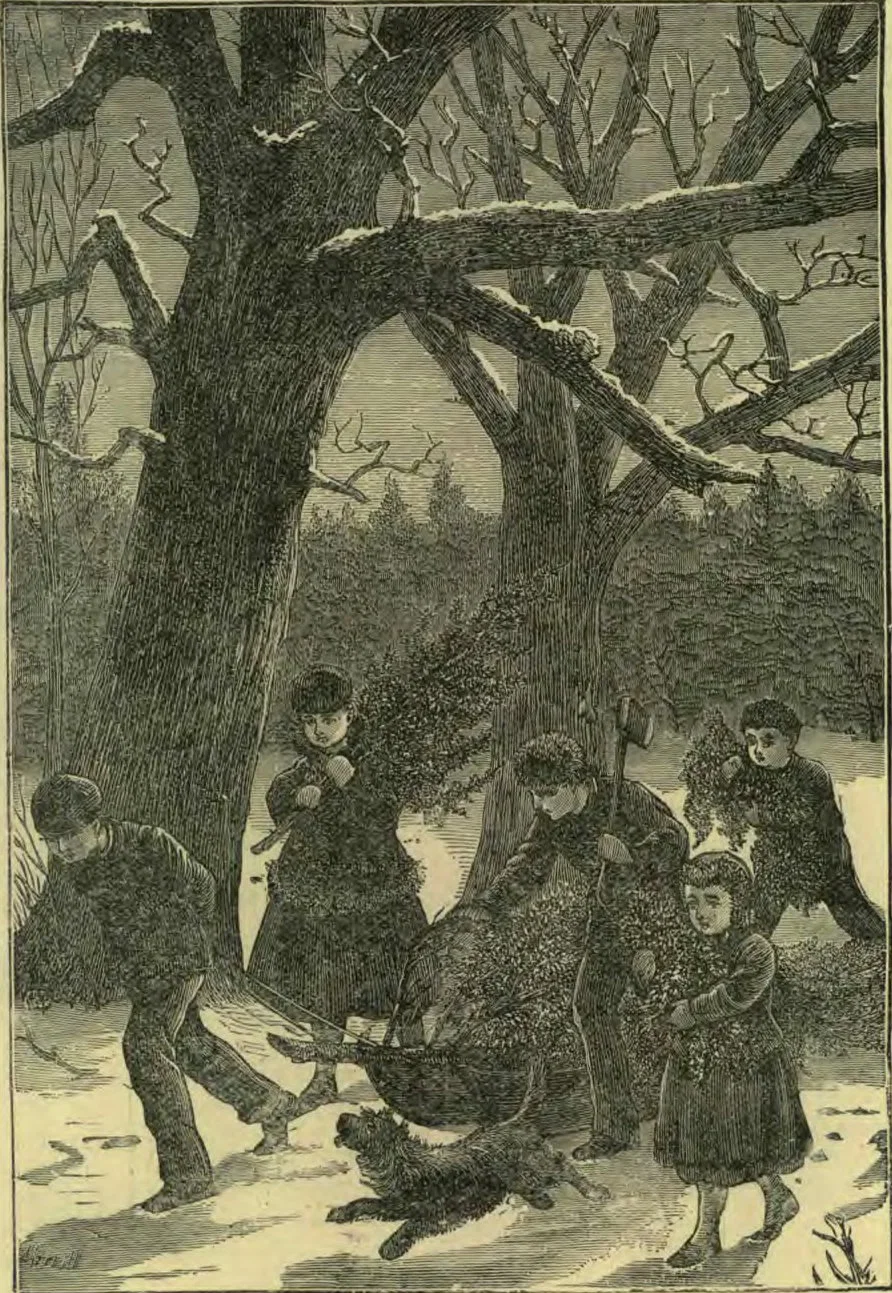
Next day they all went to the woods to get the tree, stopping on their way to ask Mrs. Bennett to come up to their house. They brought home some dark trailing vines with red berries on them, and evergreens, to trim the parlor.
After they had set the tree up, they popped and strung corn for their mother to hang in festoons on the branches, and made little cornucopias of bright-colored paper and filled them with pop-corn and molasses candy. Then Susie sent them all out of the room while she hung the presents on the tree.
In the evening their father was lifted into the easy chair and wheeled into the parlor to see the tree. It looked very pretty as their mother set the lamps behind it. Mrs. Bennett had not been forgotten, for their mother had put many useful things on the tree for her; and Grace, after several crying spells, had given her best doll to the little girl.
They spent a very happy evening looking at their presents and playing games. When their company had gone, and they were sitting around the fire, Ben said, “It’s a good thing father was sick, anyway.”
“Why, Ben!” said Susie.
“Well, I don’t mean just that,” Ben said; “only if he hadn’t been, we would have had more money to spend, and wouldn’t have known how nice it is to make things ourselves.”
“I think,” said Will, “it is the happiest Christmas we ever had.”
“That,” said their mother, “is because you have tried to make others happy instead of thinking only of yourselves.”
The children were quite surprised when their father and mother said that they should prize the things that they had made for them much more than anything they could have bought.
And with the soft snow that was falling silently to the earth, came into their hearts a double portion of that “peace on earth and good will toward men” which the Christmas-time was meant to bring. W. E. L.

You have reached the end of this edition.

The Youth’s Instructor · Dec 19, 1883