Your ShelfYour Projects

Signs of the Times, Vol. 31, No. 9.

THE ANGEL OF PATIENCE
Earlier text: EVOLUTION AND GEOLOGY

Encouraging Reports From China

Reports to headquarters of the China Inland Mission are said to be very encouraging. One report says: "During the last fortnight over two hundred converts have been noted; these come from twenty stations in seven provinces." Another says: "In several districts the lives of the converts have received spiritual quickening, and expensive idols have been destroyed." A further report announces that "everywhere there are openings for the propagation of the Gospel and the dissemination of Christian literature; and, influenced by all kinds of motives, men of all ranks are willing to listen to the missionary." Another missionary says: "In one district in Hunan, at least two hundred families have abandoned idolatry, and a much larger number profess interest in the Gospel." From another we have this announcement: "In Kuangyuen, a very idolatrous city, one woman
burnt all her idols and her ancestral tablet at the grave of her deceased husband during the funeral. She had long desired to give up idolatry, but her husband had forbidden her. Now that she is free she has embraced her earliest opportunity of doing so and joining the Christian church." To which we may add the following from still another report: "The literary chancellor of Shensi, in his recent farewell address to some five hundred Chinese graduates, not only spoke favorably of Christianity, but said they were at liberty to join the Protestant church if they wished to do so."
Writing from China to the Mission Board, Rev. W. S. Sweet says: "It was my privilege to see an audience of over 300 literati at Suchow University, who listened for two hours to the presentation of the history, growth, and benefits of Christianity. To one who believes in the virile power of the Gospel, it means the conversion of large numbers of this class. Then, if the grip with which this class has held China be loosened, and some of them become advocates of the truth, many millions will be gathered into the Christian church. This educational evangel is one of the forces that has punctured idolatry. It is surely within the facts to state that in all the educational centers of the Chekiang Province, six men out of ten have virtually dropped the worship of idols. In conversation the other day with a doctor of philosophy in regard to ancestral worship, he said: 'I know that our ancestral worship is false, and many of my friends are coming to be of the same opinion. The truth will conquer.'"

THE PROBLEMS OF CONFUCIANISM.

[H. P. Beach, Educational Secretary Student Volunteer Movement.]
THE complexity of Confucianism arises from the fact that it is at once a system of politics, of economics, of ethics, and of religion. Not only so, but, within each of these departments there is great heterogeneity. Failure by the missionary to comprehend this complexity, and a tendency to attack the system indiscriminately, have led to great misunderstanding, while the emphasis of its strong points only has been an unfortunate compromise.
The literati of the Chinese Empire are a serious obstacle in the way of Christian missions. They are not only numerous—a quarter of a million of these scholars having presented themselves last year at the second degree, or M.A., examination alone—but are also found in every village and hamlet of the empire. These leaders and rulers of the people are usually inaccessible to the missionary, and, when seen by him, are so steeped in conceit, and so full of contempt for everything foreign, that little impression can be made upon them. Their corruption in official life is the source of China's greatest weakness; and this, coupled with their power, which is really greater than that of the emperor, have been twin evils pitted against Christianity.
The difficulties presented by its doctrinal teachings arise from a combination of theoretical atheism with a very practical polytheism and idolatry, from a deficient, and, in some respects, false theory of man's nature, and from its consequent doctrine of self-salvation. Its hopeless future leads men in this life into oriental Epicureanism. Perhaps the most serious obstacle met with on Confucianism's doctrinal side is its marvelous system of ethics, which, in spite of defects, so fully satisfies the Chinese mind that Christianity is felt to be a needless superfluity.
A mighty empire, the most populous in the world; an antiquity, not only remote, but filled with noteworthy deeds and striking inventions; a people which, perhaps, to-day is the best fitted to survive in the family of nations; intellectual ability akin to the German, and destined to produce the leading scholars of the twentieth century: these and other equally significant traits are under the control of a nominal Confucianism, and other impulses coming from effete forms of Taoism, Mohammedanism, and Buddhism. The combined influences of these factors in the broader situation is one of profound apathy on religious subjects, and of virtual atheism in many leading minds.
The first solution of these problems is that attempted by western civilization. Successive wars with western powers have forced upon the unwilling empire a navy, a foreign-drilled army, and railroads and telegraphs so fatal to the hitherto all-powerful system of Feng Shui, or geomancy. As an indirect consequence, the customs service was organized under foreign supervision, and has made an object-lesson of official honesty. Industrial progress has been especially marked since the conclusion of the Japanese war, and is already beginning to affect for good China's economical situation, through the starting of mills, and the exploitation of mines. More important still is the encouragement of western science resultant upon the opening of national doors.
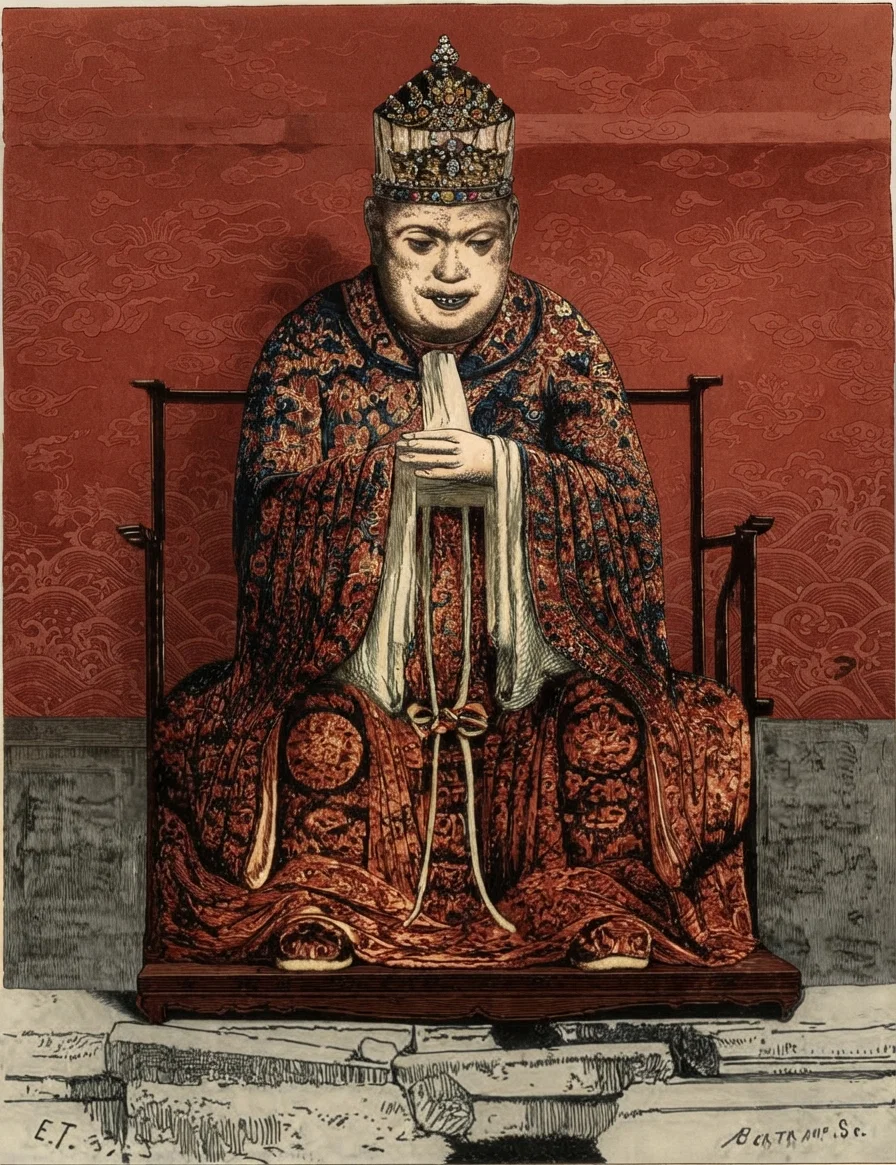
A Temple of Confucius.
A second attempt to solve China's problems has been that of storming Confucianism's high places. The New Testament, costing $1,200, that was presented to the empress dowager on her sixtieth birthday; the emperor's purchase of copies of the same; his interest in the study of English; Li Hung Chang's contact with missionaries and board secretaries; the success of the publications of the Christian Literature Society in reaching the chief official opponents of the foreigners; the Reform Club in Peking, under the influence of two former missionaries—these have all been efforts of great significance.
The essential solution of China's greatest problem—that of the regeneration of her people—must be a more radical one. It lies, first of all, in a representation of the life of Jesus in the persons of foreign missionaries, who are sent to touch life at all points as He did in Palestine. His Spirit must be the leaven in the lives of native Christians and Christian helpers who come into closer contact with Confucianism. The Word of God, so largely used hitherto in China, will be a silent missionary in tens of thousands of homes, and His Spirit must be believed in, and prayed for, and possessed by every Christian in the empire, before the final victory is won.

OUR WORK AND WORKERS.

THE baptism of three candidates at Grand Rapids, Mich., is noted in the Herald.
EIGHT new Sabbath-keepers at McHugh, Minn., are reported in the Worker by Brother H. Steen.
SEVEN converts are reported at Bowdle, S. D., where Brother V. Leer has been conducting meetings.
THE Congregational church at Battle Creek, Mich., was recently opened to a series of health lectures by physicians of the sanitarium.
A RECENT report from Brother George F. Enoch, Bridgetown, Barbados, mentions the baptism of sixteen candidates. He also reports large audiences at Sunday night meetings.
WRITING from Edinburg, Scotland, January 11, to the New York Indicator, Brother W. A. Westworth reports the admission of twenty-nine persons to church fellowship during the past quarter.
IN the South Dakota Worker, Brother L. D. Randall states that nine different papers in Sioux Falls gave favorable reports of meetings held in that city. Six of these journals are English, one Danish-Norwegian, and one German.
WRITING of the progress of the work in Great Britain, Brother O. A. Olsen notes the baptism of seventeen persons in West London, with others soon to follow, and a church to be organized; five baptized at Southampton, six at Newport, ten at Abertillary, Wales, and a church of twenty-four members to be organized at East Cowes, Isle of Wight.
WE have received from the Central New England Tract Society, South Lancaster, Mass., a pamphlet entitled, "The Marriage Supper of the Lamb." The subject is one of more than ordinary importance at this stage of the world's history, and is stated in a logical and instructive manner by the author, A. E. Place, president of Central New England Conference. 32 pp.; price 2 cents, or $1.50 per 100.
THE Seventh-day Adventist ministers connected with the work in Washington, D. C., recently issued "An Appeal to Clergy," being an open letter on the subject of Sunday observance. The matter was first published in the Washington Post, but has been issued in tract form in order that it may be circulated in unlimited quantity. 8 pages; price 40 cents per 100, or $3.75 per 1,000. Order of Review and Herald, 222 North Capitol Street, Washington, D. C.
OF the work in Mexico, Brother George M. Brown, superintendent of that mission field, says: "This country must be warned, and what is done must be done quickly. Already there is agitation for Sunday rest, closing of stores, etc., and the Roman Church is constantly increasing her hold on affairs. Already in some places the reform laws are practically a dead letter, and the civil power is dominated by the church, while priests and nuns go boldly forth in defiance of law."
OUR Washington health journal, Life and Health, is meeting with marked success. The Review says that five hundred new subscriptions were added to the list during January, and a large number of single copies were sold. This indicates that, as the Review says, "the public may recognize in this little health messenger a simplicity and a national application of the fundamental principles of health, and they want it." Monthly; 50 cents a year. Address, Review and Herald, 222 North Capitol Street, Washington, D. C.
IN the Review of the 9th inst. is a statement of the Washington Building Fund, showing that over $44,000 is yet lacking to make up the $100,000 required to be raised by May 11, when the General Conference is to convene in that city. This fact is a personal appeal to our people to lift in this matter; it is especially an appeal to those in America who have means that could be producing a blessing instead of lying dormant, or being invested in worldly projects. It is now too late to depend entirely on the small donations of the poorer classes who are always giving of their small incomes. Of course they will make it up in time, if the well-to-do are not disposed to donate proportionately; but it would be better for the latter class and for the cause if they would respond at once. The cause at Washington is a pressing one, and much is depending upon the completion of unfinished and contemplated buildings.

Religious Liberty Leaflets.

No. 1. "Principles Too Little Understood," 8 pp. No. 2. "Sunday Laws Their Origin, Nature, and Object," 8 pp. No. 3. "The Logic of Sabbath Legislation; What Sabbath Laws Mean," 8 pp. No. 4. "The Civil Sabbath; Nature of Sabbath Legislation," 12 pp.
These new tracts are written by W. A. Colcord, secretary of the Religious Liberty Bureau, of Washington, D. C., and contain matter that ought to be in the hands of the people everywhere. Each tract, envelope size, can be had from either of our publishing houses, at the rate of 40 cents per 100. Every lover of religious liberty ought to keep a stock on hand, to use in correspondence or to give away as occasion offers. Order of this office; of Review and Herald, 222 North Capitol Street, Washington, D. C.; or of Southern Watchman, Nashville, Tenn.
WE have received specimen copies of special editions of our German, Danish, and Swedish papers, published at College View, Neb. These contain, among other good things, the "Appeal to Clergy" recently issued by the Seventh-day Adventist ministers of Washington, D. C., and a telling article on "Spiritualism," by Brother R. C. Porter, president of Missouri Conference. The titles of these journals are: Christlicher Hausfreund (German), Sions Vaktare (Swedish), and Evangeliet Sendebud (Danish-Norwegian). The price of each is, five papers for 10 cents, or 100 papers for $1.50. Address International Publishing Association, College View, Neb.

Journalism for Women

What to Write
How to Write It
and
Where to Send It
By Frances H. Low
Price, 35 Cents

THE Voice

How to Develop
AND
How to Use It
BY
CHAS. H. MANLEY, M. A.
Price, 35 Cents

A TEXT-BOOK FOR THE Young Woman Journalist

This manual has been written expressly to fill the long-felt want by a large number of young women who contemplate adopting the journalistic profession as a means of livelihood, but who find themselves unable to obtain the authentic information so necessary for arriving at a proper decision in a matter of such lasting importance. In this work the authoress does not hold out any overdrawn picture of the delights, the ease and the fortune to be obtained by every writer for the press, but she gives such instructions to the novice as will materially help her to qualify and enter the literary world.
Sent Post-paid on Receipt of Price
The Bazaar Pub. Co., St. Johns, Mich.

A Manual of Voice Culture

Systematic Home Training by which the Voice is Cultivated for Platform or Private
A method of instruction on a true educational basis. Students learn to express themselves naturally and artistically and do not become mere copyists.

Testimonials

"It has been to me all that a twenty dollar correspondence course could be and perhaps more."—R. F. OSBORNE.
"I believe the method has doubled the effectiveness of my preaching."—W. K. "Every choir leader would do well to supply the members of his choir with a copy—it is invaluable."
Indispensable to the Teacher, Student, Preacher Public Speaker or Singer
Sent post-paid on receipt of price The Bazaar Pub. Co., St. Johns, Mich.

THE NORTHWESTERN LINE RUSSIA-JAPAN ATLAS.

Send ten cents in stamps to R. R. Ritchie, No. 617 Market Street, San Francisco, for Russo-Japanese War Atlas, issued by the Chicago & Northwestern Railway, three fine colored maps each 14x20, bound in convenient form for reference. The Eastern Situation shown in detail with tables showing relative military and naval strength and financial resources of Russia and Japan.

Friend in the Kitchen

FRIEND IN THE KITCHEN.—This is an educational cook book. Its object is to educate the people away from flesh-eating by presenting to them a far better way. This "better way" consists of 400 thoroughly-tested recipes for the preparation of good, wholesome dishes, none of which include meat of any kind. The book gives the nutritive value of foods, time required to digest various foods, rules for dyspeptics, best food for infants, substitutes for meats, and, in fact, about everything a person wishing to reform his dietary needs to study. Durably bound in flexible cloth...........................25c. Oilcloth....................................................................50c.
Address PUBLISHERS OF THIS PAPER.

WANTED FOR MISSIONARY WORK.

(Always prepay postage.)
ANY of our periodicals and tracts; a large quantity can be used. Address, J. Reid, 1311 N. 10th Street, Tacoma, Wash.
CLEAN copies of our periodicals for boat and prison work. Address, Miss B. Shryock, 309 Second Avenue N., Seattle, Wash.

Our Words

OUR WORDS. NO. 2.

BY MRS. E. G. WHITE.
ALL are to a great extent under the influence of their own words. They act out the sentiments expressed in their words. Thus the government of the tongue is closely bound up with personal religion. Many are by their own words led to believe that a wrong course is right. Thoughts are expressed in words, and the words react upon the thoughts, and produce other words. The influence is felt, not only upon oneself, but upon others. The Lord God alone can undo the mischievous result of unwise words. Often an opinion or decision, having been once expressed, will be acted upon, tho it may lead to an entirely wrong course. The iron will changes not, because it would be too humiliating to acknowledge oneself in error. The words hastily spoken, to give vent to strong feelings, produce their evil results in hurting, wounding and bruising souls for whom Christ died. Satan is pleased, God is dishonored, and many souls are ruined by hastily spoken words.
Speak gently. Speak words of kindness and uplifting; for this is the fruit borne on the Christian tree. Overcome all harshness. Rash speeches do much harm to the souls of those who utter them and to the souls of those who hear. Eternity alone will reveal how greatly those who made these speeches needed to humble their hearts and make confession to God.
Gossip reveals a lack of true culture and refinement, and of true goodness of heart; it unfits one both for the society of the truly cultured and refined in this world, and for association with the holy ones of heaven.
We think with horror of the cannibal who feasts on the still warm and trembling flesh of his victim; but are the results of even this practise more terrible than are the agony and ruin caused by misrepresenting motive, blackening reputation, dissecting character?
"Death and life are in the power of the tongue."
In the Scriptures, backbiters are classed with the haters of God, "with inventors of evil things," with those who are "without natural affection, implacable, unmerciful," "full of envy, murder, debate, deceit, malignity." It is "the judgment of God, that they which commit such things are worthy of death." He whom God accounts a citizen of Zion is he that "speaketh the truth in his heart;" "that backbiteth not with his tongue," "nor taketh up a reproach against his neighbor."
God's Word condemns also the use of those meaningless phrases and expletives that border on profanity. It condemns the deceptive compliments, the evasions of truth, the exaggerations, the misrepresentations in trade, that are current in society and in the business world. "Let your speech be, Yea, yea; Nay, nay; and whatsoever is more than these is of the evil one."
"As a madman who casteth firebrands, arrows, and death, so is the man that deceiveth his neighbor, and saith, Am I not in sport?"
Closely allied to gossip is the covert insinuation, the sly innuendo, by which the unclean in heart seek to insinuate the evil they dare not openly express. Every approach to these practises the youth should be taught to shun as we would shun the leprosy.
In the use of language there is perhaps no error that old and young are more ready to pass over lightly in themselves than hasty, impatient speech. They think it a sufficient excuse to plead, "I was off my guard, and did not really mean what I said." But God's Word does not treat it lightly. The scripture says:
"Seest thou a man that is hasty in his words? there is more hope of a fool than of him."
"He that hath no rule over his own spirit is like a city that is broken down, and without walls."
In one moment, by the hasty, passionate, careless tongue, may be wrought evil that a whole lifetime's repentance can not undo. O, the hearts that are broken, the friends estranged, the lives wrecked, by the harsh, hasty words of those who might have brought help and healing.
"There is that speaketh like the piercings of a sword; but the tongue of the wise is health."
"Who is the wise man and endued with knowledge among you? let him show out of a good conversation his works with meekness of wisdom." My brethren and sisters, how are you employing the gift of speech. Have you learned so to control the tongue that it shall ever obey the dictates of an enlightened conscience and holy affections? Is your conversation free from levity, pride, malice, deceit, and impurity? Are you without guile before God? Words exert a telling power. Satan will, if possible, keep the tongue active in his service. Of ourselves we can not control the unruly member. Divine grace is our only hope.
Wherever there is purity of heart and nobleness of character, it will be revealed in purity and nobility of action and speech.
"He that loveth pureness of heart, for the grace of his lips the king shall be his friend."

CAN'T AFFORD IT.

"HERE, Dan, is something that may interest you," said Farmer Brown, as he handed the boy a bulky letter.
"The postmaster missed his mark there, sure," said Dan, glancing at the untouched stamp.
"That will send a letter to your mother, Dan, and not make you any poorer, either," answered the farmer.
"I dare say it will," responded the lad, as he proceeded to moisten it at the mouth of the steaming tea-kettle.
"And you can have the two cents you thus save for marbles," suggested Mr. Brown, thoughtlessly.
"That would be cheating," whispered Dan's conscience. "The stamp has already done its duty in carrying one letter."
"It will carry another. It is not marked," argued Dan.
"But you know that was a mistake," argued the monitor within.
"That was the postmaster's fault, and not mine," was Dan's inward reply. "It is a very small thing, and the government will not miss it, no, not even know it."
"Will you not know it, and can you afford to be dishonest for so small an amount?" the small voice whispered.
Dan trembled, for it seemed that some one had spoken the words right in his ear. Flinging the stamp he had loosened into the fire, he exclaimed, "No, I can not afford to sell myself so cheap!"
"What's wrong?" asked the farmer, glancing up from his paper. "Lose the stamp after all your trouble?"
"Worse than that," replied the boy, sheepishly.
"What, burned your fingers with the steam?" questioned his employer.
"No," said Dan determinedly; "I sold my honor, or came near doing so."
"What do you mean, boy? The stamp is all right. It would never have been found out."
"But I knew it all the time, and two cents is a small amount to get for your own self-respect; besides"—
"Besides what?" queried the man.
"God knows about it, and He looks upon the heart," answered Dan.
"It's a mighty small thing to worry over, I am sure," replied Mr. Brown. The post-office department would not have been much the poorer, I assure you." "It would have been I who would have been poorer. Had I sold my honor for two cents, I should have made the worse bargain I ever did."
And so Dan gained a victory, and he was never sorry that he had obeyed the voice of conscience.—Belle V. Chisholm, in S. S. Times.

NOT ALWAYS THE HIGHWAY.

[Louise Driscoll, in Lippincott's Magazine.]
ALL day long on the highway The king's fleet couriers ride. You may hear the tread of their horses sped Over the country side, They ride for life and they ride for death And they override who tarrieth. With show of color and flash of pride They stir the dust on the highway. Let them ride on the highway wide. Love walks in little paths aside.
All day long on the highway Is a tramp of an army's feet; You may see them go in a marshaled row With the tale of their arms complete; They march for war and they march for peace, For the lust of gold and fame's increase, For victories sadder than defeat They raise the dust on the highway. All the armies of earth defied, Love dwells in little paths aside.
All day long on the highway Rushes an eager band, With straining eyes for a worthless prize That slips from the grasp like sand. And men leave blood where their feet have stood And bow them down unto brass and wood— Idols fashioned by their own hand— Blind in the dust of the highway. Power and gold and fame denied, Love laughs glad in the paths aside.
LESSON II.—MARCH 12.—THE SLAVERY OF SIN.

Lesson Scripture, John 8:31-40, A. R. V.

(31) "Jesus therefore said to those Jews that had believed Him, If ye abide in My word, then are ye truly My disciples; (32) and ye shall know the truth, and the truth shall make you free. (33) They answered unto Him, We are Abraham's seed, and have never yet been in bondage to any man; how sayest thou, Ye shall be made free? (34) Jesus answered them, Verily, verily, I say unto you, Every one that committeth sin is the bondservant of sin. (35) And the bondservant abideth not in the house for ever: the son abideth forever. (36) If therefore the Son shall make you free, ye shall be free indeed. (37) I know that ye are Abraham's seed; yet ye seek to kill Me, because My word hath not free course in you. (38) I speak the things which I have seen with My Father; and ye also do the things which ye heard from your father. (39) They answered and said unto Him, Our father is Abraham. Jesus saith unto them, If ye were Abraham's children, ye would do the works of Abraham. (40) But now ye seek to kill Me, a Man that hath told you the truth, which I heard from God; this did not Abraham."
Golden Text.—"Whosoever committeth sin is the servant of sin." Verse 34.

SUGGESTIVE QUESTIONS.

(1) What does Jesus set forth as the test of true discipleship? Verse 31. Note 1. (2) What will they know who abide in His Word? And what will the truth do for them? What is the truth? Verse 32. Note 2. (3) What did the Jews say in answer to this instruction? Verse 33. Note 3. (4) What answer did Jesus give to this boast? Verse 34. Note 4. (5) How did Jesus contrast the positions of bondservant and son? Verse 35. Note 5. (6) Who only can give us perfect freedom? Verse 36. Note 6. (7) What admission did Jesus make to the Jews? Then what grave charge did He make against them? Verse 37. Note 7. (8) What did Jesus say of the things which He spoke? What of the things which those Jews did? Verse 38. Note 8. (9) What claim did the Jews reiterate? How did Jesus reply to this insistent claim? Verse 39. Note 9. (10) Then what charge did Jesus repeat against the Jews? What kind of Man were they seeking to kill? Of whom had He received the truth which He had told them? How did this compare with the character of Abraham? Verse 40. Note 10.

NOTES.

1. "Truly My disciples."—In verse 31 Jesus makes a clear-cut distinction between professed disciples and "truly" disciples. No matter how honestly and earnestly one may start in the Christian life, it is the continuance in the Word that constitutes the true disciple. And it is not worth the while to try to be anything else. To continue in the Word is to continue in the truth (John 17:17), and the law of God is the truth (Ps. 119:142). To be a disciple, is to love God, and to love Him is to keep His commandments (John 14:15, 21, 23, 24; 1 John 5:2, 3).
2. To "know the truth" is to know Christ, for He is the truth (John 14:6); and to know Him is eternal life (chapter 17:3). Eternal life is the result of being made free from sin, which is "the transgression of the law." 1 John 3:4. This shows us the harmony between Christ and the law. The law condemns the sinner, who is therefore under the condemnation, or curse, of the law. Christ forgives the sin when repented of and confessed, and this takes away the curse of the law (Gal. 3:13), making the erstwhile sinner free from its penalty (chapter 4:4, 5). But this does not take away the law (Rom. 3:31; Matt. 5:17). As shown in Note 1 and the verse to which it applies, the forgiven one must continue in obedience in order to be a true disciple. See, also, Gal. 5:1, and Rom. 6:1-4.
3. The Jews always supposed that being literal descendants of Abraham entitled them to all the benefits of the promises; but even from that standpoint, their boast of never having been in bondage was a false claim; for, in addition to their past history, they were even then in subjection to Rome. But it was necessary for them to accept Christ as their Saviour to make their heirship from Abraham available. In this respect they were only on a par with the Gentiles (Rom. 2:28, 29; Gal. 3:27-29).
4. In verse 34 Jesus shows the character of the bondage to which He referred. It matters not whether we be bond or free, as far as our persons are concerned, in order to be accepted of Christ, and become heirs of His kingdom. Therefore "let the brother of low degree glory in his high estate; and the rich in that he is made low." James 1:9, 10.
5. The reference to bondservants in verse 35 is a figure drawn from servants in the world; for they have no heirship, excepting by special provision, such as adoption, or other recognition. But the bondservant of Christ is also an adopted child, and heir by promise. See Gal. 4:1-7; Eph. 1:3-5.
6. From what bondage does Christ set men free?—The bondage of sin. He doesn't set servants free from their masters arbitrarily, nor release His disciples from their obligation to Cæsar; but He forgives their sins, setting them free from the dominion of sin. See "Golden Text." When He forgives sin, the forgiven one is free indeed as long as he continues in obedience to the faith. Not so when puny man assumes to forgive sin.
7. Verse 37 refers to the natural seed of Abraham. Christ's word had no place in their hearts—as under the new covenant (Jer. 31:31-33)—therefore their inclination to violate His law, and to commit murder.
8. When Christ refers to the "father" of those who have not His word, or law, in their hearts, He means the devil (John 8:44).
9. In contrast with verse 37, the Lord refers to the spiritual seed in verse 39.
10. Verse 40 shows how far the literal descendants of Abraham had departed from the principles of their father—the very principles to which Christ was calling them back.

HANDSOME

BISQUE DOLL FREE
Together with a Gold Finished Necklace & Turquoise Pendant
This is a Jointed-Body Doll, nearly half a yard tall, dressed in satin and lace, and looks like the picture shown here; a perfect beauty, with a turning Bisque head, lovely curly hair, pearly teeth, large natural sleeping eyes, trimmed underclothing, real slippers and stockings that can be taken off, com- pletely dressed from head to foot.
Understand that this is not a rag doll or a cheap plaster of Paris doll, but a real
Sleeping Bisque Doll.
We will send this beautiful Doll FREE, together with a Gold Finished Necklace thirteen inches long, and Tur- quoise Pendant, *all express charges paid by us*, when you have sold for us twenty-four packages of BLUINE at 10 cents each and have returned our $2.40. We trust you with the BLUINE, the best wash- ing bluing made. Send us your name and address.
Bluine Manufacturing Co., 170 Mill St., Concord Jct., Mass. (The Old Reliable Firm.)

Sabbath School Lesson Quarterly

The Sabbath-school lessons have been discontinued. The Lesson Quarterly may be obtained, containing three months' lessons and notes, for five cents. Address, Pacific Press, Mountain View, Cal. The Sunday-school lessons will continue.
If you want to get the biggest returns for your labor and your ground, you can't afford to plant anything but FERRY'S SEEDS -the standard after 49 years' test. They always produce the largest and surest crops. All dealers sell them. Our 1905 Seed Annual free on request. D. M. FERRY & Co. DETROIT, MICH.

OLIVOILINE

The Hygienic Cooking Oil of To-day.
A Pure Vegetable Shortening—Fine for Salads. No Rancid Taste. No Chemicals.
Like Olive Oil, and Keeps in Any Climate
Testimonials From Everywhere.
Send stamp for Circulars or Money Order for trial can at following low prices.
5 gal. can $3.50; 10 gal. can (75 lbs. 9c. per lb.) $6.75.
(Refined Cottonseed Oil 10 gal. $5.50.)
Shipping Point Louisville Ky.
Address O. C. GODSMARK. Mission Ridge, Chattanooga, Tenn.
This is not an inferior compound, and we can not pay the freight or compete in price with cheaper goods that must, in time, undermine the system.
Continue reading: Trial Offer of Flower Seeds