God desires our highest welfare. To please God, therefore, we must do that which is best for ourselves. This means that we must be virtuous, pure, and self-restrained, temperate. He who lives a pure and upright life takes the course which is best for himself, and he who takes that course pleases God. It is for our sakes that the restraints of virtue are put upon us. The divine commandments are simply the marking out of a path through which we shall reach our highest good. It is for our own well-being that we are to observe those laws, and the attainment of our well-being pleases God. To serve God best we must build up our character and welfare.—Christian Enquirer.
Hold the Fort a Little Longer
HOLD the fort a little longer;
God is loving, Christ is true;
He has said, The truth shall triumph;
Who will dare to doubt it? You?
—Selected.
HENRY HUDSON.
THE name of Hudson is connected with the largest river in New York; it belongs, also, to the bay and straits in the British possessions. The river and the bay are far apart, and yet the extent of coast between them gives but a limited idea of how much of the globe Hudson explored. The country along the Hudson River belonged to the Dutch; that about Hudson's Bay was, from the first, English.
Hudson was certainly of English birth, and little more than that can be said with confidence of his early life. There is not a shadow of a reason for writing his name Hendrick Hudson, as has been done by some person in this country. Our acquaintance with the man is limited to the last five years of his life, and these were spent upon voyages of discovery. All interest in the man attaches itself to these voyages. They were made with one object in view—to find a way by the north to China and the East. It was not expected that such a way, if found, would be shorter, or in any way preferable to those already known by way of the Cape of Good Hope and Cape Horn. But the right of trading with the East by either of the known ways was already a privilege in the hands of the East India Company. A way into the Pacific by the north of Asia, or by the north of this continent, would destroy the monopoly.
Hudson's first voyage, of which he left a journal, was undertaken, he tells us, at the charge of "certain worshipful merchants of London," in 1607. Its purpose was, he says, "for to discover a passage by the north pole to Japan and China." He was absent from England from the first of May to the fifteenth of September. Within that time he explored the east coast of Greenland and the west side of Spitzbergen. He crossed the eighty-first degree of latitude,—the highest point then reached, and rarely passed since. The second expedition was made from London, in 1608. Its main purpose was the same, but this time Hudson gave his attention particularly to the passage by the northeast. He advanced no further than to Nova Zembla, where the ice compelled him to turn back, with no other result than a fuller knowledge of the difficulties by that way.
Hudson was now known abroad as well as at home for skill and intrepidity. Upon his return to London in the fall of 1608 his presence in Holland was politely desired by the Dutch East India Company. The Dutch had sent expeditions in search of a northeast passage in 1594 and in 1595. Both of these were unsuccessful. In 1596 private individuals fitted out a third expedition, which was compelled to winter on Nova Zembla with disastrous results. From the observations he had made in high latitudes, Hudson formed the theory of an open polar sea, and he believed that this sea was to be reached by keeping away from the shores of Greenland and Spitzbergen, where the ice was strongest, and by pushing on beyond the eighty-third degree of latitude, when they would be in open water. The Dutch adopted a similar view, as so many navigators since their time have done.
Early in January, 1609, Hudson entered into an agreement with the Dutch East India Company, by which he agreed to search for a passage to the north of Nova Zembla. He was to give the company the benefit of all discoveries. The directors were to pay him, "as well for his outfit for the said voyage as for the support of his wife and children," a sum equal to $320. In case he did not come back within a year, the directors were to pay his wife the further sum of $80, and thereupon be released of all liability to him or his heirs. But if he should come back within the year, and have found the passage good and suitable for the company to use, then the directors would "reward the before-named Hudson for his dangers, trouble and knowledge in their discretion, with which the before-mentioned Hudson is content." So much of this contract is given because it shows better than any other paper relating to Hudson's voyages what sort of a man he was.
The smallness of the remuneration to be received for the hazardous service upon which he was to be employed proves the spirit of a true explorer. He was not likely to have means of his own, but he shows full confidence in his ability to command success.
On the 4th of April, 1609, Hudson set sail from Amsterdam. His vessel was the Half Moon, a yacht of about eighty tons' burden and manned by a motley crew of Dutch and English. He passed the North Cape on the 5th of May, and in the course of a few days came to the edge of the ice which encompassed Nova Zembla. Although the orders given to Hudson required that he should search for a passage only by way of the northeast, yet, on the 14th of May, with the consent of his officers and men, he shaped his course toward the coast of America. On the 12th of July he first saw the American shores, and on the 18th he anchored in a safe harbor, probably Penobscot Bay, on the coast of Maine. From this point he sailed southward until he was opposite the entrance to James River, where the English had settled two years before. Satisfied that there was no passage through the continent south of that point, he now turned towards the north, and examined the coast with care. On the 28th of August he discovered Delaware Bay, and a few days later, September 3, he anchored inside of Sandy Hook. The discovery of the North River followed, and the Half Moon sailed up this river to where Albany now stands. This gave Holland title to the province of New Netherlands by right of discovery.
Returning in the fall, Hudson and his men were detained at Dartmouth, England, and the Half Moon was not sent over to Amsterdam until the next summer. Hudson and the other Englishmen of the ship were commanded by the Government to serve their own country.
In April of 1610, Hudson sailed under English auspices in search of a northwest passage. On this voyage he discovered the straits and the bay which have since borne his name. The following winter he spent on the shores of Hudson's Bay. The suffering from the want of food was great, and his crew in the spring showed a natural impatience of longer delay. In a mutinous outbreak they put their commander, with his son, and several sick sailors, into a frail boat; and on a midsummer's day, 1611, they cut him adrift in the midst of Arctic waters. No farther trace of the great navigator was ever found.—Youth's Companion.
The Home Circle.
A SERMON IN RHYME.
If you have a friend worth loving,
Love him—yes, and let him know
That you love him ere life's evening
Tinge his brow with sunset glow.
Why should good words ne'er be said
Of a friend till he is dead?
If you hear a song that thrills you,
Sung by any child of song,
Praise it; do not let the singer
Wait deserved praises long.
Why should one who thrills your heart
Lack the joy you may impart?
If you hear a prayer that moves you
By its humble, pleading tone,
Join it; do not let the seeker
Bow before his God alone.
Why should not your brother share
The strength of two or three in prayer?
If you see the hot tears falling,
Falling from a brother's eyes,
Share them; and thus by the sharing
Own your kinship with the skies.
Why should any one be glad
When a brother's heart is sad?
If a silvery laugh is rippling
Through the sunshine on his face,
Share it; 'tis the wise man's saying,
For both grief and joy a place.
There's health and goodness in the mirth
In which an honest laugh has birth.
If your work is made more easy
By a friendly, helping hand,
Say so; speak out brave and truly
Ere the darkness veil the land.
Should a brother workman dear
Falter for a word of cheer?
Scatter thus your seeds of kindness,
All enriching, as you go;
Leave them; trust the Harvest Giver:
He will make each seed to grow.
So, until life's happy end,
You shall never lack a friend.
—Selected.
Do Not Squander Time
"Dost thou love life? Then do not squander time, for that is the stuff life is made of."
THE NEXT CENSUS.
By Springfield Republican
THE taking of the national census is a costly operation. The eleventh census of the United States, which will be taken early in June, 1890, will cost nearly $6,000,000, or $1,150,000 more than the census of 1880. By the terms of the census bill which lately passed Congress, persons refusing to give proper information may be fined not more than $100, while presidents of railroads and corporations who refuse to give information may be punished with a $10,000 fine and a year in jail. It is to be hoped that would-be humorists, who regard census-taking as a joke, and rejoice in baffling census enumerators, may be reached by the provisions of this bill.—Springfield Republican.
Health and Temperance.
THE RIGHT PLACE FOR A SALOON.
WHERE is the right place for a saloon? Where is the saloon wanted? If not the fashionable mercantile establishment, what other kinds of business are likely to be helped by the proximity of gin-mills? Let some one name them. Is it the baker, the tailor, the shoemaker, the butcher, the milliner, the bookseller? Do any of these find it any particular advantage to their trade to have a grog-seller come and open shop beside them? What surroundings are necessary in order to justify the opening of resorts for loafers, of drunkard-mills, of dens for the propagation of vice and crime? What neighborhoods shall be selected for the establishment of places for the debauchment and ruin of men, for the destruction of families, for the making of paupers and felons? Which is worse—to open a saloon within two hundred feet of a church or a school, or to open one next door to a home, in front of a home, over a home, or under a home? What is there that should make a grog-shop a stench in the nostrils of the public on one street and a sweet-smelling savor on another? What should make it an ugly blot on the landscape in one locality and a thing of beauty in another? Is a saloon on Fifth Avenue calculated to do greater harm than a beer-dive on Mulberry Street? If the wealthy and the powerful cannot endure the presence of the grog-shop, will they help to thrust them on the poor and the weak? Are the tenement districts—the homes of those who are already deep down in poverty, squalor, and misery—are these the proper places to set the saloons? Are they needed here to help men live purer lives, to make happier homes, to strengthen the weak, to cheer the downcast, to guide the erring? Who shall take upon himself the responsibility of declaring where the people shall be cursed with the presence of the grog-shops and where they shall not be cursed? These, it seems to us, are practical questions, and we should like to have them answered.—New York Observer.
MAKING COLORED GLASS.
WHERE three colors are desired, pots containing each color are made. A blow-pipe is dipped first in one, and then a coating of another is put on, and finally the third layer put on. The glass is then blown into the desired shape. At first the different colors of glass all present the appearance of crystal glass; but, upon being heated, their respective colors are developed. Then a cut is made in the glass of whatever form or shape that may be desired, and extends into the layer of the color that is wanted, and the figure appears in precisely the form and color wished. A small quantity of ruby glass can be so blown as to cover a large piece of crystal glass, and though it is but a mere skin over the surface, yet it will give the whole a perfect color. Then the skim of ruby glass may be cut through, and the fine effect of ruby and crystal in the same piece given. The colored glass in ordinary tableware is nearly all stained, save one or two cheap shades of amber. Manufacturers say that the demand for colored glass is fast dying out, and that pure crystal ware is mostly called for.—Pittsburgh Dispatch.
AN INTERESTING WATCH.
THERE are some wonderfully curious and interesting clocks in various cities of the Old World, but the Yankees may yet rival foreigners in the skill and ingenuity of their inventions. A gentleman connected with the Illinois Watch Company has a curious watch-dial, on which, instead of Roman numerals to indicate the hours, there are tiny, but perfectly distinct, silhouette figures representing a man out with his dog for a day's sport. At seven o'clock they are seen starting forth; at eight the man makes a shot; at noon the sportsman takes a lunch, and the dog sits by on a stump, eyeing a piece of bread in his master's hand; at one o'clock they sally forth to fish, and at four the man has a big fish on the end of his line. At five o'clock they are on the homeward march, the man with his pole over his shoulder, and the dog following behind with his head hanging down, all tired out. Doubtless the owner of this watch is frequently importuned by children who "want to see the wheels go round," and the man and dog perform.—Selected.
NOVEL READING.
SPEAKING of the baneful effects of indiscriminate novel reading, the Christian at Work says: “As for the sensational, unreal, ill-starred, distorted extravaganzas with their sham heroism, or those others with their effluvial scandals, fostering that habit of novel reading which leads to fatty degeneration of the mind, just as dram drinking tends to fatty degeneration of the heart—banish it all from the home and keep it out. There are four great evils of today which are sapping our sociological life, and not the least of these is the craze and the curse of intemperate, indiscriminate novel reading.”
HOW TO BREAK UP BABY'S COLD.
By Clarissa Potter
WHEN I find baby has taken cold, not so feverish and sick as to require packing, which one dreads to do because of the increased danger resulting from any exposure afterward, but a smart cold in its first stages, with red eyes and running nose and stuffed head, I take the little one in my lap several times through the day, and again at bed time, and, removing boots and stockings, rub the little feet—soles and tops and ankles—with sweet oil or goose oil, and then heat them long and well before an open fire till the skin will absorb no more oil.
Then I bathe and rub the little bared back from neck to hips, especially along the spine, with oil also, shielding baby's back from cold drafts, and letting the warm rays of fire light and heat it just right, chafing and thoroughly heating till skin will absorb no more oil.
Wrapped in flannel and tucked away in her warm nest for the night, baby often wakes in the morning with but little trace of her cold.—Clarissa Potter, in Good Housekeeping.
HOW TO RELIEVE PAIN.
ONE of the simplest, most convenient, and most effectual means of relieving pain is by the use of hot water externally and internally. For bruises, sprains, and similar accidental hurts, it should be applied immediately, as hot as can be borne, by means of a cloth dipped in the water and laid on the wounded part, or by immersion, if convenient, and the treatment kept up until relief is obtained. The same treatment is helpful in severe neuralgic pains. In indigestion or wind-colic, a cup of hot water taken in sips will often relieve at once. When that is insufficient, a flannel folded in several thicknesses, large enough to fully cover the painful place, should be wrung out of hot water and laid over the seat of the pain. It should be as hot as the skin can bear without injury, and be renewed every ten minutes, or oftener if it feels cool, till the pain is gone.—Exchange.
Liquor Prohibition Among Turkish Fishermen
THE powers of Europe seem to think that the prohibition of the liquor traffic is a good thing for the Turks, if not for their own people. It is stated that the Sultan has ordered the discontinuance of the sale of intoxicating liquors in Constantinople, and the six powers contiguous to the North Sea—Great Britain, France, Belgium, Holland, Germany and Denmark—have entered into an agreement whereby the sale of such liquors to Turkish fisherman is prohibited.—The Statesman.
Yellow Fever and Alcohol
The physicians of Jacksonville, Florida, have publicly made the statement that "yellow fever strikes fatally persons of alcoholic habits." Two-thirds of the fatality is due to the use of strong drink before being attacked by the fever. It is frequently remarked in Jacksonville that yellow fever is the best temperance lecturer the city has ever had.
Germany’s Drink Trade with Africa
GERMANY is the largest drink-trader with Africa, sending there more than 7,000,000 gallons annually.
TO TEA DRINKERS.
By Editor
WHOEVER drinks tea, let him do so in moderation. Do not take it between meals on an empty stomach. Allow it to form a part of the regular meal. Make the infusion by steeping—never by boiling. Those who are troubled with insomnia should not use it in any form. Brain-workers cannot afford to overwork on the stimulus of strong tea. The poor and scantily fed cannot afford to touch it. To dyspeptics we say, tea aggravates your trouble, and many cases are cured by disusing it. Persons troubled with constipation should not use it, either weak or strong.—Table Talk.
[The fact is that it would be much better not to use tea at all as a beverage; as a medicine it is probably sometimes beneficial.—Ed.]
SECULAR.
—November 9 thirty men were killed in an explosion in a coal mine at Aulilinaia, Sicily.
—On the 6th inst. a ferry steamer sunk in a collision at Calcutta and sixty people were drowned.
—The Modesto, Cal., post-office was robbed on the night of the 7th inst. The thieves secured nearly $500.
—November 7 a reservoir at Montreux, on Lake Geneva, burst, injuring several persons and drowning many.
—A terrible collision occurred November 6 on the railway in Southern Russia near Kovel. Many were killed.
—A discovery of small diamonds on a farm near Atlanta, Ga., has created no little excitement throughout the State.
—Long Beach Hotel, twenty miles from Los Angeles, Cal., was burned on the night of the 7th inst. The loss was $90,000.
—The British Government is about to build eight first-class men-of-war, a score of swift cruisers, and many torpedo vessels.
—It is now asserted that the late accident to the Czar's train was, as at first stated, due to the explosion of a dynamite bomb.
—November 7 several vessels were wrecked on the British Coast. The gale was very heavy. It is thought that no lives were lost.
—A nest of four boilers at the Lancaster Chemical Works, Lancaster, Pa., exploded on the 7th inst., killing one man and injuring three.
—The Parliamentary committee appointed to consider a revision of the French Constitution has decided by a vote of six to four in favor of a revision.
—A recent telegram from Havre states that the Cunard steamer Nates came into collision thirty-six miles off the Lizard with the German ship Theodore Ruger, and that both vessels sank. A portion of the ship's crew landed at Trouville. The fate of the rest and the steamer's crew is unknown.
—Governor Swineford, in his report, states that the coast line of Alaska, 18,211 miles, is nearly twice the combined Atlantic and Pacific coast lines of the United States.
—The market value of the Alaska fisheries for last year is estimated at $3,000,000. A thousand salmon, averaging ten pounds each, have been taken in Sitka Bay in a single haul.
—It is said that the Russian Government is taking steps toward the solution of the question of a rail connection of the Baltic with the Pacific Ocean through Russia and Siberia.
—There is a deficiency of about $20,000 in San Francisco's school fund; and it is affirmed that there will be no money in the treasury for the payment of salaries before February next.
—Henry Blake, now Governor of Newfoundland, has been appointed Governor of Queensland. It is said that the appointment gives great dissatisfaction to the Australian colonists.
—The remains of twelve infants were found a few days since in the reservoir of the town of St. Ambroise, Canada. Complaints about the quality of the water led to the ghastly discovery.
—The London Economist says that 5,107,000 tons of sugar were consumed by the inhabitants of this planet last year. Of this amount 2,407,000 tons was beet sugar, and 2,500,000 tons cane sugar.
—The new ironclad Re Umberto, launched at Castellamare in the presence of King Humbert and of Kaiser Wilhelm on the occasion of the emperor's recent visit, is the largest of Italy's big war ships.
—Fifteen persons lost their lives in a fire in Rochester, N. Y., on the 9th inst. Ten of these were fatally injured by jumping from the third story of a burning factory and five perished in the flames.
—Prof. Chandler Roberts estimates the weight of the smoke-cloud which daily hangs over London at about 50 tons of solid carbon, and 250 tons of carbon in the form of hydrocarbon and carbonic-oxide gases.
—The topographic work of the arid lands and irrigation survey has been completed at the United States Geological Survey in Washington, and all the parties to be employed this year are already in the field.
—The most phenomenal snow-storm that ever occurred in Northern Kansas began on the morning of the 9th inst. and continued furiously all day. Trains were all delayed, and telegraph wires prostrated in all directions.
—One hundred and sixty lives were lost in a coal mine disaster at Pittsburg, Kan., on the 9th inst. Black damp is supposed to have been the cause of the explosion. Most of the victims were from the Pennsylvania coal regions.
—The residents of Hyde Park, a suburb of Chicago, have succeeded, through the aid of the police, in closing the saloons on Sunday. The saloon keepers retaliate by strict prohibition of "drinks" to the police on any day of the week.
—The fact that the price of wheat in Chicago is still maintained shows that the recent advance in price was not purely speculative. On the 5th inst. wheat sold in that city for $1.15, a bushel, and advanced to $1.15½, closing, however, at $1.15.
—A few days since 70,000 followers of the Mahdi attacked the town of Waday in the interior of Africa. The garrison repulsed the assailants and killed 3,000, but the Mahdiists re-attacked and captured the town. The Sultan of Waday fled to Cheri.
—The Russian Government has notified the Porte that should the divorce of King Milan of Servia cause troubles which would lead to the occupation of Servia by Austria, Russia will consider herself released from her obligation not to occupy Bulgaria.
—A recent St. Petersburg dispatch to a London journal says that General Gourko has sent a telegram to the Minister of the Interior announcing that he has discovered the existence of a revolutionary society in Poland, with numerous branches. Many members have been arrested, including a number of students, a magistrate and several Government officials, all of whom are in prison at Warsaw. The society has issued a manifesto regretting the failure of the recent attempt on the life of the Czar, and threatening a repetition of the attempt.
—The Senate Committee for the investigation of live stock and dressed meat, are making a tour through the country for the purpose of ascertaining the condition of cattle exported to large cities, the methods of slaughter, and the extent to which the flesh of diseased animals is put upon the market. It is claimed that Chicago is the recognized market for diseased animals. Conclusive evidence has been given that train loads of cattle suffering from Texas fever have been brought to St. Louis and elsewhere, and have been shipped to Chicago in a dying condition.
—Eighty per cent of the total manufactures of Siberia belong to the Territories of Tobolsk and Tomsk. According to the reports of the Bureau of Statistics, there are 2,300 factories, which employ 12,500 men and produce 14,000,000 rubles' worth of goods annually.
—Advices from St. Petersburg say the Czar was injured in several places in the recent accident to his train, and that he is suffering from severe pains in his chest and legs. Admiral Possirt has been dismissed from the Ministry of Railways, owing to the accident.
—The Norwegian bark Nor, from New York October 2 for Stettin, collided with and sunk the steamer Sax Mundham off Cowes, England. Twenty-two persons are missing and supposed to be drowned. Eight survivors were landed at Weymouth. The Nor was abandoned.
—A Paris dispatch of the 7th inst. says that the previous evening a dynamite bomb was exploded in the Registry office in the Rue Boucher. Another bomb was exploded in the Registry office in the Rue Francaise. Much damage was done at both places, but no one was hurt.
—The increase of population of France is steadily growing less. In the past year the number of births was 899,333; of deaths, 842,797; or 23.5 and 22 per thousand, respectively. The excess of births over deaths has decreased since 1881 from 108,229 to 56,536, or 48 per cent.
—Another of the shocking crimes, the seventh of the series known everywhere as the White Chapel murders, was perpetrated in London on the morning of the 9th inst. The body was mutilated more horribly than any of the others. There is absolutely no clew to the murderer.
—General Greely, in his annual report, says that the percentages of successful weather predictions made by the Signal Office for the year were 78.4; 75.5; temperature, 74.2; general average, 76.7. The number of cold-wave signals displayed was 1,743, of which 1,240, or 71.5 per cent., were verified.
—The total assessed valuation of real estate in the city of New York in 1886 was $1,203,941,065; in 1887, of 161,334 plats of real estate, $1,254,491,349—showing an increase in one year of $50,550,784. But as the assessed is less than two-thirds of the market value, the whole is not worth less than two billion dollars.
—Emperor Francis Joseph has officially intimated that it is his special wish that on the occasion of the anniversary of his accession to the throne he shall receive neither addresses nor deputations, and that no fêtes will be held that will involve expense. He desires his accession to be commemorated by acts of public charity.
—A dispatch from Gainesville, Fla., under date of November 10, says, "The yellow-fever scourge is thoroughly upon us and making rapid inroads upon the people, with no signs of a decrease. Almost the entire population has fled, no more than sixteen hundred remaining, and less than one hundred of those are white, with no official government."
—A furious snow-storm, extending over the whole of Quebec and the maritime provinces, began on the evening of the 8th inst. and continued for twenty-four hours. Dispatches from Lower Quebec say two and a half feet of snow fell all along the Lower St. Lawrence. It is feared that there was large loss of life among the fishermen on both shores of the Gulf.
—A recent dispatch to the London Times from Zanzibar says that the Germans have burned all the dhows and boats in Whind harbor. Lieutenant Fitzherbert of the Algerine, in face of a heavy Arab fire, chased a dhow with 200 slaves off the north coast of Madagascar, until the dhow grounded. Lieutenant Fitzherbert captured twenty-seven slaves with the dhow.
—It is said that a ministerial crisis and a disruption of the cabinet are inevitable in Spain, several of the principal ministers not being even on speaking terms with their colleagues. Insubordination and discontent reign supreme in the army. Says the Madrid correspondent of the New York Tribune: "At no time since the death of the King has Spain been in such a state of ferment as at the present moment."
—The 5th inst. was marked by a series of five disastrous explosions at various places from Windham, Maine, to Clarksville, Col. The first was a nitro-glycerine explosion near Shannopin, Pennsylvania. A large amount of property was destroyed, but only one man was killed. The second was an explosion which destroyed the mills of the Oriental Powder Company, near South Windham, Me. Two men lost their lives. The third disaster was a mine explosion, on Kettle Creek, Pa., which resulted in the loss of seventeen lives. The fourth was a similar accident in a mine at Clarksville, Col., while the fifth was an explosion in a Chicago starch factory which resulted in the loss of one life.
News and Notes.
By Editor
RELIGIOUS.
—Dwight L. Moody will spend the entire winter on the Pacific Coast. He will commence a series of evangelistic services in January at San Francisco.
—The secretaries of the American Board have united in asking for a re-inforcement of forty ordained missionaries, and also desire $750,000 to forward next year's work.
—The Methodist Church has 30,400 traveling preachers, and 4,560,000 members, and a population of over 16,000,000, or more than one-fourth of the population of the entire country.
—An earnest plea was made in the late meeting of the Women's Synodical Committee of the New York Presbytery, in behalf of Mountain Whites, the Freedmen, the Mormons, and the Indians.
—The Outlook says that "the observance of the seventh-day Sabbath has never ceased in the Eastern church. There is a branch of the Greek Church in Japan which to-day holds to this custom."
—A German pastor, desiring to go from Constantinople to Berlin through Russia, was not permitted to accomplish his desire. A decree of the Czar forbids any ecclesiastic outside of the Russian Greek Church to pass through Russia.
—The National Prison Association has adopted a resolution recommending the practice of observing one Sunday in the year as Prison Sunday. This has been practiced in some States. The resolution advises its adoption in every State.
—The women of the Presbyterian Church, during the past sixteen years, have given $2,150,000 to foreign mission work. This represents the entire support of more than 200 women missionaries, 200 native Bible readers, and over 150 schools.
—In Utah there are ninety schools, conducted by different denominations in the following proportion: Presbyterian, thirty-three; Congregationalist, twenty-two; Methodist, twenty; Catholic, seven; Episcopalian, five; Baptist, two; Swedish, one.
—At the eighteenth annual session of the ladies of the Northwestern branch of the Methodist society, it was reported that the auxiliaries of the society numbered 4,838, having a membership of 115,228; and that since their organization they have raised $1,680,315.68.
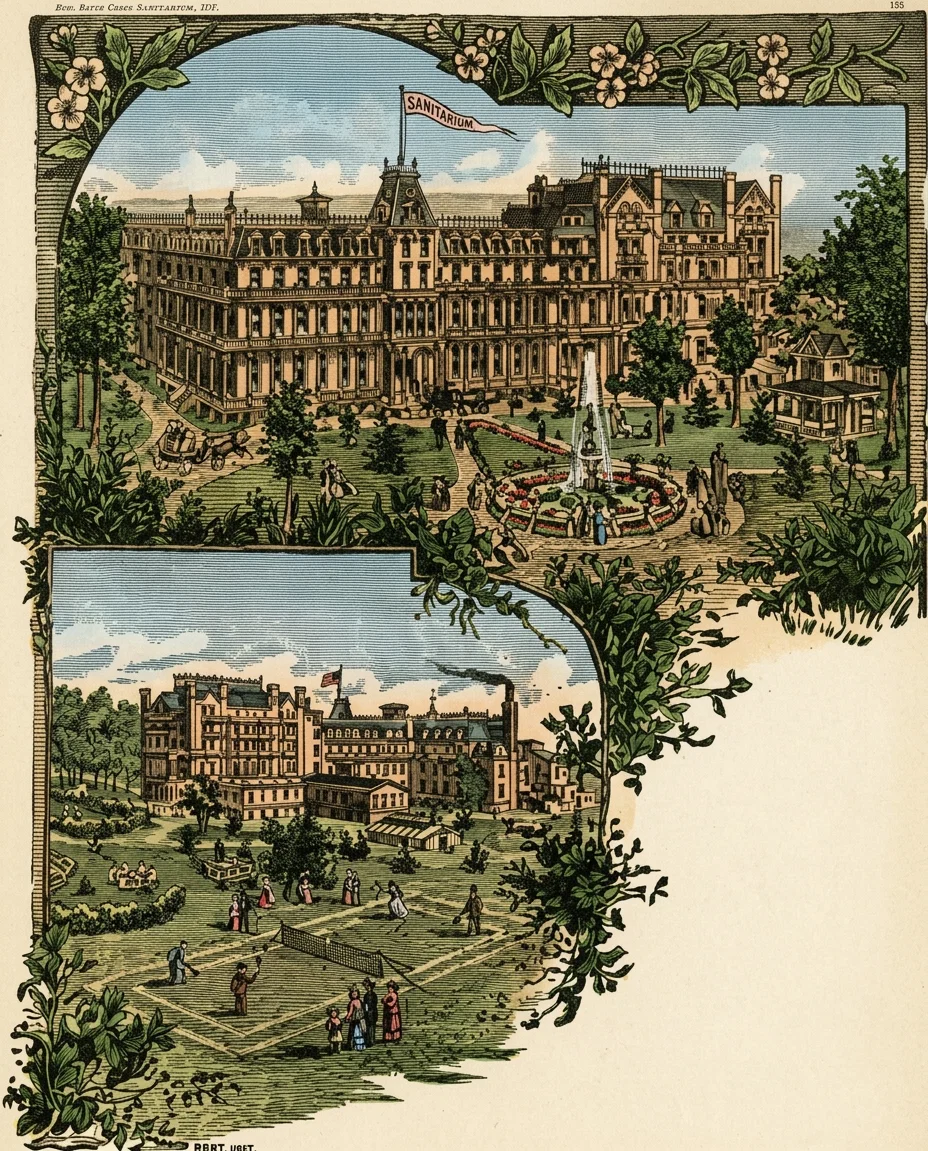
The Largest Sanitarium in the World.
THIS Institution, one of the buildings of which is shown in the cut, STANDS WITHOUT A RIVAL in the perfection and completeness of its appointments. The following are a few of the methods employed:—
Turkish, Russian, Roman, Thermo-Electric, Electro-Vapor, Electro-Hydric, Electro-Chemical, Hot Air, Vapor, and Every Form of Water Bath; Electricity in Every Form; Swedish Movements—Manual and Mechanical—Massage, Pneumatic Treatment, Vacuum Treatment, Sun Baths. All other agents of known curative value employed.
A SALUBRIOUS SUMMER CLIMATE.
A Lakeside Resort, Steamers, Sail Boats, Row Boats, Bathing, etc.
SPECIAL DEPARTMENTS for the Treatment of Diseases of the EYE, EAR, NOSE, THROAT, LUNGS, and DISEASES OF WOMEN. Special Advantages afforded Surgical Cases. Good Water, Perfect Ventilation, Steam Heating, Perfect Sewerage.
The managers have permission to refer to leading members of the medical profession. For circulars, with particulars, address, MEDICAL AND SURGICAL SANITARIUM, Battle Creek, Mich.
THE SANITARIUM TRAINING SCHOOL FOR NURSES.
THE managers of the above Institution have had for several years, in successful operation, an extensive Training School for Nurses, which is carried on in connection with the Sanitarium. The course of training in this school is the most thorough and comprehensive of any in this country, and the graduates of this school readily find good and lucrative employment.
Terms are such as to place the excellent opportunities afforded by this school within the reach of all properly qualified persons who may wish to avail themselves of its advantages. For circulars, address
SANITARIUM TRAINING SCHOOL FOR NURSES, Battle Creek, Mich.
THE AMERICAN SENTINEL.
By Editor
Assorted back numbers of the regular edition of the American Sentinel will be sent post-paid to any address in the United States or Canada for $1.50 per hundred, or sixty copies for $1.00. The American Sentinel is just the thing to hand to your neighbor, mail to friends, use in depot racks, for tract distributors, etc.
If you will send us two yearly subscriptions to the American Sentinel, at fifty cents each, we will send you the paper one year free. The Sentinel in clubs of five or more, at thirty cents a copy per year. Now is the time to get up clubs. Address, AMERICAN SENTINEL, Oakland, Cal.
Address
Address,
TIME TO RENEW.
By Editor
QUITE a number of subscriptions to the SIGNS expire soon. Please examine the address label on your paper this week, and if your time is out in November, 1888, or December, 1888, please send us your renewal at once, so that the letter will have time to reach us before your subscription expires.
TERMS, cash in advance, six months $1.00, one year $2.00, or we will send the SIGNS, American Sentinel, and Pacific Health Journal one year, post-paid, anywhere in the United States or Canada for $3.00. Or, we will send the illustrated "Great Controversy between Christ and Satan," popular edition, and the SIGNS one year for $3.00. Address, PACIFIC PRESS, Publishers, Oakland, Cal.
BOUND VOLUMES OF THE PACIFIC HEALTH JOURNAL.
By Editor
VOLUMES 1 and 2 of the Pacific Health Journal, from June, 1885, to November, 1887, inclusive, have been bound up in one neat volume, leather back and corners, cloth sides. It contains over 400 large octavo pages of very useful and instructive reading. Every family should possess a copy of this book. Price, post-paid, $2.25. Address, Pacific Health Journal and Temperance Advocate, Oakland, Cal.
SOME OF THE RESULTS.
By Editor
As our friends are aware, the American Sentinel has had a large circulation during the past two months. Besides the regular edition thousands of sample copies have been circulated. These have gone into every State and Territory in the Union.
A physician in St. Joseph, Mo., upon receipt of his first copy, writes: "Inclosed please find 20 cents, for which send me package No. 1, 'Views on National Reform.' I am opposed to any union of Church and State. Eternal vigilance is the price of liberty."
A commercial agent in Chicago writes: "Inclosed find currency, for which send me Vol. 1 of the Sentinel, and ten copies of the paper for distribution."
A hardware merchant at Indianapolis, Ind., under date of November 2, writes: "Your October number of the American Sentinel was left in my store and my attention called to the same. I am pleased with the doctrines you preach. Inclosed find postal note for $2.50, for which please send vols. 1 and 2 of the American Sentinel, bound separately in paper covers, and volume three of the paper to date, and the balance in October numbers for distribution among friends and foes."
A gentleman in Woodland, Cal., writes: "I am much pleased with the American Sentinel. It is brim full of transcendent facts for these times. Hundreds of thousands—yes, I would say it—should be scattered like the autumn leaves from ocean to ocean, especially to men of influence, such as lawyers, judges, government officials, etc. Send me 200 copies and I will send you the money for same."
The above are simply samples of letters that are being received at this office.
Publishers' Department.
By Editor
RECEIPTS.
REMIT by Bank Draft, Money Order, or Express Order.
If Postal Note or paper money is sent, register the letter.
Drafts should be made payable to the PACIFIC PRESS, on New York or San Francisco banks. Those written on other banks cost us exchange.
AFRICAN MISSION.—D W Barkley $5.
RECEIVED ON ACCOUNT.—Indiana T and M Society $142.70.
CALIFORNIA CONFERENCE FUND.—W H Averill $10, Los Angeles $250.15, Florence Watts $2.60.
CALIFORNIA T. AND M. SOCIETY.—Dist 1 Healdsburg $14.10, Little River $8.70, Calistoga $3.22, Petaluma $13.50, Dist 3 Oakland $36.15, Dist 5 Grangeville $12, Dist 6 Santa Barbara $21.25, Pasadena $8.85, San Diego $32.25, Norwalk $4.65, Bernardo $5, Arroyo Grande $3.55, Dist 8 Dows Prairie $1.60, D E McKee 65cts.
SACRED CHRONOLOGY.
By Sylvester Bliss
By SYLVESTER BLISS.
THIS work treats of the Elements of Chronology, the different systems, and the various eras, and gives the chronology of the principal events recorded in Sacred History, from the Creation till the death of John. It also contains a vindication of the numbers of the Hebrew text. As an aid to investigation it is invaluable. The book has been
Thoroughly Revised by Elder A. T. Jones,
Who has added valuable notes, and a chapter on the "PEOPLING OF THE EARTH," which is an exposition of the tenth chapter of Genesis, being an outline of the beginning of history, and of the origin of nations. No student of history can well do without it. It contains a vast amount of information in a small space, and is withal as interesting as a story, which it really is. 300 pages; cloth binding and side stamp, $1.00.