THIS reprint from the Christian Nation, of June 1, does not need any comment.
“We give an extract recently sent by THE AMERICAN SENTINEL of this city to the students of the University of Ann Arbor, Mich:—
THE SENTINEL deplores any attempt on the part of Christianity to secure political favors, as a confession of weakness which must be humiliating to every true Christian, and a just cause of reproach to every non-Christian. It believes with Madison that “religion and government will both exist in greater purity the less they are mixed together.” Hence from a patriotic conviction of duty it is unalterably opposed to any movement which looks to an alliance between them. That there are decided tendencies in this direction at the present time may be easily seen (the proposition to close the World’s Fair by law on Sunday is a good example) and every loyal citizen must sooner or later determine his own attitude toward such questions. Thus THE AMERICAN SENTINEL occupies an important field in that it discusses them fully and impartially.
“Some idea of the extent to which this evil concern has pushed the circulation of its pernicious literature may be had by reading the following clipping:—
In publishing work they are especially strong, operating five large houses located at Battle Creek, Mich.; Oakland, Cal.; Basel, Switzerland; Christiana, Norway, and Melbourne, Australia. They have also branch houses in London, England; Chicago, Ill.; New York City, and Toronto, Canada. These houses print papers and books in 14 languages. The present worth of the four principal publishing houses is estimated to be $953,261.03. Their literature consists of many bound volumes, pamphlets and tracts, from the $4 subscription book to the penny leaflet. About 1,200 canvassers will be engaged in selling the books of the denomination the present season (1892), and the sales now reach annually over $700,000.
“Referring to this notice and clipping we have received the following letter from a student at the University:—
MR. J. W. PRITCHARD—Dear Friend: A few days ago I received the inclosed notice from the Ann Arbor agency of THE SENTINEL. They seem to be supplying all the students and people of the town. The inclosed slip shows their publication work. We stand as a church for the idea that an oath to the United States Constitution or any unchristian Constitution is a dishonor to Christ. About all the chance the voters of this country have had to hear this truth is from our own church pulpits. Possibly we have reached about 10,000 voters in this way, which is less than one in 1,200. Yet we wonder why the work moves slowly.
Yours, J. M. C.
“Times without number, in private and in these columns, we have insisted on the necessity for a wider distribution of our literature, for more aggressive National Reform work by our church as a church along our high water mark lines, and for the ultimate establishment of a publication house on a sufficiently generous plan to enable us to reach all Christian people with our arguments. We must get among the people, get our literature into their hands, our arguments into their heads, and persuade their hearts by our zeal for their salvation.”
Some Queer Old Laws.
“UNCLE JOE” Brown, of the County Clerk’s office, is one of the queerest men in the court house, and also one of the best informed. Whenever any question of an especially puzzling nature comes up for settlement and no one else can answer it the seekers for information go back to the room where “Uncle Joe” works, and he explains it to their satisfaction. This sort of procedure is a matter of daily occurrence, and the old gentleman’s encyclopedical knowledge is proverbial.
The other day after a delegation of information-seekers had learned what they were in search of they hung around “Uncle Joe’s” desk to hear some of his reminiscences which their questions called up fresh to his memory.
“It is strange how the old laws cling to the statute books,” he said meditatively. “In the Eastern States many of the strict colonial laws stand unrepealed on the books. Of course where they conflict with the more advanced ideas of to-day they have become dead letters. I was the victim of an attempt to revive one of the old statutes myself when I lived in Washington City a good many years ago. I was the manager of the Washington Gas Works, and some religious enthusiasts brought a prosecution against me for violating the Sabbath by operating the works on Sunday. I knew that unless the works ran on Sunday there would be no gas on Monday night, and on the ground of public necessity felt sure I would be sustained in the suit.
“To my surprise I found the law not only exactly against me, but learned that it was supplemented with severe penalties. For the first offense the penalty was a heavy fine, and for each succeeding offense a term of imprisonment. I finally had to settle the case out of court by the payment of a considerable sum of money and the granting of some concessions. That law still stands on the books, but I have heard of no attempt to enforce it since my unhappy experience.
“The queerest of the ancient laws which has been allowed to remain unrepealed in the District of Columbia is one which makes it a crime to deny belief in the Holy Trinity, and fixes the punishment at imprisonment. If that law was suddenly put into force to-day it would cause a lively agitation. It was on the books when John Quincy Adams was President of the United States, and he was a pronounced Unitarian. Every Sunday he would go to the little Unitarian Church down on Sixth Street and lead in the singing. There was a strange spectacle during all that administration of the President of the United States living in open violation of the law.”—Indianapolis News.
Mr. Crafts and the Printers.
By R. W. Roberson
UNDER the sub-head of “Compositors and Pressmen,” in the Christian Statesman, of May 24, 1892, I find the following statement:—
The seven-days’ newspaper means seven days labor for hundreds of hard working men every week. “Nine out of every ten of us want the seventh day of rest,” say these toilers.
This statement will excite nothing but contempt for Mr. Crafts among printers, not only because of his ignorance of the conditions that surround them, but for his self-appointed championship of them and their wants. The fact is, every printer knows that there is no such thing as seven days continuous work for compositors on seven-day morning papers. By a law of the International Union a printer can only work six days continuously; on the seventh day after six days of continuous labor his case must be represented by some one else, for at least twenty-four hours. Each man is left free to select his period of rest, so as not to hinder the progress of the business. Thus Mr. Crafts could hold cases on the morning paper (if his intelligence was such as would pass muster), and not work on Sunday or any other one day out of the week.
But not only is Mr. Crafts’ position absurd on the foregoing proposition, but it is foolish and uncalled for from the consideration that no printer on a morning paper ever really works more than five days in the week,—consideration not only for his own health, but a desire to give the poor “sub” a chance for a living weighs more with the printer than any law Mr. Crafts could ever have enacted.
Instead of the printers appealing to Mr. Crafts for help in these premises, they do not need his guardianship in any respect whatever. They are not only abundantly able to take care of themselves, but they can see through the flimsy drapery of the subterfuge that would use them as cat’s paws to secure his coveted union of Church and State. Mr. Crafts must not assume that printers are ignorant of the past. They have fortunately read some history, and know how “the successors of the prophets” have used laws which were secured by just such base and fraudulent means to oppress the innocent, and they know, too, that the darkest crimes upon the pages of history were perpetrated by those so-called “successors,” etc., when they had secured power.
Mr. Crafts is not only ridiculous, but his mistaken zeal has made him foolish.
R. W. ROBERSON.
As Observed.
POLICE JUSTICE—Well, officer, what is the charge?
Police officer—Breakin' the Sunday law, yer 'Anner.
P. J.—How is that?
P. O.—Shure, he was tryin' to get into O'Connor's be th' frunt door instead uv the family intrance.—Puck.
Carrying a Light in Darkness
It is in darkness that one should carry a light.
A Holiday or a Holyday.
THE Christian at Work would have people believe that the matter of closing the World's Fair on Sunday is only “a rest-day matter.” It says:—
The question has interest for religious people on religious grounds; but as treated by Congress it is not a religious question but a holiday or rest-day question—that and that only. In some quarters we meet with the statement that Congress should close the Exhibition for religious reasons. But that involves ignorance of the fundamental law of the Nation.
If that is all that is involved why is Congress asked to consider anything in connection with the question except the purely business propositions connected with it? And why do so many “religious” people threaten to boycott the Fair upon all days if it is not closed on Sunday? It is the most arrant nonsense to deny that it is a purely religious question. If Sunday were not a religious day nobody would ask to have the Fair closed. The only way to separate it from religion and religious considerations, is to separate it from Sunday, but that would destroy the question entirely, for it is the nature of that particular day that gives rise to the question. This “civil rest-day” plea is most sickeningly hypocritical.
NATIONAL RELIGIOUS LIBERTY ASSOCIATION.
None are more earnest for the closing of the Fair Sunday than the Chicago saloon keepers. They want to enjoy the society of the visitors that day in spirituous seances.—St. Paul Globe.
Senator Quay is working hard to prevent a desecration of the Sabbath by holding the World's Fair open the first day of the week. Perhaps Mr. Quay believes that ought to be sacred to politics.—Peoria Transcript.
The Rev. Joseph Cook claims to have discovered that the Sabbath day was kept sacred a thousand years before Abraham. Possibly. Neither New York nor Chicago was doing business at that time.—New York Advertiser.
If there is a steadfast, consistent Christian in Congress, that man is Senator Morrill. He declares that if the World's Fair is closed Sundays the working people will be practically deprived of its benefits. Do the Sunday-closing people want the great Exposition exclusively for the rich?—Indianapolis Sentinel.
In their efforts to close the World's Fair Sundays, the good people who are so careful of other people's morals, seem to have temporarily forgotten their own. It occurs to us to inquire whether it would be worse in morals to look at an industrial exhibit Sunday than to concoct and utter falsehoods during the week.—Washington Post.
It is a little singular that the saloon men of Chicago are working quite as eagerly as the pious people for the closing of the World's Fair Sunday. Except for the great show, they would obtain a colossal trade from the hundreds of thousands of strangers in the city. The latter, of course, are not in league with the saloons, but their plan would help them all the same. The Fair may close Sunday but the saloons go on for ever.—Troy Times.
If there were any need of an argument against the demand that the World's Fair be closed on the only day when those who most need it can visit it, the petitioners for that act of exclusion have themselves furnished it. The names of the petitioners purporting to come from Michigan, exceed the entire population of the State, men, women, and children, according to the census, by nearly two millions. In other words, the self-elected defenders of what they call “Sabbath observance,” have deliberately forged the names of some millions of people and tried to palm them off on the managers of the World's Fair as genuine names of people who desire that exhibition to be closed on the first day of the week. It looks as if the edition of the ten commandments which those people study did not contain, “Thou shalt not bear false witness against thy neighbor.”—Detroit Free Press.
A late Sunday liquor case before Judge Lippincott, of Hoboken, N. J., is thus reported:—
The Judge displayed considerable feeling. He is usually calm and self-possessed, but on this occasion he spoke sharply and emphasized his remarks by bringing his clenched fist down on the desk. He said in part:
“Reilly was absolutely restrained from selling liquor on Sunday. We, the Court and the jury, have taken a solemn oath to enforce the law as far as we can. Of all things in the world, we can not say that we will overlook these things as that would be moral perjury. If the sentiment of the people is against this law, let the people elect representatives to repeal it. The moment the court and jury overlook the violation of one law, encroachments will immediately be made, and other laws will be violated. Let us not be led astray by ridicule on the part of some, or by the notion that there is a single law on our statute books which can be violated. ‘Let it never be said that a court and jury in this191county are too cowardly to enforce the law. Remember, too, that if we allow one violation, we throw down the gates for the admission of all moral transgressions.’”
So it is that these excise cases are a school for practice, preparatory to the attainment of the full enforcement of Sunday laws against all.
At Oskaloosa, Iowa, over two hundred arrests have lately been made, and five hundred informations filed for alleged violations of the Sunday laws.
A Seventh-Day Adventist at Malvern, Arkansas, has received letters signed, “The City of Malvern,” warning him that unless he stops working on Sunday he will receive one hundred lashes and be required to leave the State.
Watsessing, New Jersey, and its Methodist Church, is all torn up over bicycle riding on Sunday. The Methodist minister has made a text of some young men of the town who indulge in Sunday bicycling, and partisans of both sides are waxing warm in their attack and defense of the custom.
On June 7, Mr. Layton, of Ohio, presented in the House of Representatives, “Resolutions of District Grand Lodge, No. 2, of the Independent Order of B'nai B'rith, Ohio, protesting against the action of any and all governments, having treaty relations with the United States, whereby any of our citizens are discriminated against because of their religious faith.”
The Episcopal Church has, almost universally, maintained a neutrality in the strife to compel the closing of the World's Fair on Sunday, but the Diocese of Long Island, at its Annual Diocesan Convention, lately held, has made itself an unworthy exception and passed resolutions in reference to the Sunday closing of the Fair, and also favoring the enforcement of the Sunday laws in the Long Island towns; giving special mention to Newtown, Woodhaven, Maspeth, and Bowery Bay.
The annual summer revival of the Sunday laws of Asbury Park has begun, and this time it has the electric street cars to attack. The Sun, of June 6, has the following:—
“In spite of strong protests made by clergymen and church members here, the cars of the Seashore Electric Railway Company were running all day. A. S. Hickley, the Superintendent of the line, has published notices to the effect that in deference to the wishes of the people, as expressed in a petition sent to the officers of the company, the cars will be run on Sundays until further notice. The people who are opposed to Sunday traffic and travel threaten to apply to the State authorities. The cottage owners at North Asbury Park are deeply incensed at the attempt to stop the cars, and they in turn threaten that if they can not have Sunday cars that they will cause the arrest and prosecution of all merchants and livery stable men who do business on the Sabbath. As the ancient Blue Laws are still on the statute books, the liberals, as they are called, can make a great deal of trouble. The liberals met at the cottage of one of their members last night, and after a long discussion, decided to have the Sunday laws strictly enforced in case the church people should succeed in having the cars stopped on that day. No little amount of bad feeling has been already caused. The charter of the company, which was granted by the Board of Commissioners of the town, gives it the right to run cars on Sundays.”
This is the way the discussion on the Sunday closing of the World's Fair, in the House of Representatives, appeared to the Washington correspondent of the Examiner:—
On Wednesday and Thursday of the week when our anniversaries were in session, the House of Representatives was considering, in Committee of the Whole, two questions, whether the World's Columbian Exposition should be opened on Sunday, and whether the sale of intoxicating liquors be allowed. The contest was a very animated one, indeed, and you will have to watch the matter with eagle eye or they will get ahead of you yet. There is creeping on us a sentiment that all museums and expositions should be open on Sunday afternoons, at least. This opinion is cherished not only by the foreign element, but good Presbyterians of my acquaintance, after a sojourn on the continent, return converted to the new idea. In the debate which sprung up in the House Committee of the Whole over the Exposition appropriation, Mr. Johnstone, of South Carolina, introduced this amendment: “Provided, That no part of the amount hereby appropriated shall be available unless the doors of the Exposition shall be closed on Sunday.” The opposition to this was most ingenious. Few members of the Committee had the hardihood of Mr. Bland, of Missouri, to pronounce all such provisions as “rot.” One gentleman, a distinguished lawyer, inquired whether the laws of the State of Illinois did not cover the ground, and, again, whether the United States Government had any right to legislate on this matter. Amendments were piled on, and amendments to amendments, and substitutes. One provision laid an embargo upon nude painting and statuary, another upon gambling, another upon intoxicating liquor, and still another resolved that the Government exhibits at the World's Fair should not be opened to the public on the Sabbath day, which is Saturday. It was most ingeniously and ably argued that all such legislation is unnecessary. The Commissioners of the World's Fair are able men and know the people's wants. They understand also that there are rigid laws in Illinois on Sunday, and drinking, and gambling, and public morality. It seems like impugning their good faith to pack on the Sunday civil bill new legislation which is unparliamentary, and which at the same time would be a reflection on able men. The upshot of this parliamentary sham-battle was most amusing. What the Committee finally did pass was Mr. Dockery's substitute that the Government building, a very small part of the Exposition, should not be opened to the public on Sunday. This left Mr. Johnson on the third base, so to speak, with his side knocked out.
The motion to close the World's Fair on Sunday was defeated by parliamentary law. The Committee will recommend Mr. Dockery's substitute to the House, and we will probably have a yea and nay vote on the whole bill. The good people of Illinois have the matter in hand so far, and may or may not close the Exposition as they choose. Sitting in the gallery of the House of Representatives as a disfranchised American citizen, I have often wondered how far the voters of my country charged up to themselves the acts of the very men for whom they voted. If the Exposition is open on Sundays, it will be due to the conduct of the accredited representatives of American Christians.
So this was a sham battle? But sham battles are part of the drill in preparation for actual conflict.
The Church Bar.
REV. DR. W. S. RAINSFORD, Pastor of St. George's Church, this city, has advanced a novel idea in regard to the solution of the saloon problem. In a recent interview Dr. Rainsford said to a reporter of the Evening Sun:—
You can not stamp out an evil such as saloons. I have never advocated attempting reforms in this way, and I do not believe that they are practicable.
What we must do is to provide substitutes which will not be tainted with vice and unwholesome surroundings. In such a thickly populated city as ours to attempt to do away with saloons is simply impossible. But we can do the next best thing, and that is, we as a Christian community can provide the beer demanded by those who want it, and elevate the standing of the saloon to a level which it has never occupied.
Business men of the churches can open saloons and run them profitably. I do not mean to give away the beer, but to sell it at good prices with a profit. Let the saloons maintain themselves. They could do so. I only wish that I myself had the money with which to demonstrate that this is the only successful way to deal with this problem.
Would I sell whisky in these saloons? No, I don't think that I would, but beer, light wines, coffee, and chocolate, I certainly would. Reading rooms could be introduced and the saloons made an attractive place of resort, without intemperance.
What is more, I would have them open on Sunday during the proper hours, but they would be so managed that they would conform strictly to the laws and in no way evade or break them.
Of course “proper hours” for Sunday opening of saloons would be hours that would not interfere with church services. The idea is not likely to become popular, however.
To Read or Not to Read.
THE Dispatch, of Pittsburg, reports the member of the Pennsylvania Legislature, who, in 1889, introduced the bill for the repeal of certain portions of the Sunday law of 1794 as saying:—
I think my bill could be passed now without any trouble. For one thing, the crusade against the Sunday papers had not yet been inaugurated in 1889, and neither the people nor the Legislature realized the extremes to which the informers were capable of going. Why, I have been a church warden for over twenty years, and at least fairly regular in attendance on service, but I would sooner think of doing without my breakfast on Sunday than without my daily paper. It is a necessity of our civilization, and we can not do without it.
THE SENTINEL would not be understood as justifying the reading of secular papers every day in the week. Such papers ought to be banished from Christian homes on the Sabbath; but that does not justify suppressing them by civil law. True, Sabbath keeping is an individual matter, and the man who keeps the Sabbath as enjoined in Isa. 58:13, will have no use on that day for the secular news; neither will he need a civil law to bolster up his tottering morality. “He that regardeth the day, regardeth it unto the Lord; and he that regardeth not the day, to the Lord he doth not regard it.”
When Doctors Disagree.
ELLIOTT F. SHEPARD of the Mail and Express, claims that there are in this country fifty millions of people who want the World's Fair closed on Sunday. There are some people who want to see the Fair closed on Sunday, that are either better informed than Mr. Shepard, or have more regard for the truth than he. A Presbyterian pastor, of Chicago, recently made the following statement at a Sunday-closing mass meeting.
I acknowledge that a majority want the Fair open, but suppose this is the voice of the majority, have the minority no rights? I claim that it is possible for the majority to make a terrible blunder. . . . Shall public opinion rule in this matter? I say, no.
Sam Small who recently spoke in Chicago on the same subject argued thus:—
I say that the people who want Sunday closing in this country are in the majority and the minority have got to submit.
When the religious bigot is in the minority he wants his views forced on the majority because his views are right, but when he imagines that he is in the majority he demands that the minority submit to his views because the Government is a Government of the people in which the majority rule.
Without Natural Affection.
THE London Society for the Prevention of Cruelty to Children recently made a public report which is horrifying to all who have not lost their natural affections. A noticeable feature of the report is that it reveals the fact that the worst and most frequent cases of cruelty are found among the so-called better classes of English society. One woman shut her little daughter, naked, in a dark closet, tied in such a manner that she died of suffocation. This woman is said not to have been an exceptional monster. English parents have been known to put pins and lighted matches in the nostrils of their children. One baby of seven months was bitten until it was half covered with blood. A boy of six years had a rope tied around his neck and he was repeatedly thrown into a canal. The perpetrators of these cruelties plead that they have a right to give their children moral discipline for the good of their immortal souls! And yet people imagine we are living in a very intelligent and altogether superior age, when burning, or even imprisoning or whipping people to save them is entirely out of the question! The fact is, that if human nature is undergoing any change, it is becoming worse; and this conclusion agrees exactly with 2 Tim. 3: 1–5.
FATHERS OF THE CATHOLIC CHURCH.
By Ellet Joseph Waggoner
BY E. J. WAGGONER.
History repeats itself, because human nature is the same in all ages of the world. Hence, he who would know
HOW TO AVOID ERROR IN THE FUTURE
must know how errors have developed in the past. The “Fathers of the Catholic Church” shows the condition of the heathen world at the time of Christ, briefly states the principles of ancient heathen philosophy, and shows how the adoption of these principles by prominent men in the church, and the incautious lowering of the standard of pure Christianity, developed the Papacy, which was simply a new phase of paganism. The chapter on
SUN-WORSHIP AND SUNDAY
is alone worth the price of the book. Fine English cloth, substantially bound, contains about 400 pages, and will be sent post-paid for $1.00.
Address,
PACIFIC PRESS PUB. CO., 43 Bond St., New York City.
Or, Oakland, Cal.
IN THE HEART OF THE SIERRAS
By J. M. Hutchins
—BY J. M. HUTCHINS.—
This book has been out but a short time, but it has attained a large sale. It is a book which appeals to all classes of readers. As a work of art it surpasses anything of the kind which has ever before been attempted. The Yo Semite Valley is now the leading attraction for tourists, and it is visited every year by thousands. It is one of the wonders of the world, and this work written by a man who has lived so long amidst these scenes is one which all will be eager to possess.
IT IS A COMPLETE HISTORICAL AND DESCRIPTIVE SUMMARY
OF THE GREAT VALLEY AND ITS MARVELOUS
—SURROUNDINGS.—
A Book of Thrilling Interest.
All who have seen the volume pronounce it the most intensely interesting work published on the Pacific Coast.
MORE THAN ONE HUNDRED ILLUSTRATIONS.
Price, in Flexible Cloth, $1.50; Heavy Paper covers, $1.25.
PACIFIC PRESS PUBLISHING CO.
Or Oakland, Cal 43 Bond St., New York City.
THE “MEDICAL MISSIONARY.”
This little monthly ought to be in the hands of every person interested in missionary work at home or abroad. The Medical Missionary is the organ of the International Health and Temperance Association, and every month contains articles of live interest which do not appear in any other publication. Each number is illustrated.
The subscription price is 25 cents a year; the sum barely covers cost of paper and printing. The subscription price may be sent in postage stamps, postal note, or postal order, as is most convenient.
Address, GOOD HEALTH PUB. CO.,
BATTLE CREEK, MICH.
FOUND AT LAST!
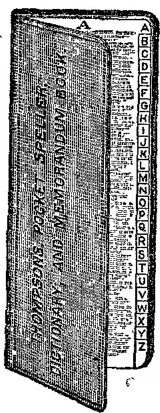
A POCKET SPELLER, DICTIONARY, AND MEMORANDUM BOOK COMBINED.
It gives the right orthography of all words (over 22,800) in common use, and in nearly every instance their definition. It also gives rules for the use of capitals and punctuation marks, abbreviations of names of States and Territories, letters of introduction and recommendation, definitions of commercial terms, forms of notes, due bills, receipts, letters of credit, orders for money, merchandise and goods stored, principal holidays, marriage anniversaries, combination of shades, and carefully selected laws of etiquette in social and business life, also a silicate slate for memorandums.
This Speller gives the most complete list of words in common use; it is a Speller, Dictionary, Handy Companion, and Memorandum Book combined; it is indexed; it prints all words pronounced alike but spelled differently, so they can be distinguished at a glance; it shows where the letter e at the end of a word is to be dropped when adding ed or ing; it gives a complete list of the most practical business forms; it gives the laws of etiquette in social and business life; these rules alone are worth the price of the Speller.
This Speller is bound in leather, is of convenient size to be carried in vest pocket, and its price brings it within the reach of all. American Russia leather, gilt edge, 50 cents. Sent post-paid to any address on receipt of price.
Address all orders to PACIFIC PRESS, 43 BOND ST., NEW YORK.
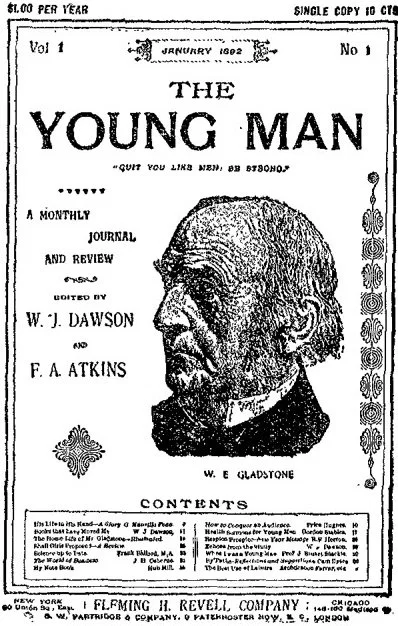
The only paper of its kind in the world
THE MAGAZINE FOR YOUNG MEN
“Young men are a power to-day in the church and the world, and a monthly that appeals directly to them cannot fail to find a wide constituency. The new periodical seems admirably adapted to fill an unoccupied niche.”—Christian Intelligencer.
SUBSCRIPTION $1.00 A YEAR, 10 CTS. PER COPY
SAMPLE COPIES MAILED ON APPLICATION
W. E. GLADSTONE
PUBLISHED BY
FLEMING H. REVELL COMPANY,
NEW YORK, 30 UNION SQUARE, E.
CHICAGO, 148 & 150 MADISON ST.
Sunday Work Indictments Threatened Against Adventists in Tennessee
WE are reliably informed that a number of indictments for Sunday work will be found against Seventh-day Adventists, at the next term of the circuit court in Obion County, Tenn. In fact, the Attorney-General told one of the editors of this paper that lack of time alone prevented the finding of such indictments by the last Grand Jury, and that, “at the next term of court every man of them will be indicted.” The Attorney-General also said: “Every man, woman, and child of them [the Adventists] that works on Sunday will be prosecuted until they quit it.”
Anarchy, Blue Laws, and the Limits of Law
THE Christian Statesman virtually admits that its cry of “Anarchy,” amounts to nothing, when it says:—
Those who cry “Blue Laws,” thereby proclaim for themselves the red laws of anarchy. After the community has incurred all the expense of making laws, they teach that every man shall use them as a bill of fare, skipping all he does not like. That is straight anarchy. Not “dirt,” but defiance of the law, marks the anarchist, and anarchy is more blamable in a washed and educated American than it is in a dirty, ignorant foreigner, raised in despotism, where law itself is lawless.
Admit that law itself may be “lawlessness,” and the whole question stands just where it ought to, namely, on the merits of the law. Does the Statesman think that the Fugitive Slave Law ought ever to have been obeyed? Does it think that laws permitting and legalizing slavery ever gave the slaveholder any just property rights in human flesh and blood? If not, how can it be that law can take from A one seventh part of his time and give it into the custody of B? A man’s time is his own just as much as is his body, and only God has a right to demand that a portion of it be rendered back to him who gave it. Human “Sabbath laws” are blasphemous because they seek to do that which only God has any right to do.
Springville Adventists Indicted Again for Sunday Work
It is stated that some of the members of the Springville, Tenn., Seventh-day Adventist Church, recently convicted of maintaining a nuisance by Sunday work, have been again indicted. Indictments have also been found against other members of the same church. It is openly the avowed purpose of the Prosecuting Attorney to “put a stop to that Sunday desecration.”
Georgia Supreme Court Upholds Sunday Hunting Law
THE Supreme Court of the State of Georgia has decided, in an appealed case from the Superior Court of Houston, Ga., that the statute making it a misdemeanor to hunt any kind of game with gun or dogs, or both, on Sunday, does not violate the Constitution of the State or the United States; and also holds that “Sunday,” and “the Sabbath day,” are synonymous in the legal and legislative language of Georgia.
Sunday Demands Compared With Nebuchadnezzar's Golden Image
The demand made by Sunday-keepers that those who observe the seventh day shall also keep Sunday, is no more reasonable than was the like demand made by Nebuchadnezzar that the three Hebrews who worshiped Jehovah, should also bow down to the golden image which he had set up. The king did not forbid the worship of the living God; he only required a very slight and formal acknowledgment of his god and of his religion. The partisans of Sunday are less modest in their demands than was the heathen king.
Judge Warns Adventists Against Future Sunday Work
THE light fine imposed by the Judge in the case of the four Adventists, referred to on another page of this paper, must not be understood as indicating a purpose on his part to discourage the prosecution of such cases or the finding of indictments for Sunday work. On the contrary, the Judge warned the prisoners that if they persisted in Sunday work in the future, the situation would resolve itself into a question of the relative strength of the law and of those who violated it, and that in such a contest the Court could take but one course.
Sunday Law Prosecutions in Henry County, Tennessee
ONE of the most contemptible features of the recent Sunday cases in Henry County, Tenn., was that brethren were made to testify against brethren. Though the work done was alleged to be a great annoyance to the people of the county, not one witness was found to testify that he was annoyed by it; and in only two instances had anybody but Adventists, who were themselves at work, seen the defendants at work on Sunday. They only supposed that it was their habit to work on Sunday because they were known to rest upon the seventh day. The indictments were found against “five of the leading members of the Seventh-day Adventist Church,” not upon evidence that they worked on Sunday, but simply because of the fact that they belonged to that church; and then the indictments were supported and four of the defendants convicted on evidence wrung from their brethren in the church.
Lessons from Sunday Law Enforcement and Court Decisions
WHAT is the lesson of the logic of the events chronicled in the last few issues of THE SENTINEL?—the Supreme Court declaration that this is a Christian Nation; judicial decisions that Sunday is the Sabbath; the result of the vote in the House of Representatives on the Sunday ice bill, and the Sunday closing at the World’s Fair; the many hundred arrests under the Sunday laws all over the country; and the prosecution of honest, simple hearted, Christian men for persecution’s sake! Who will take heed and learn?
Blue Laws Versus Anarchy: Injustice Compared
THOSE who cry “Blue Laws” do not, as the Statesman asserts, “thereby proclaim for themselves the red laws of anarchy.” Blue Laws are codified injustice; anarchy is disorganized injustice, or the tyranny of brute force. The one is little better than the other. Whatever difference there is is in favor of disorganized injustice, for where injustice is done by individuals without the color of the law it is short lived. Where it is supported by law it has an appearance of respectability that prolongs its wicked reign.