The Youth’s Instructor, Vol. 36, No. 35.

ADVERTISEMENT OF A LOST DAY

The Youth’s Instructor

Aug 29, 1888

S. D. A. Publishing Association · Battle Creek, Mich. · Aug 29, 1888

ADVERTISEMENT OF A LOST DAY.

LOST! lost! lost! A gem of countless price, Cut from the living rock, And graved in Paradise. Set round with three times eight Large diamonds, clear and bright, And each with sixty smaller ones, All changeful as the light.
Lost, where the thoughtless throng In fashion’s mazes wind, Where thrill’d folly’s song, Leaving a sting behind:
Yet to my hand ’t was given A golden harp to buy, Such as the white-robed choir attune To deathless minstrelsy.
Lost! lost! lost! I feel all search is vain; That gem of countless cost Can ne’er be mine again! I offer no reward, For, till these heart-strings sever, I know that heaven-intrusted gift Is fled away forever.
But when the sea and land Like burning scroll have fled, I’ll see it in His hand Who judgeth quick and dead; And when of scathe and loss That man can ne’er repair, The dread inquiry meets my soul, What shall it answer there? —Mrs. Sigourney.

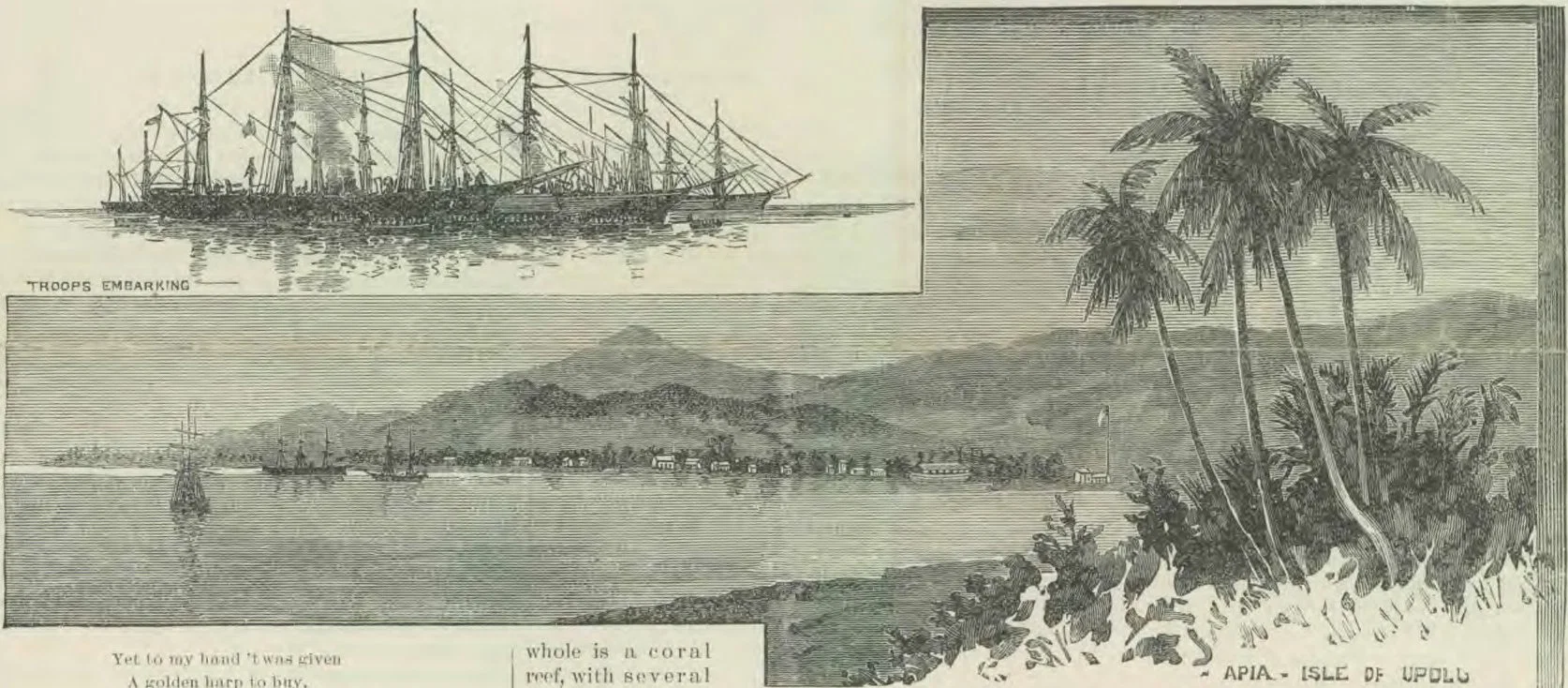
THE CAPITAL OF THE SAMOAN ISLANDS.

THE engraving shown on this page presents a view of the capital of the Samoan Islands. This group in the Pacific is composed of ten inhabited islands, ranging in size from ten to seven hundred square miles in extent. The island of Upolu, upon which is located the town of Apia, contains 560 square miles. It is about forty miles long, and thirteen wide. Extending through the island from east to west is a succession of low mountain peaks, which gradually slope down to the shore. Encircling the whole is a coral reef, with several openings through it, large enough to admit vessels of moderate size.
APIA. - ISLE OF UPOLU
The harbor shown in the picture is located on the north side of the island. Vessels lying at anchor in its waters are protected from the ocean waves by the coral reef extending across its entrance. The town of Apia is well represented in the engraving. It is but a straggling line of wooden houses near the water’s edge, with the single exception of the Catholic cathedral, which is built of stone. This is shown near the center of the town. At the right is seen the German consulate, with the German ensign waving over it. Most of those who live in the town are Europeans.
The native Samoans are generally tall and well-proportioned. The men look strong and hardy, and seem to be as much at home in the water as on the land. Some of their feats seem quite remarkable. While at the islands two years ago, some of our party tossed into the deep water small pieces of money, to test the diving qualities of the natives. No sooner had the silver struck the water, than a brawny fellow would plunge headlong after it. His feet would hardly be hidden from sight before he would turn, and appear on the surface with the piece between his fingers. This was tried several times, with the same effect.
These people are said to be kind, truthful, and hospitable. In conversation among themselves, or in dealing with foreigners, they appear very courteous. They have different styles of salutation, according to the rank of the person addressed. In speaking to a chief, or a distinguished stranger, they say Lau Afo, meaning “your Majesty.” To a common person they say, Sau, which means, “You are here.”
They differ from the Maories of New Zealand in the matter of tattooing, in that they do not mark their faces; but from the waist to the knees, are nearly covered with black stripes. Only the men tattoo. The women usually wear a short skirt, made of long leaves.
Nature has given these people an abundant supply of food, which grows wild all about them. They are not obliged to work for their subsistence, and consequently have much time for eating and sleeping. They do, however, have structures which serve the purpose of houses. A native hut is built by planting stout posts in a circle, upon which is placed a conical roof. The sides are left entirely open, in order to receive the benefit of any passing breeze. For protection against storms, the walls are hung with mats made of the long, narrow leaves of the cocoa-nut tree, a group of which is shown in the foreground of the engraving.
The Samoans were never cannibals. Their traditions show that they have always been a merciful people, free from treachery. Women are treated with the greatest respect, and children are regarded with an affection that amounts almost to extravagance. They are naturally of a religious turn of mind, hence yield readily to the influence of the missionaries. The London Missionary Society claims something over 30,000 converts among them as a result of their labors alone. Of course some of these, perhaps a large proportion of them, are but nominal adherents to Christianity.
Until the white man came among them, they were said to be among the best-behaved races in the Pacific islands. The whites taught them the use of gunpowder, and now they have trouble enough. It seems too bad that the advent of the white man among these simple islanders should be so detrimental to their peace and happiness. And yet it is so. It is said upon good authority that about the only material advancement the Samoans have made since their acquaintance with the ways of civilization, is their improved knowledge of rifles and gunpowder. If these islands could secure freedom from rash adventurers, their future would be much brighter than the present outlook. Let us hope that ere long they will so learn the ways of the Lord as to be prepared for his coming. J. O. CORLISS.

Practicing Happiness Day by Day

It's a good thing to practice being happy. Impossible? Not at all. You patiently practice a difficult passage in your last music lesson. Now set yourself resolutely for a certain time each day to see the bright side, and only the bright side, of your life. If you do not succeed to-day, try again to-morrow, and every day thereafter, increasing the time of practice from week to week. Just apply yourself to this pursuit of happiness and see how you will improve during the year.

On Paying Debts and Expressing Thanks

THANKS are cheap, and yet we can pay half our debts with them. How often do we neglect to balance our accounts? Let our consciences make answer.

THE DOLL AND TOP THAT SAVED THE FAMILY.

A short time before Colonel Taylor’s battle with the Seminole chief, Alligator, and his warriors, a family by the name of Avery went from Pennsylvania to join the white settlers in Florida. For some time after they had taken possession of their new home, their relation with the Seminoles was most friendly. The Indians visiting them frequently, they became accustomed to their savage ways, and soon learned to trust them. At length these friendly visits ceased entirely, and for a long period not an Indian crossed the red man’s line.
Mr. Avery was not troubled by the circumstance; but his young wife grew anxious regarding the change, fearing that the wild men of the woods might meditate war. One day, when Mr. Avery was absent, Mrs. Avery was much perplexed by the sudden appearance of four canoes laden with the treacherous Seminoles. They landed, and approached the house in single file; but as they drew nearer and nearer, she was greatly relieved by discovering that the party consisted wholly of women and children. Assured that it was no war band, she went out to meet them, and soon found out from their imperfect English the object of their visit.
The Seminole braves had gone on a long hunt, and the scanty store of provisions they had left behind them had been consumed by the forest fires. Even the rude wigwams that made up their little hamlet had been burnt up, and the poor squaws and papooses were without food or shelter.
Mrs. Avery, assisted by her negro servants, spread an abundance of good, wholesome food upon the grass, and then, with keen interest, watched the half-famished people satisfy their hunger.
There was one sick child among the number that touched her mother-heart most deeply. For it she prepared delicacies to tempt the appetite, believing that such dainties were better than medicine to the suffering little one. Her two children, Willie and Meta, ransacked the house for presents for the little papooses, and scarcely a red child left the premises without a keepsake, even if it were only a brass button.
Meta took a great fancy to the little sick baby, and begged permission to bestow her new doll upon it. The Indian child was delighted with her treasure, while her mother could not find words to express her gratitude.
Wishing to share in the blessedness of giving, Willie brought his top and gave it to a boy near his own age. After remaining through the night, the party took leave of the family; and as the visit was not repeated, Mrs. Avery conjectured that the hunters had been successful in their quest of game.
Soon after this the long peace between the Seminoles and the whites was broken by outrages of the tribe. Some months after the trouble began, Mr. Avery spied two Seminole warriors approaching his house unarmed. He went out to meet them, but neither of them could speak a word of English; however, they shook hands with him, and then proceeded to make certain cabalistic marks upon the house. This done, they went back to their canoes, and no more was seen of them.
“What does this all mean?” asked Mrs. Avery, when her husband returned.
“It means that clouds are gathering over the white man’s head, but that we are safe from all danger,” he replied, feelingly.
“How do you know?” questioned his wife.
“They made me understand this by their gesticulations, which could be interpreted no other way,” was his assuring answer.
“Oh, yes,” she replied, with a glance at the children; “the doll and the top and the bright buttons are all pleading for us in the dark forest.”
“That is it,” replied her husband. “The Indians never forget a kindness, and you and the children have saved our home and our lives.”
A dreadful war followed, and tragedy after tragedy was perpetrated by the treacherous Seminoles upon the white settlers, but no harm befell the Averys. Time after time news of the atrocities of the cruel foes reached their ears, but not an Indian ever ventured in sight of their plantation. In the early spring Mr. Avery was prostrated with a low fever, and the oversight of the servants fell upon Mrs. Avery.
One day when she was engaged in directing the transplanting of a young orange grove, she was horrified at discovering that her two little children were adrift in an old canoe that had lain by the river’s edge for months. The little ones had been playing in it, as was their custom, and somehow the crazy old thing had broken loose from its moorings, and was helplessly floating down the current. Mrs. Avery was a brave woman, and with all the speed she could make, she jumped into a canoe that lay hard by, and started in hot pursuit. But row as she would, the children gained upon her, and soon she beheld with dismay that her darlings were struggling in the water. With a thrill of horror, she saw their sunny heads disappear beneath the surface of the stream. They rose and sank again; and when she was about to give up in despair, three dusky forms ran down to the river from the other side, and, springing into the swift tide, struggled fiercely with the turbulent water until they reached the spot where the children had disappeared. The next moment they had seized the little limp forms as they came to the surface for the last time, and carried them triumphantly to shore. The poor mother, fearing that a worse fate than death had come to her treasures, hurried on, determined to save them or die with them. Before reaching the shore, she saw that it was lined with Indians who seemed to be watching her movements with intense interest. Some of the braves came to assist her in landing, and the women clustered eagerly around her, trying to make her understand that they were friends. Among those who took her hand were many of the same women she had fed; while the one who had carried the sick child upon the trip, held up her papoose, now well and strong, exulting. The child still clung to Meta’s doll, which at once explained all the strange kindness lavished upon her and her children.
The red skins sent a delegation of their braves to accompany them to the plantation, and then, with the assurance of further protection, the warriors returned to the forest.
“I told you they would not forget the top and doll,” exclaimed Mr. Avery, after listening to the pathetic story of the children’s double escape.
“And you were right,” said Mrs. Avery. “A good action always brings a rich reward.”
“Blessed are they who sow beside all waters.”—S. S. Classmate.

A LETTER FROM NORWAY.

On the 21st of January, we took passage at New York City for the Old World on the steamship Umbria, one of the best and fastest sailing ships on the Cunard line. This vessel usually makes a trip across the Atlantic in seven days, and those in command of the ship are as anxious to make a report of fast travel as any railroad officials on the American continent. The time quoted dates from the moment the pilot leaves the vessel until it touches Queenstown, on the coast of Ireland. There then remain some three hundred miles to travel before reaching Liverpool.
A pilot usually goes out to meet the incoming ship and guide it into the harbor with safety; for the ships are so large, and reach down into the water so far, that all precaution is necessary to effect a safe landing. He also accompanies the ship on its outward passage until all danger from sand bars and other obstructions is past. He then returns to shore, or waits in the pilot house in the ocean until another ship comes along. The pilot on our ship was paid $125 for his services in conducting us safely into deep water.
We very much wish the children could see one of these large vessels, with all the ponderous machinery that is needed to drive it through the water at the rate of twenty miles an hour. They are made of iron on the outside, as are also the most important partitions and the ceiling of the different departments. It seems at first as if such a ponderous structure would certainly sink, but when we remember its size, we can then assign the reason why the water bears it up.
One of these vessels is some 500 feet long, and over 50 feet wide; and when laden, reaches down into the water 25 or 30 feet. The hight above the water to the first deck is some 20 feet, making the ship in all some 50 feet high, nearly twice the hight of a two-story house, and containing nearly 450,000 cubic feet; or in other words, it is capable of holding 360,000 bushels of grain.
Above the first deck is a large deck on which the passengers promenade when the weather is pleasant. In heavy storms the waves sometimes dash over the first deck; and if it were not for the heavy iron fence surrounding it, every moveable thing would be washed into the sea.
As we saw this mighty structure propelled at railway speed through the sea, we were anxious to see the motive power that propelled it. Obtaining permission from the chief engineer, we descended the winding iron stairs some forty feet, or twenty feet below the level of the sea. Here we found a large number of men with shovels diligently feeding the hungry flames. The seventy-two boilers in this vessel were each from three to four feet in diameter. The steam was conducted from these to three large engines which give to the ship about 15,000 horse power. The boilers are placed in rows back of one another, and an arched passage gives a chance to wheel the coal through and in front to either side, and so on until all may be supplied. There are one hundred and twenty men employed in feeding these boilers.
We expected to find the air very impure, since the rooms were so far below the surface, but we were agreeably disappointed to find it fresh. It is drawn through a large pipe some two feet in diameter, reaching from the top to the bottom of the ship. The top of this pipe is funnel-shaped, so that it can be turned any way to gather as much air as possible. This line of steamers is said to be the best ventilated of any on the ocean.
We were detained only one hour on our voyage until we reached Queenstown, where all foreign mail is transferred, and goes by rail up the eastern coast of Ireland and across the Irish Sea. Thence it is sent out to the different kingdoms of Europe, and in many cases reaches its destination before the vessel lands in Liverpool.
When the vessel nears the shore, all are on deck, watching with anxious eyes for the first glimpse of land, and joy fills every heart as the hills loom up, giving evidence that the journey is nearly completed. As we saw every eye anxiously watching the landing of the vessel, we could but wish that the people would just as eagerly watch for the signs that show that the coming of the Lord is just at the door, when, instead of setting foot upon a shore whose beauty is marred by the curse of the fall, those who are faithful will land upon the “evergreen shore.”
R. A. HART.
Christiana, Norway.

What a Little Girl Did.

A good many years ago, a little girl of twelve years was passing the old brick prison in the city of Chicago, on her way to school, when she saw a hand beckoning to her from behind a cell window, and heard a weary voice asking her to please bring him something to read.
For many weeks after that, she went to the prison every Sunday, carrying the poor prisoner each time a book to read, from her father's library. At last, one day, she was called to his death-bed.
“Little girl,” said he, “you have saved my soul; promise me that you will do all your life for the poor people in prison what you have done for me.”
The little girl promised, and she kept her promise. Linda Gilbert has been all her life the steadfast friend of the prisoner. She has established good libraries in many prisons, visited and helped hundreds of prisoners; and from the great number of whom she has helped, six hundred are now, to her certain knowledge, leading honest lives. Prisoners from all parts of the country know and love her name, and surely the God of prisoners must look upon her merciful work with interest.
And all this because a little girl heard and heeded the call to help a suffering soul.—Family Circle.

TREAT EVERYBODY WITH RESPECT.

You have all read of Benjamin Franklin, and how he rose to distinction amid privation and toil. But there is one anecdote which I have never seen in print. It was told me by a gentleman in Boston, who remembered the old house in which Franklin was born. “Often,” said he, “have I looked at the old, tumble-down building on Milk street, and imagined the barefooted boy sitting on the door-step learning to spell from an old post-bill.”
A young girl, the daughter of a distinguished citizen, passed him one day while thus engaged, and the boy overheard her words of ridicule as she spoke to her companion, laughing at the eagerness of the poor lad, and deriding his “beautiful spelling book.”
But there came another day when Franklin was our ambassador at the court of France. A wealthy American lady, who was present at one of the festive occasions made in honor of Franklin, greatly desired an introduction to her distinguished countryman. It was obtained, and great was her surprise to hear him say, “Aye, aye, we have met before.” She could not remember when, and Franklin added, “You do not remember the barefooted little boy on Milk-street, studying his lesson from the muddy post-bill!”—S. S. Messenger.

Patience Strengthens the Spirit and Sweetens the Temper

PATIENCE strengthens the spirit, sweetens the temper, stifles anger, extinguishes envy, subdues pride; she bridles the tongue, restrains the hand, and tramples upon temptations.—Horne.

A BIG WASH-TUB.

In a letter to the Little Christian, signed Carrier Pigeon, is a pleasing description of this big tub, as seen by himself. It was nearly as follows:—
“It was some two miles long, and from a rod to a full hundred feet wide. The laundry in which it was used, was a tremendous affair. The huge boiler was set about six miles away from the middle of the tub, and was 3,335 feet high. The chimney was a dozen miles off in the opposite direction, and if I should tell you just how high it was, I fear you would think this a pretty tall story.”
“The fires under the chimney never quite go out, although they were too low when I was there to heat the water. So nicely contrived was everything, that one woman or even a child could wash clothes in it as well as 500 persons. I saw it one day in February, 1886, when there were a hundred barefooted women, girls, and boys washing clothes in it at the same time. The tub, in fact, was used for a whole city’s washing, and so of course had to be large, so large that no roof could be made to cover it, so that the sun and rain beat into it and gave life and beauty to hundreds of calla lilies, rose vines, jessamines, and other plants that grow along its sides. For this big tub was the bed of a brook, and a most beautiful brook it is, leaping and sparkling in the lovely vale of Flamengas, on its way to the sea, through the city of Horta, in the Island of Fayal.”
“What I have called the boiler does not now boil at all. It is the great caldeira, or crater, or hollow of a volcano in the top of a mountain in Fayal. There are many larger and more wonderful craters in the world, but some people think there are few or none more beautiful than the Caldeira of Fayal. The edge of the crater is about six miles round, and the sides slope steeply down to the bottom, 1,500 feet below, where is a little lake surrounding a small hill. The top of this hill has a smaller hollow of its own, and this is the real place from which the fires actually broke out, long ago, from the earth below. ‘Caldeira’ is Spanish for caldron, or boiler, and once this big boiler did boil in earnest, and sent out flames, smoke, and whole rivers of melted, hissing, bubbling lava, that plunged headlong into the sea, or cooled at last on the mountain sides.”
“What I call the chimney of the laundry is the volcano of Pico, just across the bay from Horta, a lava and ash-covered mountain, 7,613 feet high. More than once the fires under it have belched out streams of melted lava from it. Vesuvius, in Italy, has done far more mischief, but is not nearly so high, being 3,948 feet above the sea. It is said that smoke can still be seen rising from Pico at times, and when Professor Agassiz climbed to the top of it, some years ago, the end of a long rope that he let down the hole at the top never came back. The hot, hungry mountain had bitten it off for dinner. But Pico has long been quiet. Its sides are covered with vineyards, and laughing children play under fig, orange, and lemon trees, where once were heated ashes or tossing lava streams.”
“Fayal is one of the nine islands that form the beautiful group of the Azores, in the Atlantic Ocean, 2,000 miles east of the United States on a line with Philadelphia. Upon the Azore Islands washing is not done in the house, but out-of-doors, by the brook sides. The women and children dip the clothes into the pools, lay them upon the rocks, tramp on them, twist them up or beat them on the bed of the rocky brook until they are clean. It is healthful exercise for the washers, but a hard process for the clothes.”

THE THIRD ANGEL'S MESSAGE.

LESSON 11.—THE MARK OF THE BEAST.

1. Who will be required to worship the beast and his image, and to receive his mark? Rev. 13:12, 15-17.
2. In opposition to this, what does the third angel's message say? Rev. 14:9, 10.
3. What are those led to do, who heed the voice of this message? Rev. 14:12.
4. What does this show? Ans.—That the powers spoken of in Rev. 13:12-17 will put forth all their strength to compel men to do something that is contrary to the commandments of God.
5. What have we found was the principal object of the papacy in the fourth century? and what is the purpose of the Protestantism of to-day? Ans.—To use the power of the state to compel all people to keep Sunday as the Lord's day, or Christian Sabbath.
6. Of what day is Christ the Lord? Mark. 2:28.
7. What day is the Sabbath? Ex. 20:10.
8. Then what day is the Lord's day?
9. What does the Lord call the seventh day? Ex. 20:10; Isa. 58:13.
10. Is there any commandment of God for keeping Sunday? Ans.—None whatever.
11. What testimonies can you give on this point from eminent first-day authorities? Ans.—The $500 prize-essay of the American Tract Society acknowledges the “complete silence of the New Testament so far as any explicit command for the Sabbath [Sunday, the first day of the week] or definite rules for its observance are concerned.”—Abiding Sabbath, p. 184. And the $1,000 prize-essay of the American Sunday-school Union says: “Up to the time of Christ's death, no change had been made in the day.” And, “so far as the record shows, they [the apostles] did not, however, give any explicit command enjoining the abandonment of the seventh-day Sabbath, and its observance on the first day of the week.”—Lord's Day, pp. 186-188. Note.
12. What was the single link that in the fourth century united church and state, which developed the beast? Ans.—The Sunday institution.
13. What is the single point in a similar movement in our day which develops only an image to the beast? Ans.—The Sunday institution.
14. What does the papacy set forth as the sign of its authority to command men under penalty of sin for disobedience? Ans.—“The very act of changing Sabbath into Sunday, which Protestants allow of, . . . Because by keeping Sunday strictly they acknowledge the church's power to ordain feasts, and to command them under sin.”—Catechism of the Catholic Christian Instructed.
15. Then what is the mark of the beast?
16. To whom do those pay homage who keep Sunday? Ans.—“The keeping of Sunday is an homage they pay, in spite of themselves, to the Catholic church,”—Plain Talk about Protestantism.
17. Then when Protestant churches attempt to compel people by law to keep Sunday, what is that only to do? Ans.—It is only to compel men to worship the papacy—to worship the beast.
18. But, as in the very act of doing this these churches make an image to the beast, what then will be the enforced observance of Sunday in this nation? Ans.—It will be the worship of the beast and his image.
19. But may not Sunday-keeping be enforced as a civil duty? Ans.—Never. Because Sunday is wholly a religious institution; and the civil power has no right to enforce religious duties.
20. What does Christ command on this subject? Matt. 22:21.
21. By what power was Sunday-keeping instituted? Ans.—The church.
22. Why were the ancient Sunday laws enacted? Ans.—The church demanded it, and it was done to satisfy and help the church.
23. Why are Sunday laws now enacted? Ans.—For the same reasons precisely.
24. Is the church Cæsar? Ans.—No.
25. Is the church God?
26. Then what follows? Ans.—That as Sunday keeping belongs neither to Cæsar nor to God, there is no power in existence that can, of right, command it.

NOTE.

QUESTION 11.—The student is at liberty to present any other testimonies on this point that he may choose.

MORE OF THE CHINESE.

There is very much that is interesting to learn about the Chinese, but most of you have already been told that these people do every thing just the opposite from what we do. The lines in their books run up and down the page, and they begin at the upper right-hand corner to read. Carpenters draw their plane from left to right, and the artist makes his pictures wrong side up, and then turns them over, etc. But a writer in an exchange says the strangest thing about a Chinese school is that “no one studies anything in it except the alphabet. And stranger still, even the best scholar in school has not learned it yet, and not one out of the 400,000,000 of Chinese knows all his letters. You must not think from this that the Chinese are all ignorant. You will very soon say that no one could learn all the Chinese alphabet when I tell you that it contains 52,000 letters.”
“Do you ask how they came to have so many?—Thousands of years ago, when the Chinese first began to write their language, they made a picture of the sun, and that was their word for sun; and another of an eye, and that was their word for eye; and another for mouth, and that was their word for mouth; and so they have kept on inventing a new character or letter for each new word or syllable, until to-day there are 52,000 characters in their dictionary,—a number which even the smartest man could never commit to memory. In the child’s primer are 1,000 word characters. After the children learn these, they have another thousand or so to learn, and after these still other thousands; for they must learn 10,000 before they can graduate.”
“Although the Chinese have some queer ways, there are some things we ought to learn from them. Among these we may name their politeness, and their great respect for parents and old people. A lady missionary at Canton, China, says ‘they are so polite they will not, in crowded street or elsewhere, inconvenience a friend or fellow-traveler without at once offering an apology. Having the most perfect control of countenance, they never, either by look or sign, notice a mistake made in their presence by a foreigner.’”
“The Chinese are lovers of peace and good order, given to industry and frugality. Children are dutiful and obedient to parents, even though they may have grown to years of maturity and have children of their own. Respect for superiors always prevails.
“At the end of each year every debt is canceled, every account settled. As the new year is ushered in, the old ledgers are laid aside, and these houses of business begin anew, being able to say, ‘We owe no man anything.’ Where such is the order of things, stupendous failures cannot occur. But while in some respects we can model after them, the greater part of that vast population are without the light of the gospel, and so are ignorant of what is necessary for their salvation.”

A STREET OF TOMBS.

An interesting discovery was made last year in the direct line between Pompeii and Nocera. The digging of a well in a vineyard revealed the existence of a street of tombs, about one thousand feet east of the amphitheater of Pompeii. If the whole street is as closely lined with tombs as is the portion laid bare, it will be one of the most important discoveries lately made in that part of the world; but, unfortunately, money is wanting, so that the excavation is going on very slowly. Most of the tombs are covered with rude inscriptions, painted in red, many of them being in the nature of advertisements, the tombs thus serving the purpose of a newspaper along the much-frequented road. The exact date has not yet been accurately ascertained, but they probably belong to the periods of Julius Cæsar and Tiberius, nearly a hundred years before Christ. A contrast may be drawn between the condition at Pompeii and that of Pergamon, which, although double the size of Pompeii, has, thanks to the Prussian government, been laid clear within eight years. In the latter, beautiful, finely painted statues, votive offerings to Athena, and belonging to the sixth century, B. C., have been found buried in earth and literally forming the foundation of the houses above. Their style of art is one hitherto not supposed possible at so remote a period, and they cause the ruins of Pompeii to appear quite modern.—Selected.

THE HIGHEST PEAK.

The highest mountain in America must now be changed from Mount St. Elias to Mount Wrangle, a little to the north. Several of these mountains have been newly measured. Mount Hood, once “roughly” estimated at 17,000 feet, then “closely” at 16,000, was brought down by triangulation to 13,000; an aneroid barometer made it 12,000, and a mercurial barometer, 10,255. Mount St. Elias, estimated by D’Agelet to be 12,672 feet, is triangulated by Mr. Baker to 19,500. It now appears that Mount Wrangle, lying to the north, rises 18,400 feet above Copper River, which is, in turn, 2,000 feet above the sea at that point. If this holds true, Mount Wrangle is at least 1,000 feet higher than any other peak in North America. It lies within the United States boundary. —Salt Lake Tribune.

THE FUNNY BONE.

Is there a single reader of Little Folks who does not know what the “funny bone” is? But why is this bone at the elbow-joint called “funny”? Those who are learning Latin will find it easy to understand the reason, for they will remember that humerus is Latin for “shoulder.” Now humorous is English for “funny”; and it was out of a play on the two words—which, when pronounced, are almost alike in sound—that the elbow-bone was named the “funny” bone. Some of you may have heard the conundrum whose answer explains the whole thing, “Why is the ‘funny’ bone so called?”—“Because it borders on the humorous (humerus).”—Little Folks.

MONSTER FUNGUS.

Sir Joseph Banks, the celebrated naturalist, once had a cask of wine, which, on tasting, was found too sweet; it was therefore locked up in a cellar to ripen. There it remained for three years, probably during the time he was with Captain Cook in his voyage around the world. At the end of that period he directed his butler to ascertain the state of the wine; but the cellar door could not be opened on account of some powerful obstacle within. The door was cut down, when the cellar was found to be completely filled with a fungus so dense and firm as to require an ax for its removal. It was then discovered that the fungus had consumed every drop of wine, and raised the empty cask to the ceiling.—S.S. Classmate.

BISMARCK A PAPER-MAKER.

Prince Bismarck, it may not be generally known, is a paper-maker, and makes £10,000 a year—which is more than he derives from his official emoluments—out of extensive paper mills, which he originated and works himself.

THE WAY THAT JESUS GREW.

“And Jesus increased in wisdom and stature, and in favor with God and man.” Luke 2:52.
WE marked one summer’s morning Their height upon the wall; First Grace, then little Alice, Next Hal, who stood so tall. “We’ve all grown,” said Hal proudly, His brown eyes bright and clear. “If we keep on, I wonder How tall we’ll be next year.”
Said little Alice gently— Her eyes were soft and blue— “I hope that we’ll be growing The way that Jesus grew.”
It shined at prayers that morning This verse was hers to say: “Jesus increased in wisdom And stature day by day, With God and man in favor.”
Dear Lord, the lesson teach,— Thy meekness of behavior, The wisdom of thy speech; How as a child thou livedst, Unselfish, gentle, true; Till all earth’s little children Shall grow as Jesus grew. —The Child’s Paper.
Continue reading: A CURE-ALL