Your ShelfYour Projects

Review and Herald, Vol. 86, No. 7.

Victory
Earlier text: The Development of Ideals in the Home

Biennial Conference in India

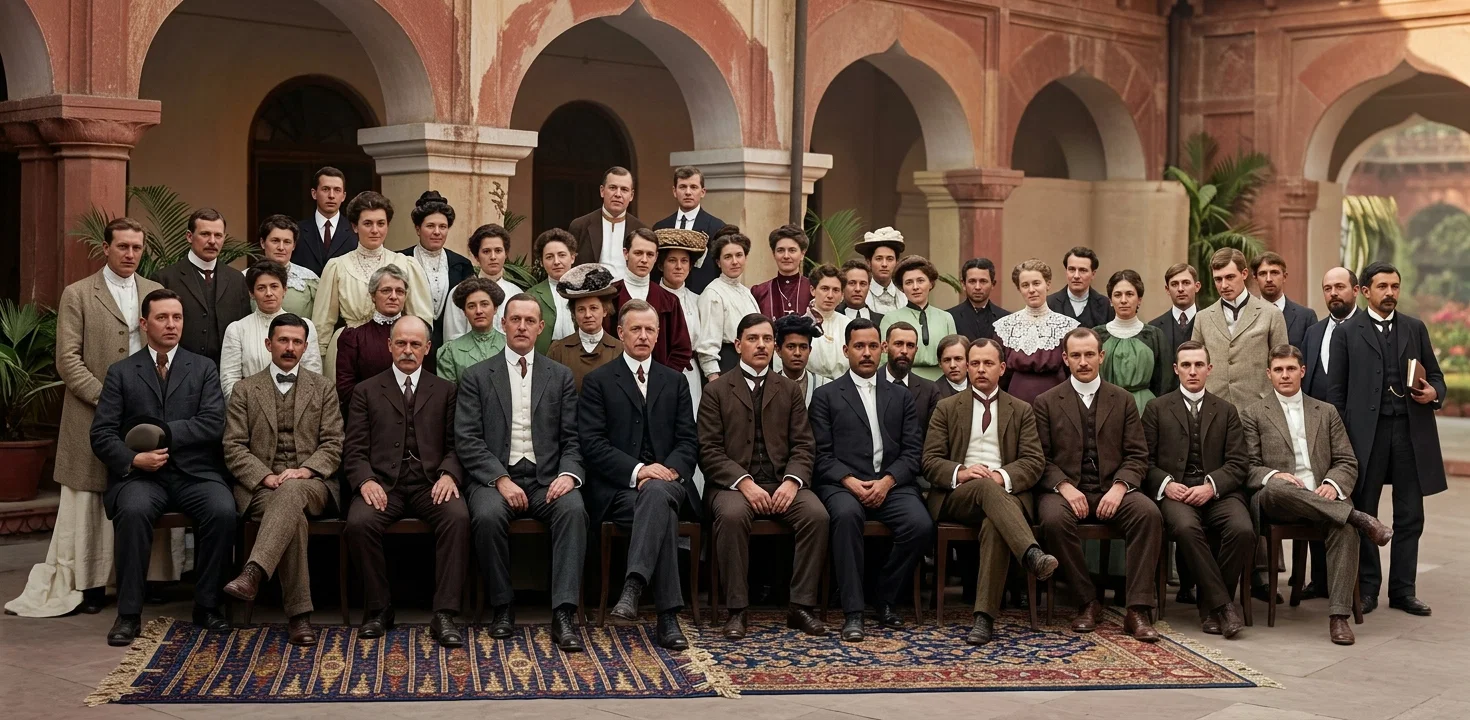
THIS meeting was held at Lucknow, North India, from Dec. 25, 1908, to Jan. 4, 1909. There was a general attendance of all our workers in India and Burma. Some arrived several days before the conference opened. The few intervening days were spent in Bible study, prayer, and counsel, the result of which was a great blessing to the conference. As workers we were led to realize as never before our imperative need of a larger measure of the Holy Spirit for the work before us in India. From the first of the conference, there was an earnest, untiring seeking after God, and the result was the continual presence of the Spirit of God with us in our council meetings. We found ourselves facing conditions we knew not how to meet, and the way in which God gave wisdom to his servants while they planned and counseled together, the sweet presence of his Spirit pervading all that was said and done, will not be soon forgotten by our missionaries in the Indian Mission field.
WORKERS WHO ATTENDED THE BIENNIAL CONFERENCE, DECEMBER 25 TO JANUARY 4, LUCKNOW, INDIA
They came many hundreds of miles from different parts of India and Burma, intent on pleading with God, and claiming more of his power to meet the difficulties before them in India, and they were not disappointed. Their faith was strengthened, their courage increased. We parted from one another with a shout of victory in our hearts, knowing that we had been in the presence of God, that he had been with us, and would go with us and grant us victory where caste and prejudice and climate oppose the march of truth.
There were a number of Sabbath-keepers present from different parts of India. We were glad to have so many Hindustani people in attendance. Their interest in the truth was encouraging. A brother who accepted the third angel’s message about a year ago, came eighteen hundred miles at his own expense to be present at this gathering. He made an urgent request that an industrial school be opened among the Burmese in northern Burma. He had with him a letter from a prominent Burman, promising that fifty pupils would attend, and would be willing to pay tuition if such a school should be opened.
A survey of the Indian Mission field shows that the work is moving onward. The number of workers has been increased. While nine have left the field during the last two years, twelve others have taken their places. During the meeting, word came from the Mission Board that a company of five workers was sailing from New York for India, thus raising the number recently coming to the field to seventeen.
We have thus far started work in this country in seven languages, besides the English,— Bengali, Hindi, Burmese, Marathi, Tamil, Urdu, and Santali. The work which has been done in each of these languages was reviewed. Scarcely a beginning has been made. Much time has been spent in language study, which, by the way, with the tongues to be mastered in India, presents an undertaking our people at home can but faintly realize. A hundred fifty different tongues, mostly of the trying Sanskrit origin, call for years of untiring study on the part of many workers. We thank God for the earnest company of sons and daughters from the home land, who, working one here and another there, are burrowing into the seven Indian tongues mentioned above.
One interesting feature of the meeting was the convention held each afternoon for the purpose of studying the Indian Mission field, our work, and plans for developing it. Papers had been prepared on various subjects. Most of these had been given very careful preparation, and were extremely helpful and suggestive. In many instances the methods of labor are so different that wise plans can be developed only through much effort and experience.
Connected with the reading of the papers was not a little open discussion on various features of mission work. This was entered into with much enthusiasm, and proved very profitable. How to work successfully in India is not to be learned in a day. The Indian mind is deep, and has proved the study of a lifetime to many Europeans. It is safe to say that our workers are learning, though we often pray earnestly for the gift of the Holy Spirit for the discerning of spirits, lest we put too much confidence in man, or fail to encourage the honest in heart who are seeking after truth.
Our work among the Hindustani, Bengali, and Tamil Sabbath-keepers was carefully canvassed. Each field presents remarkable openings. We found ourselves altogether unable to answer the calls which came. Two lady workers, recently from America, were asked to begin the language study at once,— Sister Ayers to start in Marathi work, and Sister Shryock in Tamil. The appeals for other help, though imperative, were passed on to the Mission Board. We asked for more than ever before. Nearly every one of our mission stations should be strengthened the coming year. It is hazardous to have a man and his wife, with even a lady worker, in a language alone. Dr. Oberholtzer has been working alone for two years in Moulmein, Burma. If one man fails where conditions are trying, and the climate is unhealthful, there should be another one already familiar with the language to bridge the crisis until more help is available. Our workers believe that the time has come when our stakes in India should be strengthened. We must do that before we start any new centers, however loud the call may be.
The medical work is growing. From the hot, steaming climate of Calcutta the sanitarium was transferred a year ago to the salubrious climate of Mussoorie. Though it is early to predict what the outcome of the change will be, the first year presents a very encouraging report financially and otherwise. Though cramped for room, and laboring with small and unsatisfactory equipment, good work has been done. Surgical cases have made excellent recovery. One woman, given up to die by friends and physicians, rallied from a serious operation. We need more room and better facilities. Could our sanitarium managers at home see how unsatisfactory it is to operate a sanitarium in rented buildings in India, they would realize our great need of a building of our own for this purpose. Fifteen thousand dollars would provide a property large enough for the present.
The last Sabbath of the conference was marked with the special presence of God. The Holy Spirit worked upon hearts. At the close of the morning service, Brethren J. S. James and J. C. Little were ordained to the gospel ministry. In the afternoon the ordinances were celebrated. A stirring sermon by Elder Geo. F. Enoch, on “The Meaning of Earthquakes in the Light of Prophecy,” closed the evening meetings, at which the people of Lucknow were well represented. The organization of our first Hindustani church of sixteen members was effected at the close of the conference. Four persons were baptized.
The workers are now in their various places of appointment, but the good influence of the meeting still prevails. It was a mighty uplift to all present. Yet we are not satisfied. We need more faith, more power to turn men from darkness to light, more love which begets an overwhelming love for unwarned and ignorant souls all about us in heathenism. The work and workers in India are urgently in need of the unceasing prayers of our people in every land.
J. L. SHAW.

The Atlantic Union Missionary Volunteer Council
A COUNCIL of the Missionary Volunteer secretaries of the Atlantic Union Conference was held following the educational council at South Lancaster, Mass., December 26-29. Prof. M. E. Kern and Brother F. M. Dana were in attendance, also the following conference secretaries: Mrs. Lee S. Wheeler, of the New England Conference; Miss Jennie R. Bates, of Maine; Mrs. A. E. Taylor, of Vermont; Mrs. Ralph Clapp, of Western New York; Mrs. L. H. Proctor, of Greater New York; and Mrs. J. H. Rice, of New York. Elders E. W. Farnsworth, O. Montgomery, and C. H. Edwards helped much by hearty co-operation and counsel.
In the opening meeting Elder Montgomery said that the third angel's message is a cleaver, separating our young people from the churches, schools, and society of the world. Man is so constituted that his religious, educational, and social needs must be supplied, and we must provide for them if we hope to hold our youth in the denomination. Perhaps the whole work of the council might be called a wrestling with the questions that follow a consideration of that statement, with a view to saving our young people for the Master's work.
The need of a deep spiritual life that would reveal itself in effectual prayers and holy living was felt by all present. It was also recognized that it was the province and duty of homes to teach this by precept and practise. The need of personal work was emphasized. Young people will do the most for their Master as they work and pray for one soul at a time with whom they can keep in touch. Actual experience showed that the time and money spent by a secretary in visiting our own youth was well invested.
Study of the problems of adolescence was suggested by the papers and discussions on that subject. Social needs came in for a great deal of consideration also. The dangers as well as the blessings of society were felt, and the whole seemed a great problem yet to be worked out. A correspondence school was also looked upon favorably.
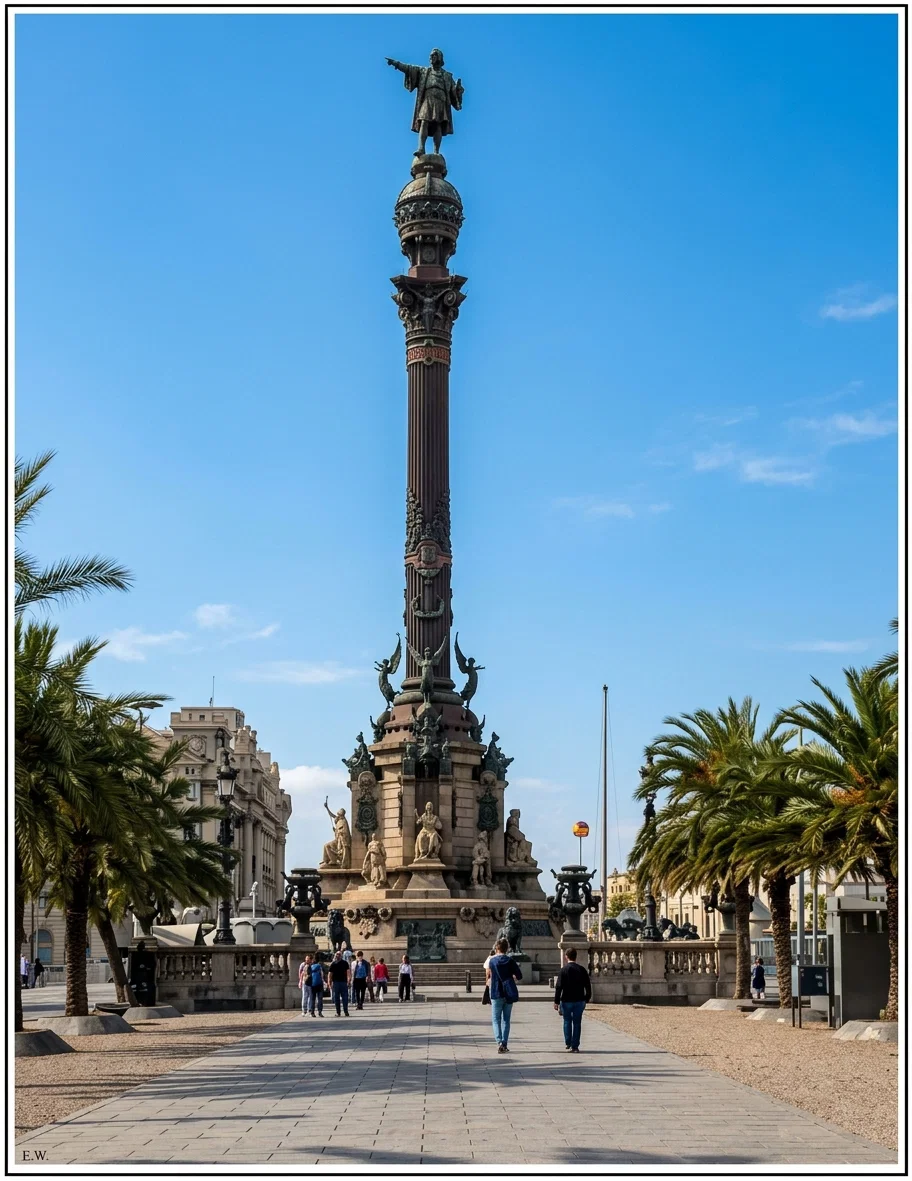
MONUMENT OF COLUMBUS POINTING TO AMERICA
The correspondence and field work of the secretary and the branches of work carried on by the department were studied carefully. The secretaries returned to their conferences, feeling that they had gained much good.
F. M. DANA, Chairman; BESSIE JACKSON RICE, Secretary.

Spain

WITH my wife and little boy I came last Monday to Rubielos de Mora, which is situated in the mountains of ancient Aragon. About seventy miles of our journey was by train, and from the railway to the town requires nearly three hours by stage.
We are at the home of one of our brethren who began to obey the truth about three or four months ago in Barcelona. His wife began to walk in the light several months before. I am glad to report that they are faithful to the message, including health reform. They were anxious that we should come and hold meetings in their home. The brother’s parents are convinced of the Sabbath truth, and are trying to obey it. They are not, however, walking in all the light. We have now held three meetings, and an excellent interest has been manifested. Without permission from the city or town officials, we are, according to Spanish law, subject to fine, if more than nineteen persons are in attendance at our meetings.
Day before yesterday I presented to the town mayor a formal written application for permission to hold meetings here. He has not yet given me an answer. Rev. 12:17 is being literally fulfilled in this town. The priests are determined to drive us away, and for two days our brother’s house has been bombarded by a stone brigade made up of boys and girls ranging from about five to fifteen years of age. Yesterday evening two large holes were made in one panel of the entrance door. During the siege a constant war-cry is kept up. The priest taught the children this song:—
“Away, away, Protestants, Away from the nation; For we wish to be lovers Of the sacred heart. Let the virgin live!”
Some of the stones which came thundering against our doors were several inches in diameter, one of them being almost as large as a man’s head.
At one time I ventured onto the veranda, to see how many were taking part in the demonstration. I counted about ninety. As we sat and listened to the storm of stones against our house, we felt no fear. That precious promise, “The angel of the Lord encampeth round about them that fear him, and delivereth them,” is dear to our hearts. We are thankful that our Saviour has promised, “Lo, I am with you all the days, even unto the end of the world.” We are grateful for a part in this blessed work. We long to see more laborers sent into this, one of the darkest of nations, and we hope and pray that plans may soon be formed whereby this may be realized.
This is a mountainous country, and as much snow has fallen near this place during the past few days, we are having quite cold weather. By hovering over the old-fashioned fireplace, we keep comfortably warm. Our courage is good, and we are glad to be used in the Master’s work.
FRANK S. BOND.

F. W. BISHOP

Chile

I LEFT the city of Valparaiso, November 27, on board the German steamer “Tanis,” for Punta Arenas, a city of ten thousand inhabitants, in the Straits of Magellan. It took nine days to make the trip. I was the only passenger. I came here to canvass, and have worked about three weeks. The times are hard, and many are out of work, but every day I sell some small books, and have orders for twenty-three large ones. There are two Protestant churches of about one hundred members each. The pastors of both churches treated me well. One bought “Christ’s Object Lessons.” Brother C. A. Nowlen was here about fifteen years ago, and left many of our books scattered throughout the country.
About a year ago a Peruvian woman came here with her family. She has been keeping the Sabbath with her daughter. There is also a German family, the women of which keep the Sabbath. The man believes, also, and I hope he will soon obey. Another woman, a Chilean, has begun to meet with us. I hope to find some who will decide to obey the truth before I leave. I shall remain till winter sets in.
The houses here are nearly all made of zinc. It is a beautiful sight to stand on the hill back of the city and look over the town, and at the ships anchored in the strait. Just across the water one can see Tierra del Fuego, ‘The Land of Fire.’ To the north lies Patagonia. Scattered over it are great sheep farms, which have from fifteen thousand to three hundred thousand sheep. Many of the shepherds are Englishmen; and some one must take the truth to them.
Here would be a good place for a minister to work. There are many English people in this city. The climate is healthful, and always cool, but not so cold as it is sometimes in the States.

F. W. BISHOP

South African Union Conference

THIS meeting convened at Claremont, Dec. 24, 1908, and continued ten days. It was not largely attended. We are passing through the worst financial strain ever experienced in Africa. As the government owns the railroads, the commercial crisis is felt by them as well as in the administration of governmental affairs. All missionary and clergy concessions have been discontinued. The holiday rate is still granted. It was the purpose in appointing the meeting at the above date to give the people the advantage of the holiday rate. This brought the meeting in the midst of harvest. Many could not leave home on this account. All those in charge of mission stations and nearly all of the laborers in the field were in attendance. The last Sabbath and Sunday representatives from several of the churches were present. There was a good attendance from the churches in the vicinity of the meeting.
In order to acquaint myself with the field in part, I visited Johannesburg and Vryheid before the meeting. I found the Johannesburg church in need of help. They had some differences with the conference , and on account of this had refused to send their tithe to the conference treasury. These misunderstandings were adjusted, and the church and conference were restored to harmony. This was taken by many as an indication of what the Lord would do for us in the union conference. At the close of the meeting at Johannesburg Elder L. R. Conradi joined me from his visit to mission stations in German and British East Africa. He gave some stirring missionary talks before leaving that church. His labor was well received. At Vryheid we met a member of the Natal Parliament, who, with his family, has accepted the message. We enjoyed our visit with this church. Our time was spent chiefly in considering the advisability of opening a mission station among the Zulus.
We returned to Cape Town in time for a two days’ rest and three days’ council before the opening of the union conference. The council, held in advance of the opening of the conference, was very profitable. Much time was given during the union conference to studying plans and policies that would put the work on a better basis. The trying financial crisis which has lasted for five years, and which is still severely felt, makes it necessary to study most carefully an economical plan of operation for the work in this field. All cheerfully took up this study, both in the conferences and institutions and in the mission fields. The Cape Colony Conference was found to be thirty-five hundred dollars behind, and the college was also running at a loss. The Natal Conference is running well. The sanitarium showed a gain. It has been successfully managed, and at the present time is running with its capacity so taxed that patients are requested to wait a little for others to make room for them before they can be received.
A number of canvassers had been employed by the Cape Colony Conference on part salary. These now undertake to make their work self-supporting, on account of the financial condition of the conference. Plans were laid to put the workers in the employ of the conference into the field in aggressive work. Two tent companies were organized, and other aggressive work was planned. Careful study was given to the Dutch work, and an aggressive movement was started on behalf of that people. Those at the head of missions engaged cheerfully in a study of plans by which we could lessen the operating expenses of mission stations. They confidently expect to be able to make all the old stations self-supporting.
It was planned to give more attention to the college work, to endeavor to make the school self-supporting, also to provide more facilities for giving suitable instruction in the Dutch language.
From the first, our councils and meetings of the union were marked by a spirit of earnest devotion. This spirit deepened as the meetings progressed. Daily Bible studies were conducted by Elder Conradi on the book of Acts, showing that the message must go to all nations, and national prejudices must be overcome through its teaching. The writer gave daily studies on principles that are fundamental to success in the giving of the message to the world, and the contrast between the principles underlying the message and those leading to apostasy. The evenings were devoted to reports from the mission stations. The workers readily received the word spoken, and all united in a spirit of harmony to study the one great theme which was the key-note of the meeting,—the finishing of the work in this generation.
On the last Sabbath of the meeting the Spirit of God came in with subduing power, and fifty persons arose for prayers for victory over temptations to which they had yielded in the past. At the close of the day, Brethren W. C. Walston and J. F. Olmstead were set apart to the work of the ministry. The workers’ meeting, the last morning of the conference, will be long remembered by those in attendance. The Holy Spirit came in as a comforter, in approval of the surrender of all to the Lord on the part of the workers. All hearts were made tender and greatly refreshed.
During the last meeting of the Cape Colony Conference, which was held in connection with the union conference, Brother H. Elffers and family, with a church now numbering nineteen, asked admission into the conference, and were received by a unanimous vote. On account of difference of plans they had decided some years ago to work independently of the denomination. When they saw the spirit of harmony that had come in among the workers, they desired to unite with the body for the finishing of the work. All were rejoiced to welcome them into fellowship.
The college and sanitarium management were placed under the union conference. This will make the management representative, and be more satisfactory to those living at a distance from the institutions.
The union conference committee chosen for the next biennial period consists of the following-named persons: R. C. Porter, W. S. Hyatt, H. J. Edmed, E. R. Williams, I. J. Hankins, Dr. Geo. Thomason, the principal of the college, M. C. Sturdevant, and J. H. de Beer. This committee constitutes the board of management of the college and sanitarium. J. V. Willson was chosen secretary and treasurer of the union, and Mrs. R. C. Porter corresponding secretary, and editor of the Missionary. Elder I. J. Hankins was chosen editor of the Sentinel, and J. R. Israel business manager of the publishing department. A Dutch paper, on the plan of the Missionary, was started, to be issued quarterly, and printed by the Elffers printing-house.
We gratefully acknowledge the goodness of God in the work he has accomplished during this meeting of the union conference. It is the Lord’s doings; we thank God and take courage.
R. C. PORTER.

W. C. HANKINS

China

Our work in Fukien is moving slowly at present. A few have been baptized this year, and there are some others nearly ready for baptism. We expect, also, to organize the companies at Dogang and Tsuan Chiu into churches soon. Personally, I have not been able to do quite as much aggressive work in the interior as I could wish. Three months out of the nine have been spent out of the province, in Shanghai and Middle China, and the building of our home has also kept me tied to Kulangsu somewhat closely. Of course there has been plenty to do here in the preparation of literature, language study, etc. This does not show much in reports. It possibly will net greater returns for the kingdom in the long run, however.

W. C. HANKINS

Field Notes

SEVERAL are investigating the truth at Columbus, Ohio, and recently a man and his wife, with their children, began the observance of the Sabbath.
ON January 2, three young people were received into the church at South Stukely, Quebec, making five additions during the last six months.
A REPORT from the German workers in Chicago, Ill., shows that three new members have been added to their number. These were baptized Sabbath, January 9.

Canvassers’ Annual Summary for 1908

Constituency Total sales Amount per capita
Atlantic Union Conference
Constituency Constituency Total sales Amount per capita
Central New England 1207 $9,780.34 $8.10
New York 906 7,350.77 8.11
Western New York 865 7,030.72 8.12
Greater New York 944 6,260.90 6.63
Vermont 407 3,131.40 7.69
Maine 429 2,913.82 6.79
Southern New England 497 1,423.78 2.86
Totals 5255 37,891.73 7.21
Columbia Union Conference
Constituency Constituency Total sales Amount per capita
New Jersey 538 10,618.96 19.73
Chesapeake 640 10,468.45 16.35
Ohio 2236 8,057.70 3.60
Eastern Pennsylvania 1135 7,934.15 6.99
Virginia 481 6,099.69 12.68
West Pennsylvania 764 4,340.07 5.68
West Virginia 315 4,172.44 13.24
Totals 6109 51,691.46 8.46
Lake Union Conference
Constituency Constituency Total sales Amount per capita
Wisconsin 3021 6,299.65 2.08
Northern Illinois 1270 5,331.20 4.19
Southern Illinois 635 5,079.80 7.99
East Michigan 1800 4,024.60 2.23
Indiana 1879 3,783.15 2.01
North Michigan 807 2,505.90 3.10
West Michigan 3475 1,337.45 .39
Totals 12887 28,361.75 2.20
Canadian Union Conference
Constituency Constituency Total sales Amount per capita
Maritime 260 3,680.65 14.15
Quebec 210 752.50 3.58
Ontario 612 3,691.45 6.03
Newfoundland 35 ….. …
Totals 1117 8,124.60 7.27
Southwestern Union Conference
Constituency Constituency Total sales Amount per capita
Arkansas 553 12,674.95 22.92
Oklahoma 1889 16,023.04 8.48
Texas 1494 18,047.50 12.08
West Texas 170 2,729.95 16.06
New Mexico 90 1,482.00 16.46
Totals 4196 50,957.44 12.14
Southeastern Union Conference
Constituency Constituency Total sales Amount per capita
South Carolina 167 9,998.98 59.87
Cumberland 510 8,082.80 15.85
Georgia 180 7,911.15 43.95
North Carolina 296 4,936.80 16.67
Florida 460 3,095.56 6.73
Totals 1613 34,025.29 21.09
Southern Union Conference
Constituency Constituency Total sales Amount per capita
Alabama 321 9,247.52 28.80
Louisiana 280 7,069.92 25.24
Tennessee River 408 6,048.70 14.82
Kentucky 282 4,875.55 17.28
Mississippi 265 3,875.65 14.62
Totals 1556 31,117.34 19.99
Northern Union Conference
Constituency Constituency Total sales Amount per capita
Minnesota 1700 9,410.78 5.53
South Dakota 969 9,133.54 9.42
Iowa 2906 5,399.05 1.85
North Dakota 1116 4,369.55 3.91
Miscellaneous … 1,000.00 …
Totals 6691 29,312.92 4.38
Central Union Conference
Constituency Constituency Total sales Amount per capita
Kansas 2490 20,550.44 8.21
North Missouri } 1535 10,008.75 6.52
Southern Missouri }
Nebraska 2122 9,621.37 4.53
Eastern Colorado } 2300 5,654.30 2.45
Western Colorado }
Wyoming 380 4,533.25 11.93
Totals 8827 50,368.11 5.70
North Pacific Union Conference
Constituency Constituency Total sales Amount per capita
Western Oregon 1618 10,841.00 6.70
Western Washington 1516 10,507.65 6.93
Upper Columbia 1550 6,420.50 4.14
South Idaho 568 3,029.55 5.33
Montana 500 2,868.50 5.73
Totals 5752 33,667.20 5.85
Pacific Union Conference
Constituency Constituency Total sales Amount per capita
California 4396 12,852.74 2.92
Southern California 2217 6,827.04 3.08
Utah 418 693.00 1.65
Arizona 242 245.00 1.01
Totals 7067 20,617.78 2.92
Western Canadian Union Conference
Constituency Constituency Total sales Amount per capita
Manitoba 220 4,780.85 21.73
Saskatchewan 84 4,477.10 53.29
British Columbia 230 3,606.90 15.68
Alberta 283 3,355.00 11.85
Totals 817 16,219.85 19.85
Union or mission Constituency Total sales Amount per capita
German Union Conference 5352 88,333.68 16.54
Australasian Union Conference 3712 62,794.44 16.91
British Union Conference 1765 54,845.58 31.07
Scandinavian Union Conference 2779 50,703.46 18.24
West Indian Union Conference 3481 11,350.90 3.26
Latin Union Conference 937 10,967.04 11.70
South African Union Conference 837 5,517.72 6.59
South American Union Conference 2210 3,598.34 1.62
Mexican Mission 70 2,498.48 35.69
China Mission 95 891.00 9.37
Total for North America 61887 392,355.47 6.34
Total, foreign union conferences and mission fields 21238 291,500.64 13.72
Grand totals 83125 $683,856.11

The Publishing Work

Conducted under the auspices of the General Conference Publishing Department.
C. H. JONES      -      -      -      -      Chairman E. R. PALMER      -      -      -      -      Secretary H. H. HALL      -      -      -      Assistant Secretary

The Annual Summary

WE take pleasure in publishing herewith a general summary of our canvassing work for the year 1908, as reported from month to month through the columns of the REVIEW. The past season has been an interesting one. Many battles have been fought, and we rejoice that there have been so many victories. Now that the year's work is in the past, it will be interesting to study this general summary, and draw from it such lessons as we may, and make such comparisons of figures as will be profitable and just. In doing this we should bear in mind the following facts:—
1. This summary does not show the actual sale of literature by the denomination. It represents the orders taken by regular canvassers as far as they have been reported in the regular way.
2. Actual sales of all kinds of literature include trade books, tracts, pamphlets, and periodicals, which for the past year will no doubt carry the figures far above the one-million-dollar mark.
3. Since this summary shows the total of orders taken as reported, it might be inferred that these figures would overestimate the actual sale of subscription books; but such is not the case; for, we are sorry to say, there are many agents who fail to report their work in full, and so the omissions more than make up for the shrinkage in deliveries. In several cases which I might mention, the actual sale of subscription books was several thousand dollars higher for the year than reported in this annual summary.
4. It will doubtless be understood that the "amount-per-capita" column represents the sale of subscription books for each member, counting the full constituency of the conference, but not the amount sold by each agent. This figuring of the amount per capita is only valuable to a limited degree; for it will be evident that certain conferences having a large constituency might do an aggressive work in proportion to the population of its territory, and yet not appear in such a favorable light in the summary as some conference or mission field having a small constituency. Such widely differing conditions should be considered in studying these figures.
However, let us not be too much inclined to excuse ourselves. “It is good for us to climb up out of the rut we are in, and look over into our neighbor's rut, and see how he is getting on.” We may discover in this way that our neighbor is manifesting more enterprise and energy than we are in pushing this department of the work of the Lord. In such cases let the feeble say, “I am strong,” and show it as well as say it during 1909. Under the great Master Workman, let us arise and build. With our work well organized in the field, with our canvassers well trained, and with the strong, ever-conquering Spirit to strengthen us by the way, we may do great things for God. E. R. P.

Current Mention

—The total of public gifts and bequests for 1908, according to compilations made at Chicago, on January 2, amounted to ninety million nine hundred thirty-two thousand dollars.
—A report from New Zealand states that the steamer “Penguin” was wrecked on the New Zealand coast on February 12, and that sixty-seven of her passengers and crew were drowned.
—The Mexican volcano, Colima, is reported to be in a state of violent activity, sending up pillars of flames, and spouting great quantities of lava. The people of that district are fleeing for safety.
—Heavy earthquake shocks were experienced in southern Italy and eastern Sicily on February 13, throwing down many of the ruined walls left standing in Reggio and Messina, and terrorizing the inhabitants.
—The special representative of the United States now in Venezuela has finally succeeded in effecting a satisfactory basis of agreement between the two countries, and diplomatic relations will be resumed.
—Reports are reaching Constantinople of wide-spread distress in many parts of Asia Minor, due to the failure of last year’s crops. Appeals are being made to other nations to send contributions to the relief of the sufferers.
—The chief engineer of the Cape-to-Cairo Railroad is now in the United States, and has expressed it as his belief that within three years this great African railway will be completed, covering a distance of about 6,400 miles.
—A report from Chicago, dated February 7, stated that the federal grand jury on the following day would take up the case of the alleged fraudulent transactions of the beef trust, and would seek to bring indictments against prominent officials of that concern.
—The Senate Committee has approved of the House provision for two monster battle-ships of 26,000 tons displacement. The Senate Committee has also restored to the naval bill the original provision for the purchase of three submarines. The bill now carries a total appropriation of $136,825,199.
—An illustration of the persistency of Catholic officials in appearing at public functions with high officials of the government is seen in the trip taken by Cardinal Gibbons, of Baltimore, to New Orleans, to be present at the reception and dinner tendered President-Elect Taft on his return from Panama.
—The agitation in this country over the Japanese question, and the fact that the Japanese are granted favors not granted to the Chinese, have stirred up the Chinese to make demands for better treatment. This seems quite likely to add to the difficulties of the present situation.
—The government of Belgium has begun legal proceedings against certain missionaries in the Kongo country, whose reports of the cruelties of Belgian officials toward the Kongo natives have been printed in many countries. The Belgian government denies the charges, and in its turn charges the missionaries with “calumnious denunciation.” If the trials result in bringing to light the true conditions in that country, it will no doubt result in great good to the long-mistreated natives.
—A report from London states that the British cabinet ministers have come to an agreement to authorize the building of six new Dreadnaught battle-ships.
—A report from Gardiner, Mass., states that Howard S. Hill, of that place, has succeeded in producing a cross between the cucumber and the orange, resulting in a new vegetable of delicious flavor.
—The cordial reception given to the king and queen of England at Berlin, Germany, on February 9, is giving much satisfaction in England, and is relieving to some extent the feeling of bitterness against the Germans on the part of the British people.
—Dr. J. D. O’Brien, of Massillon, Ohio, in an address before a medical society of that place on February 9, reported the discovery of a serum which cures the disease known as paresis, and exhibited patients cured through the new treatment. Paresis is an incomplete paralysis affecting motion, but not sensation.
—The California school bill, which has caused so much comment in the press of this country and Japan for the past several weeks, and which was intended to prevent Japanese children in California from attending schools designed for white children, came up for final action in the California Legislature on February 10, and was defeated by a vote of 41 to 37. This disposes of all the California measures which were objectionable to Japan.
—Senator P. C. Knox, who had been selected by Mr. Taft for the office of Secretary of State in the new administration, is believed to be estopped from holding that office by the fact that he was a member of Congress at the time the vote was taken to increase the salary of the Secretary of State along with the salaries of other officials. There is a provision of the Constitution which expressly forbids any member of Congress being appointed to any office, the remuneration for which has been increased during that member’s congressional term.
—The new Turkish government is facing a crisis at the present time. In order to hold his position as grand vizier, the present occupant of that position, Kiamil Pasha, dismissed the minister of war and the minister of marine. The members of the legislature at once took up the matter, and by a vote of one hundred ninety-eight to eight demanded of the sultan the appointment of another grand vizier. As a result of the vote, Kiamil Pasha has surrendered the seals of the government. European powers look upon the situation as very grave.
—Some time ago reports were published in the daily papers to the effect that the well-known inventor, Hiram P. Maxim, had invented an apparatus which would eliminate the sound of the discharge of any firearm to which it might be attached. Mr. Maxim on February 9 gave a demonstration of the effectiveness of his invention before a company of scientists and sportsmen in New York City. The invention did all that was claimed for it, eliminating all sound save the click of the weapon and the swish of the bullet through the air. It would seem that the evil uses to which such an instrument could be put should have deterred the inventor from perfecting it.
Continue reading: The California Sunday Bill