It is the privilege, the right, and the duty of every mother to choose the ideals which shall mold the characters of her children, dominate their course of action, and determine to a large degree their destiny in the world to come.
Very early in a child's life, even before he is able to speak his thoughts, it will be seen that ideals have been formed in his mind. The inward conception will find outward expression in his daily habits and preferences. As the mother is the earliest and most constant companion of the little one, the first impressions made on its plastic mind lie almost entirely under her control. First impressions are important and far-reaching in their results; but no mother should ever allow her guiding interest to cease or wane with the passing of babyhood and its first lessons. On the contrary, her vigilance should be increased day by day, while the child is growing, its mind developing, and it is being brought in contact with outside influences, worldly attractions, and perhaps with unchristian associates.
It is in the period of early school-days, when the first stinging darts of the enemy are most keenly felt, that the restraining power of a mother's love, and the shielding influence of a Christian home, have their most telling effect. It is a critical time for the little one taking its first steps out from the loving protection of the home into the bewildering maze of the world. Home must be a place where the little trials and disappointments of child-life are overcome, and turned into lessons of patience and strength; where aches and pains are soothed away by the power of love, and where weary hearts and hands find rest. To such a home the children, even when grown to manhood and womanhood, will never tire of coming.
When we speak of the influence of home, however, the living, breathing, spirit-endowed beings who compose the family are not the only character-forming instrumentalities under consideration. There are indirect and inanimate agencies, as well as the direct and living ones, which play an important part in determining a child's choice of his life's calling. One of the most influential, and at the same time the most easily controlled, of these is the pictures on the wall. Mothers, look about you. What are the pictures in your home? Does the haughty mien of war heroes, with drawn swords, 'mid scenes of blood and carnage, invite your boy to follow in their footsteps? Do hunting pictures of dogs and guns teach him to be a butcher, and to kill God's innocent creatures? Are there on your walls cheap and unreal daubings of love-sick maidens and gallant knights, or showy actresses, wielding their influence of silly day-dreams over your daughter, beguiling her to hours of idleness and unholy ambitions? If any such pernicious representations mar the walls of your little world, take them down and cast them into the fire.
But do not stop here. Replace them with the true and the beautiful. Henry Ward Beecher used to say that “a home without pictures is like a body without a soul.” Good pictures are silent but mighty teachers; give them a chance. Let the pure countenance of the Captain of our salvation win the heart of your boy. Exchange the scene of the tempest and horror of battle, for the quiet of field and stream, of cloud and sky, or of mountain wood and unfettered animal life. Such pictures as Abraham and the Angels, Moses and Aaron Before Pharaoh, Joseph's Dreams, Mary at the Saviour's Tomb, the Believer's Vision, Christ Walking on the Water, John on the Isle of Patmos, even though they are nothing but inexpensive lithographs or wood cuts, will be an inspiration to true holiness, and will furnish ideals which the angels of God will delight in, and which they can use in helping the children to form characters that will stand the test of the judgment.
Another fruitful source of family ideals is found in the literature of the home. The newspapers of our day, with their records of crime and their descriptions of evil deeds, are unfit intellectual food for the pure minds of the youth Banish them, especially the Sunday paper with its highly colored, meaningless, or pernicious pictures. We have periodicals enough to furnish us with something new and clean to think about every day, keeping us abreast of the times, and informing us as to the fulfilment of prophecy, besides giving us in a condensed form whatever news of the day is worth while. However, if in order to keep up with the events of the world, it becomes necessary to consult the newspaper, let such portions as are of consequence be read aloud by the parents, their relation to the Sacred Word pointed out, and then let them be destroyed.
There are good books without number, to place in the hands of the children; and who can estimate their value? Eternity alone will reveal the victories gained, the calls to duty answered, the heavenly aspirations reached, the souls won to Christ, through the noble resolutions formed by the perusal of a good book. Carey, “the father of modern missions,” was aroused to put into practise the missionary idea, by reading Andrew Fuller's book, “The Gospel Worthy of All Acceptation.” Abraham Cowley, the poet, read a book which he always found lying in his mother's window, until, to use his own words, it made him “irrecoverably a poet.” Robert Moffat's life was changed by fulfilling a promise made to his mother to read a chapter from the Bible every morning and evening. These are only a few of the many instances which might be cited to prove the influence of good literature. Why not, then, acknowledge its power, and grant it its true place in your home as a mighty instrument in developing the proper ideals for the guidance of your children?
Still another one of these agencies without which no home, be it the palace of the king or the cottage of the peasant, is complete, is music. Carlyle calls it “the speech of the angels,” Chateaubriand tells us that “it is the child of prayer, the companion of religion.” How is it in your home? Is it the sweet melody of sacred song, accompanied by some instrument which requires skill, study, and diligent practise to master, training the hand, developing the mind, and tuning the ear? Or is it the cheap little-tattle of dime museum or moving-picture show, with its boisterous laugh and vile suggestion reproduced on the graphophone; turning the home into a bedlam, and making rakish dancing clowns of innocent children who would otherwise be quiet and well-behaved? Never desecrate the sanctity of your home with such entertainments.
Do not imagine that these things are insignificant; they are vital, and fraught with weighty consequences. They come within your sphere of influence; they demand your attention and immediate action. Watch them! Guard them! They are avenues to the souls of your children; they are providing your little ones with ideals which are leading them to eternal ruin or to everlasting life.
Madison, Tenn.
In Northern Germany
By Guy Dail
GUY DAIL
THE third annual session of the North German Conference was held in Hannover, January 7-11. About one hundred seventy-five brethren and sisters were present, and as many strangers were at the evening lectures. Elders J. H. Schilling and E. E. Frauchiger assisted Elder H. F. Schuberth and the local workers in the business meetings, and in breaking the bread of life. Dr. Emma Behn, of Friedensau, with the head lady nurse, was also present. This is the best conference the North German field has held. The Spirit of God visited the people. Two were ordained to the ministry, Brethren W. Schwenecke and W. Hegmann.
During 1908 the membership increased from 490 to 579; 136 were added by baptism and vote. The audit shows a small surplus for the year, after the four ministers, the four licentiates, and the four Bible workers were paid, besides the payment rendered four others for a part of the time. There are thirty canvassers in the field. Their sales for 1908 amount to 27,844 marks. One thousand marks was voted to the work in Austria; and 773 marks was raised for the Friedensau School. [A mark is about twenty-five cents.] Fifty copies of “Ministry of Healing” were sold at the conference.
The resolutions passed were similar to those of the South and Rhenish conferences, with one exception: here a recommendation was considered with reference to the manner in which recently converted members should be treated: they are not to be left alone, but are to be dealt with in love and brotherly kindness, and to be further instructed in the way of life. It so often happens that the officers and members of the church forget this important work, and doubtless this is one reason why many fall away from the truth soon after embracing it.
In one small land in the territory of the North German Conference, it is unlawful to bring the Bible into any meeting we wish to hold, or to teach the Scriptures; that is, unless the message preached be that of the established state Protestant church. But our workers are able to assemble with the people, and present the truth to them in the lecture hall; for they may appear before an audience, provided the Bible is not used. So they learn the Scripture texts to which they wish to refer, and call the attention of the hearers to these without having the Bible in the assembly hall. It is wonderful that although men have done so much to keep the people in ignorance of the Scriptures, still God has so overruled that the careful and judicious laborer may always find a way of access to the hearts of those who are searching for the light.
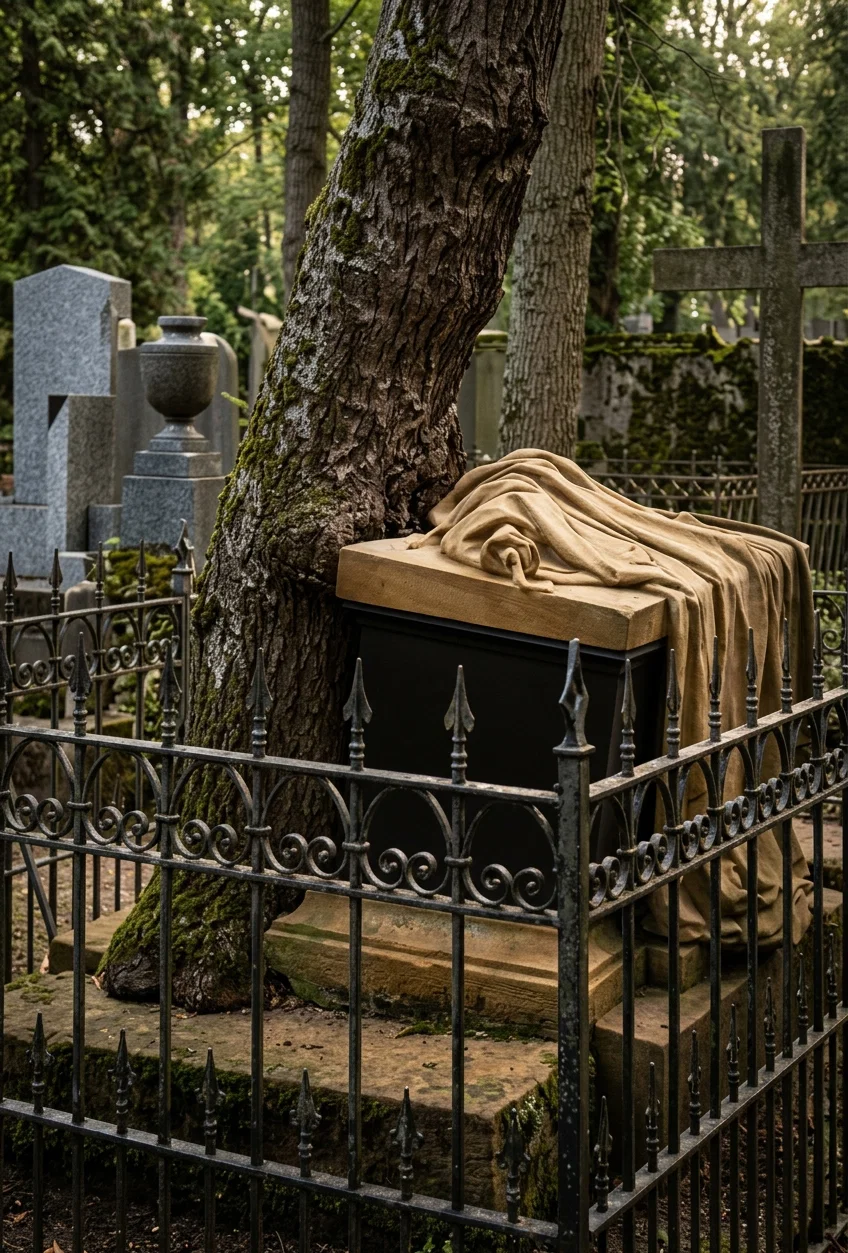
THE OPENED GRAVE, HANNOVER, GERMANY
Brother L. Mathe was again chosen president of the North German Conference. The territory of this field consists of the provinces of Hannover (except the southern part), of Oldenburg, Mecklenburg, Bremen, Luebeck, and of Schleswig-Holstein (except Altona-Wandsbeck), and has a population of over five million.
We were much interested in visiting the “opened grave,” which is to be seen in one of the Hannover churchyards. The unbeliever who lies resting here decreed that no one should ever open his grave, and the stones were bound together with iron bands. Yet somehow the power of God as manifested in a thriving seed, which developed into a strong tree, has sprung asunder the iron bands and the twelve heavy stones encasing the sepulcher, showing how little value may be attached to the words of him who would oppose the Word of God, which declares that all graves shall be opened; and even in this present world, the unbeliever’s folly is revealed to every passer-by. It is just as vain to oppose the living, vital truth of the third angel’s message: it, too, is of God; and he will see that those who have hidden the truth in honest hearts will soon unite with every genuine follower of the Master around the great white throne. It is the joy of this hope that enables the brethren of the North German Conference to go out with renewed courage to carry the banner into the heart of the enemies’ ranks as never before. They wish the prayers of all God’s people.
Hamburg.
F. W. SPIES
By F. W. Spies
Brazil
F. W. SPIES
After spending nearly two months at Maceio, we had our first baptism, on the evening of December 3, four persons being buried with their Lord in the watery grave; December 7 two others were baptized, and on December 8 these, with two others who had formerly been Baptists, were organized into a company of eight members, and the Lord’s supper was celebrated with them. Thus there has been made a definite beginning in the province of Alagoas, Brazil.
Not one half of those who were keeping the Sabbath were baptized and received into membership at this time. Of those remaining, some were engaged in what a Seventh-day Adventist must ever consider an illegitimate business, such as the selling of whisky and tobacco. A number were not married according to the law of the country, that is, by civil marriage (for although they had been married by the Catholic Church, this is regarded by the law as living in concubinage); and others were sick, and for this reason could not be baptized. Still there is a good spirit manifested on the part of all, and all are studying so to shape their affairs that they can soon be received as members.
The work here has in many respects presented some peculiar features, but this judgment message has again revealed its power over the lives of the people, and has shown that it can bring into line all who are willing to let it influence their lives.
One of the first men to keep the Sabbath was selling whisky at wholesale. He has tried several other things, but has not found another business that will support his family. Still I believe he will yet succeed.
Our strict discipline in not receiving as church-members users and venders of tobacco and alcoholic drinks, stands out in sharp contrast with the usage of other Protestant missionaries, who, as a rule, wink at these things, paying little or no attention to them. But as these missionaries become more and more slack in14their attitude to the law of God, teaching that it has been fulfilled by Christ, and that the believer is under no obligation to obey it, surely no one need wonder that many who were once really awakened by the gospel, sink back into their old vices, practising the same wickedness they formerly did, yet claiming to be saved by the grace of Christ.
The more the law is rejected, the more we shall see of this; and to reject the law entirely is the only course left to those who refuse to walk in it. As religious teachers put away the sin detector, what must inevitably be the result? A sad state indeed is being ushered in all over the world.
It looks as if the great arch-rebel was about to triumph. But we know that where his triumph seems certain, that very fact is the sure sign of his sudden and entire defeat; for then the Lord will come and will vindicate his truth and his law. Let us therefore press on courageously, ever following the Captain of the Lord’s host; for he is leading to quick and certain victory.
Maceio.
JULIUS PERSSON
By Julius Persson
Ethiopia
JULIUS PERSSON
“PRINCES shall come out of Egypt; Ethiopia shall soon stretch out her hands unto God.” Ps. 68: 31.
Before Jesus left his disciples, he entrusted to them a world-wide mission: “And he said unto them, Go ye into all the world, and preach the gospel to every creature.” Mark 16:15. And the twentieth verse reads thus: “And they went forth, and preached everywhere, the Lord working with them, and confirming the word with signs following.”
Their commission was to preach the gospel,—not fables or tales, but the gospel,—of which Paul testifies that it is the “power of God unto salvation to every one that believeth.” And reading the Acts, we shall also find how they accomplished their God-given task. In Acts 2:14-20 is recorded the opening work of the gospel, when the gift of the Holy Ghost was sent from heaven. Through its power and the testimony of the apostles, as a result largely of Jesus’ own ministry, three thousand souls were converted. In the third chapter we read that Peter preached in Jerusalem to the Jews, and as a result, about five thousand believed. Not only in Jerusalem was the gospel to be preached, but also in Samaria. So we find Philip in a city of Samaria, preaching Christ unto them. Acts 8:5. And when the brethren in Jerusalem heard that the Samaritans “had received the word of God, they sent unto them Peter and John: who, . . . when they had testified and preached the word of the Lord, returned to Jerusalem, and preached the gospel in many villages of the Samaritans.” Acts 8:14, 25.
AN AFRICAN VILLAGE
The gospel, however, was not limited either to Judea or to Samaria, but was to go to “the uttermost part of the earth.” Acts 1:8; Mark 16:15. This was accomplished in the early rain of the Spirit, by Paul and the other apostles; for Paul himself says, in Rom. 1:8, that at that time the faith of the Romans was “spoken of throughout the whole world.” Paul was preaching the gospel in the great centers of Syria, Asia Minor, Greece, and Italy. Thus we can see how the gospel gained entrance into Asia and Europe.
But our text first cited says that “Ethiopia shall soon stretch out her hands unto God.” And as this land is located in dark Africa, that continent was also to be enlightened with the true light (John 1:4, 7-9); that is, the gospel of a sinner-loving Saviour must be given also to the nations in that part of the world, that the prophecy might15be fulfilled: “The people that walked in darkness have seen a great light: they that dwell in the land of the shadow of death, upon them hath the light shined.” Isa. 9:2.
Has the gospel been preached also in Ethiopia? In Acts 8:26-40 we find the record of Philip’s preaching Jesus to an Ethiopian, who had come to Jerusalem “to worship.” When Philip had declared to him the prophecies concerning Christ,—his mission here on earth, his sufferings and death to save fallen men, his glorious victory over sin and the grave,—this Ethiopian accepted Christ as his Saviour, confessing that “Jesus Christ is the Son of God.” Further, as he was baptized, and Philip was caught away from his sight, we read that the eunuch went on his way rejoicing. As he was a man of great authority under Candace, queen of the Ethiopians, we are led to believe that he was the instrument used of God to bring the glad news of salvation to the court of Ethiopia, as Daniel, some centuries before, had been sent to the court of Babylon. The result of that witness is not related, either in the Bible or in history, but we dare not say that no result came of it. Some centuries later, when Christianity was introduced into Ethiopia, the people gladly received it.
Asmara, Eritrea.
Porto Rico
By U. BENDER
U. BENDER
OCTOBER 20 I arrived at San Juan, Porto Rico, and boarding the train at 7:15 P. M., I reached Mayaguez about three o'clock the next morning. I found Elder and Mrs. B. E. Connerly in fairly good health. After spending the remainder of the night in getting a little more sleep, we faced the duties of the every-day work that falls to the lot of God's servants in this field.
They were very busy finishing the November number of El Centinela, that it might be sent out by the first of the month. The fact that the paper is put out on time has added much to its general interest and circulation.
Between five thousand and six thousand copies are issued each month. This is no small task, when we consider the work required on one copy. Each paper consists of six sheets of four pages each. Being printed on a press ten by fifteen inches, which prints two pages at each impression, it will be seen that twelve impressions must be made for each copy. The entire issue requires over sixty thousand impressions, and is done by foot-power. Then comes the gathering, folding, stitching, trimming, and the pasting of names for the mail, making, in all, seventeen or eighteen times each paper is handled. Besides this there is the work of editing, typesetting, proof-reading, keeping the subscription list, keeping accounts, and the correspondence connected with such work.
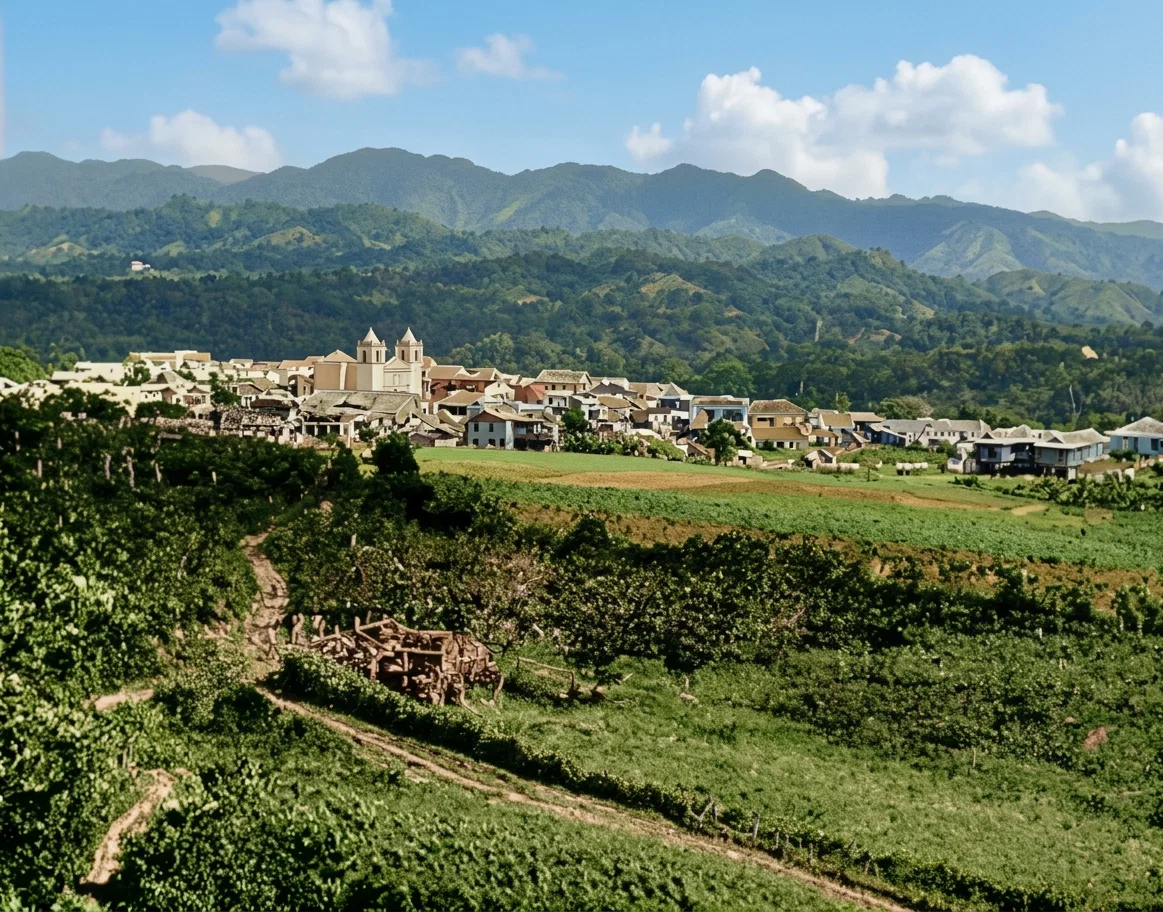
A VIEW IN PORTO RICO
Elder Connerly is in charge of the work in Porto Rico and Santo Domingo, and for this reason he is away from home a great deal of the time. Nearly every month he is here during the last week to help prepare the paper for the mail, and to plan the next month's issue.
With the aid of a young man, who works only part of the time, Mrs. Connerly looks after the translating, proof-reading, subscription list, accounts, and correspondence. A young man who is hired by the day does the typesetting and presswork. When the issue is ready, two young persons are employed to gather, and all, except the pressman, fold, stitch, and mail till the work is finished.
I spent only five days in Porto Rico this year. While we worked, we planned for the extension of the work. Brother Moulton has been doing good work in Santo Domingo during the year, but has been hindered some by sickness. The return of Brother and Sister J. C. Brower to the States has left us short of workers in Porto Rico, Elder and Mrs. Connerly being alone at present.
Riversdale, Jamaica.
Mexico
By H. A. ROBINSON
THE four brethren who left California last summer for Mexico City, to do canvassing work and learn the language, have so far shown excellent records, and much good work has been done. In January three of these went to different cities of the republic to canvass with “Heralds of the Morning” and “The Coming King.” One went to Merida, one to Puebla, and Brother J. L. Brown arrived in Tampico, January 13, much to my joy, but to my surprise. He called on me the next day, after he had been canvassing for two hours, during which time he secured twelve dollars’ worth of orders.
January 22 Elder G. W. Reaser, who is now in charge of the Mexican Mission, Brother MacCrimmon, of California, and Brother Julius Paulson, of San Luis Potosi, came here. The next day being Sabbath, they spent the time here, and the elder gave us a Bible study. We had a meeting in the morning, and one in the evening at the close of the Sabbath, at each of which we listened to inspiring words urging all to be true to the faith, and to work for the furtherance of the gospel. These brethren left Sunday evening in search of a site for a training-school, which they expect soon to establish for the preparation of workers for the Mexican field and to supply the world-wide call.
Brother Brown is still with us, and is working for the Lord. He has recently been joined by Brother Green, who was in Merida. Up to January 31, Brother Brown has taken one hundred two dollars’ worth of orders in fifty hours.
We hope the Lord will work on the hearts and minds of those who have purchased our books, persuading them to accept his last great message. Now I would ask my brethren at home, who enjoy all the church privileges, to pray for us and them, that funds may be provided and laborers raised up for this needy field. We love the truth, and you do too; so, brethren, give us of the gold and silver which you may have, and add to it that which every one is able to bestow through earnest intercession at the throne of grace, the blessing of Jehovah. H. A. ROBINSON.
A Visit to Guadalajara
By G. W. Reaser
PROBABLY there is not a more beautiful nor a cleaner city in the republic of Mexico than Guadalajara. It is the second city in size in the republic, having a population of about one hundred twenty-five thousand. Of these, six hundred are from the United States, and have located in Guadalajara for various reasons, but principally because of its excellent climate.
Brother and Sister W. S. Swayze have been in Guadalajara for the past twelve years, and have seen the city transformed from the old-fashioned, sleepy metropolis of the Pacific coast of Mexico to a wide-awake, progressive city, with almost every modern convenience.
The large churches in all the principal cities of the republic had convents adjoining the church buildings; but inasmuch as all church property was confiscated by the government, these convents are now used as municipal and government buildings, and the orders of nuns and monks have been abolished by the civil power. The government still permits the Catholics to make free use of the church buildings, although the ownership rests legally with the government.
Dr. Swayze and wife have faithfully held up the standard of truth in Guadalajara, and by their efforts a good medical mission has been established, which is quite well patronized. I am confident that no Americans in Guadalajara have the confidence of the leading people as have Brother and Sister Swayze.
We need additional workers to carry on definite missionary work in this city, which bears the title of the “Pearl of the West.”
Brother W. E. Yarnell is attending the high school in Guadalajara, to acquire the language, and is giving private treatments, and also has a class of students in English, in order to be self-supporting. Through his influence several of the students from the high school are attending some of our meetings.
G. W. REASER.
“Wafted Perfume”
A MISSIONARY gives the following as one trophy of divine grace in China. Would that the same spirit of earnestness and devotion possessed the heart of every professed Christian!
A woman was brought to a hospital for treatment, having an incurable disease. She was ignorant of her physical danger; she was ignorant also of the great salvation. Her gentle nurse hastened to tell her the “old, old story of Jesus and his love.” It was new and wonderful to this heathen mind, but she at-once believed the good news, and accepted the freely offered salvation. Then she was eager to go to her friends with this glad message of the Saviour’s love. She said to her attendant: “Will you ask the doctor how soon I shall be well?”
Her friend returned with the message, “The doctors say that they must tell you the truth: you will never be well.”
“Please ask them how long I’ll live.”
The reply was, “Three months, with the care and comforts with which you are at present surrounded.”
“And how long shall I live if I go to my old home with the blessed message from heaven?”
“Possibly not more than three weeks.”
When the answer came, this new convert exclaimed: “Get my clothes; I will start to-day.”
Expostulation was useless, for she argued: “Do you think I count the loss of a few weeks of my life anything when I have such good news to tell my people who have never heard of the Saviour, and who will be lost if they do not know?”—Selected.
The British Guiana Conference
By J. B. Beckner
THE third session of this conference was held in Georgetown, December 25-30. The laborers' reports gave evidence of the Lord's blessing during the past year. One church was added to the conference. Sixty-eight persons were baptized, and there was an increase of $233.97 in the tithe and offerings over the preceding year.
A new mission and school have been established up the Demerara River. The Indian mission at Tappacrooma Creek has secured lands, and built a comfortable mission house.
Satan has hotly contested every advance of the message in this colony,—first, the poor health of the workers; then fanaticism in many places among those who accepted the message; but we are thankful to report that these difficulties have now almost wholly disappeared.
Resolutions were passed looking to an energetic advance all along the line. Elder O. E. Davis was elected president. His health has improved to the extent that it was thought advisable for him to remain awhile in the colony. Elder E. C. Widgery has charge of the city work in Georgetown. Thirteen were baptized in the new baptistery during the conference, Elder U. Bender administering the ordinance.
A few cases of yellow fever in the neighboring colonies, with attendant quarantine restrictions, still interfere with our work; but the work is the Lord's, and we know he is leading; and final victory is sure to be ours if we are faithful to him.