The Youth’s Instructor, Vol. 35, No. 5.

THE RUFFED GROUSE

The Youth’s Instructor

Feb 2, 1887

S. D. A. Publishing Association · Battle Creek, Mich. · Feb 2, 1887

THE RUFFED GROUSE.
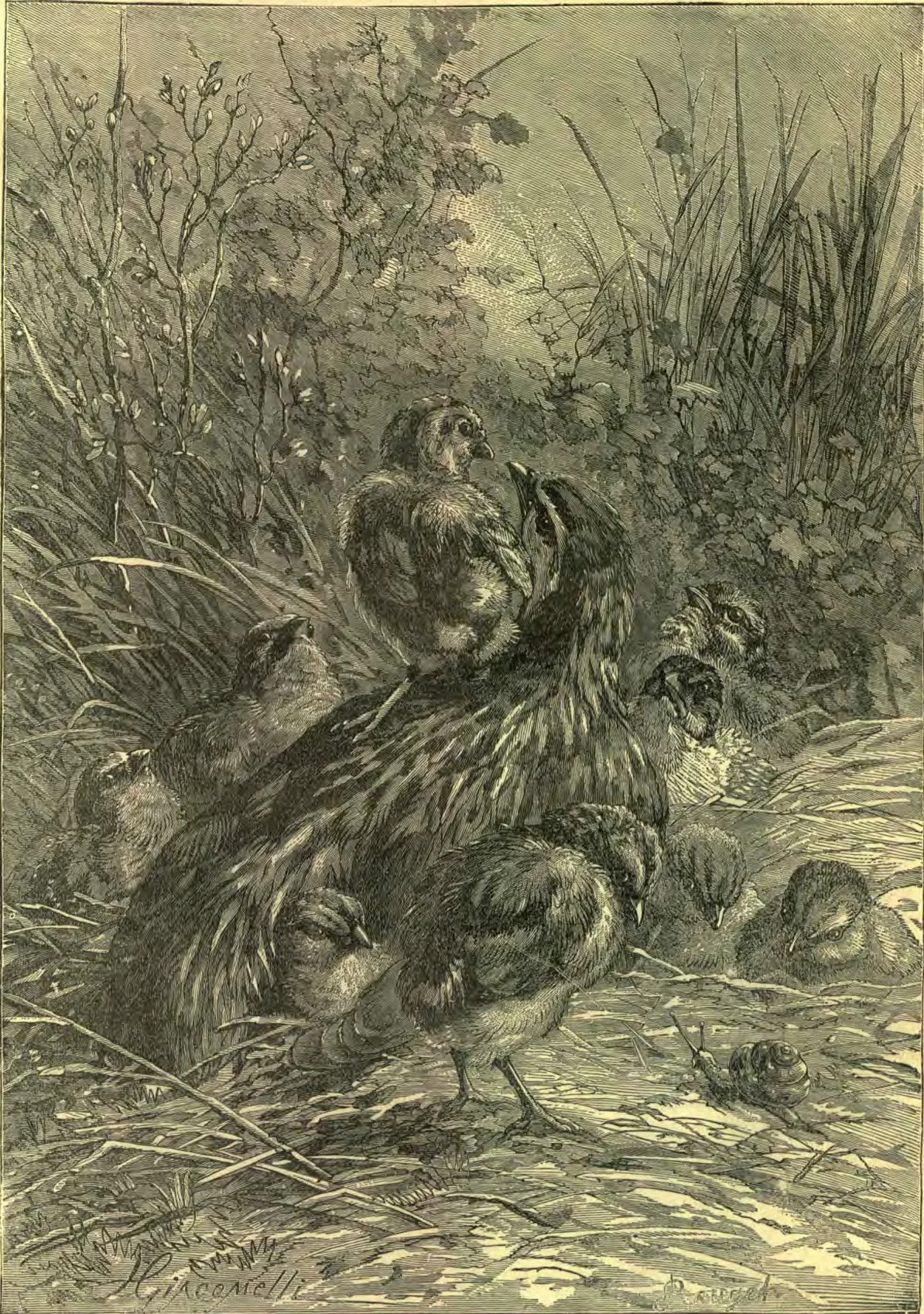
I am enjoying a pleasant afternoon stroll in the woods, where the declining sun pours a full flood of light down among the numberless millions of gleaming summer leaves.
THE PARTRIDGE.
THE PARTRIDGE.
The scene of my resort is not some frequented watering-place, nor a northern lakeside enlivened by the picnics of the summer tourists. My vacation is not a rest of two or three months taken from intellectual toil. The circumstances are merely these: a fair portion of my life has been passed amid farm toils, farm cares, and farm pleasures, and I have learned that the innocent pleasures need by no means be separated from the toils and cares. So while others delve from dawn till dark, and worry because daylight lasts but twelve hours, or because every stone which they turn over does not reveal a dollar, I have decided to take an occasional hour to learn, if possible, what nature is doing around me,—why the birds sing so lively and twitter so cheerily in the forest tangles, why the sun shines so softly on these summer leaves, and why cardinal flowers and the golden-rod look so bright after the August rain.
As intimated, I am enjoying an hour of that kind this balmy afternoon. I am reclining against a prostrate tree in a maze of ferns, amid the shades and sweet sounds of the forest. Not a human voice or footstep is near; but at a distance, here and there, rings a supper bell. The westering sun sheds a profusion of rich rosy light among the stately green trees, revealing to the eye myriads of sporting insects. The chipmunk is cheerily chippering his queer little tune. Near me is an oft-repeated rustling among the dry leaves, which reveals the persevering search of the Towhee Bunting for her favorite food of insect larvae and eggs.
But yonder! What is it?—that graceful form with noiseless step,—now hidden, now in full view among the uncertain undergrowth. As a “born naturalist,” I must know. So, improving its brief concealment behind a large trunk, I drop hat and paper; then on hands and knees creep the length of a fallen log. Rising carefully, I find myself in full view of a perfect and very beautiful specimen of the Ruffed Grouse (the Partridge of our Eastern and Northern States, the Pheasant of the Southern). She glides with short, strutting steps, her head and neck erect, and thrown forward with pleasing grace at each advance. But as she moves toward me, I detect a mysterious shyness in her manner; for though she does not appear to see me, there seems to her a mysterious something in the air, bespeaking danger near. A sudden whirring flight of a hundred yards carries her into concealment, which, however, is easily searched out by following the direct course of her flight. We find her perched without effort at concealment on a conspicuous log. Evidently she does not think herself hidden; her apparent thought is to be mistaken for something else.
Deciding to match our patience with hers, to see how long she will stand thus immovable, and how she will get out of that posture, we stand quite still, then sit, and finally lie down, feigning sleep. Suddenly she lays aside all her caution, makes a half-turn upon the log, jauntily upturns her head, the better to take in the situation, then prunes her feathers and oils them after the manner, almost exactly, of domestic fowls.
When her toilet is completed, she slides down the opposite side of the log, just as I have seen turtles slide from rocks or old logs into the water; and though I go immediately to the place, not fifty feet away, she has entirely disappeared.
This slight-of-hand way seems habitual with the partridge from the day it leaves the egg. I have, in traversing the woods, suddenly found myself confronted by the mother bird of this species flying full in my face, picking at my clothing, or feigning a broken limb or wing. So sudden and deceitful are these maneuvers, that when I have been thus led by them perhaps a hundred feet, I have as wholly forgotten the bevy or skulking little ones, which by that time has entirely disappeared, as I have till now forgotten to mention them in this description.
Often when closely pursued after a deep fall of light snow, the partridge plunges into the depths of a friendly drift, under the very eyes of the hunter, and, fortunately for the poor bird, her pursuer never knows where she is coming out. Usually, we are happy to say, it is where she is least expected.—G. A. R., in The Fireside Teacher.

NEW ZEALAND; WHERE IS IT?

If we should go directly east, we should have to travel about 18,000 miles to reach New Zealand. Should we go west, it would be a journey of about 7,000 miles, or as far as twice across this country from New York to California. New Zealand lies in the midst of the Pacific Ocean, between the continents of Australia and South America. Not until the seventeenth century was it known that there was such a country, when a Mr. Tasman brought the news to Europe. He named it New Zealand. It is called the land of our antipodes. Reckoned from London, England, the antipodes are a short distance from New Zealand, where, according to our childish reasoning, the world being round, the people on the opposite side must walk with their heads down, and their feet towards us. But we have learned better than this; though it does seem a wonderful country, turning things upside-down, as it is winter there when it is summer here, and night here when it is day there. Their winter months are July and August, and the summer months are December and January. Spring begins in September, and fall in May.
The country known as New Zealand consists of two large islands and several smaller ones, lying about twelve hundred miles south-east of Australia. The two main islands are called the North and South Islands, and are separated by Cook’s Strait, which is about eighteen miles in width. The North Island is called by the natives Te ika a Maui, which means, The fish of Maui. The South Island is called Te wahi pounamu, or The place of the green stone, because there is a green stone there which proved very serviceable to them in the manufacture of stone axes and knives. They have a tradition, which they give as a reason for naming the North Island as they did. It is this: Once there was a family of five brothers, the youngest of whom was called Potiki, the little one, because he was very small. There was something peculiar about his birth, and his brothers treated him with contempt. One day they were going fishing, and Potiki wanted to go with them. Finally they allowed him to go, providing he would bale out the boat. After fishing a long time and catching nothing, this little boy wanted to try it, and in his efforts hit his nose, causing it to bleed, and some of the blood fell on the hook. Feeling a strong bite after he had cast in his hook, all helped pull in the line, and they pulled up the North Island. Hence they gave it the name Te ika a Maui, or The fish of Maui. They claim that what proves the story to be true is the fact that the island is in the shape of a huge fish.
The North Island is evidently of a volcanic origin. There is reason to believe that it was once a part of a great continent which is now under the sea. In the Northern part extinct craters may be seen in every direction. One writer says that “The Isthmus of Auckland is one of the most remarkable volcanic districts of the earth.” It is said that within the radius of only ten miles there are no less than sixty-three separate points of eruption. In the center of the island is the burning mountain Tongariro, six thousand feet high, in constant action, with occasional eruptions. It is the same with White Island off the east coast and about one hundred and thirty miles from the former volcano. There have been numerous hot lakes, boiling springs, and hissing geysers, until the late eruption and earthquake, which has changed the whole face of the country. Earthquakes are frequently felt, until it has become quite a common thing. In 1848 and in 1855 they did some damage at Wellington, which is now the capital of New Zealand. On the last occasion, after a series of alternate depressions and elevations, it left the coast line, for a long distance, four feet higher than it was before. It is supposed that a submarine volcano lies in Cook’s Strait; for, by sounding in front of the entrance of the harbor of Wellington, it is found that there is a crater-shaped hole at the bottom of the sea, over which the water is never seen to be quite calm. There is an extensive mountain range running through both islands, interrupted by Cook’s Strait. The mountains on the South Island are much higher than those of the North. Their peaks are capped with eternal snows, and decked with alpine glaciers, rendering very appropriate their name—the Southern Alps. In the center is Mount Cook, in towering grandeur, 13,200 feet above the level of the sea, almost as high as Mont Blanc. This portion of the island is seldom visited. Mount Egmont, in the North Island, is 8,000 feet high, and always covered with snow; and there are several other mountains from five to six thousand feet in height. The snow line, as it is called, is about seven thousand feet above the sea. Next week we will tell you more about this far-off country. S. N. HASKELL.

Sea Tales: The Sperm Whale and Its Nature

SEA TALES.—NO. 14.

Naturalists describe whales as inoffensive and harmless, but sperm whales are not so gentle. They are often taken with their teeth broken off, and also their jaws broken in the desperate battle between the males. They frequently attack the whalers, and compel them to retreat discomfited.
Zoologists have classed these animals among fishes; but an examination of their structure and functions will manifest the impropriety of this classification. In common with land animals, they have warm, red blood flowing through the system. They have a heart with auricles and ventricles, through which this fluid is propelled; they have lungs with all the functions for breathing atmospheric air, and they can suspend this function only for an hour or two at a time. Being tenants solely of the deep, and having organs for propelling themselves through it, are the only fish-like qualities they possess. They seem to be a link between absolute beasts and their more near submarine neighbors.
When unmolested, the speed of a whale is about three miles per hour; but when alarmed, its velocity often reaches a rate of ten miles an hour. However it never travels long at this rate, usually diminishing it to four or five miles.
It is astonishing to see with what exactness a whale pursues his course. A ship following a whale for an entire day will not have to alter the course a single point of the compass. So far as human knowledge extends, we know that the inequalities of the earth’s surface beneath the sea are similar to those above, and therefore the conjecture is a reasonable one, which supposes that the utmost cavities of the sea do not exceed the loftiest heights above it. May not, then, these occupants of a watery world, like those of earth and air, be guided on their way by visible objects? Without such guidance, no animal, man not excepted, can long pursue an unvarying course. Instinct may urge the animal when to move, but something discernable must aid its way through the deeps with such precision.
I have been speaking principally of the right whale. There is another species called the sperm whale. Of this kind, Captain McKenzie, an old whaler, has this to say:—
“Sperm whales are found in every sea and clime, but their nursery is the great Pacific. No animal found in the sea is more timid or more easily frightened. Their power of vision is exceedingly limited; they cannot see directly ahead of them, hence, when alarmed, often run foul of each other, and foul of other objects. Their exquisite sense of hearing, however, is most extraordinary, and frequently, in large shoals, covering miles of space, the instant one is attacked, the whole shoal spring, shoot out their heads above water, and listen for a moment; and if the attack is made on a female, they will all rush with great speed to their wounded companion, as if to extend their sympathy, if nothing more, unconscious of their own danger. The females yield, on an average, fifteen barrels of oil. The male is much larger, and will yield from fifty to one hundred barrels. At the latter stage, he is a noble animal, moving through the water so gracefully, and with such majesty, and such astounding velocity, and that too without apparent muscular action—it is sublime! And when attacked, such perfect command over his locomotion as to entirely change his position as quick as thought! I have seen them lie motionless fifty feet off, and in an instant swing their large flukes under us, and at one blow, send the boat in splinters, men and all, ten feet in the air!”
When a whale, in a shoal, is wounded, and the others surround it, each boat selects one for itself; and when one is killed, to prevent loss (for, as a whale is nearly the specific gravity of the sea, only a small portion remains above it), a hole is cut in the body, and a pole, some fifteen feet long, bearing a red flag, is stuck into it. The boat then goes in search of other whales, leaving the dead one to float around until ready to haul it up to the ship.
“The right whale of Behring’s Straits and of Baffin’s Bay, are the same animals; and if so, the conclusion is inevitable that there is, at times, at least, an open water communication through the polar regions, from the Atlantic to the Pacific; for this animal, not being able to endure the warm water of the equator, could not pass from one to the other, unless by way of the arctic regions. The tropical waters are, to a right whale, as a sea of fire, through which he cannot pass, and into which he never enters.”
“It is the custom of sailors to have their harpoons marked with date and name of the ship, and Dr. Scoresby, in his work on arctic voyages, mentions several instances of whales that have been taken near the Behring’s Straits side with harpoons in them bearing stamps of ships that were known to cruise on the Baffin’s Bay side of the American Continent; and the time between being struck and being captured often too short to admit of a passage around either Cape Horn or the Cape of Good Hope, it was agreed, therefore, that there must be a northwest passage through which the whale passed from one side to the other, as whales cannot travel under ice for such a great distance as it is from one side of the continent to the other.”
W. S. C.

SPEAK KIND WORDS.

Oh! speak kind words to one and all, As through the world you go; Let helpful deeds beside your path Like flowers of beauty grow. The fragrance of a loving word Will linger in the heart, As sweetness haunts the flowers we prize When summer days depart.
As we go journeying on through life, Perhaps we may not know The good our loving words have done To those who come and go. But God will know; and surely he, In his good time and way, The giver of each kindly word Will royally repay.
So speak kind words to one and all; This life is all too brief To waste in discord and in strife, And fill the heart with grief. With sunshine born of loving words Let's scatter clouds of pain, And thus make bright the sorrowing face, As skies are, after rain.
—S. S. Times.

HOW THAT ROAD ACROSS THE RIVER WAS MADE.

“Then the town wants a road over the river?” cry the town fathers. “That means a bridge. We can’t afford that.”
There they stand, squinting at Deep River. They calculate how much stone will be needed, how much lumber, how many days of work. In imagination they haul stone, hew logs, hire workmen—and sigh. “We can’t afford that. Too big and expensive a job!” they somberly decide. Away from the banks of Deep River they turn, rubbing their hands, for it is a cold day.
“Want a way over the river?” cries Jack Frost. “Do they give it up? Too formidable, is it? I’ll take the job. I’ll build the bridge. I’ll do it for nothing.”
Does he bring big stones, huge logs? He orders a quantity of north-west wind, and goes to work. The first night he veneers this Deep River with a thin layer of ice. Beautiful but brittle, only a shaving. The second night he lays another thin layer. The third night this bridge-builder, Jack Frost, cries, “More wind! more wind!” By morning another thickness of crystal is laid upon the bridge.
“Colder, colder!” he says that day, urging on the wind. Little by little Jack’s bridge goes up, or down rather.
Soon, a small boy steals across. Then, it is a big boy. A man follows. A driver, with a team, shouts, “Git up, there!” and drives over. Finally, there is a well-traveled road across the ice.
Why do we not take advantage of this method of the king of the Frost-land? There are many things we can’t do at once, but if we keep at it, the little layers of ice will thicken into an ice-bridge. A boy can’t be a first-class farmer at once, but he can patiently hill his row of potatoes and corn. You can’t learn a carpenter’s trade at once, but you can learn how to drive a nail to-day, and how to plane a board to-morrow. Take a hint from Jack Frost. You need not order any north wind, but speak for his persistence, and go to work.—S. S. Classmate.

Healing a Broken Heart Through Cheerful Service

It is a fine recipe for curing a broken heart to have no time to think of it, and to be obliged to keep up a bright exterior for the sake of others; after a time the brightness penetrates below the surface, and, when you have time to think of your own troubles, you find the heart, if not exactly mended, still not quite so hopelessly crushed and mangled as it seemed at first. —Selected.

DUTIES OF OFFICERS.

The question has been sent in, “Please state the duties of superintendent, assistant superintendent, and secretary;” and as nothing has been said of late defining the duties of these officers, it may be that there are many newly organized schools which are in some perplexity on the subject. Hence we give in reply to the question a part of several articles written on this subject by Prof. G. H. Bell when the Sabbath-school work was first started among us.—Ed.]

THE SUPERINTENDENT.

The superintendent’s first work will be to classify the school. Although it is a work requiring judgment and care, the classification should be promptly and quietly made, with the understanding that, when necessary, scholars will be transferred from one class to another till they have found their proper place.
Most schools naturally divide into four divisions,—adults, or grown-up people; youth, or young people from fifteen to twenty; children, or boys and girls from ten to fifteen; and little ones, or those under ten years of age. The youth and children might be classified, as nearly as possible, according to their age and aptness for learning. There should be in each class not less than three, nor more than ten. When teachers are plenty, it will probably be best to have about six members in a class; but if teachers are few, the classes may have to be considerably larger. No one should be placed in a class where the lessons are too difficult for him; yet it is better to have large classes with good teachers, than small classes with poor teachers.
No part of the superintendent’s work will test his judgment and discretion more than the appointment of teachers. Other things being equal, young women generally make the best teachers for children. An intelligent, godly young woman, who loves the lambs of the fold because Christ died for them, and who has some tact in teaching, is a blessing to any Sabbath-school.
It is usually better for the superintendent, after counseling with the teachers, to assign the lessons for each division; for by so doing, the different classes of each division are kept together. It is important that the superintendent should be familiar with the lessons of every division; for if he is not, he will be unable to assign the lessons properly, or to conduct the general exercises profitably.
The general duties of the superintendent are so many and so various that it is difficult to enumerate them. As the title of his office denotes, he should have a general supervision of all the work of the school. He should try to awaken an interest in the minds of parents, teachers, and scholars. He should see that all the officers and teachers do their work promptly and well; that the school is furnished with everything necessary to its success, so far, at least, as is consistent with the means at his disposal. He should see that the room is clean, comfortable, and pleasant; that all are made welcome; that all who come in receive prompt attention; and that they are at once placed in some class, if they will consent to join the school. He should conduct the general exercises, or appoint some one to do so. He should, under God, mold and guide all the work. How important, then, that he should be a man of God; that he should be devoted to the work; that the love of God and man should fill his heart. In general, the school will be just what he makes it. If others do not do their work well, he should take hold and show them how to do it. He must not be easily discouraged; he must cheerfully adapt himself to circumstances, until the circumstances can be improved; he must patiently work and wait, cultivating that charity which hopeth all things, endureth all things.

THE ASSISTANT SUPERINTENDENT.

The assistant superintendent should be just what his title of office implies,—an assistant, ever ready to aid the superintendent in carrying out his plans, and to do any work that may be assigned him.
When the superintendent is absent, from sickness or any other cause, the assistant should take his place.

THE SECRETARY.

The secretary, as his title of office implies, should keep the records of the school.
Minutes.—Minutes should be kept, not only of business meetings, but of each session of the Sabbath-school. From Sabbath to Sabbath the secretary should note the most interesting features of the school, and these notes, together with the membership, attendance, number of visitors, etc., should be embodied in a report to be read at the opening of the school on the Sabbath following, and afterwards recorded in a book provided for that purpose.
The membership and attendance of the entire school can be made out from the teacher’s class records, and should be verified by the personal observation of the secretary.
If class records are neglected, the secretary should make out the membership and attendance just as he would if the whole school were a class under his instructions. These items should be entered in the school record book on the pages ruled and headed for that purpose.
Registers.—First, the names of officers should be entered, together with the date of their election, and such other items as may be deemed important.
This should be followed by a register containing the names of teachers, the date of their appointment, etc.
After this there should be a register containing the names of all the members of the school who are not officers or teachers, the date of their entering school, and the time and cause of their leaving, whenever they do so.
The secretary should keep a record of the attendance of officers and teachers, just as the teacher keeps a record for his class. An ordinary class book will be convenient for this purpose.
A treasurer.—Unless some one is elected for that especial purpose, the secretary is expected to act as treasurer, receiving and accounting for all moneys belonging to the school, and paying out the same on the order of the superintendent.
General duties.—The secretary should not have a class, except in cases of necessity. He should be free to aid the superintendent in looking after the minor interests of the school. He can assist in welcoming and seating new scholars and visitors as they come in. He can see that everything is in readiness; that the bell is struck at the proper time; that there is a timely distribution of the lesson papers; that cards are provided bearing, one on each, the names of all the members of the school, and that these cards are distributed to the teachers at the beginning of the class-recitations, and collected again in time for use in the general exercises. Whenever the superintendent desires it, the secretary can assist him in the general exercises by calling names or asking questions. Thus there are countless little things which a watchful, willing secretary may find to do. He should be the “vigilant committee” of the school, especially at times when the superintendent’s attention is so taken up by some matter as to cause other things to be neglected. Indeed, it is scarcely less important to have a good secretary than to have a good superintendent.
All members of the school should be prompt, but the secretary must be prompt. He should be energetic and active, yet cool-headed and accurate. Such secretaries must be found or made, if we would have the business of the school properly done.

OUR WORK.

THE work before us as Sabbath-school scholars, teachers, and officers is a great and important one. It is a work that demands our time, thought, and vigorous, earnest effort. Shall we not this year devote some of our best moments, our closest attention, our most serious thought to it; shall we not work for it as never before?
If so, let us remember that unless we walk close to the Master, unless our hearts beat in unison with his, unless his love and spirit permeate our very being, our best efforts will accomplish but little good, either for the interests of the cause of God or for ourselves. But if we are actuated by the spirit and mind of Him who lived not to please himself, but whose meat and whose drink it was to do the will of the Divine Father, we shall experience a blessed success in our efforts.
And He will aid us in the study of his Word. Its holy truths, its blessed teachings, its divine precepts, will shine out so clearly before us that their influence will be felt in our own hearts, and they will also have an effect upon those with whom we associate. Here is the main object of Sabbath-school work—not to make a display of Biblical knowledge and learning, nor to incite to study and effort by appealing to feelings of pride and vanity and for the sake of reward, but to awaken in the heart a desire to study the word of God and a love for it, because it is his word and because it leads upward to the Father's house. When the teacher obtains a true interest and love for the study of these precious lessons which we have from the Bible, he may expect to communicate some of this to those under his care, and in proportion as he has success in this work, just so far does he have true success in the Sabbath-school work.
Faithful efforts in this direction will deepen our interest for those who are associated with us in Sabbath-school relations. A love for the lessons we study during the week will lead us to make a daily application of them upon our lives; and as we are benefited by them, we seek more earnestly to labor for others around us, so that they too may be helped onward. But this work will beget in us more and more of the spirit that was in our Saviour—an earnest longing and effort for the salvation of others—it will develop more and more of the true missionary spirit.
And I suppose it was this view of the subject that led the Sabbath-school Association to pass a resolution “that the Sabbath-schools support the African Mission during the coming year.” A true interest for the salvation of others will lead us to do all we can to send the light of truth to them; and if the Sabbath-schools are actuated by the spirit which true Sabbath-school work begets, they will feel a great interest in donating liberally to this mission which is shortly to be opened up. It seems, of course, like a great undertaking, but united, continuous effort with the blessing of God will bring the desired result—and also prosperity and blessing to ourselves.
May we all feel the importance of our work, but may we also realize that true success in all our labor depends upon our individual communion with God and our love and interest for the Lord, his word, and his work in the earth. The Master will soon bid us “come up higher,” if we faithfully labor in the humbler sphere in which he has placed us.
A. B. OYEN.

EXPLANATORY

As will be seen from the following resolution passed at a recent meeting of the International Sabbath-school Association, it has been decided to merge the Sabbath-school Worker, heretofore issued as a separate quarterly publication, into the YOUNG'S INSTRUCTOR. The resolution reads: “Resolved, That the matter now contained in the Worker be published in the INSTRUCTOR in the form of a quarterly or monthly supplement, as the editors may find necessary.”
The members present at this meeting expressed their appreciation of the matter contained in the Worker, but it was thought by some that if similar matter could be published in the INSTRUCTOR, it would accomplish more, and have greater weight and influence, for the reason that it would go to a larger number of readers. There was a divided sentiment, however, as to the advisability of the proposed change, so that the proposition was carried by only a small majority. But be this as it may, the vote was passed, and in accordance with this action the publishers of the INSTRUCTOR have decided to issue every month a double number of the INSTRUCTOR, containing four pages of matter especially adapted to the Sabbath-school work. This will give about as much reading matter during the year as formerly in the Worker. Unexpired subscriptions to the S. S. Worker will be credited on the INSTRUCTOR for a proportionate length of time, if no desire is expressed to the contrary. Those wishing their money applied in some other way must notify the publishers of the INSTRUCTOR of it without delay.
A. B. OYEN.

A Good Beginning Is Only a Start

A good beginning is a start in the right direction, but it is only a start. Even if it be admitted that “what’s well begun is half done,” unless the other half is done the first half will never be a success. It is patient continuance in well-doing that wins the chiefest commendation; and the reward for well-doing is not for him who starts right, but for him who endures unto the end.—Sel.

THE AFRICAN MISSION AND OUR SABBATH-SCHOOLS.

At the late International Sabbath-school Association, held at Battle Creek, it was recommended that the Sabbath-schools of this country support the African Mission, which is to be established the coming year. A similar move had before this been made by the California Sabbath-schools, which raised the first amount for the Australian Mission. The Lord blessed them in this, and it imparted to them a missionary spirit such as they had never before experienced. It was thought by some that the donations would not be materially increased by setting before the children a missionary object, but the result proved decidedly otherwise. The donations were nearly doubled. The children felt an interest in the work in Australia, and it not only united their hearts in making sacrifices, but they felt interested to pray that God would bless this mission. And God has blessed it, so that among all the missions which have been established by our people, none have been attended with such prosperity as have those of Australia and New Zealand. It is evident that God heard the prayers of the children, and accepted their offerings. It was also thought that while the schools might make liberal donations the first quarter, the amount received the next quarter would be small; but when the time came, the donations were found to be still larger, and so it has been ever since they began to give their surplus funds to the missions. The Sabbath-schools of that State voted this year to give a thousand dollars to the African Mission. They are also paying the expenses of a missionary sent to this country from New Zealand, to obtain an education in the truth at one of our colleges.
Thus the children feel an active interest in the missions. This move has united their hearts to the missionary work as nothing else in the world could. It has also had an effect upon those who embraced the truth in Australia. When we related to one man, not of our faith, how our money was raised, and how all the Sabbath-school children of California were giving of their means for that purpose, tears started in his eyes, and he said, “If children in America can do this much, we certainly ought to help such a mission,” and immediately gave me $65 to help forward our work. Those who embraced the truth, after learning how the Sabbath-schools of America were interested in bringing it to them, immediately felt desirous of doing something themselves to extend the light to others. The Sabbath-school at one place in New Zealand has already given $50 to the foreign missions and $50 to the International Tract and Missionary Society.
But the question may arise, “How much will it cost to sustain the African Mission?” If we should set the amount at $10,000, it would be a low estimate. It will probably cost that much to have the mission established, and pay the expenses of those who go. We cannot state just what the expense will be of sending each person to South Africa, but very likely it will amount to $200. If eight persons should go, the fare would cost $1600. Then the expense of getting started will be very great. So if we estimate the entire cost of establishing the mission the coming year, it cannot be less than $10,000.
This money can easily be raised if all the schools take hold of it. But there are some schools in the southern part of the country, which would not be able to raise as much as others; so this will need to be made up by some of our schools which are in a more prosperous condition. In order to help the poorer schools, we suggest that in the northern and eastern and western parts of America, where the people have more means, they pay a dime a week, and in some instances even more than this. This amount may be raised, together with a sufficient sum to pay the running expenses of the schools. Perhaps some of the children will ask where they can get the money. This can be easily arranged if they will ask friends or parents to hire them to perform some labor during the week, and thus enable them to earn something for the Sabbath-school offering. This will bring prosperity into the schools, for God will bless a sacrificing spirit. There is no better place to inculcate the missionary spirit than in the INSTRUCTOR family. We shall look this year for prosperity such as we have never before experienced. S. N. HASKELL.
Continue reading: CONSTITUTION OF THE INTERNATIONAL S. S. ASSOCIATION