IN dealing with this subject of our city's degradation, it behooves us to look well to the causes thereof. They will not be found in the social sub-stratum known as the “under world.”
We must look higher(?). A government never attains a higher excellence than its source. In view of this axiom, a pertinent question would be, Who rules? A constitution or charter aims to throw around State or municipality certain safeguards; but a good ship often founders when manned by a bad ship's company.
Inspiration says: “But they that will be rich fall into temptation and a snare, and many foolish and hurtful lusts, which drown men in destruction and perdition. For the love of money is a root of all kinds of evil; which while some coveted after, they have been seduced, and pierced themselves through with many sorrows.” Here we find a primary cause for the degeneracy of the human heart.
This subject is a deep and far-reaching one; and its inception will not be found in any local political gang, nor its solution in any grand jury room. Its birth and development antedates these adjuncts of a doubtful civilization. A hasty glance backward over the centuries may help us to a partial solution.
Beginning life with perfect characters, and all the environments most favorable to a beautiful consummation of God's purpose in us, the spirit of covetousness gave to our race in the world's first epoch, the crime of murder,—the result of envy and a desire for power and influence. Under stress of temptation there was a yielding and sin came in. There entered society at this time the exclusively criminal element. Sacred history tells us that during the first dozen generations, man's wickedness became so great that the Lord destroyed the whole race off the earth, saving eight persons. (Gen. 4:1-14; 6:4-14.) Again, farther down the roll-call of the centuries, the “Cities of the Plain” were destroyed because of their unequaled vileness. Farther down still, Jesus the Christ warns His generation that it will be more “tolerable for Sodom and Gomorrah” in the day of judgment than for them.
And, then, looking on down to the end of this generation, and the time of His second advent, He said Noachic conditions would again involve the whole earth; implying universal destruction because of universal wickedness. (Matt. 24:37-39).
It is unnecessary for us to go into a detailed discussion of the rise and fall of governments and the causes leading thereto; but having seen the origin and development of the evils we purpose discussing, we must mention cursory the fact, that whatever the source of a government's existence, its destruction is the result of the very causes that have blackened the fame of our fair city. While the flagitious wickedness of past generations has been the inevitable teacher of this one in which we live, yet aside from these inherited tendencies, we face a far greater danger in the modern isms and demoralizing influence of false teachers. Inherited tendencies may be, and often are, overcome by true education and proper training; but false teaching and wrong training is seldom, if ever, overcome.
Thus we are continually menaced, aye, we are indeed in the thrall of all the evils of all the centuries. Handicapped by these accumulations, what say you for the possibilities of a higher morality for the rising generation, when college presidents and eminent public teachers stand before a body of young men, and unblushingly assert—with specious reasoning—that there are conditions in life when “the lie is justifiable”? Or when a representative woman, wielding a pen of great influence, and whose name is a household word of joy, enumerates a number of situations in life in which a lie is not only excusable or justifiable, but “positively imperative,” and also gives the opinion that there are circumstances in which the truth is “absolutely brutal”? This latter proposition may be a fact, but if a condition arises which makes it a fact, the same would imperatively demand “golden silence.”
Jesus died for the truth's sake; therefore we know that while exigency may sometimes demand silence, it never demands falsehood! (See John 18:37; Mark 15:3-5).
Rank materialism is taught in the pulpits, and spurious man-made salvation presented in lieu of the true; and the weaknesses of mankind are excused to condone the “lapsus moralis” of a degenerate clergy.
These are not isolated exceptions, but the ruling mode of instruction in the “upper world.” It gives color to the every-day life of the adult, and puts an indelible impress of insincerity upon the youth.
Life in the “under world” is a true reflex of these conditions. Those of the upper stratum have unlimited means to exploit their false doctrines and idolatrous isms, and to gratify their accumulations of depraved lusts. Those of the middle stratum have the unlimited desires, but not the means, so they compromise their honor, and barter their souls to attain the coveted gratification. So downward is their course as they inevitably flow into the muddier pools of life. Is it any wonder that the slums are continually growing larger?
Minneapolis is one of many. New York boasts a yearly harvest of 7,000 victims of manly(?) lusts! St. Louis had a ministerial convention some years ago which advocated the licensing of brothels, “as a protection to our wives and daughters.” Do you think these gentlemen gave the “wives and daughters” whom they sought to license, a single humane, pitying thought? But now St. Louis is facing a shameful scandal arising from the work of an organized gang of procurers who have instituted a system of harlot slavery; enticing young girls, with sundry pleasing and alluring inducements, to lives of shame, selling them at a hundred dollars a head to moneyed scoundrels.
But why specify this city and her woes, or that city and her scandals? The “Shame of Minneapolis” is the shame of every city in the world. And venal, corrupt, municipal governments are responsible for the daring perpetration of these shameful iniquities. The almost national crime of fatal assassination causes men of national prominence, and others who pause in the turmoil of life long enough to give a passing thought to the growing evils of this generation, to express a fear of “racial suicide”! One faithful watchman on the walls of Zion, proclaims fearlessly the irrefutable truth:—
“The type of depravity among persons in the higher circles is often worse than the slums. America is fast following in the steps of the old Roman Empire. The home is despised; children are an encumbrance. A poodle dog is of more value than a baby. Wealth and pride consume the life-blood of the nation, and aristocratic weaknesses sap our democratic vigor.”—Rev. Geo. Whitman, Lafayette Baptist Church, Buffalo.
Every word is true, and in regard to “America and Rome” the brother has re-uttered an ancient prophecy, perhaps unconsciously, which involves the downfall of the American empire after the similitude of the Roman; and she nurses the forces of her destruction within her own bosom. It is a horrible commentary on the boasted civilization of so-called Christian America, that many of the unmentionable vices of our cities were unknown in modern pagan cities until introduced by our people!
Now every metropolis and large city in the world practises daily every vice, every sin, and every crime9that the “Cities of the Plains” did, or that were disclosed by the mute testimonies uncovered in Pompeii and Herculaneum, or that are described in the third book of Moses, or for which the world was destroyed in the days of Noah. All the accumulated immoral and obscene literature, all the super-purulent, idolatrous filth of all the centuries is wallowed in by this generation until the earth groans with the insuperable weight of sin and iniquity.
Whatever hope we may indulge of our own purity, or however innocent of personal wrong-doing, the taint is there; neither mightiest king nor humblest slave can escape the unfailing result of sin. So shall we carry the unobliterated marks till these “evil bodies” are made “like unto His glorious body.” Then shall we be “satisfied” when we “awake with Thy likeness.” Ps. 17:15; Phil. 3:21.
These politicians who levy this tax of “blood money” upon unfortunate women whom they have helped to degrade, do so for no other purpose than to gratify their unbridled lusts, or indulge themselves in vicious pleasures which are but a continual round of lewd and wanton orgies.
BRYN MAWR.
(Concluded next week.)
A Dangerous Plaything
It is well known that the power of hypnotism is a power divorced from good, a power whose possibilities for mischief are manifold. This has been proved again and again and in many ways. The following occurrence will further illustrate the dangerous and wicked possibilities of that power. A despatch from Monmouth, Ill., dated April 6, says: “Mrs. Marshall Mink, who, with her husband, was hypnotized by reading Professor Harraden’s books on hypnotism, died at Watertown Asylum to-day. The case is one of the most peculiar and mystifying ever known to the medical fraternity.”
The victims were under thirty years of age and the parents of two children. Both were sound mentally and physically. Recently they saw an advertisement of Professor Harraden, of Jackson, Mich., who purported to teach hypnotism. The Minks sent for books. In the first lesson both became partially under hypnotic influence, and for several days continued in that state, both endeavoring to wield their will power over the other. The husband at last lost control over his wife and both were brought here. The case puzzled the physicians. A local hypnotist partially succeeded in restoring Mrs. Mink to her normal state, but only for a brief period. She became worse and was sent to an asylum. Superintendent Taylor says the case developed into the most violent mania he had ever seen; the patient’s sufferings were terrible; she imagined she had been melted into a liquid state, turned into stone, and born again; she continued growing worse and sank into a comatose state, from which she never rallied.”
It is not a difficult matter for a Christian to decide what is the source of a power which accomplishes such results. The Christian will not be found playing with any such power. It is one of Satan’s agencies for destroying the mind, that men may be unable to discern the truth of God.
THESE THINGS SHOULD HAVE NO PLACE IN A FREE REPUBLIC.
Connecticut governors still appoint Good Friday as a day of fasting and prayer. The following is Governor Chamberlain’s proclamation for this present year:—
State of Connecticut—By his Excellency, Abiram Chamberlain, Governor—A Proclamation.
In harmony with established custom, I hereby appoint Friday, the 10th day of April next, as a day of fasting, penitence, and prayer.
And I further request that all the people of this commonwealth, in their homes and various places of worship, do confess their faults, and entreat the forgiveness and favor of Almighty God, who promises in His Holy Word that the nations who observe these duties “shall understand the loving-kindness of the Lord.”
Given under my hand and the seal of the State, this 24th day of March, in the year of our Lord one thousand nine hundred and three, and of the independence of the United States the one hundred and twenty-seventh. Abiram Chamberlain.
Now it is perfectly proper, if the governor so desires, to fast, and pray, and do penance on Good Friday; if he so chooses, he may seek to induce others so to do; but he has no right to use his office for the official appointment of a purely ecclesiastical institution. It is a mixture of poor Statecraft and bad theology. God deals with men as individuals, and the fasting must be voluntary. As Saxe well sang:—
“’Tis not the stubborn fasts nor stated prayers
That make us saints;
We judge the tree by what it bears.”
A Labor-Union Decision.
The inconsistency of an employer's being compelled to formally recognize some society as a factor in his business, before a member of that society will be allowed to work for him, has been enunciated by the appellate division of the New York Supreme Court. A decision has been rendered to the effect that “a labor union has not the right to order its men to quit work where they are in receipt of the wages demanded by the organization, and where there is no attempt to employ non-union workers, but where the only question over which there is any difference is a refusal of the employer to recognize the union or its representative.” That an employer, in engaging the services of an adult person, should have to deal with any one but the individual, is the extreme of inconsistency in a professedly free country. And that an adult person, professing to be a free man, should put himself in a position where he can not engage his services to an employer without the consent of some utterly irresponsible third party, is the extreme of absurdity in a professedly free country. Is it because self-government is a failure in this land of boasted independence, that laboring men are so hastily rushing into the unions and federations to give away their liberty? If this government does run into a condition of monarchism (as appearances indicate), it will be because the common people will have it so.
The Czar’s Decree
The Czar’s proclamation of religious freedom to the inhabitants of his realm has given great satisfaction throughout the Christian world, and there has been quite a universal sentiment that the decree would be carried out. It was at first stated that this would apply to Jew and Gentile alike; but later advices from Jewish sources in Russia indicate that the Jews do not expect any amelioration of their condition because of the decree. Baron Gunzberg, of St. Petersburg, states that “the decree means nothing special for the Russian Jews.” Sokoloff, a Warsaw publisher, states that “the Jewish question remains unchanged.” It is their belief that the discriminatory laws which have worked such hardship among the Jews are still in force. Prince Krapotkin, a Russian revolutionist, in an article in the London Daily Mail, declares that the decree is the work of the minister of the interior and the procurator of the holy synod, and is designed to reduce to a minimum the reforms loudly demanded by the Russian populace. It seems unquestionable, however, that the decree is a step toward religious freedom in Russia.
Temperance Measures Across North America
In the temperance field a number of items of interest have been reported during the week. The governor of Pennsylvania has signed a bill prohibiting the sale of cigarets and cigaret-paper to any person under twenty-one years of age in that State. Reports from all the towns of Kansas which held elections on April 7 show that the vote in favor of enforcing the prohibitory law is the most overwhelming in the history of that State. Only six towns of any importance voted in favor of a “liberal” policy toward the saloons. It is good to see this revival in the temperance work in Kansas, especially since the liquor element seems to have scored a point in the prohibition State of Vermont. An anti-cigaret bill has passed both houses of the Utah legislature and been signed by the governor which lays a fine of $5 or five days’ imprisonment upon any person under eighteen years of age who has in his possession a cigaret, cigar, opium, or tobacco. The women reformers of Canada have succeeded in having passed by the Ottawa House of Commons a bill prohibiting the importation, manufacture, and sale of cigarets in the Dominion.
Radium and the Sun
It has been found that the recently discovered metal, radium, continuously emits heat and light without combustion and without change in its molecular structure. It remains spectroscopically identical after many months of this apparently uncompensated emission of energy. How it does it no one can tell. The scientists conjecture that it gathers up and converts into heat some form of energy that exists in objects unperceived about it; but they do not know. They have conjectured that the sun must be slowly consuming away, and that in time it will die out. But if radium can throw out light and heat continuously without change in its molecular structure, why may not the sun do the same thing? It is not composed of the same material, and it is not necessary that it should be. He who created radium to shine without shrinking can create suns to shine without dying.
Suitable for Dinner Parties
“Suitable for Dinner Parties.”—A Mrs. Vanderbilt, divorced wife of one of the more obscure members of the Vanderbilt family of New York, has opened a shop on Fifth Avenue for the sale of novelties. A part of her enterprise is a tea room, in which will be brewed a special brand of Ceylon tea to be served to customers. But a more striking part of her business is the selling of cigars and cigarettes suitable for serving at dinner parties.
Finnish Clergymen Deprived of Pastorates
Forty-three clergymen of Finland have been deprived of their pastorates by order of the Russian Government, because they refused to co-operate with the authorities in carrying out the new military service law; in other words, because they refused to make Russian patriotism a part of their propaganda.
“Christian” Pugilism
Pugilism is not Christian, of course, nor will we lay this to the Y. M. C. A. in general; but the fact that a pugilistic bout could be “pulled off” in Yale Mission Hall, at which the Y. M. C. A. workers were present and “cheered loudly,” shows the extent to which the “strenuous” animal life of the present has entered into religious circles, which a short time since would have denounced it. Our authority for the above is the New Haven (Conn.) Union, of March 28. The next night prayer meeting was to be held in the same place. How long will it be before men go through the form of prayer at the ring side? What a travesty is such Christianity! Yet it is no worse than many other things.
An Invisible Microbe.
—Miss Sarah M. Severance, one of the editors of the Pacific Ensign, thus pointedly touches the microbe question:—
Could it be believed that alcoholism, tobaccoism, etc., etc., are the work of microbes, bacilli, or bacteria, how our boards of health would pounce upon them! ‘Personal liberty’ would be forgotten, rum-colored flags would float around the drinker, blue about the smoker, and science would rally for general protection. Alas! when a microbe weighs 175 pounds and carries a license, our boards of health can’t see it.
Increasing Prevalence of Disease
The large increase in the number of deaths in the French army from tuberculosis and typhoid fever has caused the Minister of War to institute a special investigation into the cause of the increasing prevalence of these diseases. Since the treaty of Frankfort 90,000 French soldiers have died from these diseases. A British physician, Dr. C. Templeman, who has made an elaborate study of cancer statistics, has found that the death-rate from this disease has doubled within the last twenty-five years. He declares that cancer is due entirely to a microbe. The increase of these and other diseases is significant of the decrease in the vitality of the race which marks this the last age of the world.
Against the Utah Senator.
At the opening of the spring meeting of the Presbytery of Newark, N. J. on the 2nd inst., a communication was received from Rev. John J. Richardson, of Salt Lake City, urging action to deprive United States Senator Smoot of his seat in the Senate. The Presbytery is asked to use its influence with the New Jersey Senators to secure their protest against allowing the Utah Senator to retain his seat. Official church action is asked in the matter because Senator Smoot is an apostle of the Mormon Church, and is accused of being a polygamist. Official church action in political matters will soon be the order of the day.
Two Battleship Accidents
Two battle-ship accidents have occurred during the week, one in the British navy and one in that of the United States. In the former, two of England’s heaviest battle-ships crashed together, and the sinking of one or both of them was narrowly averted. The cost for repairs is estimated at $350,000. The accident in the American navy occurred off the coast of Florida, during target practise. One of the large guns was exploded by the pressure of the discharge. Three men were killed and five injured, and twelve feet of the muzzle of the gun was blown off. The cost of repair is estimated at $500,000.
Increasing Prevalence of Cancer
The report of the registrar general for Ireland on the prevalence and distribution of cancer shows that there has been a steady increase in that country. In 1871 the number of deaths in Ireland from that disease was 32 per 100,000. It is now 65, showing that the disease is twice as prevalent as it was in 1871. Returns from the rest of the British Isles, from the countries of Europe, and from the United States also show a distinct increase in the number of deaths from that disease. Many English doctors are convinced that the eating of pig’s flesh in various forms is responsible for much of this.
California Gas Safety Law
One of the new laws of California is an act to regulate the use of gas. The enactment of this measure was called out by the many deaths caused by asphyxiation. It would seem that the law comes into action none too soon, for in San Francisco alone, during the month of March, there were nine deaths from this cause. The new law provides for the use of a practical and safe automatic gas igniter in hotels and lodging houses. It is made a misdemeanor to turn off the flow of gas at the meter during the occupancy of a room unless such igniter is attached to each orifice.
Immigration
Immigration at the port of New York during the first ten days of April reached the highest point ever attained. During that time 38,076 immigrants landed at New York and started for western points. On one day 10,375 immigrants landed. The class arriving is said to be above the average in education and cultivation. The prospect of trouble in Europe and the rigorous Russianizing of Finland are responsible for this increasing stream of immigration.
Death of Brigham Young
The president of the Mormon Church, Brigham Young, died at Salt Lake City, Utah, on April 11. He was the second son of the late Brigham Young, founder of that church.
English Spoken in India
The English Language is now spoken by 9,000,000 of the native inhabitants of India.
INEXCUSABLE FOLLY.
Denominational, but not Christian.
Infidel, but not Manly.
A WIFE in Brownstown, N. J., has lately died who had not spoken to her husband for twenty-three years, nor had he spoken to her. They have lived together all this time. They quarreled a few years after marriage over religion. She was a Methodist, he an atheist. She said she would never speak to him until he believed in God; and he would never speak to her until she believed there was no God, and for twenty-three years they kept the vow. Their means of communication was novel. She told him what she wanted and what she thought of him through her prayers, which he overheard, and when he needed to communicate with her, he talked to the cat.—Universalist Leader.
RESPIRATORY ORGANS.
By A. J. Sanderson
We rarely stop to think of the number of forces operating, or the amount of work done within the body, in order to bring oxygen to every part of the tissues. The lungs, blood, heart, arteries, and veins are all busily engaged, constantly and unconsciously, with wonderful power within, while the individual is quietly breathing the pure or impure air by which he is surrounded.
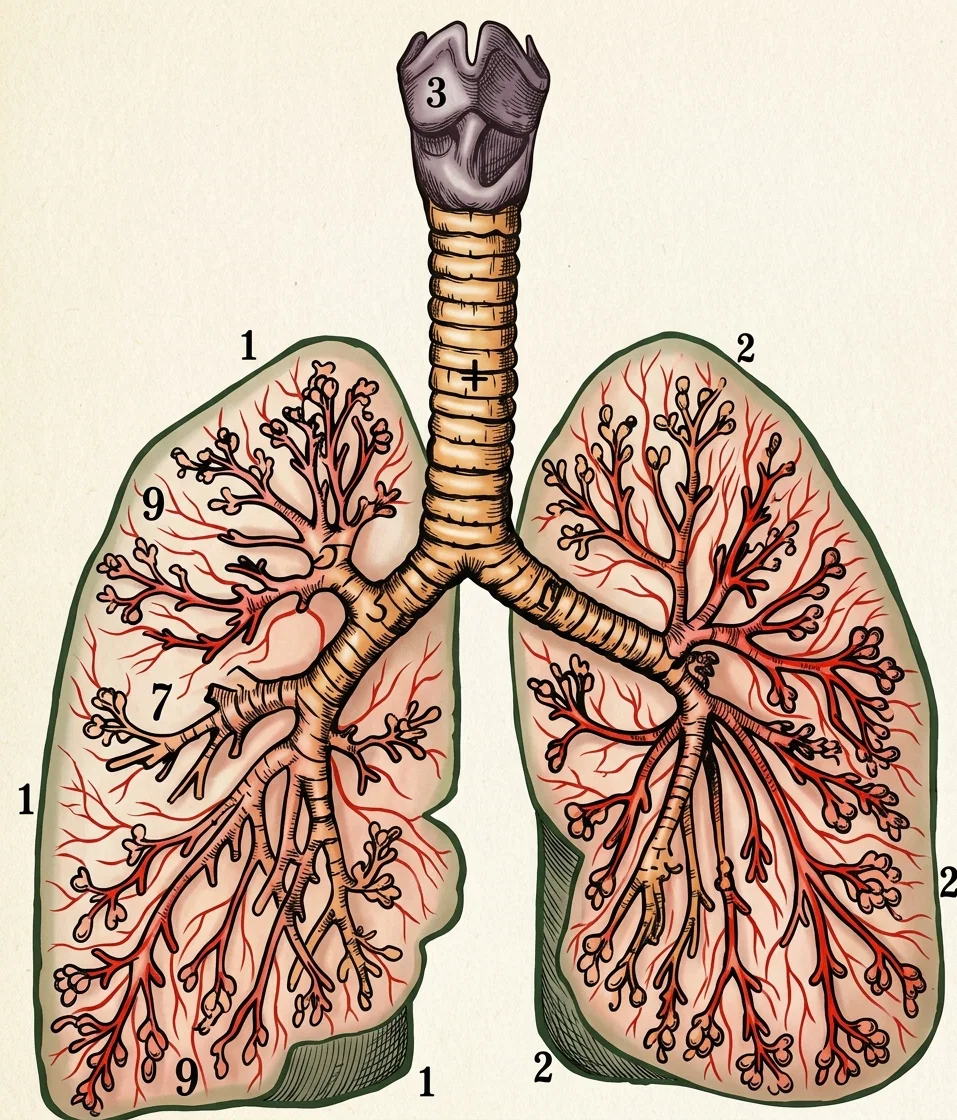
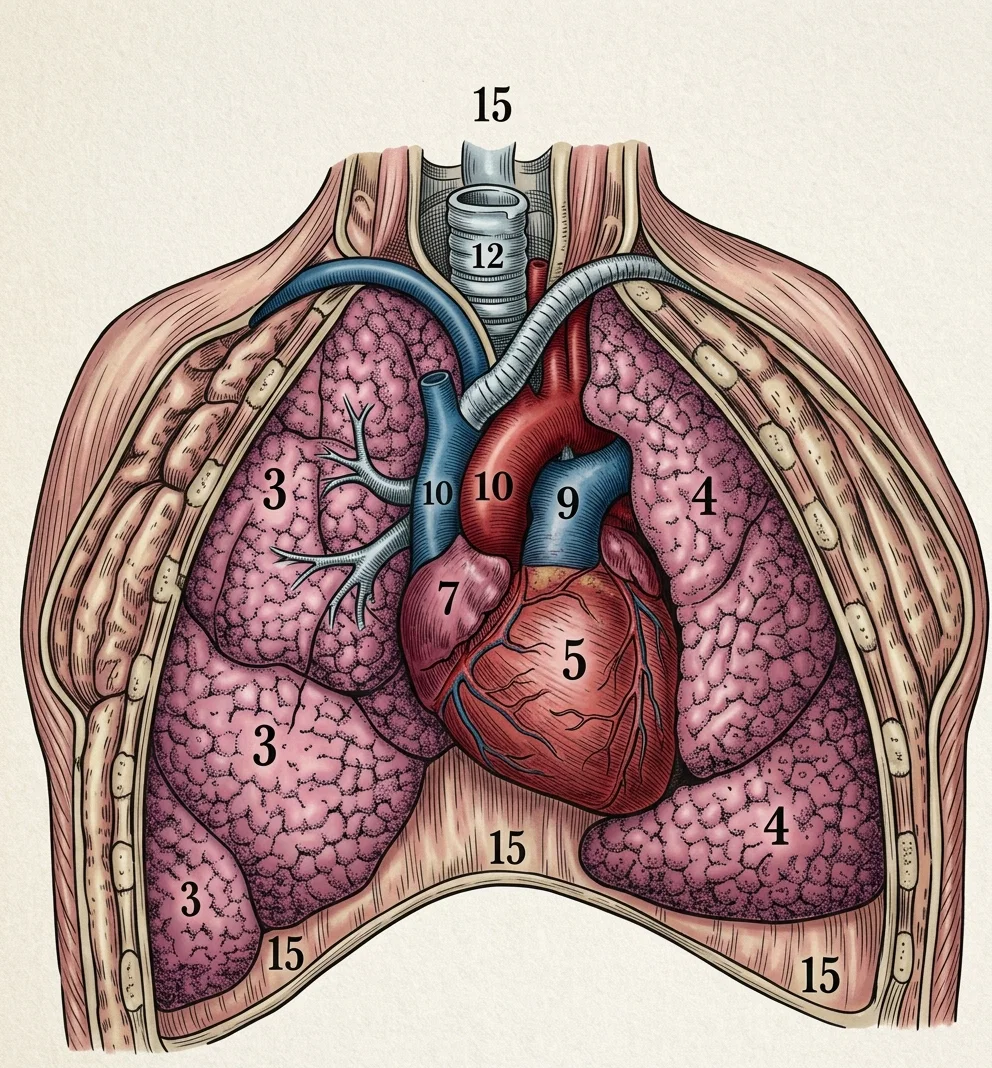
The first organs to receive the air that furnishes oxygen to the body, are the lungs. They are situated in the chest, the cavity of which they nearly fill. The right and larger lung is divided into three lobes, while the left has only two, a part of the space on this side being occupied by the heart and larger blood-vessels. The chest cavity grows to the size and shape that is necessary to give room for the expansion and contraction of the organs within. If, by improper breathing, clothing, or disease, we fail to develop the lungs, and do not through vigorous exercise create a demand for oxygen, then the chest will necessarily become proportionately contracted.
The air properly enters the respiratory organs through the nostrils, which are so formed as to produce certain important changes before it enters the more delicate organs below. Little ciliary, or hair-like projections, on the surface of the mucous membrane of the walls, by their movement, tend to cleanse the atmosphere by removing from it all particles of dust or other impurities. The fluid that is constantly secreted by the mucous membrane moistens the air and renders it more soothing to the sensitive mucous membrane in the lungs, while the warm air-chambers in and about the nasal cavity raise the passing air to a temperature more nearly equal to that of the interior of the body. These important changes in the air are not made when one breathes through the mouth. Hence mouth-breathing has a very deteriorating influence on the functions of respiration and is sure to produce diseased conditions in the lungs.
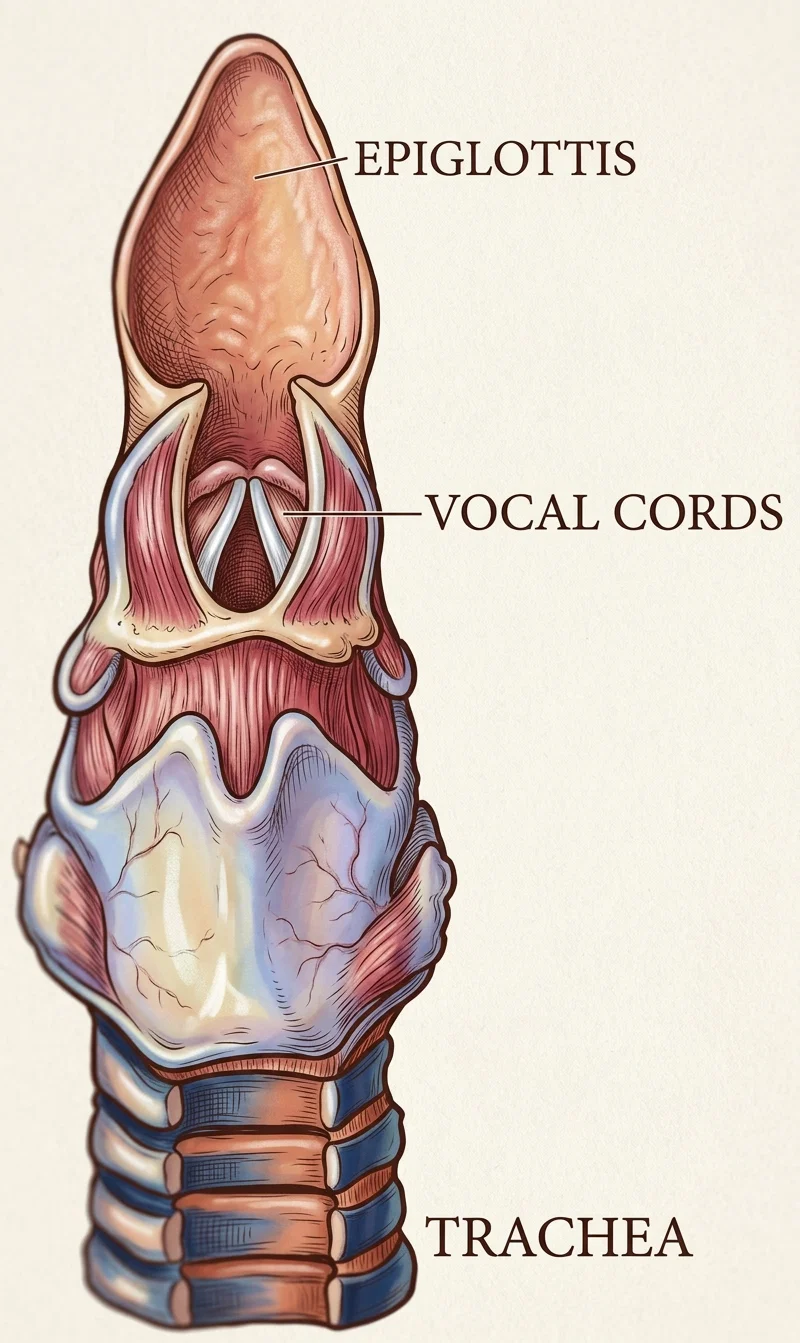
After leaving the nostrils, the air crosses the pharynx, and enters a beautifully constructed chamber known as the larynx. This has a set of muscles and cords so arranged that the return current of air from the lungs performs the function of producing sound, with all the multitude of variations of the voice. The air passes from the larynx into the trachea, and on into the lungs by a large number of bronchial tubes, which divide and subdivide until the air finally reaches the ultimate air-chamber, known as the air-cells, or vesicles. For the purpose of providing more surface with which the air may come in contact these air-vesicles are arranged in little compartments, which gives them somewhat of a honeycomb appearance. The surfaces of the cells are thin and delicate, and are very vascular on account of the millions of tiny blood channels which ramify them.
The purpose of this close relation between these blood-vessels and the surface of the air-vesicle, is to have the air come so close to the blood that an interchange of gases may take place, the oxygen passing into and combining with the elements of the blood, while the carbonic acid gas and poisonous vapors are expelled from the blood into the rarer medium of the atmosphere, and are exhaled. It is estimated by our best physiologists that there are 725 millions of these air-vesicles in a pair of lungs, the total surface of which, spread out in one sheet, would cover an area of 200 square meters, or from 100 to 150 times the area of the skin which clothes the outside of the body.
This enormous provision of nature, which is far larger than is ordinarily required, is sufficient to meet every emergency in life, and to have a large reserve force for old age when, as the elasticity of the chest is lessened, a reserve is necessary to the preservation of health. This extra provision of nature often becomes a curse to the individual, simply because he fails to use this surplus room, and the contracted portions, being poorly ventilated, become a fruitful field for the establishment of disease.
The ordinary individual has a capacity for exhaling, with forced exhalation, from 200 to 300 cubic inches of air. This, however, does not represent the total lung capacity, as there is always a certain amount of residual remaining after extreme exhalation, which is not less than 100 cubic inches. This large chemical laboratory within the lungs requires regular and systematic deep breathing in order to be kept active, clean, and free from disease.
In quiet respiration during rest, we inhale only about twenty cubic inches of air; but if the lungs are in a healthy condition, this will intermix within all the open air-chambers, and be distributed throughout the lungs. But unless all these various air-compartments are kept open by proper breathing, made necessary by hard work or systematic practise in deep breathing, it will not be thus equally distributed. If life is to be preserved to a mature old age, one must see that his chest is not contracted by any artificial means, or that it does not fail to properly develop through lack of physical exercise, or through improper habits of work, or assuming unnatural and cramped positions while standing, sitting, or lying.
A. J. SANDERSON, M.D.
POWER OF MIND OVER BODY.
By Jas. Montgomery
“Hope deferred maketh the heart sick; but when the desire cometh, it is a tree of life.” Prov. 13:12.
THE influence of the mind over the body is well known by many; but not so well known as it should be, since much sickness and many diseases are promoted by a morbid condition of the mind. The first clause of the text speaks more especially of disappointment and its effect; but the same principle applies to all unhealthful conditions of the mind.
One writer well says: “Heart-sickness makes many dyspeptics; for mental trouble has a paralyzing influence upon the digestive organs.” “That which brings sickness of body and mind to nearly all is dissatisfied feelings and discontented repinings.” Nehemiah was so concerned about the desolation of Jerusalem and the captivity of his people that his face became noticeably haggard and wan, so that the king remarked to him: “Why is thy countenance sad, seeing thou art not sick? this is nothing else but sorrow of heart.” Neh. 2:2.
Again we quote: “Nothing is so fruitful a cause of disease as depression, gloominess, and sadness.” “Sickness of mind prevails everywhere. Nine-tenths of the diseases from which men suffer have their foundation here.”
If this is true, the importance of the subject can hardly be overestimated. If it is literally true that nine-tenths of the diseases have their origin in the mind, then nine-tenths of our efforts should be to free the mind of the morbid conditions which give rise to disease—not to try to persuade the invalid that nothing is wrong, but that something is wrong and that the trouble comes from within.
A case illustrating this is mentioned in Psalms 102: 4, 5. “My heart is smitten, and withered like grass; so that I forget to eat my bread. By reason of the voice of my groaning my bones cleave to my skin.” This is an account of a case of mental disturbance where the flesh wastes away until this condition is brought about. David is not the only one who has had such experience. Many are losing their health because of worry and dissatisfied repinings.
But this is the dark side of the picture—the side where “hope is deferred,” and the “heart smitten,” where the “voice of groanings” causes the “bones to cleave to the skin.” Let us shift the scene, therefore, and view the brighter side, which is just as positive as the other. “A merry heart doeth good like a medicine; but a broken spirit drieth the bones.” Prov. 17:22. Cheerfulness has been said to be a “panacea for all ills;” but whether this be true or not, we are assured that it “doeth good like a medicine [or remedy].” “Cheerfulness and a clear conscience are better than drugs, and will be an effective agent in your restoration to health.”—Healthful Living. If any believer is afflicted, let him remember that cheerfulness of spirit and a clear conscience will be a powerful factor in his recovery. Therefore look up; be encouraged; keep up your courage—likewise your shoulders—and never say “die.” Like the psalmist declare, “I shall not die, but live, and declare the works of the Lord.” Ps. 118:17. “Pleasant words11are as an honeycomb, sweet to the soul, and health to the bones.” Prov. 16:24.
Not only are your pleasant words “health to the bones” of your neighbor; but they react with a beneficent result upon that man who uses them. And if they come spontaneously from a joyful heart, their influence is threefold—both upon the bearer and the user. “We should encourage a cheerful, hopeful, peaceful frame of mind; for our health depends upon our so doing.” If we do not already possess cheerfulness and hopefulness it is our duty to cultivate that trait at once; for our continued health depends upon it; besides, we owe something except scowls and cross words to those about us. It pays to be happy. There is a divinely appointed relationship between a happy mind and a healthful body. “He that is of a merry heart hath a continual feast” (Prov. 15:15), and not only that, but the power that such a man wields over hardened humanity by his hearty greeting and pleasant smile, can not be estimated. Cheer up; be bright; let all the good shine forth; and by all means lose not an opportunity to scatter seeds of kindness and thus implant a kindly feeling in the hearts of others.
Some two or three years ago a young man was standing at the main entrance of the old Battle Creek Sanitarium, leaning listlessly against one of the pillars. His work that day was a drudge, and his friends were enemies. The sun shone unnoticed, the winds fanned his cheek unfelt, the trees budded, the grass carpeted the earth unseen. He was discouraged. The clouds were dark and lowering. The silver lining did not appear—the young man was disheartened. Finally he noticed a lady with a baby carriage coming up the walk, and as he gazed listlessly at them, they drew near. As the carriage was immediately opposite, a small child, about one year old, drew itself to a sitting posture and caught the young man’s eye, and—smiled. That smile broke the black spell, and immediately the birds sang, the sun shone, and the trees sprang into foliage. Friends were friends again, and work that afternoon was a positive pleasure. God sent that smile to cheer a disconsolate young man,—and it did not fail in its mission. That young man was the writer.
Toronto, Ont. JAS. MONTGOMERY.
THE SECRET OF A HAPPY DAY.
Just to trust, and yet to ask
Guidance still;
Take the training or the task
As He will;
Just to take the loss or gain
As He sends it;
Just to take the joy or pain
As He lends it.
He who formed thee for His praise
Will not miss the gracious aim;
So to-day and all thy days
Shall be molded for the same.
Just to leave in His dear hand
Little things;
All we can not understand,
All that stings;
Just to let Him take the care
Sorely pressing,
Finding all we let Him bear
Changed to blessing.
This is all! and yet the way
Marked by Him who loves thee best,
Secret of a happy day,
Secret of His promised rest.
—Christian Observer.