The Youth’s Instructor, Vol. 63, No. 51.

Temperance and Liquor News Items from Abroad and at Home

The Youth’s Instructor

Dec 21, 1915

Review and Herald Publishing Assn. · Takoma Park Station, Washington, D. C. · Dec 21, 1915

Temperance and Liquor News Items from Abroad and at Home

IN September, 1913, Moscow’s 2,000,000 people drank 759,947 gallons of vodka; in October, 1914, they drank only 2,913 gallons.
SUITS for $2,000,000 damages under the dramshop law of Illinois have been started against Cook County saloon keepers by William C. Dean, attorney for the Citizens’ League — 180 suits in all.
MRS. MARY A. BURKE, Boston, Massachusetts, has been awarded a verdict of $300 against a firm of liquor dealers for selling her husband liquor so that he became drunk, fell, and broke his arm, thus depriving her of support.
SECRETARY LANSING not long ago was invited on the same Thursday evening to dine with a member of the cabinet and with a foreign ambassador — two invitations. To each his response was the same — his inability to attend because that was his night at church.
SIXTY-TWO students were recently given diplomas from the Moody Bible Institute. These students represented twenty-five States and three foreign countries. Since its establishment, twenty-eight years ago, the Moody Bible Institute has trained nearly thirteen thousand students. Of these, seven hundred have gone to the foreign field.

Truth: A Collection of Maxims and Proverbs

Truth

A THING is never much talked about but there is some truth in it.— Italian.
A thousand probabilities do not make one truth: — Italian.
Better suffer for truth than prosper by falsehood. — Danish.
Between wrangling and disputing truth is lost.— German.
Great is truth, and mighty above all things.— Bible.
“He who does not speak truth to me, does not believe me when I speak the truth.”
He who conceals a useful truth is equally guilty with the propagator of the injurious falsehood.— Augustine.
If we reject the truth we seal our own perdition. — J. M. Mason.
In too much disputing truth is lost.— French.
No crime is more infamous than the violation of the truth.— Dr. Johnson.
“Though malice may darken truth, it cannot put it out.”
Truth gives a short answer; lies go round about.— German.
Truth hates delays.— Seneca.
Truth hath a quiet breast.— Shakespeare.
Truth is always straightforward.— Sophocles.
Truth is as impossible to be soiled by any outward touch as the sunbeam.— Milton.
Truth is God’s daughter.— Spanish.
Truth is heavy; few therefore can bear it.— Hebrew.
Truth is the water of life.— German.
Truth knows no fear, While praise earned without it is purchased too dear. — Scribbleomania.
“Truth is afraid of nothing but concealment.”
Truth makes the tongue smart.— German.
Truth may languish, but can never perish.— Italian.
“Truth and roses have thorns about them.”
“Truth’s best ornament is nakedness.”
“Truth never fears investigation.”
“Truth never grows old.”
“Truth never perishes.”

M. E. KERN

From the War Zone in East Africa

Last spring I wrote to Brother A. A. Carscallen, in British East Africa, asking for missionary facts for the Church Officers’ Gazette. The last of August a reply was received. While this was too late to use when our Missionary Volunteer Societies were studying Africa, some things which Brother Carscallen has written about conditions brought about by the war will be of interest to INSTRUCTOR readers:—
KISUMU, BRITISH EAST AFRICA, July 5, 1915.
DEAR BROTHER KERN: Your welcome letter of March 12 came to hand some days ago, and I was glad to hear from you again. Some of our mail is a long time on the way before we get it, and it seems that some we do not get at all.
We had to leave our field just before the middle of September, when the soldiers advanced through that district, and we have done very little mission work since. To us it seemed unfortunate to leave. The schools were doing well, and new students were coming almost every day. We had nearly three thousand in the schools when we came away. I was back there for some time on the border, but am now on the north side of the Kavirondo Gulf. Our boys are still holding out well, and this will be a good experience for them in one way—it will teach them to stand alone. Some of them are still teaching, and doing well. We hope it will not be long before we can return.
I am sorry that I cannot send you a map of our field just now. I have some fine ones, but they are all over at Gendia, and I cannot get them until we return. We have seven stations. Gendia was the first, and when the trouble came in that district, that mission was left, as well as the rest. Brothers Morse, Lane, and Phillips have been back since, but not to stay long. Later, the house was burned, with nearly all that was in it. I lost all my books and a good many other things. Wire Hill Station has not suffered much. Kisi was looted by the natives, and nearly all the movable goods were taken or destroyed. Kamagambo was looted, and some of the buildings were damaged. Nearly all our goods there were taken or destroyed. Kaniadodo and Karungu suffered the same fate. Rusinga escaped with lighter loss, as Brother Watson was there at the time.
I cannot send you any photographs at present, as all my plates were destroyed; and I cannot take new ones, for the cameras are gone the way of the rest of the things. However, I hope to have some interesting things to tell you when we get back to our field, and to send you a map with all our stations marked on it.

M. E. KERN

Give: A Poem on Generous Giving

“GIVE! as the morning that flows out of heaven; Give! as the waves, when their channel is riven; Give! as the free air and sunshine are given; Lavishly, utterly, joyfully give — Not the waste drops of thy cup overflowing; Not the faint sparks of thy earth ever glowing; Not a pale bud from the June roses blowing — Give! as He gave thee, who gave thee to live.”

Fitting Oneself for a Place

I am not concerned that I have no place; I am concerned how I may fit myself for one. I am not concerned that I am not known; I seek to be worthy to be known.— Confucius.

Glimpses of Burma

Houses

R. B. THURBER
SOON after coming to Burma, we received a letter from a small boy acquaintance in America, asking if we lived in a tree. Perhaps this idea is akin to the notion that the sun never shines in darkest Africa, or that all the vegetation in China is yellow. However, it may be our young friend did see a picture of a house in a tree, purporting to be a reflection of life in this country. After six years’ going about I have not yet seen the reality, so I suppose the Burmese houses are just about as ordinary as American houses.
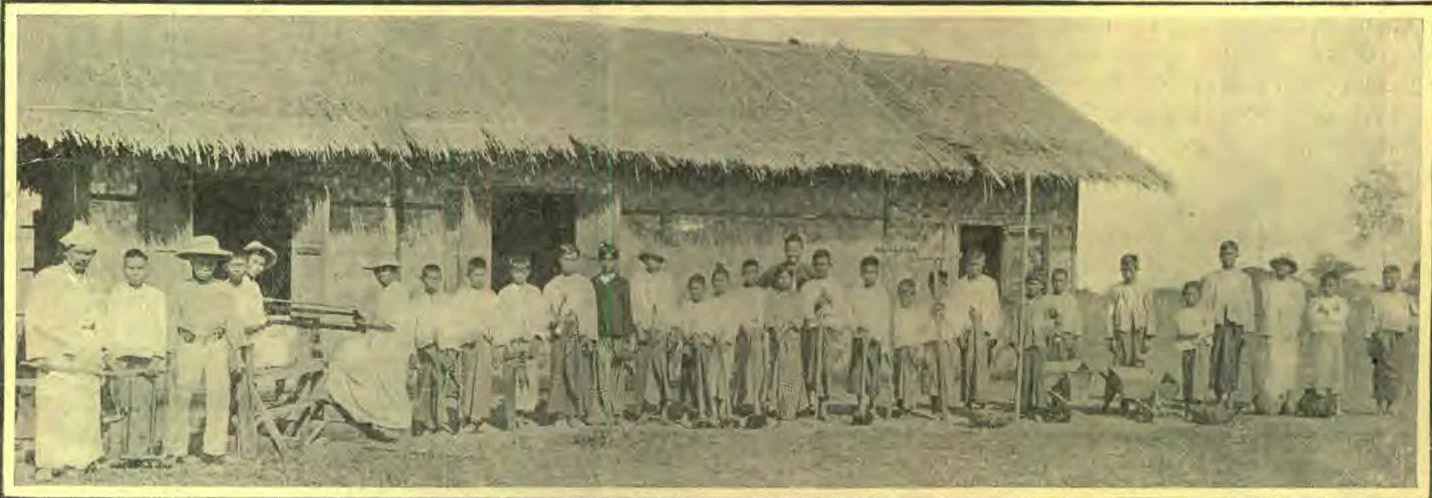
INTERESTING BURMESE YOUTH, PUPILS OF A MISSION SCHOOL, BURMA
But the Burman is fond of living “up in the air,” at least in the low-lying parts of the country. Paddy (rice) is the most general crop, and it must be kept flooded. The ground is covered with water during the rainy season; and even if it were possible, it would be very uncomfortable and unhealthful to live in a house with a dirt floor. So the people usually perch their houses high up on posts.
The typical Burmese house is made entirely of bamboo, that inestimable boon to the poor man in the tropics. Its firm structure, light weight, and straight-splitting tendency make it very valuable for building purposes. With it he makes all parts of his house, his linoleum, candlestick, drinking cup, savings bank, cowbell, wrapping paper, horoscope, water pipe, furniture, baskets, handles for tools, and a hundred other articles too common to mention. I judge the least use he makes of it is for fishing poles.
The primitive and only tool needed for the building is the dah, a long knife just about the size and shape of a straight corn-cutting knife. It is also the general weapon. It is wonderful in how many ways the Burman can use it. It is said that a skilled jungle man in the olden days could go into the forest with nothing but a dah, and emerge in a day or two with a complete and well-made bullock cart.
In a typical Burmese house large enough to have two stories, the upper story is never above the lower, but is placed at the back, so that the two are like steps. If he can help it, no Burman will live or sleep beneath the room in which another lives or sleeps. When we started our school several years ago, we did not have room enough in the dormitory; and in my ignorance I suggested that we make “double-decker” beds. We were warned before it was too late.
Below the upper or back story of the house is the stable for the bullocks and carts. The floor of the bedroom above is made of split bamboo, and has cracks about an inch wide. So the air in the sleeping apartments cannot be very fresh and clean; and it would be almost unbearable if the walls were not made of bamboo matting and the windows kept open so that the breeze can have free course.
The roof is usually made of short pieces of stripped bamboo, which are lapped like shingles. From within, it is possible to study the heavenly bodies through the roof; but it is surprising how little of even the heaviest rains comes through when once the wood is wet.
Every year a careful house owner daubs the walls and posts of his house with a coat of crude petroleum, and this preserves the light material for several years. The average life of the roof and walls is three years, when it must be entirely renewed.
There is a little corner or room at one side of the front of the house which is set aside as a cooking place. The “stove” is a low, wide box filled with earth. On it are large stones on which the cooking utensils are placed, and among which the fire is built. The rice is cooked in an earthen pot; but the most common utensil is a large, shallow iron bowl in which many foods are boiled in grease. The Burman is very fond of fatty foods.
Burmese beds are usually made up on the floor, but some have a low wooden bed with bamboo strips for springs. A double mat or thin mattress is placed on top of the bamboo strips. The pillow is round and high and hard. There are no chairs, and a mat on the floor or a low platform serves as a table.
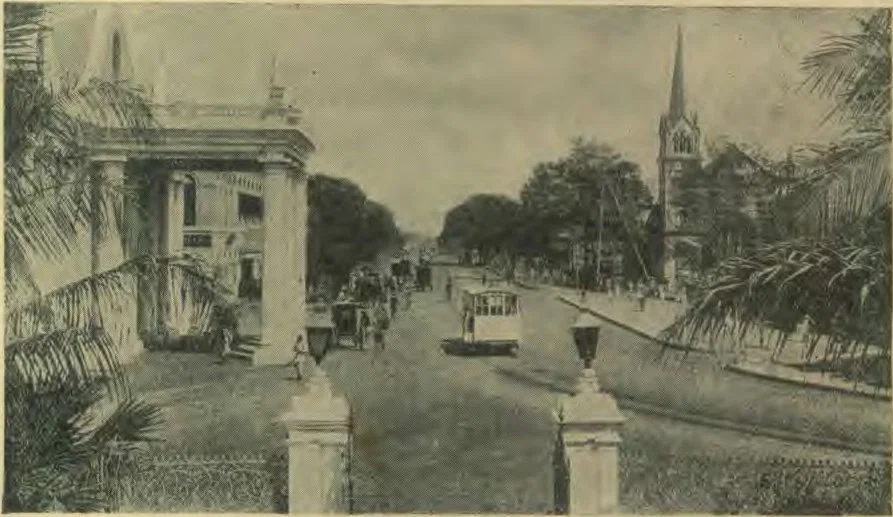
DALHOUSIE STREET, RANGOON, BURMA
Except in the larger towns, where there are sanitary laws, the surroundings of a Burmese house are kept indescribably filthy. All refuse and rubbish goes through the floor, or is dumped near the house, and left. During most of the year the ground underneath the house is covered with puddles of stagnant water. If it were not for the animal and insect scavengers, conditions would indeed be deplorable. But chickens, ducks, crows, vultures, dogs, pigs, and ants attack the waste, and thus save the lives of the people from many epidemics. Is it any wonder that these filth consumers have the freedom of the house, and are never killed? There are very few flies; but mosquitoes abound, and make fevers very prevalent.
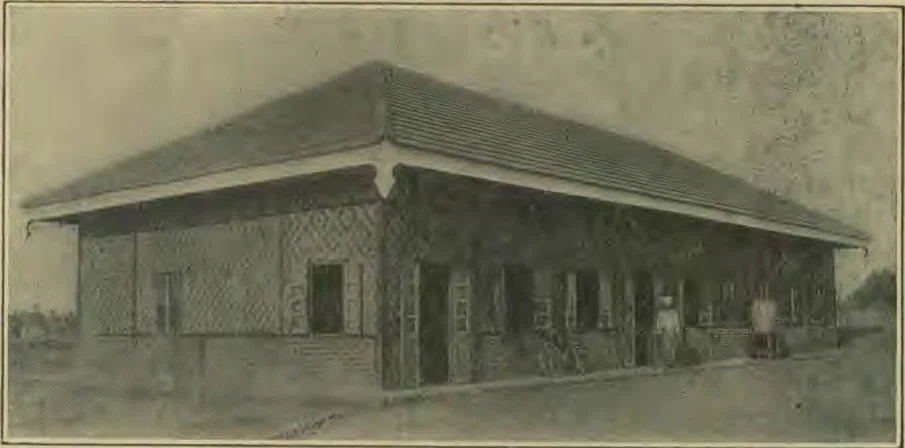
S. D. A. SCHOOL BUILDING, MEIKTILA, BURMA

One of the Great Organs of the World

ONE of the greatest organs, and in some respects the most wonderful instrument of music ever made by man, is the organ at John Wanamaker’s department store, in Philadelphia, Pennsylvania, one of the largest stores in the world. The organ became famous at the St. Louis Exposition, as the crowning work of the organ builder. It was bought by Mr. Wanamaker and installed in his new store about five years ago, and since that time there have been many additions made to it, and it is not yet finished.
The great instrument has twice the dynamic power, and when finished will have the largest number of speaking stops, of any organ in all the world. On the combination board are an almost infinite number of combinations, so that it would take many years to make all the musical combinations possible. On going inside this large organ, a person is almost lost in the forest of pipes, from the tiniest one to the great thirty-two-foot pipe, which thunders its mighty, majestic bass, causing the building to tremble and vibrate.
The organist, Dr. Irvin J. Morgan, a native of Philadelphia, is one of the greatest living organists. He studied for four years with Dr. Bridge, of Westminster Abbey, London, acknowledged while living as the world’s greatest organist. And Dr. Morgan is not only a skilled organist, but a composer of a large variety of music, secular and sacred, in the list being many hymns of acknowledged merit. He has written some remarkable Indian music, which he played at the dedication of the statue in New York harbor by ex-President Taft.
The largest part of Dr. Morgan’s music, however, is of a religious nature, a noted example being his “Sonato Religioso,” especially composed and played by him for the dedication of the new organ built for Dudley Buck in the church of the Holy Trinity, Brooklyn. The themes in each of these four movements are taken from sacred melodies in the ancient “Plain Song” and the so-called Dresden’s “Amen.” Of a deeply religious nature, Dr. Morgan’s playing has a peculiar and elevating dignity and charm that has been a real inspiration to the millions who have heard him. Mrs. S. M. McMaster, of Toronto, whose husband gave McMaster University to the city of Toronto, and who has herself donated large organs to some of the greatest churches in Canada and the United States, says: “Words cannot express my appreciation of your wonderful concerts and fine organ playing. I have heard many of the great organs and organists of the world, but these concerts of yours seem the most remarkable, and affect me more than any others I ever attended.”
Daniel Courcois, of Paris, who is the head of all organ and ecclesiastical music of all France, after naming the notable composers and musicians of the world with whom he is personally acquainted, says that for skill and art and temperament the magnificent playing of Dr. Morgan is equal, if not superior, to that of any of the best musicians. Dr. Morgan not only played this greatest instrument at the World’s Fair in St. Louis, and opened the organ at the dedication of the great Wanamaker store in Philadelphia, to an audience of 63,000, but has played it continually for five years, giving three concerts daily, besides other special concerts, an average of 1,000 concerts each year, to millions of people, thus enjoying the distinction of having played to the greatest number of people and the largest concert audiences of any organist of present or past time.
I shall never forget the solemn and overwhelming impression made not only upon myself but apparently upon all who heard the wonderful rendering of “The Refuge Psalm” on the grand organ by Dr. Morgan at the eleven o’clock concert, Nov. 4, 1915. The majestic words of the wonderful forty-sixth psalm were a theme worthy of the greatest instrument of music ever invented by man. The instrument speaks from faintest, sweetest echo to mighty peals of thunder. With stately tread the organ marched through the music of these words: “God is our refuge and strength,” repeated twice, and very tenderly, comfortingly spoke of God also as “a very present help in trouble;” then, as a great army marching, “Therefore will not we fear, though the earth be removed, and though the mountains be carried into the midst of the sea;” then, as softly as an echo from the holy city above, the peaceful flowing of the river of life, “There is a river, the streams whereof shall make glad the city of God;” then the promise, “God shall help her, when the morning appeareth,” rising through an appealing minor, to a great major climax of confidence and trust. Pathetically through the music there seemed to speak hope and solemn faith. Then the mighty rush and roar of the warlike chorus, “He breaketh the bow, and cutteth the spear in sunder; he burneth the chariot in the fire—IN THE FIRE,” and all the mighty power of the immense organ burst in a terrific crash of thunder. The great building trembled and quivered. A startling and awful silence for a moment; then, soft as an echo and yet clearly and with solemn authority, that most majestic command, “Be still, and know that I am God;” and then, more solemn than all before it, the music of the words, “The Lord of hosts is with us; the God of Jacob is our refuge.” It seemed as if the bells of heaven rang down to us that wonderful promise. Tears were in the eyes of many who knew the words and music of the psalm, and strangers listened with rapt and almost breathless hush, and immediately after the music ceased, inquired of the organist, “What was that last number?” Dr. Morgan said to me, “Why, that last part of the psalm is like a prayer; it is beautiful.” He had felt the spirit power of the thought, and feeling it, had spoken, with true musical inspiration, through the great organ.
Whatever I may forget, I shall ever remember the thrill of that wondrous music through all the discord and strife of this warring world, even to the day when I hear the music of heaven. And the memory will ever bring strength and power to fight the good fight of faith and to lay hold on eternal life.
Dr. Morgan will play “The Refuge Psalm” again December 30, at 11 A. M. J. S. WASHBURN.

Too Cheap

A preacher of the gospel had gone down in a coal mine during the noon hour to tell the miners of that grace and truth which came by Jesus Christ. After telling them the simple story of God’s love to lost sinners, man’s state and God’s remedy, the time came for the men to resume their work, and the preacher came back to the shaft to ascend to the world again. Meeting the foreman, he asked him what he thought of God’s way of salvation. The man readily replied:—
“Oh, it’s too cheap. I cannot believe in such a religion as that.”
Without any immediate answer to this remark the preacher asked,—
“How do you get out of this place?”
“Simply by getting into the cage,” was the reply.
“And does it take long to get to the top?”
“Oh, no; only a few seconds.”
“Well, that is very easy and simple. But do you not need to help raise yourself?” said the preacher.
“Of course not,” replied the miner. “As I have said, you have nothing to do but to get in the cage.”
“But how about the people who sank the shaft and perfected all this arrangement? Was there much labor or expense about it?”
“Indeed, yes; that was a laborious and expensive work. The shaft is 1,800 feet deep, and it was sunk at great cost to the proprietor; but it is our only way out, and without it we should never be able to get to the surface.”
“Just so. And when God’s Word tells you that whosoever believeth in the Son of God has life everlasting, you at once say, ‘Too cheap, too cheap,’ forgetting that God’s work to bring you and others out of the pit of destruction and death was accomplished at a vast cost, the price being the death of his own Son.”
“For God so loved the world, that he gave his only begotten Son, that whosoever believeth in him should not perish, but have everlasting life.”—Baptist Teacher.
Continue reading: Our Work in Japan