We see an old man in a tent looking at a boy fast asleep on a skin rug. As he gazes at him, the tears begin to flow down his cheeks. He brushes them away and speaks to the lad, telling him to arise and go with him on a journey. He calls two young men to go with him, and together they travel for two days. At length they come to a mountain. The old man places a bundle on the boy's back, and together they begin to climb the mountain. When on its summit, they talk about something which seems to frighten the lad. He does not oppose his father, but obeys him. The two men who left home with them are not with them now. They are waiting on the mountain side.
We see a pile of stones. The boy is lying on the stones. Is he tired? Is that a bed made for him by his father? The father has a knife in his hand. We almost hold our breath, for surely he is not going to kill his son. No, no! he stands still with the uplifted knife as if listening to some one speaking, then he turns and takes something from the bushes. The boy arises from the stones and seems very glad and happy. Soon we see smoke rising among the trees. The boy and his father call the young men, and they all return home.
Who was the boy? who the father? What and where was the mountain? Why did the old man take the journey? Why did not the boy's mother accompany them? What terrible thing was the man told to do? by whom? why? What question did the lad12ask? What reply did his father make? What was in the bushes? What did the old man do after he unbound his son? What name was given the place? What promise was made the old man? why? Where did the old man dwell after that?
ELIZA H. MORTON.
How It Begins
“GIVE me a halfpenny, and you may pitch one of these rings; and if it catches over a nail, I’ll give you threepence.”
That seemed fair enough; so the boy handed him the halfpenny and took the ring. He stepped back to the stake, tossed the ring, and it caught on one of the nails.
“Will you take six rings to pitch again, or threepence?”
“Threepence,” was the answer; and the money was put into his hand. He stepped off well satisfied with what he had done, and probably not having an idea that he had done wrong.
A gentleman standing near him watched him, and before he had time to look about and rejoin his companions, laid his hand on his shoulder and said, “My lad, this is your first lesson in gambling.”
“Gambling, sir?”
“You staked your halfpenny and won six halfpence, did you not?”
“Yes, sir, I did.”
“You did not earn them, and they were not given to you. You won them just as gamblers win money. You have taken your first lesson in their path. That man has gone through it, and you see the end. Now, I advise you to go and give his threepence back, and ask him for your halfpenny, and then stand square with the world, an honest boy.”
He hung his head, but raised it quickly, and his bright, open look, as he said, “I’ll do it,” will not soon be forgotten. He ran back, and soon emerged from the ring looking happier than ever. He touched his cap and bowed pleasantly as he ran away to join his companions. This was an honest boy, and doubtless made an honorable man.—Selected.
Watch the Clock
“WHAT is the secret of your success?” was the question put to a prosperous manufacturer the other day.
“I watch the clock,” he promptly replied.
“That does not sound like a very good policy,” remarked his questioner.
“I suppose not—at least not on the face of it. Everything depends on how you watch the clock. My plan is to see how much I can learn in each spare moment.
“I started out as an ordinary apprentice. I spent my evenings reading all the books and magazines I could get hold of that had anything to do with the trade I was trying to learn. There were no correspondence schools in my very early days, so I had to figure out things as best I could.
“When I became a full-fledged journeyman, I devoted all my spare time to the study of shop management—the I. C. S. Course. Consequently, when I was made foreman, I knew the job from A to Z; I had everything at my fingers’ tips.
“Each promotion meant more study for me. As soon as I was placed in a new position, I immediately began to study the job ahead. As a result, I was always prepared when advancement came—I was trained for the job.
“When correspondence schools came into existence, I was among the first to enroll, and it was my correspondence school training that enabled me to make good in my first executive position. Later I boosted myself along with courses in such branches as advertising, commercial law, and English.”
“I suppose you can rest on your laurels now that you are president of the company,” said his listener.
“I study harder now than ever,” returned the manufacturer. “I am constantly reading up new and improved methods of management, and devising plans for expanding the business. Just at present I am taking the I. C. S. Course in Spanish, so that I can go after the South American trade intelligently. So long as I live, I shall continue to study; for those who do not study do not really live.”
Are you training for the job ahead? Do you purpose to study? How do you watch the clock?—Ambition.
Gentle Reproof That Shames Rather Than Frightens
HE had such a gentle method of reproving their faults that they were not so much afraid as ashamed to repeat them.—Atterbury.
Truth May Be Blamed But Never Shamed
“Truth may be blamed, but shall never be shamed.”
Sacrificing Pleasure to Duty
“He who can at all times sacrifice pleasure to duty, approaches sublimity.”
FREE WITH THE “INSTRUCTOR”
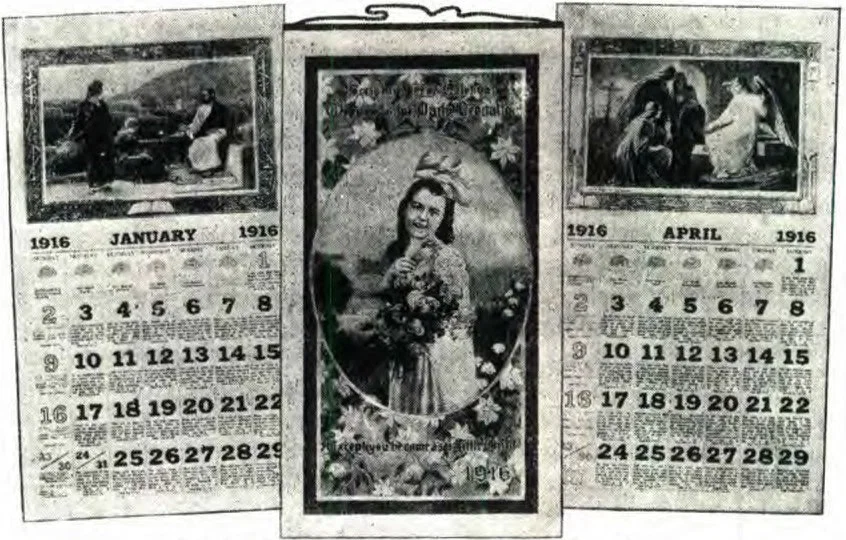
A beautiful 1916 Scripture Text Calendar, nine and one-fourth by sixteen and one-half inches in size and printed in harmonious colors, is given free with every single full-year “Instructor” subscription ($1.25), and will be sent, as long as the stock lasts, for 15 cents extra for every calendar ordered with any six months’ “Instructor” club. In order to be sure of securing this handsome and most helpful calendar, it will be necessary to order early, the supply being limited. Order through the conference tract society.
Missionary Volunteer Society Programs for Week Ending January 1
THE programs for the Missionary Volunteer Societies, Senior and Junior, for this date, with notes, illustrations, and other helpful material, will be found in the Church Officers’ Gazette for January.
Report From Hawaii
By M. E. Tamka
OUR Missionary Volunteer meetings are held every Sabbath at three in the afternoon. Our society is divided into four prayer bands. Fifteen minutes before the service opens, the prayer bands meet in different parts of the church. In each band we have a list of persons who need help, and these are made the subject of prayer. In the last report given, one young Chinese boy said that the members of his band were praying for a young man attending school with him, who never seemed interested in the Word of God, even though the Chinese lad had tried many times to talk with him. But lately the young man would ask questions, and showed a real interest. The youthful worker was thankful that his prayers were answered. The bands have been a blessing to our young people here. I am thankful for the privilege of prayer—the key that unlocks the storehouse of heaven. May the Lord give our young people more faith in this key.
We are following the programs outlined by the General Department in the Gazette. Last spring we worked out a goal for our society, and pledged ourselves as individual members to do our part in coming up to it. Here it is:—
Honolulu Missionary Volunteer Goal, 1915
Encourage all young people to observe the morning watch.
Secure a Standard of Attainment, and endeavor to get every officer and young person on the Attainment roll.
Read the Bible through during 1915, and push the plan.
Work energetically to get all to report carefully and regularly.
Encourage the young people and children to sell our magazines and thus obtain missionary money.
Endeavor to place yearly subscriptions to missionary papers in libraries and public reading rooms.
Enlist the cooperation of all in missionary effort.
Have a definite object to work for.
Encourage every young person taking part in the program to prepare his part as a talk.
Encourage every member to take part in the prayer bands.
Cooperate with the Hawaiian Mission in laying plans for this summer’s work.
Have a definite time to pray, and definite requests to make.
Encourage Juniors and Seniors to cooperate in a campaign with the Temperance INSTRUCTOR.
I am thankful to say that we can see progress in our efforts in trying to reach this goal. Our society paid for fifty lantern slides to be used in the tent effort here on the islands. Then we ordered five clubs of each of our monthly magazines, to place in the reading racks and to be used in getting subscriptions. We secured the addresses of the teachers, doctors, and office men on these islands this summer, and sent each a copy of the Signs with a letter. About sixty papers and letters were sent. Not all have answered yet. But our prayers have gone with those letters, and I know that there will be some results.
Last week we ordered sixty copies of Liberty. We have sixty addresses of prominent government men in these islands, and plan to inclose a letter calling attention to the magazine, with each copy sent out. We have two societies in Honolulu, one Senior and one Junior. Both are doing good work. I am glad to tell you that seven Seniors and about seven Juniors, perhaps more, are going to take the Reading Courses for 1915-16. We have just ordered our books, but shall not be able to begin before December 1. We are also thinking of adding to our goal.
M. E. Tamka.
Missionary Volunteer Reading Courses
Senior No. 9 — Lesson 12: “History of the Sabbath,” Pages 632-716
1. WHAT were some of the points of difference between the Anabaptists and the Reformers? By whom were the Anabaptists persecuted? Why?
2. What criticism did the Baptists prefer against the Reformers?14
3. Why are the following names of special interest: Moravia? John Balbus? Prince Lichtenstein? Barbara of Thiers? Christina Tolingerin? Rossi? Pechi?
4. Show that Sabbatarians of Reformation times were not Jews. What reasons did they give for observing the seventh day?
5. How do the opinions of Luther and Carlstadt concerning the Sabbath compare?
6. What have you learned of Sabbath observance during the Reformation in Transylvania? in France? in Russia? in Norway? in Iceland? in Finland? in Sweden?
7. What must have been the Reformers’ position on the union of church and state? on the principle of religious liberty?
8. What great blessing did the Reformation bring to Sabbath keepers? What did Sunday lose in the Reformation? What great mistake did the Reformers make?
9. How did scholasticism creep into Protestantism?
10. Trace the Puritans from their origin to their new home in America. What were their “blue laws”?
11. What arguments led Protestants to regard Sunday as the Sabbath of the fourth commandment? What were the six articles of peace?
12. How did parliaments help enforce Sunday observance?
13. In what were the reforming churches inconsistent? What were some of the errors they carried with them from Catholicism?
Junior No. 8 — Lesson 12: “Friends and Foes in Field and Forest,” Pages 8-35
NOTE.—This splendid book should help every boy and girl to enjoy nature more.
1. LEARN the poem “The Boy That Never Sees.”
2. What have you learned about the Bonny Boatman that can sail in both air and water?
3. How many legs has an insect? Name the parts of its body. How many changes does an insect pass through in life? What are they? What do insects eat?
4. How does the larva get a new suit?
5. Name seven general classes of insects, and one or more insects belonging to each class.
6. What is the meaning of each of the following words: spiracles? insect? pupa? imago? molting? ptera? antennae? facets?
7. Where does the cicada live? How many eyes has it? How does Mrs. Cicada use her auger? How does the cicada play his drums? What do cicadas eat?
8. What little insect lives in a house of bubbles when young? How far can it jump?
9. Why are fleas called great athletes? Where do they live? What do they eat? What kinds of fleas are there? What did Iva learn about the “learned fleas” of Paris?
10. How can a fly walk on the ceiling? How does it get out of its little coffin? What six things have you learned in this chapter about the fly? Of what use is it? What are some of its dangerous relatives?
11. Where does Bluebottle lay her eggs? why? How long before this fly gets out of the pupa case? How does it carry its knife for eating?
12. What have you learned about the fly that lives in leaves? on cherries? in olives? What fly caused England to hold a council against it?
13. What have you learned about the mosquito that does not sting? about the insect that breathes through its tail? What diseases do mosquitoes carry? How can the larvae be killed? What remarkable cloud did C. C. Abbott once see?
After Frost
By Eugene C. Rowell
THE woodside is aglow with goldenrod,
A healing calm is in the hazy air,
The sky is infinitely blue; and everywhere
The hills are glory-crowned, as if fresh trod
By throngs of shining angels splendor-shod,
Who on an earthly journey slowly fare
And leave the impress of their sandals there,
So lately radiant on the hills of God.
Thus be it in the days that follow grief;
When all the smitten leaves of life are sere,
And nights are long and days are chill and brief,
Then may there fall upon the pain-dulled ear
A low, calm voice to give the soul relief,
“Peace, peace, be still, for God is even here.”
— Eugene C. Rowell.
Fifty-Second Week
December 26.Revelation 12 to 14: The great red dragon; the beast and his image; the three angels and their messages.
December 27.Revelation 15 to 17: The seven last plagues; Babylon the great; etc.
December 28.Revelation 18 to 20: Babylon is fallen; burned with fire; marriage of the Lamb; judgment given to the saints.
December 29.Revelation 21, 22: The New Jerusalem; the tree of life; the water of life; “Surely I come quickly.”
December 30. Review the New Testament, noting that it contains 4 Gospels, 1 historical book, 14 Pauline epistles, 7 general epistles, and 1 book of prophecy — 27 books in all.
December 31. Take this time for a general review of the whole Bible, book by book. Taking each in its turn, ask yourself, (1) by whom it was written; (2) its great object; (3) the leading truths, or events, or persons described therein.
The Bible a Mine
The Bible is a mine of exhaustless treasure. You have explored it but a little way, and gathered a few precious jewels that will hereafter greatly enrich your spiritual life. But O, be not content! Return to the storehouse, seek new beauties, richer treasures, greater wealth. All shall be yours in greater and still greater abundance. The store is inexhaustible, but it must be mined.
The Bible Prophetic
“No one can read the Bible long,” says M. R. Vincent, “without seeing that it is prophetic. Its utterances are folded in upon themselves like a flower. You see certain petals already exposed to the light; but you see within the circle of these something more, which is to unfold in its season. The whole book is full of a sense of anticipation; the foundations it lays are for a large superstructure; the plans it foreshadows require an immense future for their development.”
The Most Precious Thing in the World
“When Queen Victoria was crowned in Westminster Abbey, three presents were made to her — first, the sword of state; second, the imperial robe; and third, a Bible, these words accompanying the gift: ‘Our gracious queen, we present you with this book, the most valuable thing the world affords. Here is wisdom; this is the royal law; these are the timely oracles of God. Blessed is he that readeth, and they that hear, the words of this book; that keep and do the things contained in it. For these are the words of eternal life, able to make you wise and happy in this world, nay, wise unto salvation, and so happy forevermore, through faith which is in Jesus Christ, to whom be glory forever. Amen.’” — Pierson.
Interesting Biblical Facts
The following items (with many others not given here) were ascertained by a gentleman in 1718, and also by another man in 1722. Each of these men is said to have spent nearly three years in the investigation:—
The Old Testament contains 39 books, 929 chapters, and 23,214 verses.
The New Testament contains 27 books, 270 chapters, and 7,931 verses.
The entire Bible contains 66 books, 1,199 chapters, 31,145 verses, and 753,692 words.
The middle book of the Old Testament is Proverbs; the middle chapter is the twentieth of Job; and the middle verse is 2 Chron. 26: 17.
The middle book of the New Testament is Second Thessalonians; the middle chapters are Romans 13, 14; and the middle verse is Acts 11: 17.
The middle chapter in the Bible, and the shortest, is Psalm 117.
Ezra 7: 21 contains all the letters of the alphabet, I and J being counted as one.
A Beautiful Bible
“The most beautiful volume among the hundreds of thousands in the Congressional Library at Washington, is a Bible which was transcribed by a monk in the sixteenth century. It could not be matched today in the best printing office in the world. The parchment is in perfect preservation. Every one of its thousand pages is a study. The general lettering is in German text, each letter perfect, in coal-black ink, without a scratch or blot from lid to lid. At the beginning of each chapter the first letter is very large, usually two or three inches, and is brightly illuminated in red and blue ink. Within each of these capitals is drawn the figure of some saint, and some incident which the chapter tells is illustrated. There are two columns on a page, and nowhere is traceable the slightest irregularity of line space or formation of the letters. Even under a magnifying glass they seem flawless. This precious volume is kept under a glass case, which is sometimes lifted to show that all the pages are as perfect as the ones which lie open. . . . The illustrated initials, in perfection of form and brilliancy of color, surpass anything produced in the present day. With all our boasted progress, nothing in either Europe or America equals it.” — Pierson.
MEMORY VERSE: “He that overcometh, the same shall be clothed in white raiment; and I will not blot out his name out of the book of life.” Rev. 3: 5.
Questions
1. By what method did Jesus continue to teach the people? Matt. 22: 1.
2. To what did he liken the kingdom of heaven? Verse 2.
3. To whom did the king send his servants? for what purpose? with what result? Verse 3.
4. How did he further show his desire to have these particular people at his feast? Verse 4.
5. But how did they persist in treating the king’s invitation? What did the country people consider more important? the city people? Verse 5.15
6. How did those who were neither farmers nor tradesmen treat his messengers? Verse 6.
7. When the king heard of this, what did he do? What did he say of those whom he had bidden? Verses 7, 8.
8. To whom was the invitation then sent? With what result? Verses 9, 10.
9. What beautiful garment did the king provide for every one of his guests?
10. Yet, in what condition did he find one man? Verse 11.
11. What excuse could the man give for not having on the wedding garment? Verse 12.
12. What was the result of his thinking that his own clothing was good enough? Verse 13.
13. Considering the great number who had been called to the feast, how many were chosen? Verse 14.
14. What is said about those who are called to the marriage supper of the Lamb? What pure white wedding garment does the King of heaven provide for his guests? Rev. 19: 8, 9.
15. Of all who are called, only which ones will be chosen? Memory verse.
Notes
Just to Be Tender, Just to Be True
“Just to be tender, just to be true,
Just to be glad the whole day through;
Just to be merciful, just to be mild,
Just to be trustful as a little child;
Just to be gentle, kind, and sweet;
Just to be helpful, with willing feet;
Just to be cheery when things go wrong,
Just to drive sadness away with a song;
Whether the hour is dark or bright,
Just to be loyal to God and right;
Just to believe that God knows best,
Just in his promises ever to rest;
Just to let love be our daily key,—
That is God’s will for you and me.”
Memory Verses for the Quarter
“He that overcometh, the same shall be clothed in white raiment; and I will not blot out his name out of the book of life.” Rev. 3: 5.
“Thou shalt love the Lord thy God with all thy heart, and with all thy soul, and with all thy mind.” Matt. 22: 37.
“God resisteth the proud, but giveth grace unto the humble.” James 4: 6.
“This people draweth nigh unto me with their mouth, and honoreth me with their lips; but their heart is far from me.” Matt. 15: 8.
“O Jerusalem, Jerusalem, . . . how often would I have gathered thy children together, even as a hen gathereth her chickens under her wings, and ye would not!” Matt. 23: 37.
“But he that shall endure unto the end, the same shall be saved.” Matt. 24: 13.
“For as the lightning cometh out of the east, and shineth even unto the west; so shall also the coming of the Son of man be.” Matt. 24: 27.
“Heaven and earth shall pass away, but my words shall not pass away.” Matt. 24: 35.
“Be ye also ready: for in such an hour as ye think not the Son of man cometh.” Matt. 24: 44.
“Watch therefore, for ye know neither the day nor the hour wherein the Son of man cometh.” Matt. 25: 13.
“Well done, good and faithful servant; thou hast been faithful over a few things, I will make thee ruler over many things.” Matt. 25: 23.
1. How did Jesus frequently speak to the people? Matt. 22: 1.
2. To what did he at this time liken the kingdom of heaven? Verse 2.
3. What did the king send his servants forth to do? What was the result? Verse 3. Note .
4. What message did he send by other servants? Verse 4.
5. What course did some who were bidden now take? Verse 5. Note .
6. What did the rest of them do? Verse 6.
7. How did the king feel when he heard what they had done? What did he do? Verse 7.
8. What did he then say to his servants? Verse 8. Note .
9. What did he direct his servants to do? Verse 9.
10. Whom did the servants gather in? What end was accomplished? Verse 10. Note .
11. When the king came in to see the guests, whom did he see among them? Verse 11.
12. What did the king say to him? How did it affect him? Verse 12.
13. What did the king then bid his servants do? Verse 13, first part.
14. How is the place of outer darkness described? Verse 13, last part.
15. What is said of the number of those who are called? What is said of the number chosen? Verse 14.
The Boy
ONE evening, at a service in New York City, I saw a very distinguished-looking man rise and say, “I will accept Christ.” I went back to the hotel and told my wife I believed I had been used by Christ to lead a great man to God. I thought I had; but the next day, which was a day of prayer, I saw this man come into the service carrying in his arms a little lame boy. He brought him forward, and placing him on the platform, he came over to me, and, placing his hand up to his mouth so the child could not hear him, he said, “I want to introduce you to my little Joe; he is going to die.” He did not need to tell me that; the little fellow’s face was so thin and his hands were so white. When I came over, he said, with all the pride of a father, “This is Joe; he led me to Christ.” I confess I was a bit disappointed. Then he told me the story. He said: “When the mission started, Joe said to me, ‘Father, I cannot go, but mother will take you; and all the time you are gone, I will pray.’ When I came into the house after a service, I never failed to hear the thud of his little crutch on the floor as he came to welcome me the moment the door was opened. He would spring into my arms and say, ‘Did you come?’ But last night he did not ask me. I heard him coming to the door, and as it was opened he sprang into my arms and buried his face on my shoulder, and I heard him say with a sob, ‘You have come, you have come, I know you have.’”— The Christian Herald.
The Higher Criticism
By Roy Temple House
EVER and ever anon,
(Burden of fear to carry!)
Cometh to Simon and John,
Mary, the daughter of Mary.
Weeping aloud: “Have ye heard,
Ye who believed and obeyed him? —
They have taken away the Lord,
And we know not where they have laid him.”
— Roy Temple House.
Rejoicing in God
ONE of Haydn's friends asked how it happened that his church music was of almost an animated, cheerful, and even festive quality. The great composer replied: “I cannot make it otherwise. I write according to the thoughts I feel. When I think upon God, my heart is so full of joy that notes dance and leap, as it were, from my pen; and since God has given me a cheerful heart, it will be easily forgiven me that I serve him with a cheerful spirit.”
Sound Counsel
Dr. Sylvanus Stall, author of a popular series of books concerning sex hygiene, died at Atlantic City, New Jersey, on November 6. Dr. Stall, as minister, editor, and author, ever sought to uplift his fellow men by directing their feet into the Christian pathway.
He studied theology at the Pennsylvania College, at Gettysburg. Six of the theological students acted as pallbearers at the obsequies. The interment was at Gettysburg. The following pertinent message from Dr. Stall to all theological students was read at the funeral services:—
“I have reached the end of the journey upon which you are just entering. I have a message for you from my open grave. Let me impress upon you the importance of a full, unqualified, and complete acceptance of the Scriptures, from cover to cover, as the inspired and infallible word of God. If you cannot accept it as such, let me say to you, You will have no message, and you ought never to enter the ministry. Preach Jesus Christ and him crucified as the only hope of the sinner, and the only Saviour of a lost and ruined world. Live and labor for God and humanity.”