Our pioneer missionary in the Sunrise Kingdom was Pastor W. C. Grainger, principal of our school at Healdsburg, California. His interest in Japan was aroused by his acquaintance with a young Japanese brother who had accepted the truth at a tent meeting in Southern California, and had come to this school for further preparation for service.
In harmony with the law that those who are really called to work in distant fields will not be unmindful of the opportunities to sow the gospel seed in the homeland, Brother Grainger laid aside his school duties, and associated himself for some time with a mission conducted by the church in Oakland for the Japanese in San Francisco. When, in 1896, he sailed for Japan, he was accompanied by T. H. Okohira, the young Japanese convert already mentioned.
From the first, the work in Japan has developed slowly. “We were of the very last of the Christian denominations to enter the field,” says Brother F. H. De Vinney, “and had to encounter all the opposition found at home from the established churches, in addition to the self-satisfied indifference of a heathen people. Elder Grainger, who was well along in years, and other foreign laborers who followed, did not acquire the language, which, by the way, is admitted by the best authorities to be one of the most difficult in the world to learn.”
Recruits
But in spite of almost insurmountable difficulties, the work was begun. The Shiba Bible School was opened in a rented house, in which daily classes for the study of the English Bible were held at various hours. A year later, Brother Grainger’s wife and daughter arrived, and in another year Brother and Sister B. O. Wade and W. D. Burden came to assist in the work. Another Bible school was opened, and was filled with students. By the earnest efforts of those pioneers, some were led to accept the truth. Several of these have developed into earnest workers.
Our Mission Paper
The need of a Japanese paper was soon felt, and in July, 1899, the first number of the Owari No Fukuin (Gospel for the Last Days) was issued. This paper has been of great value to the work in Japan. Nearly all other denominations give away their literature, but all ours is sold. To give it away makes it of less value in the eyes of the people, and is not a good training for them. Though the price is very small, still its purchase entails some sacrifice, and therefore enhances its value in the eyes of the purchaser. Moreover, in this way we are enabled to give the truth to more people, by producing more literature. In 1914 the circulation of the Owari No Fukuin averaged about five thousand copies a month, most of which were sold by canvassers. Over three million pages of tracts and other periodicals were also sold during this period.
Medical Missionary Work Begun
In 1902 the medical missionary work was begun, under the supervision of Dr. S. A. Lockwood, and his wife, Dr. Myrtle S. Lockwood. No suitable opening being found for this work in Tokio or Yokohama, it was started in Kobe, a thriving port city three hundred and seventy miles southwest of Tokio. Nurses and other helpers came from the United States, and for a time this work prospered. Two Japanese physicians also opened a small institution in Kobe, and this continued some time with good success. One of the physicians, however, was obliged to retire, owing to ill health, and the work was taken over by Dr. Noma and a group of earnest nurses, and so continues to the present time. This sanitarium, known as the Eisei-in, is doing a good work for the Japanese, a work that foreigners could not hope to do. Dr. Noma is a very hard worker; and in addition to the oversight and management of her large family, the burdens falling to the lot of the head of a sanitarium, and the faithful performance of her church duties, she has opened up and successfully carried forward treatment rooms in Osaka, a suburb of Kobe.
Tent Meetings
The use of tents for holding series of meetings has been found a successful means of reaching the people. The first tent used for this purpose in Japan was secured in 1905,—a gift from friends in the homeland,—and has been in constant use ever since. In 1910 a second tent, in 1911 a third, and in 1913 a fourth were secured. Brother De Vinney says: “Our tent experiences are not remarkable, except for the number of children who gather. We always have to hold a children’s meeting in the hour previous to the regular meeting, and then dismiss them from the tent, or we should not have room for any adults. After two evenings the children will sing our good Christian hymns as if they had been accustomed to them all their lives.”
Progress
The last few years have witnessed great progress in the development of our work in Japan. An office building of brick for the printing plant, a school building, and a number of homes for the foreign and native workers have been erected, and a permanent headquarters established.
“One more foreign building, for the manager of the printing plant, who will also act as the secretary and treasurer of the mission, a small church building, and a dormitory for the young women attending the training school, will be needed to complete the headquarters plant.
“The mission’s compound and its buildings give it a standing with the government and the people that it has not had in the past. It has been urged upon those under conviction, that we had nothing permanent, and were liable to get discouraged, give up our work, and leave the country at any time; and if they cast their lot with us, they would be left alone, without help, advice, or sympathy—a laughingstock. But now they see that we have come to remain, and that in dealing with us they are dealing with responsible persons.”
Many of the lessons learned during the early years have brought a knowledge and confidence that will be a great help in carrying forward the work from this time. Perhaps one of the greatest blessings that has come is the recognition that the situation is a difficult one and the language very hard to learn, and the resolution to overcome the obstacles in the way. Young men are studying the language with a determination to conquer it, and they are having good success.
The Japanese learn English very readily, and many of the schools require it; therefore it is not to be7greatly wondered at that they should feel more or less contempt for foreigners who come to teach them, yet who do not attain some degree of proficiency in their language. However, some recognize the difficulties in the way. A Japanese lady who speaks several modern languages, said to the writer, on one occasion, that in her home they were always very careful to use only the most correct forms of speech; it was so easy, she said, to forget them, and that would never do; it would be a disgrace.
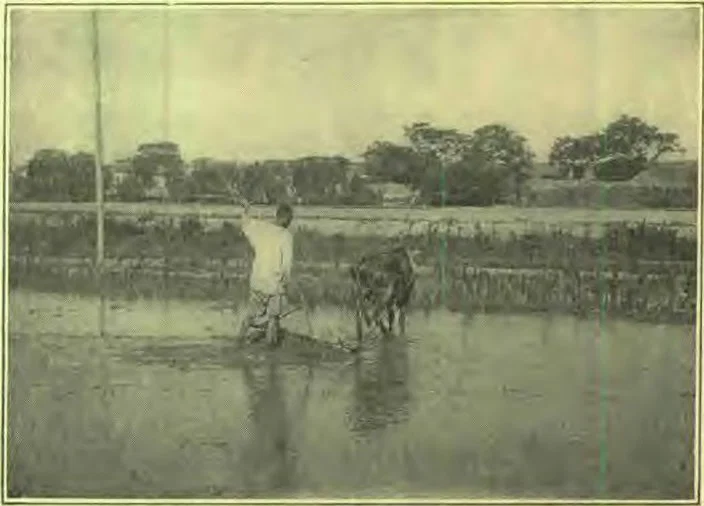
PREPARING RICE FIELD FOR PLANTING, JAPAN
Some idea of the difficulties of the language may be gained from the following from Brother H. F. Benson, head of our training school: “We do have a difficult language. There is not a foreigner, perhaps, who has ever fully mastered it. We have three languages to deal with,—the ordinary colloquial, the original language, and the public-speaking language. The latter is about halfway between the literary and the colloquial. In order to read the Japanese, we must learn all the Chinese characters, in addition to a set of explanatory symbols. But all our students who have attended the language school in Tokio have done well, and have received good grades. What the other missionaries have done we can do, and they have been able to get enough of the language so that they can do acceptable work.”
The Work Extending
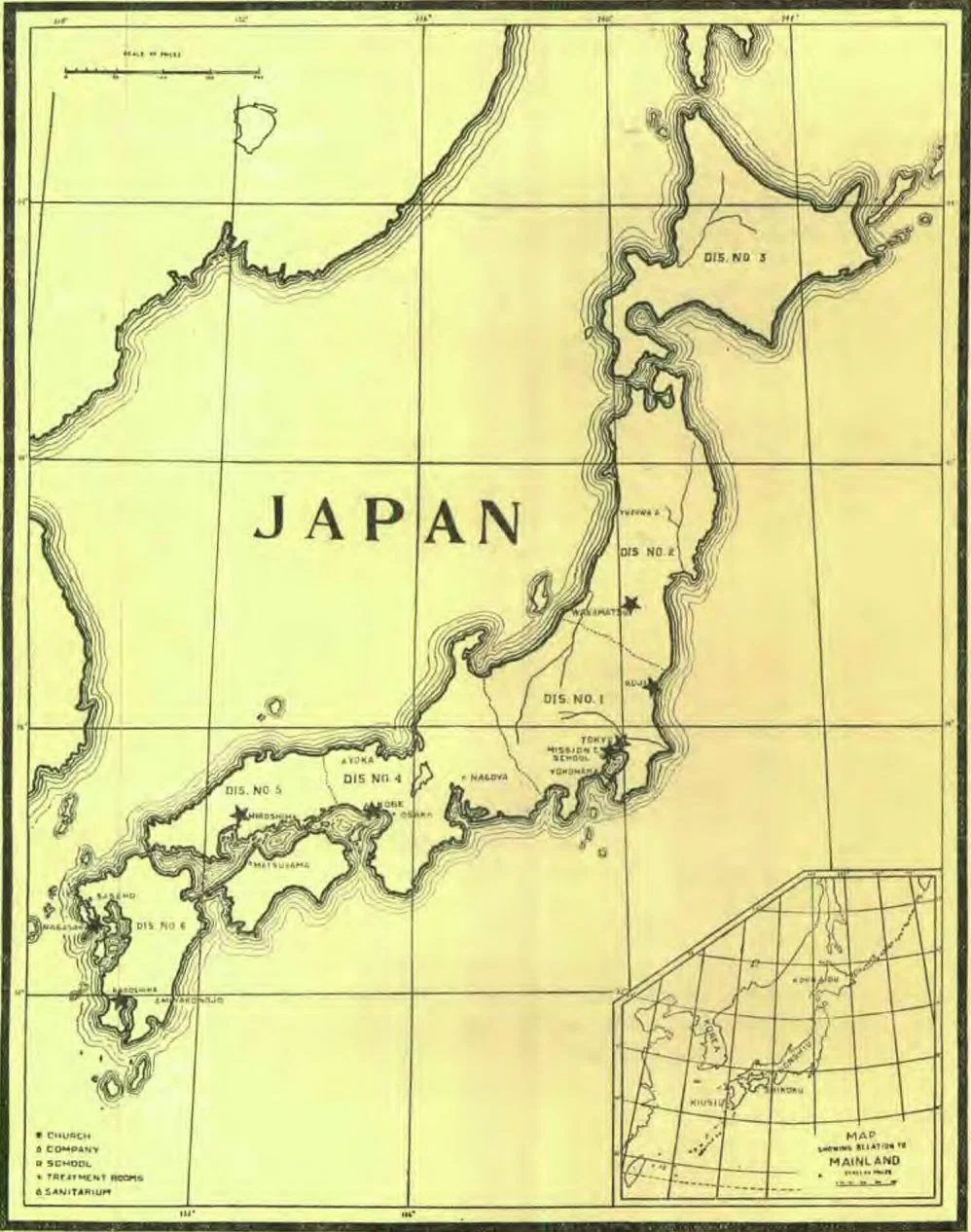
At the present time the Japanese Mission operates in three of the four main islands of Japan—Honshiu, Kiusiu, Shikoku—and in a smaller island off the western coast of Kiusiu—Hirado. The three main islands are divided into districts, with principal stations in Tokio, Kobe, Wakamatsu, Hiroshima, Nagoya, Nagasaki, and Kagoshima.
Jan. 1, 1915, the statistical report showed a total of three hundred and nineteen Sabbath keepers. Of these, seventy-six are workers, receiving their support either in whole or in part from the mission. The tithes and offerings last year showed a material increase, and the Sabbath school offerings have more than doubled.
Four tents were in the field during 1914, and good results were seen from their work. Special attention was given to instructing the women and children. In Wakamatsu a new church building was dedicated free from debt, and the debt remaining on the Kobe church was also paid. The mission now has sufficient money in hand to build a house of worship for the church in Tokio.
The Training School
Twenty students were enrolled in the training school during 1914-15, and these went into the canvassing work at the close of the school period. Our school in Japan occupies a peculiar position. In that field, when young men and young women from heathen families accept Christianity, they are in nearly all cases cast out of the home empty-handed, and not allowed to return unless they repudiate their faith and do penance to the gods and to the family. Brother De Vinney says:—
“To accept Christianity is to refuse to honor the family authority, deny the faith of the family, and insult the spirits of the dead. If the head of the family is the one thus to offend, the family is called together, and the headship and property are given to another, unless the family is already Christian. If it is a young wife who accepts the Sabbath or Christianity, in most cases the husband will divorce her, take away her children, and cast her out with nothing for her support. The condition of a wife or young woman under these conditions is truly pitiable.
“After a child passes the sixth grade, he cannot attend any public school and keep the Sabbath. A few have been admitted in denominational schools which were established before the public school system was adopted, and which are recognized by the government, but in most cases no student can go beyond the sixth grade unless he can attend our training school.
“Students who attend the government normal schools are obliged to teach for a term of years in the public schools. If such a one accepts the Sabbath, he can neither attend the normal nor teach, and must return to the state the whole cost of his normal training. There is no escape from this tax. We have one laborer who has been paying his tax for seven or eight years, and it will take him as much longer before he can be free. This year there will be two or three more in the same situation.
“Nearly all our present force of workers, and all the students of the training school have come to us under one or more of these conditions. In order to test the stability of those who enter the school, they are required to canvass for a time, that we may determine whether they are true-hearted, loyal to their8profession, and in earnest in their desire to be trained in the Lord’s work. Often, when cast out of their homes, they are left with very little, if anything; and at present the canvassing work will give little more than a living of the plainest kind. When they are ready for school, nearly all are reduced to the clothing on their backs, and in many cases only summer clothing at that. The mission must furnish them with everything during the school year, except what they can earn out of school hours and on Sundays. They are required to work each day, but we have only a limited amount to give them that will aid in their support. All the rest must come from loyal friends at home.”
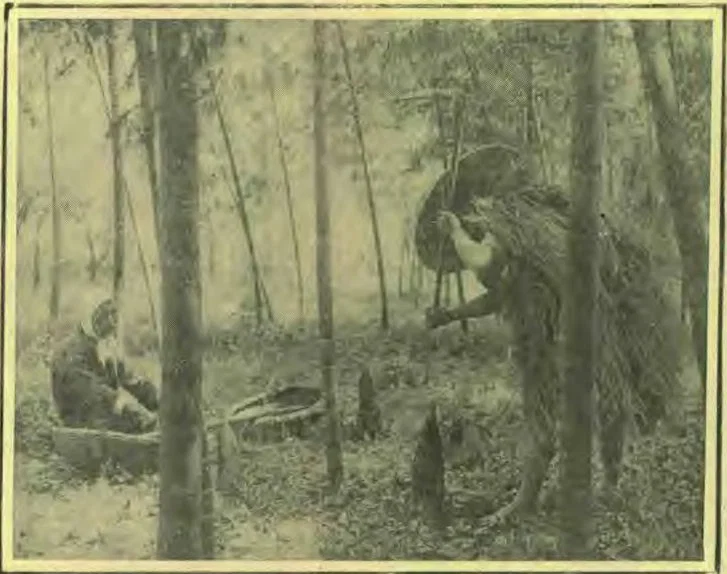
JAPANESE FARMER GATHERING BAMBOO SPROUTS FOR EATING
As the force of laborers must be constantly increased, to meet the increasing calls, it can be seen that the training school has an important work to do. School is held for six months, then the students go into the field for six months; those who are loyal take another six months, and a few have a third school year. Careful oversight is had of these young people when they enter the field to work, and frequent institutes are held with them.
Out of Heathenism
It has often been charged that we gain our converts from other denominations. Recently a careful inquiry was made into the history of every church member and baptized believer, and it was found that eighty per cent of these had come direct from heathenism, and had not previously been interested in Christianity.
Surely our hearts should be full of courage as we study the map of Japan (shown on page five of this issue), and see what has been accomplished so far. The believers in that field have much to contend with, and yet they are faithful, loyal, and earnest. In order to accept this truth, they must often suffer persecution and sever the dearest earthly ties. Let us do all we can to hasten the proclamation of the message in “Dai Nippon,” and not forget to pray that the Lord will bless the believers and workers in that distant land. A. B. E.
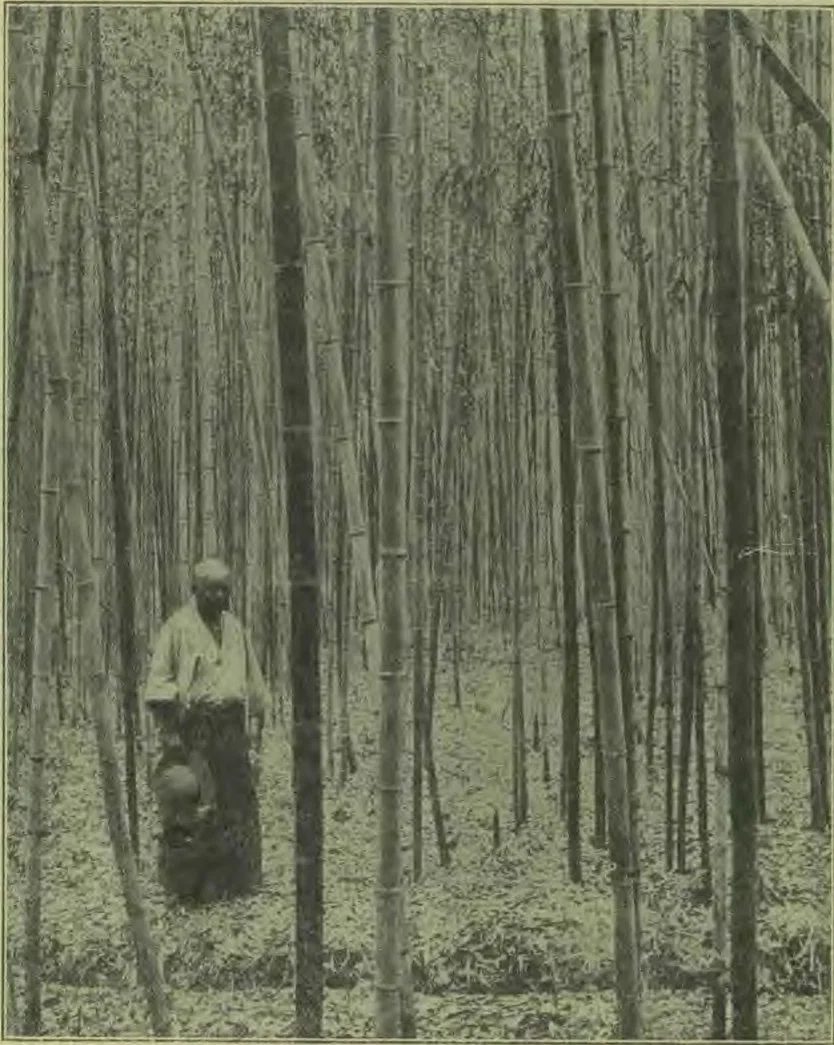
TIMBER BAMBOO, JAPAN
Leading Others in Prayer
By H. Clay Trumbull
WATER will stagnate and corrupt if it has neither fall nor tides, neither ripple nor waves. He who is just as ready at one time as another to sleep or to eat, to laugh or to cry, to ride or to walk, to sing or to pray, to sit at home or to go out and see his neighbors, can never do any one of these things with a real relish, or to the satisfaction of those who are with him. He who is never excited, never off his center, never enthusiastic, and never depressed, might have got along with the Laodiceans, who were never cold, nor ever hot, but always nauseatingly lukewarm; but he is the last man in the world to make friends or to win admiration in the communities which are in the van of social progress nowadays.
Peculiarly is it true in the field of mental activity that no general acquisition obviates the necessity of special preparation. If you hear a man make a good off-hand speech, you may be sure that that speech was not made offhand. It was prepared for in some way. If you find that a man seems always ready with his voice or his pen, you may set it down as certain that he makes himself specially ready for each call on his voice or pen. There are no exceptions to this truth.
On one occasion, when Daniel Webster was urged to make an address, he pleaded lack of time for fitting preparation. “O Mr. Webster!” was the response, “anything you say, even without preparation, will have weight with an audience. You need not prepare for it.” “If my words have weight with others,” said Mr. Webster, “it is because I never speak without preparation.” And that is the thought of every wise leader of his fellows.
When some one complimented M. Thiers on his effective impromptu speeches in the French Assembly, M. Thiers replied that he never insulted the assembly with impromptu speeches, but he rose at five o’clock every morning to prepare his “impromptus” for the day.
Dr. Thomas Arnold declared that he never taught a lesson—even in the line of studies in which he had a lifetime of general preparation—without specially preparing himself for that one class recitation. And that it was that kept Thomas Arnold the good teacher to the last. So it is all the way up and down9the scale.
He who shows any special fitness for any special work has made special preparation for that special work. General fitness is not a safe reliance for anything in particular.
Praying is not the same thing everywhere. It is one thing in the closet, another thing in the family, another thing in the Sunday school, another thing in the social prayer meeting, and yet another thing in the sanctuary, with the general congregation of worshipers. He who does not consider these differences, and make himself ready accordingly for the special service to which he is summoned, neither knows his duty nor does it, in the line of prayer.
As a practical matter, the clergyman who has power in public prayer is sure to be found a clergyman who makes special preparation beforehand for his public prayers. It is a shame for any clergyman to go into his pulpit without specific preparation for every portion of the service he is to lead—for his Bible reading, his hymn reading, his preaching, and his praying. It is not enough for him to be in the general spirit of Bible reading, and hymn reading, and preaching, and praying. He has a particular duty for that day, before that congregation, in view of the peculiar needs of those who are there before him, and the peculiar circumstances of that hour—as apart from every other hour of their lives and of his life.
Unless he makes ready for that particular duty, he is unready for it; and his hearers are aware of that fact before his service is half finished, whether he knows it or not. Special preparation for the public prayers of the day is made by the best clergymen generally. Those who fail to make such preparation show it in their failure to have the results of that preparation. And that such failures in pulpit services are pitiably common cannot be denied.
Our Lord told his disciples that there were times when they need take no thought in advance how or what they should speak before others, for it should be given them in that hour what they were to say; but when they asked him how they should pray, he did not tell them to rely wholly on the inspiration of the hour, but he gave for their guidance a pattern of prayer, the structure and methods of which he seemed to think were worthy of their study. There are, however, ten leaders in social or public worship who take pains to make ready for a sermon or an address, where there is one who prepares himself for a public prayer. Why does any man slight the latter service in comparison with the former? Is it because he deems it of less importance? or is it because he thinks he has so much more skill and power in leading others in an address to God than in making a direct address to his fellows?
A prominent clergyman, in addressing the students of a divinity school, urged the importance of careful preparation for all pulpit exercises. Referring to the common idea that God would inspire the unprepared clergyman to pray effectively in public, he said, “Remember, young men, that God does not inspire vacuity.” Another clergyman, when asked if a man could be as earnest and sincere when he had prepared himself carefully for such a service as he could if he trusted to the inspiration of the moment, replied: “God puts no premium on slovenliness. You need God’s help if you have done your best to make yourself ready for his service. You have no right to ask his help if you have neglected preparatory thought and prayer.”
If a clergyman needs special preparation for leading in public prayer, much more so a layman. And the best laymen recognize this fact. Prof. John S. Hart, the first editor of the Sunday School Times, was quite a model superintendent in his day. He was a man of disciplined mind, of ripe culture, and of rare devoutness. He had much experience, and much impressiveness and unction, in public prayer.
If any superintendent would be justified in feeling that it was unnecessary for him to make special preparation for an opening prayer in his Sunday school, it would seem to be such a man as Professor Hart. But, on the contrary, he always prepared himself with much pains for this service. He told the writer, on one occasion, that during all the time he was in charge of the State normal school of New Jersey he made particular preparation for each day’s morning prayer at the opening of school, and that he still preserved the outline plans of all those prayers.
Writing on this theme in counsel to superintendents, not long before his decease, Professor Hart said of the methods of study for a prayer, and of the value of such study: “Each week some new want will arise. Some scholar or teacher will be sick. Some family connected with the school will be in trouble. Some inquiring soul will be craving for an expression of sympathy. Be it your care to study how these various wants may find expression in your opening prayer, without improper and offensive personalities.
“Besides these wants, each week’s lesson, you will find, has certain leading thoughts. It has been selected with the express design of teaching certain religious truths, and these truths have a direct bearing upon the daily life of every member of your school, both scholars and teachers. Having yourself studied the lesson and filled your mind to saturation with the truths which it contains, you will find how much you need divine help to bring those truths home to your heart and conscience, so that you may carry them into practical life. This, your want, is the want of every teacher and scholar. See how you can in your prayer, without offense, give utterance to this want. Try, in short, to turn the lesson into a prayer, without turning it into a harangue. Let it be a real prayer, addressed to God, not an exposition addressed to the school.”
In testimony, out of his experience and observation, Professor Hart added: “As you grow older in the service, you may learn that those superintendents who have been longest in the harness, and are most familiar with the work, are often the very ones who habitually make the most painstaking preparation for each specific occasion. I could tell you of veteran superintendents who habitually spend from one to two hours each Sabbath evening in preparing for the opening service of the next Sabbath.”
It may seem to some that it would be easier for such a man as Professor Hart, with his habits of study, to prepare himself for an appropriate prayer than for one unaccustomed to systematic and persistent study to do a thing of this sort. “I could never study for a prayer,” says one superintendent or another. “I shouldn’t know how to set about it. If I pray at all, I must ask the Lord to guide and help me, and then go right at it, forgetting all about theories and plans.”—H. Clay Trumbull, in “Personal Prayer.”
(To be concluded next week)
Striking While the Iron Is Hot
“You should not only strike while the iron is hot, but you should make it hot by striking.”
Correcting Faults in Yourself First
“WHATEVER you dislike in another person be sure to correct in yourself.”
Giving Promptly Doubles the Gift
“He who gives promptly gives twice as much.”
Crisscross Hearts
By Alice Louise Lee
It was Christmas morning. Mrs. Lewis sat in the living room, with tissue-paper wrappings and holly-stamped ribbon piled in her lap. Her husband was eagerly examining a leather-bound volume with illuminated pages.
“I've always wanted something from the Wainwright shops, and never thought I could afford it!” he exclaimed enthusiastically.
“Dick's wife can, even if you can't, and Dick gets only eight hundred dollars a year,” said Mrs. Lewis, significantly.
The eagerness died out of her husband's face, and a frown took its place. He knew what she meant. Dick Howell had applied for the position of cashier at the new bank. He was a likable young fellow; but Mr. Lewis, who was president of the bank, and his wife both felt that he was living beyond his means.
“A receiver has no right to look a gift horse in the mouth,” he muttered, as he laid the book on the table.
“As the heaviest stockholder in the new bank and as its president, you are more responsible than any one else for the men you employ there. You have the public to consider.”
Mr. Lewis turned on his heel and left the room. “She's right,” he said to himself. “She usually is. We don't want a fellow for bank cashier who's living beyond his means. It's too bad. He's the most capable and popular fellow we could get for the position.”
Daysville was a village where every one knew every one else's affairs. It was common knowledge that Dick Howell received eight hundred dollars for his work as a clerk, and that he hoped to obtain a position in the new bank.
When Mrs. Lewis had put the Christmas roast into the oven, she went across the back yard with a jelly mold—a gift for Mrs. Prime. She found Mrs. Prime joyfully examining an embroidered linen combing towel.
“It's from Dick's wife!” cried Mrs. Prime. “Isn't it beautiful? She knows how much I have to lie down during the day, and that I like to comb my hair without taking off my waist.”
Mrs. Lewis silently examined the towel. “It's not only beautiful,” she said, “but expensive. How can Dick afford it, with a wife and a little sister to provide for?”
Mr. Prime, with his hands in his pockets, turned suddenly from the window and stared at the combing towel. “Seems to me he had better be retrenching his expenses rather than increasing them!” he exclaimed.
Mrs. Prime tried to show enthusiasm for the kitchen utensil that Mrs. Lewis had brought, but her eyes strayed constantly to the embroidered linen. A few minutes later Mrs. Lewis went back to her kitchen, arranged the drafts, took another look at the handsome leather-bound volume, and then went across the street to give Mrs. Tilly a set of practical dish towels.
Mr. Tilly, like Mr. Prime, was a heavy stockholder in the new bank.
“I was just going over to your house to show you what Dick's wife gave me,” cried Mrs. Tilly. “Look at it! It's the prettiest hammered-brass shade I ever saw. And isn't the candlestick a beauty?”
Mrs. Lewis surveyed the gift rather stiffly. “I wish,” she said, as she deposited her towels unobtrusively on the table, “that I could afford to give such expensive gifts. How does Dick manage it on his salary?”
Mrs. Tilly shrugged her shoulders. “I'm sure I don't know. I told Mr. Tilly this morning that I was ashamed of the gift I sent them; it was just a pair of sheets but they were hemmed by hand.”
“That's the sort of gift that Daysville has always made and received,” said Mrs. Lewis firmly, as she drew her towels into the foreground, “useful and within our means.”
As Mrs. Lewis was entering her front door, she saw a young man and a young woman across the street. They waved gayly to her, and she responded cordially enough, in spite of her disapproval of their extravagance. Every one liked Dick and his happy, busy young wife. As Mrs. Lewis watched them from a front window a moment later, perplexity was written plainly on her face.
“She has a new hat,” she said aloud, “a beautiful hat.”
Mr. Lewis glanced up from his paper. “Well,” he said uneasily, “didn't you have a new hat this winter?”
“Yes, but it hasn't a fifteen-dollar plume on it. Her last winter's hat had just such a beautiful plume, but that was pale blue to match the trimmings of her suit. Now she has a green plume to match this suit.”
“Maybe her people—” began Mr. Lewis.
“She's an orphan; she was a school-teacher in Ohio when Dick married her,” said Mrs. Lewis, as she hurried out to the kitchen.
She liked Dick, and was fonder of Dick's wife than she admitted; but she felt that her husband ought not, in fairness to the public, to employ as cashier of the bank a man with an extravagant wife. Mrs. Lewis's opposition to Dick was not personal nor selfish, but it was determined.
“When is the stockholders' meeting?” she asked her husband later in the day.
“Tomorrow night. I saw Prime just now, on the street, and he agrees with me about Dick's manner of living. Tilly came up just then, and we all think there's something queer in it.”
With lips firmly pressed together, Mrs. Lewis went into the living room, and sat down beside the table that was spread with her gifts. If the book that Dick's wife had given her did represent extravagance, it was nevertheless beautiful. She had not had time11to examine it carefully before, and she now gave herself over to that pleasure.
She had turned about half of the pages when Beatrice Howell, Dick's little sister, came in. Beatrice was small and agile, and nine years old, and more entertaining than discreet. Perching herself on the edge of a chair in front of Mrs. Lewis, she began to talk.
“Merry Christmas and a happy New Year, Mrs. Lewis! I had to come over so soon after dinner to show you what Dick's wife gave me. She has one, so when this came she said I might have—” Beatrice clapped both hands over her small red mouth and gazed round-eyed at Mrs. Lewis. “I almost let the cat out of the bag then, didn't I?” she said with a giggle. “Anyhow, I got this chain and locket, and I've wanted one for years and years.”
Mrs. Lewis took the chain disapprovingly. She did not understand the reason for the child's confusion, but she saw the value of the gift. As she examined the locket, the leather-bound book slipped from her lap and fell to the floor. Both Beatrice and Mrs. Lewis stooped for it. Beatrice reached it first, but from its pages fell a card, which Mrs. Lewis picked up.
“I haven't seen this before,” she began, and then stopped. The card read, “To Mrs. Richard Howell, with love from Aunt Annie.” It bore the date of the previous Christmas.
“O my!” cried Beatrice, aghast. “She forgot to take that out. O Mrs. Lewis, let's have it crisscross hearts, will you? You see, of course I knew that my chain came from her cousin; she says that's all in the family. But she'd feel awful to know that you knew 'bout the book, and she saved the nicest thing that came to her last year for you, 'cause she likes you the best. O dear!”
Mrs. Lewis sat holding the telltale card, and with a curious expression looked at the small betrayer of family secrets. “So that's the way Dick's wife makes handsome presents?”
Confident that Mrs. Lewis had “crisscrossed hearts,” and that she would not tell, Beatrice began to talk very fast.
“Why, she gives away most everything she gets. It's this way. She knows scores and scores of folks, and they all like her and give her presents. And you see they don't live here. They live all over, but mostly in Ohio; and she says most of them will never come to see her, and it's fair, anyway. She says she loves to get the presents, and for a year she can look at them and own them, and then when next Christmas comes she can pass them on. She says we ought to pass on all the happiness at Christmas time that we can get hold of, and she can't get hold of much else besides happiness, she says, on Dick's salary. Doing this way, she can give lots of folks happiness. She just loves to give. I”—Beatrice put her chain against her cheek and spoke with engaging frankness—“I love to get.”
Mrs. Lewis was an interested listener, and the child proceeded to give a great deal of information concerning Dick's wife. “Why, Dick says she can do the most on the least money of any one he ever heard of. We're proud of her, Dick and I are. Have you seen her new feather? The one that's light green at one end and dark at the other?”
Mrs. Lewis nodded.
Beatrice giggled, and rocked back and forth in her chair. “Well, then, it's fooled you. It isn't new at all. She never had but just that one feather. It began as a white one, she says, and she's had it colored a little darker and a little darker, until, she says, some day it will have to be black, and then all she can ever wear to go with it will be black and white. Isn't that funny? We have the best times, laughing, at our house since she came there. She's such fun, and she makes all my dresses, and hers, too; and Dick says that if he gets a position in the new bank, he can give her more money to do on.”
When Beatrice finally left, Mrs. Lewis sat thinking for a long time. It was not an easy thing for her to acknowledge that she had made a mistake, but she knew that she had unjustly planted seeds of doubt concerning Dick in the minds of the stockholders of the new bank.
Beatrice's words, quoted from Dick's wife, came to her mind: “She says we ought to pass on all the happiness at Christmas time that we can get hold of.”
Mrs. Lewis's step was firm when she crossed the back yard. “I didn't crisscross hearts,” she said to herself half guiltily, as she tapped on Mrs. Prime's kitchen door.
Later, in the early dusk, she crossed the street to Mrs. Tilly's, and in the evening she told the story to her husband.
“It isn't such a bad thing for the cat to get out of the bag sometimes, is it?” he exclaimed with a smile.
The following evening, when the outer door opened at eleven o'clock, Mrs. Lewis was waiting for her husband in the hall.
“Was the stockholders' meeting satisfactory?” she asked anxiously.
“Very.”
“And tell me what was done about Dick.”
“He was elected cashier unanimously.”—Alice Louise Lee, in Youth's Companion.