The Youth’s Instructor, Vol. 33, No. 45.

THE WALK TO EMMAUS
Earlier text: THE WALK TO EMMAUS

Little Things: Breaking Bad Habits in Children

LITTLE THINGS.—NO. 6.

In this talk, I want to tell you about some very bad habits that children are apt to have,—habits that will cause them much trouble, and make them very disagreeable to other people, unless corrected. I have seen children who always seem to want to do a thing just a little differently from what papa or mamma says. They do not want to disobey squarely, but they do want to have their own way; and so, when asked to do anything, they do not do it just as they are told.
This is as bad as open disobedience. Children often do so because they think they know better than older people do how things should be done. It is a very good training to learn to do exactly as you are told. Never be ashamed to obey those who have a right to command you, whether it is father, mother, older sister, or teacher. If it is right to obey at all, it is right to do it exactly as you are told.
One of the most disagreeable habits a child can fall into is the habit of teasing. When mother says Jane cannot have a thing, she is not satisfied with that, but she will ask again and again for it, then whine, and finally cry. Nobody loves such children; they make themselves and everybody else unhappy. I wonder if you have ever heard children tease, so that you know how it sounds?
“I know how they tease,” says Mary. “George asks mamma if he can go over and play with Henry; mamma says she does not think it is best for him. Then George says, ‘Why can’t I go just a little while?’ Then mamma says, ‘No, you can’t go to-day.’ ‘Why can’t I go?’ George asks; ‘we will be good. Come, let me go.’ Then mamma says, ‘You were there yesterday; you go too much.’ ‘No, I don’t,’ says George, ‘you don’t let me go at all.’ Then mamma says, ‘That will do; you may go and play with your blocks.’ George begins to cry, and says he can never go anywhere as other boys do. Then mamma lets him go if he will promise to be back in a little while. That is the way he does about everything.”
Do you think it is the best way to do, children?
There is another thing I wish to tell you about,—a habit altogether too common among brothers and sisters at home. Without meaning it, and almost without knowing it, they often fall into a habit of plaguing, joking, and annoying one another. On the start they do not mean to do anything bad, but just to have a little fun. Mary pulls Henry’s hair when he is not looking, and then pretends that she did not do it. She hides his hat when she knows he will want it. Then Henry “gets even” by pinching her, tripping her up, or throwing mud on her apron.
I have seen children keep on in this way, until, when they grew up, they became real enemies. If you have formed the habit, I hope you will break it as soon as you can. How much better to live in love and peace with one another!
Another really mean thing for children to do is to meddle with what does not belong to them. Many children who would not do so away from home, feel free to meddle with the things that belong to their brothers and sisters, and even with the things that belong to their parents.
“Yes,” I hear some one say, “that is just what my brother does. He goes to my room, and gets my pencils, and opens my draws, and turns things all over.”
You have often been troubled in that way, haven’t you? Never touch anything that belongs to your brothers or sisters, without their permission. You should keep out of their rooms, and out of their boxes, and let their letters alone. You ought to be very careful of the rights of others.
Keep good company. There is nothing more important for children, and older people too, than to be careful whom they go with. If you are with naughty children, almost before you know it, you will be doing as they do, and talking as they talk. Select only those for your friends whom you would choose to be like. It is an old proverb that “A person is known by the company he keeps;” and it is just as true that a boy is known by the company he keeps out of.
There are many more things I would like to talk about, but I cannot now. I hope that you will try hard to overcome all the bad habits that we have talked about, and to cultivate all the good ones. You will many times fail; yet if you do not get discouraged, but ask Jesus every day to help you, you will be sure to succeed in the end.
D. M. CANRIGHT.

Letter Budget.

Cold, gray November, with its whirling leaves foreshadowing the winter, came all unbidden; but how many used their eyes in admiring God’s beautiful world the last few weeks preceding this month? If Nature painted for all of you such beautiful landscapes as she did for those who live in Southern Michigan, you have had a rare treat; but few more lovely are given in a lifetime. It has sometimes seemed that if the glory of this autumn had burst suddenly upon the world, we would almost have felt as if we had changed spheres; for looking in any direction, as far as the eye could behold, the forests and shades have been painted in every tint of scarlet and gold, blended with enough of green to make a pleasing effect and give the appearance of massive bouquets. As we gazed upon the scene in the soft, dreamy sunshine of the October days, we queried whether heaven could be more beautiful. Indeed, the sight begat great longings to see the inside of the city of God. Shall we not suppose this panoramic view was spread out before us to quicken our steps heavenward? Let us all so interpret it.
But every season brings its peculiar joys; and when the heart is well attuned to the praises of God, every month will abound with pleasures. Probably but few Novembers will come to any of us. Let us see that the present moments are so occupied that we may joyfully welcome that grander view which is soon to be ushered in.
The remaining space we devote to letters. First in order is one from—
MINNIE M. PINES, of Boone Co., Iowa, who writes: “I have seen so many letters in the Budget, I am very much interested in them; and as I have never seen any letters from this place, I thought I would write. I am a little girl eleven years old. I have kept the Sabbath since the middle of July. There are three in our family besides myself who have signed the covenant to keep the commandments of God and the faith of Jesus,—father, mother, and my older sister, Dora. Eld. Pegg came here about the middle of June, and preached every evening until the camp-meeting at Des Moines, when he took his tent away. He returned about two weeks afterward, and pitched his tent in the town adjoining ours. He has since gone to Tennessee, leaving other ministers to continue the work; but on account of cool weather, the meetings are closed for a while. I attend Sabbath-school. We have a good one of about forty members, all of whom have signed the covenant; and including visitors, there are about seventy-eight in attendance. We take fifteen copies of the INSTRUCTOR, and expect to increase the club to thirty copies. I go to day-school now, and I am in the fifth grade. Last summer, during vacation, I canvassed for an album. I sold thirty-four. I think it is right to help our parents earn our living. We are trying to live so that we may dwell with God’s people in the earth made new. We need the prayers of the faithful. This is my first letter to the Budget. I send my love to all the INSTRUCTOR family.”
It is a mark of honor, Minnie, to assist one’s parents in providing for the family, and you know one of the commandments you have signed a covenant to keep is, “Honor thy father and thy mother,” etc. We are glad to hear such a good report from your place. May you ever be faithful in all your duties, striving earnestly to know what duty is.
EVA E. LASTINGER writes from Brooks Co., Ga. She says: “I am a little girl twelve years old, and live way down south, in Georgia; and as I have never seen a letter from this State, I thought you would like to hear from us. I have three brothers and three sisters, and we have kept the Sabbath with our parents four years; and we are often reproached by our school-mates and others for doing so. We have a Sabbath-school of about fifteen members. I learn my lessons in the INSTRUCTOR. Eld. Rupert visited us last winter, and his visit was a source of much comfort to us. There is a small church here, of which my father is the elder. I hope to be a member some day, when I am a better girl. We want you to pray earnestly for the cause in the South.”
Well, Eva, why do you wait?—what is to make you a better girl? You surely don’t expect any good thing you can do will cancel your past sins. The longer you wait, the greater sinner you will become. Knowing you are a sinner, why not come to the Saviour now, just as you are? He will freely forgive you, and help you do right, when you decide fully that in his strength you will honor him by a well-ordered life and a godly conversation.

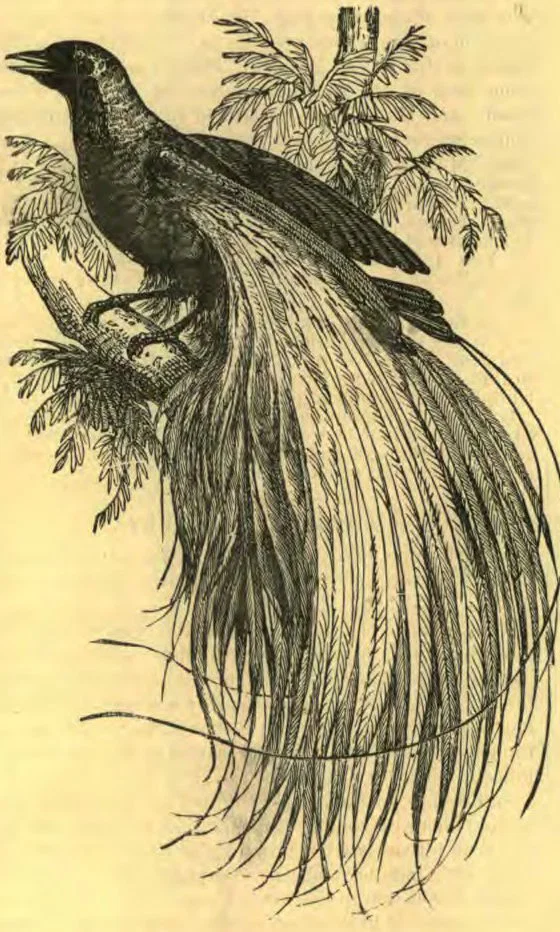
THE BIRD OF PARADISE.

In the warm countries to the south, where the cold snow never falls, but it is summer time all the year round, live many very beautiful birds, such as you never see in your northern homes. You cannot begin to imagine how beautiful they are, with their feathers of flaming scarlet, and green, and orange. We have nothing like them, unless it is the tiny little humming-bird.
In our picture, you can see one of the most gorgeous birds to be found anywhere. It is the emerald bird of paradise. Its feathers are dark brown, rich green, and yellow. But the most wonderful part of its plumage is the long, drooping feathers along its sides. It can throw these feathers out into a beautiful plume nearly over its head. A long, long time ago, people used to think this bird had no legs and feet, but that it floated around in the air, buoyed up by its fairy-like plumes; and that when it took a rest, it hung itself up on a limb a little while by its tail feathers. So they gave it the name of paradisea apoda, which means footless bird of paradise. But it had feet, as well as any bird; the trouble was that the natives who caught this shy bird, always cut off its legs before they stuffed it, and sent it to the learned men in Europe.
It is a very dainty bird, and proud of its fine feathers. It takes great pains to keep every speck of dirt from its plumes, and always flies or sits facing the wind, so that its gay dress will not get ruffled. You think you would like to see such gay birds flitting in and out among our trees? Yet when I tell you that the best music they can make is only a shrill caw,—a sort of he! hi! ho! haw! ending up with a loud noise that sounds like whock! whock! whock! I do not believe that you would change one of the little brown singers that make our spring time so sweet, for all the gay feathers in the world.
The paradise bird is very hard to catch. All day long it hides in the tops of the tall teak trees, venturing forth only at sunrise or sunset for its food. It will not come forth if it hears any unusual noise. So the hunter takes his stand at early dawn under one of these trees, and watches silently for the bird to come out for its breakfast.
For all they are so hard to get, great numbers of them are killed every year, because their beautiful skins bring a high price. Does it not seem dreadful to kill these little creatures? Yet many people think their hats and bonnets look really fine when they have fastened a little bird on the front. The birds have as good a right to life as you or I, and it seems like the meanest kind of cruelty to shoot the pretty things just to gratify somebody’s pride. I have no doubt that if people did not wear the little birds, the hunters would soon leave them to enjoy the life God gave them.
W. E. L.

IT'S ONLY FATHER.

It is related of three children, that during a thunder-storm they were asked each to choose a favorite text. One selected, “The Lord of glory thundereth,” and being asked her reason, said, “I once heard a great noise when I thought I was all alone in the house; and I was so frightened I screamed, and father's voice called out, ‘Don't be afraid, little Maggie, it's only father.’ And now, when it thunders very loud, it always seems as if I hear God say, ‘Don't be afraid, little Maggie, it's only Father;’ and I don't feel a bit frightened.”

The Fear of the Lord

THE fear of the Lord is the beginning of wisdom.

Renewing Club Subscriptions Before They Expire

☞ At this season, a great many club subscriptions to our paper expire. It would save the publishers a great amount of labor and some expense, if the clubs would renew before the names had to be cut off from the list. Please look to this.

You have reached the end of this edition.

The Youth’s Instructor · Nov 25, 1885