The Youth’s Instructor, Vol. 33, No. 45.

THE WALK TO EMMAUS

The Youth’s Instructor

Nov 25, 1885

S. D. A. Publishing Association · Battle Creek, Mich. · Nov 25, 1885

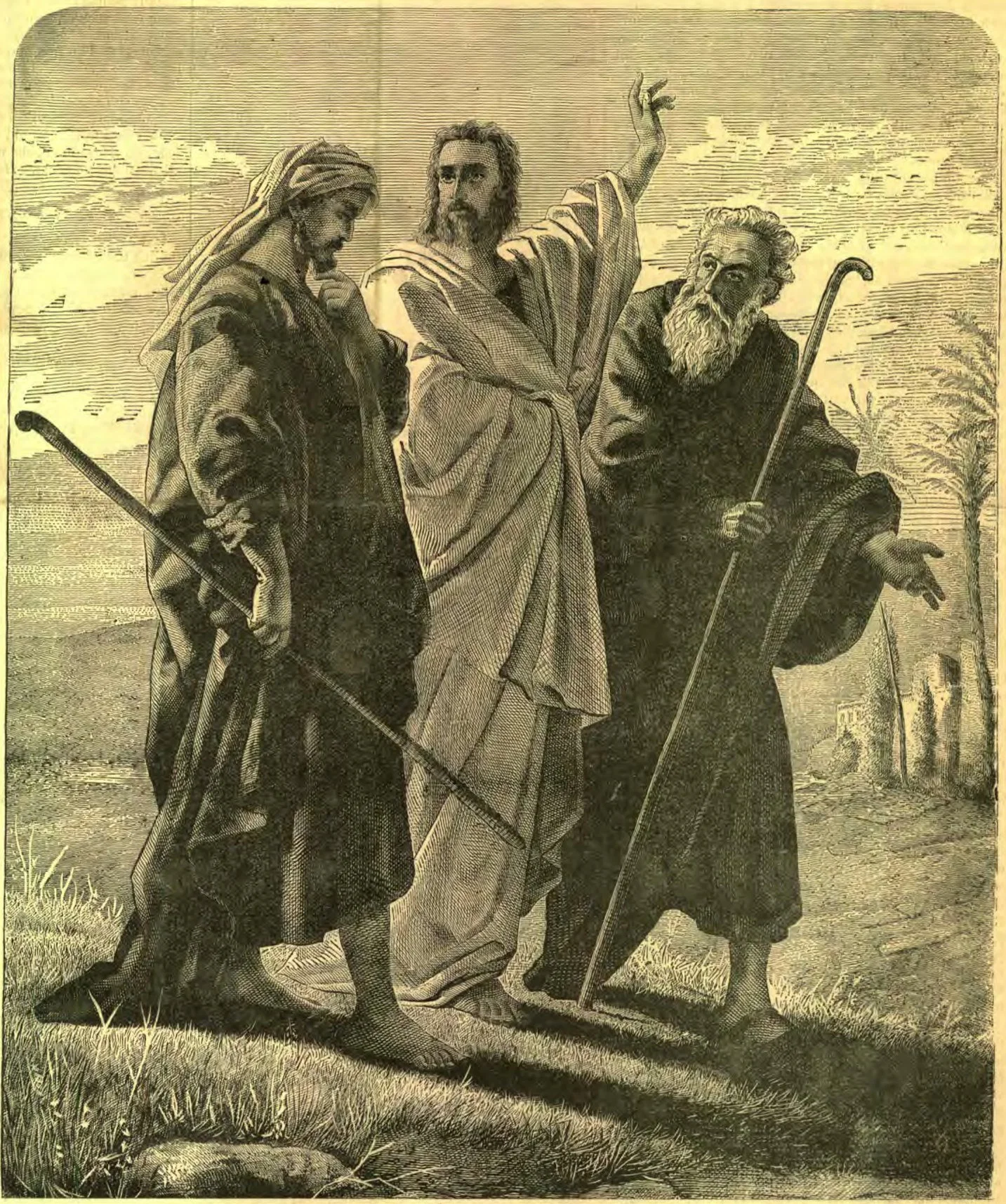
THE WALK TO EMMAUS.

THE scene which is represented in the engraving is one of those deeply interesting occurrences found only in the Bible. Our Saviour had just suffered the cruel death of the cross. The hope of the disciples had fully died with the crucifixion of their Master. The news of the Lord’s resurrection on the morning of the first day of the week no doubt spread rapidly among the disciples, but it was questioned by the company. It was too good to be believed, and deep dejection and perplexity filled the minds of all. The death of the beloved Teacher had come upon the believers by surprise, and they were slow to credit the report that he had indeed risen, and appeared to some of the brethren.
It was already past midday when two of the disciples started from Jerusalem for Emmaus, a little village some seven to eight miles distant. The name of one was Cleopas, that of the other is not given. They were passing on their way, no doubt with minds full of the rumors of the morning about the empty sepulcher, the vision of the angels, and their words that the Master was again alive.
These two disciples were not of the apostles, and we do not know whether they even belonged to the seventy. They had been to the Passover in Jerusalem, and were now going home to see if they could get any relief from the sorrow and perplexity which filled their hearts.
The main thing in their minds no doubt was, Was Jesus the true Messiah or not; and was he again alive? His life, his teachings, and his miracles seemed to show that he was the Messiah. But on the other hand, how could the Messiah of heaven have been crucified? As they were passing on their way, a stranger overtook them, and, perhaps to their disappointment, joined them. It was Jesus himself, disguised as a common Passover pilgrim. He well understood their earnest reasonings and deep sorrows. In a sympathetic way, like an interested fellow-traveler, he inquired, “What is this conversation that ye have with one another as ye walk and are so sad?” They then recounted to him the facts about the life and teachings of Jesus, his trial and death, and the report of the women that morning who found the grave empty, and the appearance of the angels, and the news of the resurrection, and the report that the Lord had actually been seen.
The Stranger then kindly replied to them and said, “O dull and slow of heart to believe what the prophets have written! Ought not Christ to have suffered just as he did, and then to enter into his heavenly glory? And beginning with Moses, he expounded unto them the prophecies of the Scriptures concerning himself.” The two brethren were silent from amazement and delight. They did not venture to ask the Stranger who he was. Perhaps they thought he was some pious and learned rabbi who was returning from the Passover, and who was deeply learned in the prophecies.
The minds of these disciples had been confused by the Jewish traditions and interpretations in regard to Christ and his future kingdom. But the clear reasoning of this unknown man made these mysterious things plain to their understanding. They seemingly had never heard such words before. Their wonder and joy increased at every step, as passage after passage was quoted, pointing to just such a Saviour as had come and suffered on the cross. Precious light shone upon obscure portions of Scripture, which made it seem altogether like a new book.
Such talk shortened the road, and found them still eagerly listening as they approached Emmaus, the end of their journey. The way had never seemed so short before, nor had time ever passed so quickly. The Stranger now made no sign of stopping, but the two disciples could not endure the thought of parting so soon with one who had completely inspired their hearts anew with hope and joy. They begged him therefore to remain and lodge with them for the night, urging as a reason that “the day was far spent.” Accepting the pressing invitation, all three went into the house.
The simple evening meal was presently preparing, no doubt the mysterious guest meanwhile continuing his discourse, and further opening to the minds of the two brethren the precious things of the Scriptures which referred to Jesus as the Christ of God. The repast being ready, the three take their position at the table, Jesus occupying the place at the head, as was his custom when with his disciples. Taking the bread in his hands, to offer the usual benediction, according to Jewish custom, he blesses it just as Jesus used to bless the bread; broke it just as Jesus had broken it; and handed it to them just as Jesus had handed it to his disciples. The bearing, the voice, and the manner were all just like the Saviour. And now, as they look at him more closely, the veil he had assumed passes away, and the very features and form were those of the beloved Teacher. It was he. There were the wounds of the nails in the hands and feet. There was the spear gash in his side. His well-known voice floats upon the air like the melody of former days. Meanwhile they gaze in spell-bound wonder and awe, and as they arise to fall at his feet to worship their risen Lord, he gently vanishes from their sight.
The whole thing now bursts upon the minds of the disciples in an instant. They have really seen Jesus. He has actually risen from the grave. For hours they have been listening to his wondrous words, but their eyes were held so that they did not at once suspect who the unknown traveler was.
But the news is too good to keep. And as joy and peace fill their hearts, their discouragement and weariness are all gone. They have no further thought of hunger or of rest. They now feel that they must hurry back to the city to tell the tidings to the brethren. In a moment they are out upon the stony path, with their faces toward Jerusalem. It is now dark; and the moon, which had fulled four days before, has not yet risen. But they have light hearts, for they have seen Jesus.
We can imagine the two brethren hurrying along the mountain path, plunging into dark glens, climbing the steep ridges, and winding around the hills, feeling their way as well as they can with their pilgrim staffs. Perhaps occasionally they miss the path, but with happy hearts they soon find it, and pass toward the city. Reaching the walls, they pass through the eastern gate, and hurry along the narrow streets till they arrive at the memorable house where is “the upper chamber” in which the disciples are assembled. “The door is shut for fear of the Jews.” They knock; but none answer. They call aloud, giving their names, when cautious hands unbar the door.
The first words they hear are, “The Lord has risen indeed, and appeared to Simon!” And now that the doors are fastened again, the excited and panting travelers tell their wonderful story. They have scarcely finished, amid the joy and wonder of the listening group, when lo! Jesus himself stands in their midst, and addresses them in the comforting words, “Peace be unto you.”
Youthful readers: This blessed “peace” which Jesus bestowed upon his disciples in that night meeting, and which filled the hearts of the two brethren on the way to Emmaus, may be ours also, if we truly love the Saviour.
Have you got this peace in your hearts?
G. W. A.

A NOVEMBER EVENING.

THE autumn night is dark and cold; The wind blows loud; the year grows old; The dead leaves whirl and rustle chill; The cricket’s chirp is long and shrill; The skies that were so soft and warm Mutter and bode of gathering storm. And now, within the homes of men The sacred hearth-fires gleam again, And joy and cheer and friendship sweet Within th’ charm’d circle meet.
The children watch with new delight The first fire dancing redly bright, That drives away the dark and cold; And Grace’s slender fingers hold A braided fan from Mexico, To make the broad flames flare and glow. Alert, alive, they leap and run Like fierce bright streamers of the sun; They shine on Robert’s placid face, And tint the pensive cheek of Grace, And chase away the doubtful gloom From every corner of the room.
O pleasant thought!—that far and near Are gathering ’round each hearthstone dear Bright faces, happy smiles, and eyes Sweet with the summer’s memories! O holy altar-fires of home! Tho’ far and wide the children roam, Your charm for them shall still endure With love so strong and peace so sure.
—Celia Thaxter.

WHAT LITTLE MARY NEWTON DID.

THE most wonderful tale of the “Arabian Nights” or of Baron Munchausen would have been more readily believed a hundred years ago, than the story that little twelve-year-old Mary Newton, by merely pressing her finger upon a button, caused an explosion of such gigantic force that it tore the solid rock bottom, the reefs, and islands of a great river to pieces. Not only is this a perfectly true statement, but everybody believes it, and accepts it as a matter of fact; for so many wonderful things happen nowadays that people are inclined to think that almost everything is possible, instead of doubting everything, as they used to. So when they are told that a touch of Mary Newton’s finger caused the greatest explosion ever produced through human agency, they say, “Oh, yes; electricity, of course,” and never for a moment question the fact that the little girl has done this wonderful thing, but only inquire what sort of a little girl she is, and how she looks and acts, and if she is not very proud of being so famous.
The way it all happened was this. For a very long time, ever since the Dutch first settled New York, a great number of vessels have been wrecked and lost each year on the rocks of Hell Gate, through which all vessels must pass to get from the East River out into Long Island Sound. In this narrow passage were quantities of reefs and rocks, bearing such names as Hallet’s Reef, Middle Reef, Flood Rock, the Pot, Gridiron, Hen and Chickens, Frying-Pan, etc. Over and around these the tides rushed and boiled with such terrible fury that the chances were very greatly against a vessel’s passing them in safety, and all the mariners of those waters dreaded Hell Gate more than any other place.
About thirty years ago the United States Government undertook to clear away these reefs and rocks, and thus to make Hell Gate as safe as any other part of the East River. The government engineers blasted away a number of the smaller rocks, and finally dug a great mine down under Hallet’s Reef. It took three years to dig this; but finally they had it finished, and had packed away in it 50,000 pounds of dynamite and other terrible explosives. When the mine was ready to fire, they led a slender wire from it to an electric battery half a mile away, and there General John Newton, the engineer having charge of the work, held the hand of his baby daughter Mary, and showed her how to press the button that sent the electric spark flying down through the water, and exploded the whole 50,000 pounds of dynamite at once, tearing the reef into small bits.
This was nine years ago, in 1876; and as soon as Hallet’s Reef was thus blown out of existence, the engineers began to plan the same fate for Middle Reef, of which Flood Rock was the most prominent point. Here they dug an immense mine down beneath the bottom of the river, and in it they placed nearly 300,000 pounds of explosives, or almost six times the quantity they had used before. On the 10th of October, when all was ready, immense throngs of people assembled to witness the great explosion, and out from among them all stepped little Mary Newton, when her father called her, to fire the mine. She was no longer a baby, but a bright little girl about twelve years old, with a very fair complexion, blue eyes, and long, light hair falling over her shoulders.
It was not necessary for anybody to guide her hand this time, for she stepped right up to the little telegraph instrument, and when the word “Now!” was given, she pressed the key, and, presto! away went mountains of rock and water, flying sky-high with a great terrible roar, and the worst reef of Hell Gate was torn into a million pieces.
The mine that was blown up by this awful explosion extended beneath nine acres of the river’s bottom. Get somebody to show you a field, or, better still, a pond that covers nine acres, and then imagine it all flying hundreds of feet up into the air at once. The galleries that ran to every part of it, and were cut out of the hardest kind of rock, would have been four miles long if they had been strung along in a straight line.
Many people thought that the blowing up of this great mine with such an enormous quantity of explosives would cause a sort of earthquake, that would tumble down chimneys and houses, and kill people, and they were much terrified at the idea. Little Mary Newton might have been frightened at what she was about to do if she had not had perfect confidence in her father; but when he told her that she would be perfectly safe, and that nobody would be hurt, she knew it would be so; and with a smile on her face and a firm hand, she pressed the button, and set loose all the mighty uproar.—Harper’s Young People.

Each Morning Carries an Unknown Future

It has been observed, with much significance, that every morning we enter on a new day, carrying a still unknown future in its bosom. How stirring the reflection! When we rise in the morning, we may remark: “Thoughts may be born to-day, which will never die; feelings may be awakened to-day, which will never expire; acts may be performed to-day, the consequences of which may be realized during eternity.”—Selected.

BE REVERENT.

PRINCE BISMARCK, when a boy, was rebuked by his father for speaking of the king as “Fritz.”
“Learn to speak reverently of his majesty,” said the old squire of Vargin, “and you will grow accustomed to think of him with veneration.”
Young Bismarck laid the advice to heart; and to this day the great chancellor always lowers his tone and assumes a grave, worshipful look when he alludes to the kaiser. If a message is brought to him from the emperor by word of mouth or in writing, he stands up to receive it.
Bismarck’s father was right about the principle of reverence and its cultivation. The man who indulges in irreverent speech about sacred things will soon show a serious loss of right feeling; while on the other hand, there is great power in habits of reverence that seem to be only forms. It would be well for all to treat age and greatness and sacred things with the venerating respect which marks Bismarck’s relations with his earthly sovereign. The young should learn to venerate parents, men consecrated to sacred offices, old age, faithful magistrates, and the gospel and its precepts. And Addison says, “We find a sacred awe and veneration for one who moves about us in a regular and illustrious course of virtue.” Veneration, therefore, is respect mingled with some degree of awe, a feeling of sentiment excited by the dignity and superiority of a person, and by the sacredness of place or character.—Selected.

THE SONG OF AUTUMN

I HAVE painted the woods, I have kindled the sky, I have brightened the hills with a glance of mine eye; I have scattered the fruits, I have gathered the corn, And now from the earth must her verdure be torn. Ye lingering flowers, ye leaves of the spray, I summon ye all—away! away!
No more from the depth of the grove may be heard The joy-burdened song of the fluttering bird; I have passed o'er the branches that sheltered him there, And their quivering drapery is shaken in air. Ye lingering flowers, ye leaves of the spray, I summon ye all—away! away!
Plead not the days are yet sunny and long, That your hues are still brightening, your fibers still strong; To vigor and beauty relentless am I— There is nothing too young or too lovely to die. Ye lingering flowers, ye leaves of the spray, I summon ye all—away! away!
And I call on the winds that repose in the north, To send their wild voices in unison forth; Let the heart of the tempest be dolefully strung, There's a wail to be made, there's a dirge to be sung. For the lingering flowers, the leaves of the spray— They are doomed—they are dying—away! away!
—Selected.

“MAMMA ALWAYS DOES THAT.”

It was “mending-hour.” Some of the “new girls” were finding the exercise peculiarly distasteful, but Madam Dupuis was fixed in her rules. The young ladies of her school were required to spend a stated time every Wednesday forenoon in the sewing-room. Rents and frays discovered in their wearing apparel were made to figure darkly in the term reports.
Hallie sat gloomily regarding a huge rent in the skirt of her gray school suit.
“I shall not try it!—I will put the dress away until vacation, and have it repaired at home.”
Jessie Wolf, intent upon her darning, suddenly looked up:—
“And who will mend it then?”
“Oh, mamma always looks after my clothing. I never mended a stocking in my life until I came to this place. I don't expect to make my way through the world on my domestic merits.”
“It seems to me,” continued Jessie, with more bluntness than consideration, “that as often as you have told us you are being educated through your mother's efforts, you would feel inclined to take as much as possible from her list of duties.”
“Oh, my dear! mending amounts to nothing. Those things all come natural to mothers.”
“Then if it amounts to nothing, I'd suggest that you darn that dress. If I had a mother, I'd save up something nicer than a torn dress to take home to her next December. Now, we all admit that you are the best musician in school, and of course we expect you to carry off the honors; but I candidly think that a girl who reserves her fingers for practice, and condemns her mother to task-work, don't deserve anything.”
“I hadn't thought of it in the light you suggested,” Hallie thoughtfully replied, as she took up the torn dress again.
Dear girls, how many are there of you who “haven't thought” that mother is robbing herself of many little spaces of rest; that she is straining the nerves and the eyes that need quiet; that she is depriving herself of the refreshing walk or the new magazine; that she is slowly, quietly, imperceptibly, but surely, slipping down into her grave as the only place of refuge from too many trifles that are growing into a heavy load?
There is the rent in the gown, the buttons from the shoe, the string from the hat, the rip in the glove,—the score of trifles that will accumulate—look for them! Don't let mother do for you what you can do for yourselves!—Sel.

IT NEVER PAYS TO ROB GOD.

THE Presbyterian tells of a man who gave his heart to Christ when a small boy. He was engaged in a brickyard, to carry clay, often on his head, for twenty-five cents a day. Then he vowed that one-tenth of his income he would give to his God. This he conscientiously did, and prosperity followed until he was worth $10,000; and then the trial of his life came, in which he went down in financial disaster. He would not give one-tenth of $10,000. Here his faith balked. He said: “After disaster had swept all away, I learned what I had not known before—that it is easier to give one-tenth of $1.50 a week than of $10,000.” He regained wealth, but it was in strict compliance with the vow of his youth, which his disaster helped him to fulfill until his death.

Kindness Toward the Ill-Minded

Ask thyself daily to how many ill-minded persons thou hast shown a kind disposition.—Marcus Antonius.

MARTYR TO DUTY.

YES, better ’tis to die. Than from the strife to fly; Be thou a hero on the field, With arm close bound to duty’s shield; Aloft the standard hold Among the true and bold; Turn not ignobly, recreant back, A traitor on life’s holy track; But fall on valiant ground, And be with honor crowned; A rank among the faithful claim, And leave to earth a blessed name, That kin and kind may hold Above the price of gold. —Anon.

IMPORTANT BIBLE SUBJECTS.

LESSON 12.—THE 1260 DAYS.

[NOTE TO THE STUDENT.—] Do not consider the lesson learned until you can give at least the substance of every text, with the correct reference for each. The references in black letters indicate those texts that should be committed to memory. A little diligent application each day will enable you to learn them, although this need not be considered a test of scholarship.
1. From what did the Papacy arise?
2. From what are the words Papacy and pope derived?
3. How did the Bishop of Rome first get the power to exercise authority over the churches, together with the title of pope, or Holy Father?
4. By what powers was this decree opposed?
5. What had to be done before the decree could be fully carried into effect?
6. What prophecy was thus fulfilled? Dan. 7: 8, 20.
7. When was the last of these powers plucked up?
8. For what did this prepare the way?
9. At what point of time, then, may it be said that the Papacy was fully established?
10. How long is it to continue? Dan. 7: 22.
11. How long were the saints, the times, and the laws to be given into its hand? Verse 25.
12. What statement is made in Rev. 13: 5, with respect to the same thing?
13. How many years would that be?
14. What was the Jewish method of reckoning time?
15. According to this method of reckoning, how many days would there be in forty-two months, or three and one-half years?
16. How many days does the Revelator give for the same period? Rev. 12: 6, 14.
17. Is this time to be regarded as literal or symbolic?
18. What fact concerning symbolic time is recognized by all commentators?
19. When did this period of 1260 years begin?
20. When did it come to an end?
21. What hostile army entered Rome in 1798?
22. What change was made in the government at that time?
23. What was done with the pope?
24. How was this a fulfillment of Rev. 13: 10?
25. When was another pope put in office?
26. What power have the popes never regained?

NOTES.

The Papacy.—The Papacy, or popedom, sprang up in the church at Rome,—a church once pure, and the same to which Paul preached, and to which his epistle was written. The words pope and Papacy are derived from the Latin papa, which means father or bishop. The power to exercise authority over all the churches was first given to the Bishop of Rome by the Emperor Justinian, who, in A. D. 533, issued a decree that the bishop of that church should be head over all the churches. But this decree was stoutly opposed by the Vandals, the Heruli, and the Ostrogoths. The last of these had possession of Rome, and were not driven out till A. D. 538, at which time the authority of the Bishop of Rome became supreme, and he received the title of pope, or Holy Father.
Before whom three fell.—This refers to the same thing as the plucking up of the three horns, and was fulfilled in the subduing of the three powers mentioned in the preceding note.
Jewish time.—The Jews reckoned thirty days to the month, and twelve months to the year.
Symbolic time.—All commentators recognize the fact that a prophetic day stands for a literal year.
The Papal grasp unloosed.—The French army under Berthier entered Rome Feb. 10, 1798; a republican form of government was proclaimed, the pope was taken prisoner, and for a time the Papal rule was suspended. Thus it was that he who had made captives of so many Christians was now taken into captivity himself, and he who had used the sword (military power) to persecute and destroy millions of Christians, was now subdued by the same power.
Two years later, another pope was instated, but since 1798 no pope has had the power to depose kings, or to destroy the saints, as the popes had done before that time.

ESKIMO AMUSEMENTS.

THE children of the cold enter into their sports with as keen a relish as do the boys and girls of more temperate climates. Lieut. Schwatka, in St. Nicholas, says:—
“There is one kind of play in which the Eskimo boys seem always ready to indulge—a roll down hill. They select a small but steep hill, or incline, well covered with snow, and seating themselves on the top of the ridge, thrust their heads between their legs, pass their clinched, gloved hands over their ankles, pressing their legs as closely against their bodies as possible. Thus they really make themselves into big balls covered with reindeer hair, and then away they go on a rolling race down hill, suddenly spreading themselves out at full length, and stopping instantly at the bottom of the hill. Every now and then when a playful mood strikes a boy, he will double himself up and roll down hill without waiting for the rivalry of a race; but it is violent exercise, and it bumps the little urchin severely.
“One sport that amuses the Eskimo boys very much would probably be called in our language ‘reindeer hunting.’ Having found a long and gentle slope on a side-hill, they place along the bottom of the hill a number of reindeer antlers, or, as we sometimes incorrectly call them, deer-horns (for you boys must not forget that the antlers of a deer are not horn at all, but bone). These antlers of the reindeer are stuck upright in the snow, singly or in groups, in such a manner that a sled, when well guided, can be run between them without knocking any of them down, the number of open spaces between the groups being equal to at least the number of sleds. The quantity of reindeer antlers they can thus arrange will, of course, depend upon their fathers’ success the autumn before in reindeer hunting; but there are nearly always enough antlers to give two or three, and sometimes five or six, to each fearless young coaster.
“The boys with their sleds, numbering from four to six in a fair-sized village, gather on the top of the hill, each boy having with him two or three spears, or a bow with as many arrows. They start together, each boy’s object being to knock down as many antlers as possible and not be the first to reach the bottom of the hill. You can see that in such a case, the slower they go when they are passing the antlers, the better. They must knock over the antlers with their spears or arrows only, as those thrown down by the sledge, or with the bow or spear in the hand do not count. They begin to shoot their arrows and throw their spears as soon as they can get within effective shooting distance; and even after they have passed between the rows of antlers, the more active boys will turn around on their flying sleds, and hurl back a spear or an arrow with sufficient force to bring down an antler.
“When all have reached the bottom of the hill, they return to the rows of antlers, where each boy picks out those he has rightfully captured, and places them in a pile by themselves. Then those accidentally knocked over by the sledges are again put up, and the boys return for another dash down the hill, until all the antlers have been ‘speared.’ Sometimes there is but one antler left; and when there are five or six contesting sleds, the race becomes very exciting; for then speed counts in reaching the antler first. When all are down, the boys count their winnings, and the victor is, of course, the one who has obtained the greatest number of antlers.”

Preparation Required for Teaching Religious Instruction

It is a great mistake to suppose that religious instruction can be given more easily than secular. You could not hope to teach grammar or mathematics by merely liking the subject, and feeling an interest in it. You would find it necessary to study it systematically, to search other books, which would throw any light on the text-book you used, and, more than all, to find out what were the best methods of presenting the subject to the mind of the learner, and the most effectual way of fixing it in his memory. And no one has a right to expect success as a teacher of God's word on any easier condition. Story and parable, psalm and prophecy, precept and doctrine, all require to be well studied before we attempt to teach them. We dishonor the Bible, and its divine Author, too, when we attempt to give an unstudied and unprepared lesson on its sacred verities.

SOME FACTS ABOUT GAS.

Wm. Murdoch, of Cornwall, England, was the real inventor of practical gas, which was put to the test between the years 1792 and 1798. Some fix the date at 1798; but the Peoples’ Cyclopedia mentions his lighting his own house and office with gas made from coal as early as 1792. An exchange gives its first use in 1798, in lighting some of the offices of the Soho Foundry, which had been finished two or three years previous, by Messrs. Boulton, Watts & Sons. This may have been its first use in public buildings.
The same paper says that, in “1802, this same foundry was again illuminated with Mr. Murdoch’s gas, upon the occasion of the ‘Peace at Amiens,’” which was a treaty signed in that city in March 27, 1802, by a plenipotentiary from each of the several countries of England, France, Spain, and Holland, and intended to settle the disputed points between those countries.
Mr. Murdoch’s enterprise seemed so visionary to the leading men of his day, that in 1809, a Parliamentary Committee was appointed to examine him, when a member of the legislature asked, “Mr. Murdoch, do you mean to tell us that it will be possible to have a light without a wick?”
“Yes, I do, indeed,” said Mr. Murdoch. “Ah! my friend,” said the legislator, “you are trying to prove too much.”
But though some doubted and scoffed, as they always will at any new invention, there were others ready to test, and avail themselves of the benefits of the discovery; and in 1813, Westminster Bridge was lighted with gas, and the Guildhall (an important public building in London), in 1815.
Gas was not manufactured successfully in the United States until about 1821, at Baltimore, Md. In 1881, there were more than 500 gas companies in this country, with an aggregate capital of more than $50,000,000.

A FAMOUS MONASTERY.

About thirty miles north-west of Madrid, in Spain, is a famous palace and mausoleum known as the Escurial. The correct title of this celebrated palace is “El real sitio de San Lorenzo el real del Escorial.” It was, so named because built in fulfillment of a vow made by Philip II. during the battle of St. Quentin. On that occasion he implored the aid of St. Lorenzo, whose martyrdom occurred the same day of the year, vowing that if that saint would give him the victory over the French, he would build the most magnificent monastery in the world.
St. Lorenzo, or Lawrence, suffered martyrdom by being broiled on a gridiron, in consideration of which the king or his architects laid the ground plan in the form of a gridiron, with handles and bars complete. This remarkable edifice was begun in 1563, and 21 years’ time and $15,000,000 were consumed in its construction. Of its form, the American Cyclopedia says:—
“The body of the gridiron is represented by 17 ranges of buildings, crossing each other at right angles, forming a parallelogram inclosing 24 courts, with a square tower 200 feet high flanking each of the four corners of the edifice, thus representing a gridiron reversed, the towers being the upturned feet. A wing 460 feet long represents the handle of the implement, and contains the royal apartments. The total length of the edifice is 740 feet north and south, and 580 feet east and west. It contains the royal palace, royal chapel, monastery with 200 cells, 2 colleges, 3 chapter houses, 3 libraries, 5 great halls, 6 dormitories, 3 hospital halls, 27 other halls, 9 refectories, 5 infirmaries, a countless number of apartments for attendants, 80 staircases, over 1,100 windows looking outward, and 1,578 inward, or, including outhouses, 4,000 in all, besides 14 gates and 86 fountains. The whole edifice is built of white stone spotted with gray, resembling granite.”
A writer in Golden Days says:—
“Its library, before being sacked by the French in 1808, contained 30,000 printed and 4,300 manuscript volumes, of which but a meager catalogue has ever been made. On this account, and also because so many of the books were destroyed, a mass of invaluable historical information concerning Spain has either passed into oblivion or cannot be found in the numberless alcoves and recesses of the enormous building.”

UNDER THE EARTH.

The subject of underground forests is one of interest. In some parts of the earth these have become stone, in some parts coal, while in other places they are found in a good state of preservation. Of the latter kind, there is one in New Jersey which is worthy of notice. A late magazine says of it:—
“Down in Jersey, four miles beyond Woodbine, out on the sandy stretch of old sea bottom or beach that is termed the Cape May Peninsula, is Dennisville, which has a population of twenty-five hundred persons, nine-tenths of whom are children. They live in scattered shanties or houses, on a long, narrow street, on each side of which are great swamps. These are over twelve square miles in extent, and are the means of providing a living to nearly all the inhabitants of Dennisville.
“We’re all in the loggin’ business,” said a tall, thin Dennis; yet as far as the eye could reach, not a tree could be seen standing. “They ain’t a growin’,” continued the man, “they are under ground. We dig for them, or spear them, as you might say. Here’s the tool,” and stepping into a low hut, he brought out a crowbar that was stretched out into a long, pointed rod. “We wade along,” continued the man, “and probe with this feeler; and when we strike a log, we feel around, and if it is a good one, we dig it up; and if it ain’t, we let it soak. That’s about the way of it.”
“Ages ago, all this area was covered with a fine growth of large trees; but they have died out, fallen down and sunk into the soft mud, and so been covered up by mold and mud until many other layers have grown over them; but in some remarkable way the wood is preserved, and these sunken, ancient logs are just as good for shingles and other articles as when alive. Hence for many years there has been a steady hunt for them, and Dennisville is the result of the industry. The tree is the evergreen white cypress; and the numbers which once grew over this swamp, and that have been entombed, are beyond conception. The trees upon or near the surface are the only ones available, and fortunately are the best. But far below these are probably myriads of others turned to stone.
“The logs are worked out by the men, who are nicknamed ‘swamp poodles,’ and who live in the midst of the malarious district all their lives. When a log is found, a ditch is made about it, into which the water soon flows. A great saw is then applied, the roots are removed, and as a rule, the log will rise to the surface, and can be cut up and carried off; though in many localities the shingles are made on the spot, and dragged over the swamp on roads, in many cases, made of boughs and twigs.
“This curious business is not confined to New Jersey; but over in Delaware and Maryland are similar swamps, where the shingle business has been carried on for years. One of the swamps in Delaware extends over twenty-five square miles, and hardly a house in Sussex County but what is shingled from the ancient deposit.
“It sometimes happens in very dry seasons that a fire will break out in the swamp and run along under ground for miles, suddenly cropping out where least expected, to engulf whole buildings and large areas of land.”

THE KUARA, OR CORAL TREE.

The beautiful tree, the kuara, which signifies “the sun,” is the production of the south and south-west parts of Abyssinia. Its flowers and fruit, in color, are equal to the coral. Its fruit is a real bean, with a black spot in the middle of it, which is inclosed in a round capsule, of a woody nature, very tough and hard. This bean has been used as a weight for gold all over Africa where that metal is found. It is called carat.
From Africa it passed to India, and it is said that it there came to be the weight of precious stones, which is given as a reason that gold and diamonds are spoken of as so many carats fine, or so many carats in weight.

A CORRECTION.

THROUGH the kindness of a reader of the INSTRUCTOR, our attention was called to an error overlooked in the item “Who is Victoria?” printed in No. 48. It reads, “James II. was son of Mary Queen of Scots.” It should read, “James II. was son of Charles I., who was son of James I., who was son of Mary Queen of Scots.”

ROBIN, GOOD-BYE!

Robin,—good-bye! Robin,—good-bye! The last crimson leaf from the maple is gone, The meadows are brown, and the swallow has flown, And heaped in the hollows the fallen leaves lie; Robin,—good-bye!
Robin,—good-bye! Robin,—good-bye! The music that falls from your beautiful throat Pipes tender and low, with a quavering note; Oh, linger no longer! To summer-land fly! Robin,—good-bye!
Robin,—good-bye! Robin,—good-bye! Far and faint from the southward we hear your mates call, Dear robin, your song was the sweetest of all. We will watch for your coming when April draws nigh; Good-bye! Good-bye!
—St. Nicholas.
Continue reading: Little Things: Breaking Bad Habits in Children