The Youth’s Instructor, Vol. 54, No. 46.

The Bride of the Adriatic

The Youth’s Instructor

Nov 13, 1906

Review and Herald Publishing Assn. · Takoma Park Station, Washington, D. C. · Nov 13, 1906

The Bride of the Adriatic
VENICE is still victorious over time. Despite her age, the City of the Sea is fascinating still. She has successfully defied a dozen centuries. All other cities in the world resemble one another. Venice remains unique. She is the city of romance—the only place on earth to-day where poetry conquers prose. The marriage of the Adriatic and its bride has never been dissolved. She is to-day, as she has been for fourteen hundred years, a capital whose streets are water, and whose vehicles are boats. She is an incomparable illustration of the poetical and the picturesque; and, were she nothing else, would still attract the world.
But she is infinitely more. The hands of Titian and Tintoretto have embellished her. She wears upon her breast some architectural jewels unsurpassed in Italy. And, finally, the splendor of her history enfolds her like the glory of her golden sunsets, and she emerges from the waves of Time, which have repeatedly endeavored to engulf her, as do her marble palaces from the encircling sea.
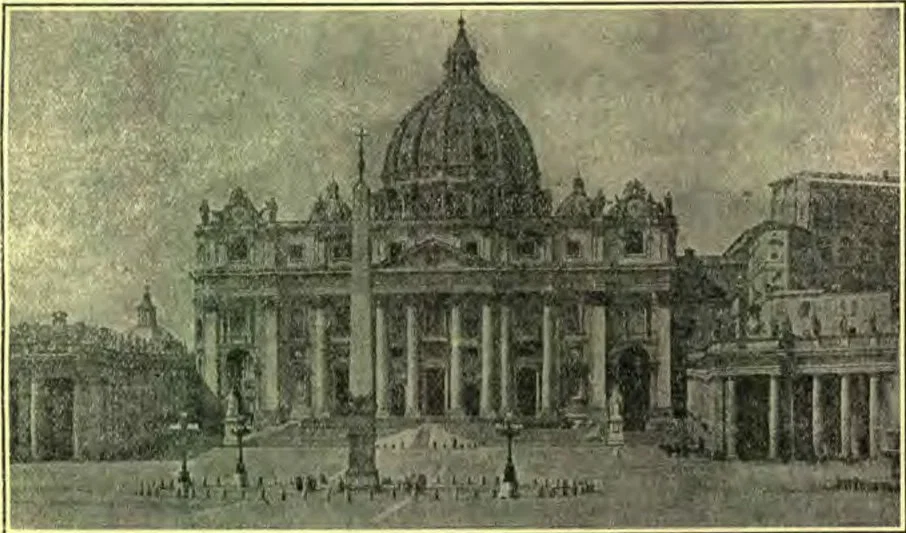
St. Peter's Cathedral, Rome, the largest church in the world, covers 5½ acres, and cost $50,000,000; height, 435 feet; founded 1450 A. D., and was 176 years in building.
The first surprise awaiting almost every visitor to Venice, is that of seeing all its buildings rise directly from the sea. He knows, of course, that Venice rests upon a hundred islands, linked by four hundred and fifty bridges. Hence he expects to see between the houses and the liquid streets, some terrace or embankment. But no; the stately mansions emerge from the ocean like a huge sea wall, and, when the surface of the water is disturbed by a light breeze or passing boat, it overflows their marble steps as softly as the ripple of the surf spreads its white foam along the beach. As, then, our gondolier takes us farther through this liquid labyrinth, we naturally ask in astonishment, “What was the origin of this mysterious city? How came it to be founded thus within the sea?” The wonder is easily explained. In the fifth century after Christ, when the old Roman empire had well-nigh perished under the deadly inroad of barbarians, another devastating army entered Italy, led by a man who was regarded as the “scourge of God.” This man was Attila. Such was the ruin always left behind him, that he could boast, with truth, that the grass grew not where his horse had trod. A few men, seeking to escape this vandal, fled to a group of uninhabited islands in the Adriatic. Exiled from land, they cast themselves in desperation on the sea, and they were rewarded for their courage. She nourished them from her abundant life.
Who can forget his first glimpse of the Grand Canal! Seen at a favorable hour, the famous thoroughfare delights the senses as it thrills the heart. Its curving banks are lined with palaces. They seem to be standing hand in hand, saluting one another gravely. These were originally the homes of men whose names were written in the record of Venetian nobility, called “The Book of Gold.” Once they were marvels of magnificence; and viewed in the sunset light or by the moon, they are so still.
From every door broad marble steps descend to the canal, and tall posts painted with the colors of the family, serve as a mooring place for gondolas.
Suspended over this noble thoroughfare is the “Bridge of the Rialto.” For centuries this was the only bridge that crossed the Grand Canal. Its huge arch is entirely of marble, and has a length of over one hundred and fifty feet. Its cost exceeded half a million dollars, and the foundations, which for three hundred and twenty years have faithfully supported it, are twelve thousand trunks of elm trees, each ten feet in length.
Venice, though beautiful, shows marks of age. The glare of day is far too strong for her pathetically fair, but wrinkled face.
Venice is pre-eminently the City of Silence. No roar of wheels disturbs one here; no strident gongs, no tramp of horses’ feet. Reclining on the cushion of a gondola, one floats in absolute tranquillity upon a noiseless sea. To go to another city after being in Venice is like removing from one’s ears the fingers which for a little time had closed them to all sounds.
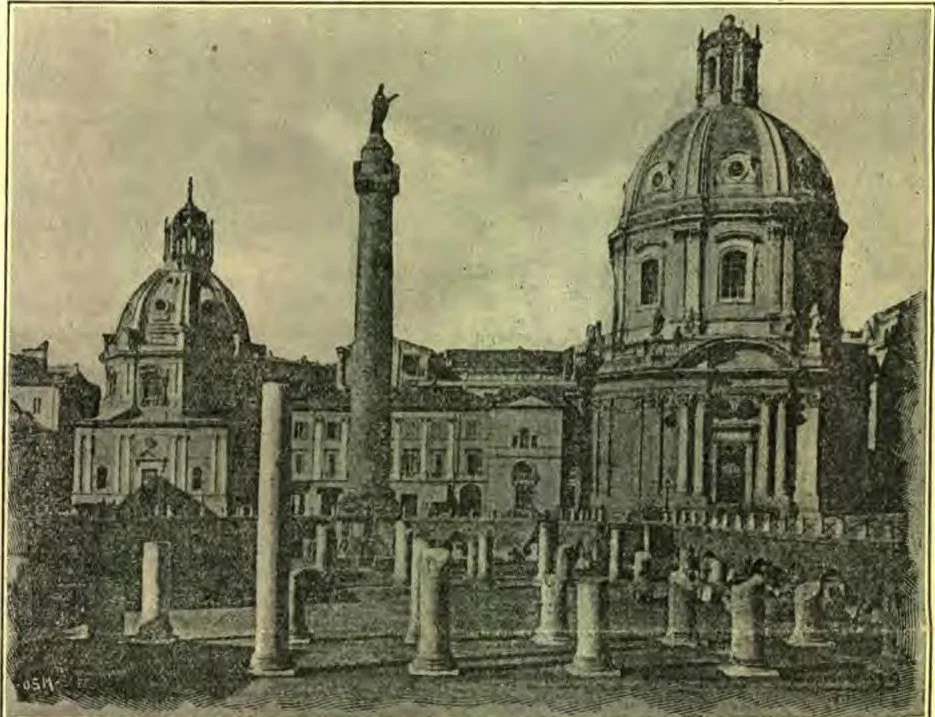
FORUM OF EMPEROR TRAJAN, CONSTRUCTED 114 A. D.
In the golden age of Venice, her victorious flag rolled out its purple folds over the richest islands of the Mediterranean and the Adriatic; she possessed the largest armory and the most extensive dockyards in the world, she could boast of having the first bank of deposit ever founded in Europe; she was (Rome excepted) the first to print books in Italy; and she sold in St. Mark’s Square the first newspaper ever known to the world, demanding for it a little coin called gazetta, which has given us the word “gazette.”
Her royal palaces were superbly beautiful. The roof and walls are covered with enormous masterpieces set in golden frames. One of them, finished by Tintoretto when he was more than threescore years and ten, is seventy feet in length, and is the largest painting known to art. Each of these gold-enameled halls is like a gorgeous vase, in which are blooming fadelessly the flowers of Venetian history.
Just behind the residence of the doges, or rulers of Venice, suspended over the canal,—“a palace and a prison on each hand,”—is one of the best-known structures in the world,—the “Bridge of Sighs.” This is indeed a sad memorial of tyranny; and dims the splendor of Venetian palaces. It receives its name from the fact that the prisoners of Venice as they walked from the Ducal palace through it to the dungeon cells at the other end, and finally to death, breathed through its grated windows a last sigh, as they relinquished life and liberty. Far down below the water’s edge are some of the most horrible dungeons that human cruelty has ever designed. All who have visited them will recollect those fetid cells, slimy with dampness, and stifling from the exhausted air which filters to them through the narrow corridors. They will remember the iron grating through which was passed the scanty food that for a time prolonged the prisoner’s life; the grooves of the old guillotine, by means of which, after excruciating torture, he was put to death; and then the narrow opening through which the body was removed at night and rowed out to a distant spot and dropped into the sea, where it was death to cast a net.
Connected with the royal palace is the world-renowned St. Mark’s Cathedral. There is no other structure like it in the world. It is the treasure-house of Venice, a palace of pride as well as of prayer. Here was heaped up the booty which she gained from her repeated conquests. The work of beautifying this old church was carried on enthusiastically for five hundred years. Its domes and spires glisten with gold. Here, massed in serried ranks, are scores of variously colored marble columns, each one a monolith, and all possessing an eventful history. Some are from Ephesus, others from Smyrna, while still others are from Constantinople, and more than one even from Jerusalem.
To the lover of the beautiful in nature, the most enchanting characteristic of this City of the Sea is its sunset glow. Italian sunsets are all beautiful; but those of Venice are the loveliest of all. Their softness, brilliancy, and splendor can not be described. The last I beheld here, on a night in June, surpassed all others I had ever seen. The shadows were falling to the eastward; the hush of night was stealing on the world. The cares of life seemed disappearing down the radiant west together with the god of day. Between us and the setting sun there seemed to fall a shower of powdered gold. The entire city was pervaded by a golden light, which yet was perfectly transparent, like the purest ether.
As we drew nearer the Grand Canal, the scene grew even more enchanting. In the refulgent light the city lay before us like a beautiful mirage, enthroned upon a golden bank between two seas,—the ocean and the sky. Her streets seemed filled with liquid sunshine. The steps of her patrician palaces appeared entangled in the meshes of a golden net. The neighboring islands looked like jeweled wreckage floating from a barge of gold. I have seen many impressive sights in many climes; but for triumphant beauty, crystallized in stone and glorified by the setting sun, I can recall no scene more matchless in its loveliness than that which I enjoyed, when, on this richly tinted sea, I watched the Bride and Sovereign of the Adriatic pass to the curtained chamber of the night enveloped in a veil of gold.—John L. Stoddard.

The Catacombs

THE word “catacombs” might justly be used as title to a long, sad chapter in the history of the persecutions which have walked side by side with the faithful from the days of Abel. It would be viewed as such, no doubt, by the sacred historian. But let us consider the catacombs also in regard to their construction and purpose.
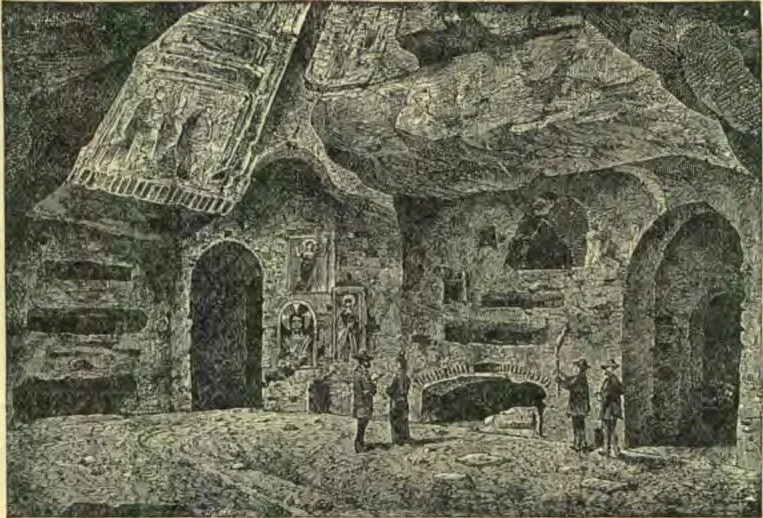
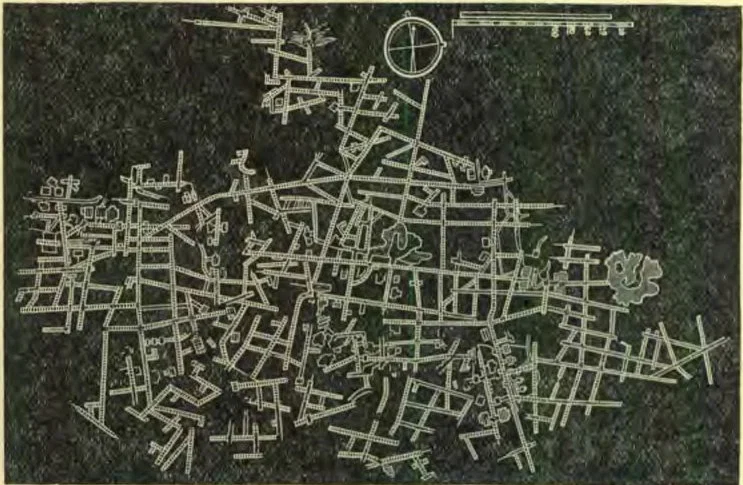
In the hills just outside the city of Rome were excavated long galleries, at three different levels. They crossed and recrossed one another, and even extended under the city itself. They are only three or four feet wide, with niches on each side for bodies. It is estimated that if these galleries were placed end to end, they would extend for hundreds of miles.
For a long time the catacombs were used by the Christians for a cemetery. Seventy thousand graves have been counted, and one historian estimates the entire number to be more than three million.
As the Roman law protected both pagan and Christian burial places, the Christians took advantage of this, and gradually began using the catacombs as a place for holding religious services. They excavated large rooms for this purpose. Later on during the times of persecution these rooms were used by the Christians as hiding places.
When the Emperor Valerian learned that the Christians were worshiping in the catacombs, he issued an edict forbidding them, and they were hunted through this labyrinth of halls by the Roman soldiers. Some were dragged out and tortured, while others were blocked up in the rooms and buried alive. In order to protect themselves they broke down some of the stairways, built new galleries; and filled up others. Wells were dug for water, and storehouses were built for provisions. Thus they lived and served God until the days of tribulation were over.
CHAMBER OF A CATACOMB
In exploring the catacombs since then, hundreds of lamps have been discovered which were used to light those dark recesses. Many pictures and inscriptions were also found which depicted the sufferings of the people while hidden away in the earth.
The Lord watches those old catacombs with a jealous eye; not that he cares for the worldly glory of the great emperors who ruled when they were constructed, nor for the so-called bravery of the soldiers who hunted down the Christians in those dark caverns, nor to preserve them to satisfy the curiosity of men; but because precious in his sight are those who gave up their lives in them for him. When the trump of God shall sound in the last day, they shall come forth out of the heart of the earth, to glorify their Creator and Redeemer. “They wandered in deserts, and in mountains, and in dens and caves of the earth.”
We ought to thank the Lord that we are permitted to worship him in peace and safety—in the light of the sun, and not in the darkness of earth’s caves.
C. E. HOLMES.

The Roman Slave System

ROME in its greatness had two elements of weakness that were destined in time to work serious ruin to the government. One of these was the immense number of slaves which war and conquest had brought into the country. At one time there were twelve million slaves to three million freemen in Italy. They were numerous also in other parts of Rome’s possessions. Sicily was full of them, where they were made to work like cattle on great estates. They were so cheap that it paid better to work them to death than to take care of them. Some estates had as many as twenty thousand slaves, many of whom had been taken in war, and were equal or superior in intellect and culture to their masters.
But such an unjust course must soon bring rebellion. In 134 B. C. the slaves of Sicily rebelled, and for three years defied the Roman power, defeating four armies that were sent against them. There were two hundred thousand of them in arms, but finally the revolt was quelled.
At a later time, in the year 72 B. C., a rebellion began in Italy. Spartacus, a slave gladiator, headed a party of slaves, and took refuge in the crater of Vesuvius where hosts of slaves and outlaws joined them. His force grew to be one hundred thousand. He defeated the Roman forces in several battles, so that the city itself was in danger. But at last his army was overcome, and he was slain.
The following supposed address of Spartacus to the chief gladiators at Rome, by Mr. Elijah Kellogg, reveals the spirit of bitterness that some of Rome’s slaves felt toward her for her unjust course toward those taken as captives during war:—
“Ye call me chief, and ye do well to call him chief, who for twelve long years has met upon the arena every shape of man or beast the broad empire of Rome could furnish, and who never yet lowered his arm.
“If there be one among you who can say that in public fight or private brawl my actions did belie my tongue, let him stand forth and say it. If there be three in all your company dare face me on the bloody sand, let him come on. And yet I was not always thus,—a hired butcher, a savage chief of still more savage men. My ancestors came from Old Sparta, and settled among the vine-clad rocks and citron groves of Syrasella. My early life ran quiet as the brooks by which I sported; and when at noon, I gathered the sheep beneath the shade and played upon the shepherd’s flute, there was a friend, the son of a neighbor, to join me in the pastime. We led our flocks to the same pasture, and partook together our rustic meal.
PLAN OF CATACOMBS
PLAN OF CATACOMBS
“One evening, after the sheep were folded, and we were all seated beneath the myrtle which shaded our cottage, my grandsire, an old man, was telling of Marathon and Leuctra; and how, in ancient times, a little band of Spartans, in a defile of the mountains, had withstood a whole army. I did not then know what war was; but my cheeks burned, I know not why, and I clasped the knees of that venerable man, until my mother, parting the hair from off my forehead, kissed my throbbing temples, and bade me go to rest, and think no more of those old tales and savage wars.”
“That very night the Romans landed on our coast. I saw the breast that had nourished me trampled by the hoof of the war-horse—the bleeding body of my father flung amidst the blazing rafters of our dwelling! To-day I killed a man in the arena; and when I broke his helmet clasps, behold! he was my friend! He knew me, smiled faintly, gasped, and died; the same sweet smile upon his lips that I had marked, when in adventuresome boyhood, we scaled the lofty cliff to pluck the first ripe grapes, and bear them home in childish triumph! I told the praetor that the dead man had been my friend, generous and brave; and I begged that I might bear away the body to burn it on a funeral pile, and mourn over its ashes. Ay! upon my knees, amid the dust and blood of the arena, I begged that poor boon, while all the assembled maids and matrons, and the holy virgins they call vestals, and the rabble shouted in derision, deeming it rare sport, forsooth, to see Rome’s fiercest gladiator turn pale and tremble at sight of that piece of bleeding clay! And the praetor drew back as if I were pollution, and sternly said, ‘Let the carrion rot! There are no noble men but Romans.’”
“And so, fellow gladiators, must you, and so must I, die like dogs! O Rome! Rome! thou hast been a tender nurse to me. Ay! thou hast given to that poor, gentle, timid shepherd lad, who never knew a harsher tone than a flute-note, muscles of iron and a heart of flint; taught him to drive the sword through plaited mail and links of rugged brass, and warm it in the marrow of his foe; to gaze into the glaring eyeballs of the fierce Numidian lion, even as a boy upon a laughing girl! And he shall pay thee back, until the yellow Tiber is red as frothing wine, and in its deepest ooze thy life-blood is curdled.
“Ye stand now like giants as ye are! The strength of brass is in your toughened sinews; but to-morrow some Roman Adonis, breathing sweet perfume from his curly locks, shall with his lily fingers pat your red brawn, and bet his sesterces upon your blood. Hark! hear ye yon lion roaring in his den? ’Tis three days since he has tasted flesh; but to-morrow he shall break his fast upon yours,—and a dainty meal for him ye will be!
“If ye are beasts, then stand here like fat oxen waiting for the butcher’s knife! If ye are men, follow me! Strike down yon guard, gain the mountain passes, and then do bloody work, as did your sires at old Thermopylae!
“Is Sparta dead? Is the old Grecian spirit frozen in your veins, that you do crouch and cower like a belabored hound beneath his master’s lash? O, comrades! warriors! Thracians! if we must fight, let us fight for ourselves! If we must slaughter, let us slaughter our oppressors! If we must die, let it be under the clear sky, by the bright waters, in noble, honorable battle.”
The other great element of Rome’s weakness was that the rich were taking possession of all the lands, so that the people were being divided into the rich and the poor. There was bitter opposition to this. Two young Roman nobles espoused the cause of the poor, but they and their followers were slain by the aristocrats. But in the year 90 B. C. there began a civil war called the Social War. The people of Italy said they had as much right to be Roman citizens as the people of the city. The right was denied by the Romans. A war began which cost the lives of three hundred thousand people, and brought ruin to many cities and districts, but it resulted in giving citizenship to all Italians.

Growth and Extent of the Roman Empire
WAR was the business of the Romans. They had a passion for conquest, and they succeeded because they knew how to bear and overcome defeat. But they were a cruel and ruthless people in their wars, and the sum of human suffering they caused would make a gruesome record.
The one settled policy of the rulers was to extend the Roman power. It first spread through Italy and into northern Africa, then through Europe, east and west, and then far into Asia, until finally it took in nearly all the civilized world. From east to west the empire was twenty-seven hundred miles in length, and more than one thousand miles from north to south. At the opening of the Christian era, this empire took in the countries now known as Spain, France, Belgium, England, Switzerland, Greece, Turkey, and the lower parts of Germany and Austria, besides possessions in Asia and Africa. When it conquered the Grecian kingdom in the year 188 B. C., it became the world’s fourth universal kingdom, the “kingdom of iron” mentioned by the prophet.
Rome was true in every respect to the description given of it in the second chapter of Daniel. During the time of its greatest strength it was likened to “a mighty colossus bestriding the nations, conquering everything, and giving laws to the world.”
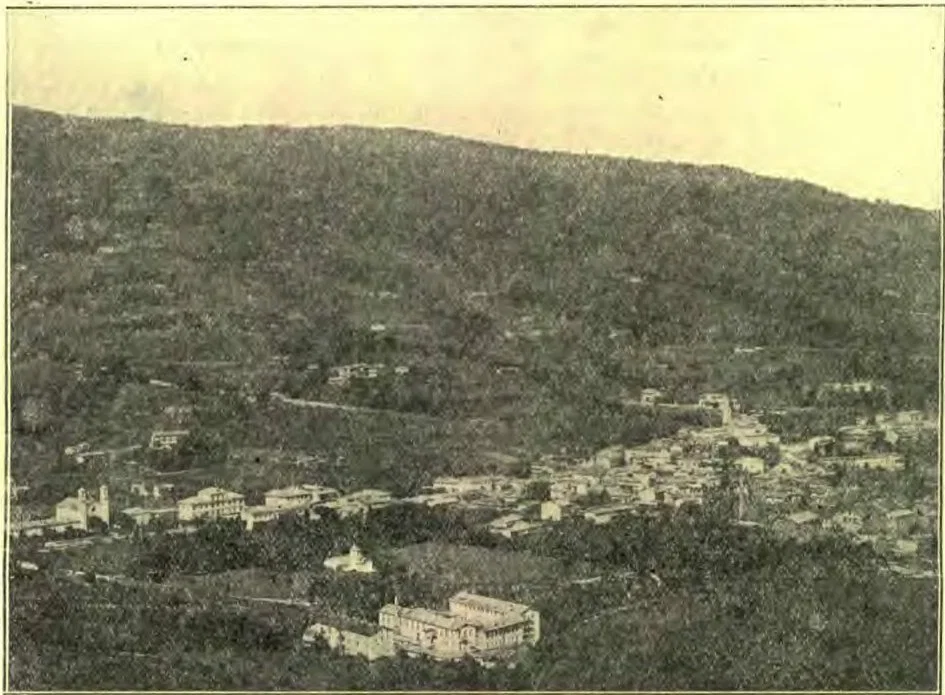
TORRE PELLICE, IN ONE OF THE WALDENSIAN VALLEYS
But it was not always thus to continue. “Luxury, with its accompanying effeminacy and degeneracy, the destroyer of nations as well as individuals, began to corrode and weaken its iron sinews,” and thus prepared the way for its subsequent disruption into ten kingdoms, all of which is represented by the “feet and toes, part of potter’s clay, and part of iron.”

Its Overthrow

North of the Rhine and Danube Rivers, dwelt a multitude of barbarians who were to put an end to the empire of Rome. They came out of their forest depths and swept down like a dread torrent over the empire, plundering and burning its cities, sweeping away its greatness and glory, and planting barbarism where civilization had so long flourished. The Huns, Ostrogoths, Visigoths, Franks, Vandals, Suevi, Burgundians, Heruli, Anglo-Saxons, and the Lombards were the tribes that were thus responsible for the division of Rome into ten kingdoms between the years 351 and 483 A. D.

Titus: Roman Emperor and Conqueror of Jerusalem

Titus

Titus was born in the year 40 A. D. He was educated in the imperial court, and was thoroughly trained in all elegant accomplishments; he could speak Greek fluently, and was proficient in music. He was commanding in appearance, and a well-trained soldier. He took an active part in the Jewish war, being finally left in command. He conducted the siege against Jerusalem, and his victory was celebrated by a triumphal arch in the city of Rome. On the arch may still be seen sculptured representations of Jewish captives and of the captured trophies.
Two great disasters occurred during the reign of Titus, who succeeded to the throne on the death of his father, Vespasian, in 79 A. D. One of the calamities was the eruption of Vesuvius in the same year that he ascended the throne. It was at this time that the cities of Pompeii and Herculaneum were buried. The emperor visited the scenes of desolation, and contributed liberally to the relief of the distressed inhabitants. During his absence a fire raged for three days at Rome, in which the Capitol was burned. This disaster was followed by a pestilence.
Titus delighted in making costly gifts, and it is said that he counted the day lost in which he failed to bestow a gift upon some one.
Vespasian and Titus built the Colosseum, an immense theater capable of seating eighty-seven thousand persons, and affording standing room to many thousands more. Portions of the walls of the building are still standing.
In the center of the amphitheater was the great open arena where the gladiators fought, and where the deadly conflicts with wild beasts took place. The arena could suddenly be flooded for the exhibition of sea fights.
During the various persecutions of the Christians many of these were thrown to the wild beasts in the arena of the Colosseum.
The sand used on the floor of the arena was mixed with scarlet grains to hide the stain, and there were perfumed showers to overcome the scent of blood, and silken embroidered awnings to keep off the sun; but there was nothing to hide the wickedness of it from the Father above.
Titus died after a reign of about two years, and his brother Domitian took his place as Italy's emperor.

Jerusalem Destroyed by Titus

For forty years after the doom of Jerusalem had been pronounced by Christ himself, the Lord delayed his judgments upon the city and the nation. Wonderful was the long-suffering of God toward the rejecters of his gospel and the murderers of his Son; but this long-suffering only confirmed the Jews in their stubborn impenitence.
Terrible were the calamities that fell upon Jerusalem when the siege was resumed by Titus. The city was besieged at the time of the Passover, when millions of Jews were assembled within its walls. Their stores of provision, which if carefully preserved would have supplied the inhabitants for years, had previously been destroyed through the jealousy and revenge of the contending factions, and now all the horrors of starvation were experienced. So fierce were the pangs of hunger, that men would gnaw the leather of their belts and sandals and the covering of their shields.
Natural affection seemed to have been destroyed. Husbands robbed their wives, and wives their husbands. Children would be seen snatching the food from the mouths of their aged parents. “The hands of the pitiful women have sodden their own children: they were their meat in the destruction of the daughter of my people.”
The Roman leaders endeavored to strike terror
(Concluded on page 6)
Continue reading: Our Field — The World