INTO the great Mediterranean Sea, Europe sends down three peninsulas,—Greece in the east, Italy in the center, and Spain in the west. Our lesson study this week is about Italy, that long boot-shaped stretch of land that comes downward from the Alpine mountains, and nearly touches the island of Sicily with its toe.
“Italy is celebrated for its blue skies, bright sunshine, brilliant sunsets, and balmy breezes. The clear air gives a peculiar charm to its landscapes. Its treasures of art rival its natural charms.” Tourists from all parts of the world visit its chief cities, its mountains, and its turbulent volcano, Vesuvius.
The fertile plains of the north have developed an intelligent and industrious people, but the hot climate of the south and the rugged surface have tended to make the inhabitants poor and indolent. The population is dense, and wages are low, so there are thousands annually who emigrate.
Agriculture, cattle raising, fruit growing, and manufacturing are the leading occupations.
The kingdom of Italy includes the islands of Sicily and Sardinia. It also claims possessions in northeastern Africa. It is little among the nations of the earth to-day, but for centuries Rome ruled the civilized world.
Of its early history Mr. Morris says: “If we attempt to discover the early history of Italy, we seem to be gazing on a dense cloud with faint shadows showing through it. During those thousands of years in which Egypt and Babylonia were flourishing States, Italy was the home of savages or barbarians. Long after the active and enterprising people of Greece began to make themselves well known, the tribes of Italy were still lost in the clouds of obscurity. The ships of the Phoenicians may have borne to them the first rays of the sun of civilization. Afterward Greece founded colonies in the south of Italy. Tarentum, Sybaris, Crotona, also Syracuse on the island of Sicily, were Greek colonies. These Grecian cities were like so many seeds of civilization planted deep in the soil of Italy.”
The most important people or tribe were the Latins of central Italy, south of the Tiber River. In time they became the ruling people. They seem to have come from the same stock from which the Greeks descended, as well as we ourselves, the Aryan race.
The story of the founding of Rome by Romulus and Remus has long entertained students of history, but is now regarded as too legendary to be given as history. Nearly all that is known is that in early times Rome was governed by kings, who seem to have had much power over the people. Some of them were good, but others were tyrants. Under the king was the senate, or “council of the old men,” who gave advice to the monarch, which he could take or not as he pleased. Under the kings Rome grew to be large and powerful. The last king was so hated by the people that he was dethroned in 509 B. C., and they declared that no king should rule over them again.
For centuries after this Rome was ruled by consuls, two chief magistrates appointed by the people, and elected for one year only. These were followed by the emperors, the last one of whom was dethroned in 476 A. D., by a German chief, who took the throne and proclaimed himself king of Italy.
Rome and the Papacy
The apostle Paul suffered much in order to establish the work of God in Rome, the world’s metropolis. There was an earnest church raised up, and the work prospered for many years; but in time there was a falling away from the pure principles of the gospel. The man of sin was revealed, “the son of perdition; who opposeth and exalteth himself above all that is called God, or that is worshiped; so that he as God sitteth in the temple of God, showing himself that he is God.” This false system of religion, though Christian in name, which resulted from the “falling away” of which the apostle wrote, has done more to oppose the true Christian religion than any other system ever devised, and more to hold the people in darkness and to destroy the true spirit of liberty, and independence of thought and action, than all other systems put together. For centuries the leaders of the papacy have had their seat in Rome, and from the Vatican papal mandates have gone to all the world.
Rome, under the influence of this false system, renounced paganism, and espoused the cause of Christianity as represented in Roman Catholicism. The church finally dominated the state, and used the secular power to execute her will against all who did not hold her tenets. As a result, millions of the true children of God suffered martyrdom. In 1798 her temporal power was taken away; but the papacy still lives, and is destined again to dominate the world. It is fast climbing up to its former position of power and influence. America already servilely heeds her bidding. Only one illustration need be cited to show the extent of her influence. In all the libraries of the land, books of whatever character that speak against Rome are being taken from the shelves and carried to the cellar. All histories and readers that merely cite facts of history that are derogatory to the Catholic religion are debarred also from the public schools.
Rome never changes. In a catechism sent out by the new pope, the question is asked, “Do all men who are baptized pertain to the church of Jesus Christ though they do not recognize the Roman pontiff as its head? Answer.—No; all those who do not recognize the Roman pontiff as its head, do not pertain to the church of Jesus Christ.”
Another question is, “What should a Christian do if the Bible is offered to him by an emissary of the Protestants? Answer.—He should refuse it with horror, inasmuch as it is prohibited by the church. If he has received it ignorantly, he should cast it into the fire at once, or deliver it to his priest.”
A paragraph on the same question reads thus: “The authority of the church, that is to say in concrete cases, that of the pope, is superior tothat of God, and of his word contained in the holy books.”
Not long ago one of our workers was out selling tracts. After having canvassed a small country village, he was on the sidewalk arranging his bicycle to start for the next town. The parish priest came down the middle of the street, singing and bearing an image. Because our brother did not remove his hat, the priest had him arrested and taken to jail. But he was an old-time friend of the chief official, so he was released without trial.
Present Situation
Life in Italy with all except the wealthy is a hard battle. Upon the faces of the poor is an expression of hopelessness, as if they expected only hunger, toil, and misery. Long-established custom has made living in stables, in parts of Italy, quite popular. At night when it is very cold, it is customary to take a bundle of straw or leaves, and lie as close to the cattle as possible. One small window furnishes light for the apartment, while the bodies and breath of the cattle, and the decaying matter about, provide the only source of warmth. It is very difficult, if not quite impossible, to obtain either churches or schoolhouses in which to hold services; so our workers often have to hold Bible readings and meetings with the people in the stables.
In 1881 Elder Haskell visited Italy, and Mrs. E. G. White did so in the year of 1885. Speaking of her visit to the Piedmont Valleys, she says: “There will be many, even in these valleys, where the work seems to start with such difficulty, who will recognize the voice of God speaking to them through his Word, and, coming out from under the influence of the clergy, will take their stand for the truth. This field is not an easy one in which to labor, nor is it one which will show immediate results; but there is an honest people here who will obey in time. The persecutions which their fathers endured have made them apathetic and close-mouthed, and they look upon strangers and strange doctrines with suspicion. But the miracle of God’s mercy, working with man’s human effort, will yet cause the truth to triumph upon the very soil where so many have died to defend it. Knowledge will be increased, faith and courage will revive, and the truth will shine as the light of the morning all through these valleys. The old battle-field will yet be the scene of victories now unseen, and the adoption of Bible truth will vindicate the past fidelity of their fathers.”
At the time of Mrs. White’s visit to Italy, Elder D. T. Bourdeau was laboring in Torre Pellice, Italy. At the close of the effort, a church of fourteen was organized. He labored also in St. Germain, and other cities. A church was established in Naples as early as the year 1877. But for many years the work was neglected in this country, and many lights went out.
After the organization of the Latin Union Conference, a call was made for a gospel worker for Rome, who would develop Italian interests. Brother Everson, his wife, and sister-in-law were sent in response to this call. Their work has already developed very encouragingly. Some canvassing has been done, but only a beginning has been made in this as in every other line of work.
In a recent report from Brother Everson, he says: “We have begun a new campaign at Rome. We have many studying the truth. Many are becoming convinced of their duty, but thus far we have found great difficulty about the Sabbath question, because the country is poor, and work is scarce. But we know that God must have some solution of this problem also for this people.” He further says: “We expect to open up work this year at Turin, a city about the size of San Francisco before the earthquake. It is the ancient capital of the Italian reigning house.”
(Concluded on page 6)
Roman Stories
Cincinnatus
THERE was a patrician family in Rome of noble character, the father of which received the name Cincinnatus from his curly hair. He was a man of sound mind and far sight, and nearly all the people believed that he would be governed in all things by his sense of right. He lived on a farm of four acres, and people who sought his wisdom visited him there.
In the wars with the neighboring tribes there came a time of great peril, and a council of the people met to consider what it was best to do.
The people deliberated. They saw their need of great wisdom and prudence, and at the last some one made a proposal that was received with general approval: “Make Cincinnatus dictator.” They chose messengers to go to see Cincinnatus at his farm by the blue Tiber. They found him plowing in the field.
And queerly enough, his good wife was helping him plow. The messengers told him their errand. Cincinnatus turned to his wife and said: “Racilia, go fetch me my toga.” Then, we are told, he washed his face and started in a boat on the Tiber toward Rome.
Cincinnatus took the lead of a volunteer army, routed the enemy, and resigned his dictatorship at the end of sixteen days. He refused to accept any of the spoil, but went back to his farm, and again followed the plow.—Hezekiah Butterworth.
Camillus and the Boys
ONE of the Roman dictators named Camillus conquered and spoiled the city of Veii. Very soon after he made war upon Falerii, a town allied to Veii. An interesting incident occurred during this war. The sons of the chief families of Falerii were in charge of a certain ambitious schoolmaster, who seems to have thought that he could make a name for himself by turning traitor, and becoming a subject of Rome.6
So one day the schoolmaster took his boys without the walls of the city, pretending to give them exercise, and led them directly into the camp of Camillus. He told Camillus that the boys were the sons of the ruling families, and that he would have only to hold them prisoners to bring the city to terms. Camillus, to his horror, listened to the proposal with indignation.
“No,” he said, “I will not keep the boys. And instead of rewarding you for such a base proposal, I will cause the boys to punish you, as your treachery merits.”
He ordered that rods, or whips, should be given the boys.
“He has been untrue to you,” said the Roman. “Now whip him all the way to the city.”
The boys whipped the crafty teacher back to the gates, and received a lesson in Roman honor which they did not soon forget.—“Little Arthur’s History of Rome.”
“Aha! Aha!”
By Mrs. G. R. Alden
I THINK David used language in a masterly way when he described his enemies as saying, “Aha, aha! our eye hath seen it.”
Could a more vivid picture of gloating over the misfortune or discomfiture of another be expressed in few words? One can seem to see the evil-faced man, his eyes alight with a wicked smile, his voice exultant, and that hateful “Aha!” on his lips.
Descendants of David’s enemies still live, and are quite as hateful as they could have been of old. It would perhaps be difficult to think of any form of sin which in its bald aspect repels the generous-hearted more than that vindictive “Aha! I saw you,” and the spirit which always accompanies it.
But it is with a more cultured form of the same sin (if that word “cultured” may be used in such connection) that I want especially to speak at this time.
I have been noting illustrations of it all this week, and can probably make my meaning plainer by citing some of them.
The demonstrator is a young girl who has not the least idea that she is giving lessons. Nor does she realize that she is every day, and indeed almost every hour, helping to bind herself in the meshes of that hateful habit of triumphing over the mishaps or mistakes of others.
Perhaps I should say that she has also a habit of carelessness with regard to her own and other people’s things, as well as with regard to her home duties, that calls down upon her constant criticism.
“Elsie, where is the pencil I lent you?”
“What did you do with the towels I sent you to put away, Elsie?”
“Elsie, did you get those books I told you I was waiting for?”
“Elsie, you didn’t rinse those glasses, as you promised you would.”
“Why, Elsie! you haven’t done your room work yet!”
These, and kindred complaints, are continually in Elsie’s ear. At almost any time of the day a listening member of the same household can hear some annoyed victim calling her to account for doing or not doing.
I will confess at once that I have a certain amount of sympathy for Elsie. She is annoying, certainly, and her careless habits should be corrected. But in trying to do this her entire family have fallen into such a habit of “nagging” that they do it on very slight occasion; and indeed I think it would be hard for some of them to commend Elsie for anything.
This habit of theirs has, I believe, something to do with her serious fault of which I am especially speaking.
She has a brother who is methodical in all his ways to a degree that is positively painful to the careless Elsie. He has a watch that is always right, and he is never behind time in any of his engagements. At least, that is his reputation. But yesterday he missed an important appointment by being one minute too late for his train.
“Aha!” said Elsie, when she saw the train move off just as he was striding across the network of tracks. “Look at him! Robert, the soul of promptness, has actually lost his train!” and she clapped her hands in glee.
The annoyed brother flashed an angry glance at her, and muttered that he wished she would hurry and grow up, for she had been at the disagreeable age quite long enough.
She has an aunt who is the soul of neatness and propriety. Yesterday she came in from a trip down-town with a yard of skirt-binding trailing from her dress. Somewhere in her travels, all unknown to her, a vicious nail or stick must have caught her and wrought damage. The sight convulsed Elsie with laughter.
“Ha, ha, ha!” her voice rang out. “How you must have looked parading down Main Street with a yard of skirt-binding trailing behind you! That’s too funny! You of all persons to be caught in such a plight! I would give anything to have seen you with my own eyes, when you passed the bank, for instance.”
I think she had no conception of how hateful she was making herself appear. It is a habit already deep-seated. Even her mother is not free from her exultant exclamations. She is a quiet, careful woman, and rarely meets with any of the embarrassments due to haste and carelessness. But to-day, in making a swift movement to save a dish from burning, she overturned and broke it.
“Aha!” shouted Elsie. “Who is breaking dishes now, I wonder! Dear, dear! to think I should live to see such a sight as this!”
I might multiply examples, but of what use? I am afraid that Elsie already appears to you as a very disagreeable person without any redeeming traits. This is not true; on the contrary, she is a winsome, lovable girl, with many sterling qualities. If by some good fortune she could be made to realize how hideous a blot this habit is making on her daily life, I feel sure that she would bestir herself to overcome it.
This morning in reading an old book I came upon some quaint lines, as quaint in spelling as in diction, that I should like to copy for Elsie’s room if I did not fear that it would be too public a manner of calling her attention to her fault. Perhaps, instead, I will quote the lines here, not only for my Elsie, but for others who may need a like hint:—
“They gape and drawe their mouthes in scornful wise,
And crie, ‘Fie, fie, wee sawe it with our eyes.’
But thou their deed, O Lord, dost also see;
Then bee not silent soe, nor farr from mee.”
—Mrs. G. R. Alden, in Christian Endeavor World.
An Ideal Girl
By Alma Lamberton Case
SHE'S a dainty little maiden, With a happy, winning face, Seeming nearest like a flower, In her sweet, unconscious grace.
She has pleasant, kindly manners; And her gentle, loving ways Seem to bring the blessed sunshine, Even into cloudy days.
She is tender-hearted, pities, Careful not to give offense By a thoughtless word or action; She has sympathetic sense.
She's a little willing worker; Help you do not have to ask, For she watches, and with pleasure Lends a hand at any task.
In her dress and in her person She is neat and sweet and clean, Trying always to be tidy, Even though she is not seen.
She's a modest little maiden, Rather shy at first than bold; And acquaintance soon reveals it, That her heart is good as gold.
She respects and loves the aged, Cheering hearts with sunny smiles; Helps to banish thoughts of sadness, By her merry, winsome wiles.
And she loves the poor dumb creatures, Giving always gentle care; But the birds, in her affections, Hold the best and largest share.
She delights in nature's beauties, Loves the rocks and hills and flow'rs, Hears the trees and river talking, Joys in sunshine and in show'rs.
Books have charm for this rare maiden; Study seems no hardship great: Reading lives of true and noble, She will strive to imitate.
Is there lack in this fair picture? Yes, there's one thing wanting yet, More important than the others; This one thing do not forget:
Our ideal is a Christian, Serving God in childish way, Telling him her childish troubles, Asking him for help each day.
ALMA LAMBERTON CASE.
Jerusalem Destroyed by Titus
By Ellen G. White
(Concluded from page 3)
to the Jews, and thus cause them to surrender. Those prisoners who resisted when taken were scourged, tortured, and crucified before the wall of the city. Hundreds were daily put to death in this manner, and the dreadful work continued until, along the valley of Jehoshaphat and at Calvary, crosses were erected in so great numbers that there was scarcely room to move among them.
Titus would willingly have put an end to the fearful scene, and thus have spared Jerusalem the full measure of her doom. He was filled with horror as he saw the bodies of the dead lying in heaps in the valleys. Like one entranced, he looked from the crest of Olivet upon the magnificent temple, and gave command that not one stone of it be touched. Before attempting to gain possession of this stronghold, he made an earnest appeal to the Jewish leaders not to force him to defile the sacred place with blood. If they would come forth and fight in any other place, no Roman should violate the sanctity of the temple. In vain were the efforts of Titus to save the temple; One greater than he had declared that not one stone was to be left upon another.
The blind obstinacy of the Jewish leaders, and the detestable crimes perpetrated within the besieged city, excited the horror and indignation of the Romans, and Titus at last decided to take the city by storm. He determined, however, that if possible, it should be saved from destruction. But his commands were disregarded. After he had retired to his tent at night, the Jews, sallying from the temple, attacked the soldiers without. In the struggle a firebrand was flung by a soldier through an opening in the porch, and immediately the cedar-lined chambers about the holy house were in a blaze. Titus rushed to the place, followed by his generals and legionaries, and commanded the soldiers to quench the flames. His words were unheeded. In their fury the soldiers hurled blazing brands into the chambers adjoining the temple, and then with their swords they slaughtered in great numbers those who had found shelter there. Blood flowed down the steps like water.
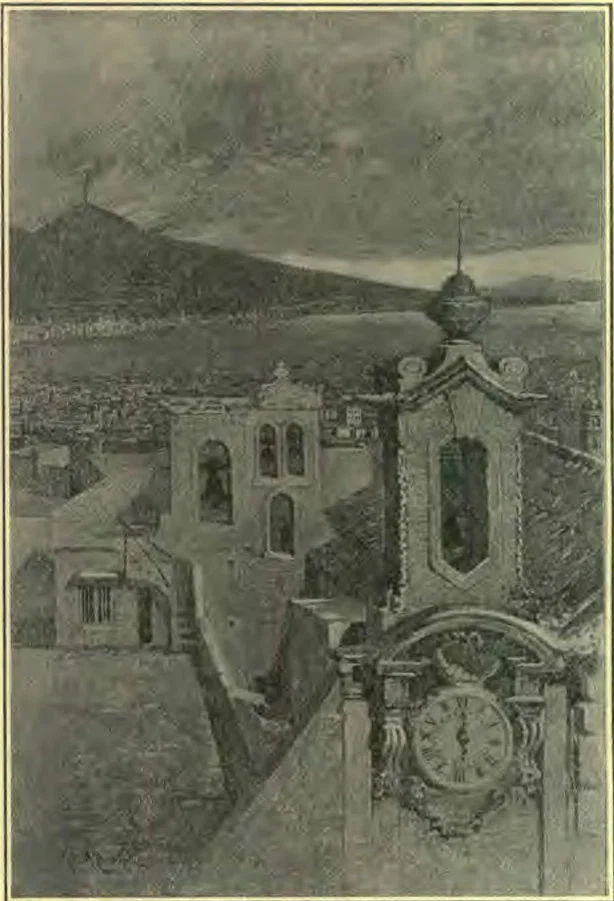
A VIEW IN NAPLES, WITH MT. VESUVIUS IN THE DISTANCE
It was an appalling spectacle to the Roman; what was it to the Jew? The whole summit of the hill which commanded the city blazed like a volcano. One after another the buildings fell in, with a tremendous crash, and were swallowed up in the fiery abyss. The roofs of cedar were like sheets of flame; the gilded pinnacles shone like spikes of red light; the gate towers sent up tall columns of flame and smoke. The neighboring hills were lighted up; and dark groups of people were seen watching in horrible anxiety the progress of the destruction; the walls and heights of the upper city were crowded with faces, some pale with the agony of despair, others scowling unavailing vengeance. The shouts of the Roman soldiery as they ran to and fro, and the howlings of the insurgents who were perishing in the flames, mingled with the roaring of the conflagration and the thundering sound of the falling timbers. The echoes of the mountains replied or brought back the shrieks of the people on the heights; all along the walls resounded screams and wailings; men who were expiring with famine rallied their remaining strength to utter a cry of anguish and desolation. The number of the slain exceeded that of the slayers.
After the destruction of the temple, the whole city fell into the hands of the Romans. The leaders of the Jews forsook their impregnable towers, and Titus found them solitary. He gazed upon them in amazement, and declared that God had given them into his hands.
The horrible cruelties enacted in the destruction of Jerusalem are a demonstration of Satan’s vindictive power over those who yield to his control. God does not stand toward the sinner as an executor of the sentence against transgression; but he leaves the rejecters of his mercy to themselves, to reap that which they have sown. The destruction of Jerusalem is a solemn warning to all who are trifling with the offers of divine grace, and resisting the pleadings of divine mercy.—Mrs. E. G. White.
Our Field—The World
(Concluded from page 4)
There are already some Sabbath-keepers there.”
The total population of Italy is 32,475,253, while the number of laborers is six, one laborer to five millions of people. Back in 1885 Sister White said: “We must have more books and pamphlets in the French and Italian languages. We are moving altogether too slowly in this respect. Time is passing. Workers who are willing to enter this field as evangelists or translators should be selected and educated.”
More than twenty years have passed since7these words were written, and there are now but thirty-two Sabbath-keepers in all Italy; one organized church of four members. It must be that we as a people have greatly neglected our opportunities. Are we now doing for Italy all that God demands of us?
The Vatican
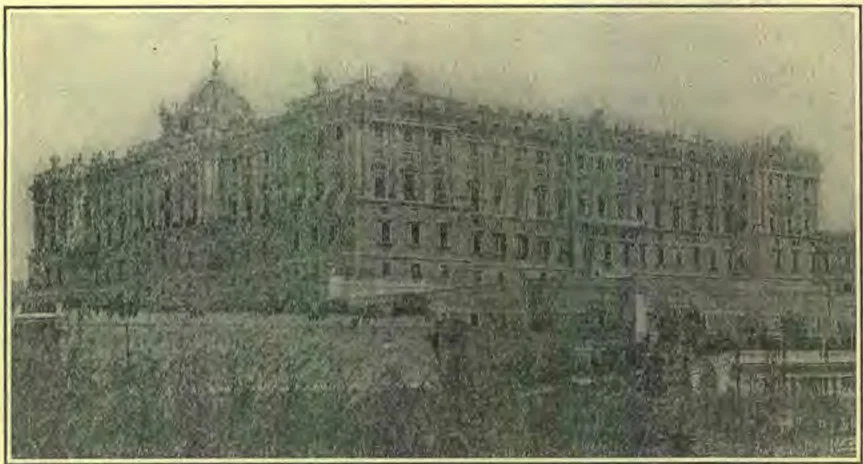
THE pope’s palace takes its name from the mountain (Mons Vaticanus) on which it stands.
THE VATICAN PALACE
This is one of the most interesting and magnificent palaces in the world. It has grown up by degrees, having been enlarged and beautified by various popes. It has been their permanent residence since 1378. The American Encyclopedia says that “the whole palace, which is rather a collection of separate buildings than one regular edifice, has over two hundred staircases, twenty courts, and four thousand four hundred and twenty-two rooms.” There are four chambers containing elaborate frescoes by Raphael. Its library contains hundreds of thousands of books, and its museum is one of the best collections of the kind ever made.
Since the French general Berthier took the pope prisoner in 1798, thus depriving the Catholic Church of its temporal power, the popes have refused to leave the Vatican grounds. They have voluntarily made themselves prisoners, hoping, I suppose, to excite the sympathy of the world, and expecting this influence to aid them in regaining their lost power. The present pope, however, seems not to hold himself so rigidly to this custom.
The Pigeons of Venice
By John L. Stoddard
ONE pretty feature of Venice, Italy, is its pigeons. Their homes are in the marble arches of the adjoining buildings; and shortly after mid-day every afternoon, they suddenly appear in great numbers; now rising in a pretty cloud of fluttering wings; now grouped together like an undulating wave of eider-down. Foreigners, in particular, love to feed them; and in return for the kindness they receive, the pigeons at times alight upon the shoulders of a stranger or courageously pick up crumbs from outstretched hands. It is not strange that Venice should guard these birds so tenderly. Six centuries ago, when the Venetians were blockading the island of Candia, the officers of the doges, or rulers of Venice, observed that pigeons frequently flew above their heads. Suspecting something, they contrived to shoot a few, and each was found to have beneath its wing a message to the enemy. Acting on information thus acquired, the Venetian admiral made his attack at once, and captured the island in twelve hours.
The carrier-pigeons which they found there were therefore taken home to Venice and treated with the utmost kindness, and their descendants have ever since been favorites of the people.—John L. Stoddard.
VIII — The New Earth
(November 24)
MEMORY VERSE: “He that overcometh shall inherit all things; and I will be his God, and he shall be my son.” Rev. 21:7.
Review.—Because Adam sinned, — he lost his —. Satan then became —. Jesus came to —. Under Satan’s dominion the earth became —. The Lord sent — to destroy —. Before Jesus comes again, the world will be as —. In the last days there will be — saying, —. To the wicked the — will come as —. Those who are — will not be overtaken as by a —. After — is destroyed, we look for — where — shall dwell.
Questions
1. What will God create after this earth has passed away? Rev. 21: 1-4.
2. What did John see coming down from heaven? How did the city appear? Who will dwell with those who live in the new earth? How do we know that the people there will be happy?
3. What will be the name of the capital city in the new earth? Rev. 21: 10-19. What was seen around the city? How did it appear? How many gates in the wall? Who are the gatekeepers? What names are written on the gates? Of what is the wall built? What will beautify its foundations? Of what are the gates made?
4. With what is the street of the city paved? Verse 21.
5. What flows through the principal street? Rev. 22: 2. What grows on each side of the river? How often does it bear fruit?
6. How will the city be lighted? Rev. 21: 11, 23. What will not be found there? Verse 27.
7. What is said of the animals in the new earth? Isa. 11: 6-9. How do you know that children will be there? Verse 8. With what will the earth be filled? Verse 9.
8. How will the wilderness appear in the new earth? Isa. 35: 1, 2.
9. What change will be wrought in the blind, deaf, lame, and dumb? Verses 5, 6.
10. How will they express their joy in that land? Verse 10.
11. What will the people do in that country? Isa. 65: 21. Will they keep the Sabbath? Isa. 66: 23.
13. Who will have a right to eat the fruit of the tree of life? Rev. 22: 14.
14. Who can not enter that beautiful city? Rev. 22: 15.
Lesson Story
“And I saw a new heaven and a new earth: for the first heaven and the first earth were passed away; and there was no more sea. And I John saw the holy city, New Jerusalem, coming down from God out of heaven, prepared as a bride adorned for her husband.” God will dwell with his people in that beautiful city, and he will cause their tears to cease, for there will be no death, neither sorrow nor crying, “neither shall there be any more pain.”
The New Jerusalem will be most glorious to behold. It will have a wall great and high. The glory of God covers the place, and its light is like that of a precious stone. There will be twelve gates in the wall, and an angel will stand at each gate, and each will have one of the names of the twelve tribes of Israel. The wall is made of jasper, and the foundation will be adorned with all kinds of precious stones. The gates are made of pearl.
The city is square, and is three hundred and seventy-five miles on each side. It is built of purest gold, and its streets are paved with gold. The river of life flows from the throne of God, and on each side of it grows the tree of life, bearing twelve kinds of fruit.
There will be no night in the New Jerusalem, for it will be lighted by the glory of God, and they have no need of the sun there. Nothing that defileth can enter through those gates, nor those who make lies. Only those written in the book of life can have a home there.
There will be animals in the new earth, for “the wolf also shall dwell with the lamb, and the leopard shall lie down with the kid; and the calf and the young lion and the fatling together; and a little child shall lead them. And the cow and the bear shall feed; their young ones shall lie down together: and the lion shall eat straw like the ox. And the sucking child shall play on the hole of the asp, and the weaned child shall put his hand on the cockatrice’ den. They shall not hurt nor destroy in all my holy mountain: for the earth shall be full of the knowledge of the Lord, as the waters cover the sea.”
There will be no barren, desolate places, for “the wilderness and the solitary place shall be glad for them; and the desert shall rejoice, and blossom as the rose.” “Then the eyes of the blind shall be opened, and the ears of the deaf shall be unstopped. Then shall the lame man leap as an hart, and the tongue of the dumb sing.” “And the ransomed of the Lord shall return, and come to Zion with songs and everlasting joy upon their heads: they shall obtain joy and gladness, and sorrow and sighing shall flee away.”
“And they shall build houses, and inhabit them; and they shall plant vineyards, and eat the fruit of them. They shall not build, and another inhabit; they shall not plant, and another eat: for as the days of a tree are the days of my people, and mine elect shall long enjoy the work of their hands.” “And it shall come to pass, that from one new moon to another, and from one Sabbath to another, shall all flesh come to worship before me, saith the Lord.”
“Blessed are the meek, for they shall inherit the earth.” “Blessed are they that do his commandments, that they may have right to the tree of life, and may enter in through the gates into the city.”
“And there shall in no wise enter into it anything that defileth, . . . but they which are written in the Lamb’s book of life.”