Your ShelfYour Projects

Signs of the Times, Vol. 38, No. 48.

SIGNS OF THE TIMES

Earlier text: What Christ’s Coming Means to the Earth

Christ Will Come Again

1. What question asked by the disciples on a certain occasion showed that they had a definite belief in the second coming of Christ?
And as He sat upon the Mount of Olives, the disciples came unto Him privately, saying, Tell us, when shall these things be? and what shall be the sign of Thy coming, and of the end of the world? Matt. 24: 3.
2. On another occasion, what very definite and clear promise did He make concerning His coming?
Let not your heart be troubled: ye believe in God, believe also in Me. In My Father's house are many mansions: if it were not so, I would have told you. I go to prepare a place for you. And if I go and prepare a place for you, I will come again, and receive you unto Myself; that where I am, there ye may be also. And whither I go ye know, and the way ye know. John 14: 1-4.
3. How is the promise of His coming expressed by Paul in the book of Hebrews?
So Christ was once offered to bear the sins of many; and unto them that look for Him shall He appear the second time without sin unto salvation. Heb. 9: 28.
4. Who does He say will attend Him when He comes?
For the Son of Man shall come in the glory of His Father with His angels; and then He shall reward every man according to his works. Matt. 16: 27.
5. What text shows that the belief of the second coming of Christ was held in very ancient times?
And Enoch also, the seventh from Adam, prophesied of these, saying, Behold, the Lord cometh with ten thousands of His saints. Jude 14.
6. Was the doctrine of the second coming of Christ held in ancient times by Job?
For I know that my Redeemer liveth, and that He shall stand at the latter day upon the earth: and tho after my skin worms destroy this body, yet in my flesh shall I see God: whom I shall see for myself, and mine eyes shall behold, and not another; tho my reins be consumed within me. Job 19: 25-27.
7. In what words does the psalmist speak of the coming of the Lord and the great judgment-day?
Sing unto the Lord with the harp; with the harp, and the voice of a psalm. With trumpets and sound of cornet make a joyful noise before the Lord, the King. Let the sea roar, and the fulness thereof; the world, and they that dwell therein. Let the floods clap their hands: let the hills be joyful together before the Lord; for He cometh to judge the earth: with righteousness shall He judge the world, and the people with equity. Ps. 98: 5-9.
8. How did John, the writer of the book of Revelation, regard the promises of the coming of Christ?
He which testifieth these things saith, Surely I come quickly. Amen. Even so, come, Lord Jesus. Rev. 22: 20.

The Price of Greatness

NEVER to rest is the price paid for our greatness. Could we rest, we must become smaller in soul. Whoever is satisfied with what he does has reached the culminating point—he will progress no more. Man's destiny is to be not satisfied, but forever unsatisfied.—F. W. Robertson.

Importance of Bible Study

By Edwin Clark Hall, in "Herald of Gospel Liberty"
WHEN we get at the Scriptural doctrines of God's holiness, we see that the study of the Scripture becomes of still greater importance. It is good for man to learn that God is a Person, the Creator, and a moral Lawgiver. It is better when he learns that God is a holy Person, a holy Lawgiver, and Giver of a holy law.
What other truth is more calculated to make men what they should be? Man is everywhere proud, selfish, self-willed. Some idea of God's holiness is needed to subdue the pride, selfishness, and insolence of men. Without some knowledge of His holiness, I fear men can not know His love; for one must know how holy God is in order to know how sinful sin is. One must know that sin is exceedingly sinful, before he can see the goodness and the love of God in forgiving the sinner.

Life Touched by God

LIFE touched by God cares not what serves or helps itself, but what will help mankind. —A Kempis.

In the Lions' Lair

By Delwin Rees Buckner
The hush of death stagnates the sluggish air, Save only where low-crouching lions file Their palsied claws upon a pallid pile Of sightless skulls, made spectral by the stare Of their infuriated eyes, that flare A hectic flush throughout the den meanwhile Their nervous nostrils vomit vapor, vile As steam from some volcano, burned and bare. Here, 'mid bloodthirsty, fierce-fanged beasts, that fight For flinching flesh, on bald bones, ivoried By their cruel, crunching teeth, can Daniel kneel, Entangled in the tentacles of night, And pray the prayer that puny men forbid, Which God can with His pleased approval seal.
Isla de San Andrés, Colombia.

PRESENT WORLD MOVEMENTS IN PROPHECY

World-Wide Ecclesiastical Empire

By A. O. Tait
IN the previous articles under our heading of "Present World Movements in Prophecy," evidence has been given to show that God has a message due to the world to-day that is just as definite as the message of Noah to the antediluvian world, or the message of John the Baptist, the forerunner of the Messiah at His first advent.
This message for to-day, as has been shown, carries the "everlasting Gospel" to all the earth, and directs particular attention to the divine Father as the Creator of all things. But coupled with this world-wide Gospel message there is also a world-wide warning against certain forms of false worship. The language of this warning is the following:
And another angel, a third, followed them, saying with a great voice, If any man worshipeth the beast and his image, and receiveth a mark on his forehead, or upon his hand, he also shall drink of the wine of the wrath of God, which is prepared unmixed in the cup of His anger; and he shall be tormented with fire and brimstone in the presence of the holy angels, and in the presence of the Lamb: and the smoke of their torment goeth up forever and ever; and they have no rest day and night, they that worship the beast and his image, and whose receiveth the mark of his name. Here is the patience of the saints, they that keep the commandments of God, and the faith of Jesus. Rev. 14:9-12.
The study of the foregoing scripture in connection with what has been presented during the last few weeks will show that God first sends a world-wide Gospel message to heal and to save. But there are many who refuse the life and light of the Gospel that is sent them, and there follows the warning of the above text, the most fearful warning that can be found anywhere in all the Bible.
This warning message against the worship of the beast and his image is a great world movement. The angel announcing this solemn and awful warning, as the text clearly states, follows the angel that went to "every nation and tribe and tongue and people," and the message itself is addressed to "any man." Thus do we see that the very language of this message from God demands that it shall be urged upon the conscience of every individual man whether he belong to a "nation" or merely to a "tribe," provided he has a "tongue" or language.
But it will be seen that while this message from God is world-wide, it is addressed against a movement that is world-wide also. According to the text, the "beast and his image" are to fill the whole earth; for "any man" that worships them is to receive the unmingled wrath of God, and the unmingled wrath of God is wrath and nothing else, or wrath with no mercy in it. And thus do we incidentally see that when this message is all finished, probation will be closed, and we will have reached the time when God no longer offers mercy to the sinner; sin, rebellion against God, reaches its climax, and mercy's door is forever closed.
The great world movement, or world organization, against which this message from God is directed, is a religious movement, for it is demanding "worship." And God's reply to this demand for worship is, "If any man worshipeth the beast and his image, and receiveth a mark on his forehead, or upon his hand, he also shall drink of the wine of the wrath of God, which is prepared unmixed in the cup of His anger."
Other scriptures tell the same story of world movements that will arise in the last days. Read one of them in the following:
And it shall come to pass in the latter days, that the mountain of Jehovah's house shall be established on the top of the mountains, and shall be exalted above the hills; and all nations shall flow unto it. And many peoples shall go and say, Come ye, and let us go up to the mountain of Jehovah, to the house of the God of Jacob; and He will teach us of His ways, and we will walk in His paths: for out of Zion shall go forth the law, and the word of Jehovah from Jerusalem. And He will judge between the nations, and will decide concerning many peoples; and they shall beat their swords into plowshares, and their spears into pruning-hooks; nation shall not lift up sword against nation, neither shall they learn war any more. Isa. 2:2-4.
Notice that the foregoing text tells of a doctrine that "many people" shall teach "in the latter days." The text does not say that the doctrine will be true; it simply says that the "many people" will be teaching it. But the text does show that what these "many people" will be teaching is a religious doctrine. Many persons in these times have used this text to show that we were to have a universal peace that would prevail all over the earth. But the text does not say that. It simply says that "many people" will teach such a doctrine, and many other scriptures unite in saying that their doctrine is a false one.
Almost identical in wording with the foregoing from Isaiah is the following from Micah:
But in the latter days it shall come to pass, that the mountain of Jehovah's house shall be established on the top of the mountains, and it shall be exalted above the hills; and peoples shall flow unto it. And many nations shall go and say, Come ye, and let us go up to the mountain of Jehovah, and to the house of the God of Jacob; and He will teach us of His ways, and we will walk in His paths. For out of Zion shall go forth the law, and the word of Jehovah from Jerusalem; and He will judge between many peoples, and will decide concerning strong nations afar off; and they shall beat their swords into plowshares, and their spears into pruning-hooks; nation shall not lift up sword against nation, neither shall they learn war any more. But they shall sit every man under his vine and under his fig-tree; and none shall make them afraid: for the mouth of Jehovah of Hosts hath spoken it. For all the peoples walk every one in the name of his god; and we will walk in the name of Jehovah our God forever and ever.
In that day, saith Jehovah, will I assemble that which is lame, and I will gather that which is driven away, and that which I have afflicted; and I will make that which was lame a remnant, and that which was cast far off a strong nation: and Jehovah will reign over them in Mount Zion from henceforth even forever. And Thou, O Tower of the flock, the Hill of the daughter of Zion, unto Thee shall it come, yea, the former dominion shall come, the kingdom of the daughter of Jerusalem. Micah 4:1-8.
Observe that both scriptures say that they apply in "the latter days." They both tell of what "many peoples" or "many nations" shall be saying. Both texts show that these many peoples are making a universal call to join in a world-wide religious movement, to go up to the mountain of Jehovah. But this world-wide call among the people is not for a close union as called for in the Gospel of Christ, but is for a confederacy. For the text says these people are saying, "All the peoples walk every one in the name of his god; and we will walk in the name of Jehovah our God." The most unbounded "liberality" is practised so long as the confederacy is subscribed to.
But the text goes on to say, "In that day, saith Jehovah, will I assemble that which is lame, and I will gather that which is driven away, and that which I have afflicted; and I will make that which was lame a remnant, and that which was cast far off a strong nation." Then in that time when these many peoples are making their loud and popular calls, there is still that which they have "driven away" and "cast off," and God will assemble these and make them His strong nation. These two mighty forces—the one mighty from the great weight of numbers, and the other mighty because led and supported by the invincible power of God—form the two great armies already referred to in the passage quoted from Revelation.
The "beast and his image" of Revelation 14 work in unison as one power. They are spoken of in other passages of Revelation as combining into world-wide power all the nations of earth in a great ecclesiastical organization. The voice of John in the book of Revelation, and of Isaiah, and of Micah, and of others of the prophets as well, are a unit in saying that one of the characteristics that is to be the leading feature of the last days will be a world-wide religious despotism.
Next week we will examine some of the evidences that show the deep-rooted conviction and sentiment that obtain in the minds of men favoring such world domination.

The Plain Truth

SUCH the Word and Way, a Baptist paper, calls the answer of a Baptist pastor to a question asked by the editor. The editor, referring to moral religious conditions, asked, "What is the matter?" This the pastor calls "man's question," and then printed below it the following passage from Paul, which he called "God's answer:"
In the last days grievous times shall come. For men shall be lovers of self, lovers of money, boastful, haughty, railers, disobedient to parents, unthankful, unholy, without natural affection, implacable, slanderers, without self-control, fierce, no lovers of good, traitors, headstrong, puffed up, lovers of pleasure rather than lovers of God. 2 Tim. 3:1-4.
The editor adds: "We thank the pastor of the First Baptist Church for calling attention to these verses from one of Paul's epistles. Some have thought the editorial in question too pessimistic and its language too strong, but, compared with the apostle's words, it is optimistic and moderate."

THE OUTLOOK

"Watchman, what of the night?"

Reasons for Opposing Its Passage

The Johnston Sunday Bill—No. 2

Reasons for Opposing Its Passage

By W. A. Colcord
We recognize the purpose and good intentions of many who urge the passage of this bill — the improvement of moral conditions in the District of Columbia. With this purpose we are in hearty accord; but we wish to inquire if this is a proper means to be employed for the accomplishment of this purpose.
In its legitimate sphere — civil affairs — prohibitive legislation in civil government, we readily admit, may not only be beneficial but frequently absolutely essential; but again we raise a query, and ask, Does the proposed legislation come within this sphere?
There is a sphere to which human legislation is inapplicable — the sphere of religion. If the measure falls within this, its passage, we hold, would be out of place, and its results disastrous.

Text of the Bill

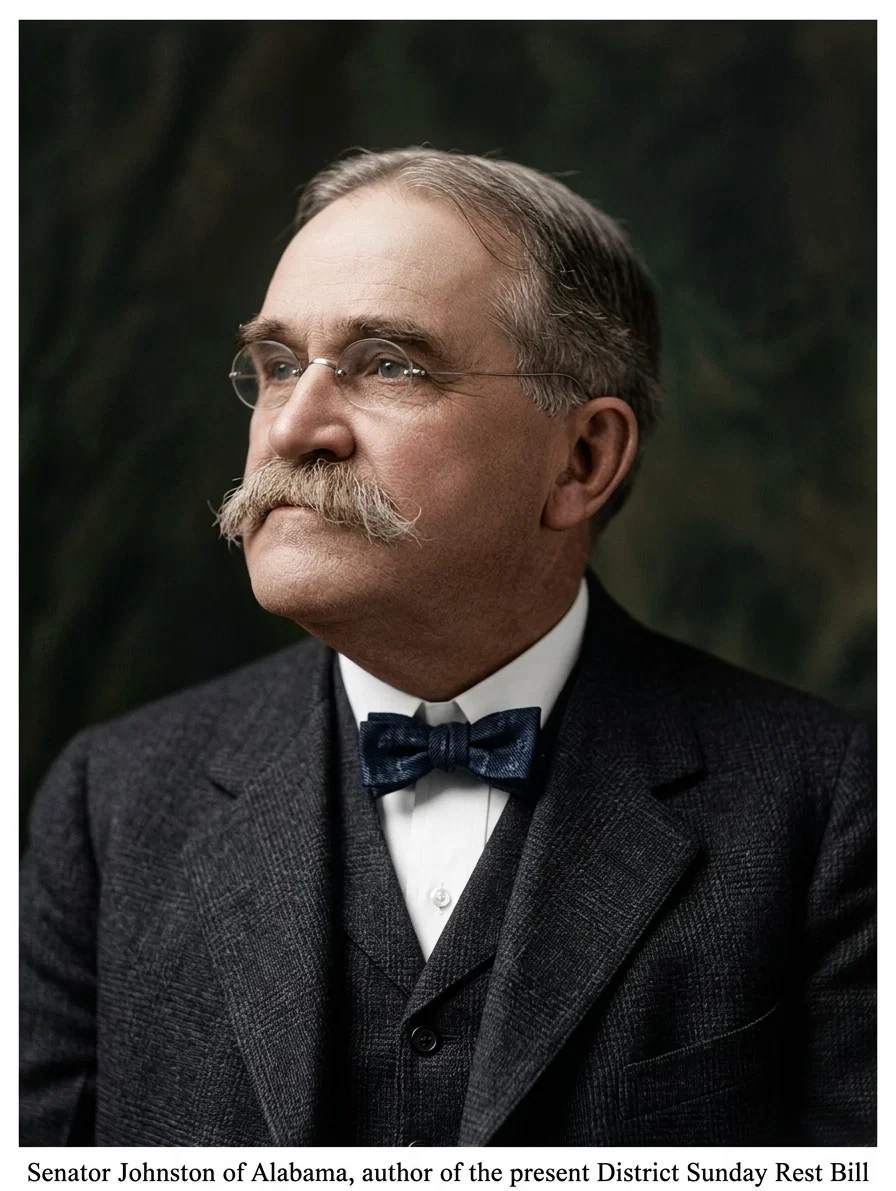
As stated in our former article, this bill was introduced in special session of the sixty-second Congress by Senator Johnston, of Alabama, April 6, of the present year. It is known as Senate bill No. 237; and according to precedent, it will be a live issue in the present session. See the center of this page for exact copy.

Our Ground of Protest

We do not oppose this measure, as has been supposed and alleged by some, simply because it selects the FIRST instead of the SEVENTH day of the week. While it must be apparent to every one at all familiar with the divine law that the bill does not name the day specified in that law, we would still be opposed to it if it did, believing that civil government has no right to attempt to enforce by law any religious institution or observance, even tho commanded by God, and exactly as God commanded it. We are opposed, upon principle, to all religious legislation on the part of civil government, and would not wish to see the religion which we ourselves believe and profess enforced by law upon others.
Neither is our opposition based, as some may suppose, upon the ground that we are looking simply to our own interests, pleading only for our own rights, or asking for special favors. This must be apparent from the fact that, as now worded, observers of another day than Sunday are exempt from the provisions of the proposed law. While we desire and appreciate protection from the Government in the exercise and enjoyment of our rights, we ask for no protection, liberties, or favors that are not, upon the same terms, freely accorded to all. Our plea is for the recognition and protection of the rights and liberties of all.
Our objections to this bill may be classified under a number of heads. In the first place, like all Sunday legislation,

It Is Religious

This is clearly indicated by its title; by its phraseology; by the exemption at the close of the first section; by the distinction it makes in days; by the character of its chief promoters; by the arguments adduced in its behalf; and by the nature of the Sabbath institution itself.
According to its title, the object of this proposed law is “the PROPER observance” of the day. God alone has a right to say what proper Sabbath observance is, as He has likewise to say which day shall be observed as the Sabbath.
The bill speaks of “Sabbath,” Sabbath “observance,” and “sacred concerts,” all of which are religious terms.
The exemption at the close of the first section exempts only upon religious grounds, and makes the observance of one day in each week, — if not Sunday, then some other day, — “AS A SABBATH,” compulsory upon all.
A bill for the proper observance of Sunday as a day of rest in the District of Columbia 1 Be it enacted by the Senate and House of Representatives of the United States of America in Congress assembled, 2 That it shall be unlawful for any person or corporation in the District of Columbia on the first day of the week, commonly called Sunday, to labor at any trade or calling, or to employ or cause to be employed his apprentice or servant in any labor or business, except in household work or other work of necessity or charity, and except also newspaper publishers and their employees, and except also public service corporations and their employees, in the necessary supplying of service to the people of the District: Provided, That persons who are members of a religious society Folio 2 1 who observe as a Sabbath any other day in the week than Sunday shall not be liable to the penalties prescribed in this Act if they observe as a Sabbath one day in each seven, as herein provided. 2 Sec. 2. That it shall be unlawful for any person in said District on said day to engage in any circus, show, or theatrical performance: Provided, That the provisions of this Act shall not be construed so as to prohibit sacred concerts, nor the regular business of hotels and restaurants on said day; nor to the delivery of articles of food, including meats, at any time before ten o'clock in the morning of said day from June first to October first; nor to the sale of milk, fruit, confectionery, ice, soda and mineral waters, newspapers, periodicals, cigars, drugs, medicines, and surgical appliances; nor to the business of livery stables, or other public or the use of private conveyances; nor to the handling and operation of the United States mail. 3 Sec. 3. That any person or corporation who shall violate the provisions of this Act shall, on conviction thereof, be punished by a fine of not more than ten dollars, or by imprisonment in the jail of the District of Columbia for not more than ten days, or by both such fine and imprisonment in the discretion of the court. 4 Sec. 4. That all prosecutions for violations of this Act shall be in the police courts of the District of Columbia and in the name of the District.
In protecting the rights of man in his relation to man, the law should offer the same protection every day of the week. This bill singles out Sunday, and makes special regulations concerning this day alone. But it is impossible to distinguish Sunday from other days of the week except upon religious grounds. The whole history and interpretation of Sunday legislation proves this.
The chief promoters of this bill are the Interdenominational Committee on Sunday Observance in the District of Columbia, consisting largely of clergymen of the city of Washington, and certain church leaders and Sunday Rest Associations throughout the country.
These promoters have stated in print that they desired such a law upon the ground that they wished “efficient LORD’S DAY legislation for the District;” that “the FOURTH COMMANDMENT has been repealed” here; and because of “the SUPPORT” which such a law, they say, would “lend to the cause of our national CHRISTIANITY.” In the discussion of the bill in the Senate, January 27, 1910, during the sixty-first Congress, Senator Gallinger, the chairman of the Senate District Committee, objected to changing the expression “Sabbath” in the bill to “day of rest,” saying, “Had I been in charge of the bill I would not have accepted the amendment offered by the Senator from Utah, because I think the word ‘Sabbath’ ought to remain in the bill.” —Congressional Record, January 27, 1910, page 1078.
Senator Johnston of Alabama, author of the present District Sunday Rest Bill
The weekly Sabbath is a religious institution, ordained by God as such in the beginning. See Gen. 2:1-3; Ex. 20:8-11. Any law requiring the observance of such a Sabbath must therefore be religious.
These facts all show and prove conclusively the character of the bill. It is religious.

Unconstitutional

Being religious, its enactment into law by Congress would be unconstitutional, for the Constitution of the United States expressly forbids Congress’s making any law “respecting an establishment of religion, or prohibiting the free exercise thereof.” This reason alone ought to be sufficient forever to debar Congress from passing any such measure. To this clause in the Constitution, no doubt, is very largely due the fact that for one hundred years Congress has refused to enact a compulsory Sunday law.
Other reasons against the passage of this bill will be presented in our next article.
—**—
Peace and War.—The Marquis de Castellane, Paris correspondent of the Hearst papers, truly says that Carnegie’s Temple of Peace is a record of war, and that every stone is belligerent. “Four campaigns have been waged since its inception, and the European atmosphere is still red.” When it was decided to build it the Anglo-Boer war broke out; with the adoption of the plans came the Russo-Japanese war; the first stone was laid on the day Kaiser Wilhelm started out for Tangier and inaugurated the Morocco-European complications. Austria emphasized the completion of the first story of the temple by grabbing Bosnia and Herzegovina. The finishing of the second story found France and Germany in trouble. The painters and decorators and furnishers are yet to come, and there seems to be more prospect of war than ever before. China is rent with civil revolution, and Turkey and Italy are in actual war. While it is said that the best artists are to adorn the ceilings of the Temple of Peace with allegorical pictures showing the triumph of peace, the marquis says each one may mean a shower of shrapnel somewhere. And this is in harmony with Scripture. They shall cry “Peace, peace,” the prophetic Word declares, when there is no peace. And another prophecy, that of Joel 3, strongly avers that the great preparation which the world will make in the last days is for war, universal war. Peace temples and war preparations and actual combat are all fulfilling the divine Word.

Reclaiming Mississippi Valley Swamp Lands

Vice-President Park, of the Illinois Central Railroad, estimates that the reclamation of swamp lands in the Mississippi Valley now under consideration by Congress will add a value of at least one billion dollars to the nation’s land wealth.
Continue reading: Revolution in China