Review and Herald Publishing Company · Battle Creek, Michigan · April 30, 1903
Our Favorite Steamship, the “Oceanic”
DURING the last one or two days, and specially during the last few hours, before the sailing of a great transatlantic steamship, hundreds of relatives and friends of the persons who are to sail, improve the opportunity offered by the courtesy of the shipping companies to visit the ship, and make a tour of inspection. To those who have enjoyed this privilege, a few facts concerning a first-class Atlantic steamer may be interesting.
During the year 1902 the majority of our missionaries traveled from New York to London by the “Oceanic,” of the White Star Line. For several years this has been one of our favorite steamers; for she is one of the largest, finest ships that sail the seas, and her second-class accommodations can hardly be excelled. Our missionaries have traveled between New York and Liverpool so frequently by this line that they have become well known to the managers; and every reasonable effort has been made to supply our workers with pleasant accommodations and a good vegetarian diet.
Figures and Facts
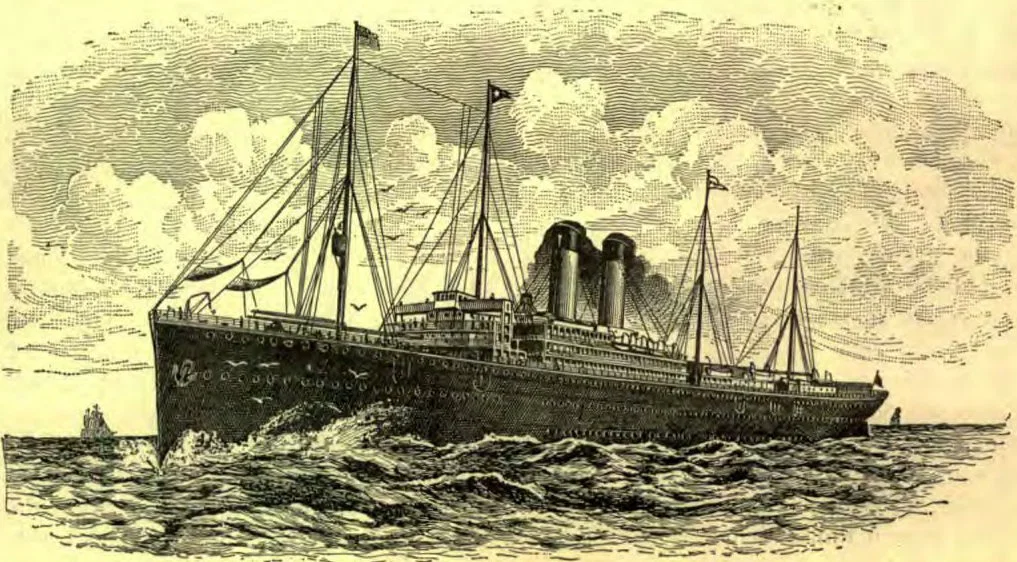
The accompanying picture represents the “Oceanic” at sea. If you wish to get a good idea of her size, take a measuring stick, and measure off the distances which I will give you, in your dooryard, if you find the yard is large enough.
She is seven hundred and four feet long, and sixty-eight feet wide, and weighs 17,240 tons. Sometimes this weight is called so many tons’ displacement; for the weight of the ship is the same as the weight of the water which is displaced by the ship. Her speed is from twenty to twenty-two miles an hour, and she requires between six and seven days to make the trip between New York and Liverpool. She carries about one thousand seven hundred passengers, and from seven hundred to nine hundred employees. There are six officers, twenty-six engineers, over four hundred stewards, and one hundred and twenty stokers. Besides these, there are sailors, painters, cooks, a doctor, two or three barbers, and many other helpers.
You will wonder that so many stokers are required to feed the fires on one steamship; but this is explained when I tell you that there are ninety-six furnaces, which consume about five hundred tons of coal each day. It is very hot in the furnace rooms, and the stokers work only eight hours a day. The one hundred and twenty men work in three “shifts” of forty each. Each “shift” works four hours, and then has eight hours’ rest.
THE “OCEANIC”
Second-Class Accommodations
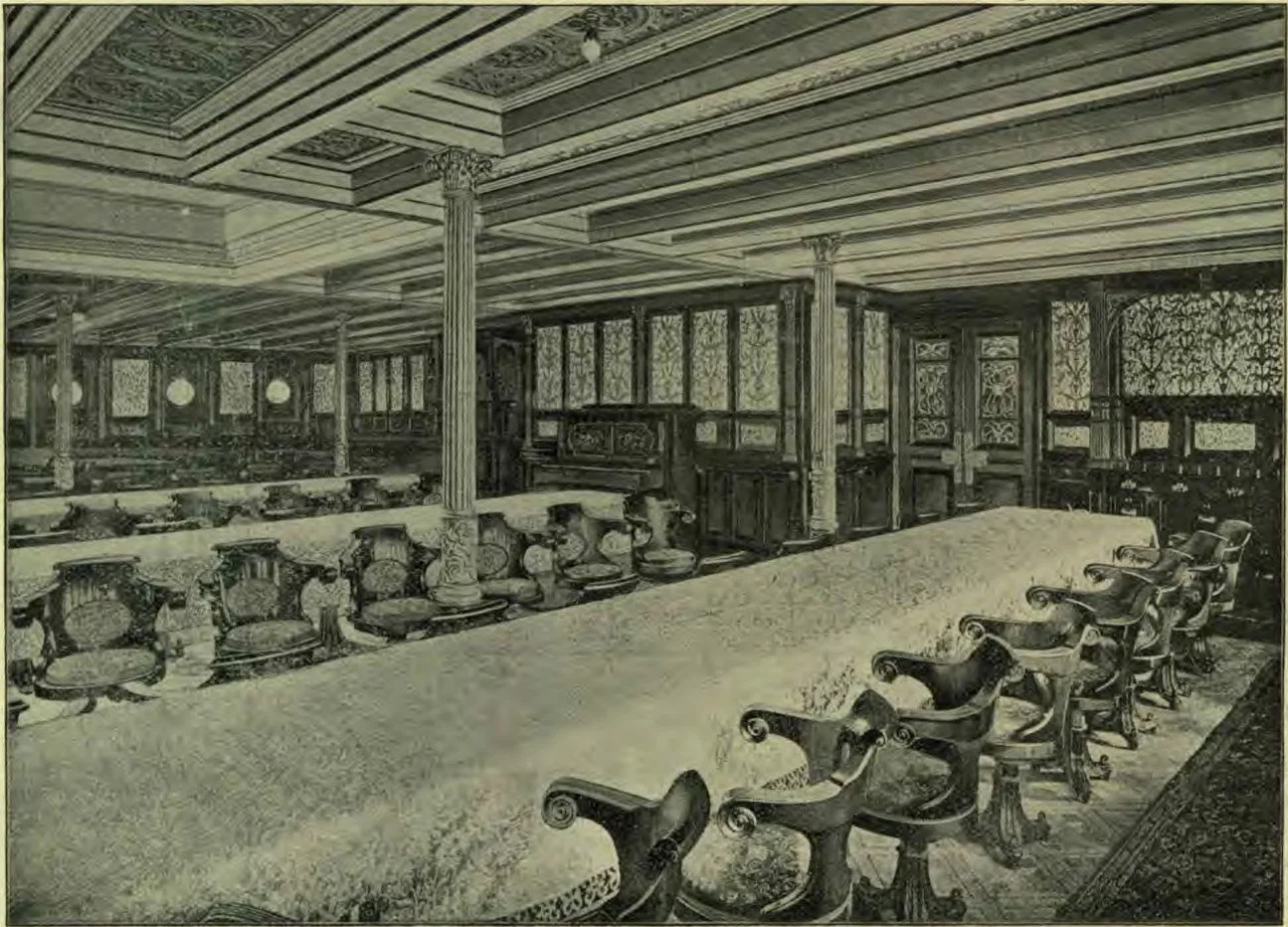
There are three main decks which are occupied by the passengers. The second-class passengers occupy a space about two hundred and fifty feet in length in the stern of the vessel. As our missionaries nearly all travel second class, I will describe that class only. On the lower deck is the spacious dining-room, which will seat comfortably at the tables about two hundred passengers. The accompanying picture is a photograph of the dining saloon; and the large table in the front is the one which was occupied by the delegates and missionaries who sailed from New York on April 30, 1902. Back of the dining-room are a large number of cabins. The second deck is occupied almost wholly by cabins, and the third, or upper, deck has in the center a smoking-room on one side of the central gangway, and a large, well-furnished library on the other side. With the exception of the small space occupied by these two rooms, the upper deck is clear, and is greatly enjoyed by the passengers for promenading, for games, and for lounging about in reclining deck-chairs.
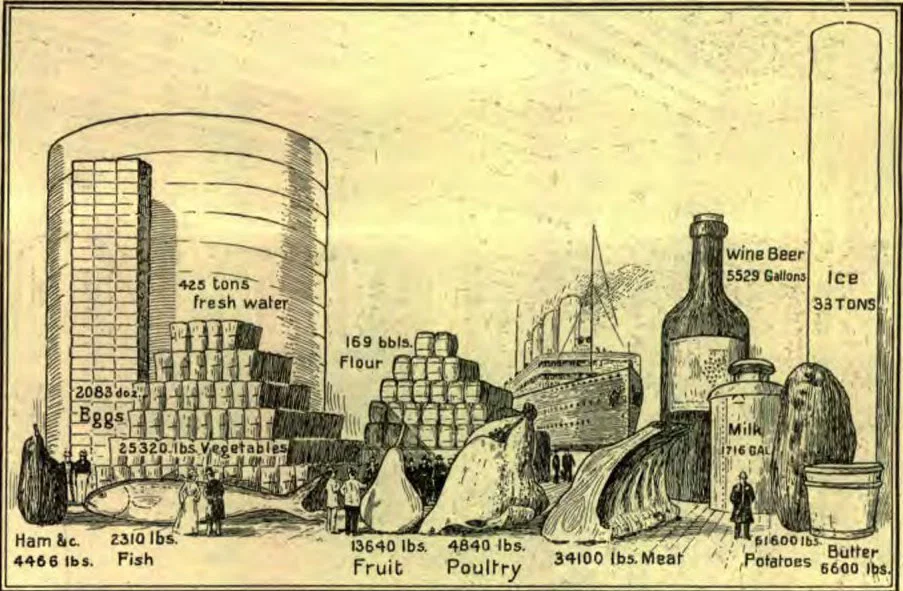
A GRAPHICAL COMPARISON OF THE PROVISIONS OF A TRANSATLANTIC LINER
Courtesy of The Scientific American (New York)
The Cabins
The cabins differ in size. They are usually arranged for two, four, or six passengers. The four-berth cabin is the most common. It is about seven feet high, six feet long, and six feet wide, with four beds, each about eighteen inches wide. There are two on each side, one above the other. While this space is very small, and exceedingly crowded when occupied by four passengers with all their luggage, yet in the “Oceanic” these cabins are so conveniently furnished that they seem quite comfortable after the first adjustment of things has been made. The ventilation is so perfect that four persons can sleep in a room without waking in the morning with the impression that they have been “shut up all night in a clothes-press or in a cupboard.” In fact, if it were not for the difficulty of seasickness, from which nearly all travelers suffer, one might be as comfortable on board a steamship crossing the Atlantic as in a first-class hotel.
A Grand Invention
A journey across the Atlantic is not now accompanied with such danger and with such painful experiences as described by Dickens and others years ago. As one beholds a fine steamer, proudly riding the waves, and battling with2the storms, he is impressed with the fact that the modern vessel is a grand invention. From year to year these ships have been improved in strength, comfort, and speed until they seem almost to have triumphed over wind and wave. It is stoutly affirmed that one of the safest places in the world to-day is in the saloon or stateroom of a first-class Atlantic steamer. Statistics go far toward showing that this is true. It is a remarkable fact that the steamers of the Cunard Line have never lost a passenger nor a mail-bag.
Provisions for a Voyage
We should not close this sketch without giving some idea of the quantity of food necessary to provision an ocean liner for a single voyage. The accompanying illustration, as well as the following paragraph, is taken from the Scientific American:—
“Not the least striking evidence of the size of these modern monsters of the deep is afforded by the vast quantities of food which must be taken aboard for a single trip across the Atlantic. For the fifteen hundred passengers, and the several hundred men constituting the crew, car-loads of food and whole tanks of liquids are necessary. To enumerate in cold type the exact quantities of bread, meat, and vegetables consumed in a weekly trip would give but an inadequate idea of the storing capacity of a modern liner. We have, therefore, prepared a picture which graphically shows by comparison with the average man the equivalent of the meat, poultry, and breadstuffs, as well as the liquors used. Each kind of food has been concentrated into a giant unit, compared with which the figure of the average man seems puny. . . . It must not be forgotten that in provisioning a liner an allowance is made for accidents, which may prolong a voyage many days. For that reason not all, but only the major portion, of the food taken aboard is consumed.” E. R. PALMER.
Experiences of a Medical Missionary
It is five o’clock in the morning. In our mission houses everybody is sleeping quietly. Not so in the near-by villages. The negroes, seldom counted as very diligent, are, however, up with the sun. Now some one is knocking at the door of my bedroom. Thinking I am called to attend to a very sick person, I jump out of my bed, dress myself in haste, and step out on the veranda. There I find Amega, a negro whom I know very well. He smiles, and shakes hands with me. I ask what he wishes so early in the morning, and he innocently tells me that he has come to thank me for the box of matches which I gave him yesterday. Now, really, I did not care much for Amega’s thanks, at least not so early, but could I scold this kind and thankful native?—No, I also smile, shake hands, and have a little conversation with him.
After he leaves, I hope to have a quiet hour by myself; but far from it! Half an hour later I hear a repeated knocking at my door. From inside I call “lalaviade!” (wait a little). Scarcely five minutes have gone by, and the same knocking is heard. And now I am reminded every five minutes that some one is waiting. At half-past six o’clock I unlock the door, and stepping out, I see about twenty persons gathered together, men and women, young and old. Everybody wants something of the missionary. Two or three have come to thank him for a small gift or service; others are sick, and will have medical treatment; some will buy medicine; a mother brings a child that is dangerously ill; several schoolboys want slates, chalk, books, and so on. In about an hour everybody is satisfied. Just when I am leaving the little hospital, a girl twelve years of age comes with a heavy load on her back. It is the mother of the child, who is stung by a scorpion. The pain must be intense, for she beats the ground with her hands and feet. To her, also, medical assistance is given, and now I can return to the mission house to eat my breakfast.
THE SECOND-CLASS DINING SALOON OF THE “OCEANIC”
While we missionaries sit at the table,—doors and windows are open on account of the heat,—the natives still gather. They have to wait now, but while they wait, a lively conversation arises among them, held sufficiently loud for us to hear. One of the women thinks that it is more comfortable to eat with the fingers; for there is not so much work to do. To this a gray-haired man replies: “Yes, but then I would like to have such a nice silver fork or knife to eat with every day.” While we are still at breakfast, a native comes with a trap, and shows us a large rat which he has caught, remarking that he is going to prepare himself a splendid meal. After the breakfast I try to satisfy those who have waited for me, and the other missionaries do the same.
At nine o’clock my teacher comes to teach me the Eohe language. This language is very difficult to learn, so much depends upon the pronunciation. Many words which are spelled alike have quite a different meaning when pronounced differently; for instance, ahá, palm-wine; or ahá, pig.
The Lord’s prayer in Eohe will give an idea of the language: “Hia To si ele dziwowo; Wo nko nuti nako! Wo faduwe nava! Woawo wo lolonu le anyigba dzi, sigbe alesi wowona le dziwo ene! Na miawe nuvuvu si asu mia nu egbe mi! Eye natso miawe vo dadawo ake mi, sigbe alesi miawo ha mietsona kea amesiwo da vo ve mia nuti ene! Eye megakplo mi yi de tetekpo me wo; ke de mi tso vo di to la si me! Ela.ena towoe nye fiadwoe kple nuse kple nuti-kokoe yi de mavomavo me. Amen!”
When, an hour later, I step to the porch, I have to do some business with ten load-carriers. From the coast they have brought provisions, oil, turpentine, medicine, and other things, carrying these in boxes on their heads. Now they are tired, and want their wages, which I give them after the goods are examined. How happy these carriers look, and how contented they are when they have a dollar’s worth of money in their fingers; for with this sum they can live from six to eight weeks. Some of the load-carriers hurry home, while the rest, four or five men, stay a little longer, and look around the room. I seize the opportunity to tell these heathen of God, who so loved the world that he gave his only begotten Son that whosoever believes on him shall not perish, but have everlasting life.
Meanwhile noontime has come. A servant brings the message: “Nuvuvu le kplo dsi,” dinner is ready. After our meal we retire to our rooms for a quiet hour of rest, or to read. The hours from two to five, every day except Sunday, are spent in the little hospital, dressing wounds, performing operations, extracting teeth, or giving advice. I talk to them as well as I can, and try to tell them of the best Physician, who can heal body and soul. From thirty to forty sick persons come daily from near-by villages and towns, and others whose homes are fifty or one hundred miles distant, stay in the hospital for some time.
After supper I take a walk with another missionary. We visit the heathen and Christians in a near-by village, have a lively and often interesting conversation or debate with them, and at the same time we learn more of the melodious Eohe language. When returning we must pass the schoolhouse. The schoolboys, younger or little ones, as well as some who are proud of a mustache, sit in the yard, joking and playing, and at times laughing as loud and heartily as only these Africans can. We bid them “good night;” for the night already draws near, and return to our home. The bright shining moon sheds a mellow light upon the earth, and in this light how beautiful the cocoa- and wine-palms, the eucalyptus, and the mango trees appear. From the heathen villages the dull beating of drums greets our ears. A day’s work is done. *
Trying to Tell the Exact Truth
“Do you think it is an easy thing to tell the exact truth? If you do, try it for a week. During that time, see that you do not either overstate or understate in any of your representations. For every failure fine yourself a nickel, and devote the amount to missions. But don't stop after a week's trial, though you may remit the fines.”
The Working of God's Power in Common Things
By Edison Driver
“SCIENCE needs no God,” declared a handsome, proud young university student the other day. “We account for all natural phenomena nowadays without bringing him into the question at all.”
By way of answer, the minister with whom he was chatting set a microscope on the study table, together with a glass of water, some little bottles of salt, alum, and other chemicals, and some slips of glass.
In a few drops of the water he dissolved a pinch of salt. In a few drops more he put some alum; and so on till he had a number of different solutions. Then he took a tiny drop of the salty water on a toothpick, and therewith moistened the center of a slip of glass in the microscope.
“Now,” he said, “look, and explain what you see.”
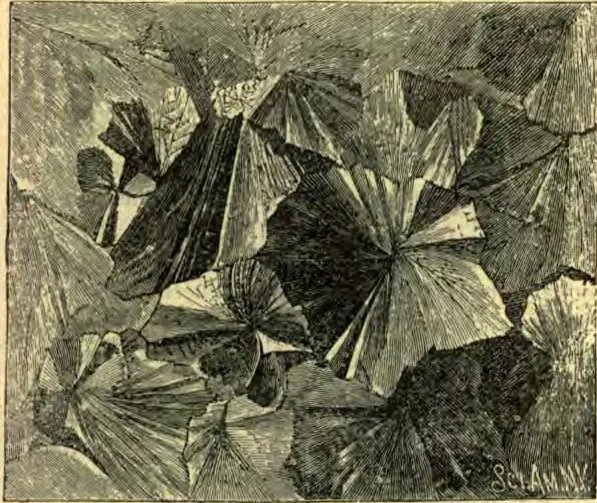
The young fellow tried the solutions, one after another; and this is what he saw: the tiny drops of water soon dried away; and as they dried, the chemicals in it crystallized into most beautiful forms—some like little pansies, some in little cubes and hair-like lines, some like moss, some in spires, some like ferns, but no two alike. Another drop of salty water placed by the first, crystallized in exactly the same way it had before. It could not be mistaken for any of the other chemicals, any more than President Roosevelt’s face would be mistaken for Abraham Lincoln’s. There were the crystal pansies, the crystal ferns, the crystal lines, every one declaring the chemical that made it.
SALICINE CRYSTALS
Chemists enjoy watching the process of crystallization, even though they have seen it a thousand times; for it is one of the most marvelous things in the world. So with the young skeptic. He forgot to answer the minister’s question for some time, but finally he said, “I see here the beautiful crystallization of salt, alum, potassium bichromate, lithic acid, salicine, and a number of others I can not name. It is very interesting to me.”
“Yes,” replied the other, “it is interesting. But tell me why the salt always forms in those short, chunky pieces, with just so many faces; why the lithic acid makes variegated plates; why the salicine gives little round discs,—can you?”
“Why, of course,” said the young fellow, “that is easy enough. Each chemical element or combination has characteristic properties, governed by laws; and in crystallizing it simply obeys those laws, and comes into the shape they direct.”
SULPHATE OF CADMIUM
The minister smiled at the answer. “Now, my friend,” he said, “just lay aside your ‘characteristic properties’ for a moment, and your ‘governing laws,’ and think of this little drop of salty water. Here are countless millions of little lumps of salt floating around, grinding together, mixing up—what happens? The water begins to dry. Those particles begin to arrange themselves like well-drilled soldiers. There is motion, there is just enough motion, there is intelligence to take each one of those little particles to just the place it belongs; and you look at it, and say: ‘Yes; those are salt-crystals.’ But tell me, if you can, what governing law there is to take each one to its right place in combination with millions of others. Each one shapes its action according to the action of all the others. Can it see them? Can it see what they are doing, and reason with itself that there is need for it in just such a place—a place it has never been before, and then move into that place? Does it know beforehand that it is to be part of a cube or a fern crystal or a pansy? Can science explain it?”
The young fellow thought a while, with a puzzled expression on his face, and finally said:
“No, it can not. I have never before thought of it in just that way, but I see you have the argument, plainly enough. There is an Intelligence behind the crystals, and I suppose I might as well recognize that it is the wisdom of the God of order. What an incomprehensible thought it is, that the great Maker of worlds is working right here under our very eyes to-night!” EDISON DRIVER.
An Intelligent Dog
By John Codman
LITHIC ACID
MANY years ago, says Capt. John Codman, in the New York Times, I was the second mate on the ship “Carolina” of Boston, commanded by Capt. Stephen Lemist. He had on board a fine black shaggy Newfoundland dog called Neptune. Nep was the pet of the men, as well as of his master. He had the full liberty of the quarter-deck, and sometimes availed himself of it by carelessly walking about on the taff-rail. We were bound to New Orleans, and were being towed up the Mississippi in company with four other vessels. Nep was walking on the rail as was his occasional custom, when he unfortunately lost his balance, and fell overboard.
It was impossible to stop without disarranging the tow, which the captain of the tug would not consent to do. So Captain Lemist and the grief-stricken crew were constrained to leave the dog to his fate. For a while he swam after the fleet, but finding that he could not keep up with us, he struck out for the western shore. The only satisfaction that we had was that his life was in no danger; for we were sure that he would reach the land. As for ourselves, we mourned that we had forever parted company with our dear shipmate, and the captain, as I can see him now, laid his head upon the binnacle and sobbed like a child.
We were about fifty miles below New Orleans at the time of the accident, and in a few hours were berthed at the levee, where we remained for three days discharging our cargo. A freight of cotton and tobacco for London was engaged, and we were towed up to Lafayette, some three or four miles above, to take it in, and were berthed the third outside in a tier of vessels, the cargo being carried on planks over the decks of the others. One morning after we had been there two days, as we were busily engaged at our work, to our utter astonishment Nep walked on board!
It is almost needless to say that our joy equaled his own. Wagging his organ of recognition, as a dog’s tail has been so aptly termed, and crying in a dog’s language of delight, he jumped upon every one of his old friends, entirely ignoring the stevedores, whom he did not know, and then rushed down the companionway in search of the captain, who did not happen to be on board. Then he came on deck dejected and wobegone, taking no further interest in any of us, beyond casting about his inquiring looks. I expect to be believed, for I am telling the truth, when I say that the big tears stood in his eyes. The captain had gone ashore to his consignee’s office in the city, as the chief mate knew. “Come, Nep,” said he, “come along.”
Nep understood him readily enough, and followed him down to the office, where he was clasped in his fond master’s arms.
There is not a particle of fiction in this pathetic story. How Neptune found his ship was beyond our ken; we merely guessed that he had traveled fifty miles up the river till he came to the ferry, crossed over to New Orleans, and then found his way up to Lafayette, walked over two tiers of ships, and reached his old home again.
— Jennie G. Clarke
By Jennie G. Clarke
Secrets
WHAT is the secret the pine-trees know
That keeps them whispering, soft and low?
All day long in the breezes swaying,
What can it be they are always saying?
The nodding daisies deep in the grass
Seem to beckon me as I pass.
What have they that is worth the showing,
Out in the meadow where they’re growing?
If I listen close where the brook flows strong,
I can hear it singing a low, sweet song.
Is it just because of the watch it’s keeping,
There where the baby ferns are sleeping?
The sweet, white clovers out in the sun
Have told the bumblebees, every one,
And high in the maple-tree swinging, swinging,
Loud and clear is a robin singing.
Is the flower’s secret for bird and bee,
And not for a little girl like me?
— Jennie G. Clarke
Lesser Duties Give Way to Greater
By Phillips Brooks
LESSER things will drop out as the hand closes upon the larger duty or the greater blessing, just as the hand that reaches out to grasp the great, strong oak lets go its hold on the blade of grass it had gathered.—Phillips Brooks.
The Bible in the Missionary Meeting
By Belle M. Brain
THE greatest of all missionary books is the Bible. Without it there would be no missionary work. The most helpful of all missionary libraries is the “little library of sixty-six small books, usually bound together as one great Book, which has been the inspiration of every missionary and missionary worker since the world began.”
Too little use is made of the Bible in the missionary meeting. Frequently where the most elaborate preparation is made for the remainder of the program, little or no thought is given to the Scripture lesson. It is true that reading the Bible at the opening of the missionary meeting is an almost universal custom, but too often it is done merely as a matter of form, and not with the definite purpose of accomplishing something. The idea seems to prevail that if the Bible is read, no matter how, a holy service has been performed, and a blessing is sure to follow. Yet to be effective the Scripture lesson must be carefully and prayerfully selected, impressively read, and its teachings forcibly applied. Otherwise it will make but little impression, and leave scarcely a memory behind.
The writer recalls a missionary meeting where the Scripture lesson, selected hastily at the last moment, was read in so perfunctory a manner that less than half an hour later, when a test was made, not a single person present was able to tell what had been read! It was one of the most striking missionary passages in the Bible, yet it had made no impression whatever.
On another well-remembered occasion a missionary worker of no little prominence was asked to read the Scripture lesson at a missionary conference. The passage selected was obscure, with seemingly no bearing whatever on the cause of missions. As he made no comment and drew no parallels, his hearers are still in ignorance of the lessons he intended to convey. Selecting inappropriate passages is, unfortunately, not an uncommon failing. The writer recently heard of a leader of a children’s mission band who opened her meeting by reading an entire chapter from the book of Lamentations!
Instances such as the foregoing, which could probably be duplicated by any one in the habit of attending missionary meetings, show the careless and ineffectual way in which the Scriptures are used. The result is that there is a great loss of power.
The Bible in the Devotional Service
There are many profitable ways of using the Bible in the devotional service of the missionary meeting. The wise leader will sometimes use one, sometimes another.
To be effectual, the Scripture lesson need not be long. Sometimes a single text, followed by a few pointed remarks, will make a deeper impression than a whole chapter aimlessly read. For example: “Carest thou not that we perish?” Mark 4:38. These words of the disciples to the Master on the Sea of Galilee may well be taken as the cry of the forty million heathen who die every year in foreign lands. Forty million will die during the ensuing year. They are passing away at the rate of one hundred thousand a day. Every tick of the watch sounds the death-knell of a heathen soul. With every breath we draw, four souls pass away never having heard of Christ. Carest thou not that they perish?
Uniting two texts somewhat similar in thought sometimes impresses a stronger lesson than using either alone. For example:—
“I must be about my Father’s business.” Luke 2:49.
“The king’s business required haste.” 1 Sam. 21:8.
“See that ye refuse not him that speaketh.” Heb. 12:25.
Following the Scripture lesson with a few terse questions is an excellent way of concentrating thought upon it and bringing out its teachings. The following questions on 1 Cor. 16:2 have been suggested:—
How often are we to give? (Upon the first day of the week.)
Who are to be givers? (Every one of you.)
What method should be used in giving? (Let every one of you lay by him in store; that is, set apart a certain portion.)
What is to be the measure of Christian liberality? (As God hath prospered.)
It is sometimes a good plan to call upon the society to give the Scripture lesson. Either with or without previous notice, let the leader ask those present to name some of the things given to God by prominent Bible characters. (Isaiah gave himself, Hannah gave Samuel, the widow gave her mite, the little lad his “five loaves and two small fishes,” Dorcas her needle, etc.) This is a most helpful lesson. For another meeting those present may be asked to repeat some of the promises to which Judson referred when he said: “The prospect is as bright as the promises of God.”
A very effective lesson, contrasting the idols of the heathen with the Jehovah God of the Christian, may be given as follows: Read Isa. 40:9-31, describing the majesty and power of God, and give special emphasis to the words, “Behold your God!” Verse 9. Then, holding up an idol, say, “Behold the heathen’s god!” and read Ps. 115:4-8.
Studying the Bible as a Missionary Book;
In addition to reading the Scriptures during the devotional service, it would be well for every missionary society to devote some time to the systematic study of the Bible as a missionary book. Because so few have done this, the average Christian has no clear conception of the place of missions in the plan of God.
Half an hour, or even a quarter of an hour, devoted to a systematic study of the Bible in the missionary meeting would be a blessing. The result would be a band of strong and reliable workers, able to give a reason for the hope that is in them, and standing strong in the faith that the day will come when the kingdoms of earth shall have become the kingdoms of our Lord and of his Christ.—Belle M. Brain, in Missionary Review of the World.
The Otis Church School
By Isaac Schmidt
THERE is nothing more a blessing to me than the church school. In studying the geography lessons I must say that the Bible and the YOUTH'S INSTRUCTOR go hand in hand. These lessons are especially interesting because they tell us just where the love of God needs to be preached.
This church school is doing missionary work for the Lord every Friday. The Lord is blessing the work, and every one is glad to work in the cause. Last Friday we distributed 774 pages of tracts. We have sold a number of copies of The Life Boat, which was a great blessing to us.
We are now nearing the end of our school, and my desire is that the glory of God may rest upon us, and that many young people in the State may be prepared for the work of God. The Lord is calling for the youth. Why not follow him, and have a treasure in heaven?
ISAAC SCHMIDT.
THE WEEKLY STUDY
By E. H.
May Study of the Field
(May 3-9)
Suggestive Program
1. OPENING EXERCISES:—
Singing.
Prayer.
Scripture Reading.
2. Field Study:—
(a) Spain, the Land of the Inquisition.
(b) Dialects of China.
(c) Rhodesia.
(d) The Message in Japan.
(e) Two-minute reports from Barbados, East Caribbean Conference, Society Islands, England, Brazil, Colombia, Finland, Fiji, Iceland, Central India.
3. Closing Exercises.
NOTE.—The material for the study this month will be found in the issues of the Review of March 31 and April 7 and 14. The two-minute reports can be made very interesting if five or ten different persons are asked to prepare beforehand on one or two different fields, so that the reports can be given in quick succession, the leader or some one pointing out each place on the map. Let the speaker tell in a brief sentence or two the fact from the field which impressed him the most. This exercise will also be a profitable drill for the young people. It is valuable to be able to state a fact in a brief, but concise and comprehensive manner.
The article, “The Bible in the Missionary Meeting,” is very suggestive. The leader may glean some thoughts that could be presented in the meeting with profit, and which will lead all to see more and more the place of missions in the Bible, and of the Bible in missions. E. H.
Oklahoma Church Societies Report Membership and Activities
Oklahoma
Two Societies have reported. The one at West Cooper has a membership of sixty-five. At Oklahoma City there are fifteen members. At the latter place meetings are held each Sabbath afternoon, and the INSTRUCTOR lessons studied. The members are supplying reading racks with our denominational literature.
Missions the Table Talk
LETTERS received every day in our Mission Board office show that God’s people are taking a firmer hold on his work than ever before. It is becoming more and more a part of their lives.
A brother sending three dollars and a half to the Mission Board wrote that their table talk at breakfast that morning had been about our Nyasaland mission, and as a result, a friend visiting them became so interested that he added one dollar and a half to their family contribution of two dollars, all of which was inclosed.
What could be more beautiful or more pleasing to heavenly angels than such a scene — gathered around the family board, enjoying God’s bounties, with thoughts all turned to the great work in the earth? This is the way genuine missionary characters will be developed.
Children will have no desire to spend their pennies foolishly, nor, as they grow older, to engage in worldly enterprises, if the needs and the abundant opportunities in the great fields beyond become so familiar and are made so interesting. In such a home there will be not only an increased interest in missions, but deeper spirituality and greater liberality, and even more—converted children, who will be ready to respond to the Macedonian call for help, “Here am I; send me.” The progress of the third angel’s message will become the topic of our conversation when it is the one aim of our lives.