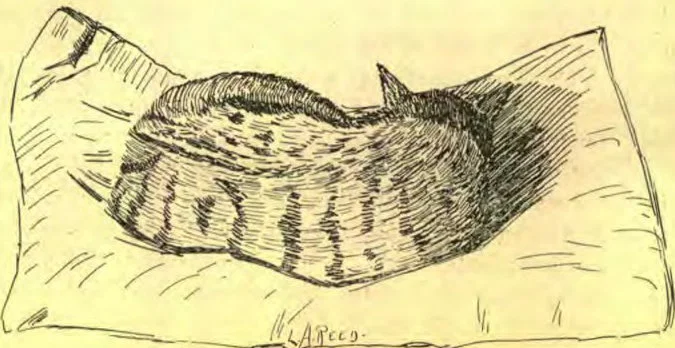
TWENTY little servants
Has Johnny, all his own,
Not brownies, elves, nor fairies,
But sturdy flesh and bone.
They crave in winter, raiment;
In summer they go bare,
No further pay they covet
Than work and play to share.
They’re faithful little servants,
They never disobey;
They’re never rude to Johnny,
And never in his way.
They do as Johnny bids them;
They go where Johnny goes,—
His ten little fingers,
And his ten little toes.
ELIZABETH ROSSER.
“Grip,” the Talking Crow
By Eudora Black
“Grip” was his name. He was so called in honor of the talking raven immortalized by Charles Dickens. Ever since I read of the original Grip, I longed to possess a raven. But there were no ravens in the country in which I lived, and the next best thing was his cousin, the crow. I had heard and read of crows becoming interesting pets; in some instances, of their learning to articulate a few words after having had their tongues split,—a cruel operation, which I did not believe gave them the power of speech. It seemed as unreasonable as it was cruel, and I want to say that my pet was never subjected to such torture. He learned to talk by using his tongue as nature fashioned it.
Grip came into my possession in this wise: One day in April I chanced to meet two boys who had been robbing and destroying crows’ nests, thinking they were doing a kindness to the farmers by exterminating the robbers of their corn-fields. I had long believed that the crow was not so black as he was painted, and that for every kernel of corn he stole, he destroyed many grubs and insects, which would have injured the crops far more than the bird could have done in all his depredations.
A sorrier object I never saw than this poor kidnapped baby crow, crouching in the folds of a ragged and tattered old hat. He was very ugly in his half-fledged feathers, with large head and long beak, but he looked so pitiful that my heart went out to him at once.
As soon as I had reached home, I placed him in a good-sized chicken-crate under a large pine-tree in the front yard, where I fed him bread and milk, which he gulped down greedily. I kept him in the crate for several days, feeding him often. When he saw me approaching, he would spread his wings, open his mouth, and shrilly caw for something to eat. His appetite was voracious. He would eat anything given to him,—meat, bread, cake, fruit, eggs, all went greedily into his gullet. I wondered how the parent crows ever filled the maws of a hungry family.
Grip, as I called him, soon grew quite tame; so I left the door of his house open, and he went in and out at pleasure. He showed no disposition nor inclination to wander away, but spent the day hopping around the large yard, hunting worms and insects, pulling the long grass, and carrying about little sticks in his beak. He came to me readily to be fed from my hand. At night he would go into his house to bed, which was a perch, just as a chicken would go to roost.
Grip’s babyhood did not last long. He grew so rapidly that in three weeks he was a full-fledged crow, with beautiful glossy black feathers, of which he was very proud.
SOLID COMFORT
He bathed regularly every morning in a pan of water I kept under the tree for him, and how he would dress and preen his feathers! He was, in truth, a handsome bird, and well he knew it. He could fly, and the chicken-crate no longer served him for a bedroom. He found one more to his liking in the pine-tree. The chicken-crate, alas! became his prison at times; for he had begun to grow very mischievous. On the family wash-days he had to be shut up, else all the clothes-pins would be plucked from the line. Small articles, also, such as collars, handkerchiefs, and the like, would be missing. We soon learned that Grip was a cunning thief. He would fly into the house, snatch up a spoon, or any other bright object he could carry off, and take it to some secret hiding-place.
A large bed of pansies near the house, which was my pride, was his especial delight. Every morning I would pluck the blossoms, which were so like little faces that smiled up to me. Grip was always on hand to assist me; but he would ruin every flower by snipping it off, and he did it so spitefully, I knew that he was jealous of the flowers I loved.
“Go ’way, Grip, go ’way,” I would say to him, sometimes using a little switch to drive him off. The moment I was out of sight, however, down he would swoop again into the pansy-bed, and “snip, snip,” would go their heads. There was scarcely an hour in the day when some one was not calling out, “Go ’way, Grip, go ’way;” for the whole family kept watch over those pansies.
At times Grip would be very loving. Alighting on my shoulder, he would cuddle down close to my face, uttering soft little croaking notes. Then he would slyly pull the pin from my collar, and begin snatching at the hairpins in my braids. At other times, when I called him, he would not come to me, but would alight near me, and look at me so impishly while I coaxed, “Come here, Grip; come, Grippy, come here.”
One day I was coaxing him thus as he hopped along on the top board of the fence. He put his head down and seemed to be choking and swallowing. After several such spasms he uttered the words, “Go ’way, Grip, go ’way,” very distinctly. I could hardly believe my ears. Grip, my crow, could say three words: “Go ’way, Grip.” For a long time he had chattered and made guttural noises; but now he could talk! He soon learned to say, “Go ’way, Grip,” without effort, and not long after that I heard him say, “Come here, Grip; come, Grippy, come here,” in the same coaxing tone I used to him.
Rainy days were his delight. Then he held high carnival on the woodpile, where he would chatter and laugh, coax and scold, by turns: “Come here, Grip, come here,” in a soft, coaxing tone; then harshly, “Go ’way, Grip, go ’way.” It sounded as if two children were quarreling.
Later he learned to say, “All right,” “Hurry up;” and almost any hour in the day he might be heard, if not seen, practising his new accomplishments.
He would scold the dog, “Go ’way, go ’way,” in so human a voice that Towser would sneak off with slinking tail. Once I heard Grip scolding in a furious manner. He was perched on the garden gate. Towser was gnawing a bone. Grip continued his angry “Go ’way, go ’way,” until the poor old dog actually left his bone, and walked off with an injured air. Mr. Grip then flew down and took possession of the bone, chattering, screaming, and laughing, “Ha, ha, ha!” over his victory.
The cat, Tom, a fine Maltese and a household pet, received his share of Grip’s teasing. When he was lapping his supper of new milk, or dozing peacefully, Grip would slip up behind him, and give his tail a tweak. Puss would utter a distressed yowl, and spring up with swelling tail, and green eyes flashing with fury. It was well for her tormentor that his strong wings could take him out of reach.
The chickens, too, were often annoyed by this busy mischief-maker. I feared he might kill the little chicks, but he never harmed them. He was not cruel, and was only teasing out of pure mischief.
This he accomplished with the fowls by swooping down upon them like a hawk, brushing them with his wings as he flew by, causing a great cackling and flurry among them, which excitement he greatly enjoyed. Again, he would startle them by loud cackling such as theirs.
How can I relate all of Grip’s pranks? He was so busy each day! A favorite occupation and diversion of his was to go into the cellar, where, on a swinging shelf, the old bottles were kept. He would spend hours pulling corks, and rolling the bottles about, chattering and talking to himself.
All bright trinkets attracted his attention. One day my little sister sat in the window, counting the pennies in her purse. Grip flew upon the window-sill, and watched the operation. She jingled the pennies and shook them at him, then dropped them one by one into the purse, closing it with a snap-catch. I cautioned her, but too late. Grip had been watching his chance. In a twinkling, and quicker than lightning, he had snatched the purse and flown away with it to some secret hiding-place. Long afterward we found the purse, together with a long-missing thimble, a spoon, several button-hooks, and other small articles which he had pilfered, hidden snugly away in the hollow of an apple-tree far out in the orchard.
When the pansy-bed was raked over in the spring, we found there an assortment of his treasures, consisting of bits of glass and china, nails, corks, and hairpins. All these he had secreted there. It seemed that the things he valued most, or that he feared we would take from him, he had cunningly hidden in the tree.
Grip was particularly busy when the fall harvest of fruits and vegetables was being garnered, going back and forth continually between field or orchard and cellar with the men. He always took a great interest in the barn-chores, following the men about as they cared for the dumb and faithful creatures. Now and then would be heard Grip’s voice saying, “All right,” “Hurry up.” Perhaps he would be circling high overhead. It caused one to have a strange and uncanny feeling. He would perch on the orchard fence when the horses were turned out to graze awhile every evening, and call: “Cope, Coaly! cope, Coaly! cope, cope, cope!” as he had heard the men halloo to the horses.
During that fall I taught the district school, half a mile from home. It was a pleasant walk, in good weather. Grip was on hand6to see me safely on my way each morning. He would hop or fly along, or ride on my shoulder, until he came to the bridge which spanned the creek just half-way to the schoolhouse. Then he would fly up into a tall willow-tree bending over the water, and wait for me.
One morning, however, he alighted on the window of the schoolhouse, tapping loudly with his beak upon the glass to be let in. The children all knew Grip. He was famed throughout the neighborhood for his powers of speech and his cunning pranks. Immediately the hands went up to beg permission to let him in, with promises to be good and to study hard.
The unanimous request was granted, and Grip flew to my desk and began picking up pencils and pieces of chalk. Then he went from one desk to another, looking for more pencils. No doubt he thought he had struck a rich field. I must confess that lessons were forgotten, so intent were the children in watching this strange bird, which hopped from desk to desk and peered into their faces in such a curious way.
When it was time for recess, Grip had a merry play with the children, who knew how to entertain him. They fed him choice titbits from their dinner-pails, drove little sticks into the ground for him to pull out, and gave him their handkerchiefs to pull by the corners. These he would tug at and pull until he “was black in the face,” as one little girl remarked, and then he would hang tightly on, beak and claws, and be swung in the air.
When the bell rang, in he came again with the children, and perched upon my desk, as much as to say: “Well, what next?” When we sang, he cawed loudly with delight. At the end of the song, when all was quiet and lessons resumed, he began talking, saying, “Go ’way, Grip, go ’way.”
It was useless to try to teach school with Grip there, so, like Mary’s little lamb, he was turned out. He did not, however, like the lamb, linger patiently about, but winged his way home. On my return that night, there he was, my faithful sentinel, waiting as usual for me on the top bough of the willow-tree.
After that he was a frequent visitor at the schoolhouse. He came in time for the forenoon recess, and when school was called again, not being allowed to enter the building, he soared off home.
The children learned from him lessons not to be found in books—of how there is much to learn from even the lowest of God’s creatures. In the Spring there was no robbing of birds’ nests in that school yard; not a stone was thrown to frighten birds away. Grip’s friendship inspired them with a love for all bird-kind, and a desire to study their ways and habits.
By and by the winter days were upon us. Grip seemed to enjoy the cold and the snow. Instead of water-baths he now took snow-baths. He would skim along over the snow, just brushing it with his wings, then take a plunge, wallowing in it as though he were in his accustomed water-bath under the pine-tree. Much of his time on stormy days was spent in the barn with the men. Often he would be seen sitting on Coaly’s back, warming his feet. He liked to come into the house whenever the nuts which he had helped me gather were being cracked.
When the time came for him to go to roost, he would watch his chance to fly out at the door and hie away to his pine-tree. One stormy night I nailed a perch high up in one corner of the woodshed. I then called Grip to my shoulder, from which he readily flew to the perch. After that he came every night at dusk to be put to bed in the same way. He slept there through the cold winter nights, well sheltered from the storms.
March came, and Grip was often seen circling around overhead with a flock of crows that frequented the place. I wondered if he would not select a mate and set up housekeeping in his pine-tree, and rear a family of talking crows. He was becoming more fluent in our language, every now and then adding a new word to his vocabulary, until it consisted of the following: “Go ’way, Grip, go ’way,” “Come here, Grip; come, Grippy, come,” “All right,” “Hurry up,” “Cope, Coaly, cope, Coaly, cope, cope,” “Hurrah,” and other words that were not quite plain enough to understand, but which, no doubt, he would have mastered in time.
But, alas! he came to an untimely death. One night he failed to meet me at the willow, upon my return from school. No one had seen him that afternoon.
I found him in a shed, crouched upon an old barrel, looking very sick and miserable, and with green stains upon his bill. The can of Paris green was found overturned in the barn, and that told the story. The poor fellow had been eating the poison. He refused food, uttering plaintive little croaks as I stroked him and said “Poor Grippy!” I left him for the night, hoping his crow constitution was strong enough to resist the deadly poison.
In the morning I found him sitting as I had left him, but no soft croak greeted me. He was cold and stiff. Do you wonder that my tears fell freely, and that I felt no shame in weeping for a dead crow? Free as the air, he had been my willing captive, preferring to live among human beings rather than among his own kind. He even tried to learn our language. He was a thief and marauder by birth, yet he had proved his possession of affection, intelligence, and cunning, far beyond my understanding of his wild nature.—Eudora Black, in St. Nicholas.
Three Hausa Proverbs
“REPENT to God; leave off repenting like a wildcat. It repents with the fowl in its mouth; it puts it not down.”
“He who fasts, but at the same time eats in secret, I have no doubt but that you may call him a heathen.”
“Whoever chooses this world rejects the choice of the next; he seizes one cowrie, but loses two thousand cowries.”
Customs of Korean Boys
ONE sees a good deal of the boys in Korea, for they play on the street. The little girls are kept inside after they are eight or nine. If they do come out, they have to cover up their heads and faces with a big veil. This “veil” looks like a big kitchen apron thrown over the head, and held in front under the chin, just allowing room to peek out.
Well, these boys generally wear long red coats fastened to one side. Their clothes are tied on—sometimes buttoned, but that is a luxury. They do not know what pins are. Then the hair is always in a braid down their backs. When they marry, the hair is done up on the top of the head in a queer little knot. A very tight band is worn, coming over the forehead, and then—but never till then—they wear a hat. Before the hair is done up, they always go bareheaded.
Little Korean boys do not wear any clothes at all in summer-time. In winter they wear very wide, clumsy trousers, caught in at the ankle, and straw and wooden shoes. Their clothes are so heavy and clumsy that they can scarcely walk. From being tied to some one’s back when a baby, almost every Korean is bow-legged. When boys come to our church, where do you think they like to sit?—Why, right up in front, as near to the preacher as possible, and they are quiet and listen very attentively.
You know we sit on the floor in church in Korea. These boys very seldom have any money for the collection, and they seem really sorry; but money is very scarce among the poorer classes, and probably they never had any of their own. One day I went with one of the missionaries into a courtyard, and we had a meeting just with boys. We had the little organ, and soon the boys came in from the street. Some of them did not know what a prayer was; but when they were told, they all shut their eyes through quite a long prayer in Korean. Then we gave each a card to take home, on which was a verse written in Korean.
The boys are never rude to us. Sometimes they call after me on the street, saying: “Lady, where are you going?” But that is Korean custom,7and quite polite. It is also Korean custom to answer: “Yes, where are you going?” When we say that, they think we have been quite polite and nice to them.—Great Thoughts.
No Remainder
By John W. Nelson
“SEVEN sheep were standing
By the pasture wall;
Tell me,” said the teacher
To her scholars small,
“One poor sheep was frightened,
Jumped, and ran away;
One from seven—how many
Woolly sheep would stay?”
Up went Kitty’s fingers—
A farmer’s daughter she,
Not so bright at figures
As she ought to be.
“Please, ma’am—” “Well, then, Kitty,
Tell us if you know.”
“Please, if one jumped over,
All the rest would go.”
—John W. Nelson, in Little Chronicle.
What We Can Learn from the Rain
EVERY rain-drop that splashes down teaches us of God’s care; for it seems to say, “I have been sent by your Heavenly Father to make the grass grow and bring you bread to eat.” When you feel impatient because the rain spoils your plans for play, remember every rain-drop brings strength to play and work.
The rain-drops teach us about God’s mercy; for he “sendeth the rain on the just and the unjust.” Suppose we got rain only when we had done not the slightest thing wrong. How many of us would starve! But God has pity on our weakness, and feeds us with the hand that we strike by our disobedience.
Sometimes when it is raining, and the sun is shining, you can see the beautiful bow spanning the heavens with its bright colors. Some silly people used to believe that if one walked to where the end of the rainbow rested on the earth, he would find a pot of gold.
There is something better than a pot of gold under the rainbow—God’s promise is there that the world shall never be drowned again, and his faithfulness to his promises makes us feel safe.
Look closely into the rain-drop, and see if it does not tell you three lessons,—God’s care for your body, God’s mercy to the sinful, God’s faithfulness in keeping his promises to you.—Junior C. E. World.
An African's Description of the Railway
A NATIVE of Uganda, who accompanied the prime minister on his way to the coronation of King Edward, wrote to his friend about the Uganda railway, giving the following description of it: “My friend, I can tell you the Europeans have done a marvelous thing to make the railway and the trains. They fasten ten or fifteen houses together, and attach them to a fireplace, which is as big as an elephant, and the road it goes on is as smooth as the stem of a plantain. It goes as fast as a swallow flying, and everything you see outside flies past you like a spark from a fire. If it were to drop off one of the bridges, not one in it would be saved; for it goes dreadfully quick. The hills it passes are as high as those of Koki, and they have bridged over great valleys so deep that you can not see the bottom when you are going over them.”
INTERMEDIATE LESSON
VI — The Quails Sent; Miriam and Aaron Murmur against Moses
The Lord brought Israel out of Egypt that they might worship him. He had given them the manna every day, and brought the fresh, sparkling streams from the rock, that they might drink. In so many ways he showed them his loving care for them. But just after they left Sinai, where the love of God for them had been so tenderly manifested in giving the law and in providing food for them, they again began to murmur. “They spake against God; they said, Can God furnish a table in the wilderness? Behold, he smote the rock, that the waters gushed out, and the streams overflowed; can he give bread also? can he provide flesh for his people?”
God had provided the very best food for them all these months, but they wanted something different. God gives us, even the children, the very best things for us; but sometimes when we are determined to have our own way, he permits us to have it, just as he gave the children of Israel their own way, to teach us a lesson.
They wanted flesh, although they knew that it was not good for them, and he gave it to them, not for a day, or two days, or a week, but for a whole month. They were so glad to get the flesh, that when the Lord sent the quails into the camp, they “stood up all that day, and all that night, and all the next day, and they gathered the quails.” They preserved that which they could not use by drying it, so that they had enough to last a whole month. But while they were still eating the flesh, the Lord permitted a great plague to come upon them, and a large number died.
We can all learn a lesson from this; first, that God sometimes permits us to have our own way, because nothing else will satisfy us, but when we do this, we suffer the consequences. The best way is to do that which we know pleases him. Then again he has told us what is good food, but he does not compel us to eat it; but if we partake of those things which are harmful, we may expect to suffer the consequences.
This experience occurred while they were encamped at Kibroth-hattaavah. (Find this place on the map, and trace out the travels of Israel thus far.) The next place of encampment was at Hazeroth. It was at this place that Miriam became a leper. We all remember how Miriam guarded her baby brother when he was hid in the rushes of the Nile. That brother was Moses. Miriam had been especially chosen of the Lord to bear a part in delivering Israel; but she became proud and haughty, and jealous of Moses. Aaron shared in this also, so both he and Miriam were called to the tabernacle, and there the Lord came down in the pillar of cloud and spoke to them. He showed them how wicked their sin had been. His displeasure was so great that the cloud was withdrawn from the tabernacle, and Miriam became a leper.
They were both ashamed of their sins, and confessed them. Moses, who was the meekest man in all the earth, prayed for them, and in answer to his prayers, Miriam was healed. But she had to remain outside of the camp seven days. As soon as she was outside of the camp, the cloud came and rested over the tabernacle, showing that God’s favor still rested upon the tabernacle. The children of Israel stayed at Hazeroth until Miriam came back into camp.
Questions
1. Where did the children of Israel camp next after leaving Sinai? What occurred there?
2. Of what did they complain? How had God provided for them?
3. How is the manna described in chapter 11:7-9?
4. What did Moses say to the Lord about the people?
5. What was he told to do?
6. What spirit was placed upon these seventy elders? How were they to help Moses?
7. How did the Lord answer the cry of the people for flesh to eat?
8. What did the people do when the quails began to fall in the camp?
9. What fearful result followed their determination to have their own way?
10. Where did they next encamp?
11. In what wicked practise did Miriam and Aaron engage?
12. How did the Lord look upon their sin?
13. How were they punished? Who prayed the Lord for them?
14. How did the Lord show his displeasure when they had sinned, and that he had not forsaken his people when Miriam was banished from the camp?
15. What lesson may we learn from this experience?
Finally then, brethren, we beseech and exhort you in the Lord Jesus, that, as ye received of us how ye ought to walk and to please God, even as ye do walk, that ye abound more and more. For you know what charge we gave you through the Lord Jesus. For this is the will of God, even your sanctification, that ye abstain from fornication ; that each one of you know how to possess himself of his own vessel in sanctification and honor, not in the passion of lust, even as the Gentiles who know not God; that no man transgress, and wrong his brother in the matter: because the Lord is an avenger in all these things, as also we forewarned you and testified. For God called us not for uncleanness, but in sanctification. Therefore he that rejecteth, rejecteth not man, but God, who giveth his Holy Spirit unto you. But concerning love of the brethren, ye have no need that one write unto you: for ye yourselves are taught of God to love one another; for indeed ye do it toward all the brethren that are in Macedonia. But we exhort you, brethren, that ye abound more and more; and that ye study to be quiet, and to do your own business, and to work with your hands, even as we charged you; that ye may walk becomingly toward them that are without, and may have need of nothing.—American Standard Revised Version.
Questions
1. How does the apostle exhort the church to walk? In whose name does he make this exhortation?
2. What evidence have we from this text that the Christian can not stand still? See also Phil. 3:13, 14.
3. Was this instruction new to the Thessalonians?
4. What is the will of God concerning his people?
5. How is this experience to be obtained? Chapter 5:23. How much does it embrace?
6. How does the life of the Christian differ from that of the one who knows not God? Verse 4; Rom. 6:19.
7. What class of people were they warned not to follow?
8. What warning is given in verse 6? Who will avenge God’s people? See also Luke 18:7.
9. To what has God called us?
10. Then in turning from this calling, whom do we reject? Besides calling us to holiness, what has God given by which we may walk as he walked? Verse 8; Rom. 2:12.
11. How is the Christian taught the law of love? Verse 9; Rom. 5:5.
12. How had the Thessalonians given proof of their love? Was this sufficient?
13. What were they, and what are we, exhorted to do?
14. What will be the result of such a course?
Notes
Do not neglect to commit the scripture.
One thought emphasized in this chapter is the fact that the Christian can not stand still. The Christian warfare is a progressive one. We must be nearer the Lord to-day than we were a week ago, else we are farther from him. “The path of the just is as the shining light, that shineth more and more unto the perfect day.” The Christian graces are to be added. 2 Peter 1: 5-8. Our faith and our love are to abound yet more and more.
The most precious fact of all this is the blessed privilege of growing in him. We can not make ourselves grow or increase, but we can take the food that God provides, and grow thereby. We can read his Word,—not once a week, or occasionally, but regularly every day,—feeding upon it, just as we take food to nourish our physical bodies. This is the secret of life. By feeding upon God’s Word and communion with him, we become partakers of his nature. 2 Peter 1: 4. Sometimes we are tempted as young people to think that we can not enjoy being Christians as older people do. But every young Christian who will make the study of the Word and prayer the first work of every day, getting up an hour earlier, if necessary, so as to have a quiet time in which to commune with the Lord, will find the way growing brighter and more joyous. New beauties will spring up from the Word of God, and real blessing will be enjoyed in devoted service.
Redemption for Even New Guinea
In 1871 a beginning was made by a few Polynesian missionaries—themselves recently rescued from lowest degradation. They landed at Port Moresby, from that time the headquarters of the mission. Eighty-two men and one hundred and twenty women and children died of malaria or of violence. It was six years before the first convert was secured. “Now,” said Dr. Lawes, well known as one of the leaders of the mission, at a recent meeting, “on the first Sunday of every month three thousand men and women gathered together to the communion, reverently commemorating Christ’s death. Many of these he had known as savages in the days of feathers and paint, and many of the native pastors and deacons had on their breasts the tattoo marks recording the lives their spears had destroyed. From the first, young men had been trained to be preachers and teachers, and now there were sixty-four whose ability, earnestness, and general capacity were most encouraging. A college opened twenty-seven years ago, has now twenty-four married students in residence, and these would form the nucleus of a force that might yet bring the tribes of the interior to Christ. The whole coast, from East Cape to Fly River, was dotted with churches and missionaries’ houses at irregular intervals.”